

Noise-assisted energy transfer in quantum networks and light-harvesting complexes
Open accessThe DOI matches its Crossref record; 46 of the 46 references it cites were found in a registry or an index.
Abstract
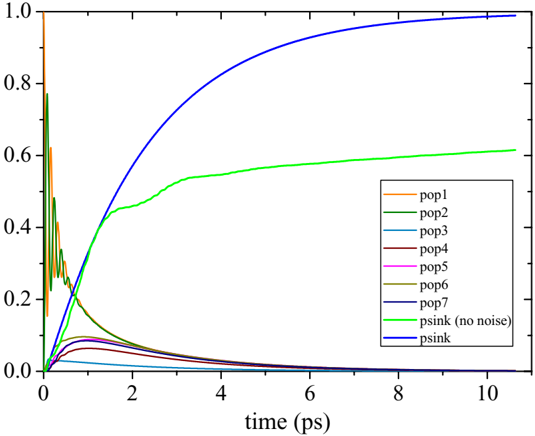
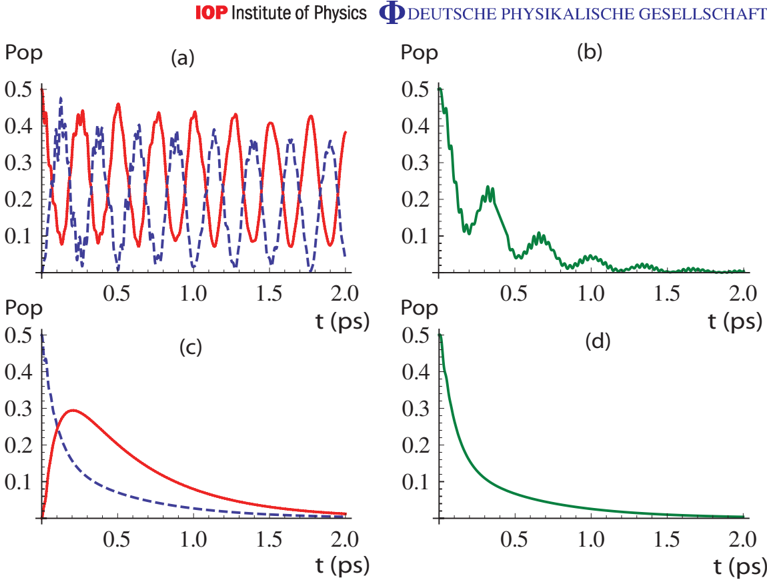
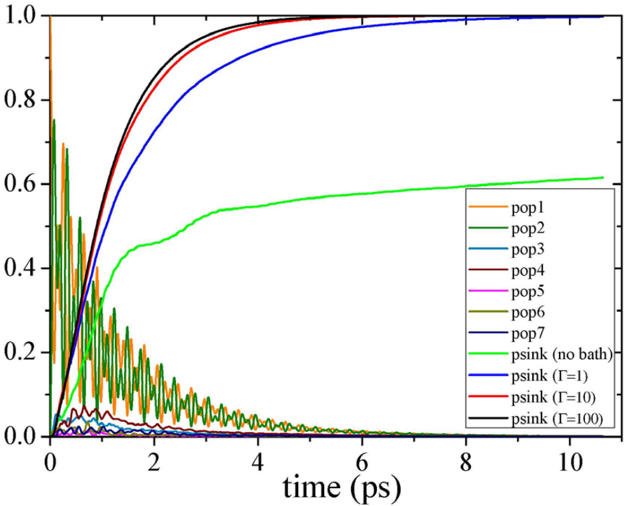
We provide physically intuitive mechanisms for the effect of noise on excitation energy transfer (EET) in networks. Using these mechanisms of dephasing-assisted transport (DAT) in a hybrid basis of both excitons and sites, we develop a detailed picture of how noise enables energy transfer with efficiencies well above 90% across the Fenna–Matthew–Olson (FMO) complex, a type of light-harvesting molecule. We demonstrate explicitly how noise alters the pathways of energy transfer across the complex, suppressing ineffective pathways and facilitating direct ones to the reaction centre. We explain that the fundamental mechanisms underpinning DAT are expected to be robust with respect to the considered noise model but show that the specific details of the exciton–phonon coupling, which remain largely unknown in these type of complexes, and in particular the impact of non-Markovian effects, result in variations of dynamical features that should be amenable to experimental verification with current or planned technology. A detailed understanding of DAT in natural compounds could open up a new paradigm of 'noise-engineering' by which EET can be optimized in artificial light-harvesting structures.
Overview
The claims and statistics of this paper haven’t been checked yet.
Free: it reads the open-access text and checks the first 5 claims that cite a source we can check. Create a free account to check every claim.
Integrity signals
Registry
Cites
Statistics
Figures
Verification
Claims the paper makes
The claims and statistics of this paper haven’t been checked yet.
Free: it reads the open-access text and checks the first 5 claims that cite a source we can check. Create a free account to check every claim.
Claims other papers make about this one
Each is checked against this paper’s own text: does it say what the citing paper says it does?
The cited source says what the claim attributes to it.
In the citing paper
“It has been predicted that the efficiency of coherent transport can be enhanced through dynamic interaction between the system and a noisy environment.”
From Enhancing coherent transport in a photonic network using controllable decoherence (2016) · cites this paper as [7]
Self-check
Percentages, sums and reported differences re-computed from the paper’s own numbers.
The self-check needs the paper’s full text.
Citations
Cites
Zwischenmolekulare Energiewanderung und Fluoreszenz
Förster, T. (1948) · Annalen der Physik · doi:10.1002/andp.19484370105 · Cited by 8,285
Evidence for wavelike energy transfer through quantum coherence in photosynthetic systems
Engel, G. S., Calhoun, T. R., Read, E. L., Ahn, T.-K., Mančal, T., Cheng, Y.-C., Blankenship, R. E., & Fleming, G. R. (2007) · Nature · doi:10.1038/nature05678 · Cited by 3,315
Coherently wired light-harvesting in photosynthetic marine algae at ambient temperature
Collini, E., Wong, C. Y., Wilk, K. E., Curmi, P. M. G., Brumer, P., & Scholes, G. D. (2010) · Nature · doi:10.1038/nature08811 · Cited by 1,649
The Theory of Relaxation Processes
REDFIELD, A. G. (1965) · Advances in Magnetic and Optical Resonance · doi:10.1016/b978-1-4832-3114-3.50007-6 · Cited by 1,511
Two-dimensional spectroscopy of electronic couplings in photosynthesis
Brixner, T., Stenger, J., Vaswani, H. M., Cho, M., Blankenship, R. E., & Fleming, G. R. (2005) · Nature · doi:10.1038/nature03429 · Cited by 1,241
Long-Range Resonance Energy Transfer in Molecular Systems
Scholes, G. D. (2003) · Annual Review of Physical Chemistry · doi:10.1146/annurev.physchem.54.011002.103746 · Cited by 1,191
Environment-assisted quantum walks in photosynthetic energy transfer
Mohseni, M., Rebentrost, P., Lloyd, S., & Aspuru-Guzik, A. (2008) · The Journal of Chemical Physics · doi:10.1063/1.3002335 · Cited by 1,189
Coherence Dynamics in Photosynthesis: Protein Protection of Excitonic Coherence
Lee, H., Cheng, Y.-C., & Fleming, G. R. (2007) · Science · doi:10.1126/science.1142188 · Cited by 1,081
Long-lived quantum coherence in photosynthetic complexes at physiological temperature
Panitchayangkoon, G., Hayes, D., Fransted, K. A., Caram, J. R., Harel, E., Wen, J., Blankenship, R. E., & Engel, G. S. (2010) · Proceedings of the National Academy of Sciences · doi:10.1073/pnas.1005484107 · Cited by 1,072
Dephasing-assisted transport: quantum networks and biomolecules
Plenio, M. B., & Huelga, S. F. (2008) · New Journal of Physics · doi:10.1088/1367-2630/10/11/113019 · Cited by 1,002
Self-citation
Research works printed but not linked: 9
- Panitchayangkoon G et al 2010 arXiv:1001.5108 · arXiv
- Caruso F et al 2009 Phys. Rev. A at press arXiv:0912.0122 · arXiv
- Fassioli F and Olaya-Castro A 2010 arXiv:1003.3610 · arXiv
- Caruso F, Huelga S F and Plenio M B 2010 arXiv:1003.5877 · arXiv
- Perdomo A et al 2010 arXiv:1001.2602 [quant-ph] · arXiv
- Lee H, Cheng Y-C and Fleming G R 2007 Science 316 1462 · DOI · Paper page
- Fassioli F et al 2009 arXiv:0907.5183 · arXiv
- Prior J et al 2010 arXiv:1003.5503 · arXiv
- Dijkstra A G and Tanimura Y 2010 arXiv:1004.1450 · arXiv
Cited by
Colloquium: Quantum coherence as a resource
Streltsov, A., Adesso, G., & Plenio, M. B. (2017) · Reviews of Modern Physics · doi:10.1103/revmodphys.89.041003 · Cited by 1,794
Self-citationVibrations, quanta and biology
Huelga, S. F., & Plenio, M. B. (2013) · Contemporary Physics · doi:10.1080/00405000.2013.829687 · Cited by 568
“tive transition rate to such sites and thus block unfavorable transfer paths from being followed [74, 106].”
BackgroundSelf-citationTiwari, V., Peters, W. K., & Jonas, D. M. (2013) · Proceedings of the National Academy of Sciences · doi:10.1073/pnas.1211157110 · Cited by 566
Efficient Simulation of Strong System-Environment Interactions
Prior, J., Chin, A. W., Huelga, S. F., & Plenio, M. B. (2010) · Physical Review Letters · doi:10.1103/physrevlett.105.050404 · Cited by 480
Self-citationElectronic and optoelectronic materials and devices inspired by nature
Meredith, P., Bettinger, C. J., Irimia-Vladu, M., Mostert, A. B., & Schwenn, P. E. (2013) · Reports on Progress in Physics · doi:10.1088/0034-4885/76/3/034501 · Cited by 372
“However, it has been proposed that noiseassisted dephasing can actually speed up transport to an electronic sink (reaction centre or electron acceptor site) by collapsing suppressive pathways [213, 214].”
BackgroundQuantum Chemical Studies of Light Harvesting
Curutchet, C., & Mennucci, B. (2017) · Chemical Reviews · doi:10.1021/acs.chemrev.5b00700 · Cited by 338
Nonequilibrium boundary-driven quantum systems: Models, methods, and properties
Landi, G. T., Poletti, D., & Schaller, G. (2022) · Reviews of Modern Physics · doi:10.1103/revmodphys.94.045006 · Cited by 278
Delocalized excitons in natural light-harvesting complexes
Jang, S. J., & Mennucci, B. (2018) · Reviews of Modern Physics · doi:10.1103/revmodphys.90.035003 · Cited by 234
“Later works improved these by including the effects of non-Markovian bath (Caruso et al., 2010; Chin et al., 2010; Rebentrost et al., 2009a), 34 correlated bath fluctuations (Rebentrost et al., 2009b), and full consideration of system-bath coupling at the level of HEOM (Sarovar et al., 2010).”
BackgroundTheory and Simulation of the Environmental Effects on FMO Electronic Transitions
Olbrich, C., Strümpfer, J., Schulten, K., & Kleinekathöfer, U. (2011) · The Journal of Physical Chemistry Letters · doi:10.1021/jz2007676 · Cited by 233
Olbrich, C., Jansen, T. L. C., Liebers, J., Aghtar, M., Strümpfer, J., Schulten, K., Knoester, J., & Kleinekathöfer, U. (2011) · The Journal of Physical Chemistry B · doi:10.1021/jp202619a · Cited by 226
Entanglement and entangling power of the dynamics in light-harvesting complexes
Caruso, F., Chin, A. W., Datta, A., Huelga, S. F., & Plenio, M. B. (2010) · Physical Review A · doi:10.1103/physreva.81.062346 · Cited by 223
Self-citationHarel, E., & Engel, G. S. (2012) · Proceedings of the National Academy of Sciences · doi:10.1073/pnas.1110312109 · Cited by 192
Open Quantum Dynamics Calculations with the Hierarchy Equations of Motion on Parallel Computers
Strümpfer, J., & Schulten, K. (2012) · Journal of Chemical Theory and Computation · doi:10.1021/ct3003833 · Cited by 187
Simulation of open quantum systems by automated compression of arbitrary environments
Cygorek, M., Cosacchi, M., Vagov, A., Axt, V. M., Lovett, B. W., Keeling, J., & Gauger, E. M. (2022) · Nature Physics · doi:10.1038/s41567-022-01544-9 · Cited by 185
“HE = h̄ωkckck + h̄gk(c † kcS + c † Sck), (4)”
BackgroundKreisbeck, C., Kramer, T., Rodríguez, M., & Hein, B. (2011) · Journal of Chemical Theory and Computation · doi:10.1021/ct200126d · Cited by 181
Quantum Stochastic Processes and Quantum non-Markovian Phenomena
Milz, S., & Modi, K. (2021) · PRX Quantum · doi:10.1103/prxquantum.2.030201 · Cited by 174
Moix, J., Wu, J., Huo, P., Coker, D., & Cao, J. (2011) · The Journal of Physical Chemistry Letters · doi:10.1021/jz201259v · Cited by 157
Efficient Biologically Inspired Photocell Enhanced by Delocalized Quantum States
Creatore, C., Parker, M. A., Emmott, S., & Chin, A. W. (2013) · Physical Review Letters · doi:10.1103/physrevlett.111.253601 · Cited by 166
Self-citationDoes Coherence Enhance Transport in Photosynthesis?
Kassal, I., Yuen-Zhou, J., & Rahimi-Keshari, S. (2013) · The Journal of Physical Chemistry Letters · doi:10.1021/jz301872b · Cited by 165
Quantum computing at the frontiers of biological sciences
Emani, P. S., Warrell, J., Anticevic, A., Bekiranov, S., Gandal, M., McConnell, M. J., Sapiro, G., Aspuru-Guzik, A., Baker, J. T., Bastiani, M., et al. (2021) · Nature Methods · doi:10.1038/s41592-020-01004-3 · Cited by 163
“One particular strength is in modeling dynamics, and there is evidence that energy transport (such as in photosynthetic complexes 28–32 ) and electron transport (such as at redox sites of metalloproteins 33 ) in biological molecules involves quantum effects that could potentially be more accurately…”
BackgroundLimits of quantum speedup in photosynthetic light harvesting
Hoyer, S., Sarovar, M., & Birgitta Whaley, K. (2010) · New Journal of Physics · doi:10.1088/1367-2630/12/6/065041 · Cited by 163
Lee, M. K., Huo, P., & Coker, D. F. (2016) · Annual Review of Physical Chemistry · doi:10.1146/annurev-physchem-040215-112252 · Cited by 161
Room-Temperature Micron-Scale Exciton Migration in a Stabilized Emissive Molecular Aggregate
Caram, J. R., Doria, S., Eisele, D. M., Freyria, F. S., Sinclair, T. S., Rebentrost, P., Lloyd, S., & Bawendi, M. G. (2016) · Nano Letters · doi:10.1021/acs.nanolett.6b02529 · Cited by 135
Quantum coherent biomolecular energy transfer with spatially correlated fluctuations
Nalbach, P., Eckel, J., & Thorwart, M. (2010) · New Journal of Physics · doi:10.1088/1367-2630/12/6/065043 · Cited by 149
Quest for Spatially Correlated Fluctuations in the FMO Light-Harvesting Complex
Olbrich, C., Strümpfer, J., Schulten, K., & Kleinekathöfer, U. (2011) · The Journal of Physical Chemistry B · doi:10.1021/jp1099514 · Cited by 144
Iles-Smith, J., Dijkstra, A. G., Lambert, N., & Nazir, A. (2016) · The Journal of Chemical Physics · doi:10.1063/1.4940218 · Cited by 147
Chin, A. W., Huelga, S. F., & Plenio, M. B. (2012) · Philosophical Transactions of the Royal Society A: Mathematical, Physical and Engineering Sciences · doi:10.1098/rsta.2011.0224 · Cited by 145
“the application of excessive noise and the concomitant reduction of the effective transition rate between sites can also be of advantage as it may effectively block unfavorable transfer paths from being followed [12].”
BackgroundInfluentialSelf-citationOpen quantum system dynamics and the mean force Gibbs state
Trushechkin, A. S., Merkli, M., Cresser, J. D., & Anders, J. (2022) · AVS Quantum Science · doi:10.1116/5.0073853 · Cited by 146
Chin, A. W., Prior, J., Huelga, S. F., & Plenio, M. B. (2011) · Physical Review Letters · doi:10.1103/physrevlett.107.160601 · Cited by 142
Self-citationFleming, G. R., Scholes, G. D., & Cheng, Y.-C. (2011) · Procedia Chemistry · doi:10.1016/j.proche.2011.08.011 · Cited by 123
König, C., & Neugebauer, J. (2011) · ChemPhysChem · doi:10.1002/cphc.201100408 · Cited by 132
Distribution of entanglement in light-harvesting complexes and their quantum efficiency
Fassioli, F., & Olaya-Castro, A. (2010) · New Journal of Physics · doi:10.1088/1367-2630/12/8/085006 · Cited by 117
Loss-Free Excitonic Quantum Battery
Liu, J., Segal, D., & Hanna, G. (2019) · The Journal of Physical Chemistry C · doi:10.1021/acs.jpcc.9b06373 · Cited by 122
Quantum battery of interacting spins with environmental noise
Zhao, F. P., Dou, F.-Q., & Zhao, Q. (2021) · Physical Review A · doi:10.1103/physreva.103.033715 · Cited by 119
Enhancing coherent transport in a photonic network using controllable decoherence
Biggerstaff, D. N., Heilmann, R., Zecevik, A. A., Gräfe, M., Broome, M. A., Fedrizzi, A., Nolte, S., Szameit, A., White, A. G., & Kassal, I. (2016) · Nature Communications · doi:10.1038/ncomms11282 · Cited by 117
Rivera, E., Montemayor, D., Masia, M., & Coker, D. F. (2013) · The Journal of Physical Chemistry B · doi:10.1021/jp4011586 · Cited by 111
McCutcheon, D. P. S., & Nazir, A. (2011) · The Journal of Chemical Physics · doi:10.1063/1.3636081 · Cited by 109
Trapped ions in optical lattices for probing oscillator chain models
Pruttivarasin, T., Ramm, M. T., Talukdar, I., Kreuter, A., & Häffner, H. (2011) · New Journal of Physics · doi:10.1088/1367-2630/13/7/075012 · Cited by 110
Dissipation-Assisted Matrix Product Factorization
Somoza, A. D., Marty, O., Lim, J., Huelga, S. F., & Plenio, M. B. (2019) · Physical Review Letters · doi:10.1103/physrevlett.123.100502 · Cited by 106
Self-citationExploiting Structured Environments for Efficient Energy Transfer: The Phonon Antenna Mechanism
Rey, M. D., Chin, A. W., Huelga, S. F., & Plenio, M. B. (2013) · The Journal of Physical Chemistry Letters · doi:10.1021/jz400058a · Cited by 96
Self-citationDynamic entanglement in oscillating molecules and potential biological implications
Cai, J., Popescu, S., & Briegel, H. J. (2010) · Physical Review E · doi:10.1103/physreve.82.021921 · Cited by 82
Jonas, D. M. (2018) · Annual Review of Physical Chemistry · doi:10.1146/annurev-physchem-052516-050602 · Cited by 102
Killoran, N., Huelga, S. F., & Plenio, M. B. (2015) · The Journal of Chemical Physics · doi:10.1063/1.4932307 · Cited by 94
Self-citationEquivalence of the measures of non-Markovianity for open two-level systems
Zeng, H.-S., Tang, N., Zheng, Y.-P., & Wang, G.-Y. (2011) · Physical Review A · doi:10.1103/physreva.84.032118 · Cited by 90
Quantum coherence in ion channels: resonances, transport and verification
Vaziri, A., & Plenio, M. B. (2010) · New Journal of Physics · doi:10.1088/1367-2630/12/8/085001 · Cited by 88
Self-citationDephasing enhanced transport in nonequilibrium strongly correlated quantum systems
Mendoza-Arenas, J. J., Grujic, T., Jaksch, D., & Clark, S. R. (2013) · Physical Review B · doi:10.1103/physrevb.87.235130 · Cited by 87
Shedding (Incoherent) Light on Quantum Effects in Light-Induced Biological Processes
Brumer, P. W. (2018) · The Journal of Physical Chemistry Letters · doi:10.1021/acs.jpclett.8b00874 · Cited by 86
Quantum Coherence and Sensitivity of Avian Magnetoreception
Bandyopadhyay, J. N., Paterek, T., & Kaszlikowski, D. (2012) · Physical Review Letters · doi:10.1103/physrevlett.109.110502 · Cited by 72
McCutcheon, D. P. S., & Nazir, A. (2011) · Physical Review B · doi:10.1103/physrevb.83.165101 · Cited by 86
Coherent Vibronic Coupling in Light-Harvesting Complexes from Photosynthetic Marine Algae
Richards, G. H., Wilk, K. E., Curmi, P. M. G., Quiney, H. M., & Davis, J. A. (2012) · The Journal of Physical Chemistry Letters · doi:10.1021/jz201600f · Cited by 80
Harnessing symmetry to control quantum transport
Manzano, D., & Hurtado, P. I. (2018) · Advances In Physics · doi:10.1080/00018732.2018.1519981 · Cited by 81
“The focus now is not only to understand transport across natural chromophore networks, but also to design specific network architectures for optimal transport [170], engineer noise sources to enhance transport efficiency [171], or even to create artificial light-harvesting quantum antennae using genetic engineering te…”
BackgroundContextual Wavefunction collapse: an integrated theory of quantum measurement
Drossel, B., & Ellis, G. (2018) · New Journal of Physics · doi:10.1088/1367-2630/aaecec · Cited by 83
Noise-Enhanced Classical and Quantum Capacities in Communication Networks
Caruso, F., Huelga, S. F., & Plenio, M. B. (2010) · Physical Review Letters · doi:10.1103/physrevlett.105.190501 · Cited by 79
Self-citationUnusual dynamical properties of disordered polaritons in microcavities
Engelhardt, G., & Cao, J. (2022) · Physical review. B./Physical review. B · doi:10.1103/physrevb.105.064205 · Cited by 75
Identifying the quantum correlations in light-harvesting complexes
Brádler, K., Wilde, M. M., Vinjanampathy, S., & Uskov, D. B. (2010) · Physical Review A · doi:10.1103/physreva.82.062310 · Cited by 71
“[41] A.”
BackgroundTscherbul, T. V., & Brumer, P. W. (2015) · The Journal of Chemical Physics · doi:10.1063/1.4908130 · Cited by 68
Microscopic quantum coherence in a photosynthetic-light-harvesting antenna
Dawlaty, J. M., Ishizaki, A., De, A. K., & Fleming, G. R. (2012) · Philosophical Transactions of the Royal Society A Mathematical Physical and Engineering Sciences · doi:10.1098/rsta.2011.0207 · Cited by 66
Observation of Noise-Assisted Transport in an All-Optical Cavity-Based Network
Viciani, S., Lima, M., Bellini, M., & Caruso, F. (2015) · Physical Review Letters · doi:10.1103/physrevlett.115.083601 · Cited by 65
Self-citationQuantum Transport in Networks and Photosynthetic Complexes at the Steady State
Manzano, D. (2013) · PLoS ONE · doi:10.1371/journal.pone.0057041 · Cited by 65
“In the transient regime, similar master equations have been previously used to describe the dynamics of the FMO complex and to analyse the effects of noise on the quantum dynamics [9, 10].”
InfluentialMeasures and implications of electronic coherence in photosynthetic light-harvesting
Smyth, C., Fassioli, F., & Scholes, G. D. (2012) · Philosophical Transactions of the Royal Society A Mathematical Physical and Engineering Sciences · doi:10.1098/rsta.2011.0420 · Cited by 65
Quantum mechanics of excitation transport in photosynthetic complexes: a key issues review
Levi, F., Mostarda, S., Rao, F. V., & Mintert, F. (2015) · Reports on Progress in Physics · doi:10.1088/0034-4885/78/8/082001 · Cited by 66
Sublinear Scaling in Non-Markovian Open Quantum Systems Simulations
Cygorek, M., Keeling, J., Lovett, B. W., & Gauger, E. M. (2024) · Physical Review X · doi:10.1103/physrevx.14.011010 · Cited by 63
“Examples include: solid-state quantum dots (QDs) coupled to local phonon environments [4, 13–16], charge or excitation transport in biomolecules [10, 17, 18], ultrafast spin dynamics [19, 20], spontaneous emission in photonic structures [21, 22], and superconducting qubits in quantum computers [2].”
BackgroundDo photosynthetic complexes use quantum coherence to increase their efficiency? Probably not
Harush, E. Z., & Dubi, Y. (2021) · Science Advances · doi:10.1126/sciadv.abc4631 · Cited by 64
Propagation of nonclassical correlations across a quantum spin chain
Campbell, S., Apollaro, T. J. G., Franco, C. D., Banchi, L., Cuccoli, A., Vaia, R., Plastina, F., & Paternostro, M. (2011) · Physical Review A · doi:10.1103/physreva.84.052316 · Cited by 62
León‐Montiel, R. D. J., Kassal, I., & Torres, J. P. (2014) · The Journal of Physical Chemistry B · doi:10.1021/jp505179h · Cited by 61
Trapped-ion quantum simulation of electron transfer models with tunable dissipation
So, V., Suganthi, M. D., Menon, A., Zhu, M., Zhuravel, R., Pu, H., Wolynes, P. G., Onuchic, J. N., & Pagano, G. (2024) · Science Advances · doi:10.1126/sciadv.ads8011 · Cited by 58
“In particular, the presence of an optimal relaxation rate underscores the crucial role of dephasing in transport phenomena that was previously pointed out in solid-state [40] and atomic systems [22], as well as in biomolecules [41–44].”
Functional Subsystems and Quantum Redundancy in Photosynthetic Light Harvesting
Skochdopole, N., & Mazziotti, D. A. (2011) · The Journal of Physical Chemistry Letters · doi:10.1021/jz201154t · Cited by 58
“The particular form of the Lindblad operators chosen here follows the operators selected in previous studies of the FMO complex [30].”
BackgroundTheoretical description of quantum effects in multi-chromophoric aggregates
Zimanyi, E. N., & Silbey, R. (2012) · Philosophical Transactions of the Royal Society A Mathematical Physical and Engineering Sciences · doi:10.1098/rsta.2011.0204 · Cited by 56
Dimerization-assisted energy transport in light-harvesting complexes
Yang, S., Xu, D., Song, Z., & Sun, C. (2010) · The Journal of Chemical Physics · doi:10.1063/1.3435213 · Cited by 56
Journeys from quantum optics to quantum technology
Barnett, S. M., Beige, A., EKERT, A. K., Garraway, B. M., Keitel, C. H., Kendon, V. M., Lein, M., Milburn, G. J., Moya-Cessa, H. M., Murao, M., et al. (2017) · Progress in Quantum Electronics · doi:10.1016/j.pquantelec.2017.07.002 · Cited by 56
Self-citationUniversally optimal noisy quantum walks on complex networks
Caruso, F. (2014) · New Journal of Physics · doi:10.1088/1367-2630/16/5/055015 · Cited by 54
Self-citationVibration-enhanced quantum transport
Semião, F. L., Furuya, K., & Milburn, G. J. (2010) · New Journal of Physics · doi:10.1088/1367-2630/12/8/083033 · Cited by 49
Geesink, J. H., & Meijer, D. K. F. (2017) · Electromagnetic Biology and Medicine · doi:10.1080/15368378.2017.1389752 · Cited by 55
Universal Origin for Environment-Assisted Quantum Transport in Exciton Transfer Networks
Zerah-Harush, E., & Dubi, Y. (2018) · The Journal of Physical Chemistry Letters · doi:10.1021/acs.jpclett.7b03306 · Cited by 53
Huo, P., & Coker, D. F. (2012) · The Journal of Chemical Physics · doi:10.1063/1.3693019 · Cited by 54
The radical pair mechanism and the avian chemical compass: Quantum coherence and entanglement
Zhang, Y., Berman, G. P., & Kais, S. (2015) · International Journal of Quantum Chemistry · doi:10.1002/qua.24943 · Cited by 38
Ai, Q., Yen, T., Jin, B., & Cheng, Y. (2013) · The Journal of Physical Chemistry Letters · doi:10.1021/jz4011477 · Cited by 52
Wertnik, M., Chin, A. W., Nori, F., & Lambert, N. (2018) · The Journal of Chemical Physics · doi:10.1063/1.5040898 · Cited by 51
Self-citationAi, Q., Fan, Y.-J., Jin, B., & Cheng, Y. (2014) · New Journal of Physics · doi:10.1088/1367-2630/16/5/053033 · Cited by 51
Coherent optimal control of photosynthetic molecules
Caruso, F., Montangero, S., Calarco, T., Huelga, S. F., & Plenio, M. B. (2012) · Physical Review A · doi:10.1103/physreva.85.042331 · Cited by 50
Self-citationTscherbul, T. V., & Brumer, P. W. (2015) · Physical Chemistry Chemical Physics · doi:10.1039/c5cp01388g · Cited by 50
Caycedo‐Soler, F., Mattioni, A., Lim, J., Renger, T., Huelga, S. F., & Plenio, M. B. (2022) · Nature Communications · doi:10.1038/s41467-022-30565-4 · Cited by 50
Self-citationOptimal networks for excitonic energy transport
Scholak, T., Wellens, T., & Buchleitner, A. (2011) · Journal of Physics B Atomic Molecular and Optical Physics · doi:10.1088/0953-4075/44/18/184012 · Cited by 50
“…drawn from the statistical ensemble, adding the right amount of noise helps to accelerate the transfer, in accordance with previous results on environment-assisted transport (Plenio and Huelga 2008, Caruso et al 2009, Rebentrost et al 2009, Cao and Silbey 2009, Wu et al 2010, Chin et al 2010).”
BackgroundResultDephasing-assisted transport in linear triple quantum dots
Contreras-Pulido, L. D., Bruderer, M., Huelga, S. F., & Plenio, M. B. (2014) · New Journal of Physics · doi:10.1088/1367-2630/16/11/113061 · Cited by 49
Self-citationPurchase, R., & de Groot, H. J. M. (2015) · Interface Focus · doi:10.1098/rsfs.2015.0014 · Cited by 47
The nature of the low energy band of the Fenna-Matthews-Olson complex: Vibronic signatures
Caycedo-Soler, F., Chin, A. W., Almeida, J., Huelga, S. F., & Plenio, M. B. (2012) · The Journal of Chemical Physics · doi:10.1063/1.3703504 · Cited by 46
Self-citationLeón‐Montiel, R. D. J., Quiroz-Juarez, M. A., Quintero‐Torres, R., Domínguez‐Juárez, J. L., Moya-Cessa, H. M., Torres, J. P., & Aragón, J. L. (2015) · Scientific Reports · doi:10.1038/srep17339 · Cited by 45
Emergent ultrafast phenomena in correlated oxides and heterostructures
Gandolfi, M., Celardo, G. L., Borgonovi, F., Ferrini, G., Avella, A., Banfi, F., & Giannetti, C. (2017) · Physica Scripta · doi:10.1088/1402-4896/aa54cc · Cited by 45
Benenti, G., Siccardi, S., & Strini, G. (2013) · The European Physical Journal D · doi:10.1140/epjd/e2013-40080-y · Cited by 45
Vibration-assisted resonance in photosynthetic excitation-energy transfer
Irish, E. K. T., Gómez‐Bombarelli, R., & Lovett, B. W. (2014) · Physical Review A · doi:10.1103/physreva.90.012510 · Cited by 44
Realistic and verifiable coherent control of excitonic states in a light-harvesting complex
Hoyer, S., Caruso, F., Montangero, S., Sarovar, M., Calarco, T., Plenio, M. B., & Whaley, K. B. (2014) · New Journal of Physics · doi:10.1088/1367-2630/16/4/045007 · Cited by 43
Self-citationMultiscale photosynthetic and biomimetic excitation energy transfer
Ringsmuth, A. K., Milburn, G. J., & Stace, T. M. (2012) · Nature Physics · doi:10.1038/nphys2332 · Cited by 44
Ganim, Z., Tokmakoff, A., & Vaziri, A. (2011) · New Journal of Physics · doi:10.1088/1367-2630/13/11/113030 · Cited by 42
Motional effects on the efficiency of excitation transfer
Asadian, A., Tiersch, M., Guerreschi, G. G., Cai, J., Popescu, S., & Briegel, H. J. (2010) · New Journal of Physics · doi:10.1088/1367-2630/12/7/075019 · Cited by 42
“Environmental noise induced by thermal motion, and specifically dephasing, may lead to an enhancement of the efficiency of transport through a network of sites [17]–[22].”
BackgroundFocus on quantum effects and noise in biomolecules
Fleming, G. R., Huelga, S. F., & Plenio, M. B. (2011) · New Journal of Physics · doi:10.1088/1367-2630/13/11/115002 · Cited by 35
“Sens. 21 773; Chin et al 2010 New J. Phys.”
Self-citationJesenko, S., & Žnidarič, M. (2013) · The Journal of Chemical Physics · doi:10.1063/1.4802816 · Cited by 41
Effects of the Backbone and Chemical Linker on the Molecular Conductance of Nucleic Acid Duplexes
Beall, E., Ulku, S., Liu, C., Wierzbiński, E., Zhang, Y., Bae, Y., Zhang, P., Achim, C., Beratan, D. N., & Waldeck, D. H. (2017) · Journal of the American Chemical Society · doi:10.1021/jacs.7b02260 · Cited by 41
Vibronic effects in the spectroscopy and dynamics ofC-phycocyanin
Womick, J. M., West, B. A., Scherer, N. F., & Moran, A. M. (2012) · Journal of Physics B Atomic Molecular and Optical Physics · doi:10.1088/0953-4075/45/15/154016 · Cited by 42
Cygorek, M., & Gauger, E. M. (2024) · The Journal of Chemical Physics · doi:10.1063/5.0221182 · Cited by 40
Measurement-dependent corrections to work distributions arising from quantum coherences
Solinas, P., Miller, H. J. D., & Anders, J. (2017) · Physical Review A · doi:10.1103/physreva.96.052115 · Cited by 40
Metadata
- Authors
- Chin, A. W., Datta, A., Caruso, F., Huelga, S. F., & Plenio, M. B.
- Affiliations
- University of Hertfordshire (GB)
- Imperial College London (GB)
- Universität Ulm (DE)
- Corresponding author
- Plenio, M B
- Venue
- New Journal of Physics
- Publisher
- IOP Publishing
- Published
- 2010-06-08
- Volume
- 12
- Issue
- 6
- Pages
- 065002
- ISSN
- 1367-2630 (ISSN-L)
- OpenAlex
- W2044133255
- Semantic Scholar
- 34fd1ce0bd324945f8faa913154296b8442c2217
- Cited by
- 338
- References
- 44
- Citations by year
- 2026: 10 · 2025: 17 · 2024: 14 · 2023: 16 · 2022: 18 · 2021: 14 · 2020: 20 · 2019: 15 · 2018: 20 · 2017: 23 · 2016: 26 · 2015: 25 · 2014: 22 · 2013: 24 · 2012: 29
- FWCI
- 16.81
- Type
- journal article
- Language
- en
- Open access
- gold
- doi.org
- Licence
- cc-by
- Locations
- New Journal of Physics (publishedVersion, cc-by)
- arXiv (Cornell University) (publishedVersion)
- University of Hertfordshire Research Archive (University of Hertfordshire) (submittedVersion)
- Florence Research (University of Florence) (submittedVersion, other-oa)
- OPen Access Repositorium der Universität Ulm (OPARU) (Ulm University) (submittedVersion)
- arXiv (Cornell University)
- Universität Ulm, Kommunikations- und Informationszentrum (kiz)
- Funders
- Engineering and Physical Sciences Research Council (EP/C546237/1)
- Topics
- Physical Sciences › Physics and Astronomy › Atomic and Molecular Physics, and Optics › Spectroscopy and Quantum Chemical Studies
- Physical Sciences › Chemistry › Physical and Theoretical Chemistry › Photochemistry and Electron Transfer Studies
- Physical Sciences › Physics and Astronomy › Atomic and Molecular Physics, and Optics › Strong Light-Matter Interactions
- Keywords
- Fenna-Matthews-Olson complex, light-harvesting complexes, exciton-phonon coupling, non-Markovian effects, quantum networks, noise engineering, energy transfer pathways, reaction center
About these checks
Registry, retraction, Cites and statistics results are computed, not judged, with one exception: a printed reference that no index lists is read once by a model before it counts as a citation error. Claims are extracted by a model and kept only when their quote appears verbatim in the text; each cited source is then checked, with a model’s help, for whether it says what the claim relies on. Those verdicts can be wrong — read the claim’s quote and the cited source before relying on one.
Statistics and arithmetic are recomputed, not judged.
Confidence bands are shown only for fields calibrated on our annotated test set. None is calibrated yet, so no band is shown.
What counts as a claim ›How we measure confidence ›How we check this ›
Are you an author, or do you see a problem with this page? Request a review
Data sources
Bibliographic data: Semantic Scholar, OpenAlex, Crossref.
Contains information from the Semantic Scholar Academic Graph Datasets, made available under the ODC Attribution License (ODC-BY 1.0).
Semantic Scholar’s data is described in: Kinney, R., et al. (2023). The Semantic Scholar Open Data Platform. arXiv:2301.10140.
