

Two-photon quantum walks in an elliptical direct-write waveguide array
Open accessThe DOI matches its Crossref record; 33 of the 34 references it cites were found in a registry or an index, and 1 are not checked yet; 11 of the 24 sources its claims cite were checked for support.
Abstract
Integrated optics provides an ideal testbed for the emulation of quantum systems via continuous-time quantum walks. Here, we study the evolution of two-photon states in an elliptic array of waveguides. We characterize the photonic chip via coherent light tomography and use the results to predict distinct differences between temporally indistinguishable and distinguishable two-photon inputs, which we then compare with experimental observations. This work highlights the feasibility of emulation of coherent quantum phenomena in three-dimensional waveguide structures.
Verified 2026-11-22 · 1 reference not checked yet
Overview
CoChat Summary
TL;DR
The paper demonstrates two-photon continuous-time quantum walks in a six-waveguide elliptical direct-write fused-silica array, comparing temporally distinguishable and indistinguishable photon inputs. Coherent-light tomography predicts and experimentally confirms non-classical interference signatures, though the measured two-photon visibilities do not match predictions well.
Key findings
- The chip supports two-photon quantum walks with distinct differences between distinguishable and indistinguishable inputs: for nearest-neighbour inputs 1 and 2, interference visibility was \(V = 38 \pm 2\%\), and generalized overlap fidelities were \(S_d = 93.4 \pm 0.3\%\) and \(S_i = 91.6 \pm 0.4\%\).
- For next-nearest-neighbour inputs 2 and 4, non-classical interference visibilities up to \(V_{2,4} = 28 \pm 3\%\) were observed, with fidelities \(S_d = 97.9 \pm 1\%\) and \(S_i = 96.2 \pm 0.8\%\).
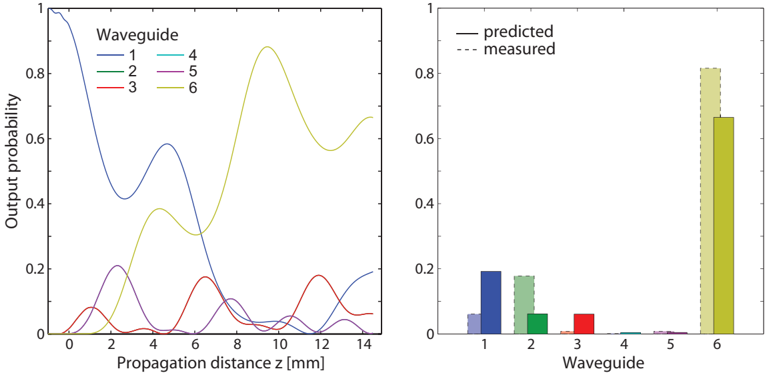
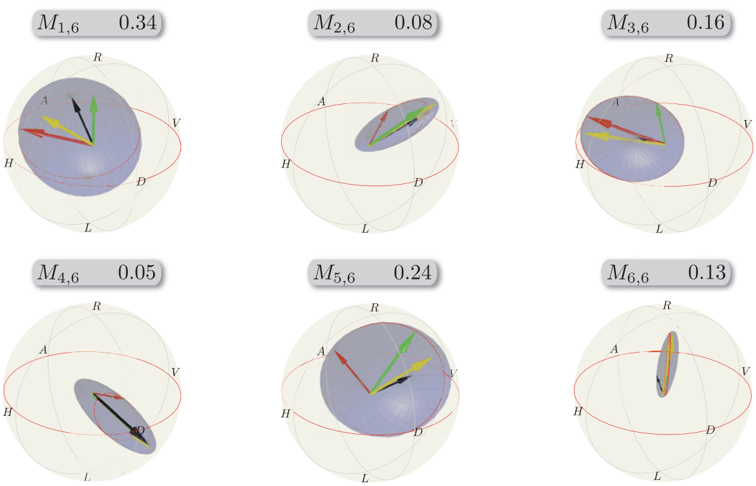
- Coherent-light tomography revealed strong polarization effects: inputting \(|H\rangle\) into waveguide 5 rotated 29% of the overall output to \(|V\rangle\), while for channels 1, 2 and 4 more than 91% of \(|H\rangle\) was retained; for \(|H\rangle\) into waveguide 1, 80% of total output intensity was in channel 6, but for \(|V\rangle\) only 11% was in that channel.
- The elliptical geometry produced non-negligible longer-range coupling: modelled coupling constants included \(C_{24}=0.963\ \mathrm{mm}^{-1}\), \(C_{12}=0.312\ \mathrm{mm}^{-1}\), \(C_{14}=0.050\ \mathrm{mm}^{-1}\), and \(C_{16}=0.044\ \mathrm{mm}^{-1}\), with \(C_{14}\) and \(C_{16}\) leading to modelled 40% and 33% coupling over the interaction length in isolation.
Methods
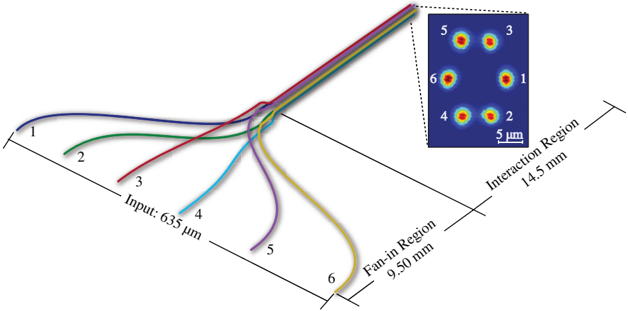
- Six waveguides were written into high-purity fused silica using ultrafast direct-write laser techniques; inputs were spaced by 127 µm and converged via a two-stage fan-in to an ellipse with semi-major axis 10.2 µm and semi-minor axis 7.0 µm.
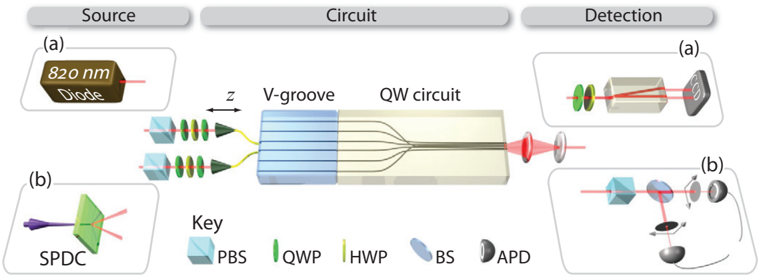
- The chip was characterized with an 820 nm laser diode and polarization-sensitive coherent light tomography: six input polarizations into each waveguide and six measured output polarizations yielded 216 CCD images and a 36-element Mueller-matrix array.
- Two-photon walks used SPDC photon pairs from a 76 MHz, 820 nm laser frequency-doubled to 410 nm and focused into a 2 mm type-I BBO crystal; photon pairs were created at 180 kHz and 6.5 kHz were detected at the circuit output. Measured coincidence distributions were compared with predictions from the waveguide array unitary \(U\).
Limitations
- The paper states that the Mueller-matrix array derived from coherent beam intensities only yields the squared absolute values of the unitary \(U\) elements and does not determine the generally complex phase relations of the waveguide array.
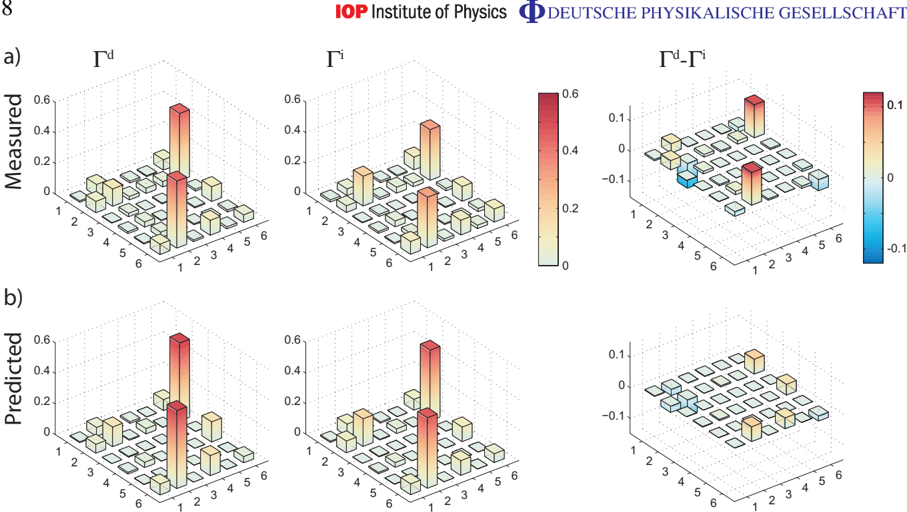
- The paper states that the measured two-photon visibilities matched predictions poorly, and that the resulting probability distributions did not exhibit a conclusively quantum signature as quantified by the witness in [16], most likely due to significant polarization-dependent coupling and loss causing non-unitary evolution.
- The paper states that scaling to larger, more elaborate structures will make individual mode addressing tricky, and that unlike quantum simulation there are no known fault-tolerance or error-correction techniques for quantum emulation in quantum walks. Evident from the text: single-photon loss was about 73%, with main loss from poor input coupling between the V-groove array and chip (about 31%).
Model-written summary. Check it against the paper before relying on it.
Integrity signals
Registry
Cites
Statistics
Figures
Verification
Claims the paper makes
10 Valid · 4 Not valid · 7 Not checked · 37 Own results and interpretations
A result the paper reports from its own data — it cites no other source for it, so there is none to check. The quote shows it is in the paper.
In the paper
“notably some of the next-nearest-neighbour and even next-next-nearest-neighbour couplings are non-negligible over the interaction length in the chip.”
§ Two-photon quantum walks in an elliptical direct-write waveguide array > 2. Device description
plain- Asserted: passes — The authors put it forward as true.
- Checkable: passes — It can be checked against evidence.
- Load-bearing: passes — The paper’s conclusions depend on it.
- Based: passes — The paper gives a reason why it holds.
A result the paper reports from its own data — it cites no other source for it, so there is none to check. The quote shows it is in the paper.
In the paper
“The single-photon loss is thus ∼ 73%, factoring out the 50/50 beamsplitter, which reduces the number of coincidences by 50%.”
§ Two-photon quantum walks in an elliptical direct-write waveguide array > 4. Two-photon walks
plain- Asserted: passes — The authors put it forward as true.
- Checkable: passes — It can be checked against evidence.
- Load-bearing: unclear — It is unclear whether the paper’s conclusions depend on it.
- Based: passes — The paper gives a reason why it holds.
A result the paper reports from its own data — it cites no other source for it, so there is none to check. The quote shows it is in the paper.
In the paper
“The latter two are negligible: our model predicts that, in the absence of the other waveguides, less than 2% of light input into one waveguide of either of these pairs would couple to the other waveguide over the interaction length of the chip.”
§ Two-photon quantum walks in an elliptical direct-write waveguide array > 5. Discussion
plain- Asserted: passes — The authors put it forward as true.
- Checkable: passes — It can be checked against evidence.
- Load-bearing: passes — The paper’s conclusions depend on it.
- Based: passes — The paper gives a reason why it holds.
- Rests on 2 assumptions not shown here.
A result the paper reports from its own data — it cites no other source for it, so there is none to check. The quote shows it is in the paper.
In the paper
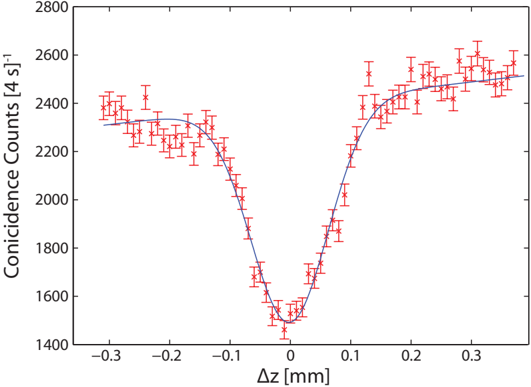
“Distinct differences are observed between the two cases, as suggested by the strong two-photon interference signature in figure 5.”
§ Two-photon quantum walks in an elliptical direct-write waveguide array > 4. Two-photon walks
hedgedstates an associationn = 2- Asserted: passes — The authors put it forward as true.
- Checkable: passes — It can be checked against evidence.
- Load-bearing: passes — The paper’s conclusions depend on it.
- Based: passes — The paper gives a reason why it holds.
A result the paper reports from its own data — it cites no other source for it, so there is none to check. The quote shows it is in the paper.
In the paper
“The main loss contributions stemmed from the poor input coupling efficiency between the V-groove array and the chip (∼ 31%).”
§ Two-photon quantum walks in an elliptical direct-write waveguide array > 4. Two-photon walks
plainstates a cause- Asserted: passes — The authors put it forward as true.
- Checkable: passes — It can be checked against evidence.
- Load-bearing: unclear — It is unclear whether the paper’s conclusions depend on it.
- Based: passes — The paper gives a reason why it holds.
14 more claims
Create a free account to see all 58 claims and to verify the 1 reference still open.
- Probably not a substantial claim. 23
- It may state two separate claims as one. 16
- The quote only partly states this claim. 2
Claims other papers make about this one
Each is checked against this paper’s own text: does it say what the citing paper says it does?
The cited source doesn’t support the claim as written.
In the citing paper
“different experiments using different plasmonic configurations, and off-chip photon detection schemes achieved visibilities far beyond the classical limit up to 0.95 [183][184][185][186], thus fully certifying the quantumness of the two plasmon interferences.”
From Two-photon interference: the Hong–Ou–Mandel effect (2021) · cites this paper as [186]
Checked by a reasoning model — may be wrong.
Experimental — accuracy not yet measuredThe cited source says what the claim attributes to it.
In the citing paper
“Very recently quantum walks of two identical photons have been performed only in ordered structures [18, 33, 34].”
From Anderson localization of entangled photons in an integrated quantum walk (2013) · cites this paper as [33]
The cited source says what the claim attributes to it.
In the citing paper
“Special attention is paid to direct laser-written waveguides since they offer the possibility of implementing complex lattice geometries including the third spatial dimension [129, 130], and consequently of utilization for investigating systems beyond the standard model [131], in quantum biophysics [132-134], and in quantum artificial life [135,136].”
From Integrated photonic quantum walks (2020) · cites this paper as [129]
Self-check
Percentages, sums and reported differences re-computed from the paper’s own numbers.
Each contradiction between two passages listed here was confirmed by an independent check.
Rated minor: it would not touch a result — a value no result rests on, a p-value that stays on the same side of the significance level, or a conflict that is clerical, resolved elsewhere in the paper, or outside its own findings.
In the paper
§ Two-photon quantum walks in an elliptical direct-write waveguide array > 5. Discussion
“For our chip, simulation predicts two leading nearest-neighbour coupling strengths of C 24 = 0.963 mm -1 and C 12 = 0.312 mm -1 , reflecting the elliptical geometry.”
§ Two-photon quantum walks in an elliptical direct-write waveguide array > 4. Two-photon walks
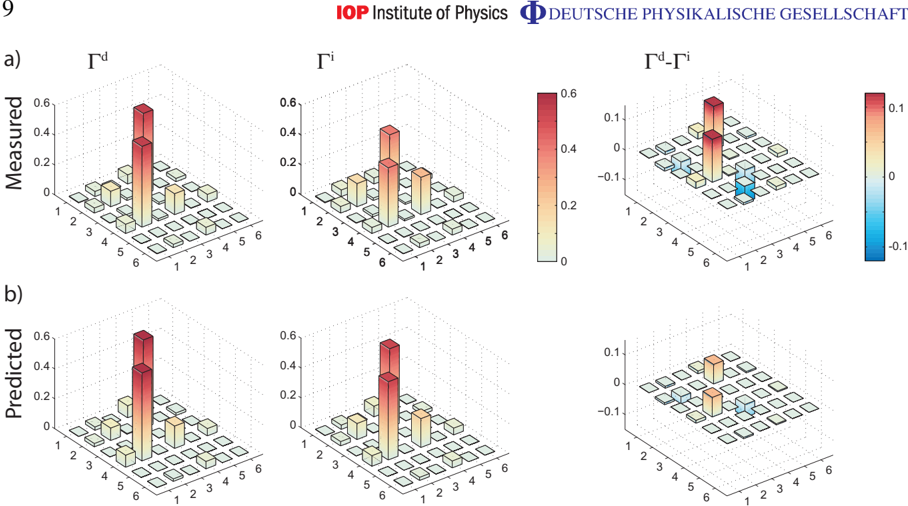
“Figure 7(a) shows correlation matrices for inputs 2 and 4 as an example of two-photon walks with next-nearest neighbour input ports.”
Citations
Cites
Simulating physics with computers
Feynman, R. P. (1982) · International Journal of Theoretical Physics · doi:10.1007/bf02650179 · Cited by 7,691
Measurement of subpicosecond time intervals between two photons by interference
Hong, C. K., Ou, Z. Y., & Mandel, L. (1987) · Physical Review Letters · doi:10.1103/physrevlett.59.2044 · Cited by 4,369
Lloyd, S. (1996) · Science · doi:10.1126/science.273.5278.1073 · Cited by 3,088
Writing waveguides in glass with a femtosecond laser
Davis, K. M., Miura, K., Sugimoto, N., & Hirao, K. (1996) · Optics Letters · doi:10.1364/ol.21.001729 · Cited by 2,622
Aharonov, Y., Davidovich, L., & Zagury, N. (1993) · Physical Review A · doi:10.1103/physreva.48.1687 · Cited by 1,622
Quantum random walks: An introductory overview
Kempe, J. (2003) · Contemporary Physics · doi:10.1080/00107151031000110776 · Cited by 1,413
Quantum computation and decision trees
Farhi, E., & Gutmann, S. (1998) · Physical Review A · doi:10.1103/physreva.58.915 · Cited by 1,215
Environment-assisted quantum walks in photosynthetic energy transfer
Mohseni, M., Rebentrost, P., Lloyd, S., & Aspuru-Guzik, A. (2008) · The Journal of Chemical Physics · doi:10.1063/1.3002335 · Cited by 1,189
Dephasing-assisted transport: quantum networks and biomolecules
Plenio, M. B., & Huelga, S. F. (2008) · New Journal of Physics · doi:10.1088/1367-2630/10/11/113019 · Cited by 1,002
Quantum Walks of Correlated Photons
Peruzzo, A., Lobino, M., Matthews, J. C. F., Matsuda, N., Politi, A., Poulios, K., Zhou, X.-Q., Lahini, Y., Ismail, N., Wörhoff, K., et al. (2010) · Science · doi:10.1126/science.1193515 · Cited by 929
Cited by
Items 101–140 of 140
Quantum coherence measurement of qudit systems using three-dimensional photonic circuits
Cardoso, W. R., Lima, P., Vianna, R. O., & Pádua, S. (2020) · Physical Review A · doi:10.1103/physreva.102.032609 · Cited by 4
Transport properties in directed quantum walks on the line
Chaves, R., Santos, J. B., & Chagas, B. (2023) · Quantum Information Processing · doi:10.1007/s11128-023-03874-w · Cited by 3
“Since then, many other facets of the CTQW have been investigated, such as the evolution [29, 30], quantum correlations [31] and the effects of noise with regards to quantum transport [32, 33].”
BackgroundEffect of Quantum Coins on Two-Particle Quantum Walks
Gan, S., He, X., Liu, B., & Feng, C. (2015) · Chinese Physics Letters · doi:10.1088/0256-307x/32/8/080305 · Cited by 4
Quantum Walks in Quasi-Periodic Photonics Lattices
Nguyen, D. T., Nolan, D. A., & Borrelli, N. F. (2019) · IntechOpen eBooks · doi:10.5772/intechopen.87758 · Cited by 4
Numerical solution of Schrödinger equation for biphoton wave function in twisted waveguide arrays
Vavulin, D. N., & Sukhorukov, A. A. (2015) · Nanosystems Physics Chemistry Mathematics · doi:10.17586/2220-8054-2015-6-5-689-696 · Cited by 3
“Quantum walks and generation of biphoton states with OAM can be implemented in arrays of coupled waveguides with closed-loop boundary conditions [5].”
Vavulin, D. N., & Sukhorukov, A. A. (2017) · Physical Review A · doi:10.1103/physreva.96.013812 · Cited by 3
Quantum walk with quadratic position-dependent phase defects
Farooq, U., Alshammari, A. S., & Rekik, N. (2019) · Quantum Information Processing · doi:10.1007/s11128-019-2496-y · Cited by 3
Photonic cellular automaton simulation of relativistic quantum fields: Observation of Zitterbewegung
Suprano, A., Zia, D., Polino, E., Poderini, D., Carvacho, G., Sciarrino, F., Lugli, M., Bisio, A., & Perinotti, P. (2024) · Physical Review Research · doi:10.1103/physrevresearch.6.033136 · Cited by 2
Perfect transfer of arbitrary continuous variable states across optical waveguide lattices
Anuradha, T., Patra, A., Gupta, R., & Sen, A. (2025) · Physics Letters A · doi:10.1016/j.physleta.2025.130746 · Cited by 6
Armaghani, S., & Rostami, A. M. (2026) · Scientific Reports · doi:10.1038/s41598-025-34361-0 · Cited by 3
Quantum walk with one variable absorbing boundary
Wang, F., Zhang, P., Wang, Y., Liu, R., Gao, H., & Fu-li, L. (2016) · Physics Letters A · doi:10.1016/j.physleta.2016.10.033 · Cited by 4
Generation of orbital-angular-momentum entangled biphotons in twisted nonlinear waveguides
Vavulin, D. N., & Sukhorukov, A. A. (2017) · Journal of Physics Conference Series · doi:10.1088/1742-6596/917/6/062010 · Cited by 2
“Also of interest are quantum walks [2], where interference of several walkers can be used to realize various simulations, including quantum teleportation [3,4] and quantum cryptography [5-7], enabling absolutely secure communications.”
BackgroundThe effect of coherence between two photons on quantum random walk
Zhang, Z., Song, J., & Zhao, Y. Z. (2020) · Optik · doi:10.1016/j.ijleo.2020.164288 · Cited by 1
Transverse and Quantum Localization of Light: A Review on Theory and Experiments
Giordani, T., Schirmacher, W., Ruocco, G., & Leonetti, M. (2021) · Frontiers in Physics · doi:10.3389/fphy.2021.715663 · Cited by 3
An atomic boson samplerPreprint
Young, A. W., Geller, S., Eckner, W. J., et al. (2023) · arXiv (Cornell University) · doi:10.48550/arxiv.2307.06936 · Cited by 2
“…to generate and interfere large Fock states of photons because of transmission losses and the probabilistic techniques that are often 2–8, 75 ( The low loss and high-state preparation and detection fidelities presented in this work enable studies of boson sampling that require fewer…”
Photon-Limited Imaging by Timestamped All-Pixel Sensing (PITAS)
Li, Z., Wu, S., Wang, Z.-Y., Gao, J., Yan, Z., Zhou, H., Yin, S., & Jin, X. (2025) · ACS Photonics · doi:10.1021/acsphotonics.4c01275 · Cited by 1
Quantum walks of photon pairs in twisted waveguide arrays
Vavulin, D. N., & Sukhorukov, A. A. (2015) · Journal of Physics Conference Series · doi:10.1088/1742-6596/643/1/012050 · Cited by 1
“In particular, coherent quantum phenomena can be potentially simulated in closed-loop arrangements of waveguides [5].”
BackgroundQuantum state transfer in a ring geometry of optical waveguides having nonuniform couplings
Beder, I., & Brandão, P. A. (2024) · Physics Letters A · doi:10.1016/j.physleta.2024.129926 · Cited by 3
Research progress of integrated optical quantum computing
Zhou, W., Wang, Y., Weng, W.-K., & Jin, X. (2022) · Acta Physica Sinica · doi:10.7498/aps.71.20221782 · Cited by 3
Matthews, J. C. F. (2012) · Springer theses · doi:10.1007/978-3-642-32870-1_7
Mosley, P. J., Gris-Sánchez, I., Stone, J. M., et al. (2015) · doi:10.1364/cleo_si.2015.sm2l.4
Polarization dependent coupling in waveguide arrays
Meany, T., Liu, Q., Jovanović, N., Marshall, G. D., Steel, M. J., & Withford, M. J. (2011) · doi:10.1109/iqec-cleo.2011.6194024
“In the case of a QRW on an ellipse a recent study by Owens et al [4], has shown a high degree of birefringence in the waveguides utilized in the array.”
Self-citationLaser written multiport quantum circuits
Chaboyer, Z. J., Meany, T., Helt, L. G., Steel, M. J., & Withford, M. J. (2015) · Proceedings of SPIE, the International Society for Optical Engineering/Proceedings of SPIE · doi:10.1117/12.2081030 · Cited by 1
“The buried waveguides can be produced at multiple depths meaning light can be routed in three dimensions.(21,22) Furthermore, pairs of waveguides can be brought in close proximity to allow their evanescent fields to overlap and exchange energy.”
BackgroundSelf-citationHybrid integration for spatially multiplexed single-photon generation
Meany, T., Ngah, L. A., Collins, M. J., Clark, A. S., Williams, R. J., Eggleton, B. J., Steel, M. J., Withford, M. J., Alibart, O., & Tanzilli, S. (2014) · Proceedings of SPIE, the International Society for Optical Engineering/Proceedings of SPIE · doi:10.1117/12.2055265
“The buried waveguides can be produced at multiple depths meaning light can be routed in three dimensions.(13,14) Furthermore, pairs of waveguides can be brought in close proximity to allow their evanescent fields to overlap and exchange energy.”
BackgroundSelf-citationPaul, S., & Thyagarajan, K. (2015) · Journal of the Optical Society of America A · doi:10.1364/josaa.32.001032
Two photon dynamics in an integrated photonic three port beamsplitter
Meany, T., Delanty, M., Marshall, G. D., Steel, M. J., & Withford, M. J. (2012) · Frontiers in Optics · doi:10.1364/fio.2012.ftu4d.6
Self-citationLaser Written 3D Lightwave Circuits and Applications
Gross, S., Riesen, N., Love, J. D., & Withford, M. J. (2015) · Conference on Lasers and Electro-Optics · doi:10.1364/cleo_at.2015.ath3a.2
Self-citationIntegrated Waveguide Technology
Sansoni, L. (2014) · Springer theses · doi:10.1007/978-3-319-07103-9_4
Exploring topological phases in quantum walks of twisted light
Cardano, F. (2017) · Proceedings of SPIE, the International Society for Optical Engineering/Proceedings of SPIE · doi:10.1117/12.2251367
Time‐Multiplexed Networks for Quantum Optics
Barkhofen, S., Sansoni, L., & Silberhorn, C. (2016) · Wiley eBooks · doi:10.1002/9783527805785.ch26
Femtosecond laser written photonics for high speed telecommunications
Gross, S., Ross‐Adams, A., Fernandez, T. T., Riesen, N., & Withford, M. J. (2020) · Conference on Lasers and Electro-Optics · doi:10.1364/cleo_at.2020.atu3k.1
Self-citationDemonstration of Quantum Walks in Periodic and Quasiperiodic Fibonacci Multicore Ring Fibers
Nguyen, D. T., Khrapko, R. R., & Nolan, D. A. (2020) · OSA Advanced Photonics Congress · doi:10.1364/iprsn.2020.iw1a.4
Quantum Transport in Presence of Disorder
Sansoni, L. (2014) · Springer theses · doi:10.1007/978-3-319-07103-9_10
Bosonic and Fermionic Quantum Walk
Sansoni, L. (2014) · Springer theses · doi:10.1007/978-3-319-07103-9_9
Fiber Optic Devices Based on Tapered Fibers
Shindyaev, O. P., & Shkalikov, A. V. (2021) · Bulletin of the Russian Academy of Sciences Physics · doi:10.3103/s1062873821120315
Matthews, J. C. F. (2012) · Springer theses · doi:10.1007/978-3-642-32870-1_9
Matthews, J. C. F. (2012) · Springer theses · doi:10.1007/978-3-642-32870-1_1
Localized Quantum Walks in Quasiperiodic Photonics Lattices
Nguyen, D. T., Nolan, D. A., Borrelli, N. F., & Loeber, D. A. S. (2022) · Quantum 2.0 Conference and Exhibition · doi:10.1364/quantum.2022.qw4b.4
Photonic timestamped confocal microscopy
Yin, S., Wu, S., Li, Z., Lu, H., Wang, Z., Yan, Z., & Jin, X. (2024) · Advanced imaging. · doi:10.3788/ai.2024.10011 · Cited by 1
Quantum walk with a local spin interactionPreprint
Yamagishi, M., Hatano, N., Kawabata, K., Kiumi, C., Nishino, A., Nori, F., & Obuse, H. (2026) · SSRN Electronic Journal · doi:10.2139/ssrn.6660638
Metadata
- Authors
- Owens, J. O., Broome, M. A., Biggerstaff, D. N., Goggin, M. E., Fedrizzi, A., Linjordet, T., Ams, M., Marshall, G. D., Twamley, J., Withford, M. J., & White, A. G.
- Affiliations
- The University of Queensland (AU)
- ARC Centre of Excellence for Engineered Quantum Systems (AU)
- Centre for Ultrahigh Bandwidth Devices for Optical Systems (AU)
- Corresponding author
- Fedrizzi, A
- Venue
- New Journal of Physics
- Publisher
- IOP Publishing
- Published
- 2011-07-13
- Volume
- 13
- Issue
- 7
- Pages
- 075003
- ISSN
- 1367-2630 (ISSN-L)
- OpenAlex
- W2119350624
- Semantic Scholar
- 34c8783e90599bcee92e5aad4d6d68705ce3949b
- Cited by
- 135
- References
- 31
- Citations by year
- 2026: 2 · 2025: 2 · 2024: 8 · 2023: 2 · 2022: 3 · 2021: 7 · 2020: 6 · 2019: 9 · 2018: 3 · 2017: 10 · 2016: 13 · 2015: 18 · 2014: 13 · 2013: 18 · 2012: 20
- FWCI
- 14.47
- Type
- journal article
- Language
- en
- Open access
- gold
- doi.org
- Licence
- cc-by
- Locations
- New Journal of Physics (publishedVersion, cc-by)
- arXiv (Cornell University) (submittedVersion)
- arXiv (Cornell University)
- Funders
- Intelligence Advanced Research Projects Activity
- Army Research Office
- Topics
- Physical Sciences › Computer Science › Artificial Intelligence › Quantum Computing Algorithms and Architecture
- Physical Sciences › Physics and Astronomy › Atomic and Molecular Physics, and Optics › Quantum Information and Cryptography
- Physical Sciences › Physics and Astronomy › Atomic and Molecular Physics, and Optics › Quantum Mechanics and Applications
- Keywords
- continuous-time quantum walks, integrated photonics, photon indistinguishability, quantum emulation
About these checks
Registry, retraction, Cites and statistics results are computed, not judged, with one exception: a printed reference that no index lists is read once by a model before it counts as a citation error. Claims are extracted by a model and kept only when their quote appears verbatim in the text; each cited source is then checked, with a model’s help, for whether it says what the claim relies on. Those verdicts can be wrong — read the claim’s quote and the cited source before relying on one.
The claim verdicts this report counts are experimental: their accuracy is not yet measured.
A language model drew the claims from the paper on 2026-10-07, under version 3 of the claim definition (model deepseek-v4.1-flash, prompt extract-v3).
A second model labelled each claim on 2026-10-07 (model jev-1.13-20260917, definition revision gold-guideline-v0.2).
Statistics and arithmetic are recomputed, not judged.
Confidence bands are shown only for fields calibrated on our annotated test set. None is calibrated yet, so no band is shown.
What counts as a claim ›How we measure confidence ›How we check this ›
Are you an author, or do you see a problem with this page? Request a review
Data sources
Bibliographic data: Semantic Scholar, OpenAlex, Crossref.
Contains information from the Semantic Scholar Academic Graph Datasets, made available under the ODC Attribution License (ODC-BY 1.0).
Semantic Scholar’s data is described in: Kinney, R., et al. (2023). The Semantic Scholar Open Data Platform. arXiv:2301.10140.
