

Quantum-circuit design for efficient simulations of many-body quantum dynamics
Open accessThe DOI matches its Crossref record; 29 of the 29 references it cites were found in a registry or an index.
Abstract
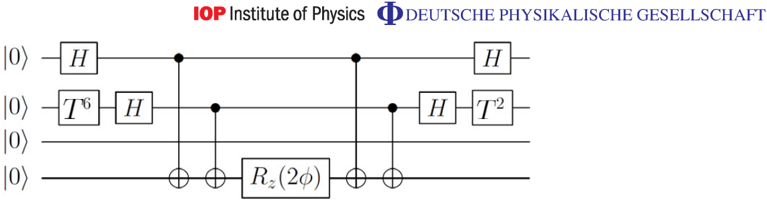
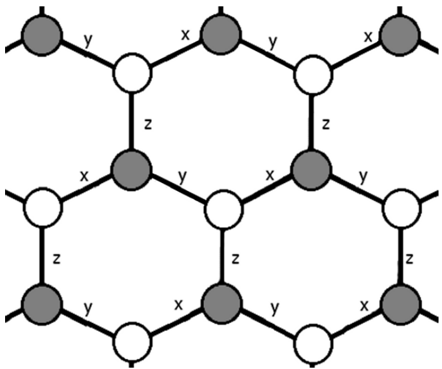
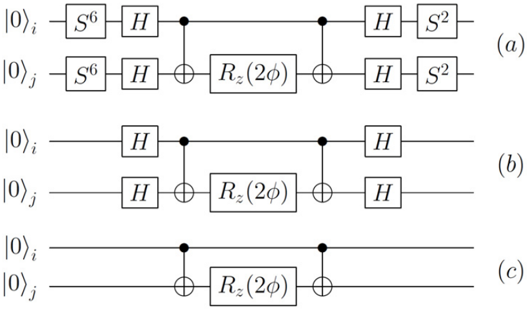
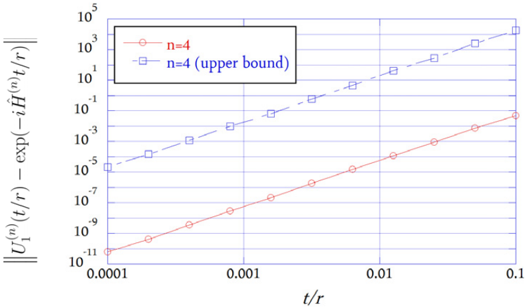
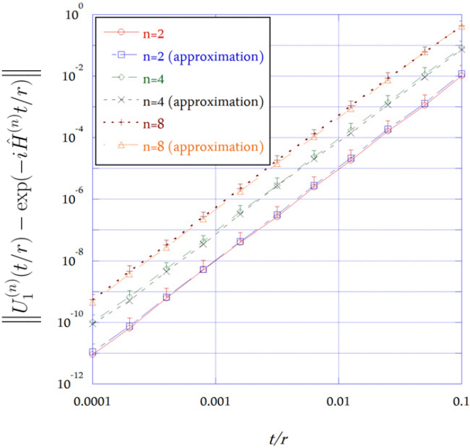
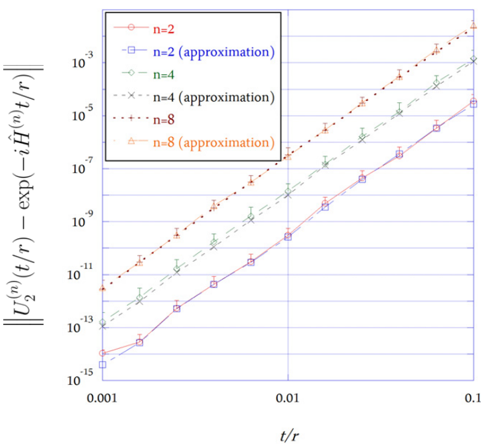
We construct an efficient autonomous quantum-circuit design algorithm for creating efficient quantum circuits to simulate Hamiltonian many-body quantum dynamics for arbitrary input states. The resultant quantum circuits have optimal space complexity and employ a sequence of gates that is close to optimal with respect to time complexity. We also devise an algorithm that exploits commutativity to optimize the circuits for parallel execution. As examples, we show how our autonomous algorithm constructs circuits for simulating the dynamics of Kitaev's honeycomb model and the Bardeen–Cooper–Schrieffer model of superconductivity. Furthermore, we provide numerical evidence that the rigorously proven upper bounds for the simulation error here and in previous work may sometimes overestimate the error by orders of magnitude compared to the best achievable performance for some physics-inspired simulations.
Overview
The claims and statistics of this paper haven’t been checked yet.
Free: it reads the open-access text and checks the first 5 claims that cite a source we can check. Create a free account to check every claim.
Integrity signals
Registry
Cites
Statistics
Figures





Verification
Claims the paper makes
The claims and statistics of this paper haven’t been checked yet.
Free: it reads the open-access text and checks the first 5 claims that cite a source we can check. Create a free account to check every claim.
Claims other papers make about this one
Each is checked against this paper’s own text: does it say what the citing paper says it does?
In the citing paper
“The block-by-block optimization procedure improves convergence and is analogous to the segment-by-segment pre-training strategy employed in machine learning to avoid barren plateaus in the optimization of neural networks 333,334 .”
From Quantum Chemistry in the Age of Quantum Computing (2019) · cites this paper as [333]
Self-check
Percentages, sums and reported differences re-computed from the paper’s own numbers.
The self-check needs the paper’s full text.
Citations
Cites
Hohenberg, P., & Kohn, W. (1964) · Physical Review · doi:10.1103/physrev.136.b864 · Cited by 53,541
Mahan, G. D. (2000) · doi:10.1007/978-1-4757-5714-9 · Cited by 8,249
Simulating physics with computers
Feynman, R. P. (1982) · International Journal of Theoretical Physics · doi:10.1007/bf02650179 · Cited by 7,691
Ring, P., & Schuck, P. (1980) · Springer eBooks · doi:10.1007/978-3-642-61852-9 · Cited by 5,779
Anyons in an exactly solved model and beyond
Kitaev, A. (2006) · Annals of Physics · doi:10.1016/j.aop.2005.10.005 · Cited by 5,245
Lloyd, S. (1996) · Science · doi:10.1126/science.273.5278.1073 · Cited by 3,088
Simulated Quantum Computation of Molecular Energies
Aspuru-Guzik, A., Dutoi, A. D., Love, P. J., & Head-Gordon, M. (2005) · Science · doi:10.1126/science.1113479 · Cited by 1,418
Classical and Quantum Computation
Kitaev, A., Shen, A., & Vyalyi, M. (2002) · Graduate Studies in Mathematics · doi:10.1090/gsm/047 · Cited by 1,387
Controlling Spin Exchange Interactions of Ultracold Atoms in Optical Lattices
Duan, L.-M., Demler, E., & Lukin, M. D. (2003) · Physical Review Letters · doi:10.1103/physrevlett.91.090402 · Cited by 1,170
Buluta, I., & Nori, F. (2009) · Science · doi:10.1126/science.1177838 · Cited by 876
Weimer, H., Müller, M., Lesanovsky, I., Zoller, P., & Büchler, H. P. (2010) · Nature Physics · doi:10.1038/nphys1614 · Cited by 867
Suzuki, M. (1990) · Physics Letters A · doi:10.1016/0375-9601(90)90962-n · Cited by 853
Suzuki, M. (1991) · Journal of Mathematical Physics · doi:10.1063/1.529425 · Cited by 762
Simulation of Many-Body Fermi Systems on a Universal Quantum Computer
Abrams, D. S., & Lloyd, S. (1997) · Physical Review Letters · doi:10.1103/physrevlett.79.2586 · Cited by 745
Quantum simulation of the Dirac equation
Gerritsma, R., Kirchmair, G., Zähringer, F., Solano, E., Blatt, R., & Roos, C. F. (2010) · Nature · doi:10.1038/nature08688 · Cited by 725
Efficient Quantum Algorithms for Simulating Sparse Hamiltonians
Berry, D. W., Ahokas, G., Cleve, R., & Sanders, B. C. (2007) · Communications in Mathematical Physics · doi:10.1007/s00220-006-0150-x · Cited by 692
Self-citationUniversal Digital Quantum Simulation with Trapped Ions
Lanyon, B. P., Hempel, C., Nigg, D., Müller, M., Gerritsma, R., Zähringer, F., Schindler, P., Barreiro, J. T., Rambach, M., Kirchmair, G., et al. (2011) · Science · doi:10.1126/science.1208001 · Cited by 613
Simulating a quantum magnet with trapped ions
Friedenauer, A., Schmitz, H., Glueckert, J. T., Porras, D., & Schaetz, T. (2008) · Nature Physics · doi:10.1038/nphys1032 · Cited by 602
Simulation of electronic structure Hamiltonians using quantum computers
Whitfield, J. D., Biamonte, J., & Aspuru-Guzik, A. (2011) · Molecular Physics · doi:10.1080/00268976.2011.552441 · Cited by 472
Dawson, C. M., & Nielsen, M. A. (2006) · Quantum Information and Computation · doi:10.26421/qic6.1-6 · Cited by 288
Higher order decompositions of ordered operator exponentials
Wiebe, N., Berry, D., Høyer, P., & Sanders, B. C. (2010) · Journal of Physics A: Mathematical and Theoretical · doi:10.1088/1751-8113/43/6/065203 · Cited by 208
Self-citationCreation, Manipulation, and Detection of Abelian and Non-Abelian Anyons in Optical Lattices
Aguado, M., Brennen, G. K., Verstraete, F., & Cirac, J. I. (2008) · Physical Review Letters · doi:10.1103/physrevlett.101.260501 · Cited by 120
Simulating quantum dynamics on a quantum computer
Wiebe, N., Berry, D. W., Høyer, P., & Sanders, B. C. (2011) · Journal of Physics A: Mathematical and Theoretical · doi:10.1088/1751-8113/44/44/445308 · Cited by 110
Self-citationPolynomial-Time Simulation of Pairing Models on a Quantum Computer
Wu, L.-A., Byrd, M. S., & Lidar, D. A. (2002) · Physical Review Letters · doi:10.1103/physrevlett.89.057904 · Cited by 108
Brown, K. R., Clark, R. J., & Chuang, I. L. (2006) · Physical Review Letters · doi:10.1103/physrevlett.97.050504 · Cited by 98
Digital quantum simulation with Rydberg atoms
Weimer, H., Müller, M., Büchler, H. P., & Lesanovsky, I. (2011) · Quantum Information Processing · doi:10.1007/s11128-011-0303-5 · Cited by 67
Limitations on the simulation of non-sparse Hamiltonians
Childs, A. M., & Kothari, R. (2010) · Quantum Information and Computation · doi:10.26421/qic10.7-8-7 · Cited by 58
On the efficiency of quantum algorithms for Hamiltonian simulation
Papageorgiou, A., & Zhang, C. (2011) · Quantum Information Processing · doi:10.1007/s11128-011-0263-9 · Cited by 47
Quantum Computation of Scattering in Scalar Quantum Field TheoriesPreprint
Jordan, S. P., Lee, K. S. M., & Preskill, J. P. (2011) · arXiv (Cornell University) · doi:10.48550/arxiv.1112.4833 · Cited by 8
Research works printed but not linked: 5
- Berry D W, Ahokas G, Cleve R and Sanders B C 2007 Mathematics of quantum computation and quantum technology Quantum Algorithms for Hamiltonian Simulation ed G Chen, L H Kauffman and S J Lomonaco (Oxford: Chapman and Hall) chapter 4, pp 89-110
- Jordan S P, Lee K S M and Preskill J 2011 arXiv:1111.3633 · arXiv
- Nielsen M A and Chuang I L 2000 Quantum Computation and Quantum Information (Cambridge: Cambridge University Press)
- Dawson C M and Nielsen M A 2006 Quantum Inform. Process. 6 81
- Vizing V G 1964 Diskret. Analiz. 3 25
Cited by
Georgescu, I. M., Ashhab, S., & Nori, F. (2014) · Reviews of Modern Physics · doi:10.1103/revmodphys.86.153 · Cited by 2,932
“Some of the representative studies on DQS are (Abrams and Lloyd, 1997; Lidar and Biham, 1997; Lloyd, 1996; Marzuoli and Rasetti, 2002; Ortiz et al., 2001; Raeisi et al., 2012; Somma et al., 2002; Terhal and DiVincenzo, 2000; Verstraete et al., 2009; Wiesner, 1996; Zalka, 1998a,b).”
BackgroundQuantum Chemistry in the Age of Quantum Computing
Cao, Y., Romero, J., Olson, J. P., Degroote, M., Johnson, P. D., Kieferová, M., Kivlichan, I. D., Menke, T., Peropadre, B., Sawaya, N. P. D., et al. (2019) · Chemical Reviews · doi:10.1021/acs.chemrev.8b00803 · Cited by 1,560
Quantum Chemistry in the Age of Quantum Computing
Cao, Y., Romero, J., Olson, J., Degroote, M., Johnson, P., Kieferová, M., Kivlichan, I., Menke, T., Peropadre, B., Sawaya, N., et al. (n.d.) · OPUS - Open Publications of UTS Scholars (University of Technology Sydney) · Cited by 1,265
Elucidating reaction mechanisms on quantum computers
Reiher, M., Wiebe, N., Svore, K. M., Wecker, D., & Troyer, M. (2017) · Proceedings of the National Academy of Sciences · doi:10.1073/pnas.1619152114 · Cited by 745
“The first, often coined nesting, is discussed in [34, 37].”
BackgroundSelf-citationToward the first quantum simulation with quantum speedup
Childs, A. M., Maslov, D., Nam, Y., Ross, N. J., & Su, Y. (2018) · Proceedings of the National Academy of Sciences · doi:10.1073/pnas.1801723115 · Cited by 551
“To address this, we report empirical error estimates by extrapolating the error seen in direct classical simulations of small instances [as also explored in previous work on simulating many-body dynamics (28) and quantum chemistry (29, 30)].”
BackgroundMethod
Metadata
- Authors
- Raeisi, S., Wiebe, N., & Sanders, B. C.
- Affiliations
- University of Waterloo (CA)
- University of Calgary (CA)
- Corresponding author
- Raeisi, Sadegh
- ORCID
- Sanders, Barry C
- Venue
- New Journal of Physics
- Publisher
- IOP Publishing
- Published
- 2012-10-09
- Volume
- 14
- Issue
- 10
- Pages
- 103017
- ISSN
- 1367-2630 (ISSN-L)
- OpenAlex
- W2073977329
- Semantic Scholar
- a11abb4e4732f7134fe5a9e0811e9cd1381e1ba3
- Cited by
- 72
- References
- 27
- Citations by year
- 2025: 10 · 2024: 11 · 2023: 4 · 2022: 7 · 2021: 6 · 2020: 3 · 2019: 8 · 2018: 4 · 2017: 2 · 2016: 3 · 2015: 4 · 2014: 5 · 2013: 5
- FWCI
- 4.41
- Type
- journal article
- Language
- en
- Open access
- gold
- doi.org
- Licence
- cc-by-nc-sa
- Locations
- New Journal of Physics (publishedVersion, cc-by-nc-sa)
- arXiv (Cornell University) (submittedVersion)
- DOAJ (DOAJ: Directory of Open Access Journals) (submittedVersion)
- arXiv (Cornell University)
- Funders
- Canadian Institute for Advanced Research
- Alberta Innovates - Technology Futures
- Mitacs
- Natural Sciences and Engineering Research Council of Canada
- Topics
- Physical Sciences › Computer Science › Artificial Intelligence › Quantum Computing Algorithms and Architecture
- Physical Sciences › Physics and Astronomy › Atomic and Molecular Physics, and Optics › Quantum many-body systems
- Physical Sciences › Physics and Astronomy › Atomic and Molecular Physics, and Optics › Quantum Information and Cryptography
- Keywords
- quantum circuit design, quantum simulation, quantum many-body dynamics, Hamiltonian simulation, space complexity, commutativity, Kitaev honeycomb model
About these checks
Registry, retraction, Cites and statistics results are computed, not judged, with one exception: a printed reference that no index lists is read once by a model before it counts as a citation error. Claims are extracted by a model and kept only when their quote appears verbatim in the text; each cited source is then checked, with a model’s help, for whether it says what the claim relies on. Those verdicts can be wrong — read the claim’s quote and the cited source before relying on one.
Statistics and arithmetic are recomputed, not judged.
Confidence bands are shown only for fields calibrated on our annotated test set. None is calibrated yet, so no band is shown.
What counts as a claim ›How we measure confidence ›How we check this ›
Are you an author, or do you see a problem with this page? Request a review
Data sources
Bibliographic data: Semantic Scholar, OpenAlex, Crossref.
Contains information from the Semantic Scholar Academic Graph Datasets, made available under the ODC Attribution License (ODC-BY 1.0).
Semantic Scholar’s data is described in: Kinney, R., et al. (2023). The Semantic Scholar Open Data Platform. arXiv:2301.10140.
