Cited by 64

The DOI matches its Crossref record; 7 of the 7 references it cites were found in a registry or an index.

Quantum simulation of non-trivial topology

Boada, Octavi, Celi, Alessio, Rodríguez-Laguna, Javier, Latorre, José I, Lewenstein, Maciej·2015·New Journal of Physics

Overview

The claims and statistics of this paper haven’t been checked yet.

Run the check — free, no account needed. It reads the open-access text and checks the sources it cites.

A few free checks a day · papers already verified open instantly · results are public

Integrity signals

Registry

Crossref · 10.1088/1367-2630/17/4/045007

Cites

7 of 7 references verified0 citation errors · 0 not checkable

Statistics

Figures

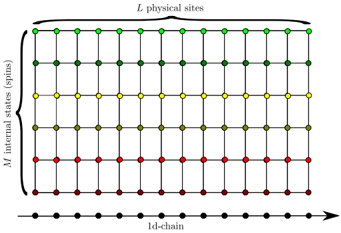
FIG. 1 Idea of a synthetic lattice: a 1D chain of length L sites with M species is equivalent to a L × M synthetic lattice, once the chain is dressed with appropriate couplings between species.
FIG. 1 Idea of a synthetic lattice: a 1D chain of length L sites with M species is equivalent to a L × M synthetic lattice, once the chain is dressed with appropriate couplings between species.CC-BY · From the PDF
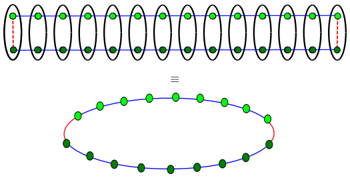
FIG. 2 Engineering a circumference of 2 L lattice sites from a L synthetic lattice that carries M = 2 species. The blue solid links indicate the hopping along the chain, e.g., the free hopping in a cold-atom implementation, while the two dashed red links are induced local interactions between the two species, e.g., a Raman coupling between hyperfine levels of atoms. The vertical black ellipses represent the physical sites in the real 1D-chain occupied by the two species.
FIG. 2 Engineering a circumference of 2 L lattice sites from a L synthetic lattice that carries M = 2 species. The blue solid links indicate the hopping along the chain, e.g., the free hopping in a cold-atom implementation, while the two dashed red links are induced local interactions between the two species, e.g., a Raman coupling between hyperfine levels of atoms. The vertical black ellipses represent the physical sites in the real 1D-chain occupied by the two species.CC-BY · From the PDF
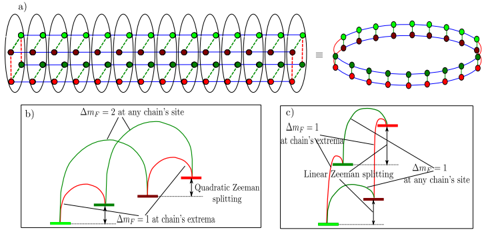
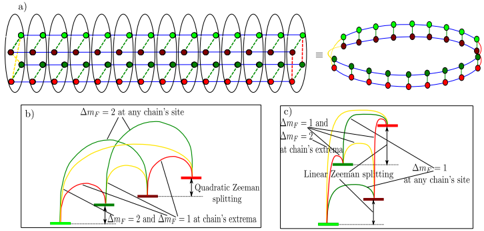
FIG. 3 Engineering a cylinder of basis L x and height L y lattice sites from a L × M synthetic lattice with L = L x / 2 and M = 2 L y . (a) L y = 2 synthetic cylinder. In a cold atom implementation, the blue solid links indicate the free hopping while the dashed ones are laser or radio-frequency induced. The dashed red links are the 'sewing' hoppings C σσ ′ closing each circle of the cylinder, while the dashed green ones are the hoppings B σσ ′ along its height, connecting the different circles. (b) and (c) Spectroscopical arrangement of the four internal degrees of freedom in the one-manifold and two-manifold scheme, respectively. The former can be realized by using the groundstate of atoms F ≥ 3 2 like Li, K, Yb, Sr, Er, etc, and requires quadratic Zeeman splitting in order to have J ′ -coupling (in red) only between odd-even m F -states. The latter requires earth-alkali like atoms with F ≥ 1 2 as 171 Yb, 173 Yb, and 87 Sr and in this case the linear splitting is sufficient in order to make the spin accessible by Raman lasers or radio-frequency pulses.
FIG. 3 Engineering a cylinder of basis L x and height L y lattice sites from a L × M synthetic lattice with L = L x / 2 and M = 2 L y . (a) L y = 2 synthetic cylinder. In a cold atom implementation, the blue solid links indicate the free hopping while the dashed ones are laser or radio-frequency induced. The dashed red links are the 'sewing' hoppings C σσ ′ closing each circle of the cylinder, while the dashed green ones are the hoppings B σσ ′ along its height, connecting the different circles. (b) and (c) Spectroscopical arrangement of the four internal degrees of freedom in the one-manifold and two-manifold scheme, respectively. The former can be realized by using the groundstate of atoms F ≥ 3 2 like Li, K, Yb, Sr, Er, etc, and requires quadratic Zeeman splitting in order to have J ′ -coupling (in red) only between odd-even m F -states. The latter requires earth-alkali like atoms with F ≥ 1 2 as 171 Yb, 173 Yb, and 87 Sr and in this case the linear splitting is sufficient in order to make the spin accessible by Raman lasers or radio-frequency pulses.CC-BY · From the PDF
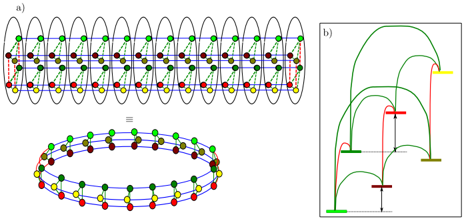
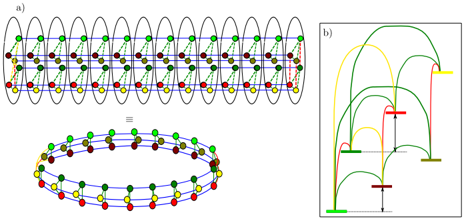
FIG. 4 Engineering a torus by converting each fiber into a circumference. In (a) we show the L y = 3 synthetic torus. In a cold atom implementation, the blue solid links indicate the free hopping while the dashed ones are laser or radiofrequency induced. The dashed red links are unchanged with respect to Fig. 3 (a), while additional green dashes ones are used to glue the basis of the cylinder connecting the top and bottom circles, and correspond to the additional terms in B σσ ′ . In (b) we show the spectroscopical arrangement of the six internal degrees of freedom in the two-manifold scheme requiring F ≥ 3 2 , for instance, 173 Yb.
FIG. 4 Engineering a torus by converting each fiber into a circumference. In (a) we show the L y = 3 synthetic torus. In a cold atom implementation, the blue solid links indicate the free hopping while the dashed ones are laser or radiofrequency induced. The dashed red links are unchanged with respect to Fig. 3 (a), while additional green dashes ones are used to glue the basis of the cylinder connecting the top and bottom circles, and correspond to the additional terms in B σσ ′ . In (b) we show the spectroscopical arrangement of the six internal degrees of freedom in the two-manifold scheme requiring F ≥ 3 2 , for instance, 173 Yb.CC-BY · From the PDF
FIG. 5 Engineering a M¨ obius strip by twisting the cylinder. In (a) we show the L y = 2 synthetic strip. In a cold atom implementation, the blue solid links indicate the free hopping while the dashed ones are laser or radio-frequency induced. The dashed green links and half of the dashed red links are unchanged with respect to Fig. 3 (a), while the yellow dashed ones are the twisted closing hoppings connecting different circles, reflecting the change from C σσ ′ to C M σσ ′ . In (b) and (c) we see the spectroscopical arrangement of the four internal degrees of freedom in the one-manifold and two-manifold scheme, respectively. The former can be realized by using the ground state of atoms F ≥ 3 2 like Li, K, Yb, Sr, Er, etc., while the latter requires earth-alkali like atoms with F ≥ 1 2 as 171 Yb, 173 Yb, and 87 Sr. in both cases, the hyperfine levels are linearly split in order to make them accessible by multiple Raman lasers or radio-frequency pulses.
FIG. 5 Engineering a M¨ obius strip by twisting the cylinder. In (a) we show the L y = 2 synthetic strip. In a cold atom implementation, the blue solid links indicate the free hopping while the dashed ones are laser or radio-frequency induced. The dashed green links and half of the dashed red links are unchanged with respect to Fig. 3 (a), while the yellow dashed ones are the twisted closing hoppings connecting different circles, reflecting the change from C σσ ′ to C M σσ ′ . In (b) and (c) we see the spectroscopical arrangement of the four internal degrees of freedom in the one-manifold and two-manifold scheme, respectively. The former can be realized by using the ground state of atoms F ≥ 3 2 like Li, K, Yb, Sr, Er, etc., while the latter requires earth-alkali like atoms with F ≥ 1 2 as 171 Yb, 173 Yb, and 87 Sr. in both cases, the hyperfine levels are linearly split in order to make them accessible by multiple Raman lasers or radio-frequency pulses.CC-BY · From the PDF
FIG. 6 Engineering a twisted torus by wrapping the M¨ obius strip. Equivalently, a twisted torus can be visualized as a torus cut and glued with a twist. In (a) we see the L y = 3 synthetic twisted torus. In a cold atom implementation, the blue solid links indicate the free hopping while the dashed ones are laser or radio-frequency induced. The dashed red links are unchanged with respect to Fig. 5 (a), while the green dashed ones are used to glue the borders of the M¨ obius strip. In (b) we show the spectroscopical arrangement of the six internal degrees of freedom in the two-manifold scheme, which requires F ≥ 3 2 as, for instance, in 173 Yb.
FIG. 6 Engineering a twisted torus by wrapping the M¨ obius strip. Equivalently, a twisted torus can be visualized as a torus cut and glued with a twist. In (a) we see the L y = 3 synthetic twisted torus. In a cold atom implementation, the blue solid links indicate the free hopping while the dashed ones are laser or radio-frequency induced. The dashed red links are unchanged with respect to Fig. 5 (a), while the green dashed ones are used to glue the borders of the M¨ obius strip. In (b) we show the spectroscopical arrangement of the six internal degrees of freedom in the two-manifold scheme, which requires F ≥ 3 2 as, for instance, in 173 Yb.CC-BY · From the PDF
Image 7
CC-BY · From the PDF
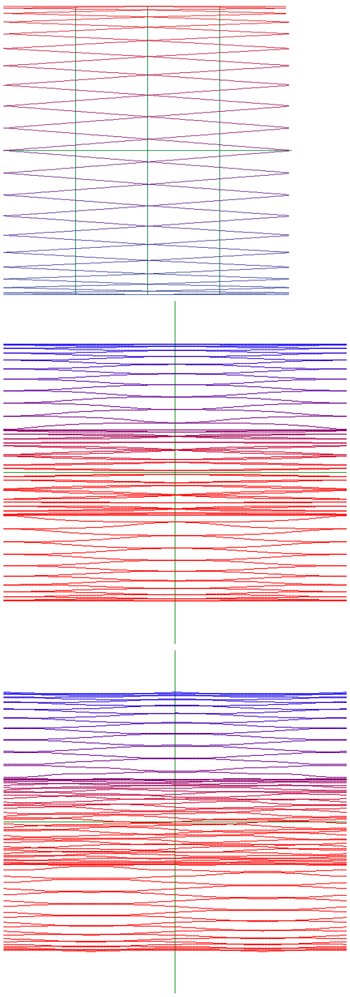
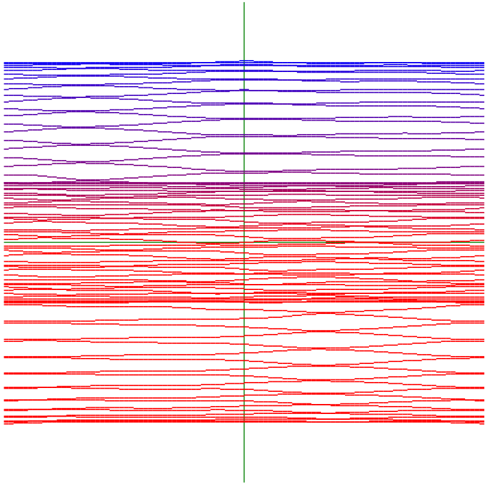
FIG. 8 Hofstadter-like single-particle spectra of several quasi-1D systems under a continuous change of boundary conditions. In all cases the X -axis is labeled by φ ∈ [0 , 2 π ], and color corresponds to eigenvalue index. In (a) we present the spectrum for a PBC system such as that in Eq. (1) with L = 40, pierced with a flux J c = e iφ with φ ∈ [0 , 2 π ]. In (b) and (c) we show the single-body spectrum of a ladder of size 40 × 2, such as Eq. (3) in which the opposite extremes are joined with a unitary matrix of different types: cylindrical in (b) and M¨ obius-like in (c), as specified in the boundary conditions given in equations (12) and (13).
FIG. 8 Hofstadter-like single-particle spectra of several quasi-1D systems under a continuous change of boundary conditions. In all cases the X -axis is labeled by φ ∈ [0 , 2 π ], and color corresponds to eigenvalue index. In (a) we present the spectrum for a PBC system such as that in Eq. (1) with L = 40, pierced with a flux J c = e iφ with φ ∈ [0 , 2 π ]. In (b) and (c) we show the single-body spectrum of a ladder of size 40 × 2, such as Eq. (3) in which the opposite extremes are joined with a unitary matrix of different types: cylindrical in (b) and M¨ obius-like in (c), as specified in the boundary conditions given in equations (12) and (13).CC-BY · From the PDF
FIG. 9 Single-particle spectrum of the 40 × 2 ladder Hamiltonian represented in Eq. (3) undergoing a smooth transition between a cylinder and a M¨ obius strip, with boundary conditions specified in Eq. (14).
FIG. 9 Single-particle spectrum of the 40 × 2 ladder Hamiltonian represented in Eq. (3) undergoing a smooth transition between a cylinder and a M¨ obius strip, with boundary conditions specified in Eq. (14).CC-BY · From the PDF
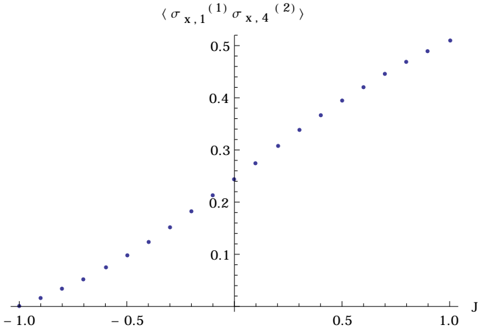
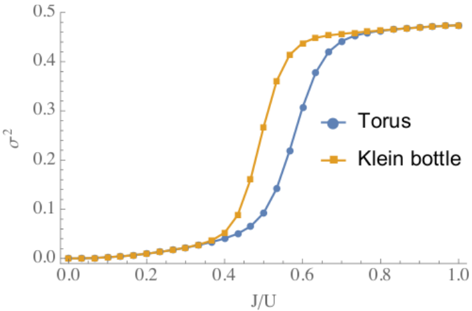
FIG. 10 Ground state particle-number fluctuations for the Bose-Hubbard model of Eq. 15 at half filling, defined on a 2D lattice with periodic boundary conditions in both directions a torus- and on a 2D lattice with the boundary conditions of a Klein bottle, computed via exact diagonalization. The results are for a 4x4 lattice. Similarly to the results for the M¨ obius band, the ground state in twisted boundary conditions seems to favor larger particle-number fluctuations at intermediate values of J/U . The computation has been done with small disorder in µ to remove the degeneracy at J = 0, as the two complementary checkerboard coverings of the lattice are ground states.
FIG. 10 Ground state particle-number fluctuations for the Bose-Hubbard model of Eq. 15 at half filling, defined on a 2D lattice with periodic boundary conditions in both directions a torus- and on a 2D lattice with the boundary conditions of a Klein bottle, computed via exact diagonalization. The results are for a 4x4 lattice. Similarly to the results for the M¨ obius band, the ground state in twisted boundary conditions seems to favor larger particle-number fluctuations at intermediate values of J/U . The computation has been done with small disorder in µ to remove the degeneracy at J = 0, as the two complementary checkerboard coverings of the lattice are ground states.CC-BY · From the PDF
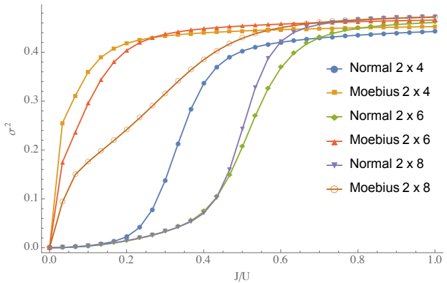
FIG. 11 Particle-number fluctuations in the ground state of the Bose-Hubbard model of Eq. (15) at half filling defined on a strip with periodic and M¨ obius boundary conditions computed with exact diagonalization. The results are for strips 4, 6 and 8 sites long. For large interactions compared to the hopping parameter the ground state presents larger particlenumber fluctuations for twisted boundary conditions than for regular ones. This behavior does not disappear as the system size increases, for the range of sizes analyzed. The computation has been done with small disorder in µ to remove spurious degeneracy.
FIG. 11 Particle-number fluctuations in the ground state of the Bose-Hubbard model of Eq. (15) at half filling defined on a strip with periodic and M¨ obius boundary conditions computed with exact diagonalization. The results are for strips 4, 6 and 8 sites long. For large interactions compared to the hopping parameter the ground state presents larger particlenumber fluctuations for twisted boundary conditions than for regular ones. This behavior does not disappear as the system size increases, for the range of sizes analyzed. The computation has been done with small disorder in µ to remove spurious degeneracy.CC-BY · From the PDF
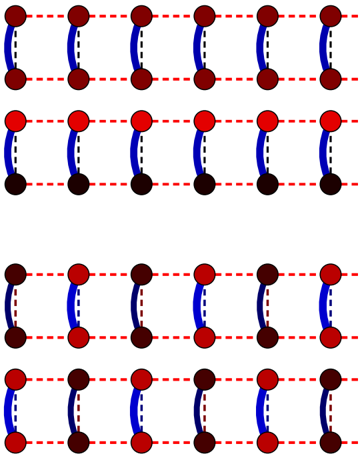
FIG. 12 Representation of the ground state and first excited state of the fermionic Hubbard model (16) on a cylinder and a M¨ obius strip of size L x = 6 and L y = 2. The repulsion only takes place along the same rung. The color of each node represents the expected value of 〈 n i 〉 . The color of the bent line represents the correlator 〈 n i n j 〉 - 〈 n i 〉 〈 n j 〉 . The dashed lines are the correlators 〈 a † i a j 〉 .
FIG. 12 Representation of the ground state and first excited state of the fermionic Hubbard model (16) on a cylinder and a M¨ obius strip of size L x = 6 and L y = 2. The repulsion only takes place along the same rung. The color of each node represents the expected value of 〈 n i 〉 . The color of the bent line represents the correlator 〈 n i n j 〉 - 〈 n i 〉 〈 n j 〉 . The dashed lines are the correlators 〈 a † i a j 〉 .CC-BY · From the PDF

Verification

Claims the paper makes

The claims and statistics of this paper haven’t been checked yet.

Run the check — free, no account needed. It reads the open-access text and checks the sources it cites.

A few free checks a day · papers already verified open instantly · results are public

Claims other papers make about this one

Each is checked against this paper’s own text: does it say what the citing paper says it does?

Self-check

Percentages, sums and reported differences re-computed from the paper’s own numbers.

The self-check needs the paper’s full text.

Citations

Cites

Show all 7 references

Research works printed but not linked: 97

  1. 10.1103/RevModPhys.83.1523 · DOI · Paper page
  2. 10.1103/PhysRevLett.109.125302 · DOI
  3. 10.1103/PhysRevLett.109.175302 · DOI
  4. 10.1016/j.aop.2012.11.009 · DOI
  5. 10.1103/PhysRevLett.110.125304 · DOI
  6. 10.1103/PhysRevLett.110.125303 · DOI
  7. 10.1038/ncomms3615 · DOI
  8. 10.1038/nphys2519 · DOI
  9. 10.1103/PhysRevLett.61.2015 · DOI · Paper page
  10. Sakurai J J, 2011, Modern Quantum Mechanics
  11. 10.1103/PhysRevLett.42.1698 · DOI · Paper page
  12. 10.1103/PhysRevD.13.3398 · DOI · Paper page
  13. 10.1016/0550-3213(79)90031-2 · DOI
  14. 10.1016/0550-3213(79)90332-8 · DOI
  15. 10.1103/RevModPhys.82.3045 · DOI · Paper page
  16. 10.1103/RevModPhys.80.1083 · DOI · Paper page
  17. 10.1016/S0003-4916(02)00018-0 · DOI · Paper page
  18. 10.1038/nphys1614 · DOI · Paper page
  19. 10.1038/nature09801 · DOI · Paper page
  20. 10.1103/PhysRevB.82.235114 · DOI · Paper page
  21. 10.1103/PhysRevB.88.121406 · DOI
  22. 10.1103/PhysRevLett.111.185301 · DOI
  23. 10.1103/PhysRevLett.111.185302 · DOI · Paper page
  24. 10.1103/PhysRevLett.108.255303 · DOI
  25. 10.1073/pnas.1300170110 · DOI
  26. 10.1103/PhysRevLett.111.135302 · DOI
  27. 10.1103/PhysRevA.84.063629 · DOI
  28. 10.1103/PhysRevA.89.023619 · DOI
  29. 10.1103/PhysRevLett.112.043001 · DOI
  30. 10.1038/nphys2998 · DOI
  31. 10.1103/PhysRevA.85.063614 · DOI
  32. 10.1103/PhysRevA.81.033622 · DOI
  33. 10.1103/PhysRevA.86.063632 · DOI
  34. 10.1103/PhysRevA.88.053619 · DOI
  35. 10.1103/PhysRevLett.105.255302 · DOI · Paper page
  36. 10.1103/PhysRevLett.109.145301 · DOI
  37. 10.1038/nature12185 · DOI
  38. 10.1038/nature13915 · DOI · Paper page
  39. 10.1103/PhysRevA.90.031601 · DOI
  40. 10.1103/PhysRevLett.107.235301 · DOI
  41. 10.1103/PhysRevLett.111.120402 · DOI
  42. 10.1103/PhysRevLett.110.166802 · DOI
  43. 10.1103/PhysRevLett.110.165304 · DOI
  44. 10.1103/PhysRevLett.113.045303 · DOI
  45. 10.1126/science.1222360 · DOI · Paper page
  46. 10.1103/PhysRevLett.106.220402 · DOI · Paper page
  47. 10.1103/PhysRevA.79.063616 · DOI
  48. 10.1103/PhysRevA.62.063610 · DOI
  49. 10.1103/PhysRevA.62.063610 · DOI
  50. 10.1103/PhysRevLett.106.130401 · DOI
  51. 10.1103/PhysRevX.4.031052 · DOI
  52. 10.1103/PhysRevLett.113.045305 · DOI
  53. 10.1103/PhysRevA.88.063633 · DOI
  54. 10.1103/PhysRevA.88.053615 · DOI
  55. 10.1103/PhysRevLett.110.025302 · DOI
  56. 10.1103/PhysRevLett.106.130401 · DOI
  57. 10.1103/PhysRevB.89.235112 · DOI
  58. 10.1016/j.ssc.2014.10.024 · DOI
  59. Boada O, 2011, New J. Phys., 13, 10.1088/1367-2630/13/3/035002 · DOI
  60. 10.1103/PhysRevLett.108.133001 · DOI
  61. 10.1103/PhysRevLett.99.260401 · DOI
  62. Brand J, 2001, J. Phys. B: At. Mol. Opt. Phys., 34, L113, 10.1088/0953-4075/34/4/105 · DOI
  63. 10.1103/PhysRevA.89.053602 · DOI
  64. 10.1103/PhysRevA.87.013619 · DOI
  65. 10.1103/PhysRevA.87.043601 · DOI
  66. 10.1103/PhysRevA.81.043619 · DOI
  67. 10.1103/PhysRevA.79.043620 · DOI
  68. 10.1007/s10909-008-9847-x · DOI
  69. 10.1103/PhysRevA.74.065601 · DOI
  70. 10.1103/PhysRevA.75.063406 · DOI
  71. 10.1103/PhysRevA.72.063612 · DOI
  72. Bhattacherjee A B, 2004, J. Phys. B: At. Mol. Opt. Phys., 37, 4397, 10.1088/0953-4075/37/22/001 · DOI
  73. 10.1103/PhysRevA.66.033602 · DOI
  74. 10.1103/PhysRevA.63.013608 · DOI
  75. 10.1103/PhysRevA.59.2990 · DOI
  76. Benakli M, 1999, Europhys. Lett., 46, 275, 10.1209/epl/i1999-00256-8 · DOI
  77. 10.1038/nature08482 · DOI
  78. 10.1038/nature09378 · DOI
  79. 10.1103/PhysRevLett.58.771 · DOI
  80. 10.1016/0003-4916(88)90015-2 · DOI
  81. 10.1103/PhysRevA.87.013814 · DOI
  82. 10.1103/PhysRevLett.109.135701 · DOI
  83. 10.1103/PhysRevA.87.013611 · DOI
  84. 10.1103/PhysRevLett.112.010404 · DOI
  85. Wall M L, 2015, New J. Phys., 17
  86. 10.1038/nphys2878 · DOI
  87. 10.1103/PhysRevLett.113.120402 · DOI
  88. 10.1038/nphys3061 · DOI
  89. 10.1103/PhysRevA.89.043616 · DOI
  90. 10.1103/PhysRevLett.77.2913 · DOI
  91. 10.1103/PhysRevLett.93.123001 · DOI · Paper page
  92. 10.1103/PhysRevA.82.062704 · DOI
  93. 10.1126/science.1212652 · DOI
  94. 10.1103/PhysRevLett.109.095301 · DOI
  95. 10.1103/PhysRevLett.111.095301 · DOI
  96. 10.1007/BF01223371 · DOI · Paper page
  97. 10.1103/RevModPhys.80.885 · DOI · Paper page

Cited by

Sorted by citations

See all 64

Metadata

Authors
Boada, O., Celi, A., Rodríguez-Laguna, J., Latorre, J. I., & Lewenstein, M.
Venue
New Journal of Physics
Published
2015-04-15
Volume
17
Issue
4
Pages
045007
ISSN
1367-2630
Cited by
64
References
7
Funders
  • Ministerio de Economia y Competitividad: (FIS2012-33642, FIS2013-41757-P)
  • Instituto de Telecomunicações: (IT/QuSim)
  • European Research Council: (AdG OSYRIS)
  • EU FP7: (GA 318287, GA 323901)
  • Fundação para a Ciência e a Tecnologia: (PEst-OE/EGE/UI0491/2013,)

About these checks

Registry, retraction, Cites and statistics results are computed, not judged, with one exception: a printed reference that no index lists is read once by a model before it counts as a citation error. Claims are extracted by a model and kept only when their quote appears verbatim in the text; each cited source is then checked, with a model’s help, for whether it says what the claim relies on. Those verdicts can be wrong — read the claim’s quote and the cited source before relying on one.

Statistics and arithmetic are recomputed, not judged.

Confidence bands are shown only for fields calibrated on our annotated test set. None is calibrated yet, so no band is shown.

What counts as a claim ›How we measure confidence ›How we check this ›

Are you an author, or do you see a problem with this page? Request a review

How to cite

Cite CoChat for the checks on this page, and the paper for its own findings.

This page
CoChat. (2026). Citation check: Quantum simulation of non-trivial topology. https://app.cochat.ai/papers/10.1088/1367-2630/17/4/045007
The paper
Boada, O., Celi, A., Rodríguez-Laguna, J., Latorre, J. I., & Lewenstein, M. (2015). Quantum simulation of non-trivial topology. New Journal of Physics. https://doi.org/10.1088/1367-2630/17/4/045007