

Variational-state quantum metrology
Open accessThe DOI matches its Crossref record; 89 of the 90 references it cites were found in a registry or an index.
Abstract
Quantum technologies exploit entanglement to enhance various tasks beyond their classical limits including computation, communication and measurements. Quantum metrology aims to increase the precision of a measured quantity that is estimated in the presence of statistical errors using entangled quantum states. We present a novel approach for finding (near) optimal states for metrology in the presence of noise, using variational techniques as a tool for efficiently searching the high-dimensional space of quantum states, which would be classically intractable. We comprehensively explore systems consisting of up to 9 qubits and find new highly entangled states that are not symmetric under permutations and non-trivially outperform previously known states up to a constant factor 2. We consider a range of environmental noise models; while passive quantum states cannot achieve a fundamentally superior scaling (as established by prior asymptotic results) we do observe a significant absolute quantum advantage. We finally outline a possible experimental setup for variational quantum metrology which can be implemented in near-term hardware.
Overview
The claims and statistics of this paper haven’t been checked yet.
Free: it reads the open-access text and checks the first 5 claims that cite a source we can check. Create a free account to check every claim.
Integrity signals
Registry
Cites
Statistics
Figures
Verification
Claims the paper makes
The claims and statistics of this paper haven’t been checked yet.
Free: it reads the open-access text and checks the first 5 claims that cite a source we can check. Create a free account to check every claim.
Claims other papers make about this one
Each is checked against this paper’s own text: does it say what the citing paper says it does?
The cited source says what the claim attributes to it.
In the citing paper
“Using it as a cost function, recent works have explored quantum metrology to prepare a better probe state in a VQA set-up (Beckey et al. , 2020; Kaubruegger et al. , 2019; Koczor et al. , 2020; Ma et al. , 2020).”
From Noisy intermediate-scale quantum algorithms (2022) · cites this paper as Koczor et al., 2020
The check wasn’t confident either way, so it gives no verdict — never disputed.
In the citing paper
“Ref. [188] introduced a VQA to estimate the quantum fidelity between an arbitrary state σ and a low-rank state ρ .”
From Variational quantum algorithms (2021) · cites this paper as [188]
Experimental — accuracy not yet measuredThe check wasn’t confident either way, so it gives no verdict — never disputed.
In the citing paper
“The analytic descent has been shown to achieve faster convergence as compared to the QNG.”
From Noisy intermediate-scale quantum algorithms (2022) · cites this paper as Koczor and Benjamin, 2020
Experimental — accuracy not yet measured
Self-check
Percentages, sums and reported differences re-computed from the paper’s own numbers.
The self-check needs the paper’s full text.
Citations
Cites
A variational eigenvalue solver on a photonic quantum processor
Peruzzo, A., McClean, J., Shadbolt, P., Yung, M.-H., Zhou, X.-Q., Love, P. J., Aspuru-Guzik, A., & O’Brien, J. L. (2014) · Nature Communications · doi:10.1038/ncomms5213 · Cited by 4,552 · cited 1×
“Optimisation of the ansatz parameters For the optimisation of the ansatz parameters, one might employ any suitable one of a range of methods: for example a direct search such as Nelder–Mead (demonstrated experimentally in 2014 [1]), or a systematic scan if the number of parameters is small [59].”
MethodOn the Theory of the Brownian Motion
Uhlenbeck, G. E., & Ornstein, L. S. (1930) · Physical Review · doi:10.1103/physrev.36.823 · Cited by 4,482 · cited 1×
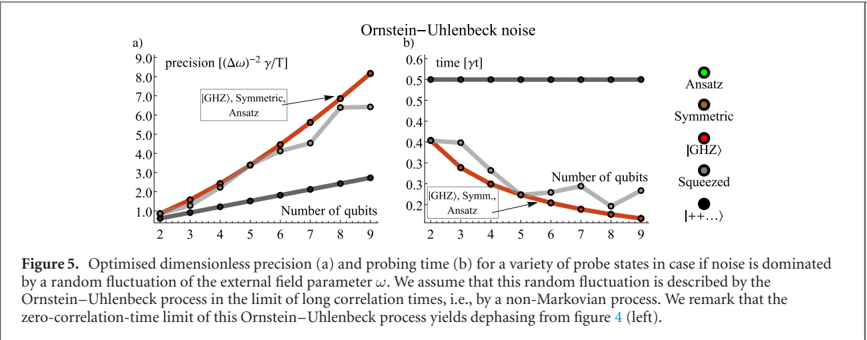
“n increasing system size. Ornstein-Uhlenbeck noise | We nally consider a noise model that is dominated by a random uctuation of the external eld which follows the so-called Ornstein-Uhlenbeck process [66]. This noise process is non-Markovian in general and in the limit of long correlation times an improved scaling can…”
MethodGiovannetti, V., Lloyd, S., & Maccone, L. (2011) · Nature Photonics · doi:10.1038/nphoton.2011.35 · Cited by 3,894 · cited 7×
“where FQ(ρω) is the so-called quantum Fisher information of the state ρω [45, 46, 13, 14, 12].”
BackgroundInfluentialStatistical distance and the geometry of quantum states
Braunstein, S. L., & Caves, C. M. (1994) · Physical Review Letters · doi:10.1103/physrevlett.72.3439 · Cited by 3,176 · cited 1×
“In particular, performing measurements in the eigenbasis of L saturates the quantum Cramér–Rao bound [12, 45].”
MethodQuantum-Enhanced Measurements: Beating the Standard Quantum Limit
Giovannetti, V., Lloyd, S., & Maccone, L. (2004) · Science · doi:10.1126/science.1104149 · Cited by 3,038
Hardware-efficient variational quantum eigensolver for small molecules and quantum magnets
Kandala, A., Mezzacapo, A., Temme, K., Takita, M., Brink, M., Chow, J. M., & Gambetta, J. M. (2017) · Nature · doi:10.1038/nature23879 · Cited by 2,982
The theory of variational hybrid quantum-classical algorithms
McClean, J. R., Romero, J., Babbush, R., & Aspuru-Guzik, A. (2016) · New Journal of Physics · doi:10.1088/1367-2630/18/2/023023 · Cited by 2,227 · cited 2×
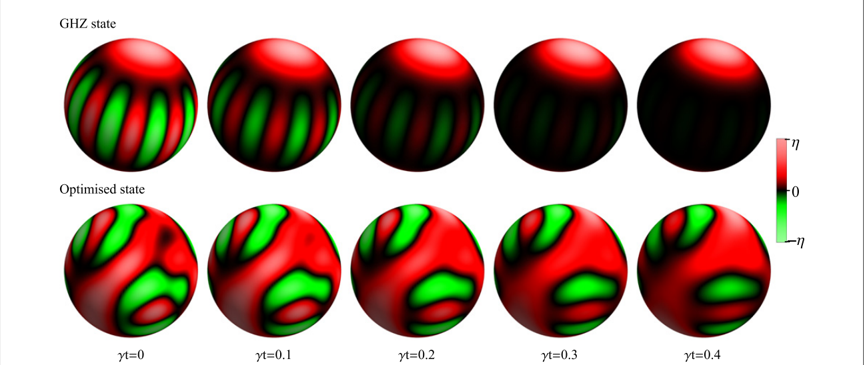
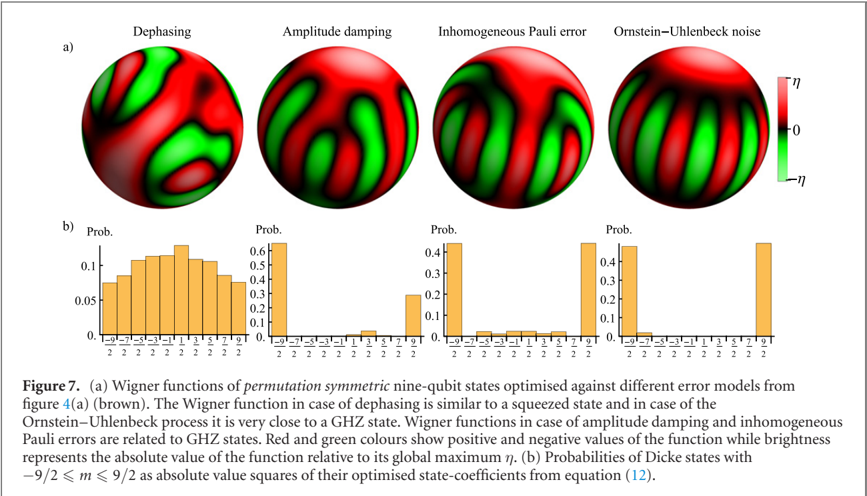
“e and negative values of the function while brightness represents the absolute value of the function relative to its global maximum . usually referred to as the variational quantum eigensolver (VQE) [1, 2, 3, 4]. Quantum machine learning is another area where variational techniques may be valuable. One is then interes…”
BackgroundClarke, J., & Wilhelm, F. K. (2008) · Nature · doi:10.1038/nature07128 · Cited by 2,076 · cited 1×
“demonstrated in [80, 81, 82]. On the other hand, superconducting qubits can contain a SQUID-structure, and so the applied magnetic elds can shift the resonant frequency of the superconducting qubits [83]. There have been several experimental demonstrations of using superconducting qubits as highly sensitive magnetic e…”
BackgroundA Quantum Approximate Optimization Algorithm
Farhi, E., Goldstone, J., & Gutmann, S. (2014) · arXiv · doi:10.48550/arxiv.1411.4028 · Cited by 1,789
Superconducting quantum circuits at the surface code threshold for fault tolerance
Barends, R., Kelly, J., Megrant, A., Veitia, A., Sank, D., Jeffrey, E., White, T. C., Mutus, J., Fowler, A. G., Campbell, B., et al. (2014) · Nature · doi:10.1038/nature13171 · Cited by 1,733
Research works printed but not linked: 5
- Levitt M H 2001 Spin Dynamics: Basics of Nuclear Magnetic Resonance (Chichester: Wiley)
- Ramsden E 2011 Hall-effect Sensors: Theory and Application (Amsterdam: Elsevier)
- Nielsen M A and Chuang I L 2011 Quantum Computation and Quantum Information: 10th Anniversary Edition 10th edn (Cambridge: Cambridge University Press)
- Ouyang Y, Nathan S and Markham D 2019 Robust quantum metrology with explicit symmetric states arXiv:1908.02378 · arXiv
- Sakurai J J 1994 Modern Quantum Mechanics (Reading: Addison-Wesley)
Cited by
Variational quantum algorithms
Cerezo, M., Arrasmith, A., Babbush, R., Benjamin, S. C., Endo, S., Fujii, K., McClean, J. R., Mitarai, K., Yuan, X., Cincio, L., et al. (2021) · Nature Reviews Physics · doi:10.1038/s42254-021-00348-9 · Cited by 3,385
Self-citationNoisy intermediate-scale quantum algorithms
Bharti, K., Cervera-Lierta, A., Kyaw, T. H., Haug, T., Alperin-Lea, S., Anand, A., Degroote, M., Heimonen, H., Kottmann, J. S., Menke, T., et al. (2022) · Reviews of Modern Physics · doi:10.1103/revmodphys.94.015004 · Cited by 2,231
Cost function dependent barren plateaus in shallow parametrized quantum circuits
Cerezo, M., Sone, A., Volkoff, T., Cincio, L., & Coles, P. J. (2021) · Nature Communications · doi:10.1038/s41467-021-21728-w · Cited by 1,047
Noise-Induced Barren Plateaus in Variational Quantum Algorithms
Wang, S., Fontana, E., Cerezo, M., Sharma, K., Sone, A., Cincio, L., & Coles, P. J. (2020) · arXiv · doi:10.48550/arxiv.2007.14384 · Cited by 791
Noise-induced barren plateaus in variational quantum algorithms
Wang, S., Fontana, E., Cerezo, M., Sharma, K., Sone, A., Cincio, L., & Coles, P. J. (2021) · Nature Communications · doi:10.1038/s41467-021-27045-6 · Cited by 773
“By keeping the quantum circuit depth relatively short, VQAs mitigate hardware noise and may enable near-term applications including electronic structure [5–8], dynamics [9– 12], optimization [13–16], linear systems [17, 18], metrology [19, 20], factoring [21], compiling [22–24], and others [25–30].”
Background
Metadata
- Authors
- Koczor, B., Endo, S., Jones, T., Matsuzaki, Y., & Benjamin, S. C.
- Affiliations
- University of Oxford (GB)
- National Institute of Advanced Industrial Science and Technology (JP)
- Venue
- New Journal of Physics
- Publisher
- IOP Publishing
- Published
- 2020-08-01
- Volume
- 22
- Issue
- 8
- Pages
- 083038
- ISSN
- 1367-2630 (ISSN-L)
- OpenAlex
- W2969241977
- Cited by
- 101
- References
- 84
- Citations by year
- 2026: 7 · 2025: 17 · 2024: 24 · 2023: 18 · 2022: 12 · 2021: 21 · 2020: 2
- FWCI
- 5.20
- Type
- journal article
- Language
- en
- Open access
- gold
- doi.org
- Licence
- cc-by
- creativecommons.org/licenses/by/4.0/ (vor, 13 d)
- iopscience.iop.org/info/page/text-and-data-mining (tdm, 13 d)
- Locations
- New Journal of Physics (publishedVersion, cc-by)
- arXiv (Cornell University) (submittedVersion)
- DOAJ (DOAJ: Directory of Open Access Journals) (submittedVersion)
- arXiv (Cornell University)
- Funders
- Ministry of Education, Culture, Sports, Science and Technology (15H05870)
- Japan Student Services Organization
- Horizon 2020 Framework Programme (EU‐H2020, 820495)
- Intelligence Advanced Research Projects Activity
- Engineering and Physical Sciences Research Council (820495, EU H2020, M013243/1, EP/T001062/1, EP/M013243/1, T001062)
- Japan Society for the Promotion of Science (15H05870)
- Clarendon Fund
- Army Research Office (820495)
- Topics
- Physical Sciences › Physics and Astronomy › Atomic and Molecular Physics, and Optics › Quantum Information and Cryptography
- Physical Sciences › Computer Science › Artificial Intelligence › Quantum Computing Algorithms and Architecture
- Physical Sciences › Physics and Astronomy › Atomic and Molecular Physics, and Optics › Quantum Mechanics and Applications
- Keywords
- quantum metrology, variational quantum states, entangled states, quantum advantage, passive state, qubit systems, quantum state optimization
About these checks
Registry, retraction, Cites and statistics results are computed, not judged, with one exception: a printed reference that no index lists is read once by a model before it counts as a citation error. Claims are extracted by a model and kept only when their quote appears verbatim in the text; each cited source is then checked, with a model’s help, for whether it says what the claim relies on. Those verdicts can be wrong — read the claim’s quote and the cited source before relying on one.
Statistics and arithmetic are recomputed, not judged.
Confidence bands are shown only for fields calibrated on our annotated test set. None is calibrated yet, so no band is shown.
What counts as a claim ›How we measure confidence ›How we check this ›
Are you an author, or do you see a problem with this page? Request a review
How to cite
Cite CoChat for the checks on this page, and the paper for its own findings.
- This page
- CoChat. (2026). Citation check: Variational-state quantum metrology. https://app.cochat.ai/papers/10.1088/1367-2630/ab965e
- The paper
- Koczor, B., Endo, S., Jones, T., Matsuzaki, Y., & Benjamin, S. C. (2020). Variational-state quantum metrology. New Journal of Physics. https://doi.org/10.1088/1367-2630/ab965e
Data sources
Bibliographic data: Semantic Scholar, OpenAlex, Crossref.
Contains information from the Semantic Scholar Academic Graph Datasets, made available under the ODC Attribution License (ODC-BY 1.0).
Semantic Scholar’s data is described in: Kinney, R., et al. (2023). The Semantic Scholar Open Data Platform. arXiv:2301.10140.
