

Variational-state quantum metrology
Open accessThe DOI matches its Crossref record; 89 of the 90 references it cites were found in a registry or an index.
Abstract
Quantum technologies exploit entanglement to enhance various tasks beyond their classical limits including computation, communication and measurements. Quantum metrology aims to increase the precision of a measured quantity that is estimated in the presence of statistical errors using entangled quantum states. We present a novel approach for finding (near) optimal states for metrology in the presence of noise, using variational techniques as a tool for efficiently searching the high-dimensional space of quantum states, which would be classically intractable. We comprehensively explore systems consisting of up to 9 qubits and find new highly entangled states that are not symmetric under permutations and non-trivially outperform previously known states up to a constant factor 2. We consider a range of environmental noise models; while passive quantum states cannot achieve a fundamentally superior scaling (as established by prior asymptotic results) we do observe a significant absolute quantum advantage. We finally outline a possible experimental setup for variational quantum metrology which can be implemented in near-term hardware.
Overview
The claims and statistics of this paper haven’t been checked yet.
Free: it reads the open-access text and checks the first 5 claims that cite a source we can check. Create a free account to check every claim.
Integrity signals
Registry
Cites
Statistics
Figures
Verification
Claims the paper makes
The claims and statistics of this paper haven’t been checked yet.
Free: it reads the open-access text and checks the first 5 claims that cite a source we can check. Create a free account to check every claim.
Claims other papers make about this one
Each is checked against this paper’s own text: does it say what the citing paper says it does?
The cited source says what the claim attributes to it.
In the citing paper
“Using it as a cost function, recent works have explored quantum metrology to prepare a better probe state in a VQA set-up (Beckey et al. , 2020; Kaubruegger et al. , 2019; Koczor et al. , 2020; Ma et al. , 2020).”
From Noisy intermediate-scale quantum algorithms (2022) · cites this paper as Koczor et al., 2020
The check wasn’t confident either way, so it gives no verdict — never disputed.
In the citing paper
“Ref. [188] introduced a VQA to estimate the quantum fidelity between an arbitrary state σ and a low-rank state ρ .”
From Variational quantum algorithms (2021) · cites this paper as [188]
Experimental — accuracy not yet measuredThe check wasn’t confident either way, so it gives no verdict — never disputed.
In the citing paper
“The analytic descent has been shown to achieve faster convergence as compared to the QNG.”
From Noisy intermediate-scale quantum algorithms (2022) · cites this paper as Koczor and Benjamin, 2020
Experimental — accuracy not yet measured
Self-check
Percentages, sums and reported differences re-computed from the paper’s own numbers.
The self-check needs the paper’s full text.
Citations
Cites
A variational eigenvalue solver on a photonic quantum processor
Peruzzo, A., McClean, J., Shadbolt, P., Yung, M.-H., Zhou, X.-Q., Love, P. J., Aspuru-Guzik, A., & O’Brien, J. L. (2014) · Nature Communications · doi:10.1038/ncomms5213 · Cited by 4,552 · cited 1×
“Optimisation of the ansatz parameters For the optimisation of the ansatz parameters, one might employ any suitable one of a range of methods: for example a direct search such as Nelder–Mead (demonstrated experimentally in 2014 [1]), or a systematic scan if the number of parameters is small [59].”
MethodOn the Theory of the Brownian Motion
Uhlenbeck, G. E., & Ornstein, L. S. (1930) · Physical Review · doi:10.1103/physrev.36.823 · Cited by 4,482 · cited 1×
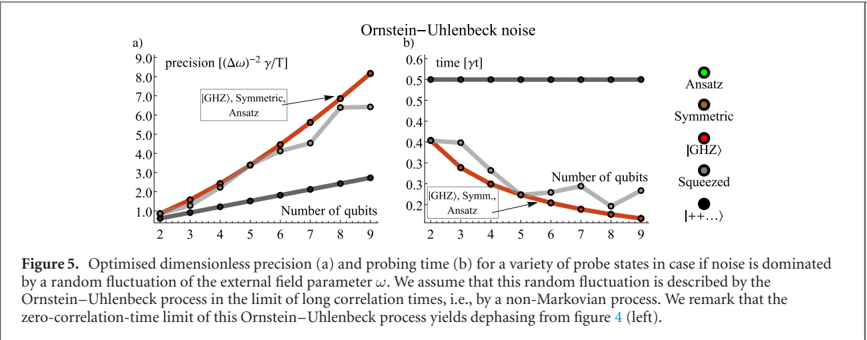
“n increasing system size. Ornstein-Uhlenbeck noise | We nally consider a noise model that is dominated by a random uctuation of the external eld which follows the so-called Ornstein-Uhlenbeck process [66]. This noise process is non-Markovian in general and in the limit of long correlation times an improved scaling can…”
MethodGiovannetti, V., Lloyd, S., & Maccone, L. (2011) · Nature Photonics · doi:10.1038/nphoton.2011.35 · Cited by 3,894 · cited 7×
“where FQ(ρω) is the so-called quantum Fisher information of the state ρω [45, 46, 13, 14, 12].”
BackgroundInfluentialStatistical distance and the geometry of quantum states
Braunstein, S. L., & Caves, C. M. (1994) · Physical Review Letters · doi:10.1103/physrevlett.72.3439 · Cited by 3,176 · cited 1×
“In particular, performing measurements in the eigenbasis of L saturates the quantum Cramér–Rao bound [12, 45].”
MethodQuantum-Enhanced Measurements: Beating the Standard Quantum Limit
Giovannetti, V., Lloyd, S., & Maccone, L. (2004) · Science · doi:10.1126/science.1104149 · Cited by 3,038
Hardware-efficient variational quantum eigensolver for small molecules and quantum magnets
Kandala, A., Mezzacapo, A., Temme, K., Takita, M., Brink, M., Chow, J. M., & Gambetta, J. M. (2017) · Nature · doi:10.1038/nature23879 · Cited by 2,982
The theory of variational hybrid quantum-classical algorithms
McClean, J. R., Romero, J., Babbush, R., & Aspuru-Guzik, A. (2016) · New Journal of Physics · doi:10.1088/1367-2630/18/2/023023 · Cited by 2,227 · cited 2×
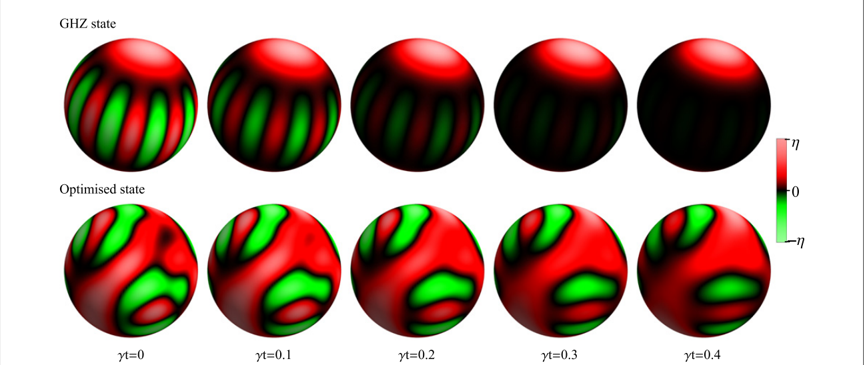
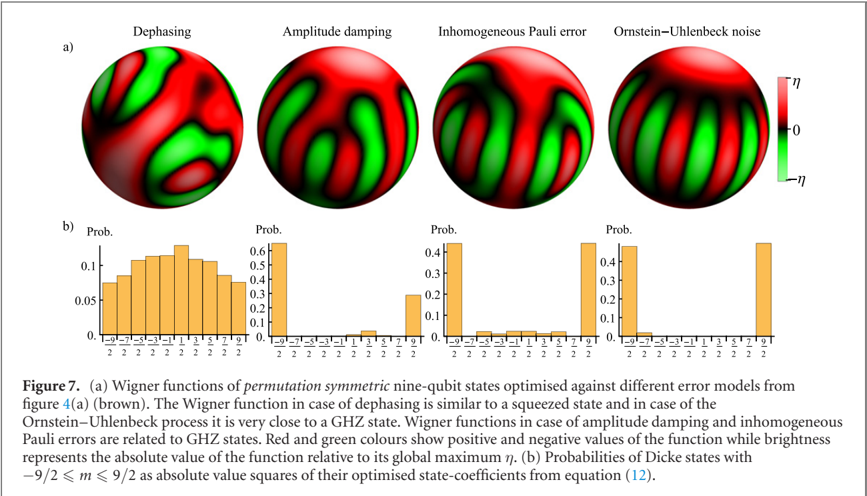
“e and negative values of the function while brightness represents the absolute value of the function relative to its global maximum . usually referred to as the variational quantum eigensolver (VQE) [1, 2, 3, 4]. Quantum machine learning is another area where variational techniques may be valuable. One is then interes…”
BackgroundClarke, J., & Wilhelm, F. K. (2008) · Nature · doi:10.1038/nature07128 · Cited by 2,076 · cited 1×
“demonstrated in [80, 81, 82]. On the other hand, superconducting qubits can contain a SQUID-structure, and so the applied magnetic elds can shift the resonant frequency of the superconducting qubits [83]. There have been several experimental demonstrations of using superconducting qubits as highly sensitive magnetic e…”
BackgroundA Quantum Approximate Optimization Algorithm
Farhi, E., Goldstone, J., & Gutmann, S. (2014) · arXiv · doi:10.48550/arxiv.1411.4028 · Cited by 1,789
Superconducting quantum circuits at the surface code threshold for fault tolerance
Barends, R., Kelly, J., Megrant, A., Veitia, A., Sank, D., Jeffrey, E., White, T. C., Mutus, J., Fowler, A. G., Campbell, B., et al. (2014) · Nature · doi:10.1038/nature13171 · Cited by 1,733
Quantum metrology with nonclassical states of atomic ensembles
Pezzè, L., Smerzi, A., Oberthaler, M. K., Schmied, R., & Treutlein, P. (2018) · Reviews of Modern Physics · doi:10.1103/revmodphys.90.035005 · Cited by 1,682 · cited 5×
“, GHZ, squeezed or symmetric Dicke states [12, 14].”
BackgroundMethodInfluentialMitarai, K., Negoro, M., Kitagawa, M., & Fujii, K. (2018) · Physical Review A · doi:10.1103/physreva.98.032309 · Cited by 1,639 · cited 1×
“then interested in optimising a cost function that quantifies how similar the output of the quantum circuit is to a fixed dataset [7, 8].”
BackgroundScalable Quantum Simulation of Molecular Energies
O’Malley, P. J. J., Babbush, R., Kivlichan, I. D., Romero, J., McClean, J. R., Barends, R., Kelly, J., Roushan, P., Tranter, A., Ding, N., et al. (2016) · Physical Review X · doi:10.1103/physrevx.6.031007 · Cited by 1,059 · cited 1×
“Optimisation of the ansatz parameters For the optimisation of the ansatz parameters, one might employ any suitable one of a range of methods: for example a direct search such as Nelder–Mead (demonstrated experimentally in 2014 [1]), or a systematic scan if the number of parameters is small [59].”
MethodImprovement of Frequency Standards with Quantum Entanglement
Huelga, S. F., Macchiavello, C., Pellizzari, T., Ekert, A. K., Plenio, M. B., & Cirac, J. I. (1997) · Physical Review Letters · doi:10.1103/physrevlett.79.3865 · Cited by 999
General framework for estimating the ultimate precision limit in noisy quantum-enhanced metrology
Escher, B. M., de Matos Filho, R. L., & Davidovich, L. (2011) · Nature Physics · doi:10.1038/nphys1958 · Cited by 928 · cited 5×
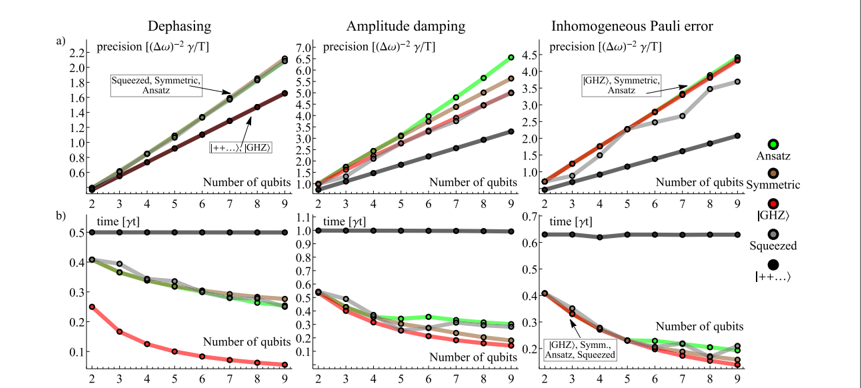
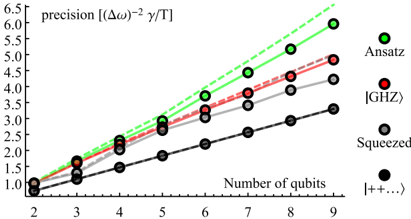
“The dimensionless precision achieved in our simulations with squeezed states (grey) is nearly optimal and results in a comparable performance to general symmetric states (brown) and ansatz states (green) as also expected from [23, 38, 39].”
BackgroundResultInfluentialState preservation by repetitive error detection in a superconducting quantum circuit
Kelly, J., Barends, R., Fowler, A. G., Megrant, A., Jeffrey, E., White, T. C., Sank, D., Mutus, J. Y., Campbell, B., Chen, Y., et al. (2015) · Nature · doi:10.1038/nature14270 · Cited by 916
Quantum metrology from a quantum information science perspective
Tóth, G., & Apellaniz, I. (2014) · Journal of Physics A Mathematical and Theoretical · doi:10.1088/1751-8113/47/42/424006 · Cited by 862 · cited 8×
“where FQ(ρω) is the so-called quantum Fisher information of the state ρω [45, 46, 13, 14, 12].”
BackgroundInfluentialMa, J., Wang, X., Sun, C. P., & Nori, F. (2011) · Physics Reports · doi:10.1016/j.physrep.2011.08.003 · Cited by 846 · cited 2×
“e remark that GHZ states can be prepared using shallow circuits consisting of a ladder of N 1 CNOT gates applied to the state j+i j0i(N 1). One axis twisted squeezed states (Fig. 4 grey) are obtained [52] by the interaction under the permutation symmetric Hamiltonian J2 z = P N k;l=1 ˙ (k) z ˙ (l) z and we dene squeez…”
BackgroundMethodQuantum Fisher information matrix and multiparameter estimation
Liu, J., Yuan, H., Lu, X.-M., & Wang, X. (2020) · Journal of Physics A: Mathematical and Theoretical · doi:10.1088/1751-8121/ab5d4d · Cited by 802 · cited 3×
“Its calculation is more involved in case if the evolution is not unitary [47, 48].”
BackgroundMethodHigh-Fidelity Quantum Logic Gates Using Trapped-Ion Hyperfine Qubits
Ballance, C. J., Harty, T. P., Linke, N. M., Sepiol, M. A., & Lucas, D. M. (2016) · Physical Review Letters · doi:10.1103/physrevlett.117.060504 · Cited by 777 · cited 1×
“We note that this is comparable to currently existing technology [89].”
ResultThe elusive Heisenberg limit in quantum-enhanced metrology
Demkowicz-Dobrzański, R., Kołodyński, J., & Guţă, M. (2012) · Nature Communications · doi:10.1038/ncomms2067 · Cited by 773 · cited 2×
“Note that all curves have a linear, classical scaling in the number of qubits which conforms with the linear asymptotic bound [24, 25, 39, 67] on the quantum Fisher information obtained for this noise channel.”
BackgroundQuantum optimization using variational algorithms on near-term quantum devices
Moll, N., Barkoutsos, P., Bishop, L. S., Chow, J. M., Cross, A., Egger, D. J., Filipp, S., Fuhrer, A., Gambetta, J. M., Ganzhorn, M., et al. (2018) · Quantum Science and Technology · doi:10.1088/2058-9565/aab822 · Cited by 744 · cited 2×
“e and negative values of the function while brightness represents the absolute value of the function relative to its global maximum . usually referred to as the variational quantum eigensolver (VQE) [1, 2, 3, 4]. Quantum machine learning is another area where variational techniques may be valuable. One is then interes…”
BackgroundOptical magnetic imaging of living cells
Le Sage, D., Arai, K., Glenn, D. R., DeVience, S. J., Pham, L. M., Rahn-Lee, L., Lukin, M. D., Yacoby, A., Komeili, A., & Walsworth, R. L. (2013) · Nature · doi:10.1038/nature12072 · Cited by 730 · cited 1×
“For example, sensing magnetic fields with high precision is crucial in many applications, such as determining chemical structure [15] or imaging living cells [16].”
BackgroundEfficient Variational Quantum Simulator Incorporating Active Error Minimization
Li, Y., & Benjamin, S. C. (2017) · Physical Review X · doi:10.1103/physrevx.7.021050 · Cited by 686
Self-citationQuantum Metrology in Non-Markovian Environments
Chin, A. W., Huelga, S. F., & Plenio, M. B. (2012) · Physical Review Letters · doi:10.1103/physrevlett.109.233601 · Cited by 645 · cited 3×
“GHZ states are therefore optimal and have an improved scaling [26, 27].”
BackgroundRealization of three-qubit quantum error correction with superconducting circuits
Reed, M. D., DiCarlo, L., Nigg, S. E., Sun, L., Frunzio, L., Girvin, S. M., & Schoelkopf, R. J. (2012) · Nature · doi:10.1038/nature10786 · Cited by 585
Global entanglement in multiparticle systems
Meyer, D. A., & Wallach, N. R. (2002) · Journal of Mathematical Physics · doi:10.1063/1.1497700 · Cited by 520
Minimum mean-squared error of estimates in quantum statistics
Helstrom, C. W. (1967) · Physics Letters A · doi:10.1016/0375-9601(67)90366-0 · Cited by 441
Subpicotesla Diamond Magnetometry
Wolf, T., Neumann, P., Nakamura, K., Sumiya, H., Ohshima, T., Isoya, J., & Wrachtrup, J. (2015) · Physical Review X · doi:10.1103/physrevx.5.041001 · Cited by 378
Agarwal, G. S. (1981) · Physical Review A · doi:10.1103/physreva.24.2889 · Cited by 311
Improved Quantum Metrology Using Quantum Error Correction
Dür, W., Skotiniotis, M., Fröwis, F., & Kraus, B. (2014) · Physical Review Letters · doi:10.1103/physrevlett.112.080801 · Cited by 308 · cited 2×
“It is known from prior studies that quantum states subject to noise do not offer an improved fundamental scaling [24, 25, 12, 26, 27] unless they are actively corrected during the environmental interaction [28, 29, 30, 31, 32, 33, 34, 35, 36].”
BackgroundWolf, M. M., & Cirac, J. I. (2008) · Communications in Mathematical Physics · doi:10.1007/s00220-008-0411-y · Cited by 288
Optimal States and Almost Optimal Adaptive Measurements for Quantum Interferometry
Berry, D. W., & Wiseman, H. M. (2000) · Physical Review Letters · doi:10.1103/physrevlett.85.5098 · Cited by 288 · cited 1×
“We remark that GHZ states can be prepared using linear depth circuits consisting of a cascade of N − 1 CNOT gates applied to the state |+〉 ⊗ |0〉⊗(N−1), refer also to [52, 53] for the preparation of a more general class of states that includes the GHZ state as a special case.”
Quantum Error Correction for Metrology
Kessler, E. M., Lovchinsky, I., Sushkov, A. O., & Lukin, M. D. (2014) · Physical Review Letters · doi:10.1103/physrevlett.112.150802 · Cited by 279
QuEST and High Performance Simulation of Quantum Computers
Jones, T., Brown, A., Bush, I., & Benjamin, S. C. (2019) · Scientific Reports · doi:10.1038/s41598-019-47174-9 · Cited by 253 · cited 2×
“We numerically (exactly) simulate the device introduced in the previous section using the software package QuEST which can efficiently simulate quantum circuits including noise processes [51].”
MethodSelf-citationCharacterizing the entanglement of symmetric many-particle spin-12systems
Stockton, J. K., Geremia, J. M., Doherty, A. C., & Mabuchi, H. (2003) · Physical Review A · doi:10.1103/physreva.67.022112 · Cited by 225 · cited 1×
“n the number of qubits. This subspace is spanned by so-called symmetric Dicke states jJ= N=2;mi, where Nis the number of qubits and J is the total angular momentum and its z projection is m, refer to [53, 54, 55, 56]. Every symmetric state is then a linear combination of Dicke states with complex coecients c m jsymmi:…”
MethodBrif, C., & Mann, A. (1999) · Physical Review A · doi:10.1103/physreva.59.971 · Cited by 222
Stochastic gradient descent for hybrid quantum-classical optimization
Sweke, R., Wilde, F., Meyer, J., Schuld, M., Faehrmann, P. K., Meynard-Piganeau, B., & Eisert, J. (2020) · Quantum · doi:10.22331/q-2020-08-31-314 · Cited by 219
Approximate quantum error correction can lead to better codes
Leung, D. W., Nielsen, M. A., Chuang, I. L., & Yamamoto, Y. (1997) · Physical Review A · doi:10.1103/physreva.56.2567 · Cited by 214
Magnetic field sensing beyond the standard quantum limit under the effect of decoherence
Matsuzaki, Y., Benjamin, S. C., & Fitzsimons, J. (2011) · Physical Review A · doi:10.1103/physreva.84.012103 · Cited by 208 · cited 4×
“This noise process is non-Markovian in general and in the limit of long correlation times an improved scaling can be reached when using GHZ states as already established by some of us in [26].”
BackgroundInfluentialSelf-citationIncreasing Sensing Resolution with Error Correction
Arrad, G., Vinkler, Y., Aharonov, D., & Retzker, A. (2014) · Physical Review Letters · doi:10.1103/physrevlett.112.150801 · Cited by 202 · cited 2×
“It is known from prior studies that quantum states subject to noise do not offer an improved fundamental scaling [24, 25, 12, 26, 27] unless they are actively corrected during the environmental interaction [28, 29, 30, 31, 32, 33, 34, 35, 36].”
BackgroundQuantum gradient descent and Newton’s method for constrained polynomial optimization
Rebentrost, P., Schuld, M., Wossnig, L., Petruccione, F., & Lloyd, S. (2019) · New Journal of Physics · doi:10.1088/1367-2630/ab2a9e · Cited by 196 · cited 1×
“[58]) was recently proven to converge when assuming only a finite number of measurements for determining the gradient vector [59, 60].”
BackgroundParity operator and quantization of δ-functions
Grossmann, A. (1976) · Communications in Mathematical Physics · doi:10.1007/bf01617867 · Cited by 194
Force-detected nuclear magnetic resonance: recent advances and future challenges
Poggio, M., & Degen, C. L. (2010) · Nanotechnology · doi:10.1088/0957-4484/21/34/342001 · Cited by 182 · cited 1×
“Various different types of high-performance magnetic field sensors have been developed, including hall-effect sensors [17], superconducting quantum interference devices (SQUID) [18] and force sensors [19].”
BackgroundGradiometric micro-SQUID susceptometer for scanning measurements of mesoscopic samples
Huber, M. E., Koshnick, N. C., Bluhm, H., Archuleta, L. J., Azua, T., Björnsson, P. G., Gardner, B. W., Halloran, S. T., Lucero, E. A., & Moler, K. A. (2008) · Review of Scientific Instruments · doi:10.1063/1.2932341 · Cited by 171 · cited 1×
“Various different types of high-performance magnetic field sensors have been developed, including hall-effect sensors [17], superconducting quantum interference devices (SQUID) [18] and force sensors [19].”
BackgroundEfficient tools for quantum metrology with uncorrelated noise
Kołodyński, J., & Demkowicz-Dobrzański, R. (2013) · New Journal of Physics · doi:10.1088/1367-2630/15/7/073043 · Cited by 169 · cited 2×
“Note that all curves have a linear, classical scaling in the number of qubits which conforms with the linear asymptotic bound [24, 25, 39, 67] on the quantum Fisher information obtained for this noise channel.”
BackgroundHavel, T. F. (2003) · Journal of Mathematical Physics · doi:10.1063/1.1518555 · Cited by 167
Wigner Functions for Arbitrary Quantum Systems
Tilma, T., Everitt, M. J., Samson, J. H., Munro, W. J., & Nemoto, K. (2016) · Physical Review Letters · doi:10.1103/physrevlett.117.180401 · Cited by 165
A fibre bundle over manifolds of quantum channels and its application to quantum statistics
Fujiwara, A., & Imai, H. (2008) · Journal of Physics A: Mathematical and Theoretical · doi:10.1088/1751-8113/41/25/255304 · Cited by 163 · cited 2×
“with the asymptotic bounds on the quantum Fisher information obtained for usual Markovian channels [38, 39, 64, 24, 25].”
BackgroundIshikawa, T., Fu, K. C., Santori, C., Acosta, V. M., Beausoleil, R. G., Watanabe, H., Shikata, S., & Itoh, K. M. (2012) · Nano Letters · doi:10.1021/nl300350r · Cited by 160 · cited 1×
“This information can then be extracted via a Ramsey-type measurement [20, 21, 22] that uses repeated projective measurements.”
MethodAn Adaptive Optimizer for Measurement-Frugal Variational Algorithms
Kübler, J. M., Arrasmith, A., Cincio, L., & Coles, P. J. (2020) · Quantum · doi:10.22331/q-2020-05-11-263 · Cited by 141 · cited 1×
“[58]) was recently proven to converge when assuming only a finite number of measurements for determining the gradient vector [59, 60].”
BackgroundAn observable measure of entanglement for pure states of multi-qubit systems
Brennen, G. (2003) · Quantum Information and Computation · doi:10.26421/qic3.6-5 · Cited by 137
Spin squeezing and decoherence limit in Ramsey spectroscopy
Ulam-Orgikh, D., & Kitagawa, M. (2001) · Physical Review A · doi:10.1103/physreva.64.052106 · Cited by 130
Quantum gradient descent and Newton’s method for constrained polynomial optimization
Rebentrost, F. P., & Lloyd, S. (2019) · DSpace@MIT (Massachusetts Institute of Technology) · Cited by 130
Qubit metrology and decoherence
Shaji, A., & Caves, C. M. (2007) · Physical Review A · doi:10.1103/physreva.76.032111 · Cited by 127 · cited 2×
“Nevertheless, optimisations of particular probe states show that a significant improvement as a constant absolute factor [12, 23, 37] can be gained, even without active error correction.”
BackgroundQuantum Fisher Information for Density Matrices with Arbitrary Ranks
Liu, J., Jing, X.-X., Zhong, W., & Wang, X.-G. (2014) · Communications in Theoretical Physics · doi:10.1088/0253-6102/61/1/08 · Cited by 126 · cited 2×
“he quantum Fisher information of ˆ(!t;) avoids simulating the analysis step, however, it is completely equivalent to that. We remark that explicit expressions are readily available in the literature [47, 48] for computing the quantum Fisher information from the eigendecomposition of the density matrix. However, these…”
BackgroundEntanglement evolution in a non-Markovian environment
Yu, T., & Eberly, J. H. (2009) · Optics Communications · doi:10.1016/j.optcom.2009.10.042 · Cited by 122 · cited 5×
“In this case the decay rate is characterised by f(t) ≈ bt/2 the bandwidth of the classical process [70].”
BackgroundMethodInfluentialUltrasensitive magnetic field detection using a single artificial atom
Bal, M., Deng, C., Orgiazzi, J.-L., Ong, F. R., & Lupaşcu, A. (2012) · Nature Communications · doi:10.1038/ncomms2332 · Cited by 103 · cited 2×
“There have been several experimental demonstrations of using superconducting qubits as highly sensitive magnetic field sensors [20, 84].”
BackgroundMethodFlexible resources for quantum metrology
Friis, N., Orsucci, D., Skotiniotis, M., Sekatski, P., Dunjko, V., Briegel, H. J., & Dür, W. (2017) · New Journal of Physics · doi:10.1088/1367-2630/aa7144 · Cited by 91 · cited 1×
“We remark that GHZ states can be prepared using linear depth circuits consisting of a cascade of N − 1 CNOT gates applied to the state |+〉 ⊗ |0〉⊗(N−1), refer also to [52, 53] for the preparation of a more general class of states that includes the GHZ state as a special case.”
BackgroundRandom Bosonic States for Robust Quantum Metrology
Oszmaniec, M., Augusiak, R., Gogolin, C., Kołodyński, J., Acín, A., & Lewenstein, M. (2016) · Physical Review X · doi:10.1103/physrevx.6.041044 · Cited by 86 · cited 3×
“nsing an external eld under environmental noise (as in Eq. 8) is symmetric under permutations and, to our best knowledge, states reported so far in the context of quantum metrology are also symmetric [23, 38, 39, 40, 41, 42, 43] e.g., GHZ, squeezed or symmetric Dicke states [14, 12]. Variational-State Quantum Metrolog…”
BackgroundResultInfluentialHeisenberg limited metrology using Quantum Error-Correction CodesPreprint
Ozeri, R. (2013) · arXiv (Cornell University) · doi:10.48550/arxiv.1310.3432 · Cited by 64
Loshchilov, I., Schoenauer, M., & Sébag, M. (2011) · Genetic and Evolutionary Computation Conference (GECCO) · doi:10.1145/2001576.2001697 · Cited by 62 · cited 1×
“lobal optimum without making any prior assumptions on the optimal states. This allows us to also explore, e.g., non-symmetric states. We used a randomised adaptive coordinate descent search algorithm [62] to nd the global optimum and made our code openly accessible [63]. Although we cannot guarantee global optimality…”
MethodInfluentialContinuous phase-space representations for finite-dimensional quantum states and their tomography
Koczor, B., Zeier, R., & Glaser, S. J. (2020) · Physical Review A · doi:10.1103/physreva.101.022318 · Cited by 57
Self-citationMeasurement Cost of Metric-Aware Variational Quantum Algorithms
van Straaten, B., & Koczor, B. (2021) · PRX Quantum · doi:10.1103/prxquantum.2.030324 · Cited by 55
Self-citationMaximally Entangled Multipartite States: A Brief Survey
Enríquez, M., Wintrowicz, I., & Życzkowski, K. (2016) · Journal of Physics: Conference Series · doi:10.1088/1742-6596/698/1/012003 · Cited by 54 · cited 1×
“This quantity is related to the Mayer-Wallach measure and quantifies the average entanglement between a single qubit and the rest of the system, refer to [68, 69, 70].”
BackgroundQuantum natural gradient generalised to noisy and non-unitary circuits
Koczor, B., & Benjamin, S. C. (2019) · arXiv · doi:10.48550/arxiv.1912.08660 · Cited by 54
Self-citationRobust quantum compilation and circuit optimisation via energy minimisation
Jones, T., & Benjamin, S. C. (2018) · arXiv · doi:10.48550/arxiv.1811.03147 · Cited by 54
Self-citationA search algorithm for quantum state engineering and metrology
Knott, P. A. (2016) · New Journal of Physics · doi:10.1088/1367-2630/18/7/073033 · Cited by 53 · cited 1×
“[85] employs a classical optimisation method to obtain metrologically useful states in case of quantum optics.”
MethodQVECTOR: an algorithm for device-tailored quantum error correction
Johnson, P. D., Romero, J., Olson, J., Cao, Y., & Aspuru-Guzik, A. (2017) · arXiv · doi:10.48550/arxiv.1711.02249 · Cited by 50
Sensing in the presence of an observed environment
Plenio, M. B., & Huelga, S. F. (2016) · Physical Review A · doi:10.1103/physreva.93.032123 · Cited by 49
Matrix Product States for Quantum Metrology
Jarzyna, M., & Demkowicz-Dobrzański, R. (2013) · Physical Review Letters · doi:10.1103/physrevlett.110.240405 · Cited by 43
Optimal quantum states for frequency estimation
Fröwis, F., Skotiniotis, M., Kraus, B., & Dür, W. (2014) · New Journal of Physics · doi:10.1088/1367-2630/16/8/083010 · Cited by 42 · cited 3×
“First, in contrast to previous approaches which assumed and were limited to specific noise models to maximise the metrological performance [38, 39, 40, 41, 42, 43], our algorithm is independent of the choice of particular noise models.”
BackgroundResultQuantum Error-Correction-Enhanced Magnetometer Overcoming the Limit Imposed by Relaxation
Herrera-Martí, D. A., Gefen, T., Aharonov, D., Katz, N., & Retzker, A. (2015) · Physical Review Letters · doi:10.1103/physrevlett.115.200501 · Cited by 41
Variational Quantum Gate Optimization
Heya, K., Suzuki, Y., Nakamura, Y., & Fujii, K. (2018) · arXiv · doi:10.48550/arxiv.1810.12745 · Cited by 41 · cited 1×
“optimising a metric on related quantum states [9, 10].”
BackgroundElectron paramagnetic resonance spectroscopy using a single artificial atom
Toida, H., Matsuzaki, Y., Kakuyanagi, K., Zhu, X., Munro, W. J., Yamaguchi, H., & Saito, S. (2019) · Communications Physics · doi:10.1038/s42005-019-0133-9 · Cited by 35 · cited 1×
“There have been several experimental demonstrations of using superconducting qubits as highly sensitive magnetic field sensors [20, 87].”
BackgroundSelf-citationQuantum natural gradient generalised to non-unitary circuitsPreprint
Koczor, B., & Benjamin, S. C. (2019) · arXiv (Cornell University) · Cited by 35
Self-citationChannel-Optimized Quantum Error Correction
Taghavi, S., Kosut, R. L., & Lidar, D. A. (2010) · IEEE Transactions on Information Theory · doi:10.1109/tit.2009.2039162 · Cited by 30 · cited 3×
“It is known from prior studies that quantum states subject to noise do not offer an improved fundamental scaling [24, 25, 12, 26, 27] unless they are actively corrected during the environmental interaction [28, 29, 30, 31, 32, 33, 34, 35, 36].”
BackgroundQuantum compilation and circuit optimisation via energy dissipationPreprint
Jones, T., & Benjamin, S. C. (2018) · arXiv (Cornell University) · Cited by 30
Self-citationTime evolution of coupled spin systems in a generalized Wigner representation
Koczor, B., Zeier, R., & Glaser, S. J. (2018) · Annals of Physics · doi:10.1016/j.aop.2018.11.020 · Cited by 23 · cited 1×
“of a rotated parity operator Π0 where phase space is spanned by the rotation angles Ω := (θ, φ) on the sphere and R(Ω) is the rotation operator R(Ω) := eiφJzeiθJy , refer to [71, 72, 73, 74, 75, 76] and to works [77, 78, 79] on rotated parity operators.”
BackgroundSelf-citationInfinitely Divisible Markov Mappings in Quantum Probability Theory
Denisov, L. V. (1989) · Theory of Probability and Its Applications · doi:10.1137/1133064 · Cited by 20
Koczor, B., Zeier, R., & Glaser, S. J. (2018) · Journal of Physics A Mathematical and Theoretical · doi:10.1088/1751-8121/aaf302 · Cited by 18 · cited 1×
“of a rotated parity operator Π0 where phase space is spanned by the rotation angles Ω := (θ, φ) on the sphere and R(Ω) is the rotation operator R(Ω) := eiφJzeiθJy , refer to [71, 72, 73, 74, 75, 76] and to works [77, 78, 79] on rotated parity operators.”
BackgroundSelf-citationKoczor, B. (2019) · Cited by 5
Self-citationSupervised Learning Enhanced by an Entangled Sensor Network.
Zhuang, Q., & Zhang, Z. (2019) · Cited by 4
An observable measure of entanglement for pure states of multi-qubit systemsPreprint
Brennen, G. K. (2003) · arXiv (Cornell University) · doi:10.48550/arxiv.quant-ph/0305094 · Cited by 2
Physical-Layer Supervised Learning Assisted by an Entangled Sensor NetworkPreprint
Zhuang, Q., & Zhang, Z. (2019) · Figshare · doi:10.48550/arxiv.1901.09566 · Cited by 1 · cited 1×
“then interested in optimising a cost function that quantifies how similar the output of the quantum circuit is to a fixed dataset [7, 8].”
BackgroundMeasurement cost of metric-aware variational quantum algorithms
van Straaten, B., & Koczor, B. (2020) · arXiv · doi:10.48550/arxiv.2005.05172
Self-citationStochastic gradient descent for hybrid quantum-classical optimization
Sweke, R., Wilde, F., Meyer, J., Schuld, M., Faehrmann, P. K., Meynard-Piganeau, B., & Eisert, J. (2019) · arXiv · doi:10.48550/arxiv.1910.01155 · cited 1×
“[58]) was recently proven to converge when assuming only a finite number of measurements for determining the gradient vector [59, 60].”
BackgroundRobust quantum metrology with explicit symmetric states
Ouyang, Y., Shettell, N., & Markham, D. (2019) · arXiv · doi:10.48550/arxiv.1908.02378
An Adaptive Optimizer for Measurement-Frugal Variational Algorithms
Kübler, J. M., Arrasmith, A., Cincio, L., & Coles, P. J. (2019) · arXiv · doi:10.48550/arxiv.1909.09083 · cited 1×
“[58]) was recently proven to converge when assuming only a finite number of measurements for determining the gradient vector [59, 60].”
BackgroundPhase Spaces, Parity Operators, and the Born-Jordan Distribution
Koczor, B., Ende, F. V., de Gosson, M., Glaser, S. J., & Zeier, R. (2018) · arXiv · doi:10.48550/arxiv.1811.05872
Self-citation
Research works printed but not linked: 5
- Levitt M H 2001 Spin Dynamics: Basics of Nuclear Magnetic Resonance (Chichester: Wiley)
- Ramsden E 2011 Hall-effect Sensors: Theory and Application (Amsterdam: Elsevier)
- Nielsen M A and Chuang I L 2011 Quantum Computation and Quantum Information: 10th Anniversary Edition 10th edn (Cambridge: Cambridge University Press)
- Ouyang Y, Nathan S and Markham D 2019 Robust quantum metrology with explicit symmetric states arXiv:1908.02378 · arXiv
- Sakurai J J 1994 Modern Quantum Mechanics (Reading: Addison-Wesley)
Cited by
Variational quantum algorithms
Cerezo, M., Arrasmith, A., Babbush, R., Benjamin, S. C., Endo, S., Fujii, K., McClean, J. R., Mitarai, K., Yuan, X., Cincio, L., et al. (2021) · Nature Reviews Physics · doi:10.1038/s42254-021-00348-9 · Cited by 3,385
Self-citationNoisy intermediate-scale quantum algorithms
Bharti, K., Cervera-Lierta, A., Kyaw, T. H., Haug, T., Alperin-Lea, S., Anand, A., Degroote, M., Heimonen, H., Kottmann, J. S., Menke, T., et al. (2022) · Reviews of Modern Physics · doi:10.1103/revmodphys.94.015004 · Cited by 2,231
Cost function dependent barren plateaus in shallow parametrized quantum circuits
Cerezo, M., Sone, A., Volkoff, T., Cincio, L., & Coles, P. J. (2021) · Nature Communications · doi:10.1038/s41467-021-21728-w · Cited by 1,047
Noise-Induced Barren Plateaus in Variational Quantum Algorithms
Wang, S., Fontana, E., Cerezo, M., Sharma, K., Sone, A., Cincio, L., & Coles, P. J. (2020) · arXiv · doi:10.48550/arxiv.2007.14384 · Cited by 791
Noise-induced barren plateaus in variational quantum algorithms
Wang, S., Fontana, E., Cerezo, M., Sharma, K., Sone, A., Cincio, L., & Coles, P. J. (2021) · Nature Communications · doi:10.1038/s41467-021-27045-6 · Cited by 773
“By keeping the quantum circuit depth relatively short, VQAs mitigate hardware noise and may enable near-term applications including electronic structure [5–8], dynamics [9– 12], optimization [13–16], linear systems [17, 18], metrology [19, 20], factoring [21], compiling [22–24], and others [25–30].”
Background
Metadata
- Authors
- Koczor, B., Endo, S., Jones, T., Matsuzaki, Y., & Benjamin, S. C.
- Affiliations
- University of Oxford (GB)
- National Institute of Advanced Industrial Science and Technology (JP)
- Venue
- New Journal of Physics
- Publisher
- IOP Publishing
- Published
- 2020-08-01
- Volume
- 22
- Issue
- 8
- Pages
- 083038
- ISSN
- 1367-2630 (ISSN-L)
- OpenAlex
- W2969241977
- Cited by
- 101
- References
- 84
- Citations by year
- 2026: 7 · 2025: 17 · 2024: 24 · 2023: 18 · 2022: 12 · 2021: 21 · 2020: 2
- FWCI
- 5.20
- Type
- journal article
- Language
- en
- Open access
- gold
- doi.org
- Licence
- cc-by
- creativecommons.org/licenses/by/4.0/ (vor, 13 d)
- iopscience.iop.org/info/page/text-and-data-mining (tdm, 13 d)
- Locations
- New Journal of Physics (publishedVersion, cc-by)
- arXiv (Cornell University) (submittedVersion)
- DOAJ (DOAJ: Directory of Open Access Journals) (submittedVersion)
- arXiv (Cornell University)
- Funders
- Ministry of Education, Culture, Sports, Science and Technology (15H05870)
- Japan Student Services Organization
- Horizon 2020 Framework Programme (EU‐H2020, 820495)
- Intelligence Advanced Research Projects Activity
- Engineering and Physical Sciences Research Council (820495, EU H2020, M013243/1, EP/T001062/1, EP/M013243/1, T001062)
- Japan Society for the Promotion of Science (15H05870)
- Clarendon Fund
- Army Research Office (820495)
- Topics
- Physical Sciences › Physics and Astronomy › Atomic and Molecular Physics, and Optics › Quantum Information and Cryptography
- Physical Sciences › Computer Science › Artificial Intelligence › Quantum Computing Algorithms and Architecture
- Physical Sciences › Physics and Astronomy › Atomic and Molecular Physics, and Optics › Quantum Mechanics and Applications
- Keywords
- quantum metrology, variational quantum states, entangled states, quantum advantage, passive state, qubit systems, quantum state optimization
About these checks
Registry, retraction, Cites and statistics results are computed, not judged, with one exception: a printed reference that no index lists is read once by a model before it counts as a citation error. Claims are extracted by a model and kept only when their quote appears verbatim in the text; each cited source is then checked, with a model’s help, for whether it says what the claim relies on. Those verdicts can be wrong — read the claim’s quote and the cited source before relying on one.
Statistics and arithmetic are recomputed, not judged.
Confidence bands are shown only for fields calibrated on our annotated test set. None is calibrated yet, so no band is shown.
What counts as a claim ›How we measure confidence ›How we check this ›
Are you an author, or do you see a problem with this page? Request a review
Data sources
Bibliographic data: Semantic Scholar, OpenAlex, Crossref.
Contains information from the Semantic Scholar Academic Graph Datasets, made available under the ODC Attribution License (ODC-BY 1.0).
Semantic Scholar’s data is described in: Kinney, R., et al. (2023). The Semantic Scholar Open Data Platform. arXiv:2301.10140.
