

The DOI matches its Crossref record; 38 of the 38 references it cites were found in a registry or an index.
BRAND: a platform for closed-loop experiments with deep network models
Open accessPublished version of a preprint
Abstract
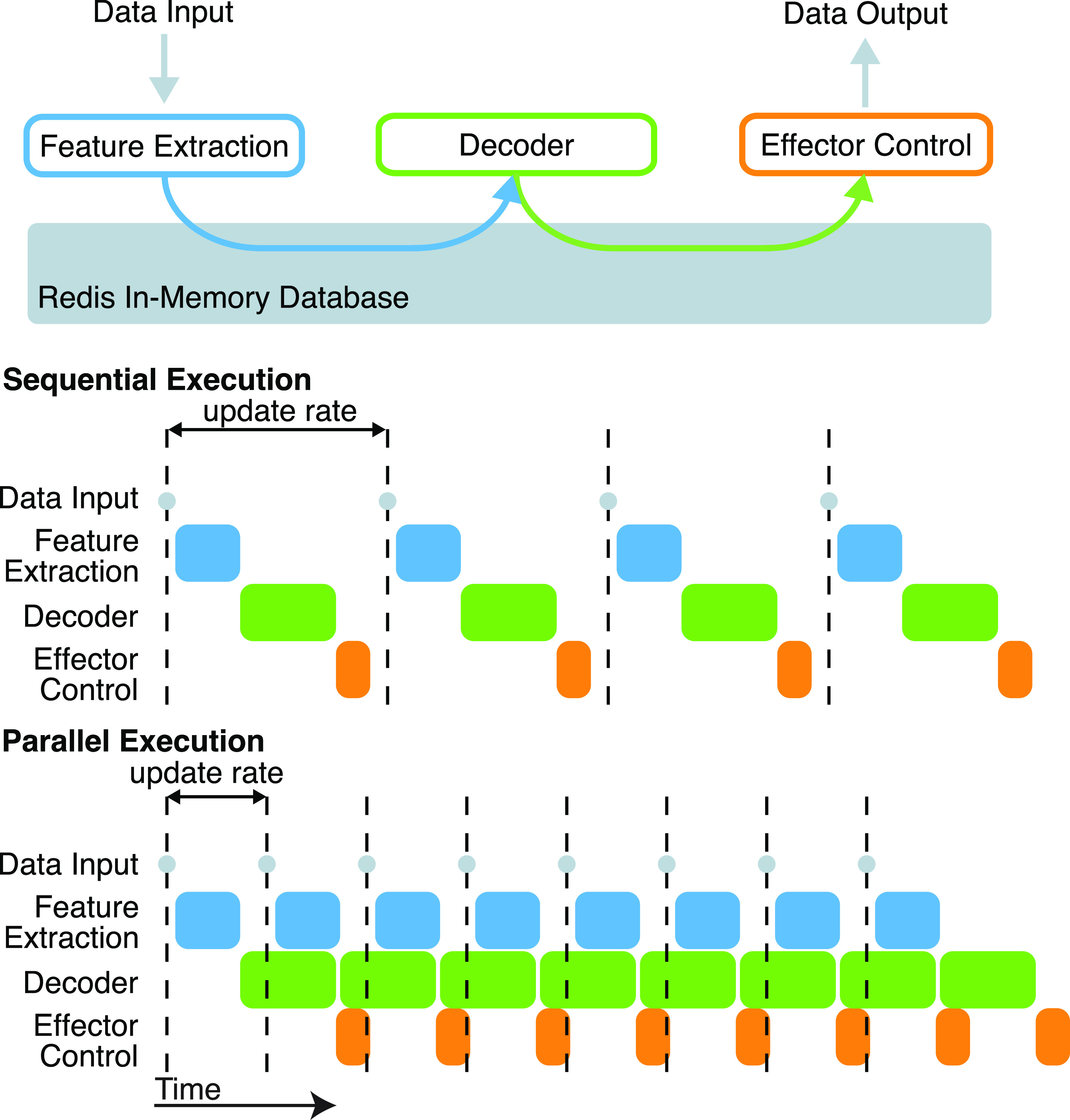
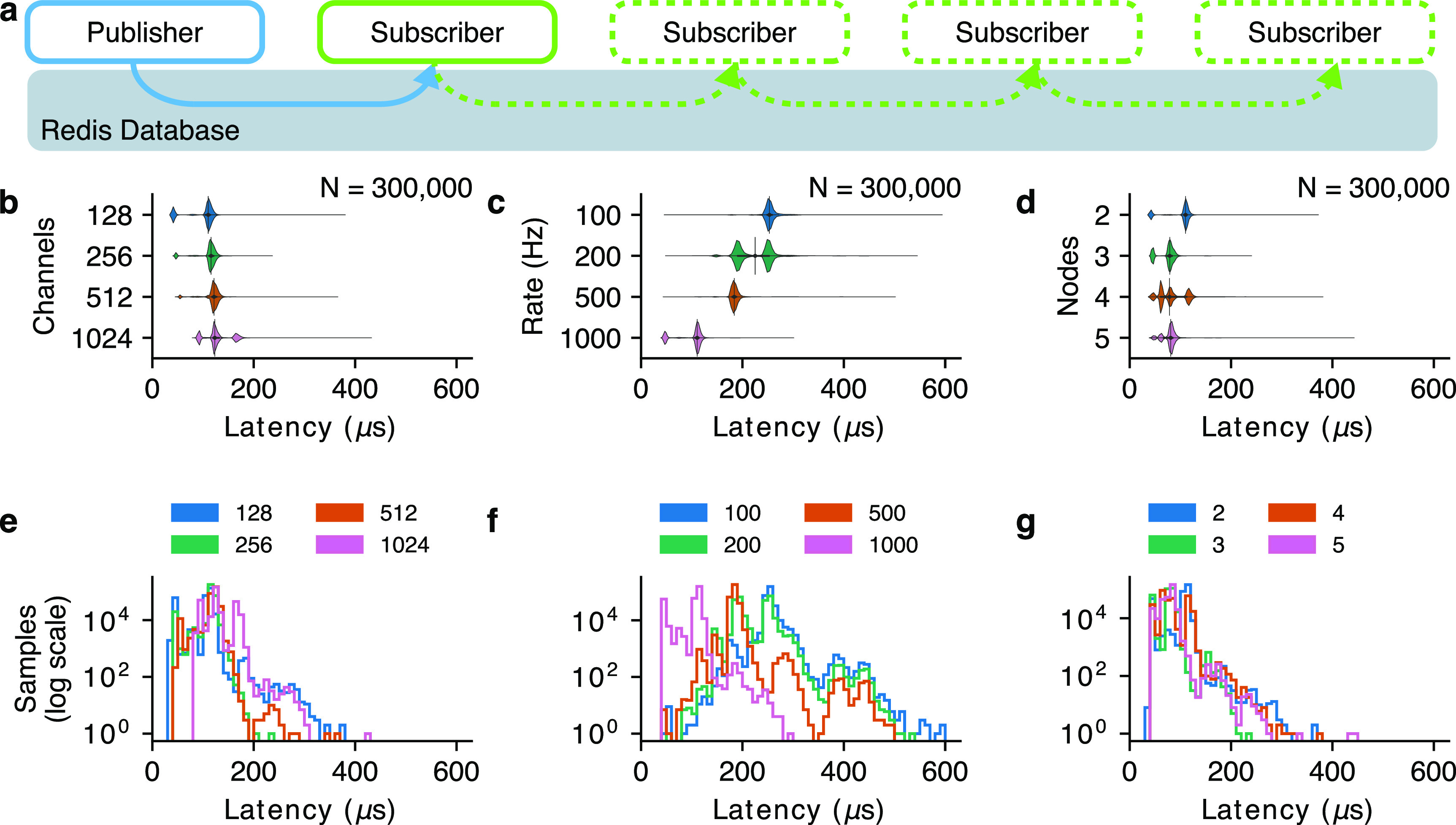
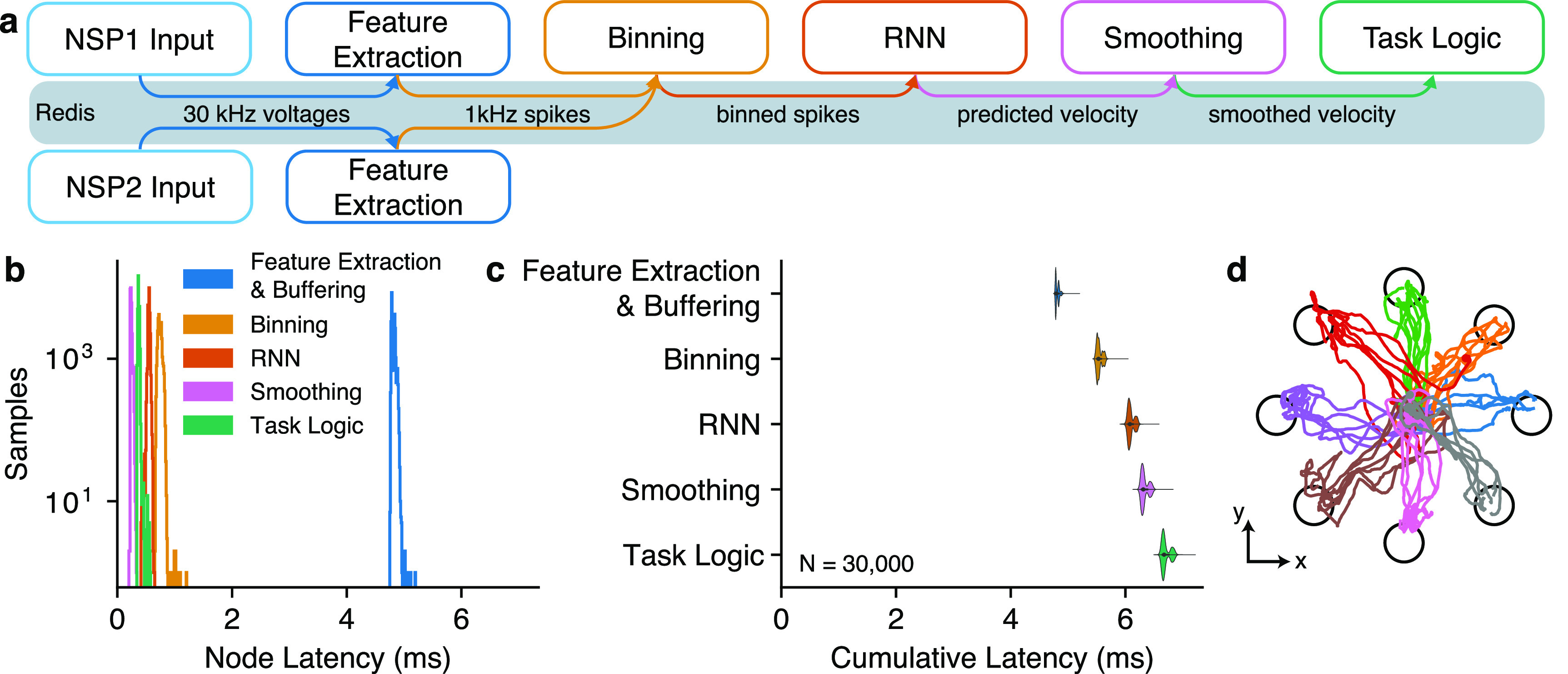
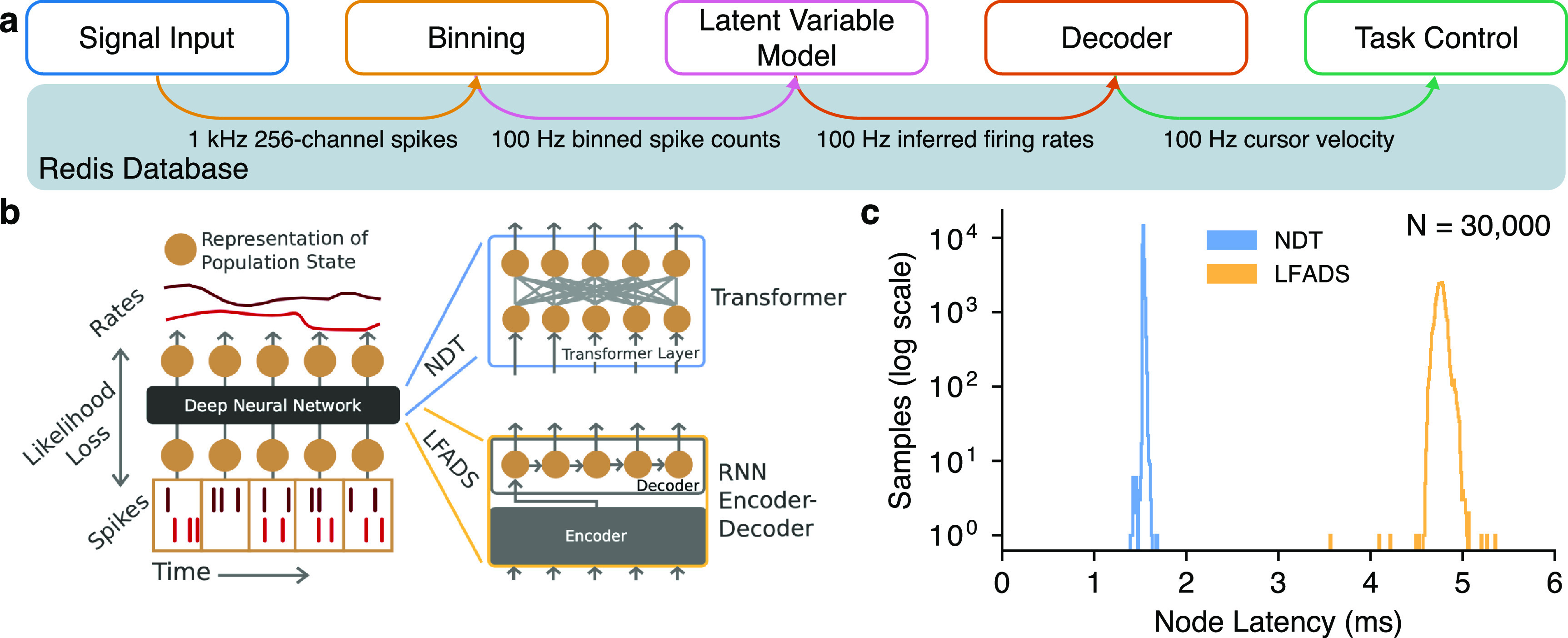
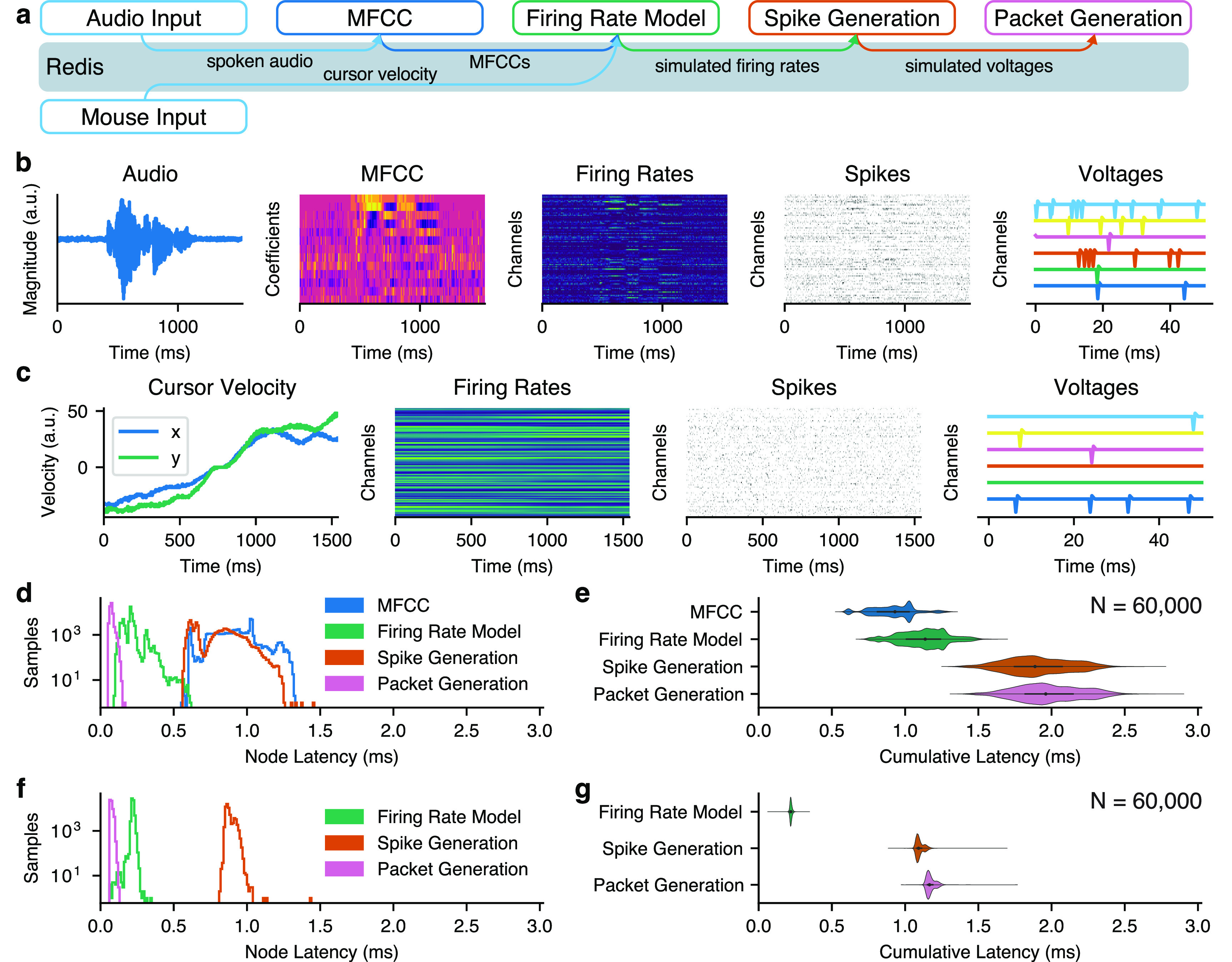
Objective. Artificial neural networks (ANNs) are state-of-the-art tools for modeling and decoding neural activity, but deploying them in closed-loop experiments with tight timing constraints is challenging due to their limited support in existing real-time frameworks. Researchers need a platform that fully supports high-level languages for running ANNs (e.g. Python and Julia) while maintaining support for languages that are critical for low-latency data acquisition and processing (e.g. C and C++). Approach. To address these needs, we introduce the Backend for Realtime Asynchronous Neural Decoding (BRAND). BRAND comprises Linux processes, termed nodes , which communicate with each other in a graph via streams of data. Its asynchronous design allows for acquisition, control, and analysis to be executed in parallel on streams of data that may operate at different timescales. BRAND uses Redis, an in-memory database, to send data between nodes, which enables fast inter-process communication and supports 54 different programming languages. Thus, developers can easily deploy existing ANN models in BRAND with minimal implementation changes. Main results. In our tests, BRAND achieved <600 microsecond latency between processes when sending large quantities of data (1024 channels of 30 kHz neural data in 1 ms chunks). BRAND runs a brain-computer interface with a recurrent neural network (RNN) decoder with less than 8 ms of latency from neural data input to decoder prediction. In a real-world demonstration of the system, participant T11 in the BrainGate2 clinical trial (ClinicalTrials.gov Identifier: NCT00912041) performed a standard cursor control task, in which 30 kHz signal processing, RNN decoding, task control, and graphics were all executed in BRAND. This system also supports real-time inference with complex latent variable models like Latent Factor Analysis via Dynamical Systems. Significance. By providing a framework that is fast, modular, and language-agnostic, BRAND lowers the barriers to integrating the latest tools in neuroscience and machine learning into closed-loop experiments.
Overview
The claims and statistics of this paper haven’t been checked yet.
Free: it reads the open-access text and checks the first 5 claims that cite a source we can check. Create a free account to check every claim.
Integrity signals
Registry
Cites
Statistics
Figures
Verification
Claims the paper makes
The claims and statistics of this paper haven’t been checked yet.
Free: it reads the open-access text and checks the first 5 claims that cite a source we can check. Create a free account to check every claim.
Self-check
Percentages, sums and reported differences re-computed from the paper’s own numbers.
The self-check needs the paper’s full text.
Citations
Cites
ROS: an open-source Robot Operating System
Quigley, M. (2009) · Proceedings - IEEE International Conference on Robotics and Automation/Proceedings · Cited by 8,729
Topological domains in mammalian genomes identified by analysis of chromatin interactions
Dixon, J. R., Selvaraj, S., Yue, F., Kim, A., Li, Y., Shen, Y., Hu, M., Liu, J. S., & Ren, B. (2012) · Nature · doi:10.1038/nature11082 · Cited by 6,829
Davis, S., & Mermelstein, P. (1980) · IEEE Transactions on Acoustics, Speech, and Signal Processing · doi:10.1109/tassp.1980.1163420 · Cited by 5,465
BCI2000: A General-Purpose Brain-Computer Interface (BCI) System
Schalk, G., McFarland, D. J., Hinterberger, T., Birbaumer, N., & Wolpaw, J. R. (2004) · IEEE Transactions on Biomedical Engineering · doi:10.1109/tbme.2004.827072 · Cited by 3,024
Reach and grasp by people with tetraplegia using a neurally controlled robotic arm
Hochberg, L. R., Bacher, D., Jarosiewicz, B., Masse, N. Y., Simeral, J. D., Vogel, J., Haddadin, S., Liu, J., Cash, S. S., van der Smagt, P., et al. (2012) · Nature · doi:10.1038/nature11076 · Cited by 2,719 · cited 1×
“In research with intracortical BCIs (iBCI), closed-loop systems have enabled people with paralysis to control a robotic arm, spell sentences, move limbs with functional electrical stimulation, and speak [1]–[6].”
BackgroundSelf-citationHigh-performance neuroprosthetic control by an individual with tetraplegia
Collinger, J. L., Wodlinger, B., Downey, J. E., Wang, W., Tyler-Kabara, E. C., Weber, D. J., McMorland, A. J., Velliste, M., Boninger, M. L., & Schwartz, A. B. (2013) · The Lancet · doi:10.1016/s0140-6736(12)61816-9 · Cited by 1,848
Direct Cortical Control of 3D Neuroprosthetic Devices
Taylor, D. M., Tillery, S. I. H., & Schwartz, A. B. (2002) · Science · doi:10.1126/science.1070291 · Cited by 1,540 · cited 1×
“The intended cursor velocity was approximated as the vector resulting from subtracting the cursor’s position from the target’s position scaled to the original OLE prediction’s magnitude or zeroed if the cursor reached the target [23].”
MethodHigh-performance brain-to-text communication via handwriting
Willett, F. R., Avansino, D. T., Hochberg, L. R., Henderson, J. M., & Shenoy, K. V. (2021) · Nature · doi:10.1038/s41586-021-03506-2 · Cited by 1,024
Self-citationAjiboye, A. B., Willett, F. R., Young, D. R., Memberg, W. D., Murphy, B. A., Miller, J. P., Walter, B. L., Sweet, J. A., Hoyen, H. A., Keith, M. W., et al. (2017) · The Lancet · doi:10.1016/s0140-6736(17)30601-3 · Cited by 862
Self-citationInferring single-trial neural population dynamics using sequential auto-encoders
Pandarinath, C., O’Shea, D. J., Collins, J., Jozefowicz, R., Stavisky, S. D., Kao, J. C., Trautmann, E. M., Kaufman, M. T., Ryu, S. I., Hochberg, L. R., et al. (2018) · Nature Methods · doi:10.1038/s41592-018-0109-9 · Cited by 686 · cited 2×
“To further evaluate the advanced ANN inference capabilities that BRAND provides, we sought to benchmark the latencies of two state-of-the-art latent variable models: LFADS and NDT [19, 20].”
MethodSelf-citation
Cited by
An Accurate and Rapidly Calibrating Speech Neuroprosthesis
Card, N. S., Wairagkar, M., Iacobacci, C., Hou, X., Singer-Clark, T., Willett, F. R., Kunz, E. M., Fan, C., Vahdati Nia, M., Deo, D. R., et al. (2024) · New England Journal of Medicine · doi:10.1056/nejmoa2314132 · Cited by 268
Self-citationThe lab streaming layer for synchronized multimodal recording
Kothe, C., Shirazi, S. Y., Stenner, T., Medine, D., Boulay, C., Grivich, M. I., Artoni, F., Mullen, T., Delorme, A., & Makeig, S. (2025) · Imaging Neuroscience · doi:10.1162/imag.a.136 · Cited by 195
“For example, BRAND reported up to 0.5 ms in its “inter-node” communication, that is, prior to running additional processing or feature extraction pipelines ( Ali et al., 2023).”
InfluentialAn instantaneous voice-synthesis neuroprosthesis
Wairagkar, M., Card, N. S., Singer-Clark, T., Hou, X., Iacobacci, C., Miller, L. M., Hochberg, L. R., Brandman, D. M., & Stavisky, S. D. (2025) · Nature · doi:10.1038/s41586-025-09127-3 · Cited by 146
Self-citationStabilizing brain-computer interfaces through alignment of latent dynamics
Karpowicz, B. M., Ali, Y. H., Wimalasena, L. N., Sedler, A. R., Keshtkaran, M. R., Bodkin, K. L., Ma, X., Rubin, D. B., Williams, Z. M., Cash, S. S., et al. (2025) · Nature Communications · doi:10.1038/s41467-025-59652-y · Cited by 113
Self-citationInner speech in motor cortex and implications for speech neuroprostheses
Kunz, E. M., Abramovich Krasa, B., Kamdar, F., Avansino, D. T., Hahn, N., Yoon, S., Singh, A., Nason-Tomaszewski, S. R., Card, N. S., Jude, J. J., et al. (2025) · Cell · doi:10.1016/j.cell.2025.06.015 · Cited by 55
“For T12 sessions starting in December, T15, T16, and T17, BRAND 74 was used to implement modular, Python-based neural data processing and task software.”
InfluentialSelf-citation
Metadata
- Authors
- Ali, Y. H., Bodkin, K., Rigotti-Thompson, M., Patel, K., Card, N. S., Bhaduri, B., Nason-Tomaszewski, S. R., Mifsud, D. M., Hou, X., Nicolas, C., Allcroft, S., Hochberg, L. R., Au Yong, N., Stavisky, S. D., Miller, L. E., Brandman, D. M., & Pandarinath, C.
- Affiliations
- Georgia Institute of Technology (US)
- Northwestern University (US)
- University of California, Davis (US)
- Massachusetts General Hospital (US)
- Brown University (US)
- Harvard University (US)
- Corresponding author
- Pandarinath, Chethan
- ORCID
- Venue
- Journal of Neural Engineering
- Publisher
- IOP Publishing
- Published
- 2024-04-01
- Volume
- 21
- Issue
- 2
- Pages
- 026046
- ISSN
- 1741-2552 (ISSN-L)
- 1741-2560
- PMC
- PMC11021878
- OpenAlex
- W4393970686
- Cited by
- 32
- References
- 37
- Citations by year
- 2026: 13 · 2025: 15 · 2024: 3
- FWCI
- 7.51
- Type
- journal article
- Language
- en
- Open access
- hybrid
- doi.org
- Licence
- cc-by
- creativecommons.org/licenses/by/4.0 (vor, 16 d)
- iopscience.iop.org/info/page/text-and-data-mining (tdm, 16 d)
- Locations
- Journal of Neural Engineering (publishedVersion, cc-by)
- bioRxiv (Cold Spring Harbor Laboratory) (acceptedVersion)
- PubMed Central (publishedVersion, cc-by)
- PubMed (publishedVersion)
- eScholarship (California Digital Library) (submittedVersion, cc-by)
- PubMed Central (submittedVersion)
- Funders
- Emory Neuromodulation and Technology Innovation Center
- Eunice Kennedy Shriver National Institute of Child Health and Human Development (F32HD112173)
- National Institute on Deafness and Other Communication Disorders (DP2DC021055)
- Simons Foundation (872146SPI)
- Rehabilitation Research and Development Service (A2295R)
- National Institute of Neurological Disorders and Stroke (DP2NS127291)
- National Institute of Biomedical Imaging and Bioengineering (T32EB025816)
- Topics
- Life Sciences › Neuroscience › Cognitive Neuroscience › EEG and Brain-Computer Interfaces
- Physical Sciences › Engineering › Control and Systems Engineering › Embedded Systems and FPGA Design
- Social Sciences › Education › Undergraduate Neuroscience Education and Research
- Keywords
- brand, closed-loop experiments, real-time neural decoding, interprocess communication, Redis, brain-computer interface, cursor control, modular software architecture
About these checks
Registry, retraction, Cites and statistics results are computed, not judged, with one exception: a printed reference that no index lists is read once by a model before it counts as a citation error. Claims are extracted by a model and kept only when their quote appears verbatim in the text; each cited source is then checked, with a model’s help, for whether it says what the claim relies on. Those verdicts can be wrong — read the claim’s quote and the cited source before relying on one.
Statistics and arithmetic are recomputed, not judged.
Confidence bands are shown only for fields calibrated on our annotated test set. None is calibrated yet, so no band is shown.
What counts as a claim ›How we measure confidence ›How we check this ›
Are you an author, or do you see a problem with this page? Request a review
How to cite
Cite CoChat for the checks on this page, and the paper for its own findings.
- This page
- CoChat. (2026). Citation check: BRAND: a platform for closed-loop experiments with deep network models. https://app.cochat.ai/papers/10.1088/1741-2552/ad3b3a
- The paper
- Ali, Y. H., Bodkin, K., Rigotti-Thompson, M., Patel, K., Card, N. S., Bhaduri, B., Nason-Tomaszewski, S. R., Mifsud, D. M., Hou, X., Nicolas, C., Allcroft, S., Hochberg, L. R., Au Yong, N., Stavisky, S. D., Miller, L. E., Brandman, D. M., & Pandarinath, C. (2024). BRAND: a platform for closed-loop experiments with deep network models. Journal of Neural Engineering. https://doi.org/10.1088/1741-2552/ad3b3a
Data sources
Bibliographic data: Semantic Scholar, OpenAlex, Crossref.
Contains information from the Semantic Scholar Academic Graph Datasets, made available under the ODC Attribution License (ODC-BY 1.0).
Semantic Scholar’s data is described in: Kinney, R., et al. (2023). The Semantic Scholar Open Data Platform. arXiv:2301.10140.
