

An analytical model of evaporator performance under frosting conditions for lumped-parameter simulations of heat pumps
Open accessThe DOI matches its Crossref record; 9 of the 9 references it cites were found in a registry or an index; none of the 23 sources its claims cite is checked for support yet.
Abstract
Enhancing the energy efficiency of HVAC systems is crucial for meeting the nZEB standards. This involves developing analytical models for simulating building-system dynamics over time with low computational resources. However, existing models struggle with accuracy in heating mode due to evaporator frosting, a factor not usually accounted for commercial software. To address this, a new heat exchanger block that accurately models frosting and its impact on system performance is developed using the Simscape™ language in Simulink® environment. This innovative block enhances the predictive capability of heat-pump simulations that use a lumpedparameter approach, ensuring compatibility and easy integration with existing toolboxes. The improved model overcomes conventional limitations, offering reliable simulations in heating mode and providing insights into energy transport and efficiency. Incorporating accurate frosting representation aids in developing more effective defrost strategies, minimizing energy losses and improving compliance with energy efficiency standards.
Overview
CoChat Summary
TL;DR
The paper develops a low-computational-cost Simscape/Simulink heat exchanger segment block that models evaporator frosting and its effect on heat-pump performance. Clean-HX results match a commercial Simscape block with only three evaporator segments or four condenser segments, and a frosting case shows realistic frost growth and airflow redistribution effects.
Key findings
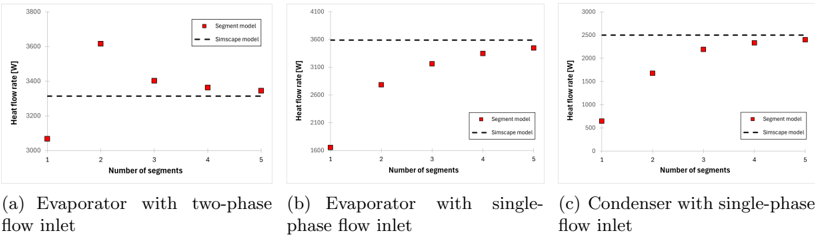
- A clean heat exchanger can be represented with sufficient accuracy using only three segments for an evaporator and four segments for a condenser, based on comparison with the standard Simscape Evaporator-Condenser (2P-MA) block.
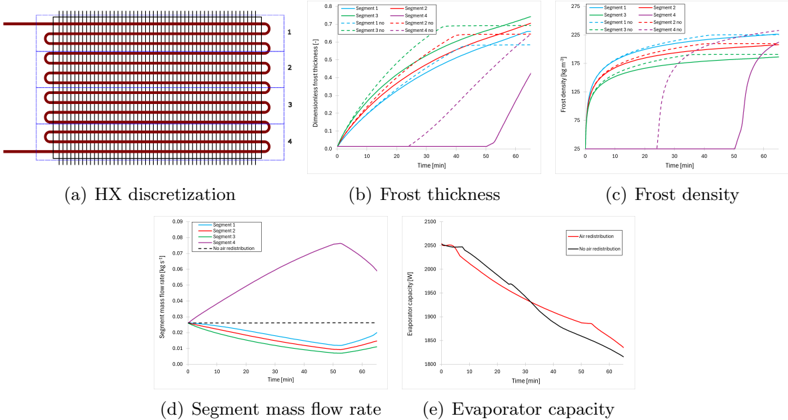
- In the frosting simulation with refrigerant evaporation at -15 °C, vapor quality 0.2, refrigerant mass flow 40 kg·h⁻¹, air at 8 °C and 80% RH, air mass flow 375 kg·h⁻¹, four segments, and a 65-minute period, the simulation without air redistribution reaches the frost point in just 30 min and halts further frost growth.
- With air redistribution, airflow to frosted segments is reduced, lowering segment surface temperature and allowing much more significant frost growth over time.
- For that particular case, evaporator capacity does not change drastically with or without the flow redistribution algorithm, though the paper states the difference could be much more significant in general.
Methods
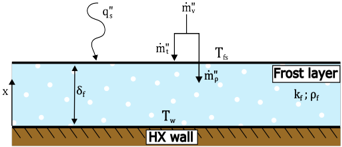
- A quasi-steady-state, segment-by-segment heat exchanger model was developed in Simulink/Simscape, including frost initiation, frost surface energy balance, frost growth and densification, effective diffusion coefficient, fin efficiency with frost, heat and mass transfer, air-side pressure drop, refrigerant-side heat transfer and pressure drop via a built-in Pipe (2P) block, and a modified ε-NTU overall heat transfer calculation.
- Clean-HX validation compared the model against the standard Simscape Evaporator-Condenser (2P-MA) block for three inlet refrigerant conditions: evaporation at -15 °C with vapor quality 0.2, evaporation at -5 °C with 5 °C subcooling, and condensation at 45 °C with 5 °C superheating; refrigerant mass flow was 40 kg·h⁻¹ and air-side conditions were 20 °C and 50% RH with 360 kg·h⁻¹, varying the number of segments.
- Frosting demonstration used a single-circuit heat exchanger subdivided into four segments under the stated frosting conditions, with an air flow redistribution algorithm enforcing equal pressure drop across segments.
Limitations
- Stated: experimental validation of the frosted heat exchanger model is the next challenge, and integration of a defrost model remains future work; the model is quasi steady-state and neglects frost thermal capacity, with validity of that hypothesis cited from Padhmanabhan.
- Evident: the frosting results are described as appearing realistic but are not experimentally validated, and only one frosting case is simulated; the clean validation is against a commercial Simscape block rather than experimental data.
Model-written summary. Check it against the paper before relying on it.
Integrity signals
Registry
Cites
Statistics
Figures
Verification
Claims the paper makes
0 Valid · 0 Not valid · 20 Not checked · 22 Own results and interpretations
A result the paper states — it cites no source for it, so there is none to check. The quote shows it is in the paper.
In the paper
“To address this, a new heat exchanger block that accurately models frosting and its impact on system performance is developed using the Simscape™ language in Simulink ® environment.”
§ An analytical model of evaporator performance under frosting conditions for lumped-parameter simulations of heat pumps > Abstract
plainstates a cause- Asserted: passes — The authors put it forward as true.
- Checkable: passes — It can be checked against evidence.
- Load-bearing: passes — The paper’s conclusions depend on it.
- Based: passes — The paper gives a reason why it holds.
- Rests on 4 assumptions not shown here.
A result the paper states — it cites no source for it, so there is none to check. The quote shows it is in the paper.
In the paper
“A lumped-parameter model of an elementary block (i.e.segment) of a heat exchanger, including frosting, was developed in this work.”
§ An analytical model of evaporator performance under frosting conditions for lumped-parameter simulations of heat pumps > 6. Conclusions and future developments
plain- Asserted: passes — The authors put it forward as true.
- Checkable: passes — It can be checked against evidence.
- Load-bearing: passes — The paper’s conclusions depend on it.
- Based: passes — The paper gives a reason why it holds.
A result the paper reports from its own data — it cites no other source for it, so there is none to check. The quote shows it is in the paper.
In the paper
“Conversely, as shown in figure 2b, if the inlet state is liquid and transitions to vapor at the outlet, a minimum of four segments is necessary to achieve an acceptable accuracy.”
§ An analytical model of evaporator performance under frosting conditions for lumped-parameter simulations of heat pumps > 3. Model results and validation under standard conditions
plainstates a cause- Asserted: passes — The authors put it forward as true.
- Checkable: passes — It can be checked against evidence.
- Load-bearing: unclear — It is unclear whether the paper’s conclusions depend on it.
- Based: passes — The paper gives a reason why it holds.
A result the paper states — it cites no source for it, so there is none to check. The quote shows it is in the paper.
In the paper
“The non-uniform frost growth on the HX surface, caused by the subdivision into segments, leads to various degrees of blockage across the different segments.”
§ An analytical model of evaporator performance under frosting conditions for lumped-parameter simulations of heat pumps > 4. Air flow redistribution algorithm
plainstates a cause- Asserted: passes — The authors put it forward as true.
- Checkable: passes — It can be checked against evidence.
- Load-bearing: passes — The paper’s conclusions depend on it.
- Based: passes — The paper gives a reason why it holds.
A result the paper reports from its own data — it cites no other source for it, so there is none to check. The quote shows it is in the paper.
In the paper
“As shown in figure 2, the accuracy of the solution depends on the number of segments, as it approaches the Simscape™ model solution.”
§ An analytical model of evaporator performance under frosting conditions for lumped-parameter simulations of heat pumps > 3. Model results and validation under standard conditions
plainstates an association- Asserted: passes — The authors put it forward as true.
- Checkable: passes — It can be checked against evidence.
- Load-bearing: passes — The paper’s conclusions depend on it.
- Based: passes — The paper gives a reason why it holds.
15 more claims
Create a free account to see all 42 claims and to verify the 13 references still open.
- It may state two separate claims as one. 9
- The quote only partly states this claim. 1
- Probably not a substantial claim. 14
Citations
Cites
Improved Magnus Form Approximation of Saturation Vapor Pressure
Alduchov, O. A., & Eskridge, R. E. (1996) · Journal of Applied Meteorology · doi:10.1175/1520-0450(1996)035<0601:imfaos>2.0.co;2 · Cited by 979
Wang, C.-C., Chi, K.-Y., & Chang, C.-J. (2000) · International Journal of Heat and Mass Transfer · doi:10.1016/s0017-9310(99)00333-6 · Cited by 546
A one-dimensional model for frost formation on a cold flat surface
Lee, K.-S., Kim, W.-S., & Lee, T.-H. (1997) · International Journal of Heat and Mass Transfer · doi:10.1016/s0017-9310(97)00074-4 · Cited by 296
Heat transfer and friction correlation for compact louvered fin-and-tube heat exchangers
Wang, C.-C., Lee, C.-J., Chang, C.-T., & Lin, S.-P. (1999) · International Journal of Heat and Mass Transfer · doi:10.1016/s0017-9310(98)00302-0 · Cited by 265
Modelling of frost growth and densification
Le Gall, R., Grillot, J. M., & Jallut, C. (1997) · International Journal of Heat and Mass Transfer · doi:10.1016/s0017-9310(96)00359-6 · Cited by 153
Fan supplied heat exchanger fin performance under frosting conditions
Chen, H., Thomas, L., & Besant, R. W. (2003) · International Journal of Refrigeration · doi:10.1016/s0140-7007(02)00011-7 · Cited by 59
Qiao, H., Aute, V., & Radermacher, R. (2017) · International Journal of Refrigeration · doi:10.1016/j.ijrefrig.2017.08.020 · Cited by 29
Simple Correlation to Evaluate Efficiency of Annular Elliptical Fin Circumscribing Circular Tube
Nemati, H., & Samivand, S. (2014) · Arabian Journal for Science and Engineering · doi:10.1007/s13369-014-1474-z · Cited by 22
(2005) · CINECA IRIS Institutial Research Information System (University of Genoa)
Research works printed but not linked: 7
- Hayashi Y, Aoki K and Yuhara H 1977 Heat Transf. J. Res. 6 79-94,
- O'Neal D and Tree D 1985 ASHRAE Transactions 91 267-281
- Padhmanabhan S 2011 Study of frost growth on heat exchangers used as outdoor coils in air source heat pump systems Ph.D. thesis Oklahoma State University
- Górnicki K, Winiczenko R, Kaleta A and Choińska A 2017 Tech. Sci. 20 241-257
- Wark K 1988 Thermodynamics (McGraw-Hill Science, Engineering & Mathematics)
- Sanders C T 1974 The influence of frost formation and defrosting on the performance of air coolers Ph.D. thesis Technical University of Delft, Netherlands
- Kays W M and London A L 1984 Compact heat exchangers (McGraw-Hill, New York, NY)
Cited by
Sedoni, R., Santangelo, P. E., & Angeli, D. (2026) · Results in Engineering · doi:10.1016/j.rineng.2026.113465 · Cited by 1
Self-citationModellazione e analisi sperimentale di sistemi avanzati per la climatizzazione di ambienti confinati
Angeli, D., Santangelo, P. E., Zambonelli, F., & Sedoni, R. (2026) · IRIS UNIMORE (University of Modena and Reggio Emilia) · Cited by 1
Self-citation
Metadata
- Authors
- Sedoni, R., Santangelo, P. E., Angeli, D., Romani, M., & Fioravanti, L.
- Affiliations
- University of Modena and Reggio Emilia (IT)
- Corresponding author
- Sedoni, R
- Venue
- Journal of Physics: Conference Series
- Publisher
- IOP Publishing
- Published
- 2025-01-01
- Volume
- 2940
- Issue
- 1
- Pages
- 012015
- ISSN
- 1742-6588 (ISSN-L)
- 1742-6596
- OpenAlex
- W4406902448
- Semantic Scholar
- 1fe686c1b74e15d39cb7b072d5d01166b454973b
- Cited by
- 2
- References
- 9
- Citations by year
- 2026: 2
- FWCI
- 3.44
- Type
- conference paper
- Language
- en
- Open access
- diamond
- doi.org
- Licence
- cc-by
- creativecommons.org/licenses/by/4.0/ (vor)
- iopscience.iop.org/info/page/text-and-data-mining (tdm)
- Locations
- Journal of Physics Conference Series (publishedVersion, cc-by)
- IRIS UNIMORE (University of Modena and Reggio Emilia) (submittedVersion, other-oa)
- Topics
- Physical Sciences › Engineering › Mechanical Engineering › Refrigeration and Air Conditioning Technologies
- Physical Sciences › Engineering › Building and Construction › Building Energy and Comfort Optimization
- Physical Sciences › Engineering › Mechanical Engineering › Adsorption and Cooling Systems
- Keywords
- heat pumps, lumped parameter model, HVAC systems, energy efficiency, heating mode, Simscape, building energy simulation, zero energy buildings
About these checks
Registry, retraction, Cites and statistics results are computed, not judged, with one exception: a printed reference that no index lists is read once by a model before it counts as a citation error. Claims are extracted by a model and kept only when their quote appears verbatim in the text; each cited source is then checked, with a model’s help, for whether it says what the claim relies on. Those verdicts can be wrong — read the claim’s quote and the cited source before relying on one.
A language model drew the claims from the paper on 2026-11-26, under version 3 of the claim definition (model deepseek-v4.1-flash, prompt extract-v3).
A second model labelled each claim on 2026-11-26 (model jev-1.13-20260917, definition revision gold-guideline-v0.2).
Statistics and arithmetic are recomputed, not judged.
Confidence bands are shown only for fields calibrated on our annotated test set. None is calibrated yet, so no band is shown.
What counts as a claim ›How we measure confidence ›How we check this ›
Are you an author, or do you see a problem with this page? Request a review
How to cite
Cite CoChat for the checks on this page, and the paper for its own findings.
- This page
- CoChat. (2026). Citation check: An analytical model of evaporator performance under frosting conditions for lumped-parameter simulations of heat pumps. https://app.cochat.ai/papers/10.1088/1742-6596/2940/1/012015
- The paper
- Sedoni, R., Santangelo, P. E., Angeli, D., Romani, M., & Fioravanti, L. (2025). An analytical model of evaporator performance under frosting conditions for lumped-parameter simulations of heat pumps. Journal of Physics: Conference Series. https://doi.org/10.1088/1742-6596/2940/1/012015
Data sources
Bibliographic data: Semantic Scholar, OpenAlex, Crossref.
Contains information from the Semantic Scholar Academic Graph Datasets, made available under the ODC Attribution License (ODC-BY 1.0).
Semantic Scholar’s data is described in: Kinney, R., et al. (2023). The Semantic Scholar Open Data Platform. arXiv:2301.10140.
