

Diverse policy implications for future ozone and surface UV in a changing climate
Open accessThe DOI matches its Crossref record; 36 of the 37 references it cites were found in a registry or an index.
Abstract
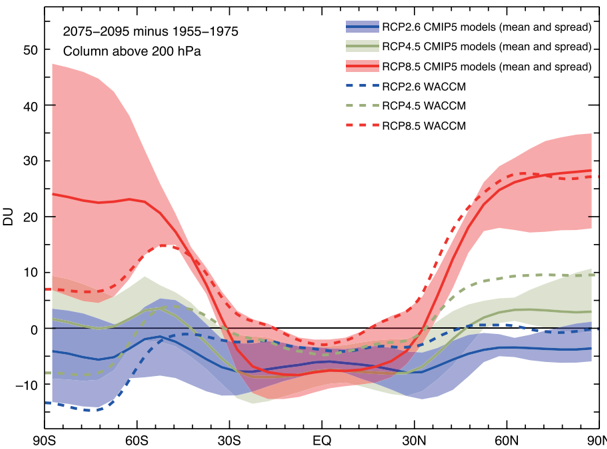
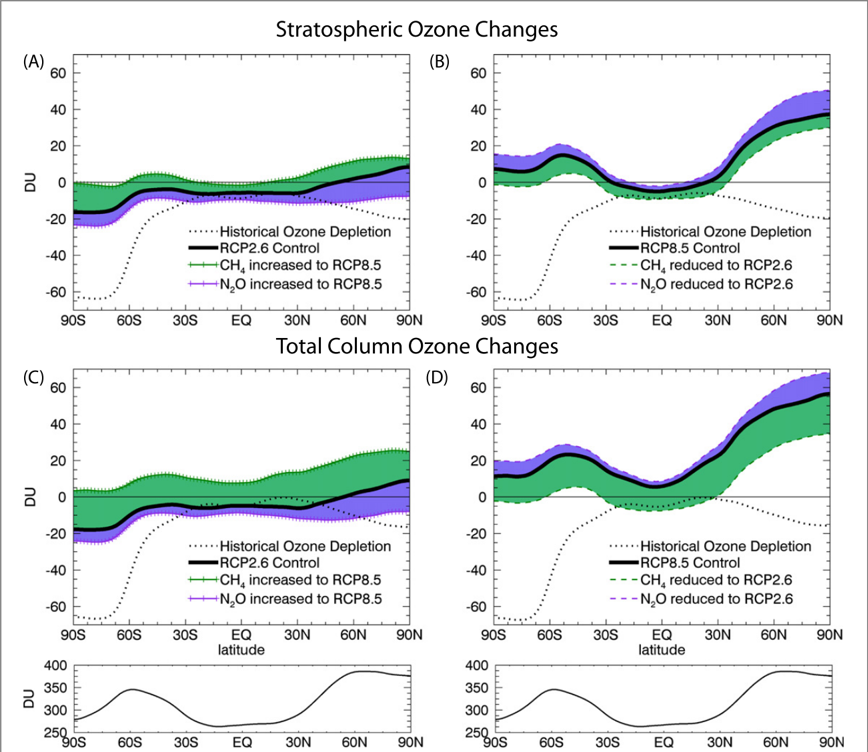
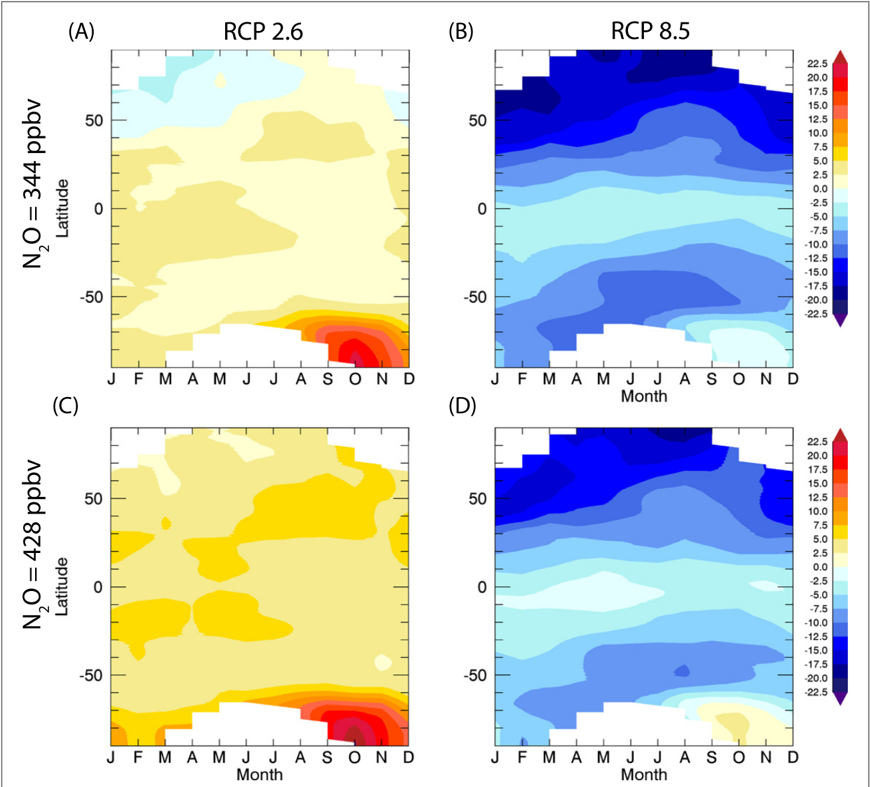
Due to the success of the Montreal Protocol in limiting emissions of ozone-depleting substances, concentrations of atmospheric carbon dioxide, nitrous oxide, and methane will control the evolution of total column and stratospheric ozone by the latter half of the 21st century. As the world proceeds down the path of reducing climate forcing set forth by the 2015 Conference of the Parties to the United Nations Framework Convention on Climate Change (COP 21), a broad range of ozone changes are possible depending on future policies enacted. While decreases in tropical stratospheric ozone will likely persist regardless of the future emissions scenario, extratropical ozone could either remain weakly depleted or even increase well above historical levels, with diverse implication for ultraviolet (UV) radiation. The ozone layer's dependence on future emissions of these gases creates a complex policy decision space for protecting humans and ecosystems, which includes unexpected options such as accepting nitrous oxide emissions in order to maintain historical column ozone and surface UV levels.
Overview
The claims and statistics of this paper haven’t been checked yet.
Free: it reads the open-access text and checks the first 5 claims that cite a source we can check. Create a free account to check every claim.
Integrity signals
Registry
Cites
Statistics
Figures


Verification
Claims the paper makes
The claims and statistics of this paper haven’t been checked yet.
Free: it reads the open-access text and checks the first 5 claims that cite a source we can check. Create a free account to check every claim.
Claims other papers make about this one
Each is checked against this paper’s own text: does it say what the citing paper says it does?
The source backs part of the claim, not all of it — or backs it for a different population, condition or comparison.
In the citing paper
“However, recent climate model simulations [20–22], also reviewed by Bernhard et al. [23], suggest that under some scenarios of increasing greenhouse gas emissions, stratospheric O3 could exceed the 1980 baseline (the so-called “super-recovery”).”
From Changes in tropospheric air quality related to the protection of stratospheric ozone in a changing climate (2023) · cites this paper as [20]
Experimental — accuracy not yet measured
Self-check
Percentages, sums and reported differences re-computed from the paper’s own numbers.
The self-check needs the paper’s full text.
Citations
Cites
An Overview of CMIP5 and the Experiment Design
Taylor, K. E., Stouffer, R. J., & Meehl, G. A. (2012) · Bulletin of the American Meteorological Society · doi:10.1175/bams-d-11-00094.1 · Cited by 14,052 · cited 6×
“In agreement with previous studies (Oman et al 2010, Fleming et al 2011, Portmann et al 2012, Revell et al 2012, Eyring et al 2013, Stolarksi et al 2015, Iglesias-Suarez et al 2016), there is a broad range of possible changes to the stratospheric ozone layer by the end of the century (2075–2095) compared to the histor…”
MethodInfluentialNitrous Oxide (N 2 O): The Dominant Ozone-Depleting Substance Emitted in the 21st Century
Ravishankara, A. R., Daniel, J. S., & Portmann, R. W. (2009) · Science · doi:10.1126/science.1176985 · Cited by 4,581 · cited 2×
“N2O is currently the largest ozone-depletion-potential (ODP)-weighted emission (Ravishankara et al 2009) and a potent Original content from this workmay be used under the terms of the Creative CommonsAttribution 3.0 licence.”
BackgroundMethodInfluentialSelf-citationThe RCP greenhouse gas concentrations and their extensions from 1765 to 2300
Meinshausen, M., Smith, S. J., Calvin, K., Daniel, J. S., Kainuma, M. L. T., Lamarque, J.-F., Matsumoto, K., Montzka, S. A., Raper, S. C. B., Riahi, K., et al. (2011) · Climatic Change · doi:10.1007/s10584-011-0156-z · Cited by 3,584
Self-citationVitamin D status and ill health: a systematic review
Autier, P., Boniol, M., Pizot, C., & Mullie, P. (2014) · The Lancet Diabetes & Endocrinology · doi:10.1016/s2213-8587(13)70165-7 · Cited by 1,107 · cited 2×
“disease, multiple sclerosis, and rheumatoid arthritis (Autier et al. 2014).”
BackgroundClimate Change from 1850 to 2005 Simulated in CESM1(WACCM)
Marsh, D. R., Mills, M. J., Kinnison, D. E., Lamarque, J.-F., Calvo, N., & Polvani, L. M. (2013) · Journal of Climate · doi:10.1175/jcli-d-12-00558.1 · Cited by 1,081
Butchart, N. (2014) · Reviews of Geophysics · doi:10.1002/2013rg000448 · Cited by 791 · cited 1×
“Increased CO2 is expected to accelerate the BrewerDobson Circulation (BDC), leading to stratospheric ozone decreases in the tropics and increases in the extratropics (Butchart 2014).”
BackgroundLong-term Climate Change: Projections, Commitments and Irreversibility Pages 1029 to 1076
(2014) · Climate Change 2013 – The Physical Science Basis · doi:10.1017/cbo9781107415324.024 · Cited by 687
Young, P. J., Archibald, A. T., Bowman, K. W., Lamarque, J.-F., Naik, V., Stevenson, D. S., Tilmes, S., Voulgarakis, A., Wild, O., Bergmann, D., et al. (2013) · Atmospheric Chemistry and Physics · doi:10.5194/acp-13-2063-2013 · Cited by 677
Self-citationOzone depletion and climate change: impacts on UV radiation
McKenzie, R. L., Aucamp, P. J., Bais, A. F., Björn, L. O., Ilyas, M., & Madronich, S. (2011) · Photochemical & Photobiological Sciences · doi:10.1039/c0pp90034f · Cited by 609
Effects of UV radiation on aquatic ecosystems and interactions with other environmental factors
Häder, D.-P., Williamson, C. E., Wängberg, S.-Å., Rautio, M., Rose, K. C., Gao, K., Helbling, E. W., Sinha, R. P., & Worrest, R. (2014) · Photochemical & Photobiological Sciences · doi:10.1039/c4pp90035a · Cited by 423
Cited by
United Nations Environment Programme, E. E. A. P. (2012) · Photochemical & Photobiological Sciences · doi:10.1039/c1pp90033a · Cited by 240
Ozone—climate interactions and effects on solar ultraviolet radiation
Bais, A. F., Bernhard, G., McKenzie, R. L., Aucamp, P. J., Young, P. J., Ilyas, M., Jöckel, P., & Deushi, M. (2019) · Photochemical & Photobiological Sciences · doi:10.1039/c8pp90059k · Cited by 206
Self-citationEstimates of ozone return dates from Chemistry-Climate Model Initiative simulations
Dhomse, S. S., Kinnison, D., Chipperfield, M. P., Salawitch, R. J., Cionni, I., Hegglin, M. I., Abraham, N. L., Akiyoshi, H., Archibald, A. T., Bednarz, E. M., et al. (2018) · Atmospheric Chemistry and Physics · doi:10.5194/acp-18-8409-2018 · Cited by 198
“Many studies have investigated the impacts of CH4, N2O, and CO2 evolution on ozone abundance and recovery (e.g., Haigh & Pyle, 1979; Le Texier et al., 1988; Rosenfield et al., 2002; Randeniya et al., 2002; Royer et al., 2002; Chipperfield and Feng, 2003; Portmann and Solomon, 2007; Shepherd et al., 2008; Ravishankara…”
Delay in recovery of the Antarctic ozone hole from unexpected CFC-11 emissions
Dhomse, S. S., Feng, W., Montzka, S. A., Hossaini, R., Keeble, J., Pyle, J. A., Daniel, J. S., & Chipperfield, M. P. (2019) · Nature Communications · doi:10.1038/s41467-019-13717-x · Cited by 156
Self-citationEffects of Different Stratospheric SO2 Injection Altitudes on Stratospheric Chemistry and Dynamics
Tilmes, S., Richter, J. H., Mills, M. J., Kravitz, B., MacMartin, D. G., Garcia, R. R., Kinnison, D. E., Lamarque, J., Tribbia, J., & Vitt, F. (2018) · Journal of Geophysical Research: Atmospheres · doi:10.1002/2017jd028146 · Cited by 127
Variability and trend in ozone over the southern tropics and subtropics
Toihir, A. M., Portafaix, T., Sivakumar, V., Benchérif, H., Pazmiño, A., & Bègue, N. (2018) · Annales Geophysicae · doi:10.5194/angeo-36-381-2018 · Cited by 72
The Response of the Ozone Layer to Quadrupled CO2 Concentrations
Chiodo, G., Polvani, L. M., Marsh, D. R., Stenke, A., Ball, W., Rozanov, E., Muthers, S., & Tsigaridis, K. (2018) · Journal of Climate · doi:10.1175/jcli-d-17-0492.1 · Cited by 70
Wilson, S. R., Madronich, S., Longstreth, J. D., & Solomon, K. R. (2019) · Photochemical & Photobiological Sciences · doi:10.1039/c8pp90064g · Cited by 68
Madronich, S., Sulzberger, B., Longstreth, J. D., Schikowski, T., Andersen, M. P. S., Solomon, K. R., & Wilson, S. R. (2023) · Photochemical & Photobiological Sciences · doi:10.1007/s43630-023-00369-6 · Cited by 64
Simulation of Record Arctic Stratospheric Ozone Depletion in 2020
Grooß, J., & Müller, R. (2021) · Journal of Geophysical Research: Atmospheres · doi:10.1029/2020jd033339 · Cited by 65
“As it is expected that in the upcoming decades ozone-depleting substances decline and greenhouse gases increase, the importance of dynamical processes for determining Arctic springtime ozone will likely grow (Butler et al., 2016; Portmann et al., 2012).”
BackgroundClear-sky ultraviolet radiation modelling using output from the Chemistry Climate Model Initiative
Lamy, K., Portafaix, T., Josse, B., Brogniez, C., Godin-Beekmann, S., Bencherif, H., Revell, L., Akiyoshi, H., Bekki, S., Hegglin, M. I., et al. (2019) · Atmospheric Chemistry and Physics · doi:10.5194/acp-19-10087-2019 · Cited by 62
United Nations Environment Programme, E. E. A. P. (2016) · Photochemical & Photobiological Sciences · doi:10.1039/c6pp90004f · Cited by 58
Sensitivity of Total Column Ozone to Stratospheric Sulfur Injection Strategies
Tilmes, S., Richter, J. H., Kravitz, B., MacMartin, D. G., Glanville, A. S., Visioni, D., Kinnison, D. E., & Müller, R. (2021) · Geophysical Research Letters · doi:10.1029/2021gl094058 · Cited by 50
“The super recovery (above 1980 values) is caused by a speed-up of the stratospheric Brewer-Dobson circulation, as well as by a cooling of the stratosphere with increasing greenhouse gases, which increases gas-phase ozone production in the upper stratosphere (Butler et al., 2016).”
BackgroundUnited Nations Environment Programme, E. E. A. P. (2010) · Photochemical & Photobiological Sciences · doi:10.1039/b923342n · Cited by 55
A brief review of health-related issues occurring in urban areas related to global warming of 1.5°C
Bartholy, J., & Pongrácz, R. (2018) · Current Opinion in Environmental Sustainability · doi:10.1016/j.cosust.2018.05.014 · Cited by 46
Amos, M., Young, P. J., Hosking, J. S., Lamarque, J., Abraham, N. L., Akiyoshi, H., Archibald, A. T., Bekki, S., Deushi, M., Jöckel, P., et al. (2020) · Atmospheric chemistry and physics · doi:10.5194/acp-20-9961-2020 · Cited by 48
Self-citationIdentifying the safe operating space for food systems
Wierik, S. T., DeClerck, F., Beusen, A. H. W., Gerten, D., Maggi, F., Norberg, A., Noone, K. J., Schulte‐Uebbing, L., Springmann, M., Tang, F. H. M., et al. (2025) · Nature Food · doi:10.1038/s43016-025-01252-6 · Cited by 51
“However, the contribution of N 2 O to stratospheric ozone depletion remains small, and the concentration of stratospheric ozone is expected to return to historical values by the end of this century even without any further N 2 O reductions 39 .”
Planetary boundaries transgressions: A review on the implications to public health
Kemarau, R. A., Sakawi, Z., Eboy, O. V., Suab, S. A., Ibrahim, M. F., Rosli, N. N., & Nor, N. N. F. M. (2024) · Environmental Research · doi:10.1016/j.envres.2024.119668 · Cited by 38
Attribution of Stratospheric and Tropospheric Ozone Changes Between 1850 and 2014 in CMIP6 Models
Zeng, G., Morgenstern, O., Williams, J., O’Connor, F. M., Griffiths, P. T., Keeble, J., Deushi, M., Horowitz, L. W., Naïk, V., Emmons, L. K., et al. (2022) · Journal of Geophysical Research Atmospheres · doi:10.1029/2022jd036452 · Cited by 40
“…and air pollutant harmful to hu-83 man health and vegetation.84 In addition to ODSs, increases in long-lived GHGs (especially CO2, N2O, and CH4)85 also impact stratospheric ozone chemically and dynamically (Fleming et al., 2011; Reader86 et al., 2013; Revell et al., 2015; Butler et al., 2016).”
BackgroundSelf-citationWu, G., Bornman, J. F., Bennett, S. J., Clarke, M. W., Fang, Z., & Johnson, S. K. (2017) · Journal of Cereal Science · doi:10.1016/j.jcs.2017.07.014 · Cited by 33
Improving the social cost of nitrous oxide
Kanter, D., Wagner‐Riddle, C., Groffman, P. M., Davidson, E. A., Galloway, J. N., Gourevitch, J. D., van Grinsven, H. J. M., Houlton, B. Z., Keeler, B., Ogle, S. M., et al. (2021) · Nature Climate Change · doi:10.1038/s41558-021-01226-z · Cited by 32
Lamy, K., Portafaix, T., Brogniez, C., Godin-Beekmann, S. M., Benchérif, H., Morel, B., Pazmiño, A., Metzger, J. M., Auriol, F., Deroo, C., et al. (2018) · Atmospheric chemistry and physics · doi:10.5194/acp-18-227-2018 · Cited by 30
“These projections depend strongly on the evolution of future climate, and Butler et al. (2016) presented the complexities associated with future ozone change and therefore surface UV change.”
BackgroundInfluence of Ozone Forcing on 21st Century Southern Hemisphere Surface Westerlies in CMIP6 Models
Revell, L. E., Robertson, F., Douglas, H., Morgenstern, O., & Frame, D. J. (2022) · Geophysical Research Letters · doi:10.1029/2022gl098252 · Cited by 31
“Consequently, the CHEM models simulate less ozone destruction via catalytic cycles involving reactive nitrogen and hydrogen oxides released from the photochemical breakdown of N2O and CH4 in the stratosphere (Butler et al., 2016; Revell et al., 2012), compared with simulations following RCP85.”
MethodThe future ozone trends in changing climate simulated with SOCOLv4
Karagodin‐Doyennel, A., Rozanov, E., Sukhodolov, T., Egorova, T. A., Sedláčék, J., & Peter, T. (2023) · Atmospheric chemistry and physics · doi:10.5194/acp-23-4801-2023 · Cited by 35
Keeble, J., Bednarz, E., Banerjee, A., Abraham, N. L., Harris, N., Maycock, A. C., & Pyle, J. A. (2017) · Atmospheric chemistry and physics · doi:10.5194/acp-17-13801-2017 · Cited by 30
Perspective on aircraft in the stratosphere: 50 years from COMESA through the ozone hole to climate
Tuck, A. F. (2021) · Quarterly Journal of the Royal Meteorological Society · doi:10.1002/qj.3958 · Cited by 23
“While we have made some great advances (Butler et al., 2016), some humility is in order when faced with the highly coupled system in which stratospheric aviation will operate, particularly as regards aerosol effects.”
BackgroundLamy, K., Portafaix, T., Brogniez, C., Lakkala, K., Pitkänen, M. R. A., Arola, A., Forestier, J.-B., Amélie, V., Toihir, A. M., & Rakotoniaina, S. (2021) · Earth system science data · doi:10.5194/essd-13-4275-2021 · Cited by 30
Stratospheric aerosol injection may impact global systems and human health outcomes
Tracy, S. M., Moch, J. M., Eastham, S. D., & Buonocore, J. J. (2022) · Elementa Science of the Anthropocene · doi:10.1525/elementa.2022.00047 · Cited by 36
Rendell, R. J., Higlett, M. P., Khazova, M., & O’Hagan, J. (2020) · Journal of Environmental and Public Health · doi:10.1155/2020/2589601 · Cited by 23
Atmospheric gas-phase composition over the Indian Ocean
Tegtmeier, S., Marandino, C., Jia, Y., Quack, B., & Mahajan, A. S. (2022) · Atmospheric chemistry and physics · doi:10.5194/acp-22-6625-2022 · Cited by 21
Envisioning a sustainable future for space launches: a review of current research and policy
Brown, T. F. M., Bannister, M. T., & Revell, L. E. (2023) · Journal of the Royal Society of New Zealand · doi:10.1080/03036758.2022.2152467 · Cited by 34
“…and Grewe 2002 ; Stenke and Grewe 2005; Vogel et al. 2011), so the magnitude of impacts described in Table 1 depends on the background atmospheric composition and relative concentrations of other species (Röckmann et al. 2004 ; Portmann et al. 2012; Revell et al. 2015 ; Butler et al. 2016).”
BackgroundZhang, J., Wuebbles, D. J., Kinnison, D. E., & Baughcum, S. L. (2021) · Journal of Geophysical Research Atmospheres · doi:10.1029/2021jd034971 · Cited by 18
“will depend on the assumed levels of the various source gases (such as N2O, CH4, and CO2); levels of these greenhouse gases could be affected by the future climate policy and this could significantly influence the estimated ozone perturbation from the assumed supersonic fleet (Butler et al., 2016; Portmann et al., 201…”
BackgroundUnited Nations Environment Programme, & Panel, E. E. A. (2005) · Photochemical & Photobiological Sciences · doi:10.1039/b418650h · Cited by 23
Feng, R., Li, Z., & Qi, Z. (2024) · Journal of Environmental Management · doi:10.1016/j.jenvman.2024.120234 · Cited by 16
The influence of future changes in springtime Arctic ozone on stratospheric and surface climate
Chiodo, G., Friedel, M., Seeber, S., Domeisen, D., Stenke, A., Sukhodolov, T., & Zilker, F. (2023) · Atmospheric Chemistry and Physics · doi:10.5194/acp-23-10451-2023 · Cited by 10
Banerjee, A., Maycock, A. C., & Pyle, J. A. (2018) · Atmospheric chemistry and physics · doi:10.5194/acp-18-2899-2018 · Cited by 10
“However, we note that changing concentrations of N2O within the RCP scenarios is also expected to impact on ozone, and hence be associated with an indirect RF in the stratosphere (Butler et al., 2016; Fleming et al., 2011; Portmann and Solomon, 2007; Revell et al., 2012).”
BackgroundHow marine cloud brightening could also affect stratospheric ozone
Bednarz, E., Haywood, J., Visioni, D., Butler, A. H., & Jones, A. (2025) · Science Advances · doi:10.1126/sciadv.adu4038 · Cited by 10
Self-citationImpacts of Breaching Planetary Boundaries on Human Health: Current and Future Threats
Kemarau, R. A., Sakawi, Z., Eboy, O. V., Jaafar, W. S. W. M., Sa’adi, Z., & Suab, S. A. (2025) · GeoHealth · doi:10.1029/2024gh001107 · Cited by 14
“Meul et al. (2016) and Butler et al. (2016) linked decreased ozone in the tropics to increased UV exposure, consequently heightening cataract risks.”
Ningombam, S. S., Vemareddy, P., & Song, H. (2018) · Journal of Atmospheric and Solar-Terrestrial Physics · doi:10.1016/j.jastp.2018.05.011 · Cited by 8
Apportionment of long-term trends in different sections of total ozone column over tropical region
Kumar, C., Dogra, A., Yadav, S., Tandon, A., & Attri, A. K. (2022) · Environmental Monitoring and Assessment · doi:10.1007/s10661-022-09980-z · Cited by 4
“So, it has been anticipated that stratospheric ozone increase will soon be recognizable comprehensively (World Meteorological Organization, 2010, 2014, 2018), except in the tropics (Butler et al., 2016; Eyring et al., 2007).”
BackgroundElsbury, D., Butler, A. H., Albers, J. R., Breeden, M. L., & Langford, A. O. (2023) · Atmospheric chemistry and physics · doi:10.5194/acp-23-5101-2023 · Cited by 5
Self-citationSimulation of the record Arctic stratospheric ozone depletion in 2020
Grooß, J., & Muller, R. H. (2021) · EGU General Assembly Conference Abstracts · doi:10.5194/egusphere-egu21-2429 · Cited by 5
Exploring ozone–climate interactions in idealized CMIP6 DECK experiments
Wang, J., Chiodo, G., Ayarzagüena, B., Ball, W. T., Diallo, M., Haßler, B., Keeble, J., Nowack, P. J., Orbe, C., Vattioni, S., et al. (2025) · Atmospheric chemistry and physics · doi:10.5194/acp-25-17819-2025 · Cited by 12
“B3), which leads to more effi-cient wave generation and propagation, thus enhancing the upwelling in the tropics, which is consistent with previous studies (Chrysanthou et al., 2020) It is thus pertinent to ask whether the climate model sensitivity correlates with tropical upwelling and thus ozone .”
García, P. L., Rivela, C. B., Gibilisco, R. G., Salgado, S., Wiesen, P., Teruel, M. A., & Blanco, M. B. (2020) · RSC Advances · doi:10.1039/c9ra08034a
(2021) · Earth system science data · doi:10.5194/essd-2021-55-ec1
(2021) · Earth system science data · doi:10.5194/essd-2021-55-rc1
(2017) · Atmospheric chemistry and physics · doi:10.5194/acp-2017-324-rc1
Lamy, K. (2021) · Earth system science data · doi:10.5194/essd-2021-55-ac2
(2021) · Earth system science data · doi:10.5194/essd-2021-55-rc2
Lamy, K. (2021) · Earth system science data · doi:10.5194/essd-2021-55-ac1
Author comment to referee report
Chiodo, G. (2023) · doi:10.5194/egusphere-2023-672-ac1
Examining the effect of cost information and framing on support for methane regulations in Europe
Bergquist, P., & Mahdavi, P. (2023) · Environmental Research Letters · doi:10.1088/1748-9326/acf32c · Cited by 1
Roy, R. (2023) · doi:10.5194/egusphere-2023-1189-ac1
Lamy, K. (2018) · theses.fr (ABES) · doi:10.70675/02cfdffaz555az4aadz9d78z12391f7a561e · Cited by 1
“Le rayonnement UV à la surface étant fortement dépendant de la colonne totale d’ozone, certains modèles ont montré qu’une diminution de l’UV aux moyennes latitudes et une augmentation aux tropiques est probable (Hegglin and Shepherd, 2009; Eyring et al., 2010; Butler et al., 2016).”
Background
Metadata
- Authors
- Butler, A. H., Daniel, J. S., Portmann, R. W., Ravishankara, A. R., Young, P. J., Fahey, D. W., & Rosenlof, K. H.
- Affiliations
- National Oceanic and Atmospheric Administration (US)
- Colorado State University (US)
- Lancaster University (GB)
- Corresponding author
- Butler, A H
- Venue
- Environmental Research Letters
- Publisher
- IOP Publishing
- Published
- 2016-06-01
- Volume
- 11
- Issue
- 6
- Pages
- 064017
- ISSN
- 1748-9326 (ISSN-L)
- OpenAlex
- W2412010961
- Semantic Scholar
- 2ae5def74653f5d3572a97bc31e04c3f8a7f51a4
- Cited by
- 59
- References
- 37
- Citations by year
- 2025: 4 · 2024: 2 · 2023: 12 · 2022: 5 · 2021: 11 · 2020: 5 · 2019: 4 · 2018: 9 · 2017: 3 · 2016: 1
- FWCI
- 3.45
- Type
- journal article
- Language
- en
- Open access
- gold
- doi.org
- Licence
- cc-by
- iopscience.iop.org/info/page/text-and-data-mining (tdm, 19 d)
- creativecommons.org/licenses/by/3.0/ (vor, 19 d)
- Locations
- Environmental Research Letters (publishedVersion, cc-by)
- Lancaster EPrints (Lancaster University) (submittedVersion)
- DOAJ (DOAJ: Directory of Open Access Journals) (submittedVersion)
- NOAA Institutional Repository (submittedVersion)
- Topics
- Physical Sciences › Earth and Planetary Sciences › Atmospheric Science › Atmospheric Ozone and Climate
- Physical Sciences › Earth and Planetary Sciences › Atmospheric Science › Atmospheric chemistry and aerosols
- Physical Sciences › Environmental Science › Global and Planetary Change › Climate variability and models
- Keywords
- stratospheric ozone, surface ultraviolet radiation, Montreal Protocol, ozone-depleting substances, climate policy, greenhouse gas emissions scenarios, nitrous oxide emissions, methane, carbon dioxide, ozone recovery
About these checks
Registry, retraction, Cites and statistics results are computed, not judged, with one exception: a printed reference that no index lists is read once by a model before it counts as a citation error. Claims are extracted by a model and kept only when their quote appears verbatim in the text; each cited source is then checked, with a model’s help, for whether it says what the claim relies on. Those verdicts can be wrong — read the claim’s quote and the cited source before relying on one.
Statistics and arithmetic are recomputed, not judged.
Confidence bands are shown only for fields calibrated on our annotated test set. None is calibrated yet, so no band is shown.
What counts as a claim ›How we measure confidence ›How we check this ›
Are you an author, or do you see a problem with this page? Request a review
Data sources
Bibliographic data: Semantic Scholar, OpenAlex, Crossref.
Contains information from the Semantic Scholar Academic Graph Datasets, made available under the ODC Attribution License (ODC-BY 1.0).
Semantic Scholar’s data is described in: Kinney, R., et al. (2023). The Semantic Scholar Open Data Platform. arXiv:2301.10140.
