

Diverse policy implications for future ozone and surface UV in a changing climate
Open accessThe DOI matches its Crossref record; 36 of the 37 references it cites were found in a registry or an index.
Abstract
Due to the success of the Montreal Protocol in limiting emissions of ozone-depleting substances, concentrations of atmospheric carbon dioxide, nitrous oxide, and methane will control the evolution of total column and stratospheric ozone by the latter half of the 21st century. As the world proceeds down the path of reducing climate forcing set forth by the 2015 Conference of the Parties to the United Nations Framework Convention on Climate Change (COP 21), a broad range of ozone changes are possible depending on future policies enacted. While decreases in tropical stratospheric ozone will likely persist regardless of the future emissions scenario, extratropical ozone could either remain weakly depleted or even increase well above historical levels, with diverse implication for ultraviolet (UV) radiation. The ozone layer's dependence on future emissions of these gases creates a complex policy decision space for protecting humans and ecosystems, which includes unexpected options such as accepting nitrous oxide emissions in order to maintain historical column ozone and surface UV levels.
Overview
The claims and statistics of this paper haven’t been checked yet.
Free: it reads the open-access text and checks the first 5 claims that cite a source we can check. Create a free account to check every claim.
Integrity signals
Registry
Cites
Statistics
Figures


Verification
Claims the paper makes
The claims and statistics of this paper haven’t been checked yet.
Free: it reads the open-access text and checks the first 5 claims that cite a source we can check. Create a free account to check every claim.
Claims other papers make about this one
Each is checked against this paper’s own text: does it say what the citing paper says it does?
The source backs part of the claim, not all of it — or backs it for a different population, condition or comparison.
In the citing paper
“However, recent climate model simulations [20–22], also reviewed by Bernhard et al. [23], suggest that under some scenarios of increasing greenhouse gas emissions, stratospheric O3 could exceed the 1980 baseline (the so-called “super-recovery”).”
From Changes in tropospheric air quality related to the protection of stratospheric ozone in a changing climate (2023) · cites this paper as [20]
Experimental — accuracy not yet measured
Self-check
Percentages, sums and reported differences re-computed from the paper’s own numbers.
The self-check needs the paper’s full text.
Citations
Cites
An Overview of CMIP5 and the Experiment Design
Taylor, K. E., Stouffer, R. J., & Meehl, G. A. (2012) · Bulletin of the American Meteorological Society · doi:10.1175/bams-d-11-00094.1 · Cited by 14,052 · cited 6×
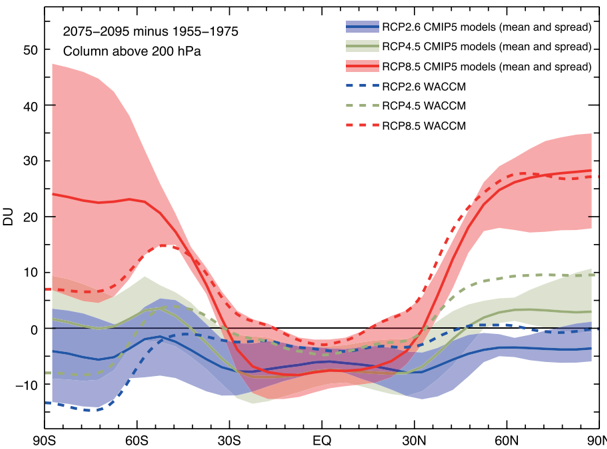
“In agreement with previous studies (Oman et al 2010, Fleming et al 2011, Portmann et al 2012, Revell et al 2012, Eyring et al 2013, Stolarksi et al 2015, Iglesias-Suarez et al 2016), there is a broad range of possible changes to the stratospheric ozone layer by the end of the century (2075–2095) compared to the histor…”
MethodInfluentialNitrous Oxide (N 2 O): The Dominant Ozone-Depleting Substance Emitted in the 21st Century
Ravishankara, A. R., Daniel, J. S., & Portmann, R. W. (2009) · Science · doi:10.1126/science.1176985 · Cited by 4,581 · cited 2×
“N2O is currently the largest ozone-depletion-potential (ODP)-weighted emission (Ravishankara et al 2009) and a potent Original content from this workmay be used under the terms of the Creative CommonsAttribution 3.0 licence.”
BackgroundMethodInfluentialSelf-citationThe RCP greenhouse gas concentrations and their extensions from 1765 to 2300
Meinshausen, M., Smith, S. J., Calvin, K., Daniel, J. S., Kainuma, M. L. T., Lamarque, J.-F., Matsumoto, K., Montzka, S. A., Raper, S. C. B., Riahi, K., et al. (2011) · Climatic Change · doi:10.1007/s10584-011-0156-z · Cited by 3,584
Self-citationVitamin D status and ill health: a systematic review
Autier, P., Boniol, M., Pizot, C., & Mullie, P. (2014) · The Lancet Diabetes & Endocrinology · doi:10.1016/s2213-8587(13)70165-7 · Cited by 1,107 · cited 2×
“disease, multiple sclerosis, and rheumatoid arthritis (Autier et al. 2014).”
BackgroundClimate Change from 1850 to 2005 Simulated in CESM1(WACCM)
Marsh, D. R., Mills, M. J., Kinnison, D. E., Lamarque, J.-F., Calvo, N., & Polvani, L. M. (2013) · Journal of Climate · doi:10.1175/jcli-d-12-00558.1 · Cited by 1,081
Butchart, N. (2014) · Reviews of Geophysics · doi:10.1002/2013rg000448 · Cited by 791 · cited 1×
“Increased CO2 is expected to accelerate the BrewerDobson Circulation (BDC), leading to stratospheric ozone decreases in the tropics and increases in the extratropics (Butchart 2014).”
BackgroundLong-term Climate Change: Projections, Commitments and Irreversibility Pages 1029 to 1076
(2014) · Climate Change 2013 – The Physical Science Basis · doi:10.1017/cbo9781107415324.024 · Cited by 687
Young, P. J., Archibald, A. T., Bowman, K. W., Lamarque, J.-F., Naik, V., Stevenson, D. S., Tilmes, S., Voulgarakis, A., Wild, O., Bergmann, D., et al. (2013) · Atmospheric Chemistry and Physics · doi:10.5194/acp-13-2063-2013 · Cited by 677
Self-citationOzone depletion and climate change: impacts on UV radiation
McKenzie, R. L., Aucamp, P. J., Bais, A. F., Björn, L. O., Ilyas, M., & Madronich, S. (2011) · Photochemical & Photobiological Sciences · doi:10.1039/c0pp90034f · Cited by 609
Effects of UV radiation on aquatic ecosystems and interactions with other environmental factors
Häder, D.-P., Williamson, C. E., Wängberg, S.-Å., Rautio, M., Rose, K. C., Gao, K., Helbling, E. W., Sinha, R. P., & Worrest, R. (2014) · Photochemical & Photobiological Sciences · doi:10.1039/c4pp90035a · Cited by 423
Ballaré, C. L., Caldwell, M. M., Flint, S. D., Robinson, S. A., & Bornman, J. F. (2011) · Photochemical & Photobiological Sciences · doi:10.1039/c0pp90035d · Cited by 402
Stratospheric ozone depletion due to nitrous oxide: influences of other gases
Portmann, R. W., Daniel, J. S., & Ravishankara, A. R. (2012) · Philosophical Transactions of the Royal Society B: Biological Sciences · doi:10.1098/rstb.2011.0377 · Cited by 382
Self-citationSolar ultraviolet radiation in a changing climate
Williamson, C. E., Zepp, R. G., Lucas, R. M., Madronich, S., Austin, A. T., Ballaré, C. L., Norval, M., Sulzberger, B., Bais, A. F., McKenzie, R. L., et al. (2014) · Nature Climate Change · doi:10.1038/nclimate2225 · Cited by 379 · cited 4×
“Discussion and conclusions The negative health effects of enhanced UV exposure, namely increased incidence of skin cancers and cataracts (Williamson et al 2014, Lucas et al 2015), could continue to impact the Southern Hemisphere as well as much of the globe in an RCP 2.6 future climate,…”
BackgroundInfluentialOzone depletion and climate change: impacts on UV radiation
Bais, A. F., McKenzie, R. L., Bernhard, G., Aucamp, P. J., Ilyas, M., Madronich, S., & Tourpali, K. (2014) · Photochemical & Photobiological Sciences · doi:10.1039/c4pp90032d · Cited by 326 · cited 5×
“Under some future emission scenarios, extratropical ozone far exceeds historical levels, reducing surface UV below their historical levels (Hegglin and Shepherd 2009, Watanabe et al 2011, Bais et al 2015).”
BackgroundInfluentialLong‐term ozone changes and associated climate impacts in CMIP5 simulations
Eyring, V., Arblaster, J. M., Cionni, I., Sedláček, J., Perlwitz, J., Young, P. J., Bekki, S., Bergmann, D., Cameron‐Smith, P., Collins, W. J., et al. (2013) · Journal of Geophysical Research: Atmospheres · doi:10.1002/jgrd.50316 · Cited by 324
Self-citationLarge climate-induced changes in ultraviolet index and stratosphere-to-troposphere ozone flux
Hegglin, M. I., & Shepherd, T. G. (2009) · Nature Geoscience · doi:10.1038/ngeo604 · Cited by 280 · cited 2×
“Under some future emission scenarios, extratropical ozone far exceeds historical levels, reducing surface UV below their historical levels (Hegglin and Shepherd 2009, Watanabe et al 2011, Bais et al 2015).”
BackgroundSORCE Contributions to New Understanding of Global Change and Solar Variability
Lean, J., Rottman, G., Harder, J., & Kopp, G. (2005) · Solar Physics · doi:10.1007/s11207-005-1527-2 · Cited by 278
SORCE Contributions to New Understanding of Global Change and Solar Variability
Lean, J., Rottman, G., Harder, J., & Kopp, G. (2007) · The Solar Radiation and Climate Experiment (SORCE) · doi:10.1007/0-387-37625-9_3 · Cited by 250 · cited 1×
“Solar spectral irradiances (SSI), specified from the Lean et al (2005)model and used for solar heating and photolysis reactions, vary on daily timescales in the transient runs, but are set constant in the historical time-slice run to 1960 values and in the future time-slice runs to 2095 values.”
BackgroundBornman, J. F., Barnes, P. W., Robinson, S. A., Ballaré, C. L., Flint, S. D., & Caldwell, M. M. (2014) · Photochemical & Photobiological Sciences · doi:10.1039/c4pp90034k · Cited by 226 · cited 2×
“affect terrestrial and aquatic ecosystems, as well as biogeochemical and carbon cycles (Williamson et al. 2014; Erickson III et al. 2015; Ballare et al. 2011; Bornman et al. 2015; Hader et al. 2015).”
BackgroundLucas, R. M., Norval, M., Neale, R. E., Young, A. R., de Gruijl, F. R., Takizawa, Y., & van der Leun, J. C. (2014) · Photochemical & Photobiological Sciences · doi:10.1039/c4pp90033b · Cited by 158 · cited 8×
“find evidence of vitamin D supplementation reducing risk of these diseases (Lucas et al. 2015).”
BackgroundInfluentialQuantifying the ozone and ultraviolet benefits already achieved by the Montreal Protocol
Chipperfield, M. P., Dhomse, S. S., Feng, W., McKenzie, R. L., Velders, G. J. M., & Pyle, J. A. (2015) · Nature Communications · doi:10.1038/ncomms8233 · Cited by 150 · cited 2×
“historical levels (1955-1975, prior to significant depletion) by the latter half of this century and prevent significant health consequences of excessive UV exposure (Newman & McKenzie 2011; Chipperfield et al. 2015).”
BackgroundA model study of the impact of source gas changes on the stratosphere for 1850–2100
Fleming, E. L., Jackman, C. H., Stolarski, R. S., & Douglass, A. R. (2011) · Atmospheric Chemistry and Physics · doi:10.5194/acp-11-8515-2011 · Cited by 93
A post-Kyoto partner: Considering the stratospheric ozone regime as a tool to manage nitrous oxide
Kanter, D., Mauzerall, D. L., Ravishankara, A. R., Daniel, J. S., Portmann, R. W., Grabiel, P. M., Moomaw, W. R., & Galloway, J. N. (2013) · Proceedings of the National Academy of Sciences · doi:10.1073/pnas.1222231110 · Cited by 86 · cited 1×
“© 2016 IOPPublishing Ltd greenhouse gas; its potential mitigation via the Montreal Protocol has been examined (Kanter et al 2013).”
BackgroundSelf-citationProjections of UV radiation changes in the 21st century: impact of ozone recovery and cloud effects
Bais, A. F., Tourpali, K., Kazantzidis, A., Akiyoshi, H., Bekki, S., Braesicke, P., Chipperfield, M. P., Dameris, M., Eyring, V., Garny, H., et al. (2011) · Atmospheric Chemistry and Physics · doi:10.5194/acp-11-7533-2011 · Cited by 86 · cited 1×
“These results are in general agreement with previous studies, though some studies find weak increases in UV exposure in the tropics (Bais et al. 2011; Watanabe et al. 2011).”
ResultThe changing ozone depletion potential of N2O in a future climate
Revell, L. E., Tummon, F., Salawitch, R. J., Stenke, A., & Peter, T. (2015) · Geophysical Research Letters · doi:10.1002/2015gl065702 · Cited by 80
Multimodel assessment of the factors driving stratospheric ozone evolution over the 21st century
Oman, L. D., Plummer, D. A., Waugh, D. W., Austin, J., Scinocca, J. F., Douglass, A. R., Salawitch, R. J., Canty, T., Akiyoshi, H., Bekki, S., et al. (2010) · Journal of Geophysical Research: Atmospheres · doi:10.1029/2010jd014362 · Cited by 75
Future projections of surface UV-B in a changing climate
Watanabe, S., Sudo, K., Nagashima, T., Takemura, T., Kawase, H., & Nozawa, T. (2011) · Journal of Geophysical Research · doi:10.1029/2011jd015749 · Cited by 74 · cited 5×
“These results are in general agreement with previous studies, though some studies find weak increases in UV exposure in the tropics (Bais et al 2011, Watanabe et al 2011).”
BackgroundResultInfluentialAnalytic Formula for the Clear‐sky UV Index
Madronich, S. (2007) · Photochemistry and Photobiology · doi:10.1111/j.1751-1097.2007.00200.x · Cited by 71 · cited 2×
“aerosol-free, low-surface albedo conditions (Madronich 2007):”
MethodInfluentialErickson, D. J., Sulzberger, B., Zepp, R. G., & Austin, A. T. (2014) · Photochemical & Photobiological Sciences · doi:10.1039/c4pp90036g · Cited by 69
UV impacts avoided by the Montreal Protocol
Newman, P. A., & McKenzie, R. (2011) · Photochemical & Photobiological Sciences · doi:10.1039/c0pp00387e · Cited by 68 · cited 1×
“…success story, the Montreal Protocol and its amendments will return ODSs to near historical levels (1955–1975, prior to significant depletion) by the latter half of this century and prevent significant health consequences of excessive UV exposure (Newman and McKenzie 2011, Chipperfield et al 2015).”
BackgroundThe sensitivity of stratospheric ozone changes through the 21st century to N 2 O and CH 4
Revell, L. E., Bodeker, G. E., Huck, P. E., Williamson, B. E., & Rozanov, E. (2012) · Atmospheric Chemistry and Physics · doi:10.5194/acp-12-11309-2012 · Cited by 67 · cited 2×
“In agreement with previous studies (Oman et al 2010, Fleming et al 2011, Portmann et al 2012, Revell et al 2012, Eyring et al 2013, Stolarksi et al 2015, Iglesias-Suarez et al 2016), there is a broad range of possible changes to the stratospheric ozone layer by the end of the century (2075–2095)…”
BackgroundResultImpact of future nitrous oxide and carbon dioxide emissions on the stratospheric ozone layer
Stolarski, R. S., Douglass, A. R., Oman, L. D., & Waugh, D. W. (2015) · Environmental Research Letters · doi:10.1088/1748-9326/10/3/034011 · Cited by 63 · cited 3×
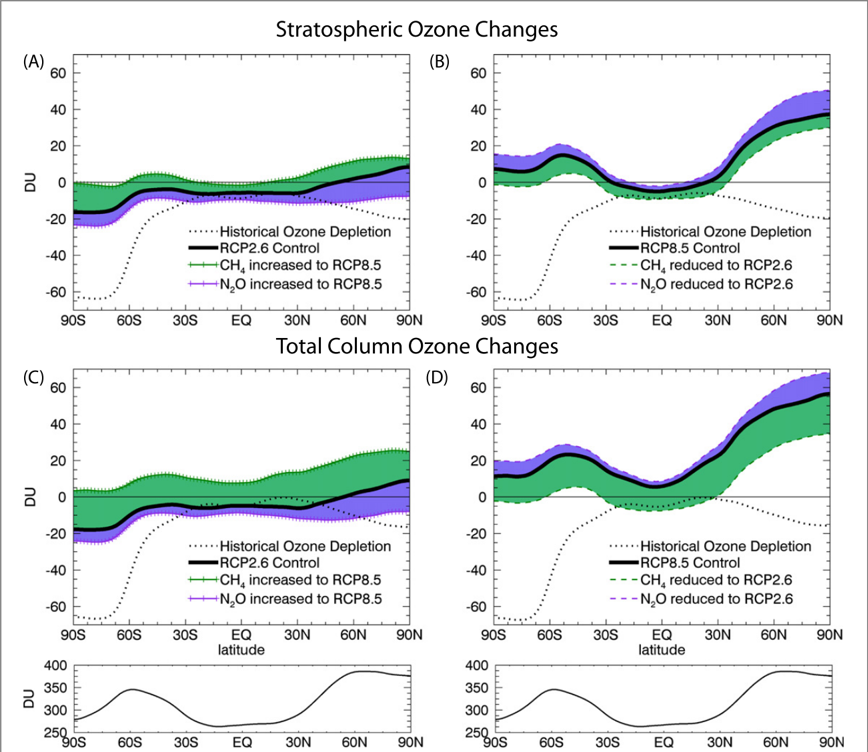
“determined by CO2, N2O, and methane (Eyring et al. 2013; Fleming et al. 2011; Stolarksi et al. 2015; Portmann et al. 2012; Revell et al. 2012; Oman et al. 2010; Iglesias-Suarez et al. 2016).”
BackgroundResultStratospheric ozone depletion from future nitrous oxide increases
Wang, W., Tian, W., Dhomse, S. S., Xie, F., Shu, J., & Austin, J. (2014) · Atmospheric chemistry and physics · doi:10.5194/acp-14-12967-2014 · Cited by 42
Iglesias-Suarez, F., Young, P. J., & Wild, O. (2016) · Atmospheric Chemistry and Physics · doi:10.5194/acp-16-343-2016 · Cited by 36 · cited 1×
“determined by CO2, N2O, and methane (Eyring et al. 2013; Fleming et al. 2011; Stolarksi et al. 2015; Portmann et al. 2012; Revell et al. 2012; Oman et al. 2010; Iglesias-Suarez et al. 2016).”
Self-citationCorrêa, M. D. P., Godin-Beekmann, S. M., Haeffelin, M., Bekki, S., Saïag, P., Badosa, J., Jégou, F., Pazmiño, A., & Mahé, E. (2013) · Photochemical & Photobiological Sciences · doi:10.1039/c3pp50024a · Cited by 31 · cited 2×
“deficiencies are already prevalent (Lucas et al. 2015; Correa et al. 2013).”
BackgroundMeul, S., Oberländer‐Hayn, S., Abalichin, J., & Langematz, U. (2015) · Atmospheric chemistry and physics · doi:10.5194/acp-15-6897-2015 · Cited by 12 · cited 1×
“Although N2O, CH4, and CO2 all exacerbate climate change, they have different, and possibly non-linear (Meul et al 2015), influences on both total column and stratospheric columnozone.”
Background
Cited by
United Nations Environment Programme, E. E. A. P. (2012) · Photochemical & Photobiological Sciences · doi:10.1039/c1pp90033a · Cited by 240
Ozone—climate interactions and effects on solar ultraviolet radiation
Bais, A. F., Bernhard, G., McKenzie, R. L., Aucamp, P. J., Young, P. J., Ilyas, M., Jöckel, P., & Deushi, M. (2019) · Photochemical & Photobiological Sciences · doi:10.1039/c8pp90059k · Cited by 206
Self-citationEstimates of ozone return dates from Chemistry-Climate Model Initiative simulations
Dhomse, S. S., Kinnison, D., Chipperfield, M. P., Salawitch, R. J., Cionni, I., Hegglin, M. I., Abraham, N. L., Akiyoshi, H., Archibald, A. T., Bednarz, E. M., et al. (2018) · Atmospheric Chemistry and Physics · doi:10.5194/acp-18-8409-2018 · Cited by 198
“Many studies have investigated the impacts of CH4, N2O, and CO2 evolution on ozone abundance and recovery (e.g., Haigh & Pyle, 1979; Le Texier et al., 1988; Rosenfield et al., 2002; Randeniya et al., 2002; Royer et al., 2002; Chipperfield and Feng, 2003; Portmann and Solomon, 2007; Shepherd et al., 2008; Ravishankara…”
Delay in recovery of the Antarctic ozone hole from unexpected CFC-11 emissions
Dhomse, S. S., Feng, W., Montzka, S. A., Hossaini, R., Keeble, J., Pyle, J. A., Daniel, J. S., & Chipperfield, M. P. (2019) · Nature Communications · doi:10.1038/s41467-019-13717-x · Cited by 156
Self-citationEffects of Different Stratospheric SO2 Injection Altitudes on Stratospheric Chemistry and Dynamics
Tilmes, S., Richter, J. H., Mills, M. J., Kravitz, B., MacMartin, D. G., Garcia, R. R., Kinnison, D. E., Lamarque, J., Tribbia, J., & Vitt, F. (2018) · Journal of Geophysical Research: Atmospheres · doi:10.1002/2017jd028146 · Cited by 127
Metadata
- Authors
- Butler, A. H., Daniel, J. S., Portmann, R. W., Ravishankara, A. R., Young, P. J., Fahey, D. W., & Rosenlof, K. H.
- Affiliations
- National Oceanic and Atmospheric Administration (US)
- Colorado State University (US)
- Lancaster University (GB)
- Corresponding author
- Butler, A H
- Venue
- Environmental Research Letters
- Publisher
- IOP Publishing
- Published
- 2016-06-01
- Volume
- 11
- Issue
- 6
- Pages
- 064017
- ISSN
- 1748-9326 (ISSN-L)
- OpenAlex
- W2412010961
- Semantic Scholar
- 2ae5def74653f5d3572a97bc31e04c3f8a7f51a4
- Cited by
- 59
- References
- 37
- Citations by year
- 2025: 4 · 2024: 2 · 2023: 12 · 2022: 5 · 2021: 11 · 2020: 5 · 2019: 4 · 2018: 9 · 2017: 3 · 2016: 1
- FWCI
- 3.45
- Type
- journal article
- Language
- en
- Open access
- gold
- doi.org
- Licence
- cc-by
- iopscience.iop.org/info/page/text-and-data-mining (tdm, 19 d)
- creativecommons.org/licenses/by/3.0/ (vor, 19 d)
- Locations
- Environmental Research Letters (publishedVersion, cc-by)
- Lancaster EPrints (Lancaster University) (submittedVersion)
- DOAJ (DOAJ: Directory of Open Access Journals) (submittedVersion)
- NOAA Institutional Repository (submittedVersion)
- Topics
- Physical Sciences › Earth and Planetary Sciences › Atmospheric Science › Atmospheric Ozone and Climate
- Physical Sciences › Earth and Planetary Sciences › Atmospheric Science › Atmospheric chemistry and aerosols
- Physical Sciences › Environmental Science › Global and Planetary Change › Climate variability and models
- Keywords
- stratospheric ozone, surface ultraviolet radiation, Montreal Protocol, ozone-depleting substances, climate policy, greenhouse gas emissions scenarios, nitrous oxide emissions, methane, carbon dioxide, ozone recovery
About these checks
Registry, retraction, Cites and statistics results are computed, not judged, with one exception: a printed reference that no index lists is read once by a model before it counts as a citation error. Claims are extracted by a model and kept only when their quote appears verbatim in the text; each cited source is then checked, with a model’s help, for whether it says what the claim relies on. Those verdicts can be wrong — read the claim’s quote and the cited source before relying on one.
Statistics and arithmetic are recomputed, not judged.
Confidence bands are shown only for fields calibrated on our annotated test set. None is calibrated yet, so no band is shown.
What counts as a claim ›How we measure confidence ›How we check this ›
Are you an author, or do you see a problem with this page? Request a review
Data sources
Bibliographic data: Semantic Scholar, OpenAlex, Crossref.
Contains information from the Semantic Scholar Academic Graph Datasets, made available under the ODC Attribution License (ODC-BY 1.0).
Semantic Scholar’s data is described in: Kinney, R., et al. (2023). The Semantic Scholar Open Data Platform. arXiv:2301.10140.
