

Implications of incorporating air-quality co-benefits into climate change policymaking
Open accessThe DOI matches its Crossref record; 73 of the 74 references it cites were found in a registry or an index.
Abstract
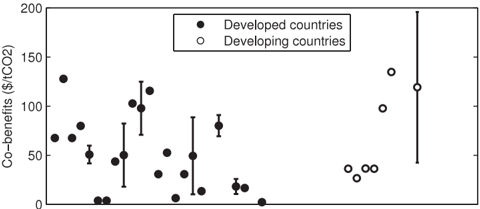
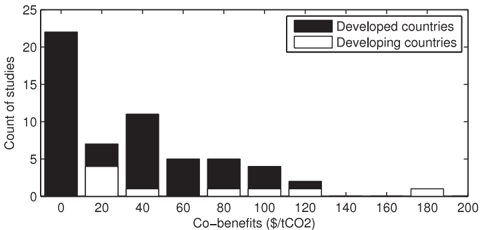
We present an analysis of the barriers and opportunities for incorporating air quality co-benefits into climate policy assessments. It is well known that many strategies for reducing greenhouse gas emissions also decrease emissions of health-damaging air pollutants and precursor species, including particulate matter, nitrogen oxides, and sulfur dioxide. In a survey of previous studies we found a range of estimates for the air quality co-benefits of climate change mitigation of $2 - 196/tCO 2 with a mean of $49/tCO 2 , and the highest co-benefits found in developing countries. These values, although of a similar order of magnitude to abatement cost estimates, are only rarely included in integrated assessments of climate policy. Full inclusion of these co-benefits would have pervasive implications for climate policy in areas including: optimal policy stringency, overall costs, distributional effects, robustness to discount rates, incentives for international cooperation, and the value of adaptation, forests, and climate engineering relative to mitigation. Under-valuation results in part from uncertainty in climatic damages, valuation inconsistency, and institutional barriers. Because policy debates are framed in terms of cost minimization, policy makers are unlikely to fully value air quality co-benefits unless they can be compared on an equivalent basis with the benefits of avoided climatic damages. While air quality co-benefits have been prominently portrayed as a hedge against uncertainty in the benefits of climate change abatement, this assessment finds that full inclusion of co-benefits depends on —rather than substitutes for—better valuation of climate damages.
Overview
The claims and statistics of this paper haven’t been checked yet.
Free: it reads the open-access text and checks the first 5 claims that cite a source we can check. Create a free account to check every claim.
Integrity signals
Registry
Cites
Statistics
Figures
Verification
Claims the paper makes
The claims and statistics of this paper haven’t been checked yet.
Free: it reads the open-access text and checks the first 5 claims that cite a source we can check. Create a free account to check every claim.
Claims other papers make about this one
Each is checked against this paper’s own text: does it say what the citing paper says it does?
The cited source says what the claim attributes to it.
In the citing paper
“mitigation efforts can reduce pollution 11,12”
From Co-benefits of addressing climate change can motivate action around the world (2016) · cites this paper as [11]
The cited source says what the claim attributes to it.
In the citing paper
“Commonly cited co-benefits addressing Dysfunction (for example, pollution, disease 11,12,15,16 ) were actually the weakest motivators of action overall.”
From Co-benefits of addressing climate change can motivate action around the world (2016) · cites this paper as [11]
Self-check
Percentages, sums and reported differences re-computed from the paper’s own numbers.
The self-check needs the paper’s full text.
Citations
Cites
(2007) · London School of Economics and Political Science Research Online (London School of Economics and Political Science) · Cited by 9,690
Slovic, P. (1987) · Science · doi:10.1126/science.3563507 · Cited by 9,271 · cited 2×
“I UK Stern 2005/PAGE2002d 2200 Yes Yes Yes Yes No J US C.B.O. (2009)e 2019 No No No — — K US EIA NEMS (2008)f 2030 Yes No No — — L US EPA ADAGE (2008)g 2050 Yes No No — — M US EPA IGEM (2008)g 2050 Yes No No — —”
BackgroundThe Economics of Climate Change: The Stern Review
Stern, N. (2007) · doi:10.1017/cbo9780511817434 · Cited by 8,371
The "Stern Review" on the Economics of Climate Change
Nordhaus, W. (2006) · National Bureau of Economic Research · doi:10.3386/w12741 · Cited by 2,774
A tale of two market failures: Technology and environmental policy
Jaffe, A. B., Newell, R. G., & Stavins, R. N. (2005) · Ecological Economics · doi:10.1016/j.ecolecon.2004.12.027 · Cited by 1,683
Albedo enhancement by stratospheric sulfur injections: a contribution to resolve a policy dilemma?
Crutzen, P. J. (2006) · Climatic Change · doi:10.1007/s10584-006-9101-y · Cited by 1,541 · cited 1×
“Indeed, some solar radiation modification schemes have the potential to reduce air quality (Crutzen 2006, Victor 2008), and even those with no adverse affect must take into account the opportunity cost of missed air quality improvements.”
BackgroundThe Economic Effects of Climate Change
Tol, R. S. J. (2009) · Journal of Economic Perspectives · doi:10.1257/jep.23.2.29 · Cited by 1,251
A question of balance: weighing the options on global warming policies
(2008) · Choice Reviews Online · doi:10.5860/choice.46-1603 · Cited by 1,239
A Question of Balance: Weighing the Options on Global Warming Policies
Nordhaus, W. (2008) · Yale University Press eBooks · doi:10.2307/j.ctt1npzkh · Cited by 1,081
Lifting the taboo on adaptation
Pielke, R., Prins, G., Rayner, S., & Sarewitz, D. (2007) · Nature · doi:10.1038/445597a · Cited by 557 · cited 1×
“The observed under-prioritization of adaptation and climate engineering relative to mitigation (Pielke et al 2007) may be partially attributable to concern over the loss of AQ co-benefits, even if not explicitly expressed.”
BackgroundThe politics of international regime formation: managing natural resources and the environment
Young, O. R. (1989) · International Organization · doi:10.1017/s0020818300032963 · Cited by 461
Gosling, S. N., Lowe, J. A., McGregor, G. R., Pelling, M., & Malamud, B. D. (2009) · Climatic Change · doi:10.1007/s10584-008-9441-x · Cited by 429 · cited 1×
“Estimation of avoided damages involves ‘deep uncertainty’ because reliable probability distributions of possible outcomes are not available (Lempert 2002, Keller et al 2008, Gosling et al 2009).”
BackgroundA new decision sciences for complex systems
Lempert, R. J. (2002) · Proceedings of the National Academy of Sciences · doi:10.1073/pnas.082081699 · Cited by 346 · cited 1×
“A IPCC IMAGEa 2100 Yes No No — — B IPCC MERGEa 2150 Yes No No — — C IPCC MESSAGEa 2100 Yes No No — — D IPCC MiniCAMa 2100 Yes No No — — E IPCC SGMa 2050 Yes No No — — F IPCC WIAGEMa 2100 Yes No No — — G Nordhaus (2008) DICE-2007b 2200 Yes Yes No — — H UK C.”
Haines, A., Smith, K. R., Anderson, D., Epstein, P. R., McMichael, A. J., Roberts, I., Wilkinson, P., Woodcock, J., & Woods, J. (2007) · The Lancet · doi:10.1016/s0140-6736(07)61257-4 · Cited by 346 · cited 1×
“Many studies discuss the benefits of a more comprehensive assessment and policy (IPCC 2007, Haines et al 2007, Bond 2007).”
BackgroundCritical Assumptions in the Stern Review on Climate Change
Nordhaus, W. (2007) · Science · doi:10.1126/science.1137316 · Cited by 292 · cited 2×
“Valuation of health and life is made worse by disagreement over the appropriate discount rate to use (Stern and Taylor 2007, Nordhaus 2007, Anthoff et al 2009).”
BackgroundThe greenhouse effect: Damages, costs and abatement
Ayres, R. U., & Walter, J. (1991) · Environmental & Resource Economics · doi:10.1007/bf00367920 · Cited by 274
Burtraw, D., Krupnick, A., Palmer, K., Paul, A., Toman, M., & Bloyd, C. (2003) · Journal of Environmental Economics and Management · doi:10.1016/s0095-0696(02)00022-0 · Cited by 260 · cited 2×
“32 Bussolo and O’Connor (2001) India All n.e. n.e. n.e. 33 O’Connor et al (2003) China All n.e. n.e. n.e. 34 Dessus and O’Connor (2003) Chile All n.e. n.e. n.e. 35 Aunan et al (2004) China Electric 36 n.e. n.e. 36 Aunan et al (2004) China Electric 27 n.e. n.e. 37 Aunan et al (2004) China Electric 36 n.e. n.e. 38 Aunan…”
BackgroundOn the regulation of geoengineering
Victor, D. G. (2008) · Oxford Review of Economic Policy · doi:10.1093/oxrep/grn018 · Cited by 218
Co-benefits of climate policy—lessons learned from a study in Shanxi, China
Aunan, K., Fang, J., Vennemo, H., Oye, K., & Seip, H. M. (2004) · Energy Policy · doi:10.1016/s0301-4215(03)00156-3 · Cited by 192
Local air pollution and global climate change: A combined cost-benefit analysis
Bollen, J., van der Zwaan, B., Brink, C., & Eerens, H. (2009) · Resource and Energy Economics · doi:10.1016/j.reseneeco.2009.03.001 · Cited by 189 · cited 1×
“Bollen et al (2009) adapt a version of model B above to perform a cost-benefit analysis that includes both climatic and AQ impacts; they find the AQ co-benefits twice as large as climatic benefits.”
BackgroundBerrens, R. P., Bohara, A. K., Jenkins-Smith, H. C., Silva, C. L., & Weimer, D. L. (2004) · Journal of Environmental Economics and Management · doi:10.1016/s0095-0696(03)00094-9 · Cited by 174
Co-Benefits of Climate Mitigation and Health Protection in Energy Systems: Scoping Methods
Smith, K. R., & Haigler, E. (2008) · Annual Review of Public Health · doi:10.1146/annurev.publhealth.29.020907.090759 · Cited by 159
Exploring the ancillary benefits of the Kyoto Protocol for air pollution in Europe
van Vuuren, D. P., Cofala, J., Eerens, H., Oostenrijk, R., Heyes, C., Klimont, Z., den Elzen, M. G. J., & Amann, M. C. (2004) · Energy Policy · doi:10.1016/j.enpol.2004.06.012 · Cited by 155
Climate Change: Risk, Ethics, and the Stern Review
Stern, N., & Taylor, C. (2007) · Science · doi:10.1126/science.1142920 · Cited by 154 · cited 2×
“Valuation of health and life is made worse by disagreement over the appropriate discount rate to use (Stern and Taylor 2007, Nordhaus 2007, Anthoff et al 2009).”
BackgroundRisk aversion, time preference, and the social cost of carbon
Anthoff, D., Tol, R. S. J., & Yohe, G. W. (2009) · Environmental Research Letters · doi:10.1088/1748-9326/4/2/024002 · Cited by 143 · cited 2×
“Valuation of health and life is made worse by disagreement over the appropriate discount rate to use (Stern and Taylor 2007, Nordhaus 2007, Anthoff et al 2009).”
BackgroundSwart, R., Bernstein, L., Ha-Duong, M., & Petersen, A. (2009) · Climatic Change · doi:10.1007/s10584-008-9444-7 · Cited by 138 · cited 1×
“Cooperation on climate change is difficult in part because the abatement costs in climate policy are so uncertain (Swart et al 2009).”
BackgroundAncillary human health benefits of improved air quality resulting from climate change mitigation
Bell, M. L., Davis, D. L., Cifuentes, L. A., Krupnick, A. J., Morgenstern, R. D., & Thurston, G. D. (2008) · Environmental Health · doi:10.1186/1476-069x-7-41 · Cited by 135 · cited 1×
“Another reason that AQ co-benefits are typically excluded is that valuation results are sensitive to choices about methodology and parameter values (Bell et al 2008).”
BackgroundCifuentes, L., Borja-Aburto, V. H., Gouveia, N., Thurston, G., & Davis, D. L. (2001) · Environmental Health Perspectives · doi:10.1289/ehp.01109s3419 · Cited by 131
Pittel, K., & Rübbelke, D. T. G. (2008) · Ecological Economics · doi:10.1016/j.ecolecon.2008.02.020 · Cited by 128
Patz, J., Campbell-Lendrum, D., Gibbs, H., & Woodruff, R. (2008) · Annual Review of Public Health · doi:10.1146/annurev.publhealth.29.020907.090750 · Cited by 126 · cited 1×
“Development of ‘Health Impact Assessment’ provides one avenue to remedy this problem (Patz et al 2008).”
BackgroundIntercontinental Transport of Air Pollution: Will Emerging Science Lead to a New Hemispheric Treaty?
Holloway, T., Fiore, A., & Hastings, M. G. (2003) · Environmental Science & Technology · doi:10.1021/es034031g · Cited by 115 · cited 1×
“The international policy regime reflects a similar separation; the UN Framework Convention on Climate Change and the Convention on Long-Range Transboundary Air Pollution remain separate despite calls for better integration (Holloway et al 2003).”
Self-citationEnergy Taxation as a Policy Instrument to Reduce CO2 Emissions: A Net Benefit Analysis
Boyd, R., Krutilla, K., & Viscusi, W. K. (1995) · Journal of Environmental Economics and Management · doi:10.1006/jeem.1995.1028 · Cited by 113
A Good Climate for Clean Air: Linkages between Climate Change and Air Pollution. An Editorial Essay
Swart, R. J., Amann, M. C., elisabeth, R. F. P., & Tuinstra, W. (2004) · Climatic Change · doi:10.1023/b:clim.0000044677.41293.39 · Cited by 111 · cited 1×
“Scientifically, the networks of institutions and individuals contributing knowledge on air quality have little overlap with those on climate change (Swart 2004).”
BackgroundManaging the risks of climate thresholds: uncertainties and information needs
Keller, K. M., Yohe, G., & Schlesinger, M. E. (2007) · Climatic Change · doi:10.1007/s10584-006-9114-6 · Cited by 101 · cited 1×
“Estimation of avoided damages involves ‘deep uncertainty’ because reliable probability distributions of possible outcomes are not available (Lempert 2002, Keller et al 2008, Gosling et al 2009).”
BackgroundSecondary Benefits of Greenhouse Gas Control: Health Impacts in China
Wang, X., & Smith, K. R. (1999) · Environmental Science & Technology · doi:10.1021/es981360d · Cited by 91
Missing feedbacks, asymmetric uncertainties, and the underestimation of future warming
Torn, M. S., & Harte, J. (2006) · Geophysical Research Letters · doi:10.1029/2005gl025540 · Cited by 82
Kan, H., Chen, B., Chen, C., Fu, Q., & Chen, M. (2003) · Atmospheric Environment · doi:10.1016/j.atmosenv.2003.09.038 · Cited by 81
Quantification of Local and Global Benefits from Air Pollution Control in Mexico City
McKinley, G., Zuk, M., Höjer, M., Avalos, M., González, I., Iniestra, R., Laguna, I., Martínez, M. A., Osnaya, P., Reynales, L. M., et al. (2005) · Environmental Science & Technology · doi:10.1021/es035183e · Cited by 79
Climate Policy without Tears CGE-Based Ancillary Benefits Estimates for Chile
Dessus, S., & O'Connor, D. (2003) · Environmental and Resource Economics · doi:10.1023/a:1024469430532 · Cited by 78
Low-CO2 energy pathways and regional air pollution in Europe
Syri, S. M., Amann, M. C., Capros, P., Mantzos, L., Cofała, J., & Klimont, Z. (2001) · Energy Policy · doi:10.1016/s0301-4215(01)00022-2 · Cited by 78
Zhang, D., Aunan, K., Seip, H. M., Larssen, S., Liu, J., & Zhang, D. (2009) · Energy Policy · doi:10.1016/j.enpol.2009.09.039 · Cited by 77
The secondary benefits of CO2 abatement: How much emission reduction do they justify?
Ekin, P. (1996) · Ecological Economics · doi:10.1016/0921-8009(95)00054-2 · Cited by 77 · cited 1×
“Especially useful previous reviews include: Ekins (1996), Burtraw et al (2003), IPCC (2007).”
BackgroundOzone air quality and radiative forcing consequences of changes in ozone precursor emissions
West, J. J., Fiore, A. M., Naïk, V., Horowitz, L. W., Schwarzkopf, M. D., & Mauzerall, D. L. (2007) · Geophysical Research Letters · doi:10.1029/2006gl029173 · Cited by 71
Tropospheric ozone and aerosols in climate agreements: scientific and political challenges
Rypdal, K., Berntsen, T. K., Fuglestvedt, J. S., Aunan, K., Torvanger, A., Stordal, F., Pacyna, J. M., & Nygaard, L. P. (2004) · Environmental Science & Policy · doi:10.1016/j.envsci.2004.09.003 · Cited by 68 · cited 1×
“Adding complexity to an already complex regime may reduce salience and consequent political feasibility as well (Young 1989, Rypdal et al 2005).”
BackgroundCan warming particles enter global climate discussions?
Bond, T. C. (2007) · Environmental Research Letters · doi:10.1088/1748-9326/2/4/045030 · Cited by 66
Manne, A. S. (1995) · Energy Policy · doi:10.1016/0301-4215(95)90163-2 · Cited by 65
Domestic Environmental Benefits of China's Energy-Related CDM Potential
Vennemo, H., Aunan, K., Jinghua, F., Holtedahl, P., Hu, T., & Seip, H. M. (2006) · Climatic Change · doi:10.1007/s10584-006-1834-0 · Cited by 64
Co-control of Urban Air Pollutants and Greenhouse Gases in Mexico City
West, J. J., Osnaya, P., Laguna, I., Martínez, J., & Fernández, A. (2004) · Environmental Science & Technology · doi:10.1021/es034716g · Cited by 63
Tollefsen, P., Rypdal, K., Torvanger, A., & Rive, N. A. (2009) · Environmental Science & Policy · doi:10.1016/j.envsci.2009.08.006 · Cited by 63
Coalition Formation and the Ancillary Benefits of Climate PolicyPreprint
Finus, M., & Rübbelke, D. (2008) · SSRN Electronic Journal · doi:10.2139/ssrn.1259699 · Cited by 63
Geo-Engineering to Confine Climate Change: Is it at all Feasible?
Bengtsson, L. (2006) · Climatic Change · doi:10.1007/s10584-006-9133-3 · Cited by 58 · cited 1×
“Concerns about climate engineering schemes that propose reducing radiative forcing without necessarily changing emissions have been raised due to uncertainties about efficacy and side effects (Bengtsson 2006).”
BackgroundLearning and knowing collectively
Norgaard, R. B. (2004) · Ecological Economics · doi:10.1016/j.ecolecon.2004.03.021 · Cited by 56
Sequestration offsets versus direct emission reductions: Consideration of environmental co-effects
Elbakidze, L., & McCarl, B. A. (2006) · Ecological Economics · doi:10.1016/j.ecolecon.2005.12.014 · Cited by 48
Environmentally Responsible Energy Pricing*
Viscusi, W. K., Magat, W. A., Carlin, A., & Dreyfus, M. K. (1994) · The Energy Journal · doi:10.5547/issn0195-6574-ej-vol15-no2-2 · Cited by 45
The Ancillary Carbon Benefits of SO2 Reductions from a Small-Boiler Policy in Taiyuan, PRC
Morgenstern, R. D., Krupnick, A., & Zhang, X. (2004) · The Journal of Environment & Development · doi:10.1177/1070496503260972 · Cited by 38
Clearing the Air in India: The Economics of Climate Policy with Ancillary Benefits
Bussolo, M., & O’Connor, D. (2001) · OECD Development Centre working papers · doi:10.1787/088226224463 · Cited by 38
Bye, B., Kverndokk, S., & Rosendahl, K. E. (2002) · Mitigation and Adaptation Strategies for Global Change · doi:10.1023/a:1024741018194 · Cited by 32
Modeling the impacts of the Finnish Climate Strategy on air pollution
Syri, S. M., Karvosenoja, N., Lehtilä, A., Laurila, T., Lindfors, V., & Tuovinen, J.-P. (2002) · Atmospheric Environment · doi:10.1016/s1352-2310(02)00263-7 · Cited by 32
Benefits of climate policies: Some tentative calculations
Alfsen, K. H., Brendemoen, A., & Glomsrød, S. (1992) · Econstor (Econstor) · Cited by 32
O’Connor, D., Zhai, F., Aunan, K., Berntsen, T. K., & Vennemo, H. (2003) · OECD Development Centre working papers · doi:10.1787/110657276654 · Cited by 31
Electricity restructuring and regional air pollution
Palmer, K., & Burtraw, D. (1997) · Resource and Energy Economics · doi:10.1016/s0928-7655(97)00002-x · Cited by 31
New Frontiers in the Economics of Climate Change
Dietz, S., & Maddison, D. (2009) · Environmental and Resource Economics · doi:10.1007/s10640-009-9278-4 · Cited by 30 · cited 1×
“More broadly, contingent valuation studies suffer from ignorance about what type of climate people actually want (Dietz and Maddison 2009).”
BackgroundLinking health and productivity impacts to climate policy costs: a general equilibrium analysis
Östblom, G., & Samakovlis, E. (2007) · Climate Policy · doi:10.1080/14693062.2007.9685663 · Cited by 24 · cited 1×
“Ostblom and Samakovlis (2007) include co-benefits in a CGE model for Sweden and find that the costs of climate policy are overstated if they are excluded.”
BackgroundNew frontiers in the economics of climate change
Maddison, D. J. (2013) · Cited by 24
Cifuentes, L. A., Borja‐Aburto, V. H., Gouveia, N., Thurston, G. D., & Davis, D. L. (2001) · Environmental Health Perspectives · doi:10.2307/3434790 · Cited by 23
Rübbelke, D., & Pittel, K. (2007) · SSRN Electronic Journal · doi:10.2139/ssrn.1025905 · Cited by 21
A multi-period analysis of a carbon tax including local health feedback: an application to Thailand
Li, J. C. (2006) · Environment and Development Economics · doi:10.1017/s1355770x06002841 · Cited by 20 · cited 1×
“I UK Stern 2005/PAGE2002d 2200 Yes Yes Yes Yes No J US C.B.O. (2009)e 2019 No No No — — K US EIA NEMS (2008)f 2030 Yes No No — — L US EPA ADAGE (2008)g 2050 Yes No No — — M US EPA IGEM (2008)g 2050 Yes No No — —”
Cost containment in climate policy and incentives for technology development
Nemet, G. F. (2010) · Climatic Change · doi:10.1007/s10584-009-9779-8 · Cited by 20 · cited 1×
“Estimates reported by the IPCC alone show a range of carbon prices from $20-100/tCO2 for 25% emissions reduction from business as usual by 2030 (Nemet 2010).”
BackgroundSelf-citationOn the verge of dangerous anthropogenic interference with the climate system?
Kriegler, E. (2007) · Environmental Research Letters · doi:10.1088/1748-9326/2/1/011001 · Cited by 18 · cited 6×
“The international policy regime reflects a similar separation; the UN Framework Convention on Climate Change and the Convention on Long-Range Transboundary Air Pollution remain separate despite calls for better integration (Holloway et al 2003).”
InfluentialEmpirical study of environmental ancillary benefits due to greenhouse gas mitigation in Korea
Joh, S., Nam, Y., Shim, S.-G., Sung, J., & Shin, Y. (2003) · International Journal of Sustainable Development · doi:10.1504/ijsd.2003.004230 · Cited by 13 · cited 1×
“1 Ayres and Walter (1991) US All 68 n.e. n.e. 2 Ayres and Walter (1991) Germany All 128 n.e. n.e. 3 Pearce (1992) Norway All 68 n.e. n.e. 4 Pearce (1992) UK All 80 n.e. n.e. 5 Alfsen et al (1992) Norway All 51 60 42 6 Holmes et al (1993) US Electric 4 n.”
Emission Trading and Public Health
Farrell, A. E., & Lave, L. B. (2004) · Annual Review of Public Health · doi:10.1146/annurev.publhealth.25.102802.124348 · Cited by 12
Interaction between local air pollution and global warming and its policy implications for Belgium
Proost, S. V., & Regemorter, D. V. (2003) · International Journal of Global Environmental Issues · doi:10.1504/ijgenvi.2003.003931 · Cited by 8
Coalition Formation and the Ancillary Benefits of Climate PolicyPreprint
Finus, M., Rübbelke, D., Finus, M., et al. (2008) · RePEc: Research Papers in Economics · doi:10.22004/ag.econ.42902 · Cited by 7
Linking health and productivity impacts to climate policy costs: a general equilibrium analysis
Östblom, G., & Samakovlis, E. (2007) · Climate Policy · doi:10.3763/cpol.2007.0720 · Cited by 6
Research works printed but not linked: 18
- Amann M et al 2009 Potentials and Costs for Greenhouse Gas Mitigation in Annex 1 Countries: Initial Results (Laxenburg: International Institute for Applied Systems Analysis)
- Barker T 1993 Secondary Benefits of Greenhouse Gas Abatement: The Effects of a UK Carbon/Energy Tax on Air Pollution (Cambridge: Department of Applied Economics, University of Cambridge)
- Caton R, 2000, Clearing the Air: A Preliminary Analysis of Air Quality Co-Benefits from Reduced Greenhouse Gas Emissions in Canada
- Caton R and Constable S 2000 Clearing the Air: A Preliminary Analysis of Air Quality Co-Benefits from Reduced Greenhouse Gas Emissions in Canada The David Suzuki Foundation CBO 2009 Congressional Budget Office Cost Estimate of H.R. 2454, American Clean Energy and Security Act of 2009 (Washington DC: Congressional Budget Office)
- DECC 2008 Climate Change Act 2008 Impact Assessment (London: UK Department of Energy and Climate Change)
- Dowlatabadi H, 1993, Estimating the Ancillary Benefits of Selected Carbon Dioxide Mitigation Strategies: Electicity Sector
- Dowlatabadi H, Tschang F and Siegel S 1993 Estimating the Ancillary Benefits of Selected Carbon Dioxide Mitigation Strategies: Electicity Sector Climate Change Division, US Environmental Protection Agency EIA 2008 Energy Market and Economic Impacts of S.1766, the Low Carbon Economy Act of 2007 (Washington DC: Energy Information Administration)
- 1997, Regulatory Impact Analysis for the Particulate Matter and Ozone National Ambient Air Quality Standards and Proposed Regional Haze Rule
- 2008, EPA’s Economic Analysis of the Low Carbon Economy Act of 2007 (S.1766)
- Goulder L 1993 Economy-Wide Emissions Impacts of Alternative Energy Tax Proposals Climate Change Division, US Environmental Protection Agency
- Han H 2001 Analysis of the Environmental Benefits of Reductions in Greenhouse Gas Emissions (Seoul: Korean Environmental Institute)
- Holmes R, 1993, Ancillary Benefits of Mitigating Climate Change: Selected Actions from the Climate Change Action Plan
- Holmes R, Keinath D and Sussman F 1993 Ancillary Benefits of Mitigating Climate Change: Selected Actions from the Climate Change Action Plan Climate Change Division, US Environmental Protection Agency IPCC 2007 Climate change 2007: Mitigation. Contribution of Working group III to the 4th Assessment Report of the Intergovernmental Panel on Climate Change (Cambridge: Cambridge University Press)
- Johnson M 2001 'Hidden Health Benefits of Greenhouse Gas Mitigation' offers nothing to policy-makers (eLetter response) Science www.sciencemag.org/cgi/eletters/293/5533/1257
- Mccubbin D, 1999, Co-Control Benefits of Greenhouse Gas Control Policies
- Nemet G, 2010, Clim. Change
- Pearce D W, 1992, The Secondary Benefits of Greenhouse Gas Control
- Rowe R, 1995, The New York State Externalities Cost Study
Cited by
The Economic Effects of Climate Change
Tol, R. S. J. (2009) · Journal of Economic Perspectives · doi:10.1257/jep.23.2.29 · Cited by 1,251
Review on Ammonia as a Potential Fuel: From Synthesis to Economics
Valera-Medina, A., Amer-Hatem, F., Azad, A. K., Dedoussi, I. C., de Joannon, M., Fernandes, R. X., Glarborg, P., Hashemi, H., He, X., Mashruk, S., et al. (2021) · Energy & Fuels · doi:10.1021/acs.energyfuels.0c03685 · Cited by 1,061
Co-benefits of mitigating global greenhouse gas emissions for future air quality and human health
West, J. J., Smith, S. J., Silva, R. A., Naik, V., Zhang, Y., Adelman, Z., Fry, M. M., Anenberg, S., Horowitz, L. W., & Lamarque, J.-F. (2013) · Nature Climate Change · doi:10.1038/nclimate2009 · Cited by 764
Climate Change: Challenges and Opportunities for Global Health
Patz, J. A., Frumkin, H., Holloway, T., Vimont, D. J., & Haines, A. (2014) · JAMA · doi:10.1001/jama.2014.13186 · Cited by 576
Self-citationHarlan, S. L., & Ruddell, D. M. (2011) · Current Opinion in Environmental Sustainability · doi:10.1016/j.cosust.2011.01.001 · Cited by 503
Metadata
- Authors
- Nemet, G. F., Holloway, T., & Meier, P.
- Affiliations
- University of Wisconsin–Madison (US)
- Venue
- Environmental Research Letters
- Publisher
- IOP Publishing
- Published
- 2010-01
- Volume
- 5
- Issue
- 1
- Pages
- 014007
- ISSN
- 1748-9326 (ISSN-L)
- OpenAlex
- W2099269882
- Semantic Scholar
- 6fc02bfc2b956b0db9f559129bcf336be95d27f2
- Cited by
- 411
- References
- 71
- Citations by year
- 2026: 16 · 2025: 12 · 2024: 16 · 2023: 22 · 2022: 22 · 2021: 25 · 2020: 33 · 2019: 25 · 2018: 48 · 2017: 29 · 2016: 32 · 2015: 35 · 2014: 29 · 2013: 21 · 2012: 13
- FWCI
- 49.81
- Type
- journal article
- Language
- en
- Open access
- gold
- doi.org
- Licence
- cc-by
- Locations
- Environmental Research Letters (publishedVersion, cc-by)
- Topics
- Social Sciences › Economics, Econometrics and Finance › Economics and Econometrics › Climate Change Policy and Economics
- Physical Sciences › Environmental Science › Global and Planetary Change › Climate Change and Geoengineering
- Physical Sciences › Environmental Science › Environmental Engineering › Environmental and Air Quality Management
- Keywords
- air quality co-benefits, climate change mitigation, greenhouse gas emissions reduction, particulate matter, nitrogen oxides, sulfur dioxide, climate policy assessment, integrated assessment models, discount rate, international climate cooperation, geoengineering, forests, distributional effects
About these checks
Registry, retraction, Cites and statistics results are computed, not judged, with one exception: a printed reference that no index lists is read once by a model before it counts as a citation error. Claims are extracted by a model and kept only when their quote appears verbatim in the text; each cited source is then checked, with a model’s help, for whether it says what the claim relies on. Those verdicts can be wrong — read the claim’s quote and the cited source before relying on one.
Statistics and arithmetic are recomputed, not judged.
Confidence bands are shown only for fields calibrated on our annotated test set. None is calibrated yet, so no band is shown.
What counts as a claim ›How we measure confidence ›How we check this ›
Are you an author, or do you see a problem with this page? Request a review
Data sources
Bibliographic data: Semantic Scholar, OpenAlex, Crossref.
Contains information from the Semantic Scholar Academic Graph Datasets, made available under the ODC Attribution License (ODC-BY 1.0).
Semantic Scholar’s data is described in: Kinney, R., et al. (2023). The Semantic Scholar Open Data Platform. arXiv:2301.10140.
