

Implications of incorporating air-quality co-benefits into climate change policymaking
Open accessThe DOI matches its Crossref record; 73 of the 74 references it cites were found in a registry or an index.
Abstract
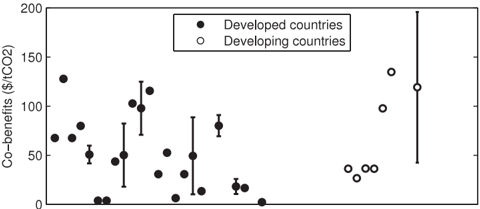
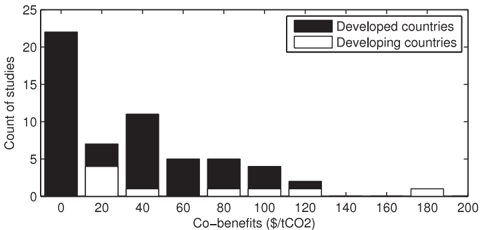
We present an analysis of the barriers and opportunities for incorporating air quality co-benefits into climate policy assessments. It is well known that many strategies for reducing greenhouse gas emissions also decrease emissions of health-damaging air pollutants and precursor species, including particulate matter, nitrogen oxides, and sulfur dioxide. In a survey of previous studies we found a range of estimates for the air quality co-benefits of climate change mitigation of $2 - 196/tCO 2 with a mean of $49/tCO 2 , and the highest co-benefits found in developing countries. These values, although of a similar order of magnitude to abatement cost estimates, are only rarely included in integrated assessments of climate policy. Full inclusion of these co-benefits would have pervasive implications for climate policy in areas including: optimal policy stringency, overall costs, distributional effects, robustness to discount rates, incentives for international cooperation, and the value of adaptation, forests, and climate engineering relative to mitigation. Under-valuation results in part from uncertainty in climatic damages, valuation inconsistency, and institutional barriers. Because policy debates are framed in terms of cost minimization, policy makers are unlikely to fully value air quality co-benefits unless they can be compared on an equivalent basis with the benefits of avoided climatic damages. While air quality co-benefits have been prominently portrayed as a hedge against uncertainty in the benefits of climate change abatement, this assessment finds that full inclusion of co-benefits depends on —rather than substitutes for—better valuation of climate damages.
Overview
The claims and statistics of this paper haven’t been checked yet.
Free: it reads the open-access text and checks the first 5 claims that cite a source we can check. Create a free account to check every claim.
Integrity signals
Registry
Cites
Statistics
Figures
Verification
Claims the paper makes
The claims and statistics of this paper haven’t been checked yet.
Free: it reads the open-access text and checks the first 5 claims that cite a source we can check. Create a free account to check every claim.
Claims other papers make about this one
Each is checked against this paper’s own text: does it say what the citing paper says it does?
The cited source says what the claim attributes to it.
In the citing paper
“mitigation efforts can reduce pollution 11,12”
From Co-benefits of addressing climate change can motivate action around the world (2016) · cites this paper as [11]
The cited source says what the claim attributes to it.
In the citing paper
“Commonly cited co-benefits addressing Dysfunction (for example, pollution, disease 11,12,15,16 ) were actually the weakest motivators of action overall.”
From Co-benefits of addressing climate change can motivate action around the world (2016) · cites this paper as [11]
Self-check
Percentages, sums and reported differences re-computed from the paper’s own numbers.
The self-check needs the paper’s full text.
Citations
Cites
(2007) · London School of Economics and Political Science Research Online (London School of Economics and Political Science) · Cited by 9,690
Slovic, P. (1987) · Science · doi:10.1126/science.3563507 · Cited by 9,271 · cited 2×
“I UK Stern 2005/PAGE2002d 2200 Yes Yes Yes Yes No J US C.B.O. (2009)e 2019 No No No — — K US EIA NEMS (2008)f 2030 Yes No No — — L US EPA ADAGE (2008)g 2050 Yes No No — — M US EPA IGEM (2008)g 2050 Yes No No — —”
BackgroundThe Economics of Climate Change: The Stern Review
Stern, N. (2007) · doi:10.1017/cbo9780511817434 · Cited by 8,371
The "Stern Review" on the Economics of Climate Change
Nordhaus, W. (2006) · National Bureau of Economic Research · doi:10.3386/w12741 · Cited by 2,774
A tale of two market failures: Technology and environmental policy
Jaffe, A. B., Newell, R. G., & Stavins, R. N. (2005) · Ecological Economics · doi:10.1016/j.ecolecon.2004.12.027 · Cited by 1,683
Albedo enhancement by stratospheric sulfur injections: a contribution to resolve a policy dilemma?
Crutzen, P. J. (2006) · Climatic Change · doi:10.1007/s10584-006-9101-y · Cited by 1,541 · cited 1×
“Indeed, some solar radiation modification schemes have the potential to reduce air quality (Crutzen 2006, Victor 2008), and even those with no adverse affect must take into account the opportunity cost of missed air quality improvements.”
BackgroundThe Economic Effects of Climate Change
Tol, R. S. J. (2009) · Journal of Economic Perspectives · doi:10.1257/jep.23.2.29 · Cited by 1,251
A question of balance: weighing the options on global warming policies
(2008) · Choice Reviews Online · doi:10.5860/choice.46-1603 · Cited by 1,239
A Question of Balance: Weighing the Options on Global Warming Policies
Nordhaus, W. (2008) · Yale University Press eBooks · doi:10.2307/j.ctt1npzkh · Cited by 1,081
Lifting the taboo on adaptation
Pielke, R., Prins, G., Rayner, S., & Sarewitz, D. (2007) · Nature · doi:10.1038/445597a · Cited by 557 · cited 1×
“The observed under-prioritization of adaptation and climate engineering relative to mitigation (Pielke et al 2007) may be partially attributable to concern over the loss of AQ co-benefits, even if not explicitly expressed.”
Background
Research works printed but not linked: 18
- Amann M et al 2009 Potentials and Costs for Greenhouse Gas Mitigation in Annex 1 Countries: Initial Results (Laxenburg: International Institute for Applied Systems Analysis)
- Barker T 1993 Secondary Benefits of Greenhouse Gas Abatement: The Effects of a UK Carbon/Energy Tax on Air Pollution (Cambridge: Department of Applied Economics, University of Cambridge)
- Caton R, 2000, Clearing the Air: A Preliminary Analysis of Air Quality Co-Benefits from Reduced Greenhouse Gas Emissions in Canada
- Caton R and Constable S 2000 Clearing the Air: A Preliminary Analysis of Air Quality Co-Benefits from Reduced Greenhouse Gas Emissions in Canada The David Suzuki Foundation CBO 2009 Congressional Budget Office Cost Estimate of H.R. 2454, American Clean Energy and Security Act of 2009 (Washington DC: Congressional Budget Office)
- DECC 2008 Climate Change Act 2008 Impact Assessment (London: UK Department of Energy and Climate Change)
- Dowlatabadi H, 1993, Estimating the Ancillary Benefits of Selected Carbon Dioxide Mitigation Strategies: Electicity Sector
- Dowlatabadi H, Tschang F and Siegel S 1993 Estimating the Ancillary Benefits of Selected Carbon Dioxide Mitigation Strategies: Electicity Sector Climate Change Division, US Environmental Protection Agency EIA 2008 Energy Market and Economic Impacts of S.1766, the Low Carbon Economy Act of 2007 (Washington DC: Energy Information Administration)
- 1997, Regulatory Impact Analysis for the Particulate Matter and Ozone National Ambient Air Quality Standards and Proposed Regional Haze Rule
- 2008, EPA’s Economic Analysis of the Low Carbon Economy Act of 2007 (S.1766)
- Goulder L 1993 Economy-Wide Emissions Impacts of Alternative Energy Tax Proposals Climate Change Division, US Environmental Protection Agency
- Han H 2001 Analysis of the Environmental Benefits of Reductions in Greenhouse Gas Emissions (Seoul: Korean Environmental Institute)
- Holmes R, 1993, Ancillary Benefits of Mitigating Climate Change: Selected Actions from the Climate Change Action Plan
- Holmes R, Keinath D and Sussman F 1993 Ancillary Benefits of Mitigating Climate Change: Selected Actions from the Climate Change Action Plan Climate Change Division, US Environmental Protection Agency IPCC 2007 Climate change 2007: Mitigation. Contribution of Working group III to the 4th Assessment Report of the Intergovernmental Panel on Climate Change (Cambridge: Cambridge University Press)
- Johnson M 2001 'Hidden Health Benefits of Greenhouse Gas Mitigation' offers nothing to policy-makers (eLetter response) Science www.sciencemag.org/cgi/eletters/293/5533/1257
- Mccubbin D, 1999, Co-Control Benefits of Greenhouse Gas Control Policies
- Nemet G, 2010, Clim. Change
- Pearce D W, 1992, The Secondary Benefits of Greenhouse Gas Control
- Rowe R, 1995, The New York State Externalities Cost Study
Cited by
The Economic Effects of Climate Change
Tol, R. S. J. (2009) · Journal of Economic Perspectives · doi:10.1257/jep.23.2.29 · Cited by 1,251
Review on Ammonia as a Potential Fuel: From Synthesis to Economics
Valera-Medina, A., Amer-Hatem, F., Azad, A. K., Dedoussi, I. C., de Joannon, M., Fernandes, R. X., Glarborg, P., Hashemi, H., He, X., Mashruk, S., et al. (2021) · Energy & Fuels · doi:10.1021/acs.energyfuels.0c03685 · Cited by 1,061
Co-benefits of mitigating global greenhouse gas emissions for future air quality and human health
West, J. J., Smith, S. J., Silva, R. A., Naik, V., Zhang, Y., Adelman, Z., Fry, M. M., Anenberg, S., Horowitz, L. W., & Lamarque, J.-F. (2013) · Nature Climate Change · doi:10.1038/nclimate2009 · Cited by 764
Climate Change: Challenges and Opportunities for Global Health
Patz, J. A., Frumkin, H., Holloway, T., Vimont, D. J., & Haines, A. (2014) · JAMA · doi:10.1001/jama.2014.13186 · Cited by 576
Self-citationHarlan, S. L., & Ruddell, D. M. (2011) · Current Opinion in Environmental Sustainability · doi:10.1016/j.cosust.2011.01.001 · Cited by 503
Metadata
- Authors
- Nemet, G. F., Holloway, T., & Meier, P.
- Affiliations
- University of Wisconsin–Madison (US)
- Venue
- Environmental Research Letters
- Publisher
- IOP Publishing
- Published
- 2010-01
- Volume
- 5
- Issue
- 1
- Pages
- 014007
- ISSN
- 1748-9326 (ISSN-L)
- OpenAlex
- W2099269882
- Cited by
- 411
- References
- 71
- Citations by year
- 2026: 16 · 2025: 12 · 2024: 16 · 2023: 22 · 2022: 22 · 2021: 25 · 2020: 33 · 2019: 25 · 2018: 48 · 2017: 29 · 2016: 32 · 2015: 35 · 2014: 29 · 2013: 21 · 2012: 13
- FWCI
- 49.81
- Type
- journal article
- Language
- en
- Open access
- gold
- doi.org
- Licence
- cc-by
- Locations
- Environmental Research Letters (publishedVersion, cc-by)
- Topics
- Social Sciences › Economics, Econometrics and Finance › Economics and Econometrics › Climate Change Policy and Economics
- Physical Sciences › Environmental Science › Global and Planetary Change › Climate Change and Geoengineering
- Physical Sciences › Environmental Science › Environmental Engineering › Environmental and Air Quality Management
- Keywords
- air quality co-benefits, climate change mitigation, greenhouse gas emissions reduction, particulate matter, nitrogen oxides, sulfur dioxide, climate policy assessment, integrated assessment models, discount rate, international climate cooperation, geoengineering, forests, distributional effects
About these checks
Registry, retraction, Cites and statistics results are computed, not judged, with one exception: a printed reference that no index lists is read once by a model before it counts as a citation error. Claims are extracted by a model and kept only when their quote appears verbatim in the text; each cited source is then checked, with a model’s help, for whether it says what the claim relies on. Those verdicts can be wrong — read the claim’s quote and the cited source before relying on one.
Statistics and arithmetic are recomputed, not judged.
Confidence bands are shown only for fields calibrated on our annotated test set. None is calibrated yet, so no band is shown.
What counts as a claim ›How we measure confidence ›How we check this ›
Are you an author, or do you see a problem with this page? Request a review
Data sources
Bibliographic data: Semantic Scholar, OpenAlex, Crossref.
Contains information from the Semantic Scholar Academic Graph Datasets, made available under the ODC Attribution License (ODC-BY 1.0).
Semantic Scholar’s data is described in: Kinney, R., et al. (2023). The Semantic Scholar Open Data Platform. arXiv:2301.10140.
