

Surface albedo following biochar application in durum wheat
Open accessThe DOI matches its Crossref record; 42 of the 43 references it cites were found in a registry or an index.
Abstract
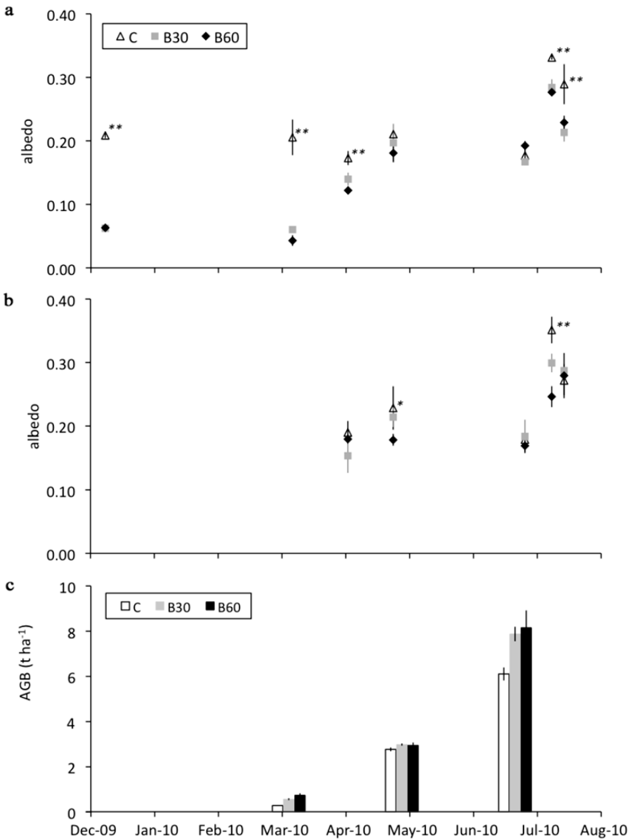
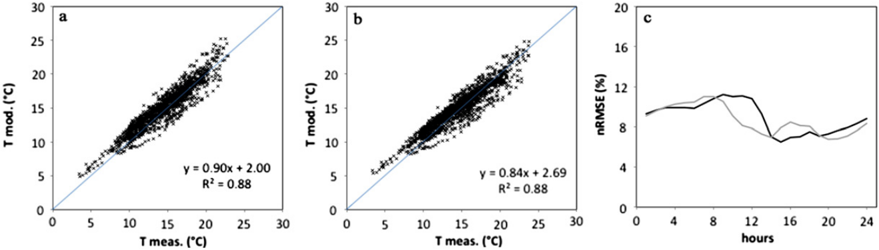
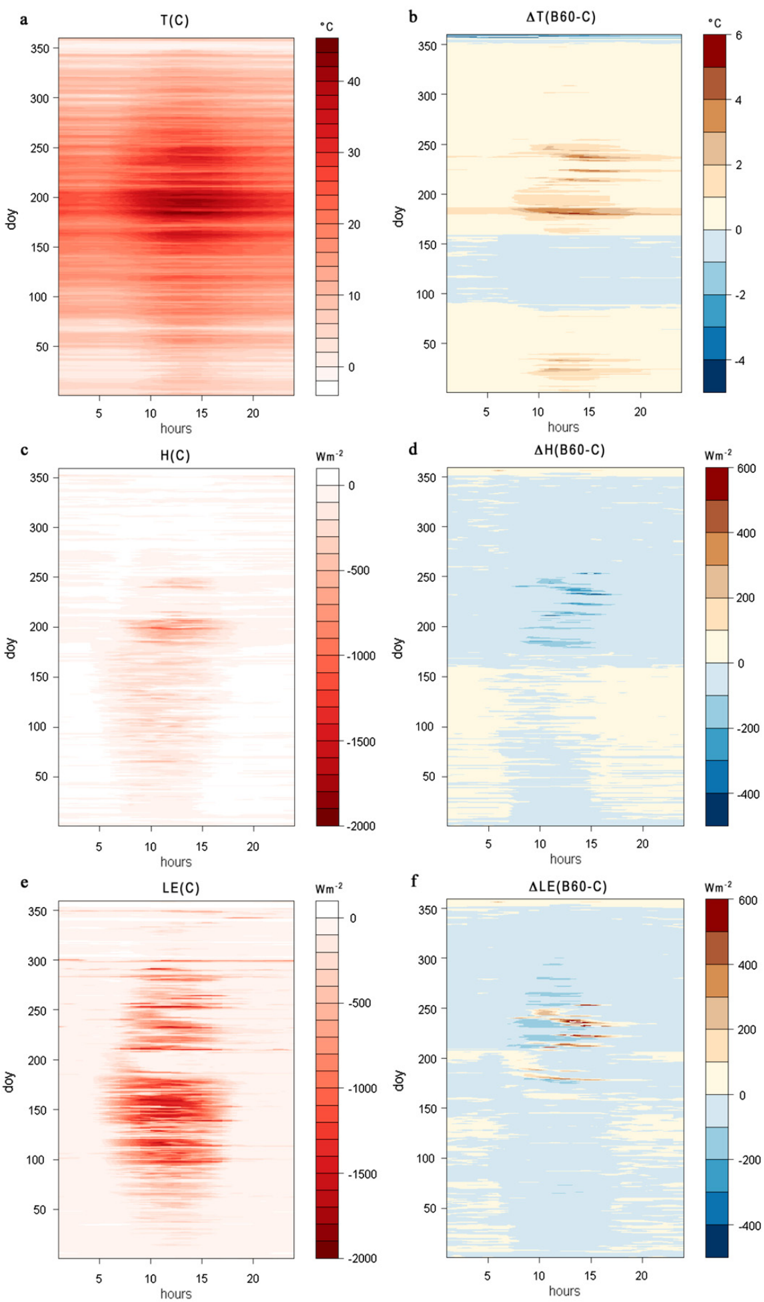
The agronomic use of charcoal from biomass pyrolysis (biochar) represents an interesting option for increasing soil fertility and sequestering atmospheric CO 2 . However, before moving toward large-scale biochar applications, additional research must evaluate all possible land–atmosphere feedbacks. Despite the increasing number of studies investigating the effect of biochar on soil physical, chemical and biological properties, only a few have been done on surface albedo variations on agricultural lands. The present work had the aim of characterizing the annual albedo cycle for a durum wheat crop in Central Italy, by means of a spectroradiometer measurement campaign. Plots treated with biochar, at a rate of 30–60 t ha −1 , showed a surface albedo decrease of up to 80% (after the application) with respect to the control in bare soil conditions, while this difference tended to decrease during the crop growing season, because of the prevailing effect of canopy development on the radiometer response. After the post-harvesting tillage, the soil treated with biochar again showed a lower surface albedo value (<20–26% than the control), while the measurements taken in the second year after application suggested a clear decrease of biochar influence on soil color. The modeling of the surface energy balance highlighted changes in the partitioning of heat fluxes and in particular a substantial increase of ground heat fluxes on an annual basis.
Overview
The claims and statistics of this paper haven’t been checked yet.
Free: it reads the open-access text and checks the first 5 claims that cite a source we can check. Create a free account to check every claim.
Integrity signals
Registry
Cites
Statistics
Figures
Verification
Claims the paper makes
The claims and statistics of this paper haven’t been checked yet.
Free: it reads the open-access text and checks the first 5 claims that cite a source we can check. Create a free account to check every claim.
Claims other papers make about this one
Each is checked against this paper’s own text: does it say what the citing paper says it does?
The source backs part of the claim, not all of it — or backs it for a different population, condition or comparison.
In the citing paper
“Studies suggest that alterations in albedo could decrease the climate mitigation potential of biochar by 20 e 26% [45]”
From Life cycle assessment of biochar as a green sorbent for soil remediation (2024) · cites this paper as [45]
Experimental — accuracy not yet measuredThe cited source says what the claim attributes to it.
In the citing paper
“Changes in surface albedo due to the darkening of soils after biochar application could result in warming feedback that reduces the climate mitigation potential of biochar”
From Life cycle assessment of biochar as a green sorbent for soil remediation (2024) · cites this paper as [45]
Self-check
Percentages, sums and reported differences re-computed from the paper’s own numbers.
The self-check needs the paper’s full text.
Citations
Cites
A decimal code for the growth stages of cereals
ZADOKS, J. C., CHANG, T. T., & KONZAK, C. F. (1974) · Weed Research · doi:10.1111/j.1365-3180.1974.tb01084.x · Cited by 10,173
Forests and Climate Change: Forcings, Feedbacks, and the Climate Benefits of Forests
Bonan, G. B. (2008) · Science · doi:10.1126/science.1155121 · Cited by 6,238
Changes in Atmospheric Constituents and in Radiative Forcing
Forster, P. M. D. F., Ramaswamy, V., Artaxo, P. E., Berntsen, T. K., Betts, R., Fahey, D. W., Haywood, J., Lean, J. L., Lowe, D. C., Myhre, G., et al. (2007) · elib (German Aerospace Center) · Cited by 5,216
Sustainable biochar to mitigate global climate change
Woolf, D., Amonette, J. E., Street-Perrott, F. A., Lehmann, J., & Joseph, S. (2010) · Nature Communications · doi:10.1038/ncomms1053 · Cited by 2,680 · cited 2×
“Mitigation potentials of biochar were estimated to be as high as 12% of current anthropogenic CO2 emissions (Woolf et al 2010), something that might be possibly achieved under a win–win framework leading to a substantial enhancement of soil fertility (Sohi et al 2010), increased crop yields and…”
BackgroundInfluentialA review of biochar and its use and function in soil
Sohi, S. P., Krull, E., Lopez-Capel, E., & Bol, R. (2010) · Advances in Agronomy · doi:10.1016/s0065-2113(10)05002-9 · Cited by 2,240
Peixoto, J. P., & Oort, A. H. (1992) · Medical Entomology and Zoology · Cited by 1,943
Agronomic values of greenwaste biochar as a soil amendment
Chan, K. Y., Van Zwieten, L., Meszaros, I., Downie, A., & Joseph, S. (2007) · Soil Research · doi:10.1071/sr07109 · Cited by 1,902
Lehmann, J., Pereira da Silva, J., Steiner, C., Nehls, T., Zech, W., & Glaser, B. (2003) · Plant and Soil · doi:10.1023/a:1022833116184 · Cited by 1,878 · cited 1×
“Most of the recent research on biochar focused on its effect on plant productivity (Lehmann et al 2003, Yamato et al 2006, Chan et al 2007, Rondon et al 2007, Van Zwieten et al 2008, Baronti et al 2010, Vaccari et al 2011).”
BackgroundLehmann, J. (2007) · Frontiers in Ecology and the Environment · doi:10.1890/1540-9295(2007)5[381:bitb]2.0.co;2 · Cited by 1,714 · cited 1×
“The application of charred biomass residues (biochar) to soils is considered one of the most promising strategies to sustainably sequester atmospheric CO2 in agricultural soils (Lehmann 2007, Woodward et al 2009, Sohi et al 2010).”
Background
Research works printed but not linked: 1
- Van Zwieten L, Kimber S, Sinclair K, Chan K Y and Downie A 2008 Biochar: potential for climate change mitigation, improved yield and soil health Proc. 23rd Annu. Conf. of the Grassland Society of NSW pp 30-3
Cited by
Items 101–174 of 174
Softwood biochar as a soil amendment material for boreal agriculture
Tammeorg, P. (2014) · Helda - University of Helsinki Institutional Repository · Cited by 7
Yu, K., Su, Y., Ciais, P., Lauerwald, R., Ceschia, É., Makowski, D., Xu, Y., Abbessi, E., Bazzi, H., Tallec, T., et al. (2024) · Environmental Research Letters · doi:10.1088/1748-9326/ad5859 · Cited by 6
“Cover crops and biochar are also not evaluated here but were shown to have been addressed as having significant impacts on surface albedo through alterations in crop structure and leaf traits, and soil pigmentation, respectively (Genesio et al 2012, Lugato et al 2020).”
BackgroundHuang, C., Hou, S., Wang, B., Yuchuan, S., Abulatijiang, A., Min, J., Sheng, J., Jiang, P., Wang, Z., & Cheng, J. (2025) · Journal of Arid Land · doi:10.1007/s40333-025-0054-2 · Cited by 5
“Finally, the dark color of biochar alters the thermal dynamics of soil, leading to a positive effect on seed germination (Genesio et al., 2012), suggesting that the application of biochar could increase crop density.”
Accounting for albedo in carbon market protocols
Riley, L., Cook‐Patton, S. C., Albert, L. P., Still, C. J., Williams, C. A., & Bukoski, J. J. (2025) · Nature Communications · doi:10.1038/s41467-025-64317-x · Cited by 5
“As with ARR, albedo and other bio-physical factors are likely to be relevant to Improved Forest Management, Reduced Deforestation and Degradation, and biochar projects 58,59 .”
Lü, S., Meng, F., Zhang, R. Q., Wang, Y., Hou, X., Pan, J., Pei, X., & Yang, H. (2026) · Agronomy · doi:10.3390/agronomy16020143 · Cited by 5
Burgeon, V. (2017) · Cited by 5
Storing Carbon for Geologically Long Timescales to Engineer Climate
Haszeldine, R. S., & Scott, V. (2014) · Royal Society of Chemistry eBooks · doi:10.1039/9781782621225-00022 · Cited by 5
Biochar amendment and greenhouse gas emissions from agricultural soils
Case, S. D. C. (2013) · NERC Open Research Archive (Natural Environment Research Council) · Cited by 5
Musumuvhi, T. (2018) · Cited by 5
Biological Carbon Sequestration Technologies
Vetter, S. H., Kuhnert, M., & Smith, P. (2022) · Elsevier eBooks · doi:10.1016/b978-0-323-90386-8.00041-3 · Cited by 5
Mak‐Mensah, E., Zhao, W., Zhou, X., Zhang, D., Zhao, X., Wang, Q., & Obour, P. B. (2022) · Journal of Soils and Sediments · doi:10.1007/s11368-022-03262-4 · Cited by 4
“Again, RFRH has been demonstrated in many studies to increase soil temperature as compared to flat planting (Genesio et al. 2012).”
BackgroundPhillips, C. L., Meyer, K. M., Hanson, C. V., Biraud, S. C., & Trippe, K. M. (2021) · Soil Science Society of America Journal · doi:10.1002/saj2.20207 · Cited by 4
Biochar Application to Soil to Improve Fertility
Zafar, S., Khan, I. M., Muddasar, M., Iqbal, R., Bashir, T., Shahzad, A., Bashir, S., & Shah, A. A. (2023) · Sustainable agriculture reviews · doi:10.1007/978-3-031-26983-7_4 · Cited by 4
Dzokom, A. (2024) · SSRN Electronic Journal · doi:10.2139/ssrn.4937663 · Cited by 5
Criscuoli, I. (2016) · theses.fr (ABES) · doi:10.70675/18fb3e13z4458z4cfbza92bz12e7bb1f3fe2 · Cited by 4
Reflecting on surface albedo and climate
Gottschalk, P., Klumpp, K., Cardinael, R., Ceschia, É., Diop, S., Genesio, L., Khalil, M. I., Kruijt, B., Lugato, E., Roujean, J., et al. (2026) · Climate Research · doi:10.3354/cr01764 · Cited by 3
Self-citationHussain, S., Hayat, R., Ullah, S., Ashraf, M., Dara, R. N., Ashraf, M. A., Khan, S. U., Norberdiyeva, M., Gupta, M., & Khan, M. A. (2024) · RENDICONTI LINCEI · doi:10.1007/s12210-024-01273-6 · Cited by 3
“Genesio et al. (2012) estimated the significance of biochar with organic amendments like composting.”
Biochar effects on durum wheat (Triticum durum) under ambient and elevated atmospheric CO2
Brilli, L., Badeck, F., Genesio, L., Baronti, S., Rizza, F., Fares, C., Cattivelli, L., Miglietta, F., Maienza, A., Zaldei, A., et al. (2025) · Journal of Agriculture and Food Research · doi:10.1016/j.jafr.2025.101719 · Cited by 3
Self-citationAltıkat, A., Alma, M. H., & Altıkat, S. (2022) · International Journal of Energy Research · doi:10.1002/er.8577 · Cited by 3
“24 In another study conducted in Germany, a 12% reduction in soil albedo was observed when biochar was mixed into the soil.”
BackgroundBiochar Role in Soil Carbon Stabilization and Crop Productivity
Přichystalová, J., Holátko, J., Hammerschmiedt, T., Datta, R., Meena, R. S., Šudoma, M., Bielská, L., Radziemska, M., Gusiatin, Z. M., Kintl, A., et al. (2021) · Springer eBooks · doi:10.1007/978-981-33-6765-4_1 · Cited by 3
Mechler, M. A. A. (2018) · UWSpace (University of Waterloo) · Cited by 4
Caquet, T., Axelos, M., Soussana, J., Martin, E., Renault, P., Augusto, L., Baumont, R., Bernet, N., Constantin, J., Fillaudeau, L., et al. (2024) · HAL · doi:10.17180/cvm4-ak69 · Cited by 3
Dayoub, E. B., Tóth, Z., & Anda, A. (2024) · Archives of Agronomy and Soil Science · doi:10.1080/03650340.2024.2398039 · Cited by 2
“This could be explained by biochar ‘s ability to significantly decrease the surface albedo before crop emergence and during the first crop growth stages (Genesio et al. 2012).”
Halim, M. A., Karim, M. R., Gale, N. V., & Thomas, S. C. (2026) · Soil Systems · doi:10.3390/soilsystems10020021 · Cited by 2
“We interpret this as evidence that the dark, surface-applied biochar layer likely altered the surface energy balance by absorbing more solar irradiation, modifying near-surface moisture storage and soil surface temperature [62], thereby accelerating evaporation.”
Biomass-Derived Biochar for Environmental Remediation
Sharma, C., Saxena, J., Pathak, P., & Kumar, S. (2024) · Materials horizons · doi:10.1007/978-981-97-4300-1_6 · Cited by 2
Utilization of Crop Residues as Soil Amendment
Mikova, A. (2014) · Bulgarian Journal of Soil Science Agrochemistry and Ecology · Cited by 2
Biochar and Soil Heat and Water Flow
Dd, D. (2018) · Open Access Journal of Agricultural Research · doi:10.23880/oajar-16000147 · Cited by 2
El-Merghany, S., Ataya, S., & Diab, S. (2021) · Journal of Plant Production · doi:10.21608/jpp.2021.223105 · Cited by 2
Eykelbosh, A. (2014) · cIRcle (University of British Columbia) · doi:10.14288/1.0135562 · Cited by 2
“100 addition, the incorporation of biochar to the soil decreases soil albedo and increased soil surface temperatures (Genesio et al., 2012), which may affect the growth or survival of young plants.”
BackgroundBiochar Effect on Soil Physical and Chemical Properties and Bermudagrass Growth
Nystrom, E. T. (2015) · OakTrust (Texas A&M University Libraries) · Cited by 2
McClean, G. J. (2016) · ERA · Cited by 2
Biochar for Saline-Sodic Soil Reclamation, Phosphorus Retention, and Crop Growth Improvement
Dugdug, A. A. (2018) · ERA: Education and Research Archive (University of Alberta) · doi:10.7939/r3fq9qm5q · Cited by 2
Biochar effects on soil quality as evaluated by physical, chemical, and biological parameters
Marks, E. A. N., & Universitat Autònoma de Barcelona. Centre de Recerca Ecològica i d'Aplicacions Forestals (2013) · LA Referencia (Red Federada de Repositorios Institucionales de Publicaciones Científicas) · Cited by 2
Salmerón, M., Cherubini, F., & de Souza, N. R. D. (2026) · Carbon Footprints · doi:10.20517/cf.2025.112 · Cited by 1
Falaque, T., Gaur, V. K., Raheja, Y., Deosthali, C., Gaur, P., Kwon, J., Pham, T.-D., & Varjani, S. (2026) · Current Pollution Reports · doi:10.1007/s40726-026-00423-8 · Cited by 1
“Some studies suggest that reduced surface reflectivity may decrease the net climate mitigation potential of biochar by roughly 20–26%, with themagnitude of this effect depend - ing on climate and land-surface conditions [109].”
Elsayed, S. A., Youssef, G., El-Abdeen, H. A. Z., & -Maksoud, E. A. (2021) · Journal of Soil Sciences and Agricultural Engineering /Journal of Soil Sciences and Agricultural Engineering · doi:10.21608/jssae.2021.179012 · Cited by 1
Biochar effects on soil biology
Kaplan, A., Khan, M. N., Ullah, B., Razzaq, A., Ali, B., Wahab, S., Shah, S. N., Iqbal, M., Jelani, G., & Özdemir, F. A. (2024) · Elsevier eBooks · doi:10.1016/b978-0-443-24137-6.00004-5 · Cited by 1
Drabkin, D. (2018) · doi:10.17169/refubium-518 · Cited by 1
Arhuire-Ossio, M. (2020) · Universidad Científica del Sur · doi:10.21142/tl.2020.1859 · Cited by 1
Short-term effects of biochar on soil CO2 efflux in boreal Scots pine forests
Zhu, X. (2020) · doi:10.5194/egusphere-egu2020-21914 · Cited by 1
Diop, S. (2024) · theses.fr (ABES) · doi:10.70675/70002bfdz35cfz4f8cz9414z2bb6da802321 · Cited by 1
Développement d'une stratégie de compensation des émissions carbone de l'EPFL
Reznicek, J. (2021) · Infoscience (Ecole Polytechnique Fédérale de Lausanne) · Cited by 1
Biotic responses to biochar addition in an Ecuadorian Amazon rainforest
Guayasamín, P. R. (2024) · TSpace (University of Toronto) · Cited by 1
Quantifying the biophysical climate impact of changes in Europe's agricultural sector
Yu, K. (2025) · theses.fr (ABES) · doi:10.70675/c5c4e899z80afz466fz9782z9a9907bc433a · Cited by 1
Gholamahmadi, B., Beillouin, D., Weber, K., Trakal, L., & Mašek, O. (2026) · bioRxiv (Cold Spring Harbor Laboratory) · doi:10.64898/2026.06.26.734746 · Cited by 1
“Biochar can darken the soil surface and reduce albedo or reflectance when it remains exposed or concentrated near the surface, potentially increasing absorbed radiation (Genesio et al., 2012; Meyer et al., 2012; Verheijen et al., 2013; Zhang et al., 2013; Usowicz et al., 2016).”
Biohiilen vaikutuksia härkäpavun sadonmuodostukseen Etelä- Suomen olosuhteissa vuosina 2010–2012
Honkala, J. (2014) · Helda - University of Helsinki Institutional Repository
Climate Intervention and Geoengineering
Bonan, G. B. (2015) · Cambridge University Press eBooks · doi:10.1017/cbo9781107339200.034
Evaluation of ecological benefits and risks of biochar systems
Meyer, S. (2014) · Digitalen Hochschulbibliothek Sachsen-Anhalt (Universitäts- und Landesbibliothek Sachsen-Anhalt) · doi:10.25673/1135
Effects of Different Carbonization Conditions on the Color Change of Biochar
Altıkat, A., & Alma, M. H. (2021) · Turkish Journal of Agricultural Engineering Research · doi:10.46592/turkager.2021.v02i02.004
“In another study, when biochar at 30-60 t ha-1 norm was mixed into the soil, the albedo decreased more than 80% (Genesio et al., 2012).”
Background(2021) · PeerJ · doi:10.7287/peerj.11889v0.1/reviews/2
“This finding is in agreement with Genesio et al. (2012), who discovered dark-colored biochar increased soil temperatures compared to no-452 biochar.”
Доброхотов, А. В., & Kozyreva, L. V. (2023) · Dokuchaev Soil Bulletin · doi:10.19047/0136-1694-2023-116-43-75
Li, S., Liu, Y., Guo, J., Yang, Q., & Liang, J. (2025) · Journal of Soils and Sediments · doi:10.1007/s11368-025-04068-w
“…soil bulk density, increase soil water holding capacity, improve soil aeration, promote soil microorganisms and enzyme activities, and thus improve the efficiency and effectiveness of soil phosphorus transformation (Ren et al. 2023), thereby increasing crop productivity (Genesio et al. 2012).”
Bedro, M. Y. (2025) · American Journal of Agricultural Science Engineering and Technology · doi:10.54536/ajaset.v9i2.4782
Dzokom, A., Balna, J., & Djouldé, D. R. (2024) · HAL
Holovchenko, O., & Hořák, J. (2025) · Acta horticulturae et regiotecturae · doi:10.2478/ahr-2025-0015
Climate-neutral farms: meaning and implicationsPreprint
Oliveira, E. M., Ceschia, É., Ziv, G., Hennessy, D., Kuhnert, M., Vries, M. D., Pishgar-Komleh, H., Zimmer, D., Andurand, J., Klumpp, K., et al. (2025) · SSRN Electronic Journal · doi:10.2139/ssrn.5934308
小野, 圭. (2019) · Institutional Repositories DataBase (IRDB) · doi:10.14943/lowtemsci.77.105
Fonseca, M. C. C. (2024) · Portuguese National Funding Agency for Science, Research and Technology (RCAAP Project by FCT)
Razvoj, trajnost in demokracija, nemogoča trojica?
Kančev, I. (2023) · Repository of the University of Ljubljana (University of Ljubljana)
Carbon dynamics in forests and croplands: influence of management and climate extremes
(2013) · Institutional Research Information System (University of Udine)
Kesan kaedah penyediaan anak benih Padi Sri untuk mesin jentanam ke atas tumbesaran padi sawah
Rusli, M. R. M. (2018) · UMS Institutional Repository (Universiti Malaysia Sabah)
Scott, V., Haszeldine, R. S., & Shackley, S. J. (2015) · Edinburgh Research Explorer (University of Edinburgh)
Awais Ali, I. A. (2018) · International Journal of Biosciences (IJB) · doi:10.12692/ijb/13.2.219-227
Biochar for Restoration in the Boreal Forest of Northwestern Ontario, Canada
Bieser, J. M. H. (2023) · TSpace (University of Toronto)
Basir, A., Khan, M. A., Adnan, M., Fahad, S., Rahman, M. U., Zheng, H., Iqbal, A., Romman, M., Erden, Z., Toprak, Ç. C., et al. (2026) · Global NEST Journal · doi:10.30955/gnj.07668
Lee, J., Lee, S.-R., Rho, J.-S., & Seo, D.-C. (2026) · Applied Biological Chemistry · doi:10.1186/s13765-026-01098-x
“The application of black biochar to the soil surface significantly lowers surface albedo, increasing solar radiation absorption [71].”
BIOCHAR DE CÁSCARA DE MANÍ: UNA ESTRATEGIA PARA OPTIMIZAR LA CALIDAD DEL SUELO
Serri, D. L., Mancilla, E. J. C., Brandán, C. P., Quiroga, M., Delaye, L. A. M., Meriles, J. M., & Gil, S. V. (2026) · Ciencia del suelo · doi:10.64132/cds.v44i1.957
“Otros estudios atribuyen al biochar una rápida germinación, lo que permite más tiempo para el crecimiento en comparación con los controles (Genesio et al., 2012), lo que facilita la ganancia de biomasa (Kammann et al., 2011), beneficios asociados a la mejora de las condiciones físicas edáficas.”
Khan, I., Wang, F., Rehman, A., Nadeem, F., Bashir, W., Liu, T., & Zhuang, P. (2026) · International Journal of Phytoremediation · doi:10.1080/15226514.2026.2705293
Metadata
- Authors
- Genesio, L., Miglietta, F., Lugato, E., Baronti, S., Pieri, M., & Vaccari, F. P.
- Affiliations
- Istituto di Biometeorologia (IT)
- Fondazione Edmund Mach (IT)
- Corresponding author
- Genesio, L
- Venue
- Environmental Research Letters
- Publisher
- IOP Publishing
- Published
- 2012-02-22
- Volume
- 7
- Issue
- 1
- Pages
- 014025
- ISSN
- 1748-9326 (ISSN-L)
- OpenAlex
- W2159549262
- Semantic Scholar
- 479c6da403069e74b4fc8fc71b6e0cb1ed74973d
- Cited by
- 142
- References
- 43
- Citations by year
- 2026: 5 · 2025: 14 · 2024: 10 · 2023: 13 · 2022: 10 · 2021: 18 · 2020: 12 · 2019: 9 · 2018: 10 · 2017: 6 · 2016: 6 · 2015: 8 · 2014: 6 · 2013: 11 · 2012: 4
- FWCI
- 14.12
- Type
- journal article
- Language
- en
- Open access
- gold
- doi.org
- Licence
- cc-by
- Locations
- Environmental Research Letters (publishedVersion, cc-by)
- CINECA IRIS Institutional Research Information System (Fondazione Edmund Mach) (submittedVersion, other-oa)
- Florence Research (University of Florence) (submittedVersion)
- INFM-OAR (INFN Catania) (submittedVersion, other-oa)
- Funders
- European Commission (265179)
- Topics
- Life Sciences › Agricultural and Biological Sciences › Soil Science › Soil Carbon and Nitrogen Dynamics
- Physical Sciences › Environmental Science › Ecology › Remote Sensing in Agriculture
- Physical Sciences › Environmental Science › Environmental Engineering › Soil Moisture and Remote Sensing
- Keywords
- biochar, surface albedo, durum wheat, land-atmosphere interactions, soil color, surface energy balance, soil heat flux, biomass pyrolysis, carbon sequestration, soil fertility
About these checks
Registry, retraction, Cites and statistics results are computed, not judged, with one exception: a printed reference that no index lists is read once by a model before it counts as a citation error. Claims are extracted by a model and kept only when their quote appears verbatim in the text; each cited source is then checked, with a model’s help, for whether it says what the claim relies on. Those verdicts can be wrong — read the claim’s quote and the cited source before relying on one.
Statistics and arithmetic are recomputed, not judged.
Confidence bands are shown only for fields calibrated on our annotated test set. None is calibrated yet, so no band is shown.
What counts as a claim ›How we measure confidence ›How we check this ›
Are you an author, or do you see a problem with this page? Request a review
Data sources
Bibliographic data: Semantic Scholar, OpenAlex, Crossref.
Contains information from the Semantic Scholar Academic Graph Datasets, made available under the ODC Attribution License (ODC-BY 1.0).
Semantic Scholar’s data is described in: Kinney, R., et al. (2023). The Semantic Scholar Open Data Platform. arXiv:2301.10140.
