

Surface albedo following biochar application in durum wheat
Open accessThe DOI matches its Crossref record; 42 of the 43 references it cites were found in a registry or an index.
Abstract
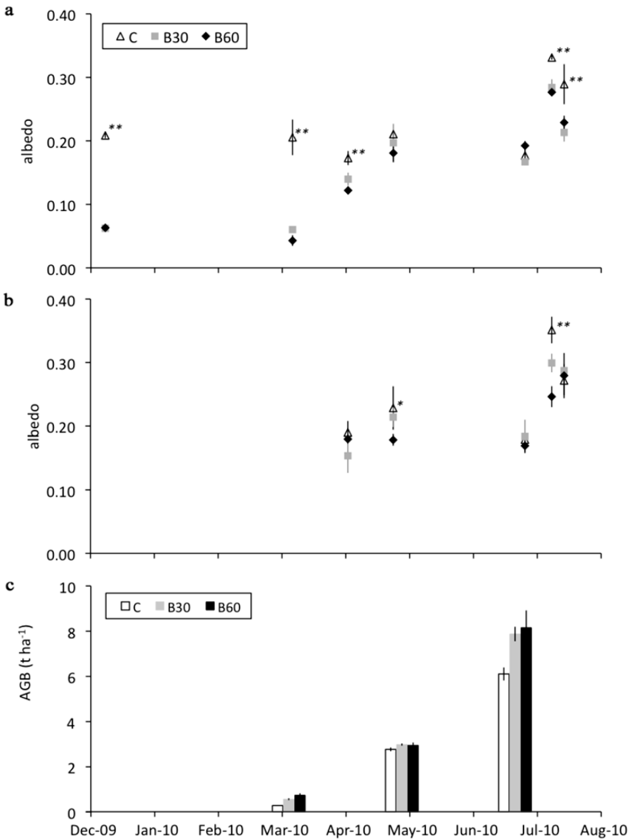
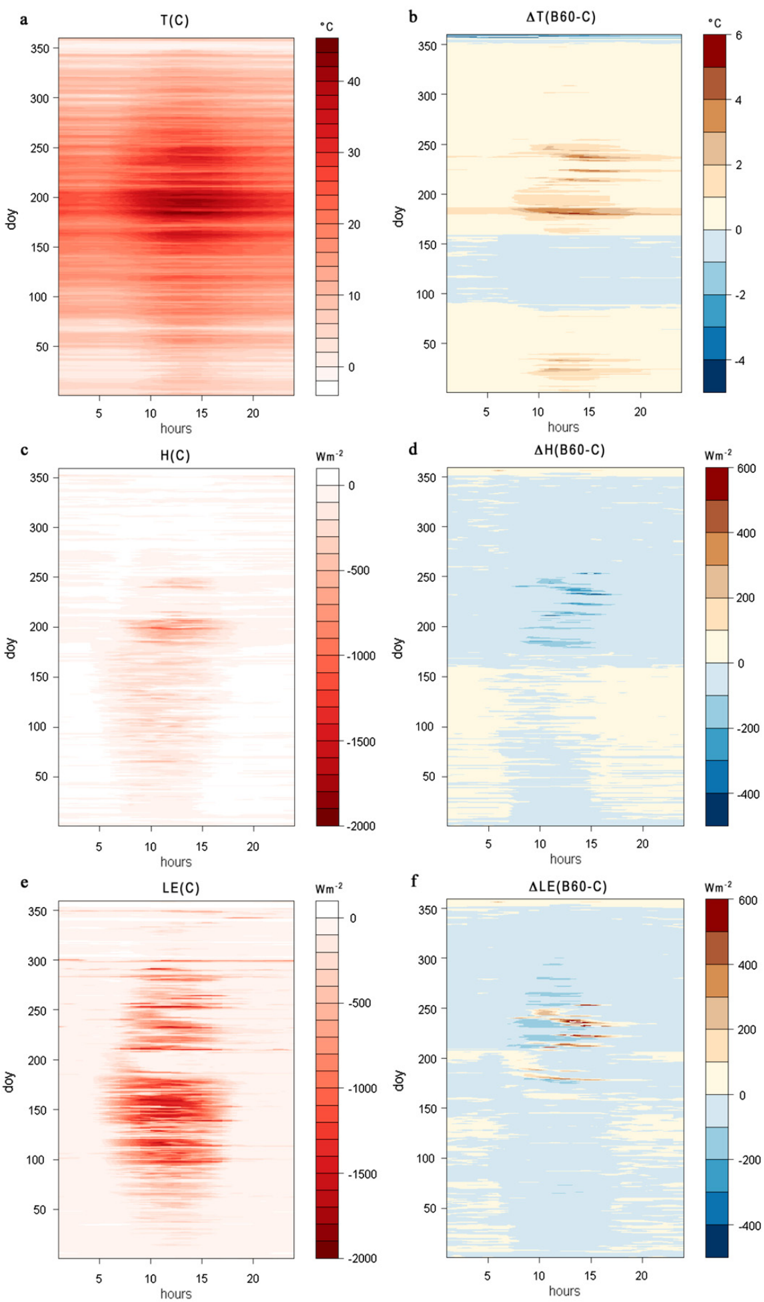
The agronomic use of charcoal from biomass pyrolysis (biochar) represents an interesting option for increasing soil fertility and sequestering atmospheric CO 2 . However, before moving toward large-scale biochar applications, additional research must evaluate all possible land–atmosphere feedbacks. Despite the increasing number of studies investigating the effect of biochar on soil physical, chemical and biological properties, only a few have been done on surface albedo variations on agricultural lands. The present work had the aim of characterizing the annual albedo cycle for a durum wheat crop in Central Italy, by means of a spectroradiometer measurement campaign. Plots treated with biochar, at a rate of 30–60 t ha −1 , showed a surface albedo decrease of up to 80% (after the application) with respect to the control in bare soil conditions, while this difference tended to decrease during the crop growing season, because of the prevailing effect of canopy development on the radiometer response. After the post-harvesting tillage, the soil treated with biochar again showed a lower surface albedo value (<20–26% than the control), while the measurements taken in the second year after application suggested a clear decrease of biochar influence on soil color. The modeling of the surface energy balance highlighted changes in the partitioning of heat fluxes and in particular a substantial increase of ground heat fluxes on an annual basis.
Overview
The claims and statistics of this paper haven’t been checked yet.
Free: it reads the open-access text and checks the first 5 claims that cite a source we can check. Create a free account to check every claim.
Integrity signals
Registry
Cites
Statistics
Figures
Verification
Claims the paper makes
The claims and statistics of this paper haven’t been checked yet.
Free: it reads the open-access text and checks the first 5 claims that cite a source we can check. Create a free account to check every claim.
Claims other papers make about this one
Each is checked against this paper’s own text: does it say what the citing paper says it does?
The source backs part of the claim, not all of it — or backs it for a different population, condition or comparison.
In the citing paper
“Studies suggest that alterations in albedo could decrease the climate mitigation potential of biochar by 20 e 26% [45]”
From Life cycle assessment of biochar as a green sorbent for soil remediation (2024) · cites this paper as [45]
Experimental — accuracy not yet measuredThe cited source says what the claim attributes to it.
In the citing paper
“Changes in surface albedo due to the darkening of soils after biochar application could result in warming feedback that reduces the climate mitigation potential of biochar”
From Life cycle assessment of biochar as a green sorbent for soil remediation (2024) · cites this paper as [45]
Self-check
Percentages, sums and reported differences re-computed from the paper’s own numbers.
The self-check needs the paper’s full text.
Citations
Cites
A decimal code for the growth stages of cereals
ZADOKS, J. C., CHANG, T. T., & KONZAK, C. F. (1974) · Weed Research · doi:10.1111/j.1365-3180.1974.tb01084.x · Cited by 10,173
Forests and Climate Change: Forcings, Feedbacks, and the Climate Benefits of Forests
Bonan, G. B. (2008) · Science · doi:10.1126/science.1155121 · Cited by 6,238
Changes in Atmospheric Constituents and in Radiative Forcing
Forster, P. M. D. F., Ramaswamy, V., Artaxo, P. E., Berntsen, T. K., Betts, R., Fahey, D. W., Haywood, J., Lean, J. L., Lowe, D. C., Myhre, G., et al. (2007) · elib (German Aerospace Center) · Cited by 5,216
Sustainable biochar to mitigate global climate change
Woolf, D., Amonette, J. E., Street-Perrott, F. A., Lehmann, J., & Joseph, S. (2010) · Nature Communications · doi:10.1038/ncomms1053 · Cited by 2,680 · cited 2×
“Mitigation potentials of biochar were estimated to be as high as 12% of current anthropogenic CO2 emissions (Woolf et al 2010), something that might be possibly achieved under a win–win framework leading to a substantial enhancement of soil fertility (Sohi et al 2010), increased crop yields and…”
BackgroundInfluentialA review of biochar and its use and function in soil
Sohi, S. P., Krull, E., Lopez-Capel, E., & Bol, R. (2010) · Advances in Agronomy · doi:10.1016/s0065-2113(10)05002-9 · Cited by 2,240
Peixoto, J. P., & Oort, A. H. (1992) · Medical Entomology and Zoology · Cited by 1,943
Agronomic values of greenwaste biochar as a soil amendment
Chan, K. Y., Van Zwieten, L., Meszaros, I., Downie, A., & Joseph, S. (2007) · Soil Research · doi:10.1071/sr07109 · Cited by 1,902
Lehmann, J., Pereira da Silva, J., Steiner, C., Nehls, T., Zech, W., & Glaser, B. (2003) · Plant and Soil · doi:10.1023/a:1022833116184 · Cited by 1,878 · cited 1×
“Most of the recent research on biochar focused on its effect on plant productivity (Lehmann et al 2003, Yamato et al 2006, Chan et al 2007, Rondon et al 2007, Van Zwieten et al 2008, Baronti et al 2010, Vaccari et al 2011).”
BackgroundLehmann, J. (2007) · Frontiers in Ecology and the Environment · doi:10.1890/1540-9295(2007)5[381:bitb]2.0.co;2 · Cited by 1,714 · cited 1×
“The application of charred biomass residues (biochar) to soils is considered one of the most promising strategies to sustainably sequester atmospheric CO2 in agricultural soils (Lehmann 2007, Woodward et al 2009, Sohi et al 2010).”
BackgroundPositive and negative carbon mineralization priming effects among a variety of biochar-amended soils
Zimmerman, A. R., Gao, B., & Ahn, M.-Y. (2011) · Soil Biology and Biochemistry · doi:10.1016/j.soilbio.2011.02.005 · Cited by 1,438
Impact of biochar amendments on the quality of a typical Midwestern agricultural soil
Laird, D. A., Fleming, P., Davis, D. D., Horton, R., Wang, B., & Karlen, D. L. (2010) · Geoderma · doi:10.1016/j.geoderma.2010.05.013 · Cited by 1,385
Rondon, M. A., Lehmann, J., Ramírez, J., & Hurtado, M. (2007) · Biology and Fertility of Soils · doi:10.1007/s00374-006-0152-z · Cited by 1,333 · cited 1×
“Most of the recent research on biochar focused on its effect on plant productivity (Lehmann et al 2003, Yamato et al 2006, Chan et al 2007, Rondon et al 2007, Van Zwieten et al 2008, Baronti et al 2010, Vaccari et al 2011).”
BackgroundThe dependence of soil CO2 efflux on temperature
Fang, C., & Moncrieff, J. B. (2001) · Soil Biology and Biochemistry · doi:10.1016/s0038-0717(00)00125-5 · Cited by 876 · cited 1×
“…is that increases in soil temperatures associated to larger soil heat flux may have a direct effect on soil organic matter decomposition and respiration (Fang and Moncrieff 2001), particularly affecting the recalcitrant soil organic pools that are more sensitive to temperature (Craine et al 2010).”
BackgroundFate of soil‐applied black carbon: downward migration, leaching and soil respiration
MAJOR, J., LEHMANN, J., RONDON, M., & GOODALE, C. (2010) · Global Change Biology · doi:10.1111/j.1365-2486.2009.02044.x · Cited by 788 · cited 1×
“Major et al (2010), for instance, produced a review on the mechanisms involved in biochar priming effect, but did not explicitly consider that biochar applications also have a soil warming potential.”
BackgroundAn African savanna: synthesis of the Nylsvley study
(1994) · Choice Reviews Online · doi:10.5860/choice.31-5447 · Cited by 683
Meyer, S., Glaser, B., & Quicker, P. (2011) · Environmental Science & Technology · doi:10.1021/es201792c · Cited by 660 · cited 1×
“…as soil amendment: the long-term stability of biochar in soil has 11748-9326/12/014025+08$33.00 c© 2012 IOP Publishing Ltd Printed in the UK not been fully demonstrated, the safety for human health not fully assessed and the impact on the radiative balance not yet evaluated (Meyer et al 2011).”
BackgroundInfluentialLuo, Y., Durenkamp, M., De Nobili, M., Lin, Q., & Brookes, P. C. (2011) · Soil Biology and Biochemistry · doi:10.1016/j.soilbio.2011.07.020 · Cited by 640 · cited 1×
“Nevertheless, soil warming effects that are associated to changes in surface albedo, must be included in the ongoing debate on the potential ‘priming’ effects of biochar application (Zimmerman et al 2011, Luo et al 2011) in which a unifying mechanism driving soil respiration has still to be found.”
BackgroundYamato, M., Okimori, Y., Wibowo, I. F., Anshori, S., & Ogawa, M. (2006) · Soil Science and Plant Nutrition · doi:10.1111/j.1747-0765.2006.00065.x · Cited by 634 · cited 1×
“Most of the recent research on biochar focused on its effect on plant productivity (Lehmann et al 2003, Yamato et al 2006, Chan et al 2007, Rondon et al 2007, Van Zwieten et al 2008, Baronti et al 2010, Vaccari et al 2011).”
BackgroundAn African Savanna: Synthesis of the Nylsvley Study
Scholes, R. J., & Walker, B. H. (1993) · Cambridge University Press eBooks · doi:10.1017/cbo9780511565472 · Cited by 606
Biochar as a strategy to sequester carbon and increase yield in durum wheat
Vaccari, F. P., Baronti, S., Lugato, E., Genesio, L., Castaldi, S., Fornasier, F., & Miglietta, F. (2011) · European Journal of Agronomy · doi:10.1016/j.eja.2011.01.006 · Cited by 473
Self-citationAn African Savanna: Community and landscape pattern and change
Scholes, R. J., & Walker, B. H. (1993) · Cited by 443
An African Savanna: The key determinants: water, nutrients, fire and herbivory
Scholes, R. J., & Walker, B. H. (1993) · Cited by 443
Protecting climate with forests
Jackson, R. B., Randerson, J. T., Canadell, J. G., Anderson, R. G., Avissar, R., Baldocchi, D. D., Bonan, G. B., Caldeira, K., Diffenbaugh, N. S., Field, C. B., et al. (2008) · Environmental Research Letters · doi:10.1088/1748-9326/3/4/044006 · Cited by 418
Widespread coupling between the rate and temperature sensitivity of organic matter decay
Craine, J. M., Fierer, N., & McLauchlan, K. K. (2010) · Nature Geoscience · doi:10.1038/ngeo1009 · Cited by 405
Strip-tillage effect on seedbed soil temperature and other soil physical properties
Licht, M. A., & Al-Kaisi, M. (2005) · Soil and Tillage Research · doi:10.1016/j.still.2004.03.017 · Cited by 362
Effects of charcoal production on soil physical properties in Ghana
Oguntunde, P. G., Abiodun, B. J., Ajayi, A. E., & van de Giesen, N. (2008) · Journal of Plant Nutrition and Soil Science · doi:10.1002/jpln.200625185 · Cited by 271
The long-term effect of increasing the albedo of urban areas
Akbari, H., Damon Matthews, H., & Seto, D. (2012) · Environmental Research Letters · doi:10.1088/1748-9326/7/2/024004 · Cited by 240
Direct climate effects of perennial bioenergy crops in the United States
Georgescu, M., Lobell, D. B., & Field, C. B. (2011) · Proceedings of the National Academy of Sciences · doi:10.1073/pnas.1008779108 · Cited by 227 · cited 1×
“…the most important bio-geophysical drivers on climate (Myhre and Myhre 2003, Kvalevåg et al 2010) altering the radiative balance and consequently the partitioning of sensible, latent and heat soil fluxes (DeFries et al 2002) with important impact on regional climate (Georgescu et al 2009, 2011).”
BackgroundHuman modification of the landscape and surface climate in the next fifty years
Defries, R. S., Bounoua, L., & Collatz, G. J. (2002) · Global Change Biology · doi:10.1046/j.1365-2486.2002.00483.x · Cited by 214
Lee, J. W., Hawkins, B., Day, D. M., & Reicosky, D. C. (2010) · Energy & Environmental Science · doi:10.1039/c004561f · Cited by 166
Tackling Regional Climate Change By Leaf Albedo Bio-geoengineering
Ridgwell, A. J., Singarayer, J. S., Hetherington, A. M., & Valdes, P. J. (2009) · Current Biology · doi:10.1016/j.cub.2008.12.025 · Cited by 149 · cited 1×
“The cultivation of plants and varieties having leaves with higher reflectance is, for instance, a credible option with large global surface cooling potentials that have been estimated to range from 0.11 to 0.21 ◦C (Ridgwell et al 2009).”
BackgroundInfluentialBaronti, S., Alberti, G., Vedove, G. D., Di Gennaro, F., Fellet, G., Genesio, L., Miglietta, F., Peressotti, A., & Vaccari, F. P. (2010) · Italian Journal of Agronomy · doi:10.4081/ija.2010.3 · Cited by 142 · cited 2×
“When combined with other observations made for the same species (Baronti et al 2010) the data confirmed that yield stimulation is proportional, in wheat, to the rate of biochar application.”
BackgroundSelf-citationClimate forcing and response to idealized changes in surface latent and sensible heat
Ban-Weiss, G. A., Bala, G., Cao, L., Pongratz, J., & Caldeira, K. (2011) · Environmental Research Letters · doi:10.1088/1748-9326/6/3/034032 · Cited by 111
Betts, R. (2007) · Tellus B: Chemical and Physical Meteorology · doi:10.1111/j.1600-0889.2007.00284.x · Cited by 91 · cited 2×
“A consistent decrease in albedo has already been reported for charcoal production sites (Oguntunde et al 2008) and in post-fire savannah (Scholes and Walker 1993), proclaiming the need to better investigate the surface energy balance before recommending large-scale application, as for other climate change adaptation a…”
BackgroundAnthropogenic land cover changes in a GCM with surface albedo changes based on MODIS data
Kvalevåg, M. M., Myhre, G., Bonan, G. B., & Levis, S. (2009) · International Journal of Climatology · doi:10.1002/joc.2012 · Cited by 55
Biological Approaches to Global Environment Change Mitigation and Remediation
Woodward, F. I., Bardgett, R. D., Raven, J. A., & Hetherington, A. M. (2009) · Current Biology · doi:10.1016/j.cub.2009.06.012 · Cited by 54
Potential impact of U.S. biofuels on regional climate
Georgescu, M., Lobell, D. B., & Field, C. B. (2009) · Geophysical Research Letters · doi:10.1029/2009gl040477 · Cited by 51 · cited 1×
“…the most important bio-geophysical drivers on climate (Myhre and Myhre 2003, Kvalevåg et al 2010) altering the radiative balance and consequently the partitioning of sensible, latent and heat soil fluxes (DeFries et al 2002) with important impact on regional climate (Georgescu et al 2009, 2011).”
BackgroundChemical genetics of β-diketone formation in wheat
Barber, H. N., & Netting, A. G. (1968) · Phytochemistry · doi:10.1016/s0031-9422(00)85661-7 · Cited by 35
Disney, M. I., Lewis, P., Thackrah, G., Quaife, T. L., & Barnsley, M. J. (2004) · International Journal of Remote Sensing · doi:10.1080/01431160410001720180 · Cited by 33 · cited 1×
“Assuming a Lambertian behavior of the surface, the reflectance measurement is directly convertible into the surface albedo value (Disney et al 2004).”
BackgroundGenetic mapping of the genes for non-glaucous phenotypes in tetraploid wheat
Yoshiya, K., Watanabe, N., & Kuboyama, T. (2010) · Euphytica · doi:10.1007/s10681-010-0283-z · Cited by 18 · cited 1×
“The existence of glaucous wheat cultivars with much higher albedo has been known for a long time (Barber and Netting 1968) and their introduction can be considered realistic (Yoshiya et al 2011).”
Background(2003) · doi:10.1175/1520-0442(2003)016 · cited 1×
“…that the variation in surface albedo, which inevitably follows changes in land use, is one of the most important bio-geophysical drivers on climate (Myhre and Myhre 2003, Kvalevåg et al 2010) altering the radiative balance and consequently the partitioning of sensible, latent and heat soil fluxes…”
Background
Research works printed but not linked: 1
- Van Zwieten L, Kimber S, Sinclair K, Chan K Y and Downie A 2008 Biochar: potential for climate change mitigation, improved yield and soil health Proc. 23rd Annu. Conf. of the Grassland Society of NSW pp 30-3
Cited by
Biochar and its effects on plant productivity and nutrient cycling: A meta-analysis
Biederman, L. A., & Harpole, W. S. (2013) · GCB Bioenergy · doi:10.1111/gcbb.12037 · Cited by 1,737
“Physical condi- tions change with biochar; its dark color alters thermal dynamics and facilitates rapid germination, allowing more time for growth compared with controls (Genesio et al., 2012).”
BackgroundSoil carbon sequestration and biochar as negative emission technologies
Smith, P. (2016) · Global Change Biology · doi:10.1111/gcb.13178 · Cited by 910
“SCS has no influence on albedo, but biochar can darken the soil surface due to the addition of substantial quantities of dark material to the soil (Genesio et al., 2012), which has been shown to increase soil temperature measurably.”
BackgroundMethodInfluentialImpact of biochar application on plant water relations in Vitis vinifera (L.)
Baronti, S., Vaccari, F. P., Miglietta, F., Calzolari, C., Lugato, E., Orlandini, S., Pini, R., Zulian, C., & Genesio, L. (2014) · European Journal of Agronomy · doi:10.1016/j.eja.2013.11.003 · Cited by 307
“polycyclic aromatic hydrocarbons) and the possible impact of changes in surface albedo of bare soils that unavoidably follows biochar application (Genesio et al., 2012; Verheijen et al., 2013).”
BackgroundSelf-citationBiochar application to soil for climate change mitigation by soil organic carbon sequestration
Lorenz, K., & Lal, R. (2014) · Journal of Plant Nutrition and Soil Science · doi:10.1002/jpln.201400058 · Cited by 299
The role of soil in regulation of climate
Lal, R., Monger, C., Nave, L., & Smith, P. (2021) · Philosophical Transactions of the Royal Society B · doi:10.1098/rstb.2021.0084 · Cited by 286
Metadata
- Authors
- Genesio, L., Miglietta, F., Lugato, E., Baronti, S., Pieri, M., & Vaccari, F. P.
- Affiliations
- Istituto di Biometeorologia (IT)
- Fondazione Edmund Mach (IT)
- Corresponding author
- Genesio, L
- Venue
- Environmental Research Letters
- Publisher
- IOP Publishing
- Published
- 2012-02-22
- Volume
- 7
- Issue
- 1
- Pages
- 014025
- ISSN
- 1748-9326 (ISSN-L)
- OpenAlex
- W2159549262
- Semantic Scholar
- 479c6da403069e74b4fc8fc71b6e0cb1ed74973d
- Cited by
- 142
- References
- 43
- Citations by year
- 2026: 5 · 2025: 14 · 2024: 10 · 2023: 13 · 2022: 10 · 2021: 18 · 2020: 12 · 2019: 9 · 2018: 10 · 2017: 6 · 2016: 6 · 2015: 8 · 2014: 6 · 2013: 11 · 2012: 4
- FWCI
- 14.12
- Type
- journal article
- Language
- en
- Open access
- gold
- doi.org
- Licence
- cc-by
- Locations
- Environmental Research Letters (publishedVersion, cc-by)
- CINECA IRIS Institutional Research Information System (Fondazione Edmund Mach) (submittedVersion, other-oa)
- Florence Research (University of Florence) (submittedVersion)
- INFM-OAR (INFN Catania) (submittedVersion, other-oa)
- Funders
- European Commission (265179)
- Topics
- Life Sciences › Agricultural and Biological Sciences › Soil Science › Soil Carbon and Nitrogen Dynamics
- Physical Sciences › Environmental Science › Ecology › Remote Sensing in Agriculture
- Physical Sciences › Environmental Science › Environmental Engineering › Soil Moisture and Remote Sensing
- Keywords
- biochar, surface albedo, durum wheat, land-atmosphere interactions, soil color, surface energy balance, soil heat flux, biomass pyrolysis, carbon sequestration, soil fertility
About these checks
Registry, retraction, Cites and statistics results are computed, not judged, with one exception: a printed reference that no index lists is read once by a model before it counts as a citation error. Claims are extracted by a model and kept only when their quote appears verbatim in the text; each cited source is then checked, with a model’s help, for whether it says what the claim relies on. Those verdicts can be wrong — read the claim’s quote and the cited source before relying on one.
Statistics and arithmetic are recomputed, not judged.
Confidence bands are shown only for fields calibrated on our annotated test set. None is calibrated yet, so no band is shown.
What counts as a claim ›How we measure confidence ›How we check this ›
Are you an author, or do you see a problem with this page? Request a review
Data sources
Bibliographic data: Semantic Scholar, OpenAlex, Crossref.
Contains information from the Semantic Scholar Academic Graph Datasets, made available under the ODC Attribution License (ODC-BY 1.0).
Semantic Scholar’s data is described in: Kinney, R., et al. (2023). The Semantic Scholar Open Data Platform. arXiv:2301.10140.
