

Cleaner air has contributed one-fifth of US maize and soybean yield gains since 1999
Open accessThe DOI matches its Crossref record; 36 of the 36 references it cites were found in a registry or an index.
Abstract
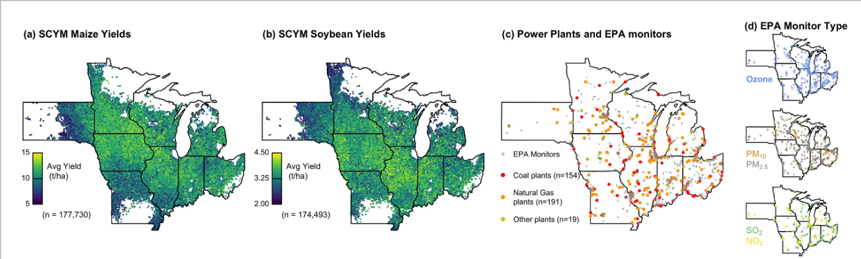
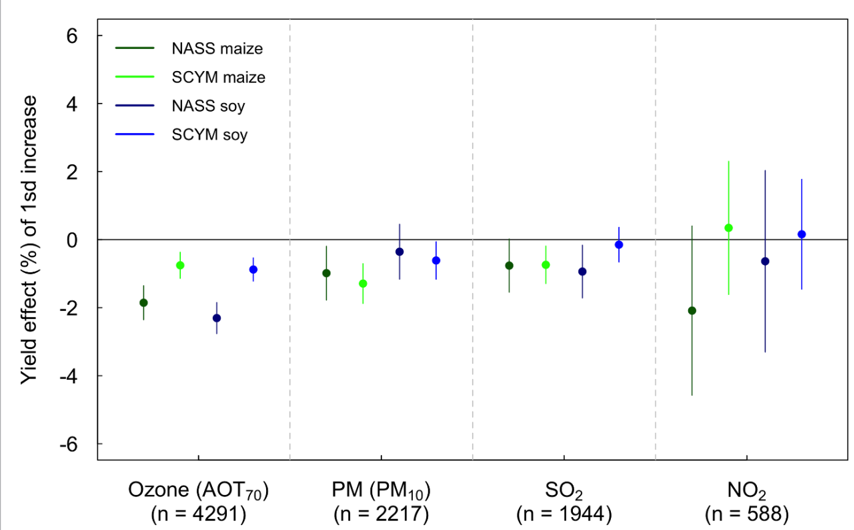
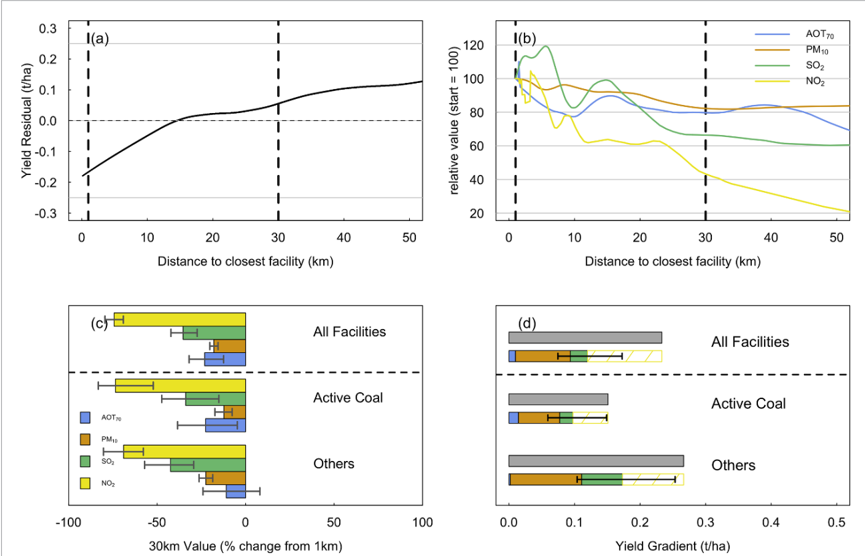
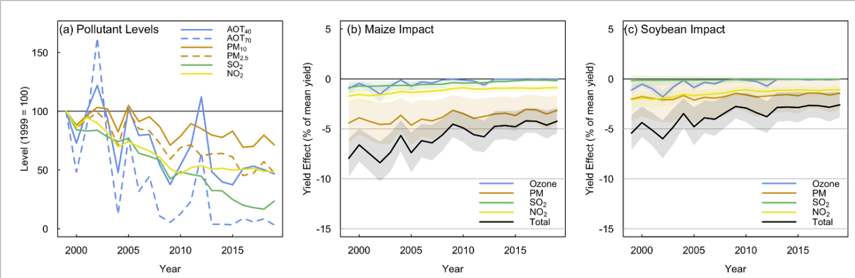
Crop productivity is potentially affected by several air pollutants, although these are usually studied in isolation. A significant challenge to understanding the effects of multiple pollutants in many regions is the dearth of air quality data near agricultural fields. Here we empirically estimate the effect of four key pollutants (ozone (O 3), particulate matter (PM), sulfur dioxide (SO 2), and nitrogen dioxide (NO 2)) on maize and soybean yields in the United States using a combination of administrative data and satellite-derived yield estimates. We identify clear negative effects of exposure to O 3, PM, and SO 2 in both crops, using yields measured in the vicinity of monitoring stations. We also show that while stations measuring NO 2 are too sparse to reliably estimate a yield effect, the strong gradient of NO 2 concentrations near power plants allows us to more precisely estimate NO 2 effects using satellite measured yield gradients. The presence of some powerplants that turn on and others that shut down during the study period are particularly useful for attributing yield gradients to pollution. We estimate that total yield losses from these pollutants averaged roughly 5% for both maize and soybean over the past two decades. While all four pollutants have statistically significant effects, PM and NO 2 appear more damaging to crops at current levels than O 3 and SO 2. Finally, we find that the significant improvement in air quality since 1999 has halved the impact of poor air quality on major crops and contributed to yield increases that represent roughly 20% of overall yield gains over that period.
Overview
The claims and statistics of this paper haven’t been checked yet.
Free: it reads the open-access text and checks the first 5 claims that cite a source we can check. Create a free account to check every claim.
Integrity signals
Registry
Cites
Statistics
Figures
Verification
Claims the paper makes
The claims and statistics of this paper haven’t been checked yet.
Free: it reads the open-access text and checks the first 5 claims that cite a source we can check. Create a free account to check every claim.
Claims other papers make about this one
Each is checked against this paper’s own text: does it say what the citing paper says it does?
In the citing paper
“A study on the historical losses to air pollutants in maize and soybean grown in the United States showed that improvements in the control of O3, SO2, PM, and NO2 have improved yields by an average of 20% [121].”
From Changes in tropospheric air quality related to the protection of stratospheric ozone in a changing climate (2023) · cites this paper as [121]
In the citing paper
“Overall, the improvement in yields was equivalent to ca US$ 5 billion.”
From Changes in tropospheric air quality related to the protection of stratospheric ozone in a changing climate (2023) · cites this paper as [121]
In the citing paper
“Of these pollutants, PM and NO2 appeared to cause more damage than O3 and SO2.”
From Changes in tropospheric air quality related to the protection of stratospheric ozone in a changing climate (2023) · cites this paper as [121]
Self-check
Percentages, sums and reported differences re-computed from the paper’s own numbers.
The self-check needs the paper’s full text.
Citations
Cites
Google Earth Engine: Planetary-scale geospatial analysis for everyone
Gorelick, N., Hancher, M., Dixon, M., Ilyushchenko, S., Thau, D., & Moore, R. (2017) · Remote Sensing of Environment · doi:10.1016/j.rse.2017.06.031 · Cited by 14,719
Daly, C., Halbleib, M., Smith, J. I., Gibson, W. P., Doggett, M. K., Taylor, G. H., Curtis, J., & Pasteris, P. P. (2008) · International Journal of Climatology · doi:10.1002/joc.1688 · Cited by 3,100
Development of gridded surface meteorological data for ecological applications and modelling
Abatzoglou, J. T. (2013) · International Journal of Climatology · doi:10.1002/joc.3413 · Cited by 1,916 · cited 1×
“In addition, for testing whether EPA monitoring stations (and, by inference, agricultural fields) upwind and downwind of power plants experienced significantly different pollution levels, we obtained daily wind speeds for each power plant facility from the University of Idaho Gridded Surface Meteorological Dataset [28…”
MethodSimultaneously Mitigating Near-Term Climate Change and Improving Human Health and Food Security
Shindell, D., Kuylenstierna, J. C. I., Vignati, E., van Dingenen, R., Amann, M., Klimont, Z., Anenberg, S. C., Muller, N., Janssens-Maenhout, G., Raes, F., et al. (2012) · Science · doi:10.1126/science.1210026 · Cited by 1,382 · cited 1×
“These uncertainties limit our ability to identify the potential benefits for agriculture from air quality improvements associated with technology or policy changes [10], as well as which pollutants deserve the most scrutiny.”
BackgroundBoryan, C., Yang, Z., Mueller, R., & Craig, M. (2011) · Geocarto International · doi:10.1080/10106049.2011.562309 · Cited by 1,212
The critical role of extreme heat for maize production in the United States
Lobell, D. B., Hammer, G. L., McLean, G., Messina, C., Roberts, M. J., & Schlenker, W. (2013) · Nature Climate Change · doi:10.1038/nclimate1832 · Cited by 1,026 · cited 1×
“Although one could argue that some of the effects attributed to extreme heat are in fact fromO3, several lines of evidence indicate a strong impact of extreme heat even in the absence of O3: extreme heat has similar effects in recent decades with much lower O3 than prior decades [38]; crop model simulations can reprod…”
BackgroundSelf-citationThe Mortality and Medical Costs of Air Pollution: Evidence from Changes in Wind Direction
Deryugina, T., Heutel, G., Miller, N. H., Molitor, D., & Reif, J. (2019) · American Economic Review · doi:10.1257/aer.20180279 · Cited by 771
Van Dingenen, R., Dentener, F. J., Raes, F., Krol, M. C., Emberson, L., & Cofala, J. (2009) · Atmospheric Environment · doi:10.1016/j.atmosenv.2008.10.033 · Cited by 719 · cited 3×
“Given the emphasis of much of the literature on O3 impacts [3, 5, 6, 34], it is somewhat surprising that bothNO2 and PMemerge asmore important thanO3 in most of our specifications.”
BackgroundA scalable satellite-based crop yield mapper
Lobell, D. B., Thau, D., Seifert, C., Engle, E., & Little, B. (2015) · Remote Sensing of Environment · doi:10.1016/j.rse.2015.04.021 · Cited by 602 · cited 10×
“SCYM estimates have been validated for both crops against county and field level data in the region [17, 18].”
BackgroundMethodSelf-citationAvnery, S., Mauzerall, D. L., Liu, J., & Horowitz, L. W. (2011) · Atmospheric Environment · doi:10.1016/j.atmosenv.2010.11.045 · Cited by 596 · cited 3×
“Given the emphasis of much of the literature on O3 impacts [3, 5, 6, 34], it is somewhat surprising that bothNO2 and PMemerge asmore important thanO3 in most of our specifications.”
Background
Cited by
Climate change exacerbates the environmental impacts of agriculture
Yang, Y., Tilman, D., Jin, Z., Smith, P., Barrett, C. B., Zhu, Y.-G., Burney, J., D’Odorico, P., Fantke, P., Fargione, J., et al. (2024) · Science · doi:10.1126/science.adn3747 · Cited by 547
“In the US, for example, pollutants such as O 3 , NO x , SO 2 , and PM 2.5 (fine particulate matter) are estimated to have caused ~5% yield loss in maize and soybean yields over the past two decades ( 22 ).”
BackgroundInfluentialSelf-citationThe EAT–Lancet Commission on healthy, sustainable, and just food systems
Rockström, J., Thilsted, S. H., Willett, W. C., Gordon, L. J., Herrero, M., Hicks, C. C., Mason-D'Croz, D., Rao, N., Springmann, M., Wright, E. C., et al. (2025) · The Lancet · doi:10.1016/s0140-6736(25)01201-2 · Cited by 475
Hu, T., Zhang, X., Khanal, S., Wilson, R., Leng, G., Toman, E. M., Wang, X., Li, Y., & Zhao, K. (2024) · Environmental Modelling & Software · doi:10.1016/j.envsoft.2024.106119 · Cited by 168
“…the crop modeling literature, the distinction between predictive and explanatory models are not always articulated, but the difference is apparent (Lobell and Burney, 2021; Shook et al., 2021): When using machine learning to estimate crop yields in the future, modelers emphasize predictive power;…”
Globally ubiquitous negative effects of nitrogen dioxide on crop growth
Lobell, D. B., Tommaso, S. D., & Burney, J. A. (2022) · Science Advances · doi:10.1126/sciadv.abm9909 · Cited by 136
“For example, the World Health Organization guidelines state a “no effect” level for vegetation of 15 to 20 g/m3 for annual average NO2 [roughly 8 to 11 parts per billion (ppb)] (25), whereas reported NO2 levels in most regions commonly exceed these values (4, 7, 19).”
BackgroundSelf-citationWheat as a Nutritional Powerhouse: Shaping Global Food Security
Sharma, K., & Sharma, P. K. (2025) · Agricultural sciences. · doi:10.5772/intechopen.1009499 · Cited by 84
Elango, D., Devi, K. D., Jeyabalakrishnan, H. K., Rajendran, K., Haridass, V. K. T., Dharmaraj, D., Charuchandran, C. V., Wang, W., Fakude, M., Mishra, R., et al. (2022) · Journal of Agriculture and Food Research · doi:10.1016/j.jafr.2022.100374 · Cited by 67
Madronich, S., Sulzberger, B., Longstreth, J. D., Schikowski, T., Andersen, M. P. S., Solomon, K. R., & Wilson, S. R. (2023) · Photochemical & Photobiological Sciences · doi:10.1007/s43630-023-00369-6 · Cited by 64
“A study on the historical losses to air pollutants in maize and soybean grown in the United States showed that improvements in the control of O3, SO2, PM, and NO2 have improved yields by an average of 20% [121].”
BackgroundMontes, C. M., Demler, H. J., Li, S., Martin, D. G., & Ainsworth, E. A. (2021) · The Plant Journal · doi:10.1111/tpj.15501 · Cited by 61
Cluster‐Enhanced Ensemble Learning for Mapping Global Monthly Surface Ozone From 2003 to 2019
Liu, X., Zhu, Y., Xue, L., Desai, A. R., & Wang, H. (2022) · Geophysical Research Letters · doi:10.1029/2022gl097947 · Cited by 58
“Surface ozone also negatively affects plant photosynthesis and further threatens food security (Liu & Desai, 2021; Lobell & Burney, 2021).”
BackgroundMarked Impacts of Pollution Mitigation on Crop Yields in China
He, L., Wei, J., Wang, Y., Shang, Q., Liu, J., Yin, Y., Frankenberg, C., Jiang, J. H., Li, Z., & Yung, Y. L. (2022) · Earth s Future · doi:10.1029/2022ef002936 · Cited by 55
“The crop yield is reduced by 1.7%–5.9% per 0.1 increase in AOD (Figure 3a), corroborating the hypothesis that particulate pollution reduces the solar radiation reaching the surface and lowers plant photosynthesis (Lobell & Burney, 2021; Tie et al., 2016).”
InfluentialAir quality improvements can strengthen China’s food security
Liu, X., Chu, B., Tang, R., Liu, Y., Qiu, B., Gao, M. C., Li, X., Xiao, J., Sun, Z., Huang, X., et al. (2024) · Nature Food · doi:10.1038/s43016-023-00882-y · Cited by 55
“The nonlinear relationship thus enabled us to effectively convert satellite-derived MDA8 to AOT40 or W126 and apply AOT40 or W126 in a statistical crop model to more appropriately assess ozone impacts in accordance with previous studies (either experimental 6,7,48–50 or statistical 29,31,34,51–53 ).”
Divergent responses of maize yield to precipitation in the United States
Xu, R., Li, Y., Guan, K., Zhao, L., Peng, B., Miao, C., & Fu, B. (2021) · Environmental Research Letters · doi:10.1088/1748-9326/ac3cee · Cited by 46
He, X., Xu, X., & Shen, Y. (2023) · Journal of Business Research · doi:10.1016/j.jbusres.2023.113864 · Cited by 41
Interactions Among Food Systems, Climate Change, and Air Pollution: A Review
Hong, C., Zhong, R., Xu, M., He, P., Mo, H., Qin, Y., Shi, D., Chen, X., He, K., & Zhang, Q. (2024) · Engineering · doi:10.1016/j.eng.2024.12.021 · Cited by 42
Hinckley, E. S., & Driscoll, C. T. (2022) · Communications Earth & Environment · doi:10.1038/s43247-022-00662-9 · Cited by 39
Lafferty, D. C., Sriver, R. L., Haqiqi, I., Hertel, T. W., Keller, K. M., & Nicholas, R. E. (2021) · Communications Earth & Environment · doi:10.1038/s43247-021-00266-9 · Cited by 38
Da, Y., Xu, Y., & McCarl, B. A. (2021) · Environmental and Resource Economics · doi:10.1007/s10640-021-00629-y · Cited by 36
Anagha, K., Kuttippurath, J., Sharma, M., & Cuesta, J. (2024) · Agricultural Systems · doi:10.1016/j.agsy.2023.103849 · Cited by 29
Yield improvement and yield components: A comparison of corn and soybean
Egli, D. B. (2023) · Crop Science · doi:10.1002/csc2.20925 · Cited by 27
Manono, B. O., Sadiq, F. K., Sadiq, A. A., Matsika, T. A., & Tanko, F. (2025) · Air · doi:10.3390/air3030024 · Cited by 24
“In the United States, PM and other air pollutants reduced maize and soybean yields by approximately 5% over two decades, although air quality improvements have halved this impact since 1999 [70].”
Pei, J., Liu, P., Feng, Z., Chang, M., Wang, J., Fang, H., Wang, L., & Huang, B. (2024) · Environmental Pollution · doi:10.1016/j.envpol.2024.123407 · Cited by 19
Heavy metal contamination of vegetables in urban and peri-urban areas. An overview
Fischer, G., & Fischer, F. (2023) · Revista Colombiana de Ciencias Hortícolas · doi:10.17584/rcch.2023v17i2.16099 · Cited by 19
“Cleaner air alone could provide up to 20% yield increase in important crops such as soybean and corn (Lobell and Burney, 2021).”
Short‐Lived Air Pollutants and Climate Forcers Through the Lens of the COVID‐19 Pandemic
Wang, Y., Zhang, C., Pennington, E. A., He, L., Yang, J., Yu, X., Liu, Y., & Seinfeld, J. H. (2024) · Reviews of Geophysics · doi:10.1029/2022rg000773 · Cited by 12
“Recent empirical studies have revealed the adverse impact of NO 2 and O 3 on crop yields (Lobell & Burney, 2021; Lobell et al., 2022).”
Triticum - The Pillar of Global Food Security
Meena, V. S., Jaiswal, J. P., Jinger, D., & Paramesh, V. (2025) · Agricultural sciences. · doi:10.5772/intechopen.1006456 · Cited by 12
Singh, K., Lobell, D. B., & Azevedo, I. L. (2025) · Proceedings of the National Academy of Sciences · doi:10.1073/pnas.2421679122 · Cited by 10
Self-citationCurrent Benefits of Wildfire Smoke for Yields in the US Midwest May Dissipate by 2050
Behrer, A. P., & Wang, S. (2022) · World Bank policy research working paper · doi:10.1596/1813-9450-9953 · Cited by 8
Bui, L. T., & Nguyen, P. H. (2023) · Computers and Electronics in Agriculture · doi:10.1016/j.compag.2023.108570 · Cited by 7
Biases in estimates of air pollution impacts: the role of omitted variables and measurement errorsPreprint
Kluger, D. M., Lobell, D. B., & Owen, A. B. (2023) · arXiv (Cornell University) · doi:10.48550/arxiv.2310.08831 · Cited by 7
“The shape and rate parameters for this Gamma distribution were chosen by applying the method of moments to the 16 coefficient estimates in Figure 2 of Lobell and Burney (2021) in order to obtain a distribution of pollutant coefficients that is roughly consistent with recent empirical work.”
BackgroundMethodInfluentialSelf-citationSandhya, P., & Venkataramana, B. (2025) · Discover Agriculture · doi:10.1007/s44279-025-00379-1 · Cited by 6
“Notably, improvements in air quality since 1999 have halved these losses and contributed to nearly 20% of yield grains, underscoring the importance of integrating environmental variables alongside spectral and management data for more holistic yield modeling [61].”
Gao, L., Guan, K., He, L., Jiang, C., Wu, X., Lu, X., & Ainsworth, E. A. (2024) · The Science of The Total Environment · doi:10.1016/j.scitotenv.2024.175748 · Cited by 6
Quantifying the indirect effects of different air pollutants on crop yields in North China Plain
Lu, C., Leng, G., & Yu, L. (2024) · Environmental Research Letters · doi:10.1088/1748-9326/ad1c1b · Cited by 7
“Several studies have also investigated the sensitivity of crop yield to air pollution at the regional scale, and most are focusing on the impacts of ozone ( 2 (Ahmed S, 2015, Lobell and Burney 2021).”
BackgroundMethodInfluentialImpact of air pollution on reproductive biology of plants: Mechanisms and consequences
Khan, N. B., Chatterjee, S., Basak, G., Sarkar, P., Singh, V. K., Adit, A., & Barman, C. (2025) · Plant Stress · doi:10.1016/j.stress.2025.101119 · Cited by 5
Bayesian Spatial Models for Projecting Corn Yields
Roth, S., Lee, B. S., Nicholas, R. E., Keller, K. M., & Haran, M. (2023) · Remote Sensing · doi:10.3390/rs16010069 · Cited by 5
Current benefits of wildfire smoke for yields in the US Midwest may dissipate by 2050
Behrer, A. P., & Wang, S. (2024) · Environmental Research Letters · doi:10.1088/1748-9326/ad5458 · Cited by 5
“Changes in ground-level aerosols and pollution, particularly ozone, can also influence how efficiently plants process sunlight into energy by interfering with photosynthetic pathways within the plants [20, 21].”
Inflated Negative Impacts of Temperature On Global Agricultural Yields Due To Ozone Omission
Liu, X., Sun, Z., & Wang, H. (2025) · Earth s Future · doi:10.1029/2024ef005072 · Cited by 4
“Fourthly, Lobell et al. (David B. Lobell & Burney, 2021) found that higher and more extreme ozone thresholds in the AOTx metric can exhibit stronger predictive power, suggesting that exploring different AOTx thresholds could be fruitful.”
InfluentialPei, J., Du, C., Liu, P., He, Y., Ji, Y., & Feng, Z. (2026) · Journal of Environmental Sciences · doi:10.1016/j.jes.2026.01.059 · Cited by 1
Sarkar, A., Acharya, P., Barik, G., Gayen, B. K., Sreekesh, S., Ghosh, S., & Biradar, Ç. (2026) · The Science of The Total Environment · doi:10.1016/j.scitotenv.2026.181714 · Cited by 1
Impacts of the COVID-19 economic slowdown on soybean crop yields in the United States
Christopoulos, J., Tong, D., Campbell, P., & Ma, S. (2023) · Scientific Reports · doi:10.1038/s41598-023-39531-6 · Cited by 1
“In addition, they are consistent with Seltzer et al. 14 (AOT40 RYL from soybean equivalent to 4.8% in 2015), Lobell et al. 15 (5% average total soybean yield losses over last two decades), Da et al. 16 (4 In this work, it is important to note meteorological effects are not separated from Campbell…”
BackgroundInfluentialAmbient Ozone and Planting Decision: Evidence From US Crop Acreage
Liu, Z. (2025) · Agricultural Economics · doi:10.1111/agec.70029 · Cited by 2
Phytoremediation of Atmospheric Pollutants in the Era of Climate Change
Khan, A., Riaz, A., Mahmood, A., Bibi, S., Florentine, S. K., Javaid, M. M., & Nargis, J. (2023) · Springer eBooks · doi:10.1007/978-3-031-37424-1_12
Liang, Y., Sheng, Q., Shi, S., Huang, Z., Yu, G., Peng, C., & Zhu, Z. (2025) · Plant Physiology and Biochemistry · doi:10.1016/j.plaphy.2025.110942
The Surprising Static and Dynamic Effects of Oil and Gas Flaring on AgriculturePreprint
Guerin, A., Najjar, N., & Schaufele, B. (2025) · SSRN Electronic Journal · doi:10.2139/ssrn.5208318
Three Essays on Ozone Pollution, Biofuel Production, and Climate Change
Da, Y. (2022) · OakTrust (Texas A&M University Libraries)
Couharde, C., & Generoso, R. (2025) · Journal of Agricultural Economics · doi:10.1111/1477-9552.70018
Açıkgöz, F. E., Dökmeci, A. H., ESER, M. G., Demirkıran, A. R., Üstündağ, Ö., Akpınar, Ç., Şabudak, T., Sertkahya, M., Adiloğlu, A., Yinanç, A., et al. (2026) · Akademisyen Kitabevi eBooks · doi:10.37609/akya.4095
Integrated climate effects on nitrogen cycles in global grasslands
Zheng, M., Cui, J., Cheng, L., Wang, S., Wang, X., Xu, X., Zhang, X., Wang, C., Ren, C., & Gu, B. (2026) · Science Advances · doi:10.1126/sciadv.aec5940
“In our fixed-effects model, we incorporated country-specific in-tercepts σ i to control for time-invariant factors, unobserved factors ( 78 , 79 ), such as national policies on agricultural trade and grass-land soil conditions, that could cause estimation bias.”
Wind Turbines, Microclimates, and Agricultural Productivity: Parcel-Level Evidence from the U.SPreprint
Lu, Q., Karwowski, N., Liu, P., & Wu, K. (2026) · SSRN Electronic Journal · doi:10.2139/ssrn.6879828
Causes, impacts and future of dust storms in California
Evan, A. T., Adibiyi, A., Burney, J. A., Chen, S.-H., Chen, W., D’Odorico, P., Fischella, M. R., Heaney, A. K., Hoyer, K. K., Kok, J., et al. (2026) · Cambridge Prisms Drylands · doi:10.1017/dry.2026.10041
“…different effects: reduced downwelling direct radiation leads to reduced photosynthesis and is not offset by any benefits from increased scattering light use efficiency (Hemes et al., 2020) and surface temperature impacts (Burney and Ramanathan, 2014; Proctor et al., 2018; Lobell and Burney, 2021).”
Self-citationAhmed, T., Lei, Y., Noman, M., Li, Z., Ondrašek, G., Shahid, M. S., Petrinec, B., Qi, X., Li, B., & Qi, Y. (2026) · Food and Energy Security · doi:10.1002/fes3.70285
The Role of Knowledge-based Economy on Environmental Pollution: The Case of Selected Asian CountriesPreprint
Tejeneki, R. Z., Nematollahi, Z., & Saghaian, S. (2026) · doi:10.20517/scierxiv202607.0481.v1
Essays on the Political Economy of Development
Nian, Y. (n.d.) · Archivio istituzionale della Ricerca - Bocconi
Metadata
- Authors
- Lobell, D. B., & Burney, J. A.
- Affiliations
- Stanford University (US)
- University of California San Diego (US)
- Corresponding author
- Lobell, David B
- Venue
- Environmental Research Letters
- Publisher
- IOP Publishing
- Published
- 2021-07-01
- Volume
- 16
- Issue
- 7
- Pages
- 074049
- ISSN
- 1748-9326 (ISSN-L)
- OpenAlex
- W3176851564
- Cited by
- 45
- References
- 36
- Citations by year
- 2026: 6 · 2025: 11 · 2024: 10 · 2023: 8 · 2022: 6 · 2021: 4
- FWCI
- 4.20
- Type
- journal article
- Language
- en
- Open access
- gold
- doi.org
- Licence
- cc-by
- creativecommons.org/licenses/by/4.0 (vor, 13 d)
- iopscience.iop.org/info/page/text-and-data-mining (tdm, 13 d)
- Locations
- Environmental Research Letters (publishedVersion, cc-by)
- DOAJ (DOAJ: Directory of Open Access Journals) (submittedVersion)
- Funders
- National Science Foundation (1639318, 1715557)
- National Aeronautics and Space Administration (80NSSC17K0652, 54308-Z6059203)
- U.S. Department of Agriculture
- NASA Harvest (80NSSC17K0652)
- National Institute of Food and Agriculture
- Topics
- Life Sciences › Agricultural and Biological Sciences › Plant Science › Plant responses to elevated CO2
- Life Sciences › Agricultural and Biological Sciences › Agronomy and Crop Science › Climate change impacts on agriculture
- Physical Sciences › Environmental Science › Health, Toxicology and Mutagenesis › Air Quality and Health Impacts
- Keywords
- air pollution, crop yield, maize, soybean, ozone, particulate matter, sulfur dioxide, nitrogen dioxide, power plants, air quality improvement, yield loss, United States
About these checks
Registry, retraction, Cites and statistics results are computed, not judged, with one exception: a printed reference that no index lists is read once by a model before it counts as a citation error. Claims are extracted by a model and kept only when their quote appears verbatim in the text; each cited source is then checked, with a model’s help, for whether it says what the claim relies on. Those verdicts can be wrong — read the claim’s quote and the cited source before relying on one.
Statistics and arithmetic are recomputed, not judged.
Confidence bands are shown only for fields calibrated on our annotated test set. None is calibrated yet, so no band is shown.
What counts as a claim ›How we measure confidence ›How we check this ›
Are you an author, or do you see a problem with this page? Request a review
Data sources
Bibliographic data: Semantic Scholar, OpenAlex, Crossref.
Contains information from the Semantic Scholar Academic Graph Datasets, made available under the ODC Attribution License (ODC-BY 1.0).
Semantic Scholar’s data is described in: Kinney, R., et al. (2023). The Semantic Scholar Open Data Platform. arXiv:2301.10140.
