

MEANDERING SHALLOW ATMOSPHERIC JET AS A MODEL OF SATURNʼS NORTH-POLAR HEXAGON
Open accessThe DOI matches its Crossref record; 28 of the 28 references it cites were found in a registry or an index; 4 of the 25 sources its claims cite were checked for support.
Abstract
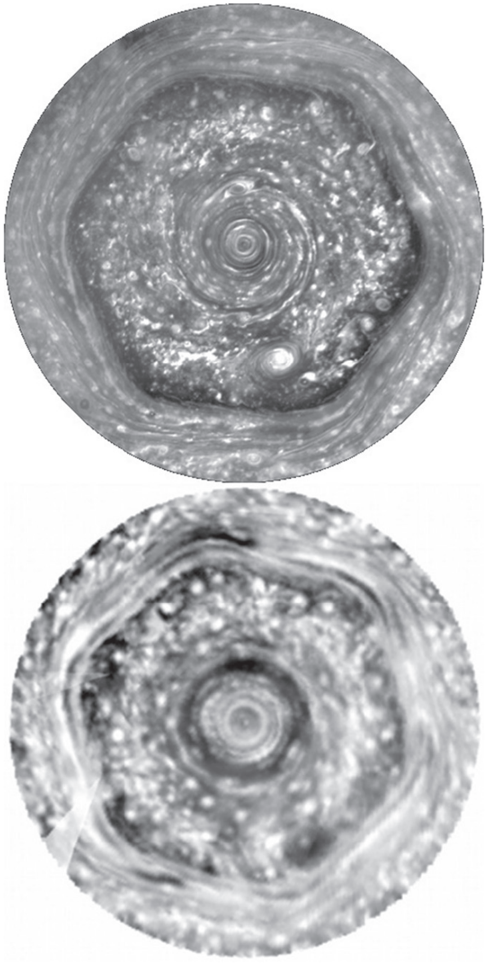
The Voyager flybys of Saturn in 1980–1981 revealed a circumpolar Hexagon at ∼78° north planetographic latitude that has persisted for over 30 Earth years, more than one Saturn year, and has been observed by ground-based telescopes, Hubble Space Telescope and multiple instruments on board the Cassini orbiter. Its average phase speed is very slow with respect to the System III rotation rate, defined by the primary periodicity in the Saturn Kilometric Radiation during the Voyager era. Cloud tracking wind measurements reveal the presence of a prograde jet-stream whose path traces the Hexagon's shape. Previous numerical models have produced large-amplitude, n = 6, wavy structures with westward intrinsic phase propagation (relative to the jet). However, the observed net phase speed has proven to be more difficult to achieve. Here we present numerical simulations showing that instabilities in shallow jets can equilibrate as meanders closely resembling the observed morphology and phase speed of Saturn's northern Hexagon. We also find that the winds at the bottom of the model are as important as the winds at the cloud level in matching the observed Hexagon's characteristics.
Overview
CoChat Summary
## TL;DR
The paper argues that Saturn’s north-polar Hexagon can be reproduced by instabilities in a shallow eastward jet that equilibrate into a meandering wave, rather than a deep vortex-street. In the best-matching simulations, the meander is nearly stationary, has dominant wavenumber 6, and matches the observed wind structure and temperature gradient.
## Key findings
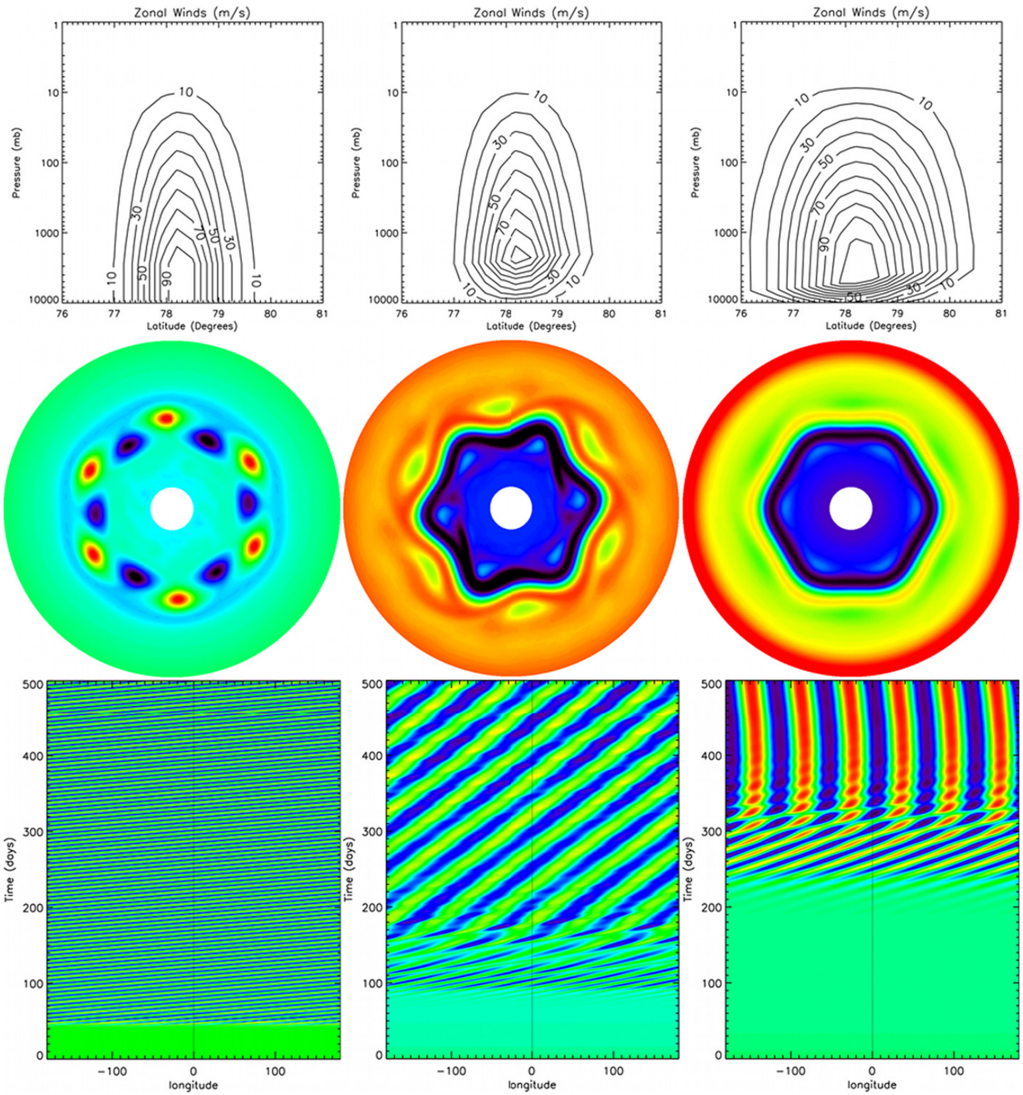
- In the first simulation series, a deep Gaussian jet always equilibrated into a vortex-street with six pairs of alternating cyclones/anticyclones after 25 days, propagating eastward at about 25 m s⁻¹, which is too fast compared with the observed Hexagon.
- In the second series, a shallow jet evolved into a hexagonal meandering jet with dominant wavenumber 6, but the meander still propagated eastward at about 3.1 m s⁻¹, faster than observed and failing at least one validation criterion.
- In the third series, using a jet that decreased toward the bottom of the model, the system equilibrated after 400 simulated days into a stable meander with dominant wavenumber 6 and propagation speed of about 0.3 m s⁻¹, described as “practically stationary.”
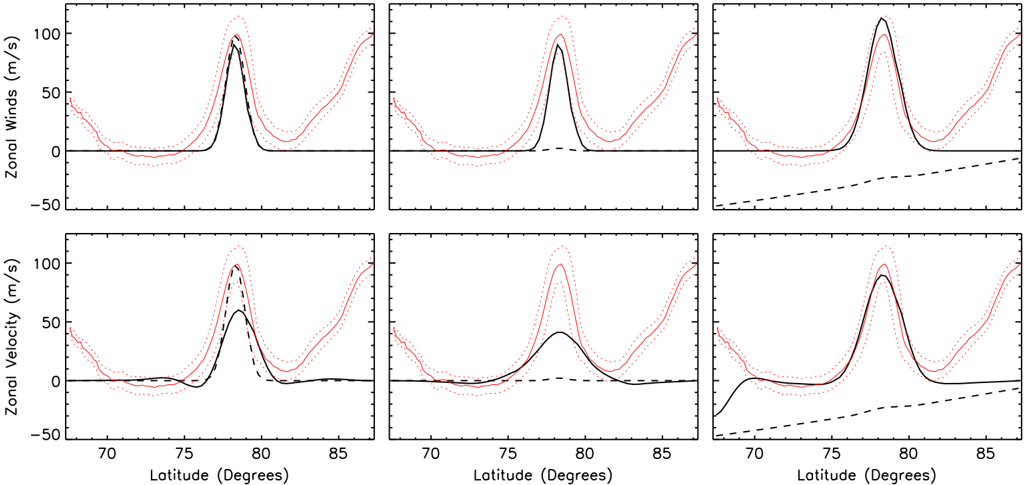
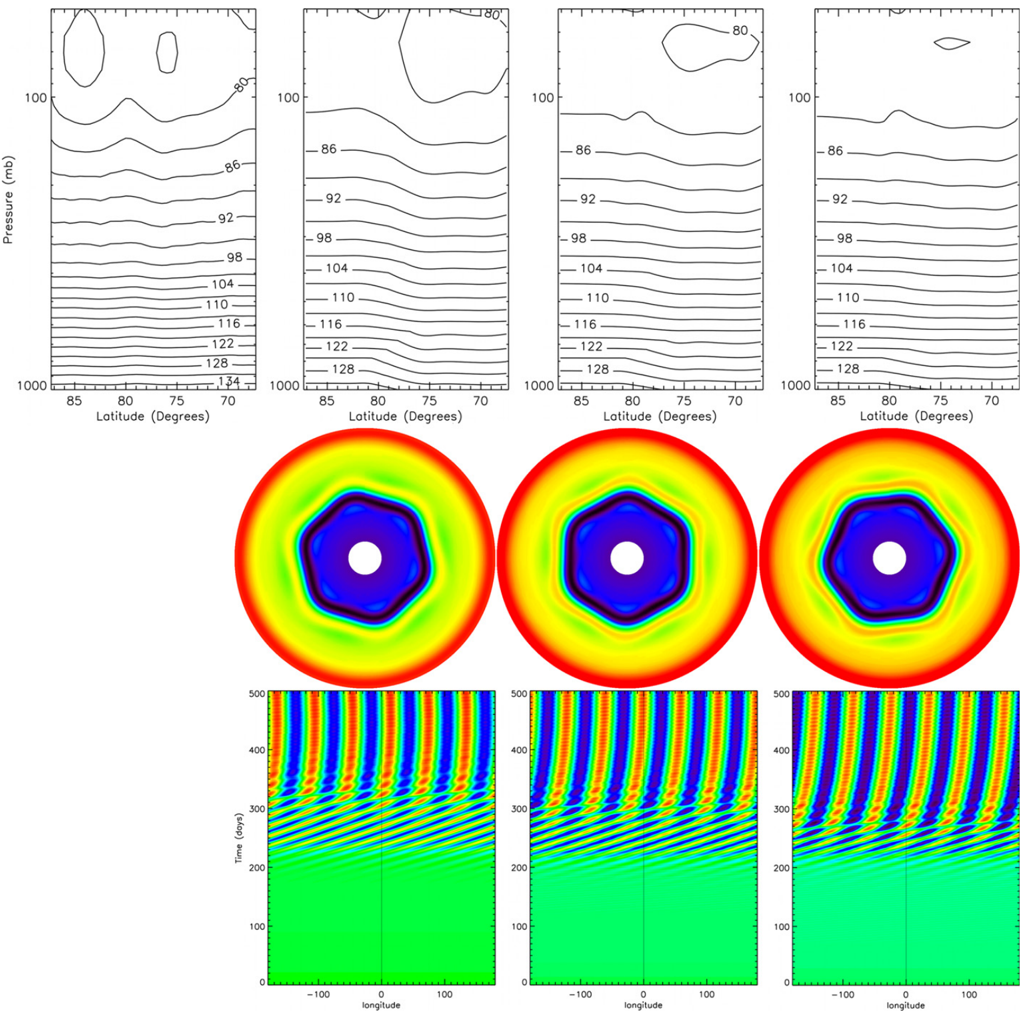
- The paper states that the successful model reproduces all observed dynamical properties of Saturn’s northern Hexagon, including no alternating vorticity patches, winds within observed errors, a sharp hexagonal shape, and a temperature gradient with the equatorial side colder than the polar side.
## Methods
- Numerical simulations used the Explicit Planetary Isentropic-Coordinate General Circulation Model on an oblate sphere, integrating the hydrostatic primitive equations.
- The nominal domain spanned 360° longitude and 67.3° to 87.3° latitude, with 20 vertical layers from 0.1 mb to 10 bars; perturbations were applied to Gaussian eastward jets and parameter sweeps varied jet amplitude, curvature, vertical shear, bottom winds, and static stability.
- The authors evaluated outcomes against four criteria: whether the jet became a meander rather than a vortex-street, whether the final wind profile matched observations, whether the drift rate matched the Hexagon, and whether the model produced the observed temperature gradient.
## Limitations
- The paper explicitly notes that outside the 76°N to 80°N region, the background wind field lacks additional jets, so it cannot reproduce temperature gradients associated with those other jets.
- The model temperatures above the 500 mbar level are on average 3 K higher than observed, and the authors say this may reflect missing physical processes such as heating and cooling by atmospheric absorbers.
- Evident from the text: the latitude test in the Southern Hemisphere is described as a “preliminary series of simulations”, so the latitude dependence results are exploratory rather than a full parameter study.
Model-written summary. Check it against the paper before relying on it.
Integrity signals
Registry
Cites
Statistics
Figures
Verification
Claims the paper makes
4 Valid · 0 Not valid · 13 Not checked · 24 Own results and interpretations
The cited sources support only part of this claim — read each source’s verdict below.
In the paper
“For the cases when the jet center is placed at 35 ° and 30 ° , the jet equilibrates in a state that is more reminiscent of the morphology of the Ribbon ( Godfrey & Moore 1986; Sayanagi et al. 2010 ) than that of the Hexagon.”
What the sources say
- Not checked — no full text of the sourcecites Godfrey & Moore 1986 matched to “The Saturnian ribbon feature—A baroclinically unstable model” (1986) source
- Partly supportedcites Sayanagi et al. 2010 matched to “Saturn’s Northern Hemisphere Ribbon: Simulations and Comparison with the Meandering Gulf Stream” (2010) sourceExperimental — accuracy not yet measured
Our copy of Sayanagi et al. (2010) clearly supplies the Ribbon side of the comparison: in section 3a (Development of jet meandering) the equilibrated 47°N jet 'follows a meandering path resembling the Ribbon's morphology,' with buckling, pinching, vortex shedding and no single dominant wavenumber, and the Abstract states a nonlinearly saturated shear instability in the 47°N jet is a viable mechanism for the Ribbon morphology. However, the paper's parameter sweeps vary only the background wind amplitude (scaling factors 0.1–2.0 on the Sánchez-Lavega et al. 2000 profile, section 3b) and the tropospheric static stability N = 0.004–0.007 s⁻¹ (sections 2b, 3c) for the fixed 47°N jet; no simulation places a jet center at 35°N or 30°N, and our copy nowhere contrasts a Ribbon-like end state with the Hexagon. So the jet-center-latitude result and the Hexagon half of the sentence are not attributable to this source, only the Ribbon-morphology characterization is. (LLM, conf=0.72)
plainstates a cause- Asserted: passes — The authors put it forward as true.
- Checkable: passes — It can be checked against evidence.
- Load-bearing: passes — The paper’s conclusions depend on it.
- Based: passes — The paper gives a reason why it holds.
A result the paper reports from its own data — it cites no other source for it, so there is none to check. The quote shows it is in the paper.
In the paper
“In our third series of simulations, the jet amplitude and shape are left relatively unaltered throughout the simulation ( Figure 3 )”
plain- Asserted: passes — The authors put it forward as true.
- Checkable: passes — It can be checked against evidence.
- Load-bearing: passes — The paper’s conclusions depend on it.
- Based: passes — The paper gives a reason why it holds.
A result the paper reports from its own data — it cites no other source for it, so there is none to check. The quote shows it is in the paper.
In the paper
“When we seed the model with a perturbation, Equation ( 2 ) , its path equilibrates into a stable meander with a dominant zonal wavenumber of six as shown in the polar projected maps of potential vorticity after 500 days.”
plainstates a causeSingle case- Asserted: passes — The authors put it forward as true.
- Checkable: passes — It can be checked against evidence.
- Load-bearing: passes — The paper’s conclusions depend on it.
- Based: passes — The paper gives a reason why it holds.
A result the paper reports from its own data — it cites no other source for it, so there is none to check. The quote shows it is in the paper.
In the paper
“We also fi nd that the winds at the bottom of the model are as important as the winds at the cloud level in matching the observed Hexagon ' s characteristics.”
- Also stated in: § 5. CONCLUSIONS · plain
“We also fi nd that the winds at the bottom of the model are as important as the winds at the cloud level in matching the observed Hexagon ' s characteristics, in particular its drift rate and its shape sharpness.”
plainstates an association- Asserted: passes — The authors put it forward as true.
- Checkable: passes — It can be checked against evidence.
- Load-bearing: passes — The paper’s conclusions depend on it.
- Based: passes — The paper gives a reason why it holds.
- Also stated in: § 5. CONCLUSIONS · plain
In the paper
“In our fi rst two series of simulations the jet decreases in amplitude and widens signi fi cantly as the simulations evolve ( Figure 3 ) , which is a characteristic signature of barotropic instability ( Pedlosky 1982 ) .”
What the sources say
- Not checked — no full text of the sourcecites Pedlosky 1982 matched to “Geophysical Fluid Dynamics” (1982) source
plainstates an association- Asserted: passes — The authors put it forward as true.
- Checkable: passes — It can be checked against evidence.
- Load-bearing: passes — The paper’s conclusions depend on it.
- Based: passes — The paper gives a reason why it holds.
16 more claims
Create a free account to see all 41 claims and to verify the 1 reference still open.
- It may state two separate claims as one. 14
- Probably not a substantial claim. 6
- The quote only partly states this claim. 1
Claims other papers make about this one
Each is checked against this paper’s own text: does it say what the citing paper says it does?
The cited source says what the claim attributes to it.
In the citing paper
“The meandering of the jetstream that forms the hexagon is believed to be a Rossby wave31 resulting from an instability of the eastward zonal jet near 78°N29,32–34 and trapped within a waveguide formed by the zonal jets.”
From A hexagon in Saturn's northern stratosphere surrounding the emerging summertime polar vortex (2018) · cites this paper as [34]
The cited source says what the claim attributes to it.
In the citing paper
“Recent numerical studies confirm that to reproduce both the shape and near-stationary vertices of the hexagon depends on the vertical wind shear shape of the wind profile at depth [99].”
From Giant Planet Atmospheres: Dynamics and Variability from UV to Near-IR Hubble and Adaptive Optics Imaging (2022) · cites this paper as [99]
Citations
Cites
Pedlosky, J., & Leibovich, S. (1981) · Journal of Applied Mechanics · doi:10.1115/1.3157711 · Cited by 4,631
On the Stability of Internal Baroclinic Jets in a Rotating Atmosphere
Charney, J. G., & Stern, M. E. (1962) · Journal of the Atmospheric Sciences · doi:10.1175/1520-0469(1962)019<0159:otsoib>2.0.co;2 · Cited by 721
Voyager measurement of the rotation period of Saturn's magnetic field
Desch, M. D., & Kaiser, M. L. (1981) · Geophysical Research Letters · doi:10.1029/gl008i003p00253 · Cited by 297
Pedlosky, J. (1982) · doi:10.1007/978-3-662-25730-2 · Cited by 265
Report of the IAU/IAG Working Group on cartographic coordinates and rotational elements: 2006
Seidelmann, P. K., Archinal, B. A., A’hearn, M. F., Conrad, A., Consolmagno, G. J., Hestroffer, D., Hilton, J. L., Krasinsky, G. A., Neumann, G., Oberst, J., et al. (2007) · Celestial Mechanics and Dynamical Astronomy · doi:10.1007/s10569-007-9072-y · Cited by 259
A hexagonal feature around Saturn's north pole
Godfrey, D. A. (1988) · Icarus · doi:10.1016/0019-1035(88)90075-9 · Cited by 156 · cited 3×
“…of the hexagonal cloud morphology; (3) there is no evidence that the Hexagon is a “vortex-street,” a series of spots of alternating vorticity staggered on the flanks of the jet; (4) measurements from Voyager images yielded a speed for the vertices of the Hexagon of 0.8 1.1 ms 1 - (Godfrey 1988).”
BackgroundInfluentialLaboratory model of a planetary eastward jet
Sommeria, J., Meyers, S. D., & Swinney, H. L. (1989) · Nature · doi:10.1038/337058a0 · Cited by 131 · cited 1×
“Other experiments have shown how polygonal patterns can emerge in flows for a wide range of parameters and different kinds of forcing (Sommeria et al. 1989; Vatistas 1990; Vatistas et al. 1994; Marcus & Lee 1998; Jansson et al. 2006).”
BackgroundThe Explicit Planetary Isentropic-Coordinate (EPIC) Atmospheric Model
Dowling, T. E., Fischer, A. S., Gierasch, P. J., Harrington, J., LeBeau, R. P., & Santori, C. M. (1998) · Icarus · doi:10.1006/icar.1998.5917 · Cited by 128 · cited 1×
“The model used in this study is the Explicit Planetary Isentropic-Coordinate General Circulation Model developed by Dowling et al. (1998).”
MethodTemperature and Composition of Saturn's Polar Hot Spots and Hexagon
Fletcher, L. N., Irwin, P. G. J., Orton, G. S., Teanby, N. A., Achterberg, R. K., Bjoraker, G. L., Read, P. L., Simon-Miller, A. A., Howett, C., de Kok, R., et al. (2008) · Science · doi:10.1126/science.1149514 · Cited by 125 · cited 7×
“Our simulations adopt a vertical thermal profile as a function of pressure above 1 bar that resembles the observed temperatures measured by Cassini CIRS during Saturn’s northern winter in 2007 (Fletcher et al. 2008).”
BackgroundMethodInfluentialSelf-citationPolygons on a Rotating Fluid Surface
Jansson, T. R. N., Haspang, M. P., Jensen, K. H., Hersen, P., & Bohr, T. (2006) · Physical Review Letters · doi:10.1103/physrevlett.96.174502 · Cited by 124
Research works printed but not linked: 4
- Antuñano, A., del Río Gaztelurrutia, T., Sánchez Lavega, A., & Hueso, R. 2015, JGRE, 120, 155
- Godfrey, D. A., & Moore, V. 1986, Icar, 68, 313 · DOI · Paper page
- Ingersoll, A. P., Beebe, R. F., Conrath, B. J., & Hunt, G. E. 1984, in Structure and Dynamics of Saturn ' s Atmosphere, ed. T. Gehrels & M. S. Matthews ( Tucson, AZ: Saturn Univ. Arizona Press ) - Jansson, T. R. N., Haspang, M. P., Jensen, K. H., Hersen, P., & Bohr, T. 2006, PhRvL, 96, 174502
- Sayanagi, K. M., Ewald, S. P., & Ingersoll, A. P. 2009, BAAS, 41, 10.08
Cited by
Showman, A. P., Tan, X., & Zhang, X. (2019) · The Astrophysical Journal · doi:10.3847/1538-4357/ab384a · Cited by 104
Spiga, A., Guerlet, S., Millour, E., Indurain, M., Meurdesoif, Y., Cabanes, S., Dubos, T., Leconte, J., Boissinot, A., Lebonnois, S., et al. (2019) · Icarus · doi:10.1016/j.icarus.2019.07.011 · Cited by 65
A hexagon in Saturn's northern stratosphere surrounding the emerging summertime polar vortex
Fletcher, L. N., Orton, G. S., Sinclair, J. A., Guerlet, S., Read, P. L., Antuñano, A., Achterberg, R. K., Flasar, F. M., Irwin, P. G. J., Bjoraker, G. L., et al. (2018) · Nature Communications · doi:10.1038/s41467-018-06017-3 · Cited by 52
Self-citationDeep rotating convection generates the polar hexagon on Saturn
Yadav, R. K., & Bloxham, J. (2020) · Proceedings of the National Academy of Sciences · doi:10.1073/pnas.2000317117 · Cited by 45
“(12) study how perturbations affect an eastward jet stream.”
BackgroundOn the dynamical nature of Saturn’s North Polar hexagon
Rostami, M., Zeitlin, V., & Spiga, A. (2017) · Icarus · doi:10.1016/j.icarus.2017.06.006 · Cited by 38
“…northern polar hexagon similar to the results of Morales-Juberias et al. (2011), and the “jet+vortex” configuration yields a “meandering jet” stable northern polar hexagon, similar to Morales-Juberias et al. (2015), featuring the sharp straight-line PV gradients on the six sides of the hexagon.”
BackgroundResultInfluentialSayanagi, K. M., Baines, K. H., Dyudina, U. A., Fletcher, L. N., Sánchez-Lavega, A., & West, R. A. (2016) · arXiv · doi:10.48550/arxiv.1609.09626 · Cited by 33
Self-citationCassini Exploration of the Planet Saturn: A Comprehensive Review
Ingersoll, A. P. (2020) · Space Science Reviews · doi:10.1007/s11214-020-00751-1 · Cited by 41
Cloud morphology and dynamics in Saturn's northern polar region
Antuñano, A., del Río-Gaztelurrutia, T., Sánchez-Lavega, A., & Rodríguez-Aseguinolaza, J. (2018) · Icarus · doi:10.1016/j.icarus.2017.07.017 · Cited by 29
Sayanagi, K. M., Baines, K. H., Dyudina, U. A., Fletcher, L. N., Sánchez-Lavega, A., & West, R. A. (2018) · Cambridge University Press eBooks · doi:10.1017/9781316227220.012 · Cited by 42
Self-citationDeep model simulation of polar vortices in gas giant atmospheres
Garcia, F., Chambers, F. R. N., & Watts, A. L. (2020) · Monthly Notices of the Royal Astronomical Society · doi:10.1093/mnras/staa2962 · Cited by 21
Hueso, R., Sánchez-Lavega, A., Rojas, J. F., Simon, A. A., Barry, T., Río-Gaztelurrutia, T. D., Antuñano, A., Sayanagi, K. M., Delcroix, M., Fletcher, L. N., et al. (2020) · Icarus · doi:10.1016/j.icarus.2019.113429 · Cited by 20
“that small perturbations to an eastward jet can grow and form a meandering jet when the jet latitude, amplitude, curvature and vertical structure are appropiate (Morales-Jubeŕıas et al., 2015).”
BackgroundSelf-citationSimon, A. A., Wong, M. H., Sromovsky, L. A., Fletcher, L. N., & Fry, P. M. (2022) · Remote Sensing · doi:10.3390/rs14061518 · Cited by 19
Self-citationA hexagon in Saturn's northern stratosphere surrounding the emerging summertime polar vortex.
Fletcher, L. N., Orton, G. S., Sinclair, J. A., Guerlet, S., Read, P. L., Antuñano, A., Achterberg, R. K., Flasar, F. M., Irwin, P. G. J., Bjoraker, G. L., et al. (2018) · RePEc: Research Papers in Economics · Cited by 18
Self-citationSpontaneous striped pattern formation in thin chiral nematic liquid crystal layers
Biagio, R. L., de Souza, R. T., Evangelista, L. R., et al. (2018) · Journal of Molecular Liquids · doi:10.1016/j.molliq.2018.08.029 · Cited by 16
Farrell, B. F., & Ioannou, P. J. (2017) · Physical Review Fluids · doi:10.1103/physrevfluids.2.073801 · Cited by 13
“Previously advanced explanations for the prominent wave-6 perturbation to Saturn’s NPJ are that it arises as the surface expression of an upward propagating Rossby wave, the origin of which is attributed to a wave-6 corrugation of an inferred deep lower layer [21], and that the wave-6 results from nonlinear equilibrat…”
BackgroundThe turbulent dynamics of Jupiter’s and Saturn’s weather layers: order out of chaos?
Read, P. L., Young, R. M. B., & Kennedy, D. (2020) · Geoscience Letters · doi:10.1186/s40562-020-00159-3 · Cited by 15
Saturn's new ribbons: Cassini observations of planetary waves in Saturn's 42N atmospheric jet
Gunnarson, J. L., Sayanagi, K. M., Blalock, J. J., Fletcher, L. N., Ingersoll, A. P., Dyudina, U. A., Ewald, S. P., & Draham, R. L. (2018) · Geophysical Research Letters · doi:10.1029/2018gl078156 · Cited by 13
“Simulations of Saturn’s north polar hexagon (Morales-Juberías et al., 2015) suggest that vortex street morphology arises in barotropic conditions, while a meandering morphology occurs in baroclinic conditions.”
BackgroundSelf-citationStreamline integration as a method for two-dimensional elliptic grid generation
Wiesenberger, M., Held, M., & Einkemmer, L. D. (2017) · Journal of Computational Physics · doi:10.1016/j.jcp.2017.03.056 · Cited by 12
Potential Vorticity of Saturn's Polar Regions: Seasonality and Instabilities
Antuñano, A., del Río-Gaztelurrutia, T., Sánchez-Lavega, A., Read, P. L., & Fletcher, L. N. (2019) · Journal of Geophysical Research Planets · doi:10.1029/2018je005764 · Cited by 11
“, 2016), with the presence of a warm stratospheric polar hood at the summer pole (Orton and Yanamandra-Fisher, 2005; Fletcher et al., 2007).”
BackgroundSelf-citationVorticity and divergence at scales down to 200 km within and around the polar cyclones of Jupiter
Ingersoll, A. P., Ewald, S. P., Tosi, F., Adriani, A., Mura, A., Grassi, D., Plainaki, C., Sindoni, G., Li, C., Siegelman, L., et al. (2022) · Nature Astronomy · doi:10.1038/s41550-022-01774-0 · Cited by 12
García‐Garrido, V. J., Curbelo, J., Mechoso, C. R., Mancho, A. M., & Wiggins, S. (2017) · Nonlinear processes in geophysics · doi:10.5194/npg-24-265-2017 · Cited by 10
Flow patterns of Jupiter's south polar region
ROGERS, J. H., Eichstädt, G., Hansen, C. J., Orton, G. S., Momary, T., Casely, A., Adamoli, G., Jacquesson, M., Bullen, R., Peach, D., et al. (2021) · Icarus · doi:10.1016/j.icarus.2021.114742 · Cited by 7
Energy Exchanges in Saturn's Polar Regions From Cassini Observations: Eddy‐Zonal Flow Interactions
Read, P. L., Antuñano, A., Colyer, G., Cabanes, S., del Río-Gaztelurrutia, T., & Sánchez-Lavega, A. (2022) · Journal of Geophysical Research Planets · doi:10.1029/2021je006973 · Cited by 9
Exploring Jupiter's Polar Deformation Lengths with High-resolution Shallow Water Modeling
Hyder, A., Lyra, W., Chanover, N. J., Morales-Juberías, R., & Jackiewicz, J. (2022) · The Planetary Science Journal · doi:10.3847/psj/ac7952 · Cited by 6
Self-citationStability of barotropic vortex strip on a rotating sphere
Sohn, S.-I., Sakajo, T., & Kim, S.-C. (2018) · Proceedings of the Royal Society A Mathematical Physical and Engineering Sciences · doi:10.1098/rspa.2017.0883 · Cited by 4
Cosgrove, J. M., & Forbes, L. K. (2017) · Monthly Notices of the Royal Astronomical Society · doi:10.1093/mnras/stx1170 · Cited by 4
“Godfrey (1988) pieced together map-projections taken as Saturn rotated and thus was the first to identify Saturn’s North Polar Hexagon.”
BackgroundMethodInfluentialVortex crystals at Jupiter’s poles: Emergence controlled by initial small-scale turbulence
Chen, S., Ingersoll, A. P., & Li, C. (2024) · Icarus · doi:10.1016/j.icarus.2024.116438 · Cited by 3
The Environment of Space Exploration
NICOGOSSIAN, A. E. (2016) · Springer eBooks · doi:10.1007/978-1-4939-6652-3_2 · Cited by 3
SIMULATION OF HEXAGONAL TURBULENT FLOW IN THE NORTH POLAR REGION OF SATURN
Trunev, A. P. (2017) · Polythematic Online Scientific Journal of Kuban State Agrarian University · doi:10.21515/1990-4665-125-050 · Cited by 2
A decagon wave around Saturn’s south pole
Sánchez-Lavega, A., Simon, A. A., Wong, M. H., Fletcher, L. N., Antuñano, A., Hueso, R., Iñurrigarro, P., Flix-Bellmunt, A., Miró, A., Garcia‐Melendo, E., et al. (2026) · Science Advances · doi:10.1126/sciadv.aee4251 · Cited by 1
“Models have replicated polygonal structures using various combinations of turbulence, jet instability, eddies and vortices, and waves in shallow and multilayer models that include vertical wind shear ( 33–35 , 39 , 41– 44 ).”
Self-citationSIMULATION OF ATMOSPHERIC VORTEX FLOWS ON JUPIER AND SATURN
Trunev, A. P. (2017) · Polythematic Online Scientific Journal of Kuban State Agrarian University · doi:10.21515/1990-4665-126-050 · Cited by 1
Symmetry breaking Paradigm In Typical Laminar-Turbulence Transition SystemPreprint
Huang, C., & Jiang, Y. (2021) · Research Square · doi:10.21203/rs.3.rs-821742/v1 · Cited by 1
The Enigma of Saturn's North-Polar HexagonPreprint
Marsh, G. E. (2017) · arXiv (Cornell University) · doi:10.48550/arxiv.1711.00338 · Cited by 1
“ion determined the dominant wave number. The model they used was initialized with a Gaussian velocity distribution for the jet whose peak velocity was 125 m/s. Their value for the curvature b !in Eq. (6) was 10!"! !! . After stabilization, the model showed a stable configuration having a wavenumber of six. When p…”
BackgroundMethodResultInfluentialOn the dynamical nature of Saturn’s North Polar hexagonPreprint
Rostami (2018) · doi:10.31219/osf.io/rvdmx
Sayanagi, K. M., Garland, J., & Saunders, W. (2025) · Elsevier eBooks · doi:10.1016/b978-0-323-96026-7.00224-1
Self-citationThe Dynamics of the Atmosphere of Saturn
Sánchez-Lavega, A. (2026) · Oxford University Press eBooks · doi:10.1093/9780197851500.003.0342
Self‐Organized Hexagon‐Shaped Jets in Rotating Fluid Experiments
Espa, S., & Lacorata, G. (2026) · Journal of Geophysical Research: Space Physics · doi:10.1029/2025ja034520
Metadata
- Authors
- Morales-Juberías, R., Sayanagi, K. M., Simon, A. A., Fletcher, L. N., & Cosentino, R. G.
- Affiliations
- New Mexico Institute of Mining and Technology (US)
- Hampton University (US)
- Goddard Space Flight Center (US)
- University of Oxford (GB)
- Venue
- The Astrophysical Journal
- Publisher
- American Astronomical Society
- Published
- 2015-06-10
- Volume
- 806
- Issue
- 1
- Pages
- L18
- ISSN
- 2041-8205 (ISSN-L)
- 2041-8213
- OpenAlex
- W2299300857
- Semantic Scholar
- cb700e8d1f987085d2460236e9efb9cf8b4261be
- Cited by
- 35
- References
- 27
- Citations by year
- 2026: 2 · 2025: 1 · 2024: 1 · 2022: 4 · 2021: 2 · 2020: 4 · 2019: 4 · 2018: 7 · 2017: 9 · 2016: 1
- FWCI
- 3.23
- Type
- journal article
- Language
- en
- Open access
- bronze
- doi.org
- Licence
- iopscience.iop.org/info/page/text-and-data-mining (tdm)
- iopscience.iop.org/page/copyright (vor)
- Locations
- The Astrophysical Journal Letters (publishedVersion)
- Figshare (submittedVersion, cc-by)
- Leicester Research Archive (University of Leicester) (submittedVersion)
- Zenodo (CERN European Organization for Nuclear Research) (submittedVersion, other-oa)
- Funders
- National Science Foundation (1212216)
- National Aeronautics and Space Administration (NNX12AR38G, NNX14AH47G)
- University of Oxford
- Topics
- Physical Sciences › Earth and Planetary Sciences › Space and Planetary Science › Astro and Planetary Science
- Physical Sciences › Earth and Planetary Sciences › Space and Planetary Science › Ionosphere and magnetosphere dynamics
- Physical Sciences › Physics and Astronomy › Astronomy and Astrophysics › Stellar, planetary, and galactic studies
- Keywords
- jet meandering, phase velocity, jet instability
About these checks
Registry, retraction, Cites and statistics results are computed, not judged, with one exception: a printed reference that no index lists is read once by a model before it counts as a citation error. Claims are extracted by a model and kept only when their quote appears verbatim in the text; each cited source is then checked, with a model’s help, for whether it says what the claim relies on. Those verdicts can be wrong — read the claim’s quote and the cited source before relying on one.
The claim verdicts this report counts are experimental: their accuracy is not yet measured.
A language model drew the claims from the paper on 2026-10-09, under version 3 of the claim definition (model deepseek-v4.1-flash, prompt extract-v3).
A second model labelled each claim on 2026-10-09 (model jev-1.13-20260917, definition revision gold-guideline-v0.2).
Cited sources are checked with a language model’s help (qwen3.8-omni-flash).
Statistics and arithmetic are recomputed, not judged.
Confidence bands are shown only for fields calibrated on our annotated test set. None is calibrated yet, so no band is shown.
What counts as a claim ›How we measure confidence ›How we check this ›
Are you an author, or do you see a problem with this page? Request a review
Data sources
Bibliographic data: Semantic Scholar, OpenAlex, Crossref.
Contains information from the Semantic Scholar Academic Graph Datasets, made available under the ODC Attribution License (ODC-BY 1.0).
Semantic Scholar’s data is described in: Kinney, R., et al. (2023). The Semantic Scholar Open Data Platform. arXiv:2301.10140.
