

Nuclear clocks for testing fundamental physics
Open accessThe DOI matches its Crossref record; 183 of the 183 references it cites were found in a registry or an index.
Abstract
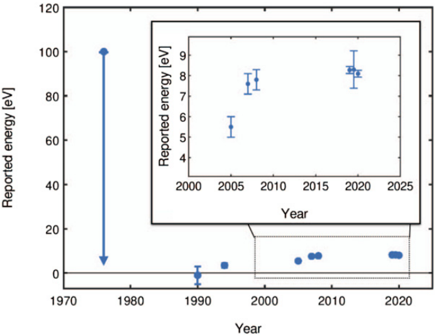
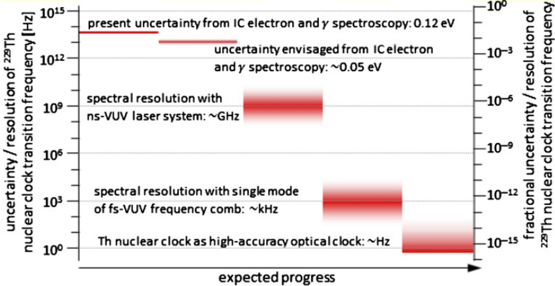
The low-energy, long-lived isomer in 229 Th, first studied in the 1970s as an exotic feature in nuclear physics, continues to inspire a multidisciplinary community of physicists. It has stimulated innovative ideas and studies that expand the understanding of atomic and nuclear structure of heavy elements and of the interaction of nuclei with bound electrons and coherent light. Using the nuclear resonance frequency, determined by the strong and electromagnetic interactions inside the nucleus, it is possible to build a highly precise nuclear clock that will be fundamentally different from all other atomic clocks based on resonant frequencies of the electron shell. The nuclear clock will open opportunities for highly sensitive tests of fundamental principles of physics, particularly in searches for violations of Einstein’s equivalence principle and for new particles and interactions beyond the standard model. It has been proposed to use the nuclear clock to search for variations of the electromagnetic and strong coupling constants and for dark matter searches. The 229 Th nuclear optical clock still represents a major challenge in view of the tremendous gap of nearly 17 orders of magnitude between the present uncertainty in the nuclear transition frequency (about 0.2 eV, corresponding to ∼48 THz) and the natural linewidth (in the mHz range). Significant experimental progress has been achieved in recent years, which will be briefly reviewed. Moreover, a research strategy will be outlined to consolidate our present knowledge about essential 229m Th properties, to determine the nuclear transition frequency with laser spectroscopic precision, realize different types of nuclear clocks and apply them in precision frequency comparisons with optical atomic clocks to test fundamental physics. Two avenues will be discussed: laser-cooled trapped 229 Th ions that allow experiments with complete control on the nucleus–electron interaction and minimal systematic frequency shifts, and Th-doped solids enabling experiments at high particle number and in different electronic environments.
Overview
The claims and statistics of this paper haven’t been checked yet.
Free: it reads the open-access text and checks the first 5 claims that cite a source we can check. Create a free account to check every claim.
Integrity signals
Registry
Cites
Statistics
Figures
Verification
Claims the paper makes
The claims and statistics of this paper haven’t been checked yet.
Free: it reads the open-access text and checks the first 5 claims that cite a source we can check. Create a free account to check every claim.
Claims other papers make about this one
Each is checked against this paper’s own text: does it say what the citing paper says it does?
The cited source says what the claim attributes to it.
In the citing paper
“The assumption of a metric coupling is actually well tested in the Solar system through 4 types of experiments; see Will (1993Will ( , 2006) ) for a detailed discussion and Peik et al. (2021), Herrmann and Ra ¨tzel (2023) for recent developments on quantum tests of relativity.”
From Fundamental constants: from measurement to the universe, a window on gravitation and cosmology (2025) · cites this paper as Peik et al. 2021
Self-check
Percentages, sums and reported differences re-computed from the paper’s own numbers.
The self-check needs the paper’s full text.
Citations
Cites
From ultrasoft pseudopotentials to the projector augmented-wave method
Kresse, G., & Joubert, D. (1999) · Physical Review B · doi:10.1103/physrevb.59.1758 · Cited by 85,307
Ludlow, A. D., Boyd, M. M., Ye, J., Peik, E., & Schmidt, P. O. (2015) · Reviews of Modern Physics · doi:10.1103/revmodphys.87.637 · Cited by 2,385
Self-citationNIST Chemistry WebBook, NIST Standard Reference Database 69
Linstrom, P. J. (1997) · National Institute of Standards and Technology (NIST) · doi:10.18434/t4d303 · Cited by 1,665
Search for new physics with atoms and molecules
Safronova, M. S., Budker, D., DeMille, D., Kimball, D. F. J., Derevianko, A., & Clark, C. W. (2018) · Reviews of Modern Physics · doi:10.1103/revmodphys.90.025008 · Cited by 1,560
Self-citationDie Rotverschiebung von extragalaktischen Nebeln
Zwicky, F. (1933) · CaltechAUTHORS (California Institute of Technology) · doi:10.5169/seals-110267 · Cited by 1,327
Bertone, G., & Hooper, D. (2018) · Reviews of Modern Physics · doi:10.1103/revmodphys.90.045002 · Cited by 1,241
Planck 2015 results: I. Overview of products and scientific results
Planck Collaboration, Adam, R., Ade, P. A. R., Aghanim, N., Akrami, Y., Alves, M. I. R., Argüeso, F., Arnaud, M., Arroja, F., Ashdown, M., et al. (2016) · Astronomy & Astrophysics · doi:10.1051/0004-6361/201527101 · Cited by 1,014
Extreme ultraviolet high-harmonic spectroscopy of solids
Luu, T. T., Garg, M., Kruchinin, S. Y., Moulet, A., Hassan, M. T., & Goulielmakis, E. (2015) · Nature · doi:10.1038/nature14456 · Cited by 882
Varying Constants, Gravitation and Cosmology
Uzan, J.-P. (2011) · Living Reviews in Relativity · doi:10.12942/lrr-2011-2 · Cited by 740
(2019) · doi:10.1103/physrevlett.123.033201 · Cited by 711
Research works printed but not linked: 8
- Vorykhalov O V and Koltsov V V 1995 Bull. Russ. Acad. Sci.: Phys. 59 20
- Inamura T T and Mitsugashira T 2006 Laser 2004 (Berlin: Springer) pp 115-23
- Beck B R et al 2010 CERN-Proc.
- Moritz D 2020 Commissioning and characterization of the ion guide and mass selection system for the nuclear clock setup Master Thesis LMU Munich
- Krutov V A and Müller K 1958 Bull. Acad. Sci. USSR, Phys. Ser. 22 171
- Krutov V A and Müller K 1958 Bull. Acad. Sci. USSR, Phys. Ser. 22 161
- Strizhov V F and Tkalya E V 1991 Sov. Phys. -JETP 72 387
- Tkalya E V 1992 Sov. Phys. -JETP 75 200
Cited by
Items 101–175 of 175
Li, Z., Li, L., Hua, X., & Tong, X. (2024) · Journal of Applied Physics · doi:10.1063/5.0202805 · Cited by 5
Shedding Light on the Thorium-229 Nuclear Clock Isomer
Thirolf, P. G. (2024) · Physics · doi:10.1103/physics.17.71 · Cited by 7
Self-citationTh 3 + 229 as an ionic optical clock for fine-structure-constant variations
Yu, S.-C., Gan, W.-T., Hua, X., Tong, X., & Li, C. (2024) · Physical Review A · doi:10.1103/physreva.109.063115 · Cited by 6
Using atomic clocks to detect local dark matter halos
Kouvaris, C., Papantonopoulos, E., Street, L., & Wijewardhana, L. C. R. (2021) · Physical review. D/Physical review. D. · doi:10.1103/physrevd.104.103025 · Cited by 5
“It has also been suggested that nuclear clocks, which can probe both the Higgs and photon portals, can reach precisions of 10−19 [108, 109].”
BackgroundPeik, E. (2023) · Wiley eBooks · doi:10.1002/9783527837427.ch14 · Cited by 4
Self-citationDark matter: what is it, and can quantum sensors help find it?
Devlin, J. A. (2024) · Contemporary Physics · doi:10.1080/00107514.2025.2513120 · Cited by 5
“Such a thorium clock nuclear transition is predicted to have K = 5900 ( 2300 ) [59], making it extremely sensitive to scalar dark matter as well as a host of other fundamental physics tests [60].”
Hiraki, T., Beeks, K., Bartokos, M., Fujimoto, H., Fukunaga, Y., Haba, H., Kasamatsu, Y., Kitao, S., Leitner, A., Masuda, T., et al. (2024) · Interactions · doi:10.1007/s10751-024-01844-x · Cited by 4
“Since the proposal of a nuclear clock [1], various applications of nuclear clocks have been proposed [6, 7].”
Self-citationLorentz violating backgrounds from quadratic, shift-symmetric, ultralight dark matter
Jiang, M., Pecjak, B. D., Pérez, G., & Sankaranarayanan, S. (2024) · Journal of High Energy Physics · doi:10.1007/jhep08(2024)114 · Cited by 4
“In particular, the nuclear clock [43, 44] is expected to improve the ability to probe scalar dark matter by 5-6 orders of magnitude, due to its strongly enhanced sensitivity.”
WITHDRAWN: Proposal for a nuclear light source
Tkalya, E. V., Borisyuk, P. V., Domashenko, M. S., & Lebedinskiǐ, Y. Y. (2022) · Chinese Physics C · doi:10.1088/1674-1137/ac9f0a · Cited by 5
“12 eV [1], has already been described repeatedly and in great detail in various works (see, for example,[7, 9, 10] and references therein).”
BackgroundLaser ionization scheme development for in-gas-jet spectroscopy studies of Th+
Claessens, A., Ivandikov, F., Bara, S., Chhetri, P., Dragoun, A., Düllmann, C. E., Elskens, Y., Ferrer, R., Kraemer, S., Kudryavtsev, Y., et al. (2023) · Nuclear Instruments and Methods in Physics Research Section B Beam Interactions with Materials and Atoms · doi:10.1016/j.nimb.2023.04.019 · Cited by 5
Self-citationShift of nuclear clock transition frequency in Th229 ions due to hyperfine interaction
Dzuba, V. A., & Flambaum, V. V. (2023) · Physical Review A · doi:10.1103/physreva.108.062813 · Cited by 5
“This is because the 229 Th nucleus has a unique feature of having very low-energy excitation connected to the nuclear ground state by the magnetic dipole (M1) transition (see, e.g. reviews [3, 4] and references therein).”
BackgroundMicroscopic nuclear structure study of 229 Th by projected shell model
Chen, Z.-R., Wang, L.-J., & Wu, Y. (2025) · Physics Letters B · doi:10.1016/j.physletb.2025.139858 · Cited by 6
Progresses on Th-doped materials for solid-state nuclear clock
赵, C.-C. 呈. Z., 李, L. 琳. L., 李, S.-M. 善. L., 龚, Q.-R. 巧. G., 张, P.-X. 沛. Z., 杭, Y. 寅. H., 马, L.-S. 龙. M., & 祝, S.-N. 世. Z. (2025) · Chinese Physics B · doi:10.1088/1674-1056/ae210f · Cited by 4
Comprehensive assessment of Th 3 + properties for nuclear clock and fundamental physics applications
Chakraborty, A., & Sahoo, B. K. (2026) · Physical Review A · doi:10.1103/88jn-939s · Cited by 4
Isomer depletion via nuclear excitation by inelastic electron scattering
Li, Z., Zhao, J., Pu, X., & Wu, Y. (2026) · Physical Review C · doi:10.1103/slrl-9yfr · Cited by 3
Towards theory constraints on ultralight dark matter from quantum gravity
Assant, G., Eichhorn, A., & Knorr, B. (2026) · Journal of High Energy Physics · doi:10.1007/jhep06(2026)276 · Cited by 5
“Unprece-dented experimental opportunities are currently being opened up by the development of nuclear clocks [18–21].”
Photon lights a path towards a nuclear clock
Pálffy, A. (2023) · Nature · doi:10.1038/d41586-023-01631-8 · Cited by 3
Self-citationAmiri, M., & Saadati-Niari, M. (2023) · Physica Scripta · doi:10.1088/1402-4896/ace2fc · Cited by 6
Seres, E., Seres, J., Martínez-de-Olcoz, L., & Schumm, T. (2024) · Optics Express · doi:10.1364/oe.522309 · Cited by 3
Self-citationHigh-fidelity nuclear coherent population transfer via mixed-state inverse engineering
Wang, Y., & Dou, F.-Q. (2024) · Physical Review C · doi:10.1103/physrevc.110.034606 · Cited by 3
Spectral Flux Enhancement of X Rays for Addressing Ultranarrow Nuclear Transitions
Kuznetsova, E., Zhang, X., Shvyd'ko, Y. V., Scully, M. O., & Kocharovskaya, O. A. (2024) · Physical Review Letters · doi:10.1103/physrevlett.133.193401 · Cited by 7
An ultra-low noise and high-gain servo controller for ultra-stable laser systems
Ji, W.-C., Zhu, X.-Q., Hu, Y., Kong, D.-Q., Jia, Z.-P., Liu, X., Cui, X.-Y., Xu, P., Dai, H.-N., Liao, S., et al. (2025) · Review of Scientific Instruments · doi:10.1063/5.0261054 · Cited by 3
Production and chemical separation of 229Pa toward observation of γ rays of 229mTh
Shigekawa, Y., Yin, X., Nambu, A., Wang, Y., & Haba, H. (2023) · Journal of Radioanalytical and Nuclear Chemistry · doi:10.1007/s10967-023-09069-y · Cited by 4
“Moreover, the nuclear clock would be useful for testing fundamental physics [7] such as the measurement of the temporal variation of the fine structure constant [8].”
Toward a Thorium-229 Isomer–Based Nuclear Clock: Recent Progress
Kraemer, S., & Duppen, P. V. (2025) · Nuclear Physics News · doi:10.1080/10619127.2025.2483617 · Cited by 2
Progresses on 148 nm light sources for precision measurement of nuclear transition of 229m Th
王, Y. 样. W., 肖, Z.-R. 峥. X., 张, H. Q. 华. Z., Hua, L., & Liu, X. (2025) · Chinese Physics B · doi:10.1088/1674-1056/ae0d78 · Cited by 2
Density functional theory study of Th-doped LiCAF and LiSAF for nuclear clock applications
Pimon, M., Kirschbaum, T., Schumm, T., Pálffy, A., & Grüneis, A. (2026) · Physical review. B./Physical review. B · doi:10.1103/8hql-f6l6 · Cited by 2
Self-citationTowards a 229 Th nuclear clock: Understanding nucleus–electron–environment interactions
徐, Y.-L. 艳. X., Zheng, H.-Y., 喻, X.-C. 希. Y., Zhang, Y.-H., Shi, T.-Y., & Tang, L.-Y. (2025) · Chinese Physics B · doi:10.1088/1674-1056/ae1f7b · Cited by 2
Continuous-wave radiation source at 148 nm for excitation of the nuclear transition in 229Th
Lal, V., Okhapkin, M. V., Tiedau, J., Irwin, N., Petrov, V. P., & Peik, E. (2025) · Optica Laser Congress (ASSL, LAC, LS&C) · doi:10.1364/assl.2025.ath3a.4 · Cited by 2
Self-citationPhotonuclear Population of 229m,g Th in Th‐Doped Crystals Toward Nuclear Clock Development
Lan, H., Wu, D., Wang, M.-Z., Chen, Z., Lv, J., Xia, Y., Wang, Z.-N., Luo, W., Xu, X., & 闫晓晋 (2026) · Advanced Science · doi:10.1002/advs.202523384 · Cited by 3
The 229 Th isomer: Nuclear structure, clocks, and tests of fundamental physics
Xiao, L., Zhao, R., & Zhou, S.-G. (2026) · Chinese Physics B · doi:10.1088/1674-1056/ae9533 · Cited by 3
Neutral and charged thorium impurity in solid argon
Nikolaev, A. V., & Tkalya, E. V. (2021) · Physical Review A · doi:10.1103/physreva.104.032819 · Cited by 2
Fluorescence calorimetry of an ion crystal
Gajewski, M., Li, W., Wolf, S., Hahn, W., Düllmann, C. E., Budker, D., Morigi, G., & Schmidt‐Kaler, F. (2022) · Physical Review A · doi:10.1103/physreva.106.033108 · Cited by 2
A setup for vacuum-ultraviolet spectroscopy of the 229Th low-energy isomer
Kraemer, S., Chhetri, P., Bara, S., Claessens, A., Witte, H. D., Elskens, Y., Ferrer, R., Kudryavtsev, Y., Sels, S., den Bergh, P. V., et al. (2023) · Nuclear Instruments and Methods in Physics Research Section B Beam Interactions with Materials and Atoms · doi:10.1016/j.nimb.2023.05.029 · Cited by 3
Karpeshin, F. F. (2024) · Physics of Atomic Nuclei · doi:10.1134/s1063778824700546 · Cited by 2
Isomer production by multiphoton excitation
Liu, W., & Wu, Y. (2025) · Physical Review C · doi:10.1103/physrevc.111.054316 · Cited by 2
Trapping and sympathetic cooling of Th3+ ions in a linear ion trap
Li, Z., Gan, W.-T., Wang, C., Li, L., Hua, X., & Tong, X. (2025) · Journal of Applied Physics · doi:10.1063/5.0300192 · Cited by 2
Electronic bridge processes in Th 229 -doped LiCaAlF 6 and LiSrAlF 6
Kirschbaum, T., Pimon, M., Grüneis, A., Schumm, T., & Pálffy, A. (2026) · Physical Review A · doi:10.1103/n8q3-jtws · Cited by 2
Self-citationCharacterization of ion-trap-induced ac magnetic fields
Joshi, M. K., Guevara-Bertsch, M., Kranzl, F., Blatt, R., & Roos, C. F. (2024) · Physical Review A · doi:10.1103/physreva.110.063101 · Cited by 3
“…of atomic standards is vital for research areas investigating the variability of fundamental constants [1, 2], building frequency and time standards [3–5], testing new theories that advocate beyond the standard model of physics [1, 6, 7], investigating many-body dynamics [8], and more [9, 10].”
Towards the time-resolved spectroscopy of photoinduced electron dynamics in nuclear transitions
Seitz, M., Calegari, F., Thirolf, P. G., & Trabattoni, A. (2025) · Physical Review A · doi:10.1103/31qf-pfvj · Cited by 2
Self-citationOctupole correlations of the K π = 5/2 + ground-state band in 229 Th
Wang, Y., & Zhao, P. W. (2025) · Chinese Physics B · doi:10.1088/1674-1056/ae13ee · Cited by 1
Theoretical evaluation of decay mode of Th 229 m in solid samples
Masuda, R., Naito, T., Kaneko, M., Kazama, H., Hashiba, S., Misawa, K., & Kasamatsu, Y. (2025) · Physical Review Research · doi:10.1103/hn1b-51yx · Cited by 1
“The lattice constants obtained are summarized in Table III without embedding a Th atom.”
刘, B. 波. L., Wang, W., & Li, Y. (2026) · Chinese Physics B · doi:10.1088/1674-1056/ae39ce · Cited by 1
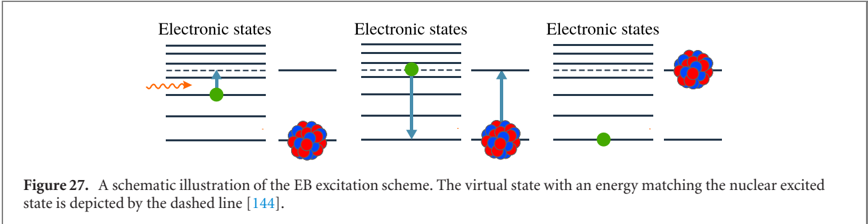
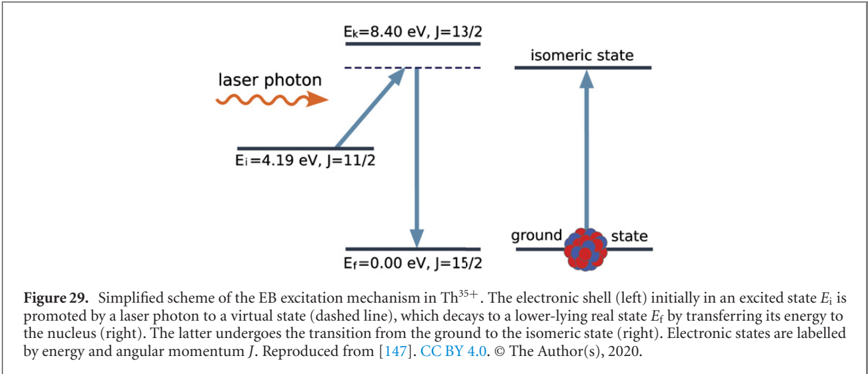
“35] The EB process refers to a nuclear transition induced by a laser-driven electronic transition, in which the coupling between the nucleus and the laser field is effectively enhanced.”
Highly efficient nuclear population transfer through physics-informed neural networks
Liu, J., & Dou, F.-Q. (2026) · Physical Review C · doi:10.1103/gdpq-k6lj · Cited by 1
Enhanced yield rate of Th 229 m via cascade decay in storage rings and electron beam ion traps
Wang, Y., Yang, Y., Li, Y., Yue, D., Zhao, K., Wang, Y., Fu, C., & G., Y. (2026) · Physical Review C · doi:10.1103/82cg-pkxb · Cited by 2
Scandium-45 nuclear-clock candidate driven by X-ray lasers
(2023) · Nature · doi:10.1038/d41586-023-02791-3 · Cited by 1
Pálffy, A., & López-Urrutia, J. R. C. (2024) · Nature · doi:10.1038/d41586-024-02662-5 · Cited by 2
Self-citationTrapping of triply charged thorium-229 for a nuclear clock
Yamaguchi, A., Shigekawa, Y., Haba, H., Wada, M., & Katori, H. (2024) · Journal of Physics Conference Series · doi:10.1088/1742-6596/2889/1/012041 · Cited by 3
Wissenberg, S., Weitenberg, J., Moreno, J., Hartung, H., Möslein, M., Burkhardt, T., Teschler, T., Schmid, F., Udem, T., Hoffmann, H.-D., et al. (2025) · Physical Review Research · doi:10.1103/physrevresearch.7.023071 · Cited by 1
“The laser system at Fraunhofer ILT is designed to generate a VUV frequency comb for performing spectro-scopy on the Th-229 isomer and to build a nuclear clock within the “ThoriumNuclearClock” ERC Synergy Grant project [16].”
Self-citationOptical Clocks with Trapped Ions: Atomic and Nuclear Clocks
Peik, E. (2022) · Conference on Lasers and Electro-Optics · doi:10.1364/cleo_si.2022.stu5o.5
“A future nuclear clock based on the low-energy magnetic dipole transition in Th-229 [3] may bring further advances in accuracy and additional opportunities for searches for new physics [4], including the sector of the nuclear interactions.”
BackgroundSelf-citationTheory of Laser-Assisted Nuclear Excitation by Electron CapturePreprint
Bilous, P. V. (2022) · arXiv (Cornell University) · doi:10.48550/arxiv.2210.07708
Horloge optique miniature à ion piégé
Achi, B. (2022) · theses.fr (ABES) · doi:10.70675/37eec1a1z10a3z4a88zb28fzd23577d8ea4c · Cited by 1
Thirolf, P. G., Kraemer, S., & Weitenberg, J. (2024) · Physik in unserer Zeit · doi:10.1002/piuz.202301696
Self-citationPrecision spectroscopic measurements of few-electron atomic systems in extreme ultraviolet region
Xiao, Z.-R., Zhang, H.-Z., Hua, L., Tang, L., & Liu, X. (2024) · Acta Physica Sinica · doi:10.7498/aps.73.20241231
Coherent dynamics of a nuclear-spin-isomer superposition
Levin, T., & Meir, Z. (2025) · Physical Review Research · doi:10.1103/physrevresearch.7.013274
TWO-PHOTON RESONANCE MECHANISM OF OPTICAL PUMPING OF THE 8.3-eV ISOMER 229mTh IN NEUTRAL ATOMS
Karpeshin, F. F. (2024) · Ядерная физика · doi:10.31857/s0044002724050039
Tuned Electron-nucleus Resonance as a Tool of Producing the 229mTh isomer
Karpeshin, F. F., & Vitushkin, L. F. (2025) · International Journal of Applied Sciences & Development · doi:10.37394/232029.2025.4.4
Nuclear excitation by near-resonant electron transition in 229 Th 39+ ions
Anonymous (2025) · Physical Review C · doi:10.1103/s5hf-nc4d · Cited by 1
Nuclear clocks could use electrical signals to keep time
Zhang, X., & Kocharovskaya, O. A. (2025) · Nature · doi:10.1038/d41586-025-03732-y
Modeling, analysis, and loop optimization of the Pound–Drever–Hall loop for ultra-stable lasers
Wenchao, 冀. J., Hu, Y., Wei, Q., Zhu, X.-Q., Kong, D.-Q., Cui, X.-Y., Xu, P., Dai, H.-N., Liao, S., Chen, Y.-A., et al. (2025) · Applied Optics · doi:10.1364/ao.581601
Zheng, H.-Y., Xu, Y.-L., Li, J.-G., Zhang, Y.-H., Shi, T.-Y., & Tang, L.-Y. (2025) · Chinese Physics Letters · doi:10.1088/0256-307x/43/2/020301 · Cited by 2
A Laser Built for Nuclear Timekeeping
Zhang, C., & Ooi, T. (2026) · Physics · doi:10.1103/physics.19.19
Moiseev, S. A., Gerasimov, K. I., Миннегалиев, М. М., Brekotkin, I., & Moiseev, E. S. (2026) · Physical Review Letters · doi:10.1103/bqzh-gy4n · Cited by 1
Comparing sliding-mode, bang–bang and linear-quadratic-Gaussian for steering an atomic clock
Bayat, A., & Sanders, B. C. (2026) · Measurement Science and Technology · doi:10.1088/1361-6501/aea17b
Sustaining the growth of the materials informatics ecosystem
Rajan, K. (2026) · Elsevier eBooks · doi:10.1016/b978-0-443-22256-6.00009-9
Nuclear non-resonant photoexcitation assisted by electron recombination
Xue, N., Liu, Z., Li, Z., Pálffy, A., Yuan, J., Wu, Y. N., Kong, X., & G., Y. (2026) · Science China Physics Mechanics and Astronomy · doi:10.1007/s11433-026-2986-4
“At the same time, nuclear transitions have been explored as potential timekeepers, with significant e ff orts directed toward developing a nuclear clock [23–31]—an innovation that promises a next-generation framework for precision metrology and advances in fundamental physics [32].”
Self-citationNew paradigm in time and frequency metrology: from the atomic to the nuclear clock
Peik, E. (2026) · tm - Technisches Messen · doi:10.1515/teme-2026-0034
“A highly precise nuclear clock would be an important additional test case for such experiments because it is probing the strong interaction between hadrons, not only the electromagnetic interaction between electrons and nucleus like most of the established atomic clocks [19].”
Self-citationLin, H., Wu, S., Si, R., Jönsson, P., & Chen, C. (2026) · Atoms · doi:10.3390/atoms14070055
Liao, W.-T., & Ahrens, S. (2026) · Communications Physics · doi:10.1038/s42005-026-02745-x
Enhancing frequency metrology with Rydberg arrays
Anonymous, Xu, P., Song, J., & Su, S. (2026) · Physical Review A · doi:10.1103/6wj8-46j3
Towards cavity-based X-ray free-electron lasers: Milestones and challenges
Li, K., Rauer, P., Huang, N., & Deng, H. (2026) · Accelerator Science Technology & Applications · doi:10.1016/j.accel.2026.100006
Tkalya, E. V. (2026) · Physical Review A · doi:10.1103/v8gk-3q8t
Photoexcitation of low-energy transitions in $$^{229}$$Th by a Laguerre–Gaussian beam
Ashurko, N. A., Bogdanov, O. V., & Wang, Y. (2026) · The European Physical Journal D · doi:10.1140/epjd/s10053-026-01259-z
Deep-ultraviolet second-harmonic generation in a three-coherence-length SrB 4 O 7 microcavity
Nambu, T., MATSUMOTO, K., MATSUKI, R., Takashima, K., YOSHIIKE, M., SATO, K., TOGAWA, H., Mori, Y., Yoshimura, M., Ishii, R., et al. (2026) · Optics Express · doi:10.1364/oe.615614
Tkalya, E. V. (2026) · Journal of Experimental and Theoretical Physics Letters · doi:10.1134/s0021364026608006
“This is a new nuclear frequency (time) standard [29– 34], a nuclear transition laser [35, 36], the Mössbauer effect in the optical range [35], the search for new physics [37, 38], variation of fundamental constants [39–41], control of isomer decay [42–46], and much more.”
Coherent Superposition of States in V-like Nuclear Systems
Karamatifar, Y., Nedaee-Shakarab, B., Shirkhanghah, N., & Akbari, H. (2026) · International Journal of Theoretical Physics · doi:10.1007/s10773-026-06453-8
Metadata
- Authors
- Peik, E., Schumm, T., Safronova, M. S., Pálffy, A., Weitenberg, J., & Thirolf, P. G.
- Affiliations
- Physikalisch-Technische Bundesanstalt (DE)
- TU Wien (AT)
- University of Delaware (US)
- Friedrich-Alexander-Universität Erlangen-Nürnberg (DE)
- Max Planck Institute of Quantum Optics (DE)
- Ludwig-Maximilians-Universität München (DE)
- Corresponding author
- Thirolf, P G
- Venue
- Quantum Science and Technology
- Publisher
- IOP Publishing
- Published
- 2021-04-15
- Volume
- 6
- Issue
- 3
- Pages
- 034002
- ISSN
- 2058-9565 (ISSN-L)
- OpenAlex
- W3135052081
- Cited by
- 154
- References
- 183
- Citations by year
- 2026: 21 · 2025: 37 · 2024: 41 · 2023: 28 · 2022: 17 · 2021: 10
- FWCI
- 10.48
- Type
- journal article
- Language
- en
- Open access
- hybrid
- doi.org
- Licence
- cc-by
- creativecommons.org/licenses/by/4.0/ (vor)
- iopscience.iop.org/info/page/text-and-data-mining (tdm)
- Locations
- Quantum Science and Technology (publishedVersion, cc-by)
- OPUS FAU (Kooperativer Bibliotheksverbund Berlin-Brandenburg (KOBV), on behalf of the Universitätsbibliothek Erlangen-Nürnberg) (submittedVersion, cc-by)
- Funders
- European Association of National Metrology Institutes (EMPIR 17FUN07 ‘Coulomb Crystals for Clocks’)
- H2020 European Research Council (Synergy grant ‘ThoriumNuclearClock’ Grant Agreemen)
- Austrian Science Fund (P33627)
- Topics
- Physical Sciences › Physics and Astronomy › Atomic and Molecular Physics, and Optics › Advanced Frequency and Time Standards
- Physical Sciences › Physics and Astronomy › Atomic and Molecular Physics, and Optics › Atomic and Molecular Physics
- Physical Sciences › Physics and Astronomy › Nuclear and High Energy Physics › Nuclear physics research studies
- Keywords
- nuclear clock, thorium-229m, nuclear isomers, laser cooling of ions, fundamental physics tests, equivalence principle violation, beyond the Standard Model, dark matter searches, electron-nucleus interaction
About these checks
Registry, retraction, Cites and statistics results are computed, not judged, with one exception: a printed reference that no index lists is read once by a model before it counts as a citation error. Claims are extracted by a model and kept only when their quote appears verbatim in the text; each cited source is then checked, with a model’s help, for whether it says what the claim relies on. Those verdicts can be wrong — read the claim’s quote and the cited source before relying on one.
Statistics and arithmetic are recomputed, not judged.
Confidence bands are shown only for fields calibrated on our annotated test set. None is calibrated yet, so no band is shown.
What counts as a claim ›How we measure confidence ›How we check this ›
Are you an author, or do you see a problem with this page? Request a review
Data sources
Bibliographic data: Semantic Scholar, OpenAlex, Crossref.
Contains information from the Semantic Scholar Academic Graph Datasets, made available under the ODC Attribution License (ODC-BY 1.0).
Semantic Scholar’s data is described in: Kinney, R., et al. (2023). The Semantic Scholar Open Data Platform. arXiv:2301.10140.
