

The DOI matches its Crossref record; 43 of the 43 references it cites were found in a registry or an index.
Safety and Glycemic Outcomes During the MiniMed™ Advanced Hybrid Closed-Loop System Pivotal Trial in Adolescents and Adults with Type 1 Diabetes
Open accessAbstract
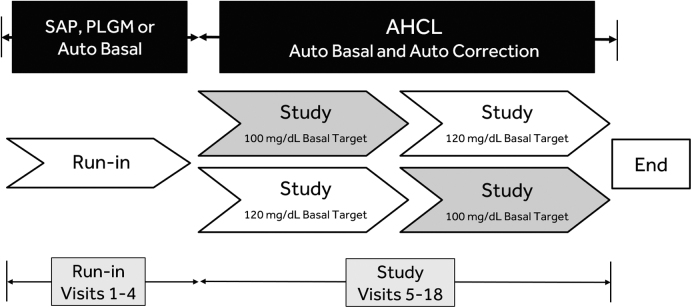
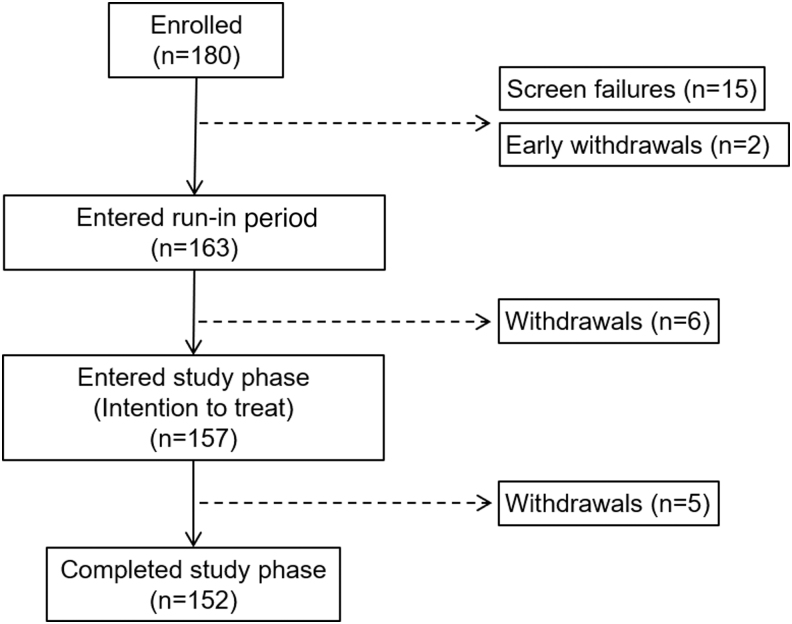
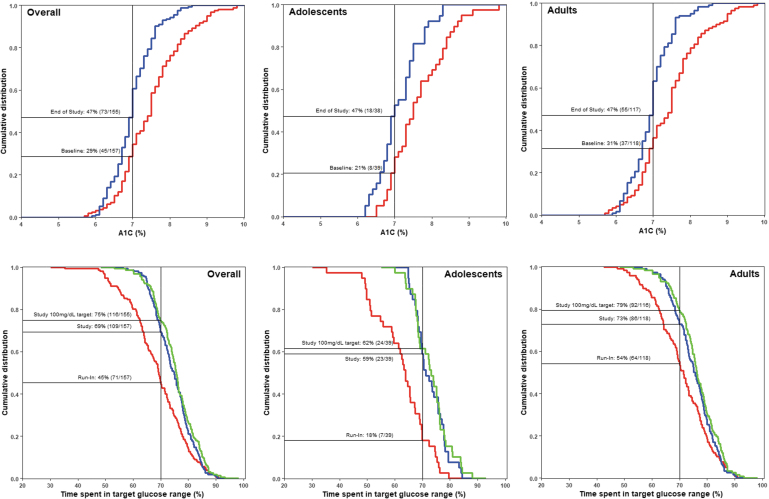
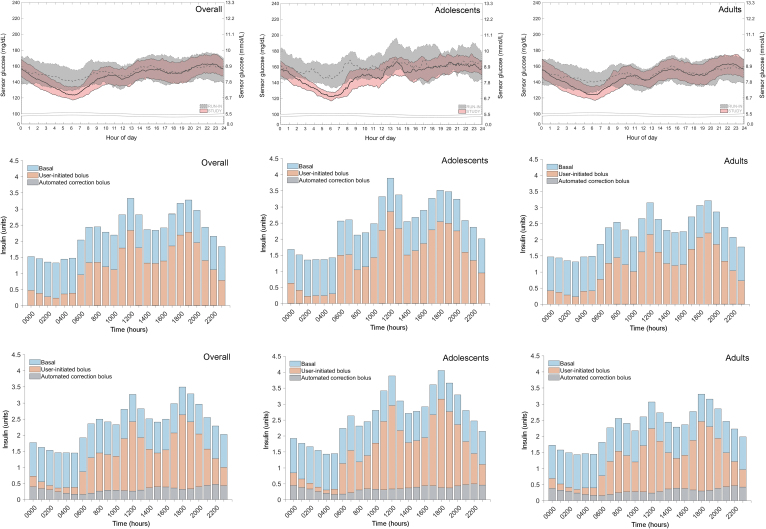
Introduction: This trial assessed safety and effectiveness of an advanced hybrid closed-loop (AHCL) system with automated basal (Auto Basal) and automated bolus correction (Auto Correction) in adolescents and adults with type 1 diabetes (T1D). Materials and Methods: This multicenter single-arm study involved an intent-to-treat population of 157 individuals (39 adolescents aged 14–21 years and 118 adults aged ≥22–75 years) with T1D. Study participants used the MiniMed™ AHCL system during a baseline run-in period in which sensor-augmented pump +/− predictive low glucose management or Auto Basal was enabled for ∼14 days. Thereafter, Auto Basal and Auto Correction were enabled for a study phase (∼90 days), with glucose target set to 100 or 120 mg/dL for ∼45 days, followed by the other target for ∼45 days. Study endpoints included safety events and change in mean A1C, time in range (TIR, 70–180 mg/dL) and time below range (TBR, <70 mg/dL). Run-in and study phase values were compared using Wilcoxon signed-rank test or paired t -test. Results: Overall group time spent in closed loop averaged 94.9% ± 5.4% and involved only 1.2 ± 0.8 exits per week. Compared with run-in, AHCL reduced A1C from 7.5% ± 0.8% to 7.0% ± 0.5% (<0.001, Wilcoxon signed-rank test, n = 155), TIR increased from 68.8% ± 10.5% to 74.5% ± 6.9% (<0.001, Wilcoxon signed-rank test), and TBR reduced from 3.3% ± 2.9% to 2.3% ± 1.7% (<0.001, Wilcoxon signed-rank test). Similar benefits to glycemia were observed for each age group and were more pronounced for the nighttime (12 AM–6 AM). The 100 mg/dL target increased TIR to 75.4% ( n = 155), which was further optimized at a lower active insulin time (AIT) setting (i.e., 2 h), without increasing TBR. There were no severe hypoglycemic or diabetic ketoacidosis events during the study phase. Conclusions: These findings show that the MiniMed AHCL system is safe and allows for achievement of recommended glycemic targets in adolescents and adults with T1D. Adjustments in target and AIT settings may further optimize glycemia and improve user experience. Clinical Trial Registration number: NCT03959423.
Overview
The claims and statistics of this paper haven’t been checked yet.
Run the check — free, no account needed. It reads the open-access text and checks the sources it cites.
Integrity signals
Registry
Cites
Statistics
Figures
Verification
Claims the paper makes
The claims and statistics of this paper haven’t been checked yet.
Run the check — free, no account needed. It reads the open-access text and checks the sources it cites.
Claims other papers make about this one
Each is checked against this paper’s own text: does it say what the citing paper says it does?
The cited source says what the claim attributes to it.
In the citing paper
“This finding supports previous studies demonstrating a correlation of %TIR with more aggressive correction targets.19 20”
From Clinical utility of the twiist Automated Insulin Delivery System: first study with twiist (2026) · cites this paper as [19]
The cited source says what the claim attributes to it.
In the citing paper
“Carlson et al reported no DKA or severe hypoglycemia events in a cohort of 39 adolescents and 118 adults using the MiniMed 780G system over a 3-month observation period.19”
From Clinical utility of the twiist Automated Insulin Delivery System: first study with twiist (2026) · cites this paper as [19]
The cited source says what the claim attributes to it.
In the citing paper
“Our results also showed safety outcomes that are comparable to other short-duration AID studies, showing no DKA or severe hypoglycemia events and very little time spent in level 1 and level 2 hypoglycemia.”
From Clinical utility of the twiist Automated Insulin Delivery System: first study with twiist (2026) · cites this paper as [19]
Self-check
Percentages, sums and reported differences re-computed from the paper’s own numbers.
The self-check needs the paper’s full text.
Citations
Cites
(1993) · New England Journal of Medicine · doi:10.1056/nejm199309303291401 · Cited by 24,667
Battelino, T., Danne, T., Bergenstal, R. M., Amiel, S. A., Beck, R., Biester, T., Bosi, E., Buckingham, B. A., Cefalu, W. T., Close, K. L., et al. (2019) · Diabetes Care · doi:10.2337/dci19-0028 · Cited by 4,237 · cited 1×
“The International Consensus on Use of Continuous Glucose Monitoring recommended standards for reporting CGM metrics(14) and recommended goals for time spent across SG ranges.(15) Recommended percentages of time spent within 70–180 mg/dL, >180 mg/dL, and <70 mg/dL ranges (TIR, TAR, and TBR, respectively) have evolved t…”
MethodSelf-citationInternational consensus on use of continuous glucose monitoring
Danne, T., Nimri, R., Battelino, T., Bergenstal, R. M., Close, K. L., DeVries, J. H., Garg, S., Heinemann, L., Hirsch, I., Amiel, S. A., et al. (2017) · Diabetes Care · doi:10.2337/dc17-1600 · Cited by 2,069
Self-citationState of Type 1 Diabetes Management and Outcomes from the T1D Exchange in 2016–2018
Foster, N. C., Beck, R. W., Miller, K. M., Clements, M. A., Rickels, M. R., DiMeglio, L. A., Maahs, D. M., Tamborlane, W. V., Bergenstal, R., Smith, E., et al. (2019) · Diabetes Technology & Therapeutics · doi:10.1089/dia.2018.0384 · Cited by 1,907
Self-citationMiller, K. M., Foster, N. C., Beck, R. W., Bergenstal, R. M., DuBose, S. N., DiMeglio, L. A., Maahs, D. M., & Tamborlane, W. V. (2015) · Diabetes Care · doi:10.2337/dc15-0078 · Cited by 1,254
Six-Month Randomized, Multicenter Trial of Closed-Loop Control in Type 1 Diabetes
Brown, S. A., Kovatchev, B. P., Raghinaru, D., Lum, J. W., Buckingham, B. A., Kudva, Y. C., Laffel, L. M., Levy, C. J., Pinsker, J. E., Wadwa, R. P., et al. (2019) · New England Journal of Medicine · doi:10.1056/nejmoa1907863 · Cited by 1,030
Gold, A. E., Macleod, K. M., & Frier, B. M. (1994) · Diabetes Care · doi:10.2337/diacare.17.7.697 · Cited by 810
Safety of a hybrid closed-loop insulin delivery system in patients with type 1 diabetes
Bergenstal, R. M., Garg, S., Weinzimer, S. A., Buckingham, B. A., Bode, B. W., Tamborlane, W. V., & Kaufman, F. R. (2016) · JAMA · doi:10.1001/jama.2016.11708 · Cited by 644
Self-citationGarg, S. K., Weinzimer, S. A., Tamborlane, W. V., Buckingham, B. A., Bode, B. W., Bailey, T. S., Brazg, R. L., Ilany, J., Slover, R. H., Anderson, S. M., et al. (2017) · Diabetes Technology & Therapeutics · doi:10.1089/dia.2016.0421 · Cited by 585 · cited 1×
“The pivotal trials of the first Food and Drug Administrationapproved hybrid closed-loop therapy, the Medtronic MiniMed 670G system, demonstrated an increase in 24-h day and nighttime TIR, a reduction in TBR and TAR, and a lowered mean A1C when compared with open-loop use, in children,(16) adolescents, and adults.(17)…”
BackgroundSelf-citationLu, J., Ma, X., Zhou, J., Zhang, L., Mo, Y., Ying, L., Lu, W., Zhu, W., Bao, Y., Vigersky, R. A., et al. (2018) · Diabetes Care · doi:10.2337/dc18-1131 · Cited by 517
Self-citation
Cited by
Sorted by citations
Phillip, M., Nimri, R., Bergenstal, R. M., Barnard-Kelly, K., Danne, T., Hovorka, R., Kovatchev, B. P., Messer, L. H., Parkin, C. G., Ambler-Osborn, L., et al. (2023) · Endocrine Reviews · doi:10.1210/endrev/bnac022 · Cited by 443
Self-citationOpportunities and challenges in the diagnostic utility of dermal interstitial fluid
Friedel, M., Thompson, I. A. P., Kasting, G. B., Polsky, R., Cunningham, D. D., Soh, H. T., & Heikenfeld, J. C. (2023) · Nature Biomedical Engineering · doi:10.1038/s41551-022-00998-9 · Cited by 389
7. Diabetes Technology: Standards of Care in Diabetes—2025
American Diabetes Association Professional Practice Committee, ElSayed, N. A., McCoy, R. G., Aleppo, G., Balapattabi, K., Beverly, E. A., Briggs Early, K., Bruemmer, D., Echouffo-Tcheugui, J. B., Ekhlaspour, L., et al. (2025) · Diabetes Care · doi:10.2337/dc25-s007 · Cited by 348
7. Diabetes Technology: Standards of Care in Diabetes — 2023
ElSayed, N. A., Aleppo, G., Aroda, V. R., Bannuru, R. R., Brown, F. M., Bruemmer, D., Collins, B. S., Hilliard, M. E., Isaacs, D., Johnson, E. L., et al. (2023) · Diabetes Care · doi:10.2337/dc23-s007 · Cited by 301
7. Diabetes Technology: Standards of Care in Diabetes—2024
American Diabetes Association Professional Practice Committee, ElSayed, N. A., Aleppo, G., Bannuru, R. R., Bruemmer, D., Collins, B. S., Ekhlaspour, L., Hilliard, M. E., Johnson, E. L., Khunti, K., et al. (2024) · Diabetes Care · doi:10.2337/dc24-s007 · Cited by 281
Metadata
- Authors
- Carlson, A. L., Sherr, J. L., Shulman, D. I., Garg, S. K., Pop-Busui, R., Bode, B. W., Lilenquist, D. R., Brazg, R. L., Kaiserman, K. B., Kipnes, M. S., Thrasher, J. R., Reed, J. H. C., Slover, R. H., Philis-Tsimikas, A., Christiansen, M., Grosman, B., Roy, A., Vella, M., Jonkers, R. A. M., Chen, X., Shin, J., Cordero, T. L., Lee, S. W., Rhinehart, A. S., Vigersky, R. A., & for the MiniMed™ AHCL Study Group
- Affiliations
- HealthPartners (US)
- Yale University (US)
- University of South Florida (US)
- Barbara Davis Center of Childhood Diabetes, Aurora, Colorado, USA.
- Division of Metabolism, Endocrinology and Diabetes, University of Michigan, Ann Arbor, Michigan, USA.
- Atlanta Diabetes Associates (US)
- Rocky Mountain Diabetes and Osteoporosis Center, Idaho Falls, Idaho, USA.
- Rainier Clinical Research Center, Renton, Washington, USA.
- SoCal Diabetes, Torrance, California, USA.
- Diabetes & Glandular Disease Clinic (US)
- Arkansas Diabetes and Endocrinology Center, Little Rock, Arkansas, USA.
- Endocrine Research Solutions (United States) (US)
- Scripps Whittier Diabetes Institute, La Jolla, California, USA.
- Diablo Clinical Research (US)
- Medtronic (United States) (US)
- Corresponding author
- Carlson, Anders L.
- ORCID
- Venue
- Diabetes Technology & Therapeutics
- Publisher
- SAGE Publications
- Published
- 2022-03
- Volume
- 24
- Issue
- 3
- Pages
- 178-189
- ISSN
- 1520-9156 (ISSN-L)
- 1557-8593
- PMC
- PMC8971997
- OpenAlex
- W3210094726
- Cited by
- 230
- References
- 43
- Citations by year
- 2026: 35 · 2025: 45 · 2024: 55 · 2023: 61 · 2022: 34
- FWCI
- 28.00
- Type
- journal article
- Language
- en
- Open access
- hybrid
- doi.org
- Licence
- Locations
- Diabetes Technology & Therapeutics (publishedVersion, cc-by)
- PubMed Central (publishedVersion, cc-by)
- PubMed (publishedVersion)
- Funders
- National Institute of Diabetes and Digestive and Kidney Diseases (P30DK020572, P30DK045735, P30DK111022)
- Topics
- Health Sciences › Medicine › Endocrinology, Diabetes and Metabolism › Diabetes Management and Research
- Health Sciences › Medicine › Endocrinology, Diabetes and Metabolism › Diabetes Management and Education
- Life Sciences › Biochemistry, Genetics and Molecular Biology › Genetics › Diabetes and associated disorders
- Keywords
- type 1 diabetes, hybrid closed-loop system, glycemic control, HbA1c, time in range, time below range, sensor-augmented pump, adolescents, adults, clinical trial safety, glycemic outcomes
- MeSH terms
- Adolescent, Adult, Aged, Blood Glucose, Diabetes Mellitus, Type 1, Humans, Hypoglycemic Agents, Insulin, Insulin Infusion Systems, Middle Aged, Blood Glucose Self-Monitoring, Young Adult
About these checks
Registry, retraction, Cites and statistics results are computed, not judged, with one exception: a printed reference that no index lists is read once by a model before it counts as a citation error. Claims are extracted by a model and kept only when their quote appears verbatim in the text; each cited source is then checked, with a model’s help, for whether it says what the claim relies on. Those verdicts can be wrong — read the claim’s quote and the cited source before relying on one.
Statistics and arithmetic are recomputed, not judged.
Confidence bands are shown only for fields calibrated on our annotated test set. None is calibrated yet, so no band is shown.
What counts as a claim ›How we measure confidence ›How we check this ›
Are you an author, or do you see a problem with this page? Request a review
