

Branched-chain amino acid and branched-chain ketoacid ingestion increases muscle protein synthesis rates in vivo in older adults: a double-blind, randomized trial
Open accessThe DOI matches its Crossref record; 62 of the 62 references it cites were found in a registry or an index.
Abstract
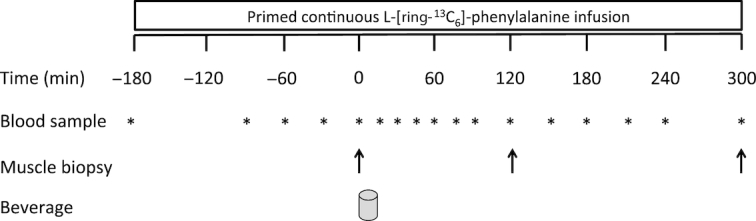
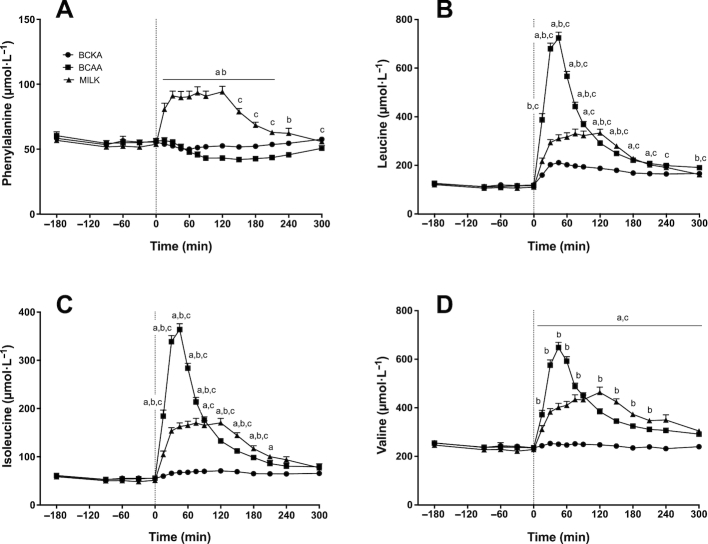
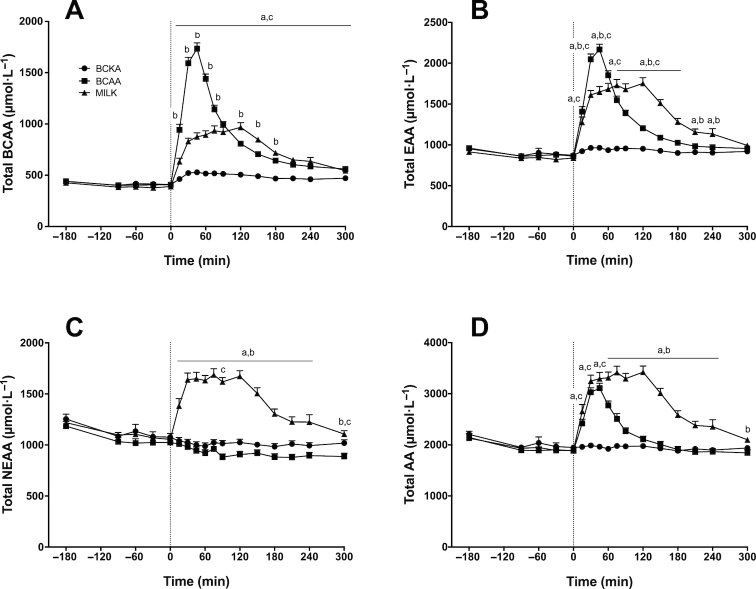
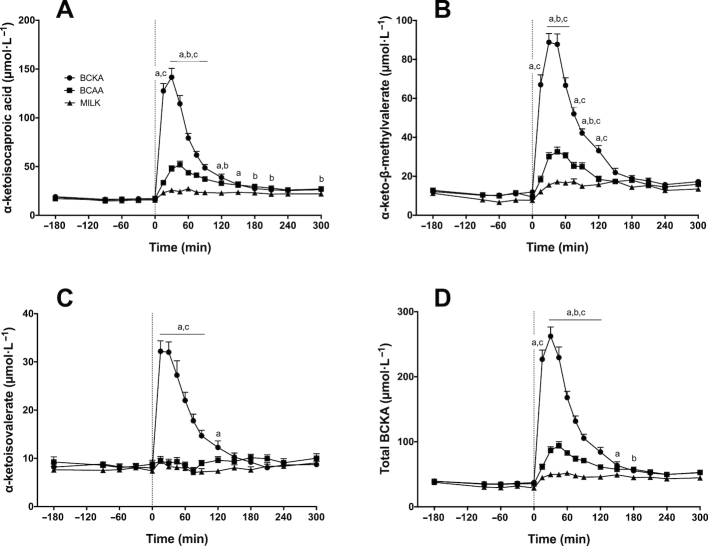
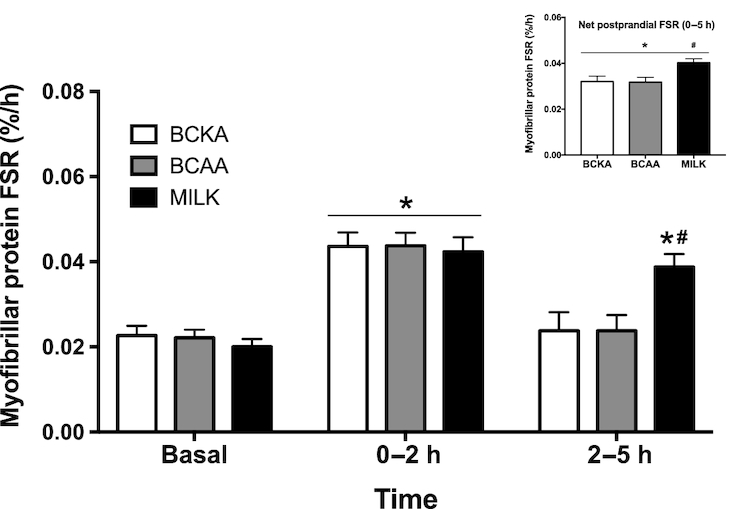
BACKGROUND: Protein ingestion increases muscle protein synthesis rates. However, limited data are currently available on the effects of branched-chain amino acid (BCAA) and branched-chain ketoacid (BCKA) ingestion on postprandial muscle protein synthesis rates. OBJECTIVE: The aim of this study was to compare the impact of ingesting 6 g BCAA, 6 g BCKA, and 30 g milk protein (MILK) on the postprandial rise in circulating amino acid concentrations and subsequent myofibrillar protein synthesis rates in older males. METHODS: In a parallel design, 45 older males (age: 71 ± 1 y; BMI: 25.4 ± 0.8 kg/m2) were randomly assigned to ingest a drink containing 6 g BCAA, 6 g BCKA, or 30 g MILK. Basal and postprandial myofibrillar protein synthesis rates were assessed by primed continuous l-[ring-13C6]phenylalanine infusions with the collection of blood samples and muscle biopsies. RESULTS: Plasma BCAA concentrations increased following test drink ingestion in all groups, with greater increases in the BCAA and MILK groups compared with the BCKA group (P < 0.05). Plasma BCKA concentrations increased following test drink ingestion in all groups, with greater increases in the BCKA group compared with the BCAA and MILK groups (P < 0.05). Ingestion of MILK, BCAA, and BCKA significantly increased early myofibrillar protein synthesis rates (0-2 h) above basal rates (from 0.020 ± 0.002%/h to 0.042 ± 0.004%/h, 0.022 ± 0.002%/h to 0.044 ± 0.004%/h, and 0.023 ± 0.003%/h to 0.044 ± 0.004%/h, respectively; P < 0.001), with no differences between groups (P > 0.05). Myofibrillar protein synthesis rates during the late postprandial phase (2-5 h) remained elevated in the MILK group (0.039 ± 0.004%/h; P < 0.001), but returned to baseline values following BCAA and BCKA ingestion (0.024 ± 0.005%/h and 0.024 ± 0.005%/h, respectively; P > 0.05). CONCLUSIONS: Ingestion of 6 g BCAA, 6 g BCKA, and 30 g MILK increases myofibrillar protein synthesis rates during the early postprandial phase (0-2 h) in vivo in healthy older males. The postprandial increase following the ingestion of 6 g BCAA and BCKA is short-lived, with higher myofibrillar protein synthesis rates only being maintained following the ingestion of an equivalent amount of intact milk protein. This trial was registered at Nederlands Trial Register (www.trialregister.nl) as NTR6047.
Overview
The claims and statistics of this paper haven’t been checked yet.
Free: it reads the open-access text and checks the first 5 claims that cite a source we can check. Create a free account to check every claim.
Integrity signals
Registry
Cites
Statistics
Figures
Verification
Claims the paper makes
The claims and statistics of this paper haven’t been checked yet.
Free: it reads the open-access text and checks the first 5 claims that cite a source we can check. Create a free account to check every claim.
Claims other papers make about this one
Each is checked against this paper’s own text: does it say what the citing paper says it does?
In the citing paper
“Further, whey protein is also high in other essential amino acids, important not only from a signaling perspective (24), but also to prevent potential substrate limitation for the continuation of elevated (> 2 h) post-exercise MyoPS rates (25, 26).”
From Plant Protein Blend Ingestion Stimulates Postexercise Myofibrillar Protein Synthesis Rates Equivalently to Whey in Resistance-Trained Adults (2024) · cites this paper as [25]
Self-check
Percentages, sums and reported differences re-computed from the paper’s own numbers.
The self-check needs the paper’s full text.
Citations
Cites
Bauer, J., Biolo, G., Cederholm, T., Cesari, M., Cruz-Jentoft, A. J., Morley, J. E., Phillips, S., Sieber, C., Stehle, P., Teta, D., et al. (2013) · Journal of the American Medical Directors Association · doi:10.1016/j.jamda.2013.05.021 · Cited by 2,553
Houston, D. K., Nicklas, B. J., Ding, J., Harris, T. B., Tylavsky, F. A., Newman, A. B., Lee, J. S., Sahyoun, N. R., Visser, M., & Kritchevsky, S. B. (2008) · The American Journal of Clinical Nutrition · doi:10.1093/ajcn/87.1.150 · Cited by 1,214
Percutaneous Needle Biopsy of Skeletal Muscle in Physiological and Clinical Research
Bergström, J. (1975) · Scandinavian Journal of Clinical & Laboratory Investigation · doi:10.1080/00365517509095787 · Cited by 1,170
Katsanos, C. S., Kobayashi, H., Sheffield-Moore, M., Aarsland, A., & Wolfe, R. R. (2006) · American Journal of Physiology-Endocrinology and Metabolism · doi:10.1152/ajpendo.00488.2005 · Cited by 923
Volpi, E., Kobayashi, H., Sheffield-Moore, M., Mittendorfer, B., & Wolfe, R. R. (2003) · The American Journal of Clinical Nutrition · doi:10.1093/ajcn/78.2.250 · Cited by 846
Moore, D. R., Churchward-Venne, T. A., Witard, O., Breen, L., Burd, N. A., Tipton, K. D., & Phillips, S. M. (2015) · The Journals of Gerontology: Series A · doi:10.1093/gerona/glu103 · Cited by 770
Nutritional Management of Chronic Kidney Disease
Kalantar-Zadeh, K., & Fouque, D. (2017) · New England Journal of Medicine · doi:10.1056/nejmra1700312 · Cited by 636 · cited 1×
“Patients with CKD are advised to adhere to low protein diets during certain stages of their disease (60),”
BackgroundKimball, S. R., & Jefferson, L. S. (2006) · The Journal of Nutrition · doi:10.1093/jn/136.1.227s · Cited by 631
Abumrad, N. N., Rabin, D., Diamond, M. P., & Lacy, W. W. (1981) · Metabolism · doi:10.1016/0026-0495(81)90074-3 · Cited by 567
Bohé, J., Low, A., Wolfe, R. R., & Rennie, M. J. (2003) · The Journal of Physiology · doi:10.1113/jphysiol.2003.050674 · Cited by 496 · cited 2×
“The postprandial increase in muscle protein synthesis rates has been attributed to the postprandial release of (essential) amino acids (3, 4, 42, 43), with the rise in circulating BCAAs”
Background
Cited by
Regulation of Skeletal Muscle Function by Amino Acids
Kamei, Y., Hatazawa, Y., Uchitomi, R., Yoshimura, R., & Miura, S. (2020) · Nutrients · doi:10.3390/nu12010261 · Cited by 252
“In addition, the intake of a leucine-rich supplement by elderly people improved muscle mass, muscle strength, and walking speed [38], and older people who ingested BCAA exhibited enhanced muscle protein synthesis [39].”
BackgroundChurch, D. D., Hirsch, K. R., Park, S., Kim, I.-Y., Gwin, J. A., Pasiakos, S. M., Wolfe, R. R., & Ferrando, A. A. (2020) · Nutrients · doi:10.3390/nu12123717 · Cited by 178
The anabolic response to plant-based protein ingestion
Pinckaers, P. J. M., Trommelen, J., Snijders, T., & van Loon, L. J. C. (2021) · Sports Medicine · doi:10.1007/s40279-021-01540-8 · Cited by 170
Ticinesi, A., Mancabelli, L., Tagliaferri, S., Nouvenne, A., Milani, C., Rio, D. D., Lauretani, F., Maggio, M. G., Ventura, M., & Meschi, T. (2020) · International Journal of Molecular Sciences · doi:10.3390/ijms21238946 · Cited by 164
Kaspy, M. S., Hannaian, S. J., Bell, Z. W., & Churchward‐Venne, T. A. (2023) · Nutrition Research Reviews · doi:10.1017/s0954422423000197 · Cited by 136
Metadata
- Authors
- Fuchs, C. J., Hermans, W. J., Holwerda, A. M., Smeets, J. S., Senden, J. M., van Kranenburg, J., Gijsen, A. P., Wodzig, W. K. H., Schierbeek, H., Verdijk, L. B., & van Loon, L. J.
- Venue
- The American Journal of Clinical Nutrition
- Publisher
- Elsevier BV
- Published
- 2019-10
- Volume
- 110
- Issue
- 4
- Pages
- 862-872
- ISSN
- 0002-9165 (ISSN-L)
- PMC
- PMC6766442
- OpenAlex
- W2955548870
- Cited by
- 104
- References
- 62
- FWCI
- 5.65
- Type
- journal article
- Language
- en
- Open access
- hybrid
- Licence
- www.elsevier.com/tdm/userlicense/1.0/ (tdm)
- www.elsevier.com/legal/tdmrep-license (tdm)
- creativecommons.org/licenses/by/4.0/ (vor)
- Funders
- Evonik Industries
About these checks
Registry, retraction, Cites and statistics results are computed, not judged, with one exception: a printed reference that no index lists is read once by a model before it counts as a citation error. Claims are extracted by a model and kept only when their quote appears verbatim in the text; each cited source is then checked, with a model’s help, for whether it says what the claim relies on. Those verdicts can be wrong — read the claim’s quote and the cited source before relying on one.
Statistics and arithmetic are recomputed, not judged.
Confidence bands are shown only for fields calibrated on our annotated test set. None is calibrated yet, so no band is shown.
What counts as a claim ›How we measure confidence ›How we check this ›
Are you an author, or do you see a problem with this page? Request a review
Data sources
Bibliographic data: Semantic Scholar, OpenAlex, Crossref.
Contains information from the Semantic Scholar Academic Graph Datasets, made available under the ODC Attribution License (ODC-BY 1.0).
Semantic Scholar’s data is described in: Kinney, R., et al. (2023). The Semantic Scholar Open Data Platform. arXiv:2301.10140.
