

Afatinib versus gefitinib in patients with EGFR mutation-positive advanced non-small-cell lung cancer: overall survival data from the phase IIb LUX-Lung 7 trial
Open accessThe DOI matches its Crossref record; 25 of the 27 references it cites were found in a registry or an index.
Abstract
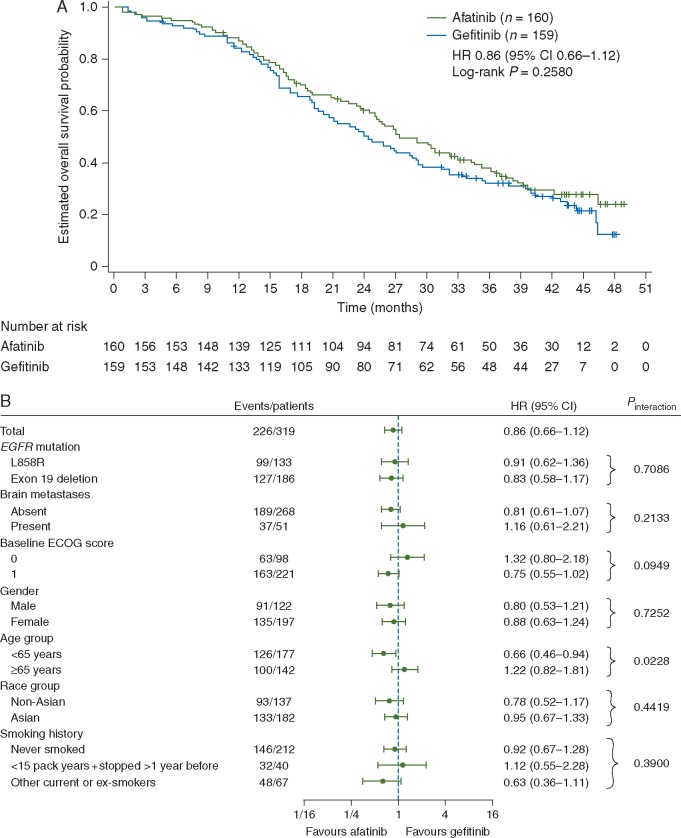
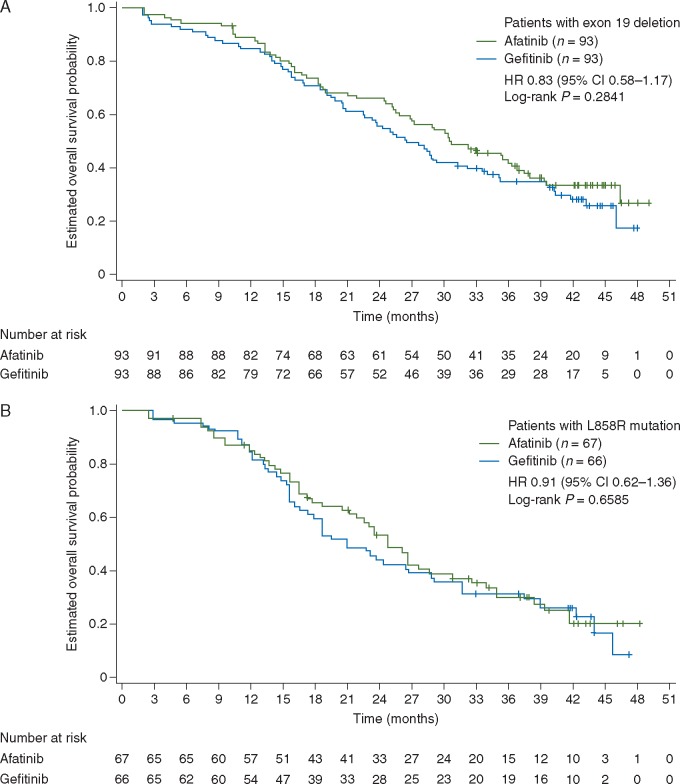
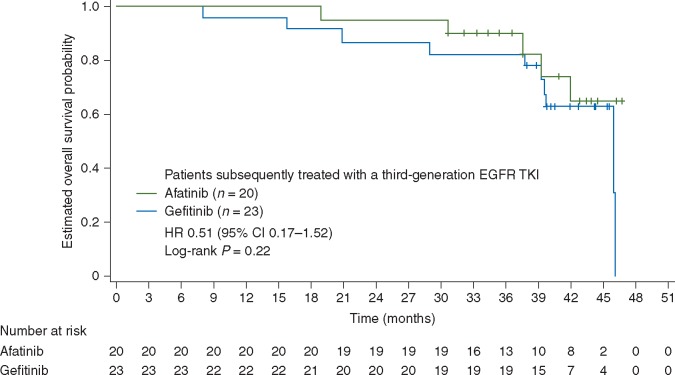
Background: In LUX-Lung 7, the irreversible ErbB family blocker, afatinib, significantly improved progression-free survival (PFS), time-to-treatment failure (TTF) and objective response rate (ORR) versus gefitinib in patients with epidermal growth factor receptor (EGFR) mutation-positive non-small-cell lung cancer (NSCLC). Here, we present primary analysis of mature overall survival (OS) data. Patients and methods: LUX-Lung 7 assessed afatinib 40 mg/day versus gefitinib 250 mg/day in treatment-naïve patients with stage IIIb/IV NSCLC and a common EGFR mutation (exon 19 deletion/L858R). Primary OS analysis was planned after ∼213 OS events and ≥32-month follow-up. OS was analysed by a Cox proportional hazards model, stratified by EGFR mutation type and baseline brain metastases. Results: Two-hundred and twenty-six OS events had occurred at the data cut-off (8 April 2016). After a median follow-up of 42.6 months, median OS (afatinib versus gefitinib) was 27.9 versus 24.5 months [hazard ratio (HR) = 0.86, 95% confidence interval (CI) 0.66‒1.12, P = 0.2580]. Prespecified subgroup analyses showed similar OS trends (afatinib versus gefitinib) in patients with exon 19 deletion (30.7 versus 26.4 months; HR, 0.83, 95% CI 0.58‒1.17, P = 0.2841) and L858R (25.0 versus 21.2 months; HR 0.91, 95% CI 0.62‒1.36, P = 0.6585) mutations. Most patients (afatinib, 72.6%; gefitinib, 76.8%) had at least one subsequent systemic anti-cancer treatment following discontinuation of afatinib/gefitinib; 20 (13.7%) and 23 (15.2%) patients received a third-generation EGFR tyrosine kinase inhibitor. Updated PFS (independent review), TTF and ORR data were significantly improved with afatinib. Conclusion: In LUX-Lung 7, there was no significant difference in OS with afatinib versus gefitinib. Updated PFS (independent review), TTF and ORR data were significantly improved with afatinib. Clinicaltrials.gov identifier: NCT01466660.
Overview
The claims and statistics of this paper haven’t been checked yet.
Free: it reads the open-access text and checks the first 5 claims that cite a source we can check. Create a free account to check every claim.
Integrity signals
Registry
Cites
Statistics
Figures
Verification
Claims the paper makes
The claims and statistics of this paper haven’t been checked yet.
Free: it reads the open-access text and checks the first 5 claims that cite a source we can check. Create a free account to check every claim.
Claims other papers make about this one
Each is checked against this paper’s own text: does it say what the citing paper says it does?
The source backs part of the claim, not all of it — or backs it for a different population, condition or comparison.
In the citing paper
“Afatinib also significantly improved ORR versus gefitinib (70% vs 56%; P = 0.0083), with a longer median duration of response (10.1 months (interquartile range (IQR), 5.6–16.8) vs 8.4 months (IQR, 6.2–13.1)), and a trend towards improved OS with afatinib vs gefitinib observed (median 27.9 vs 24.5 months; HR, 0.86 (95% CI, 0.66‒1.12), P = 0.258).”
From Afatinib for the treatment of EGFR mutation-positive NSCLC: A review of clinical findings (2020) · cites this paper as [43]
Experimental — accuracy not yet measuredThe cited source says what the claim attributes to it.
In the citing paper
“there was no statistically significant difference with afatinib versus gefitinib”
From Afatinib for the treatment of EGFR mutation-positive NSCLC: A review of clinical findings (2020) · cites this paper as [43]
The cited source says what the claim attributes to it.
In the citing paper
“In the LUX-Lung 7 trial, the 3-year OS rate was up to 90% in patients who received a third-generation EGFR TKI (osimertinib (10.3% of patients) or olmutinib (3.4%)) after discontinuing afatinib.”
From Afatinib for the treatment of EGFR mutation-positive NSCLC: A review of clinical findings (2020) · cites this paper as [43]
The cited source says what the claim attributes to it.
In the citing paper
“Afatinib has been shown to provide significant improvements over chemotherapy and gefitinib in the first-line setting in patients with EGFRm+ NSCLC,39,40,42,43 and over erlotinib in the second-line setting in patients with SCC following chemotherapy.84”
From Afatinib for the treatment of EGFR mutation-positive NSCLC: A review of clinical findings (2020) · cites this paper as [43]
The check wasn’t confident either way, so it gives no verdict — never disputed.
In the citing paper
“exploratory analysis demonstrated prolonged OS with dacomitinib versus gefitinib.”
From Afatinib for the treatment of EGFR mutation-positive NSCLC: A review of clinical findings (2020) · cites this paper as [43]
Experimental — accuracy not yet measured
Self-check
Percentages, sums and reported differences re-computed from the paper’s own numbers.
The self-check needs the paper’s full text.
Citations
Cites
Gefitinib or Carboplatin–Paclitaxel in Pulmonary Adenocarcinoma
Mok, T. S., Wu, Y.-L., Thongprasert, S., Yang, C.-H., Chu, D.-T., Saijo, N., Sunpaweravong, P., Han, B., Margono, B., Ichinose, Y., et al. (2009) · New England Journal of Medicine · doi:10.1056/nejmoa0810699 · Cited by 8,261
Self-citationGefitinib or Chemotherapy for Non–Small-Cell Lung Cancer with Mutated EGFR
Maemondo, M., Inoue, A., Kobayashi, K., Sugawara, S., Oizumi, S., Isobe, H., Gemma, A., Harada, M., Yoshizawa, H., Kinoshita, I., et al. (2010) · New England Journal of Medicine · doi:10.1056/nejmoa0909530 · Cited by 5,525
Rosell, R., Carcereny, E., Gervais, R., Vergnenegre, A., Massuti, B., Felip, E., Palmero, R., Garcia-Gomez, R., Pallares, C., Sanchez, J. M., et al. (2012) · The Lancet Oncology · doi:10.1016/s1470-2045(11)70393-x · Cited by 5,489 · cited 2×
“This rate of post-progression therapy is somewhat higher than reported in most previous trials including EGFRmutationpositive patients treated with EGFR TKIs (66%–68% in erlotinib trials [4, 7, 11], 64%–90% in gefitinib trials [12, 14, 16] and 58%–70% in afatinib trials [5, 6].”
BackgroundResultSelf-citationMitsudomi, T., Morita, S., Yatabe, Y., Negoro, S., Okamoto, I., Tsurutani, J., Seto, T., Satouchi, M., Tada, H., Hirashima, T., et al. (2010) · The Lancet Oncology · doi:10.1016/s1470-2045(09)70364-x · Cited by 4,090
Zhou, C., Wu, Y.-L., Chen, G., Feng, J., Liu, X.-Q., Wang, C., Zhang, S., Wang, J., Zhou, S., Ren, S., et al. (2011) · The Lancet Oncology · doi:10.1016/s1470-2045(11)70184-x · Cited by 4,081
Self-citationEGFR Mutation and Resistance of Non–Small-Cell Lung Cancer to Gefitinib
Kobayashi, S., Boggon, T. J., Dayaram, T., Jänne, P. A., Kocher, O., Meyerson, M., Johnson, B. E., Eck, M. J., Tenen, D. G., & Halmos, B. (2005) · New England Journal of Medicine · doi:10.1056/nejmoa044238 · Cited by 3,964
Pao, W., Miller, V. A., Politi, K. A., Riely, G. J., Somwar, R., Zakowski, M. F., Kris, M. G., & Varmus, H. (2005) · PLoS Medicine · doi:10.1371/journal.pmed.0020073 · Cited by 3,527
Sequist, L. V., Yang, J. C.-H., Yamamoto, N., O'Byrne, K., Hirsh, V., Mok, T., Geater, S. L., Orlov, S., Tsai, C.-M., Boyer, M., et al. (2013) · Journal of Clinical Oncology · doi:10.1200/jco.2012.44.2806 · Cited by 3,228
Self-citationAZD9291 in EGFR Inhibitor–Resistant Non–Small-Cell Lung Cancer
Jänne, P. A., Yang, J. C.-H., Kim, D.-W., Planchard, D., Ohe, Y., Ramalingam, S. S., Ahn, M.-J., Kim, S.-W., Su, W.-C., Horn, L., et al. (2015) · New England Journal of Medicine · doi:10.1056/nejmoa1411817 · Cited by 2,116
Self-citationWu, Y.-L., Zhou, C., Hu, C.-P., Feng, J., Lu, S., Huang, Y., Li, W., Hou, M., Shi, J. H., Lee, K. Y., et al. (2014) · The Lancet Oncology · doi:10.1016/s1470-2045(13)70604-1 · Cited by 1,978
Self-citation
Research works printed but not linked: 2
- Yoshioka, 2014, J Clin Oncol, 32 (Suppl. 15)
- Yang, 2015, A Randomized Controlled Trial of Erlotinib versus Gefitinib in Advanced Non-Small-Cell Lung Cancer Harboring EGFR Mutations (CTONG0901), J Thorac Oncol, 10, S321
Cited by
Items 101–200 of 574
Pretelli, G., Spagnolo, C. C., Ciappina, G., Santarpía, M., & Pasello, G. (2023) · International Journal of Molecular Sciences · doi:10.3390/ijms24108878 · Cited by 43
Franceschini, D., Rose, F. D., Cozzi, S., Franzese, C., Rossi, S., Finocchiaro, G., Toschi, L., Santoro, A., & Scorsetti, M. (2020) · Critical Reviews in Oncology/Hematology · doi:10.1016/j.critrevonc.2020.102894 · Cited by 42
Kim, E. S., Melosky, B. L., Park, K., Yamamoto, N., & Yang, J. C. (2021) · Future Oncology · doi:10.2217/fon-2021-0195 · Cited by 42
Self-citationCutting-Edge Therapies for Lung Cancer
La’ah, A. S., & Chiou, S. (2024) · Cells · doi:10.3390/cells13050436 · Cited by 41
Suetsugu, T., Koshizuka, K., Seki, N., Mizuno, K., Okato, A., Arai, T., Misono, S., Uchida, A., Kumamoto, T., & Inoue, H. (2017) · International Journal of Oncology · doi:10.3892/ijo.2017.4232 · Cited by 41
Ricciuti, B., Baglivo, S., Giglio, A. D., & Chiari, R. (2018) · Therapeutic Advances in Respiratory Disease · doi:10.1177/1753466618808659 · Cited by 40
Park, K., Lim, W., Okamoto, I., & Yang, J. C. (2019) · Therapeutic Advances in Medical Oncology · doi:10.1177/1758835919836374 · Cited by 39
Self-citationPapini, F., Sundaresan, J., Leonetti, A., Tiseo, M., Rolfo, C. D., Peters, G. J., & Giovannetti, E. (2021) · Critical Reviews in Oncology/Hematology · doi:10.1016/j.critrevonc.2021.103454 · Cited by 39
Nakao, K., Kobuchi, S., Marutani, S., Iwazaki, A., Tamiya, A., Isa, S., Okishio, K., Kanazu, M., Tamiya, M., Hirashima, T., et al. (2019) · Scientific Reports · doi:10.1038/s41598-019-54804-9 · Cited by 39
Peng, Y., Li, Q., Zhang, J., Shen, W., Zhang, X., Sun, C., & Cui, H. (2018) · BioScience Trends · doi:10.5582/bst.2018.01246 · Cited by 39
Tu, C., Chen, C., Liao, W.-C., Wu, B., Chen, W., Cheng, W., Hsia, T., Cheng, W., & Chen, C. (2018) · Oncotarget · doi:10.18632/oncotarget.24386 · Cited by 37
Faehling, M., Schwenk, B., Kramberg, S., Eckert, R., Volckmar, A., Stenzinger, A., & Sträter, J. (2017) · Oncotarget · doi:10.18632/oncotarget.20857 · Cited by 37
Schüler, M., Tan, E.-H., O'Byrne, K. J., Zhang, L., Boyer, M. J., Mok, T. S. K., Hirsh, V., Yang, J. C., Lee, K. H., Lü, S., et al. (2019) · Journal of Cancer Research and Clinical Oncology · doi:10.1007/s00432-019-02862-x · Cited by 35
Self-citationOverview of the LUX-Lung clinical trial program of afatinib for non-small cell lung cancer
Sharma, N., & Graziano, S. L. (2018) · Cancer Treatment Reviews · doi:10.1016/j.ctrv.2018.06.018 · Cited by 37
Uchida, A., Seki, N., Mizuno, K., Misono, S., Yamada, Y., Kikkawa, N., Sanada, H., Kumamoto, T., Suetsugu, T., & Inoue, H. (2018) · Cancer Science · doi:10.1111/cas.13853 · Cited by 35
Park, K., Bennouna, J., Boyer, M. J., Hida, T., Hirsh, V., Kato, T., Lü, S., Mok, T. S. K., Nakagawa, K., O'Byrne, K. J., et al. (2019) · Lung Cancer · doi:10.1016/j.lungcan.2019.04.014 · Cited by 34
Self-citationWhich Is Better EGFR-TKI Followed by Osimertinib: Afatinib or Gefitinib/Erlotinib?
Tamiya, M., Tamiya, A., Suzuki, H., Moriizumi, K., Nakahama, K., Taniguchi, Y., Kunimasa, K., Kimura, M., Inoue, T., Kuhara, H., et al. (2019) · Anticancer Research · doi:10.21873/anticanres.13544 · Cited by 34
Nieva, J. J., Reckamp, K. L., Potter, D. M., Taylor, A., & Sun, P. (2022) · Drugs - Real World Outcomes · doi:10.1007/s40801-022-00302-w · Cited by 33
Wu, S., Yu, C., Yang, J. C., & Shih, J. (2020) · Therapeutic Advances in Medical Oncology · doi:10.1177/1758835920946156 · Cited by 34
Self-citationZhang, J., Zhao, K., Zhou, W., Kang, R., Wei, S., Shu, Y., Cheng, Y., Ku, Y., Mao, Y., Luo, H., et al. (2024) · Signal Transduction and Targeted Therapy · doi:10.1038/s41392-024-01778-4 · Cited by 33
Self-citationGirard, N. (2019) · Future Oncology · doi:10.2217/fon-2019-0400 · Cited by 32
EGFR-TKIs in Non-Small-Cell Lung Cancer: Focus on Clinical Pharmacology and Mechanisms of Resistance
Fogli, S., Polini, B., Re, M. D., Petrini, I., Passaro, A., Crucitta, S., Rofi, E., & Danesi, R. (2018) · Pharmacogenomics · doi:10.2217/pgs-2018-0038 · Cited by 31
Melosky, B. L., Banerji, S. O., Blais, N., Chu, Q. S.-C., Juergens, R. A., Leighl, N. B., Liu, G., & Cheema, P. K. (2020) · Current Oncology · doi:10.3747/co.27.6007 · Cited by 31
Lucia, A. D., Mazzotti, L., Gaimari, A., Zurlo, M., Maltoni, R., Cerchione, C., Bravaccini, S., Delmonte, A., Crinò, L., de Souza, P. B., et al. (2025) · Frontiers in Immunology · doi:10.3389/fimmu.2025.1515748 · Cited by 31
Alflutinib (AST2818), primarily metabolized by CYP3A4, is a potent CYP3A4 inducer
Liu, X., Guo, Z., Chen, Z., Zhang, Y., Zhou, J., Jiang, Y., Zhao, Q., Diao, X., & Zhong, D. (2020) · Acta Pharmacologica Sinica · doi:10.1038/s41401-020-0389-3 · Cited by 31
Yokoyama, T., Yoshioka, H., Fujimoto, D., Demura, Y., Hirano, K., Kawai, T., Kagami, R., Washio, Y., Ishida, T., Kogo, M., et al. (2019) · Lung Cancer · doi:10.1016/j.lungcan.2019.03.030 · Cited by 30
Ju, J., Huang, A. C., Tung, P., Huang, C., Chiu, T.-H., Wang, C., Ko, H., Chung, F., Hsu, P., Fang, Y., et al. (2023) · Scientific Reports · doi:10.1038/s41598-023-45815-8 · Cited by 30
Umar, H., Wahab, H. A., Attiq, A., Amjad, M. W., Bukhari, S. N. A., & Ahmad, W. (2024) · Mutation research. Fundamental and molecular mechanisms of mutagenesis · doi:10.1016/j.mrfmmm.2024.111856 · Cited by 30
Zhang, D., Liu, X., Shen, F., Zhao, D., Shi, Y., Zhang, H., Liu, J., Gao, X., Chen, M., Zhao, J., et al. (2023) · Translational Lung Cancer Research · doi:10.21037/tlcr-23-577 · Cited by 30
Self-citationGenova, C., Rossi, G., Tagliamento, M., Rijavec, E., Biello, F., Cerbone, L., Zullo, L., & Grossi, F. (2020) · Expert Review of Respiratory Medicine · doi:10.1080/17476348.2020.1714441 · Cited by 30
Popat, S., Jung, H. A., Lee, S. Y., Hochmair, M. J., Lee, S. H., Escriu, C., Lee, M. K., Migliorino, M. R., Lee, Y. C., Girard, N., et al. (2021) · Lung Cancer · doi:10.1016/j.lungcan.2021.09.009 · Cited by 30
Self-citationSharma, M., Basu, D. A., Nathany, S., Amrith, B. P., & Batra, U. (2022) · Cancer Research Statistics and Treatment · doi:10.4103/crst.crst_222_22 · Cited by 30
Predicting cancer drug TARGETS - TreAtment Response Generalized Elastic-neT Signatures
Rydzewski, N. R., Peterson, E. R., Lang, J. M., Yu, M., Chang, S. L., Sjöström, M., Bakhtiar, H., Song, G., Helzer, K. T., Bootsma, M. L., et al. (2021) · npj Genomic Medicine · doi:10.1038/s41525-021-00239-z · Cited by 30
Tanaka, H., Taima, K., Itoga, M., Ishioka, Y., Baba, K., Shiratori, T., Sakamoto, H., Tsuchiya, J., Nakagawa, H., Hasegawa, Y., et al. (2019) · Medical Oncology · doi:10.1007/s12032-019-1278-9 · Cited by 29
de Marinis, F., Лактионов, К. К., Poltoratskiy, A., Egorova, I. V., Hochmair, M. J., Passaro, A., Migliorino, M. R., Metro, G., Gottfried, M., Tsoi, D. T. F., et al. (2020) · Lung Cancer · doi:10.1016/j.lungcan.2020.12.011 · Cited by 29
Targeted Molecular Treatments in Non-Small Cell Lung Cancer: A Clinical Guide for Oncologists
Bui, K. T., Cooper, W. A., Kao, S., & Boyer, M. J. (2018) · Journal of Clinical Medicine · doi:10.3390/jcm7080192 · Cited by 29
Self-citationTargeted Therapy for Non-Small Cell Lung Cancer
Noor, Z. S., Cummings, A. L., Johnson, M. M., Spiegel, M. L., & Goldman, J. W. (2020) · Seminars in Respiratory and Critical Care Medicine · doi:10.1055/s-0039-1700994 · Cited by 29
Tanaka, I., Morise, M., Kodama, Y., Matsui, A., Ozawa, N., Ozone, S., Goto, D., Miyazawa, A., Hase, T., Hashimoto, N., et al. (2018) · Lung Cancer · doi:10.1016/j.lungcan.2018.11.018 · Cited by 30
O'Kane, G. M., Barnes, T. A., & Leighl, N. B. (2018) · Current Oncology · doi:10.3747/co.25.3796 · Cited by 29
Advances in Treatment of Locally Advanced or Metastatic Non–Small Cell Lung Cancer
Giustini, N., Jeong, A., Buturla, J. A., & Bazhenova, L. A. (2020) · Clinics in Chest Medicine · doi:10.1016/j.ccm.2020.02.003 · Cited by 29
First-Line Treatment in EGFR Mutant Non-Small Cell Lung Cancer: Is There a Best Option?
Bulbul, A., & Husain, H. (2018) · Frontiers in Oncology · doi:10.3389/fonc.2018.00094 · Cited by 28
Novel targeted therapies for advanced non-small lung cancer
Abughanimeh, O. K. M., Kaur, A., Osta, B. E. E., & Ganti, A. K. (2022) · Seminars in Oncology · doi:10.1053/j.seminoncol.2022.03.003 · Cited by 28
Hong, M. H., Kim, H. R., Ahn, B., Heo, S. J., Kim, J. H., & Cho, B. C. (2019) · Yonsei Medical Journal · doi:10.3349/ymj.2019.60.6.525 · Cited by 28
Endonuclease IV-Regulated DNAzyme Motor for Universal Single-nucleotide Variation Discrimination
Zhang, Z., Hu, Y., Yuan, W., Hu, M., Deng, Y., Xiao, X., & Wu, T. (2021) · Analytical Chemistry · doi:10.1021/acs.analchem.1c02230 · Cited by 28
Buglione, M., Jereczek‐Fossa, B. A., Bonù, M. L., Franceschini, D., Fodor, A., Zanetti, I. B., Gerardi, M. A., Borghetti, P., Tomasini, D., Muzio, N. G. D., et al. (2020) · Lung Cancer · doi:10.1016/j.lungcan.2019.12.019 · Cited by 28
Ghafoor, Q., Baijal, S., Taniere, P., O’Sullivan, B., Evans, M., & Middleton, G. (2017) · Pathology & Oncology Research · doi:10.1007/s12253-017-0377-1 · Cited by 27
Kimura, M., Yasue, F., Usami, E., Kawachi, S., Iwai, M., Go, M., Ikeda, Y., & Yoshimura, T. (2018) · Molecular and Clinical Oncology · doi:10.3892/mco.2018.1640 · Cited by 27
Bing, Z., Han, J., Zheng, Z., & Liang, N. (2021) · Life Sciences · doi:10.1016/j.lfs.2021.120012 · Cited by 27
Yang, S., Lai, W., Hsu, J. C., Su, W., & Wang, J. (2020) · PLoS ONE · doi:10.1371/journal.pone.0231413 · Cited by 26
Afatinib in advanced NSCLC: a profile of its use
Deeks, E. D., & Keating, G. M. (2018) · Drugs & Therapy Perspectives · doi:10.1007/s40267-018-0482-6 · Cited by 26
Wu, Y.-L. L. C., Xu, C., Hu, C., Feng, J., Lü, S., Huang, Y., Li, W., Hou, M., Shi, J. H., Märten, A., et al. (2018) · OncoTargets and Therapy · doi:10.2147/ott.s160358 · Cited by 26
Self-citationGregorc, V., Lazzar, C., Karachaliou, N., Rosell, R., & Santarpía, M. (2018) · Translational Lung Cancer Research · doi:10.21037/tlcr.2018.03.19 · Cited by 26
Wu, Y.-L. L. C., Hirsh, V., Sequist, L. V. D., Hu, C., Feng, J., Lü, S., Huang, Y., Schüler, M., Mok, T. S. K., Yamamoto, N., et al. (2017) · Patient · doi:10.1007/s40271-017-0287-z · Cited by 26
Self-citationHuang, A. C., Huang, C., Ju, J., Chiu, T.-H., Tung, P., Wang, C., Liu, C., Chung, F., Fang, Y., Guo, Y., et al. (2021) · Therapeutic Advances in Medical Oncology · doi:10.1177/17588359211035710 · Cited by 25
Stanzione, B., Conte, A. D., Bertoli, E., Carlo, E. D., Bortolot, M., Torresan, S., Spina, M., & Bearz, A. (2025) · Cancers · doi:10.3390/cancers17091515 · Cited by 25
Agulló-Ortuño, M. T., García‐Ruíz, I., Díaz-García, C. V., Enguita, A. B., Pardo, V., Prieto‐García, E., Ponce, S., Iglesias, L., Zugazagoitia, J., Lopez-Martin, J. A., et al. (2019) · Cancer Chemotherapy and Pharmacology · doi:10.1007/s00280-019-04008-9 · Cited by 25
Self-citationWo, H., He, J., Zhao, Y., Yu, H., Chen, F., & Yi, H. (2018) · Journal of Cancer · doi:10.7150/jca.23356 · Cited by 25
EGFR: New Insights on Its Activation and Mutation in Tumor and Tumor Immunotherapy
Gu, Y., He, H., Qiao, S., Shao, Y., Wang, L., Zhang, Z., Zhang, L., & Zhou, F. (2025) · Advanced Science · doi:10.1002/advs.202505785 · Cited by 25
Self-citationHuang, C., Ju, J., Chiu, T.-H., Huang, A. C., Tung, P., Wang, C., Liu, C., Chung, F., Fang, Y., Guo, Y., et al. (2021) · International Journal of Cancer · doi:10.1002/ijc.33821 · Cited by 24
Wang, H., Zeng, C., Li, X., Wang, Y., Li, X., & Ge, W. (2018) · Future Oncology · doi:10.2217/fon-2018-0692 · Cited by 24
EGFR inhibition in NSCLC: New findings…. and opened questions?
Passiglia, F., Listì, A., Castiglia, M., Perez, A., Rizzo, S., Bazan, V., & Russo, A. D. (2017) · Critical Reviews in Oncology/Hematology · doi:10.1016/j.critrevonc.2017.02.009 · Cited by 25
The Role of Targeted Agents and Immunotherapy in Older Patients with Non-small Cell Lung Cancer
Gomes, F., Tay, R. Y., Chiramel, J., & Califano, R. (2018) · Drugs & Aging · doi:10.1007/s40266-018-0573-z · Cited by 24
Zhao, B., Zhang, W., Yu, D., Xu, J., & Wei, Y. (2018) · Lung Cancer · doi:10.1016/j.lungcan.2018.05.011 · Cited by 24
Defining subpopulations of differential drug response to reveal novel target populations
Keshava, N., Toh, T. S., Yuan, H., Yang, B., Menden, M. P., & Wang, D. Y. Q. (2019) · npj Systems Biology and Applications · doi:10.1038/s41540-019-0113-4 · Cited by 24
Martin, J., Lehmann, A., Klauschen, F., Hummel, M., Lenze, D., Grohé, C., Tessmer, A., Gottschalk, J., Schmidt, B., Pau, H. W., et al. (2019) · Clinical Lung Cancer · doi:10.1016/j.cllc.2019.04.012 · Cited by 24
First-line treatments in EGFR-mutated advanced non-small cell lung cancer: A network meta-analysis
Zhang, H., Chen, J., Liu, T., Dang, J., & Li, G. (2019) · PLoS ONE · doi:10.1371/journal.pone.0223530 · Cited by 23
Role of afatinib in the treatment of advanced lung squamous cell carcinoma
Vavalà, T. (2017) · Clinical Pharmacology Advances and Applications · doi:10.2147/cpaa.s112715 · Cited by 23
Roeper, J., & Griesinger, F. (2018) · Current Opinion in Oncology · doi:10.1097/cco.0000000000000495 · Cited by 23
Integrating Osimertinib in Clinical Practice for Non-Small Cell Lung Cancer Treatment
Rajappa, S. J., Krishna, M. V., & Narayanan, P. (2019) · Advances in Therapy · doi:10.1007/s12325-019-00917-6 · Cited by 23
Franek, J. A., Cappelleri, J. C., Larkin-Kaiser, K. A., Wilner, K. D., & Sandin, R. (2019) · Future Oncology · doi:10.2217/fon-2019-0270 · Cited by 22
Chen, J. A., & Riess, J. W. (2020) · Journal of Thoracic Disease · doi:10.21037/jtd.2019.08.32 · Cited by 22
Huang, C., Lin, C.-A., Su, T.-J., Yang, C., Tsai, T.-H., Hsu, C., Liao, W., Chen, K., Ho, C., & Yu, C. (2023) · BMC Cancer · doi:10.1186/s12885-023-10698-5 · Cited by 22
Aguilar-Serra, J., Gimeno‐Ballester, V., Pastor-Clerigues, A., Milara, J., Martí‐Bonmatí, E., Trigo-Vicente, C., Almiñana, M. A., & Cortijo, J. (2019) · Journal of Comparative Effectiveness Research · doi:10.2217/cer-2019-0029 · Cited by 22
Kocher, F., Tymoszuk, P., Amann, A., Sprung, S., Salcher, S., Daum, S., Haybaeck, J., Rinnerthaler, G., Huemer, F., Kauffmann-Guerrero, D. E., et al. (2021) · Lung Cancer · doi:10.1016/j.lungcan.2021.06.020 · Cited by 22
Metabolic Remodelling: An Accomplice for New Therapeutic Strategies to Fight Lung Cancer
Mendes, C., & Serpa, J. (2019) · Antioxidants · doi:10.3390/antiox8120603 · Cited by 21
“Second-generation inhibitors, such as afatinib and dacomitinib, are irreversible inhibitors that additionally target the receptors HER2 and HER4 (epidermal growth factor 2 and 4) and were reported to show higher PFS compared to first-generation EGFR inhibitors, such as gefitinib [77].”
BackgroundTreatment sequences in EGFR mutant advanced NSCLC
Wespiser, M., Swalduz, A., & Pérol, M. (2024) · Lung Cancer · doi:10.1016/j.lungcan.2024.107895 · Cited by 22
Greillier, L., Gauvrit, M., Paillaud, É., Girard, N., Montégut, C., Boulahssass, R., Wislez, M., Pamoukdjian, F., Corre, R., Cabart, M., et al. (2022) · Cancers · doi:10.3390/cancers14030769 · Cited by 21
Hsieh, P., Wu, Y., Huang, C.-Y., Yang, M.-C., Kuo, C., Tzeng, I., & Lan, C. (2022) · Frontiers in Oncology · doi:10.3389/fonc.2022.869390 · Cited by 21
Current Treatment Algorithms for Patients with Metastatic Non-Small Cell, Non-Squamous Lung Cancer
Melosky, B. L. (2017) · Frontiers in Oncology · doi:10.3389/fonc.2017.00038 · Cited by 21
Passiglia, F., Bironzo, P., Bertaglia, V., Listì, A., Garbo, E., & Scagliotti, G. V. (2022) · Translational Lung Cancer Research · doi:10.21037/tlcr-22-1 · Cited by 21
Zhang, W., Wang, W., Xu, Y., Wu, K., Shi, J., Li, M., Feng, Z.-Z., Liu, Y., Zheng, Y., & Wu, H. (2024) · Laboratory Investigation · doi:10.1016/j.labinv.2024.102094 · Cited by 21
A macrocyclic kinase inhibitor overcomes triple resistant mutations in EGFR-positive lung cancer
Suzuki, M., Uchibori, K., Oh‐hara, T., Nomura, Y., Suzuki, R., Takemoto, A., Araki, M., Matsumoto, S., Sagae, Y., Kukimoto‐Niino, M., et al. (2024) · npj Precision Oncology · doi:10.1038/s41698-024-00542-9 · Cited by 21
He, P., Du, L., Dai, Q.-Q., Li, G., Yu, B., & Chang, L. (2023) · Bioorganic Chemistry · doi:10.1016/j.bioorg.2023.106970 · Cited by 21
Yoon, B. W., Kim, J., Lee, S. H., Choi, C., Rho, J. K., Yoon, S., Lee, K. H., Kim, S., Jang, T. W., & Lee, J. C. (2019) · Translational Oncology · doi:10.1016/j.tranon.2019.04.004 · Cited by 21
Self-citationAbdallah, S. M.-B., & Hirsh, V. (2018) · Current Oncology · doi:10.3747/co.25.3732 · Cited by 21
Self-citationSafety of EGFR-TKIs for EGFR mutation-positive non-small cell lung cancer
Zhou, J., Liu, S. M., & Wu, Y.-L. L. C. (2020) · Expert Opinion on Drug Safety · doi:10.1080/14740338.2020.1753697 · Cited by 21
Liu, S., Graves, N., & Tan, A. C. (2024) · Lung Cancer · doi:10.1016/j.lungcan.2024.107794 · Cited by 21
Zheng, Q., Huang, Y., Zhao, H., Yang, Y., Hong, S., Hou, X., Zhao, Y., Ma, Y., Zhou, T., Zhang, Y., et al. (2020) · Translational Lung Cancer Research · doi:10.21037/tlcr.2020.03.35 · Cited by 21
Self-citationLi, H., Wang, S., Xu, H., Yan, X., Zhang, J., Lei, S., Li, T., Hao, X., Zhang, T., Yang, G., et al. (2022) · Cancers · doi:10.3390/cancers14215307 · Cited by 20
Lee, S. Y., Choi, C., Chang, Y. S., Lee, K. Y., Kim, S. J., Yang, S. H., Ryu, J., Lee, J. E., Lee, S. Y., Park, J. Y., et al. (2021) · Translational Lung Cancer Research · doi:10.21037/tlcr-21-501 · Cited by 20
Self-citationLin, J.-Z., Ma, S.-K., Wu, S., Yu, S., & Li, X. (2018) · Medicine · doi:10.1097/md.0000000000011569 · Cited by 20
Targeted Therapies in Non-small-Cell Lung Cancer
Hill, A., Gupta, R. V., Zhao, D., Vankina, R., Amanam, I. U., & Salgia, R. (2019) · Cancer treatment and research · doi:10.1007/978-3-030-16391-4_1 · Cited by 20
Ibrahim, M. T., Uzairu, A., Uba, S., & Shallangwa, G. A. (2020) · Future Journal of Pharmaceutical Sciences · doi:10.1186/s43094-020-00074-6 · Cited by 20
Chen, Y., Wen, S., Wu, Y., Shi, L., Xu, X., & Shen, B. (2021) · Critical Reviews in Oncology/Hematology · doi:10.1016/j.critrevonc.2021.103393 · Cited by 20
Abdallah, S. M.-B., & Hirsh, V. (2017) · Frontiers in Oncology · doi:10.3389/fonc.2017.00097 · Cited by 20
Self-citationHsieh, Y., Fang, W., Lo, Y., Chen, Y., & Chien, L. (2020) · International Journal of Cancer · doi:10.1002/ijc.32841 · Cited by 19
Liu, J., Wang, S., Yuan, H., Li, J., & Xing, P. (2024) · Oncology Letters · doi:10.3892/ol.2024.14855 · Cited by 19
Emerging drugs for EGFR-mutated non-small cell lung cancer
Sukrithan, V., Deng, L., Barbaro, A., & Cheng, H. (2018) · Expert Opinion on Emerging Drugs · doi:10.1080/14728214.2018.1558203 · Cited by 19
Wang, P., Li, Y., Lv, D., Yang, L., Ding, L., Zhou, J., Hong, W., Chen, Y., Zhang, D., He, S., et al. (2021) · Signal Transduction and Targeted Therapy · doi:10.1038/s41392-021-00773-3 · Cited by 19
Oncogene Addicted Non-Small-Cell Lung Cancer: Current Standard and Hot Topics
Vecchiarelli, S., & Bennati, C. (2018) · Future Oncology · doi:10.2217/fon-2018-0095 · Cited by 19
Metadata
- Authors
- Paz-Ares, L., Tan, E.-H., O’Byrne, K., Zhang, L., Hirsh, V., Boyer, M., Yang, J. C.-H., Mok, T., Lee, K. H., Lu, S., Shi, Y., Lee, D. H., Laskin, J., Kim, D.-W., Laurie, S. A., Kölbeck, K., Fan, J., Dodd, N., Märten, A., & Park, K.
- Affiliations
- Universidad Complutense de Madrid (ES)
- National Cancer Centre Singapore (SG)
- Sun Yat-sen University (CN)
- McGill University (CA)
- Chris O’Brien Lifehouse (AU)
- National Taiwan University (TW)
- Chinese University of Hong Kong (HK)
- Chungbuk National University (KR)
- Chinese Academy of Medical Sciences & Peking Union Medical College (CN)
- Asan Medical Center (KR)
- BC Cancer Agency (CA)
- Seoul National University (KR)
- Ottawa Hospital (CA)
- Karolinska University Hospital (SE)
- Boehringer Ingelheim (United States) (US)
- Boehringer Ingelheim (United Kingdom) (GB)
- Boehringer Ingelheim (Germany) (DE)
- Samsung Medical Center (KR)
- Corresponding author
- Paz-Ares, L.
- Venue
- Annals of Oncology
- Publisher
- Elsevier BV
- Published
- 2017-02
- Volume
- 28
- Issue
- 2
- Pages
- 270-277
- ISSN
- 0923-7534 (ISSN-L)
- PMC
- PMC5391700
- OpenAlex
- W2587420003
- Cited by
- 524
- References
- 27
- Citations by year
- 2026: 18 · 2025: 22 · 2024: 36 · 2023: 51 · 2022: 69 · 2021: 82 · 2020: 65 · 2019: 72 · 2018: 77 · 2017: 31
- FWCI
- 55.20
- Type
- journal article
- Language
- en
- Open access
- hybrid
- doi.org
- Licence
- cc-by-nc
- www.elsevier.com/tdm/userlicense/1.0/ (tdm)
- creativecommons.org/licenses/by-nc/4.0/ (vor, 1006 d)
- Locations
- Annals of Oncology (publishedVersion, cc-by-nc)
- Europe PMC (PubMed Central) (publishedVersion, cc-by-nc)
- PubMed Central (publishedVersion, cc-by-nc)
- PubMed (publishedVersion)
- Arrow@dit (Dublin Institute of Technology) (acceptedVersion)
- Seoul National University Open Repository (Seoul National University) (submittedVersion)
- Trinity's Access to Research Output (TARA) (Trinity College Dublin) (submittedVersion, cc-by-nc-sa)
- Funders
- Amgen
- Eli Lilly and Company
- Pfizer
- AstraZeneca
- GlaxoSmithKline
- International Association for the Study of Lung Cancer
- Celgene
- Vertex Pharmaceuticals
- ACEA Biosciences
- Clovis Oncology
- AstraZeneca Korea
- Chinese University of Hong Kong
- Astellas Pharma
- Ono Pharmaceutical
- Genentech
- Chugai Pharmaceutical
- Topics
- Health Sciences › Medicine › Pulmonary and Respiratory Medicine › Lung Cancer Treatments and Mutations
- Health Sciences › Medicine › Oncology › HER2/EGFR in Cancer Research
- Health Sciences › Medicine › Pulmonary and Respiratory Medicine › Lung Cancer Diagnosis and Treatment
- Keywords
- afatinib, gefitinib, EGFR-mutant non-small cell lung cancer, overall survival, exon 19 deletion, L858R mutation, EGFR tyrosine kinase inhibitors, brain metastases, progression-free survival, time to treatment failure, objective response rate, third-generation EGFR tyrosine kinase inhibitors, treatment-naive patients, subgroup analysis
- MeSH terms
- Gefitinib, Afatinib, Aged, Antineoplastic Agents, Carcinoma, Non-Small-Cell Lung, Female, Humans, Lung Neoplasms, Male, Middle Aged, Mutation, Quinazolines, Proportional Hazards Models, Treatment Outcome, Kaplan-Meier Estimate, ErbB Receptors
About these checks
Registry, retraction, Cites and statistics results are computed, not judged, with one exception: a printed reference that no index lists is read once by a model before it counts as a citation error. Claims are extracted by a model and kept only when their quote appears verbatim in the text; each cited source is then checked, with a model’s help, for whether it says what the claim relies on. Those verdicts can be wrong — read the claim’s quote and the cited source before relying on one.
Statistics and arithmetic are recomputed, not judged.
Confidence bands are shown only for fields calibrated on our annotated test set. None is calibrated yet, so no band is shown.
What counts as a claim ›How we measure confidence ›How we check this ›
Are you an author, or do you see a problem with this page? Request a review
Data sources
Bibliographic data: Semantic Scholar, OpenAlex, Crossref.
Contains information from the Semantic Scholar Academic Graph Datasets, made available under the ODC Attribution License (ODC-BY 1.0).
Semantic Scholar’s data is described in: Kinney, R., et al. (2023). The Semantic Scholar Open Data Platform. arXiv:2301.10140.
