

Afatinib versus gefitinib in patients with EGFR mutation-positive advanced non-small-cell lung cancer: overall survival data from the phase IIb LUX-Lung 7 trial
Open accessThe DOI matches its Crossref record; 25 of the 27 references it cites were found in a registry or an index.
Abstract
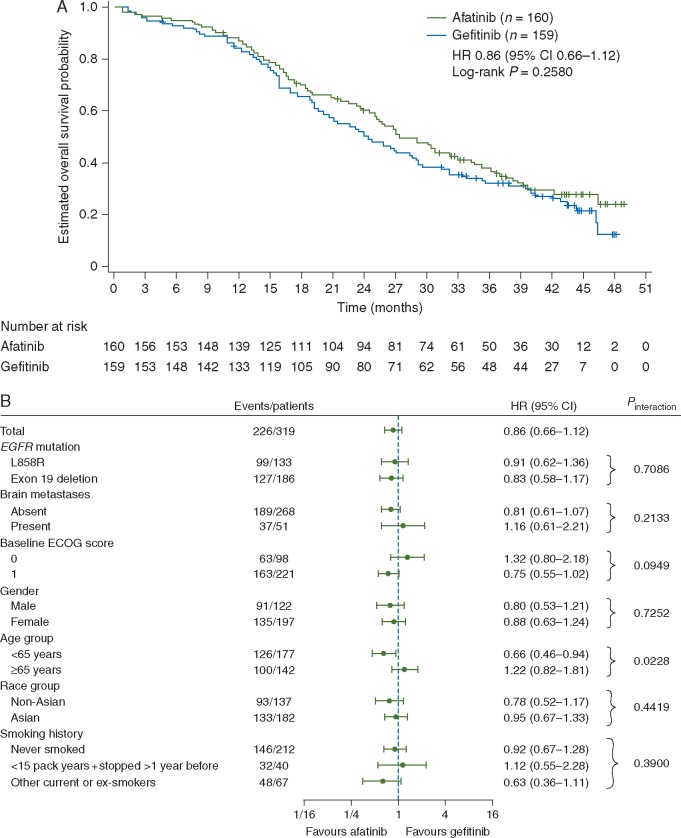
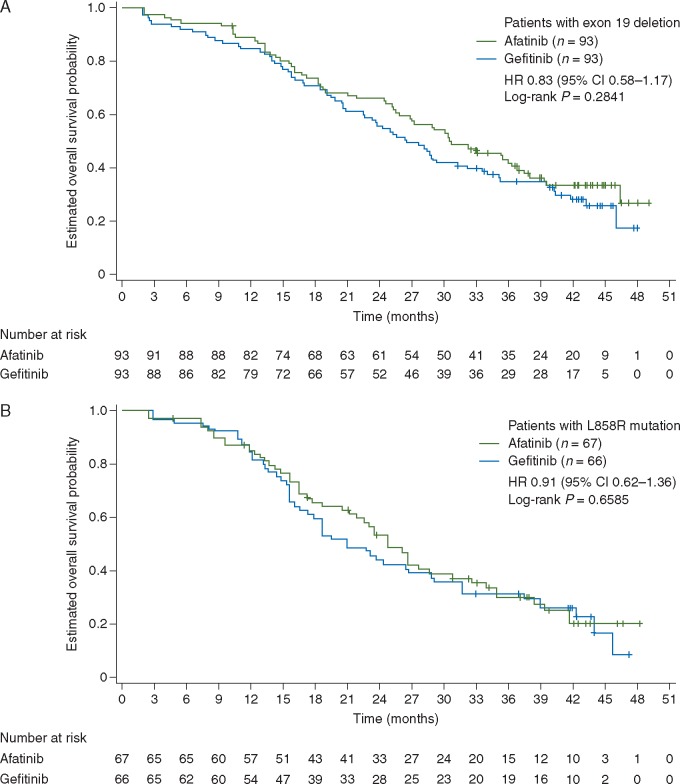
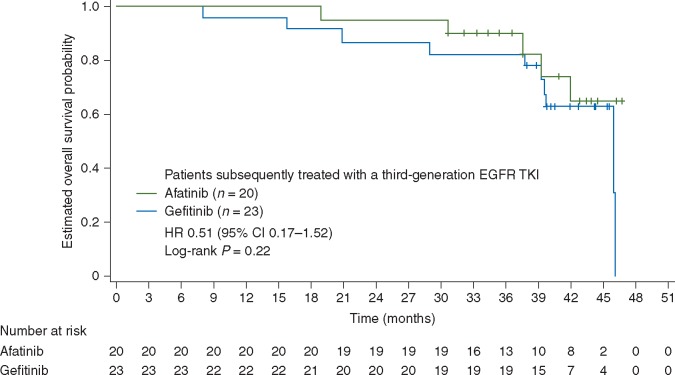
Background: In LUX-Lung 7, the irreversible ErbB family blocker, afatinib, significantly improved progression-free survival (PFS), time-to-treatment failure (TTF) and objective response rate (ORR) versus gefitinib in patients with epidermal growth factor receptor (EGFR) mutation-positive non-small-cell lung cancer (NSCLC). Here, we present primary analysis of mature overall survival (OS) data. Patients and methods: LUX-Lung 7 assessed afatinib 40 mg/day versus gefitinib 250 mg/day in treatment-naïve patients with stage IIIb/IV NSCLC and a common EGFR mutation (exon 19 deletion/L858R). Primary OS analysis was planned after ∼213 OS events and ≥32-month follow-up. OS was analysed by a Cox proportional hazards model, stratified by EGFR mutation type and baseline brain metastases. Results: Two-hundred and twenty-six OS events had occurred at the data cut-off (8 April 2016). After a median follow-up of 42.6 months, median OS (afatinib versus gefitinib) was 27.9 versus 24.5 months [hazard ratio (HR) = 0.86, 95% confidence interval (CI) 0.66‒1.12, P = 0.2580]. Prespecified subgroup analyses showed similar OS trends (afatinib versus gefitinib) in patients with exon 19 deletion (30.7 versus 26.4 months; HR, 0.83, 95% CI 0.58‒1.17, P = 0.2841) and L858R (25.0 versus 21.2 months; HR 0.91, 95% CI 0.62‒1.36, P = 0.6585) mutations. Most patients (afatinib, 72.6%; gefitinib, 76.8%) had at least one subsequent systemic anti-cancer treatment following discontinuation of afatinib/gefitinib; 20 (13.7%) and 23 (15.2%) patients received a third-generation EGFR tyrosine kinase inhibitor. Updated PFS (independent review), TTF and ORR data were significantly improved with afatinib. Conclusion: In LUX-Lung 7, there was no significant difference in OS with afatinib versus gefitinib. Updated PFS (independent review), TTF and ORR data were significantly improved with afatinib. Clinicaltrials.gov identifier: NCT01466660.
Overview
The claims and statistics of this paper haven’t been checked yet.
Free: it reads the open-access text and checks the first 5 claims that cite a source we can check. Create a free account to check every claim.
Integrity signals
Registry
Cites
Statistics
Figures
Verification
Claims the paper makes
The claims and statistics of this paper haven’t been checked yet.
Free: it reads the open-access text and checks the first 5 claims that cite a source we can check. Create a free account to check every claim.
Claims other papers make about this one
Each is checked against this paper’s own text: does it say what the citing paper says it does?
The source backs part of the claim, not all of it — or backs it for a different population, condition or comparison.
In the citing paper
“Afatinib also significantly improved ORR versus gefitinib (70% vs 56%; P = 0.0083), with a longer median duration of response (10.1 months (interquartile range (IQR), 5.6–16.8) vs 8.4 months (IQR, 6.2–13.1)), and a trend towards improved OS with afatinib vs gefitinib observed (median 27.9 vs 24.5 months; HR, 0.86 (95% CI, 0.66‒1.12), P = 0.258).”
From Afatinib for the treatment of EGFR mutation-positive NSCLC: A review of clinical findings (2020) · cites this paper as [43]
Experimental — accuracy not yet measuredThe cited source says what the claim attributes to it.
In the citing paper
“there was no statistically significant difference with afatinib versus gefitinib”
From Afatinib for the treatment of EGFR mutation-positive NSCLC: A review of clinical findings (2020) · cites this paper as [43]
The cited source says what the claim attributes to it.
In the citing paper
“In the LUX-Lung 7 trial, the 3-year OS rate was up to 90% in patients who received a third-generation EGFR TKI (osimertinib (10.3% of patients) or olmutinib (3.4%)) after discontinuing afatinib.”
From Afatinib for the treatment of EGFR mutation-positive NSCLC: A review of clinical findings (2020) · cites this paper as [43]
The cited source says what the claim attributes to it.
In the citing paper
“Afatinib has been shown to provide significant improvements over chemotherapy and gefitinib in the first-line setting in patients with EGFRm+ NSCLC,39,40,42,43 and over erlotinib in the second-line setting in patients with SCC following chemotherapy.84”
From Afatinib for the treatment of EGFR mutation-positive NSCLC: A review of clinical findings (2020) · cites this paper as [43]
The check wasn’t confident either way, so it gives no verdict — never disputed.
In the citing paper
“exploratory analysis demonstrated prolonged OS with dacomitinib versus gefitinib.”
From Afatinib for the treatment of EGFR mutation-positive NSCLC: A review of clinical findings (2020) · cites this paper as [43]
Experimental — accuracy not yet measured
Self-check
Percentages, sums and reported differences re-computed from the paper’s own numbers.
The self-check needs the paper’s full text.
Citations
Cites
Gefitinib or Carboplatin–Paclitaxel in Pulmonary Adenocarcinoma
Mok, T. S., Wu, Y.-L., Thongprasert, S., Yang, C.-H., Chu, D.-T., Saijo, N., Sunpaweravong, P., Han, B., Margono, B., Ichinose, Y., et al. (2009) · New England Journal of Medicine · doi:10.1056/nejmoa0810699 · Cited by 8,261
Self-citationGefitinib or Chemotherapy for Non–Small-Cell Lung Cancer with Mutated EGFR
Maemondo, M., Inoue, A., Kobayashi, K., Sugawara, S., Oizumi, S., Isobe, H., Gemma, A., Harada, M., Yoshizawa, H., Kinoshita, I., et al. (2010) · New England Journal of Medicine · doi:10.1056/nejmoa0909530 · Cited by 5,525
Rosell, R., Carcereny, E., Gervais, R., Vergnenegre, A., Massuti, B., Felip, E., Palmero, R., Garcia-Gomez, R., Pallares, C., Sanchez, J. M., et al. (2012) · The Lancet Oncology · doi:10.1016/s1470-2045(11)70393-x · Cited by 5,489 · cited 2×
“This rate of post-progression therapy is somewhat higher than reported in most previous trials including EGFRmutationpositive patients treated with EGFR TKIs (66%–68% in erlotinib trials [4, 7, 11], 64%–90% in gefitinib trials [12, 14, 16] and 58%–70% in afatinib trials [5, 6].”
BackgroundResultSelf-citationMitsudomi, T., Morita, S., Yatabe, Y., Negoro, S., Okamoto, I., Tsurutani, J., Seto, T., Satouchi, M., Tada, H., Hirashima, T., et al. (2010) · The Lancet Oncology · doi:10.1016/s1470-2045(09)70364-x · Cited by 4,090
Zhou, C., Wu, Y.-L., Chen, G., Feng, J., Liu, X.-Q., Wang, C., Zhang, S., Wang, J., Zhou, S., Ren, S., et al. (2011) · The Lancet Oncology · doi:10.1016/s1470-2045(11)70184-x · Cited by 4,081
Self-citationEGFR Mutation and Resistance of Non–Small-Cell Lung Cancer to Gefitinib
Kobayashi, S., Boggon, T. J., Dayaram, T., Jänne, P. A., Kocher, O., Meyerson, M., Johnson, B. E., Eck, M. J., Tenen, D. G., & Halmos, B. (2005) · New England Journal of Medicine · doi:10.1056/nejmoa044238 · Cited by 3,964
Pao, W., Miller, V. A., Politi, K. A., Riely, G. J., Somwar, R., Zakowski, M. F., Kris, M. G., & Varmus, H. (2005) · PLoS Medicine · doi:10.1371/journal.pmed.0020073 · Cited by 3,527
Sequist, L. V., Yang, J. C.-H., Yamamoto, N., O'Byrne, K., Hirsh, V., Mok, T., Geater, S. L., Orlov, S., Tsai, C.-M., Boyer, M., et al. (2013) · Journal of Clinical Oncology · doi:10.1200/jco.2012.44.2806 · Cited by 3,228
Self-citationAZD9291 in EGFR Inhibitor–Resistant Non–Small-Cell Lung Cancer
Jänne, P. A., Yang, J. C.-H., Kim, D.-W., Planchard, D., Ohe, Y., Ramalingam, S. S., Ahn, M.-J., Kim, S.-W., Su, W.-C., Horn, L., et al. (2015) · New England Journal of Medicine · doi:10.1056/nejmoa1411817 · Cited by 2,116
Self-citationWu, Y.-L., Zhou, C., Hu, C.-P., Feng, J., Lu, S., Huang, Y., Li, W., Hou, M., Shi, J. H., Lee, K. Y., et al. (2014) · The Lancet Oncology · doi:10.1016/s1470-2045(13)70604-1 · Cited by 1,978
Self-citation
Research works printed but not linked: 2
- Yoshioka, 2014, J Clin Oncol, 32 (Suppl. 15)
- Yang, 2015, A Randomized Controlled Trial of Erlotinib versus Gefitinib in Advanced Non-Small-Cell Lung Cancer Harboring EGFR Mutations (CTONG0901), J Thorac Oncol, 10, S321
Cited by
Items 201–300 of 574
Precision nanomedicine to treat non-small cell lung cancer
Dessai, A. D., Nayak, U. Y., & Nayak, Y. (2024) · Life Sciences · doi:10.1016/j.lfs.2024.122614 · Cited by 19
Harvey, M. J., Cunningham, R., Sawchyn, B., Montesion, M., Reddy, P., McBride, A., & Chawla, A. (2021) · JCO Precision Oncology · doi:10.1200/po.20.00540 · Cited by 19
Li, Y., Zhang, X., Gao, Y., Shang, C., Yu, B., Wang, T., Su, J., Huang, C., Wu, Y., Guo, H., et al. (2021) · Frontiers in Oncology · doi:10.3389/fonc.2020.625866 · Cited by 19
The role of molecular heterogeneity targeting resistance mechanisms to lung cancer therapies
Attili, I., Re, M. D., Guerini‐Rocco, E., Crucitta, S., Pisapia, P., Pepe, F., Barberis, M. C. P., Troncone, G., Danesi, R., de Marinis, F., et al. (2021) · Expert Review of Molecular Diagnostics · doi:10.1080/14737159.2021.1943365 · Cited by 18
Gijtenbeek, R. G. P., Damhuis, R. A. M., Groen, H. J. M., van der Wekken, A. J., & van Geffen, W. H. (2020) · Clinical Lung Cancer · doi:10.1016/j.cllc.2020.05.019 · Cited by 18
Zhu, J., Yang, Q., & Xu, W. (2021) · Pharmaceutics · doi:10.3390/pharmaceutics13091500 · Cited by 18
Multi‐state network meta‐analysis of progression and survival data
Jansen, J. P., Incerti, D., & Trikalinos, T. A. (2023) · Statistics in Medicine · doi:10.1002/sim.9810 · Cited by 18
Minegishi, Y., Yamaguchi, O., Sugawara, S., Kuyama, S., Watanabe, S., Usui, K., Mori, M., Hataji, O., Nukiwa, T., Morita, S., et al. (2021) · BMC Cancer · doi:10.1186/s12885-021-07861-1 · Cited by 18
Chiang, C., Huang, H.-C., Shen, C., Luo, Y., Chen, Y., & Chiu, C. (2020) · Targeted Oncology · doi:10.1007/s11523-020-00737-7 · Cited by 18
Hernandez‐Martinez, J., Güijosa, A., Flores‐Estrada, D., Cruz‐Rico, G., Turcott, J. G., Hernández‐Pedro, N., Caballé‐Perez, E., Cardona, A. F., & Arrieta, O. G. (2024) · JCO Global Oncology · doi:10.1200/go-24-00338 · Cited by 18
Biswas, B., Ghadyalpatil, N. S., Krishna, M. V., & Deshmukh, J. (2017) · Indian Journal of Cancer · doi:10.4103/ijc.ijc_589_17 · Cited by 18
Surgical resection of brain metastases prolongs overall survival in non-small-cell lung cancer.
Yen, C.-T., Wu, W.-J., Chen, Y.-T., Chang, W., Yang, S.-H., Shen, S.-Y., Su, J., & Chen, H. (2021) · PubMed Central · Cited by 18
Hirsh, V., & Singh, J. R. (2020) · American Journal of Health-System Pharmacy · doi:10.1093/ajhp/zxaa197 · Cited by 17
Self-citationEstimating the Impact of Delayed Access to Oncology Drugs on Patient Outcomes in Canada
Vanderpuye-Orgle, J., Erim, D., Qian, Y., Boyne, D. J., Cheung, W. Y., Bebb, G. D., Shah, A., Pericleous, L., Maruszczak, M. J., & Brenner, D. R. (2022) · Oncology and Therapy · doi:10.1007/s40487-022-00187-3 · Cited by 17
Exploring the chemotherapeutic potential of currently used kinase inhibitors: An update
Naik, R. R., & Shakya, A. K. (2023) · Frontiers in Pharmacology · doi:10.3389/fphar.2022.1064472 · Cited by 17
Yang, S., Lin, C., Lai, W., Chang, S., Hwang, J.-S., Su, W., & Wang, J. (2018) · Therapeutic Advances in Medical Oncology · doi:10.1177/1758834018755072 · Cited by 16
Proto, C., Russo, G. L., Corrao, G., Ganzinelli, M., Facchinetti, F., Minari, R., Tiseo, M., & Garassino, M. C. (2017) · Tumori Journal · doi:10.5301/tj.5000663 · Cited by 16
Passaro, A., de Marinis, F., Tu, H., Лактионов, К. К., Feng, J., Poltoratskiy, A., Zhao, J., Tan, E. H., Gottfried, M., Lee, V. H.-F., et al. (2021) · Frontiers in Oncology · doi:10.3389/fonc.2021.709877 · Cited by 16
Self-citationNinomiya, T., Ishikawa, N., Kozuki, T., Kuyama, S., Inoue, K., Yokoyama, T., Kanaji, N., Yasugi, M., Shibayama, T., Aoe, K., et al. (2023) · Lung Cancer · doi:10.1016/j.lungcan.2023.107349 · Cited by 16
Lee, C., Sharma, S., Miao, E., Mensah, C., Sullivan, K. M., & Seetharamu, N. (2020) · Lung Cancer Targets and Therapy · doi:10.2147/lctt.s258444 · Cited by 16
Santarpía, M., Menis, J., CHAIB-OUKADOUR, I., Cao, M. G., & Rosell, R. (2019) · Expert Review of Clinical Pharmacology · doi:10.1080/17512433.2019.1649136 · Cited by 16
Limwattananon, C., Limwattananon, S., Waleekhachonloet, O., & Rattanachotphanit, T. (2018) · Lung Cancer · doi:10.1016/j.lungcan.2018.04.003 · Cited by 16
Evolution of MET and NRAS gene amplification as acquired resistance mechanisms in EGFR mutant NSCLC
Peters, T. L., Patil, T., Le, A. T., Davies, K. D., Brzeskiewicz, P. M., Nijmeh, H., Bao, L., Camidge, D. R., Aisner, D. L., & Doebele, R. C. (2021) · npj Precision Oncology · doi:10.1038/s41698-021-00231-x · Cited by 16
Irie, H., Ito, K., Fujioka, Y., Oguchi, K., Fujioka, A., Hashimoto, A., Ohsawa, H., Tanaka, K. F., Funabashi, K., Araki, H., et al. (2019) · Molecular Cancer Therapeutics · doi:10.1158/1535-7163.mct-18-1085 · Cited by 16
Oligometastatic Disease in Non-Small-Cell Lung Cancer: An Update
Chen, Y.-H., Ho, U., & Kuo, L. (2022) · Cancers · doi:10.3390/cancers14051350 · Cited by 16
Nuclear epidermal growth factor receptor as a therapeutic target
Atwell, B., Chalasani, P., & Schroeder, J. A. (2023) · Exploration of Targeted Anti-tumor Therapy · doi:10.37349/etat.2023.00156 · Cited by 16
Li, C., Hsia, T., Yang, S., Chao, K. S. C., Tu, C., Chen, H.-J., & Li, C.-H. (2022) · Integrative Cancer Therapies · doi:10.1177/15347354221086663 · Cited by 15
Brückl, W. M., Reck, M., Griesinger, F., Schäfer, H., Kortsik, C., Gaska, T., Rawluk, J. K., Krüger, S., Kokowski, K., Budweiser, S., et al. (2021) · Therapeutic Advances in Medical Oncology · doi:10.1177/17588359211012361 · Cited by 15
Shi, J., Liu, X., Gao, M., Yu, J. J., Chai, T., Jiang, Y., Li, J., Zhang, Y., & Wu, L. (2025) · Frontiers in Pharmacology · doi:10.3389/fphar.2025.1519849 · Cited by 15
EGFR mutation-positive NSCLC: factors to consider when deciding first-line therapy
Hulo, P., Coupez, D., Denis, M. G., & Bennouna, J. (2020) · Expert Review of Anticancer Therapy · doi:10.1080/14737140.2020.1757439 · Cited by 15
Zhang, H., Zhang, Y., Zhu, Y., Dong, T., & Liu, Z. (2024) · Frontiers in Oncology · doi:10.3389/fonc.2024.1387345 · Cited by 15
Liao, D., Yu, L., Shangguan, D., Zhang, Y., Xiao, B., Liu, G., & Yang, N. (2022) · Frontiers in Pharmacology · doi:10.3389/fphar.2022.905947 · Cited by 15
Knowledge base toward understanding actionable alterations and realizing precision oncology
Takeuchi, S., & Okuda, S. (2018) · International Journal of Clinical Oncology · doi:10.1007/s10147-018-1378-0 · Cited by 15
Nie, X., Zhang, P., Gao, J., Cheng, G., Liu, W., & Li, L. (2021) · Thoracic Cancer · doi:10.1111/1759-7714.13934 · Cited by 15
Brzozowska, M., Wierzba, W., Szafraniec-Buryło, S. I., Czech, M., Majkut, G., Połowinczak-Przybyłek, J., Potemski, P., & Śliwczyński, A. M. (2019) · Archives of Medical Science · doi:10.5114/aoms.2018.80362 · Cited by 15
Facchinetti, F., Pilotto, S., Metro, G., Baldini, E., Bertolaccini, L., Cappuzzo, F., Delmonte, A., Gasparini, S., Inno, A., Marchetti, A., et al. (2019) · Tumori Journal · doi:10.1177/0300891619857418 · Cited by 14
Tanaka, H., Taima, K., Tanaka, Y., Itoga, M., Ishioka, Y., Nakagawa, H., Baba, K., Hasegawa, Y., Takanashi, S., & Tasaka, S. (2018) · Medical Oncology · doi:10.1007/s12032-018-1098-3 · Cited by 14
Roeper, J., Kurz, S., Grohé, C., & Griesinger, F. (2020) · Future Oncology · doi:10.2217/fon-2020-0854 · Cited by 14
Prabhash, K. (2019) · South Asian Journal of Cancer · doi:10.4103/sajc.sajc_227_18 · Cited by 14
MITSUYA, S., Tsuruoka, K., Kanaoka, K., Funamoto, T., Tsuji, H., Matsunaga, N., Nakamura, T., Tamura, Y., Imanishi, M., IKEDA, S., et al. (2021) · Anticancer Research · doi:10.21873/anticanres.15331 · Cited by 14
Yu, X., Si, J., Wei, J., Wang, Y., Sun, Y. P., Jin, J., Zhang, X., Ma, T., & Song, Z. (2022) · Cancer Medicine · doi:10.1002/cam4.5413 · Cited by 14
Nakao, A., Hiranuma, O., Uchino, J., Sakaguchi, C., Araya, T., Hiraoka, N., Ishizuka, T., Takeda, T., Kawasaki, M., Gotô, Y., et al. (2020) · Journal of Clinical Medicine · doi:10.3390/jcm9061762 · Cited by 14
Dai, L., Luo, C.-Y., Hu, G., Chen, G., Wu, C., Yin, J., Jiang, Z., Hu, G., Zhao, J., & Fu, W. (2020) · Annals of Palliative Medicine · doi:10.21037/apm-20-1136 · Cited by 14
Qi, Y., Xia, X., Shao, L., Guo, L., Dong, Y., Tian, J., Xu, L., Niu, R., & Wei, S. (2022) · Frontiers in Oncology · doi:10.3389/fonc.2022.616546 · Cited by 14
Hisanaga, K., Uchino, H., Kakisu, N., Miyagi, M., Yoshikawa, F., Sato, G. E., Isobe, K., Kishi, K., Homma, S. A., & Hirose, T. (2021) · Diabetes Metabolic Syndrome and Obesity · doi:10.2147/dmso.s289446 · Cited by 14
Ibrahim, M. T., Uzairu, A., Shallangwa, G. A., & Uba, S. (2020) · Egyptian Journal of Medical Human Genetics · doi:10.1186/s43042-020-00107-y · Cited by 14
Chang, W., Lin, H., Chang, T., Lin, S., & Li, Y. (2023) · JAMA Network Open · doi:10.1001/jamanetworkopen.2023.13824 · Cited by 14
Chang, Z., Chan, T., & Wu, C. (2022) · International Journal of Molecular Sciences · doi:10.3390/ijms232113451 · Cited by 13
González-Larriba, J. L., Lázaro-Quintela, M., Cobo, M., Dómine, M., Majem, M., & García‐Campelo, R. (2017) · Translational Lung Cancer Research · doi:10.21037/tlcr.2017.10.03 · Cited by 13
Poh, M. E., Chai, C.-S., Liam, C. K., Ho, G. F., Pang, Y. K., Hasbullah, H. H., Tho, L. M., Nor, I. M., Ho, K. F., Thiagarajan, M., et al. (2024) · Translational Lung Cancer Research · doi:10.21037/tlcr-23-691 · Cited by 13
Ma, J., Pang, X., Zhang, S., Huang, L., Sun, L. Y., & Han, C. (2024) · Scientific Reports · doi:10.1038/s41598-024-74496-0 · Cited by 13
Noro, R., Igawa, S., Bessho, A., Hirose, T., Shimokawa, T., Nakashima, M., Minato, K., Seki, N., Tokito, T., Harada, T., et al. (2021) · Lung Cancer · doi:10.1016/j.lungcan.2021.08.007 · Cited by 13
Yonesaka, K., Kobayashi, Y., Hayashi, H., Chiba, Y., Mitsudomi, T., & Nakagawa, K. (2018) · Oncology Reports · doi:10.3892/or.2018.6881 · Cited by 13
Ito, K., Murotani, K., Kubo, A., Kunii, E., Taniguchi, H., Shindoh, J., Asada, K., Imaizumi, K., Takahashi, K., Karayama, M., et al. (2020) · Cancer Science · doi:10.1111/cas.14560 · Cited by 13
Park, K., Kim, J.-S., Kim, J.-H., Kim, Y., Kim, H., Cho, E. K., Jin, J., Kim, M., Märten, A., & Kang, J. (2021) · BMC Cancer · doi:10.1186/s12885-021-08445-9 · Cited by 12
Self-citationChan, S.-K., Choi, C., & Lee, V. H.-F. (2022) · JTO Clinical and Research Reports · doi:10.1016/j.jtocrr.2022.100322 · Cited by 12
Sartori, G., Belluomini, L., Lombardo, F., Avancini, A., Trestini, I., Vita, E., Tregnago, D., Menis, J., Bria, E., Milella, M., et al. (2020) · Expert Review of Anticancer Therapy · doi:10.1080/14737140.2020.1776119 · Cited by 12
Huang, M., Hsieh, K., Huang, R., Hung, J., Chen, L., Tsai, M., & Yang, Y. (2021) · Journal of the Formosan Medical Association · doi:10.1016/j.jfma.2021.02.012 · Cited by 12
Ochiai, R., Hayashi, K., Yamamoto, H., Fujii, R., Saichi, N., Shinchi, H., Ishida, T., Honda, T., Shimizu, T., Matsutani, N., et al. (2022) · Cancer Science · doi:10.1111/cas.15512 · Cited by 12
Zhang, L., Luo, Y., Chen, J., Cheng, T., Yang, H., Pan, C., Li, H., & Jiang, Z. (2021) · Journal of Oncology · doi:10.1155/2021/8736288 · Cited by 12
Self-citationTsukita, Y., & Inoue, A. (2022) · Japanese Journal of Clinical Oncology · doi:10.1093/jjco/hyac012 · Cited by 12
Improvement of EGFR Testing over the Last Decade and Impact of Delaying TKI Initiation
Blanc‐Durand, F., Florescu, M., Tehfe, M. A., Routy, B., Alameddine, R. S., Tran‐Thanh, D., & Blais, N. (2021) · Current Oncology · doi:10.3390/curroncol28020102 · Cited by 12
Immune Checkpoint Inhibitors in “Special” NSCLC Populations: A Viable Approach?
Bronte, G., Cosi, D. M., Magri, C., Frassoldati, A., Crinò, L., & Calabrò, L. (2023) · International Journal of Molecular Sciences · doi:10.3390/ijms241612622 · Cited by 12
Kim, T., Jang, T. W., Choi, C., Kim, M., Lee, S. Y., Chang, Y. S., Lee, K. Y., Kim, S. J., Yang, S. H., Ryu, J., et al. (2023) · Cancer Research and Treatment · doi:10.4143/crt.2023.493 · Cited by 11
Self-citationXie, T., Zou, Z., Liu, C., Zhu, Y., Xu, Z., Wang, L., Li, J., & Xing, P. (2021) · Evidence-based Complementary and Alternative Medicine · doi:10.1155/2021/9311875 · Cited by 11
Mountzios, G., Koumarianou, A. A., Bokas, A., Mavroudis, D., Samantas, E., Fergadis, E., Linardou, H., Katsaounis, P., Athanasiadis, E., Karamouzis, M. V., et al. (2021) · Cancers · doi:10.3390/cancers13133172 · Cited by 11
Treatment choice in EGFR-mutant non-small-cell lung cancer
Brueckl, W. M. (2017) · The Lancet Oncology · doi:10.1016/s1470-2045(17)30684-8 · Cited by 11
Scodes, S., & Cappuzzo, F. (2020) · Expert Review of Respiratory Medicine · doi:10.1080/17476348.2020.1746646 · Cited by 11
Farris, M., Larkin-Kaiser, K. A., Scory, T. D., Boyne, D. J., Wilner, K. D., Pastel, M., Cappelleri, J. C., & Ivanova, J. I. (2020) · Future Oncology · doi:10.2217/fon-2020-0541 · Cited by 11
Miyazaki, K., Tamura, T., Kaburagi, T., Saito, K., Inagaki, M., Yamashita, T., Ichimura, H., Nawa, T., Endo, T., Hayashihara, K., et al. (2018) · Anticancer Research · doi:10.21873/anticanres.12871 · Cited by 11
Chen, W., Miao, J., Wang, Y., Xing, W., Xu, X.-M., & Wu, R. (2023) · Frontiers in Pharmacology · doi:10.3389/fphar.2023.1212313 · Cited by 11
Tone, M., Iwahori, K., Shiroyama, T., Futami, S., Naito, Y., Fukushima, K., Miyake, K., Koyama, S., Hirata, H., Nagatomo, I., et al. (2023) · Scientific Reports · doi:10.1038/s41598-023-35519-4 · Cited by 11
Yamamoto, N., Mera, T., Märten, A., & Hochmair, M. J. (2019) · Advances in Therapy · doi:10.1007/s12325-019-01187-y · Cited by 11
Self-citationL’Hostis, A., Palgen, J., Perrillat-Mercerot, A., Peyronnet, E., Jacob, E., Bosley, J., Duruisseaux, M., Toueg, R., Lefèvre, L., Kahoul, R., et al. (2023) · npj Systems Biology and Applications · doi:10.1038/s41540-023-00292-7 · Cited by 11
The clinical features of squamous cell lung carcinoma with sensitive EGFR mutations
Taniguchi, Y., Matsumoto, Y., Furukawa, R., Ohara, S., & Usui, K. (2018) · International Journal of Clinical Oncology · doi:10.1007/s10147-017-1233-8 · Cited by 11
Katayama, Y., Yamada, T., Tokuda, S., Okura, N., Nishioka, N., Morimoto, K., Tanimura, K., Morimoto, Y., Iwasaku, M., Horinaka, M., et al. (2022) · Cancer Medicine · doi:10.1002/cam4.4504 · Cited by 11
Huang, C., Huang, X., Qiu, X., Kong, X., Wu, C., Jiang, X., Yao, M., Wang, M., Su, L., Lv, C., et al. (2024) · Advanced Science · doi:10.1002/advs.202405130 · Cited by 11
Gutiérrez, L., Royuela, A., Carcereny, E., Castro, R. L., Rodríguez‐Abreu, D., Massutí, B., González-Larriba, J. L., García‐Campelo, R., Bosch‐Barrera, J., Guirado, M., et al. (2021) · BMC Cancer · doi:10.1186/s12885-021-08713-8 · Cited by 11
Nasu, S., Suzuki, H., Shiroyama, T., Tanaka, A., Samejima, Y., Kanai, T., Noda, Y., Morishita, N., Okamoto, N., & Hirashima, T. (2020) · Investigational New Drugs · doi:10.1007/s10637-020-00963-w · Cited by 11
Recent progress in systemic treatment for lung cancer
Clark, J. W., & Longo, D. L. (2018) · Current Opinion in Pulmonary Medicine · doi:10.1097/mcp.0000000000000493 · Cited by 11
Targeted therapy of non-small cell lung cancer
Svatoň, M. (2021) · Klinicka onkologie · doi:10.48095/ccko2021s48 · Cited by 11
Xie, J., Wang, X., Ge, H., Peng, F., Zheng, N., Wang, Q., & Tao, L. (2019) · Journal of Cellular Physiology · doi:10.1002/jcp.28881 · Cited by 10
Zhang, W., Zhang, X., Zhao, W., Guo, Z., Liu, X., Li, Y., Chen, Z., Xu, K., Liu, Y., Wang, H., et al. (2024) · BMC Pulmonary Medicine · doi:10.1186/s12890-024-03438-3 · Cited by 10
Wu, R., Yu, S., Ye, J., Wang, Y., Zhao, Z., Liu, H., & Song, Y. (2021) · Frontiers in Oncology · doi:10.3389/fonc.2021.692703 · Cited by 10
Ng, W.-W., Lin, C., Cheng, C., Jiang, J., Kao, S., & Yeh, D. Y.-W. (2021) · PLoS ONE · doi:10.1371/journal.pone.0253335 · Cited by 10
Xu, Z., Liu, C., Zhu, Y., Zou, Z., Xie, T., Xing, P., Wang, L., & Li, J. (2022) · BMC Cancer · doi:10.1186/s12885-022-09592-3 · Cited by 10
Melosky, B. L., Popat, S., & Gandara, D. R. (2017) · Clinical Lung Cancer · doi:10.1016/j.cllc.2017.05.019 · Cited by 10
Kashizaki, F., Chen, H., Miyasaka, A., Tsuchiya, N., Yamada, C., Okazaki, S., Kaneko, M., Kano, T., Kameda, Y., Kikuchi, A., et al. (2023) · Clinical Lung Cancer · doi:10.1016/j.cllc.2023.09.009 · Cited by 10
Stimulation of Eryptosis by Afatinib
Bhuyan, A. A. M., & Lang, F. J. W. (2018) · Cellular Physiology and Biochemistry · doi:10.1159/000490221 · Cited by 10
Recent advances in lung cancer genomics: Application in targeted therapy
Pathak, N., Chitikela, S. D., & Malik, P. S. (2021) · Advances in genetics · doi:10.1016/bs.adgen.2021.08.004 · Cited by 10
Predictive biomarkers and EGFR inhibitors in squamous cell carcinoma of head and neck (SCCHN)
Vigneswara, V., & Kong, A. H. (2018) · Annals of Oncology · doi:10.1093/annonc/mdy065 · Cited by 10
Shu, Y., Zhang, Q., He, X., & Chen, L. (2021) · Cancer Management and Research · doi:10.2147/cmar.s334643 · Cited by 10
Kuo, C. S., Chiu, T.-H., Tung, P., Huang, C., Ju, J., Huang, A. C., Wang, C., Ko, H., Hsu, P., Fang, Y., et al. (2022) · Cancers · doi:10.3390/cancers14020316 · Cited by 10
Prognostic Factors in Lung Adenocarcinoma with Bone Metastasis Treated with EGFR-TKIs
Chiu, T.-H., Lin, C., Hsieh, M., Lin, S., & Fang, Y. (2021) · Medicina · doi:10.3390/medicina57090967 · Cited by 9
Hintzen, G., Dulat, H. J., & Rajkovic, E. (2022) · Frontiers in Oncology · doi:10.3389/fonc.2022.892212 · Cited by 9
Caponnetto, S., Cantale, O., Friedlaender, A., Gomes, F., Daryanani, S., Gelibter, A. J., Cortellini, A., Giuffrida, D., Addeo, A., & Banna, G. L. (2021) · Journal of Molecular Pathology · doi:10.3390/jmp2010001 · Cited by 9
Absence of copy number gain ofEGFR: A possible predictive marker of long‐term response to afatinib
Nakamura, T., Sato, A., Nakashima, C., Abe, T., Iwanaga, K., Umeguchi, H., Kawaguchi, A., & Sueoka‐Aragane, N. (2022) · Cancer Science · doi:10.1111/cas.15655 · Cited by 9
Tfayli, A., & Mohty, R. (2020) · Tumori Journal · doi:10.1177/0300891620968138 · Cited by 9
Real-world assessment of afatinib for patients with EGFR-positive non-small cell lung cancer
Igawa, S., Ono, T., Kasajima, M., Kusuhara, S., Otani, S., Fukui, T., Yokoba, M., Kubota, M., Katagiri, M., Mitsufuji, H., et al. (2020) · Investigational New Drugs · doi:10.1007/s10637-020-00948-9 · Cited by 9
Morikawa, K., Tanaka, H., Itani, H., Takata, S., Watanabe, S., Kishi, K., Soejima, K., Kaira, K., Kagamu, H., Yoshimura, K., et al. (2020) · Therapeutic Advances in Medical Oncology · doi:10.1177/1758835920967254 · Cited by 9
Metadata
- Authors
- Paz-Ares, L., Tan, E.-H., O’Byrne, K., Zhang, L., Hirsh, V., Boyer, M., Yang, J. C.-H., Mok, T., Lee, K. H., Lu, S., Shi, Y., Lee, D. H., Laskin, J., Kim, D.-W., Laurie, S. A., Kölbeck, K., Fan, J., Dodd, N., Märten, A., & Park, K.
- Affiliations
- Universidad Complutense de Madrid (ES)
- National Cancer Centre Singapore (SG)
- Sun Yat-sen University (CN)
- McGill University (CA)
- Chris O’Brien Lifehouse (AU)
- National Taiwan University (TW)
- Chinese University of Hong Kong (HK)
- Chungbuk National University (KR)
- Chinese Academy of Medical Sciences & Peking Union Medical College (CN)
- Asan Medical Center (KR)
- BC Cancer Agency (CA)
- Seoul National University (KR)
- Ottawa Hospital (CA)
- Karolinska University Hospital (SE)
- Boehringer Ingelheim (United States) (US)
- Boehringer Ingelheim (United Kingdom) (GB)
- Boehringer Ingelheim (Germany) (DE)
- Samsung Medical Center (KR)
- Corresponding author
- Paz-Ares, L.
- Venue
- Annals of Oncology
- Publisher
- Elsevier BV
- Published
- 2017-02
- Volume
- 28
- Issue
- 2
- Pages
- 270-277
- ISSN
- 0923-7534 (ISSN-L)
- PMC
- PMC5391700
- OpenAlex
- W2587420003
- Cited by
- 524
- References
- 27
- Citations by year
- 2026: 18 · 2025: 22 · 2024: 36 · 2023: 51 · 2022: 69 · 2021: 82 · 2020: 65 · 2019: 72 · 2018: 77 · 2017: 31
- FWCI
- 55.20
- Type
- journal article
- Language
- en
- Open access
- hybrid
- doi.org
- Licence
- cc-by-nc
- www.elsevier.com/tdm/userlicense/1.0/ (tdm)
- creativecommons.org/licenses/by-nc/4.0/ (vor, 1006 d)
- Locations
- Annals of Oncology (publishedVersion, cc-by-nc)
- Europe PMC (PubMed Central) (publishedVersion, cc-by-nc)
- PubMed Central (publishedVersion, cc-by-nc)
- PubMed (publishedVersion)
- Arrow@dit (Dublin Institute of Technology) (acceptedVersion)
- Seoul National University Open Repository (Seoul National University) (submittedVersion)
- Trinity's Access to Research Output (TARA) (Trinity College Dublin) (submittedVersion, cc-by-nc-sa)
- Funders
- Amgen
- Eli Lilly and Company
- Pfizer
- AstraZeneca
- GlaxoSmithKline
- International Association for the Study of Lung Cancer
- Celgene
- Vertex Pharmaceuticals
- ACEA Biosciences
- Clovis Oncology
- AstraZeneca Korea
- Chinese University of Hong Kong
- Astellas Pharma
- Ono Pharmaceutical
- Genentech
- Chugai Pharmaceutical
- Topics
- Health Sciences › Medicine › Pulmonary and Respiratory Medicine › Lung Cancer Treatments and Mutations
- Health Sciences › Medicine › Oncology › HER2/EGFR in Cancer Research
- Health Sciences › Medicine › Pulmonary and Respiratory Medicine › Lung Cancer Diagnosis and Treatment
- Keywords
- afatinib, gefitinib, EGFR-mutant non-small cell lung cancer, overall survival, exon 19 deletion, L858R mutation, EGFR tyrosine kinase inhibitors, brain metastases, progression-free survival, time to treatment failure, objective response rate, third-generation EGFR tyrosine kinase inhibitors, treatment-naive patients, subgroup analysis
- MeSH terms
- Gefitinib, Afatinib, Aged, Antineoplastic Agents, Carcinoma, Non-Small-Cell Lung, Female, Humans, Lung Neoplasms, Male, Middle Aged, Mutation, Quinazolines, Proportional Hazards Models, Treatment Outcome, Kaplan-Meier Estimate, ErbB Receptors
About these checks
Registry, retraction, Cites and statistics results are computed, not judged, with one exception: a printed reference that no index lists is read once by a model before it counts as a citation error. Claims are extracted by a model and kept only when their quote appears verbatim in the text; each cited source is then checked, with a model’s help, for whether it says what the claim relies on. Those verdicts can be wrong — read the claim’s quote and the cited source before relying on one.
Statistics and arithmetic are recomputed, not judged.
Confidence bands are shown only for fields calibrated on our annotated test set. None is calibrated yet, so no band is shown.
What counts as a claim ›How we measure confidence ›How we check this ›
Are you an author, or do you see a problem with this page? Request a review
Data sources
Bibliographic data: Semantic Scholar, OpenAlex, Crossref.
Contains information from the Semantic Scholar Academic Graph Datasets, made available under the ODC Attribution License (ODC-BY 1.0).
Semantic Scholar’s data is described in: Kinney, R., et al. (2023). The Semantic Scholar Open Data Platform. arXiv:2301.10140.
