

The DOI matches its Crossref record; 12 of the 12 references it cites were found in a registry or an index.
PyDESeq2: a python package for bulk RNA-seq differential expression analysis
Open accessAbstract
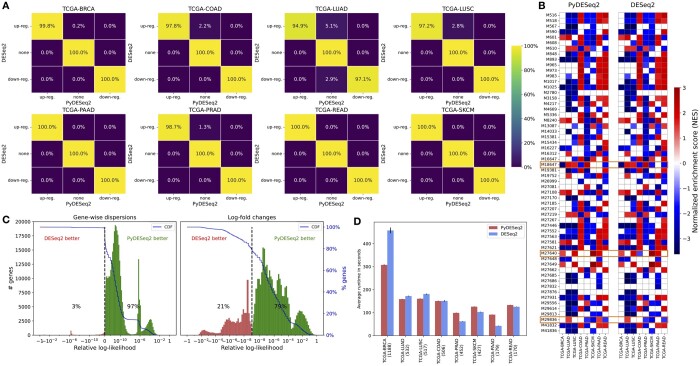
Summary: We present PyDESeq2, a python implementation of the DESeq2 workflow for differential expression analysis on bulk RNA-seq data. This re-implementation yields similar, but not identical, results: it achieves higher model likelihood, allows speed improvements on large datasets, as shown in experiments on TCGA data, and can be more easily interfaced with modern python-based data science tools. Availability and Implementation: PyDESeq2 is released as an open-source software under the MIT license. The source code is available on GitHub at https://github.com/owkin/PyDESeq2 and documented at https://pydeseq2.readthedocs.io. PyDESeq2 is part of the scverse ecosystem.
Overview
The claims and statistics of this paper haven’t been checked yet.
Free: it reads the open-access text and checks the first 5 claims that cite a source we can check. Create a free account to check every claim.
Integrity signals
Registry
Cites
Statistics
Figures
Verification
Claims the paper makes
The claims and statistics of this paper haven’t been checked yet.
Free: it reads the open-access text and checks the first 5 claims that cite a source we can check. Create a free account to check every claim.
Self-check
Percentages, sums and reported differences re-computed from the paper’s own numbers.
The self-check needs the paper’s full text.
Citations
Cites
Moderated estimation of fold change and dispersion for RNA-seq data with DESeq2
Love, M. I., Huber, W., & Anders, S. (2014) · Genome Biology · doi:10.1186/s13059-014-0550-8 · Cited by 95,106
SciPy 1.0: fundamental algorithms for scientific computing in Python
Virtanen, P., Gommers, R., Oliphant, T. E., Haberland, M., Reddy, T., Cournapeau, D., Burovski, E., Peterson, P., Weckesser, W., Bright, J., et al. (2020) · Nature Methods · doi:10.1038/s41592-019-0686-2 · Cited by 38,430 · cited 2×
“To fit GLMs, we rely on the popular scipy (Virtanen et al. , 2020) and statsmodels (Seabold and Perktold, 2010) python packages.”
MethodSciPy 1.0: fundamental algorithms for scientific computing in Python
Virtanen, P., Gommers, R., Oliphant, T. E., Haberland, M., Reddy, T., Cournapeau, D., Burovski, E., Peterson, P., Weckesser, W., Bright, J., et al. (2019) · Apollo - University of Cambridge Repository · doi:10.17863/cam.64134 · Cited by 10,460
SCANPY: large-scale single-cell gene expression data analysis
Wolf, F. A., Angerer, P., & Theis, F. J. (2018) · Genome Biology · doi:10.1186/s13059-017-1382-0 · Cited by 8,881 · cited 2×
“Examples include the scanpy suite (Wolf et al. , 2018) or the squidpy package (Palla et al. , 2022) for single-cell and spatial RNA-seq, among others.”
BackgroundStatsmodels: Econometric and Statistical Modeling with Python
Seabold, S., & Perktold, J. (2010) · Proceedings of the Python in Science Conference · doi:10.25080/majora-92bf1922-011 · Cited by 6,465 · cited 2×
“To fit GLMs, we rely on the popular scipy (Virtanen et al. , 2020) and statsmodels (Seabold and Perktold, 2010) python packages.”
MethodZhu, A., Ibrahim, J. G., & Love, M. I. (2019) · Bioinformatics · doi:10.1093/bioinformatics/bty895 · Cited by 2,072
RNA sequencing: the teenage years
Stark, R., Grzelak, M., & Hadfield, J. (2019) · Nature Reviews Genetics · doi:10.1038/s41576-019-0150-2 · Cited by 1,915 · cited 2×
“Most RNA-seq datasets are used primarily for di ↵ erential expression analysis (DEA) (Stark et al. , 2019) which provides invaluable insight on the associations between the genes’ expression and a phenotype.”
MethodRNA virus interference via CRISPR/Cas13a system in plants
Aman, R., Ali, Z., Butt, H., Mahas, A., Aljedaani, F., Khan, M. Z., Ding, S., & Mahfouz, M. (2018) · Genome Biology · doi:10.1186/s13059-017-1381-1 · Cited by 1,497
Squidpy: a scalable framework for spatial omics analysis
Palla, G., Spitzer, H., Klein, M., Fischer, D., Schaar, A. C., Kuemmerle, L. B., Rybakov, S., Ibarra, I. L., Holmberg, O., Virshup, I., et al. (2022) · Nature Methods · doi:10.1038/s41592-021-01358-2 · Cited by 1,114 · cited 2×
“, 2018) or the squidpy package (Palla et al., 2022) for single-cell and spatial RNA-seq, both of which are part of the scverse (Virshup et al.”
BackgroundThe scverse project provides a computational ecosystem for single-cell omics data analysis
Virshup, I., Bredikhin, D., Heumos, L., Palla, G., Sturm, G., Gayoso, A., Kats, I., Koutrouli, M., Community, S., Angerer, P., et al. (2023) · Nature Biotechnology · doi:10.1038/s41587-023-01733-8 · Cited by 341 · cited 1×
“, 2022) for single-cell and spatial RNA-seq, both of which are part of the scverse (Virshup et al., 2023), an ecosystem of interoperable python omics packages.”
Background
Cited by
LIANA+ Provides an All-in-One Framework for Cell–Cell Communication Inference
Dimitrov, D., Schäfer, P. S. L., Farr, E., Rodriguez-Mier, P., Lobentanzer, S., Badia-i-Mompel, P., Dugourd, A., Tanevski, J., Ramirez Flores, R. O., & Saez-Rodriguez, J. (2024) · Nature Cell Biology · doi:10.1038/s41556-024-01469-w · Cited by 263
“Asterisks signify genes with FDR <0.05, and the colour bar corresponds to log2FC 47,48 . m , Sign-coherent signalling network originating from FN1 and SPP1 and propagating down to TFs deregulated in MY in ischaemia. n , Corresponding legend for the network in m .”
InfluentialOpen-ST: High-resolution spatial transcriptomics in 3D
Schott, M., León-Periñán, D., Splendiani, E., Strenger, L., Licha, J. R., Pentimalli, T. M., Schallenberg, S., Alles, J., Samut Tagliaferro, S., Boltengagen, A., et al. (2024) · Cell · doi:10.1016/j.cell.2024.05.055 · Cited by 232
Kiviaho, A., Eerola, S. K., Kallio, H. M. L., Andersen, M. K., Hoikka, M., Tiihonen, A. M., Salonen, I., Spotbeen, X., Giesen, A., Parker, C. T. A., et al. (2024) · Nature Communications · doi:10.1038/s41467-024-54364-1 · Cited by 116
Comprehensive single-cell atlas of the mouse retina
Li, J., Choi, J., Cheng, X., Ma, J., Pema, S. P., Sanes, J. R., Mardon, G., Frankfort, B. J., Tran, N. M., Li, Y., et al. (2024) · iScience · doi:10.1016/j.isci.2024.109916 · Cited by 112
Chemotherapy induces myeloid-driven spatially confined T cell exhaustion in ovarian cancer
Launonen, I.-M. P., Niemiec, I., Hincapié-Otero, M. M., Erkan, E. P., Junquera, A., Afenteva, D., Falco, M. M., Liang, Z., Salko, M., Chamchougia, F., et al. (2024) · Cancer Cell · doi:10.1016/j.ccell.2024.11.005 · Cited by 109
Metadata
- Authors
- Muzellec, B., Teleńczuk, M., Cabeli, V., & Andreux, M.
- Affiliations
- Owkin France , Paris, 75009, France
- Corresponding author
- Muzellec, Boris
- Venue
- Bioinformatics
- Publisher
- Oxford University Press (OUP)
- Published
- 2023-09-01
- Volume
- 39
- Issue
- 9
- ISSN
- 1367-4803 (ISSN-L)
- 1367-4811
- PMC
- PMC10502239
- OpenAlex
- W4386463918
- Cited by
- 446
- References
- 11
- Citations by year
- 2026: 215 · 2025: 159 · 2024: 60 · 2023: 12
- Type
- software paper
- Language
- en
- Open access
- gold
- doi.org
- Licence
- Locations
- Bioinformatics (publishedVersion, cc-by)
- bioRxiv (Cold Spring Harbor Laboratory) (acceptedVersion, cc-by-nc-nd)
- PubMed Central (publishedVersion, cc-by)
- PubMed (publishedVersion)
- Topics
- Life Sciences › Biochemistry, Genetics and Molecular Biology › Molecular Biology › Gene expression and cancer classification
- Life Sciences › Biochemistry, Genetics and Molecular Biology › Molecular Biology › Single-cell and spatial transcriptomics
- Life Sciences › Biochemistry, Genetics and Molecular Biology › Molecular Biology › Genomics and Phylogenetic Studies
- Keywords
- DESeq2, differential expression analysis, bulk RNA-seq, Python library, re-implementation, TCGA, open source software
- MeSH terms
- Data Science, RNA-Seq, Probability, Software, Ecosystem
About these checks
Registry, retraction, Cites and statistics results are computed, not judged, with one exception: a printed reference that no index lists is read once by a model before it counts as a citation error. Claims are extracted by a model and kept only when their quote appears verbatim in the text; each cited source is then checked, with a model’s help, for whether it says what the claim relies on. Those verdicts can be wrong — read the claim’s quote and the cited source before relying on one.
Statistics and arithmetic are recomputed, not judged.
Confidence bands are shown only for fields calibrated on our annotated test set. None is calibrated yet, so no band is shown.
What counts as a claim ›How we measure confidence ›How we check this ›
Are you an author, or do you see a problem with this page? Request a review
How to cite
Cite CoChat for the checks on this page, and the paper for its own findings.
- This page
- CoChat. (2026). Citation check: PyDESeq2: a python package for bulk RNA-seq differential expression analysis. https://app.cochat.ai/papers/10.1093/bioinformatics/btad547
- The paper
- Muzellec, B., Teleńczuk, M., Cabeli, V., & Andreux, M. (2023). PyDESeq2: a python package for bulk RNA-seq differential expression analysis. Bioinformatics. https://doi.org/10.1093/bioinformatics/btad547
Data sources
Bibliographic data: Semantic Scholar, OpenAlex, Crossref.
Contains information from the Semantic Scholar Academic Graph Datasets, made available under the ODC Attribution License (ODC-BY 1.0).
Semantic Scholar’s data is described in: Kinney, R., et al. (2023). The Semantic Scholar Open Data Platform. arXiv:2301.10140.
