

nf-core/nanostring: a pipeline for reproducible NanoString nCounter analysis
Open accessThe DOI matches its Crossref record; 16 of the 16 references it cites were found in a registry or an index; none of the 13 sources its claims cite is checked for support yet.
Abstract
Motivation: The NanoString™ nCounter® technology platform is a widely used targeted quantification platform for the analysis of gene expression of up to ∼800 genes. Whereas the software tools by the manufacturer can perform the analysis in an interactive and GUI driven approach, there is no portable and user-friendly workflow available that can be used to perform reproducible analysis of multiple samples simultaneously in a scalable fashion on different computing infrastructures. Results: Here, we present the nf-core/nanostring open-source pipeline to perform a comprehensive analysis including quality control and additional features such as expression visualization, annotation with additional metadata and input creation for differential gene expression analysis. The workflow features an easy installation, comprehensive documentation, open-source code with the possibility for further extensions, a strong portability across multiple computing environments and detailed quality metrics reporting covering all parts of the pipeline. nf-core/nanostring has been implemented in the Nextflow workflow language and supports Docker, Singularity, Podman container technologies as well as Conda environments, enabling easy deployment on any Nextflow supported compatible system, including most widely used cloud computing environments such as Google GCP or Amazon AWS. Availability and implementation: The source code, documentation and installation instructions as well as results for continuous tests are freely available at https://github.com/nf-core/nanostring and https://nf-co.re/nanostring.
Overview
CoChat Summary
TL;DR
nf-core/nanostring is an open-source Nextflow pipeline within the nf-core framework that performs quality control, normalization, annotation, visualization, and reporting for NanoString nCounter gene expression data. It is designed to replace GUI-driven, manually configured manufacturer software with a portable, reproducible, scalable workflow deployable across cloud and HPC environments.
Key findings
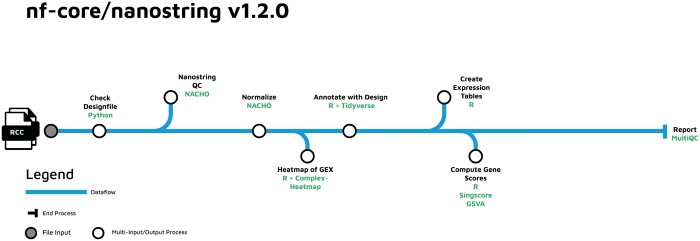
- The pipeline covers QC (via the R package NACHO, reporting Binding Density, Field of View, Positive Control Linearity, Limit of Detection and further manufacturer-defined criteria), normalization, annotation, heatmap generation, gene score computation, and a combined MultiQC HTML report.
- Normalization supports both the default geometric mean (GEO) normalization — stated to be equivalent to the NanoString nCounter analysis software output — and generalized linear model normalization, with housekeeping and non-housekeeping results both produced automatically.
- Gene scores can be computed from a user-supplied YAML gene set file using PLAGE, GSVA, SINGSCORE, SAMS, SSGSEA "as well as several other methodologies."
- The pipeline is stated to handle "thousands of samples simultaneously" and targets the NanoString nCounter platform's capacity of up to ∼800 genes.
Methods
- Design: a workflow implemented in the Nextflow workflow language using the community-curated nf-core template (nf-core tools 2.10), with individual steps packaged as Docker and Singularity containers via Biocontainers.
- Input: a comma-separated sample sheet requiring the location of RCC files produced by the NanoString nCounter instrument and a sample identifier, with optional user-supplied metadata (values may be set to NA, in which case samples are excluded from analyses requiring that metadata).
- Analysis components: QC via NACHO, normalization via NACHO's implementation of GEO and generalized linear model methods, annotation of the normalized expression matrix with design metadata, heatmap generation (tidyverse, ggplot2, ComplexHeatmap), optional gene scoring, and aggregation into a MultiQC report; outputs are formatted for downstream use such as nf-core/differentialabundance without reformatting.
Limitations
- The paper states no formal limitations section; it notes future directions including analysis of GeoMx data, gene score computation within the pipeline (listed as future in the Introduction though described as available in Section 3.6), integration of improved normalization methods for cases with technical replicates (Molania et al. 2019), and more advanced differential gene expression analyses.
- Evident from the text: no benchmarking, accuracy comparison, or performance evaluation against nSolver, NACHO, or other pipelines is reported, and no quantitative results (e.g., runtime, sample counts tested, concordance metrics) are presented — the paper is a software description rather than an empirical evaluation.
- Evident from the text: the pipeline depends on third-party implementations (NACHO for QC and normalization), so its analytical scope is bounded by those packages.
Model-written summary. Check it against the paper before relying on it.
Integrity signals
Registry
Cites
Statistics
Figures
Verification
Claims the paper makes
0 Valid · 1 Not valid · 10 Not checked · 16 Own results and interpretations
A result the paper states — it cites no source for it, so there is none to check. The quote shows it is in the paper.
In the paper
“By utilizing the GEO normalization, the normalized data is equivalent to output of the Nanostring nCounter analysis software.”
§ nf-core/nanostring: a pipeline for reproducible NanoString nCounter analysis > 3 Results > 3.3 Normalize
plain- Asserted: passes — The authors put it forward as true.
- Checkable: passes — It can be checked against evidence.
- Load-bearing: passes — The paper’s conclusions depend on it.
- Based: unclear — It is unclear why the paper says it holds.
A result the paper states — it cites no source for it, so there is none to check. The quote shows it is in the paper.
In the paper
“Furthermore, users receive both housekeeping normalized and nonhousekeeping results automatically.”
§ nf-core/nanostring: a pipeline for reproducible NanoString nCounter analysis > 3 Results > 3.3 Normalize
plainstates a cause- Asserted: passes — The authors put it forward as true.
- Checkable: passes — It can be checked against evidence.
- Load-bearing: unclear — It is unclear whether the paper’s conclusions depend on it.
- Based: passes — The paper gives a reason why it holds.
In the paper
“The pipeline ultimately creates expression and normalized expression tables which can e.g. be used to perform differential gene expression analysis using other pipelines such as nf-core/differentialabundance (Manning et al. 2024) without a requirement to perform reformatting of the data tables.”
§ nf-core/nanostring: a pipeline for reproducible NanoString nCounter analysis > 3 Results > 3.1 Design file
What the sources say
- Not matchedcites Manning et al. 2024
An author–year citation the paper’s reference list doesn’t settle. We don’t search these by name.
plainstates a cause- Asserted: passes — The authors put it forward as true.
- Checkable: passes — It can be checked against evidence.
- Load-bearing: passes — The paper’s conclusions depend on it.
- Based: passes — The paper gives a reason why it holds.
- Not matched
A result the paper states — it cites no source for it, so there is none to check. The quote shows it is in the paper.
In the paper
“To facilitate an easy exploration and interpretation of a NanoString experiment results, the pipeline combines the output information of various steps to a comprehensive MultiQC HTML report.”
- Also stated in: § 3.7 Reporting · plain
“As such the report provides a one-stop shop to explore the outcome of any NanoString nCounter analysis, without having to investigate multiple output files for a basic assessment.”
§ nf-core/nanostring: a pipeline for reproducible NanoString nCounter analysis > 3 Results > 3.7 Reporting
plainstates a cause- Asserted: passes — The authors put it forward as true.
- Checkable: passes — It can be checked against evidence.
- Load-bearing: passes — The paper’s conclusions depend on it.
- Based: passes — The paper gives a reason why it holds.
- Also stated in: § 3.7 Reporting · plain
A statement the paper makes itself — it cites no source for it, so there is none to check. The quote shows it is in the paper.
In the paper
“there is no portable and user-friendly workflow available that can be used to perform reproducible analysis of multiple samples simultaneously in a scalable fashion on different computing infrastructures.”
§ nf-core/nanostring: a pipeline for reproducible NanoString nCounter analysis > Abstract > Motivation
plain- Asserted: passes — The authors put it forward as true.
- Checkable: passes — It can be checked against evidence.
- Load-bearing: passes — The paper’s conclusions depend on it.
- Based: unclear — It is unclear why the paper says it holds.
10 references still to check
A free account verifies the references that are still open.
- It may state two separate claims as one. 16
- Probably not a substantial claim. 9
- The quote only partly states this claim. 1
Self-check
Percentages, sums and reported differences re-computed from the paper’s own numbers.
Each contradiction between two passages listed here was confirmed by an independent check.
Rated minor: it would not touch a result — a value no result rests on, a p-value that stays on the same side of the significance level, or a conflict that is clerical, resolved elsewhere in the paper, or outside its own findings.
In the paper
§ nf-core/nanostring: a pipeline for reproducible NanoString nCounter analysis > 1 Introduction
“Future developments will incorporate additional possibilities such as the analysis of GeoMx® data and gene score computation within the pipeline.”
§ nf-core/nanostring: a pipeline for reproducible NanoString nCounter analysis > 3 Results > 3.6 Gene scores
“Users can compute gene scores inside the pipeline by supplying a custom YAML formatted description file with the desired set(s) of genes and choosing one of the available methods for computing such gene scores.”
Citations
Cites
Wickham, H., Averick, M., Bryan, J., Chang, W., McGowan, L., François, R., Grolemund, G., Hayes, A., Henry, L., Hester, J., et al. (2019) · Journal of Open Source Software · doi:10.21105/joss.01686 · Cited by 22,138
GSVA: gene set variation analysis for microarray and RNA-Seq data
Hänzelmann, S., Castelo, R., & Guinney, J. (2013) · BMC Bioinformatics · doi:10.1186/1471-2105-14-7 · Cited by 15,440
In silico prediction of protein-protein interactions in human macrophages
Souiai, O., Guerfali, F., Ben Miled, S., Brun, C., & Benkahla, A. (2014) · BMC Research Notes · doi:10.1186/1756-0500-7-157 · Cited by 10,803
Significance analysis of microarrays applied to the ionizing radiation response
Tusher, V. G., Tibshirani, R., & Chu, G. (2001) · Proceedings of the National Academy of Sciences · doi:10.1073/pnas.091062498 · Cited by 10,568
MultiQC: summarize analysis results for multiple tools and samples in a single report
Ewels, P., Magnusson, M., Lundin, S., & Käller, M. (2016) · Bioinformatics · doi:10.1093/bioinformatics/btw354 · Cited by 10,143
Complex heatmaps reveal patterns and correlations in multidimensional genomic data
Gu, Z., Eils, R., & Schlesner, M. (2016) · Bioinformatics · doi:10.1093/bioinformatics/btw313 · Cited by 10,034
Wickham, H. (2011) · WIREs Computational Statistics · doi:10.1002/wics.147 · Cited by 4,304
The nf-core framework for community-curated bioinformatics pipelines
Ewels, P. A., Peltzer, A., Fillinger, S., Patel, H., Alneberg, J., Wilm, A., Garcia, M. U., Di Tommaso, P., & Nahnsen, S. (2020) · Nature Biotechnology · doi:10.1038/s41587-020-0439-x · Cited by 4,050
Self-citationNextflow enables reproducible computational workflows
Di Tommaso, P., Chatzou, M., Floden, E. W., Barja, P. P., Palumbo, E., & Notredame, C. (2017) · Nature Biotechnology · doi:10.1038/nbt.3820 · Cited by 4,001
BioContainers: an open-source and community-driven framework for software standardization
da Veiga Leprevost, F., Grüning, B. A., Alves Aflitos, S., Röst, H. L., Uszkoreit, J., Barsnes, H., Vaudel, M., Moreno, P., Gatto, L., Weber, J., et al. (2017) · Bioinformatics · doi:10.1093/bioinformatics/btx192 · Cited by 792
Cited by
Targeted degradation of CDK9 potently disrupts the MYC-regulated network
Toure, M. A., Motoyama, K., Xiang, Y., Urgiles, J., Kabinger, F., Koglin, A.-S., Iyer, R. S., Gagnon, K., Kumar, A., Ojeda, S., et al. (2025) · Cell chemical biology · doi:10.1016/j.chembiol.2025.03.001 · Cited by 24
GUANIN: an all-in-one GUi-driven analyzer for NanoString interactive normalization
Montoto-Louzao, J., Gómez‐Carballa, A., Bello, X., Pardo‐Seco, J., Camino‐Mera, A., Viz-Lasheras, S., Martín, M. J., Martinón‐Torres, F., & Salas, A. (2024) · Bioinformatics · doi:10.1093/bioinformatics/btae462 · Cited by 2
Gilchrist, R. J., Humphreys, D. T., Heitmann, S., Hill, A. P., Burton, F. L., McClure, J. D., Vandenberg, J. I., Smith, G. L., & Myles, R. C. (2026) · Cardiovascular Research · doi:10.1093/cvr/cvag209 · Cited by 1
Klar, N. J., Goldberg, J. D., Tyagi, A., Leal, A., Hochman, T., Barbury, B., Darvishian, F., Kwa, M., Meyers, M., Novik, Y., et al. (2026) · Research Square · doi:10.21203/rs.3.rs-11146137/v1
Wang, H., Zhu, Y. L., Fang, M., Zhang, X., Peng, S., Liang, H., Dong, D., Li, L., & Wang, K. (2026) · Molecular Cancer · doi:10.1186/s12943-026-02740-4
Metadata
- Authors
- Peltzer, A., Mohr, C., Stadermann, K. B., Zwick, M., & Schmid, R.
- Affiliations
- Boehringer Ingelheim (Germany) (DE)
- Corresponding author
- Peltzer, Alexander
- Venue
- Bioinformatics
- Publisher
- Oxford University Press (OUP)
- Published
- 2024-01-01
- Volume
- 40
- Issue
- 1
- Pages
- btae019
- ISSN
- 1367-4803 (ISSN-L)
- 1367-4811
- PMC
- PMC10805338
- OpenAlex
- W4390795866
- Cited by
- 5
- References
- 16
- Citations by year
- 2026: 3 · 2025: 1 · 2024: 1
- FWCI
- 0.60
- Type
- journal article
- Language
- en
- Open access
- gold
- doi.org
- Licence
- Locations
- Bioinformatics (publishedVersion, cc-by)
- PubMed Central (publishedVersion, cc-by)
- PubMed (publishedVersion)
- Funders
- Boehringer Ingelheim Pharma GmbH & Co
- Topics
- Social Sciences › Decision Sciences › Information Systems and Management › Scientific Computing and Data Management
- Life Sciences › Biochemistry, Genetics and Molecular Biology › Molecular Biology › Genomics and Phylogenetic Studies
- Life Sciences › Biochemistry, Genetics and Molecular Biology › Molecular Biology › Gene expression and cancer classification
- Keywords
- NanoString nCounter, bioinformatics pipeline, reproducible analysis, Nextflow, quality control, differential gene expression, metadata annotation, containerization
- MeSH terms
- Cloud Computing, Language, Quality Control, Software, Workflow
About these checks
Registry, retraction, Cites and statistics results are computed, not judged, with one exception: a printed reference that no index lists is read once by a model before it counts as a citation error. Claims are extracted by a model and kept only when their quote appears verbatim in the text; each cited source is then checked, with a model’s help, for whether it says what the claim relies on. Those verdicts can be wrong — read the claim’s quote and the cited source before relying on one.
A language model drew the claims from the paper on 2026-11-23, under version 3 of the claim definition (model deepseek-v4.1-flash, prompt extract-v3).
A second model labelled each claim on 2026-11-23 (model jev-1.13-20260917, definition revision gold-guideline-v0.2).
Statistics and arithmetic are recomputed, not judged.
Confidence bands are shown only for fields calibrated on our annotated test set. None is calibrated yet, so no band is shown.
What counts as a claim ›How we measure confidence ›How we check this ›
Are you an author, or do you see a problem with this page? Request a review
Data sources
Bibliographic data: Semantic Scholar, OpenAlex, Crossref.
Contains information from the Semantic Scholar Academic Graph Datasets, made available under the ODC Attribution License (ODC-BY 1.0).
Semantic Scholar’s data is described in: Kinney, R., et al. (2023). The Semantic Scholar Open Data Platform. arXiv:2301.10140.
