

The DOI matches its Crossref record; 46 of the 46 references it cites were found in a registry or an index.
Simple controls exceed best deep learning algorithms and reveal foundation model effectiveness for predicting genetic perturbations
Open accessPublished version of a preprint
Abstract
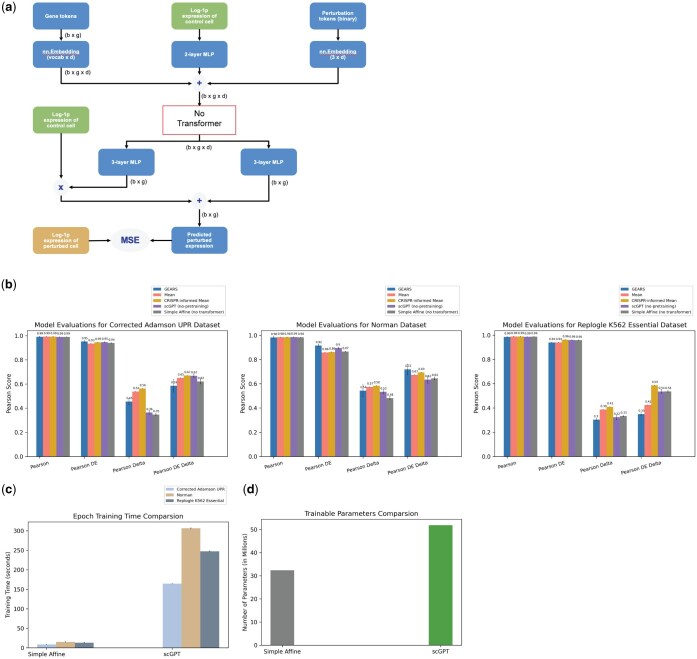
Motivation: Modeling genetic perturbations and their effect on the transcriptome is a key area of pharmaceutical research. Due to the complexity of the transcriptome, there has been much excitement and development in deep learning (DL) because of its ability to model complex relationships. In particular, the transformer-based foundation model paradigm emerged as the gold-standard of predicting post-perturbation responses. However, understanding these increasingly complex models and evaluating their practical utility is lacking, along with simple but appropriate benchmarks to compare predictive methods. Results: Here, we present a simple baseline method that outperforms both state of the art (SOTA) in DL and other proposed simpler neural architectures, setting a necessary benchmark to evaluate in the field of post-perturbation prediction. We also elucidate the utility of foundation models for the task of post-perturbation prediction via generalizable fine-tuning experiments that can be translated to different applications of transformer-based foundation models to tasks of interest. Furthermore, we provide a corrected version of a popular dataset used for benchmarking perturbation prediction models. Our hope is that this work will properly contextualize further development of DL models in the perturbation space with necessary control procedures. Availability and implementation: All source code is available at: https://github.com/pfizer-opensource/perturb_seq. The DOI is 10.5281/zenodo.15352937.
Overview
The claims and statistics of this paper haven’t been checked yet.
Run the check — free, no account needed. It reads the open-access text and checks the sources it cites.
Integrity signals
Registry
Cites
Statistics
Figures


Verification
Claims the paper makes
The claims and statistics of this paper haven’t been checked yet.
Run the check — free, no account needed. It reads the open-access text and checks the sources it cites.
Claims other papers make about this one
Each is checked against this paper’s own text: does it say what the citing paper says it does?
The cited source says what the claim attributes to it.
In the citing paper
“Since the release of our paper as a preprint, several other benchmarks15,16,22–27 were released that also show that deep learning models struggle to outperform simple baselines.”
From Deep-learning-based gene perturbation effect prediction does not yet outperform simple linear baselines (2025) · cites this paper as [27]
Experimental — accuracy not yet measured
Self-check
Percentages, sums and reported differences re-computed from the paper’s own numbers.
The self-check needs the paper’s full text.
Citations
Cites
Evolutionary-scale prediction of atomic level protein structure with a language model
Lin, Z., Akin, H., Rao, R., Hie, B., Zhu, Z., Lu, W., Smetanin, N., Verkuil, R., Kabeli, O., Shmueli, Y., et al. (2022) · doi:10.1101/2022.07.20.500902 · Cited by 5,990
Genome-Scale CRISPR-Mediated Control of Gene Repression and Activation
Gilbert, L. A., Horlbeck, M. A., Adamson, B., Villalta, J. E., Chen, Y., Whitehead, E. H., Guimaraes, C., Panning, B., Ploegh, H. L., Bassik, M. C., et al. (2014) · Cell · doi:10.1016/j.cell.2014.09.029 · Cited by 2,728
Dixit, A., Parnas, O., Li, B., Chen, J., Fulco, C. P., Jerby-Arnon, L., Marjanovic, N. D., Dionne, D., Burks, T., Raychowdhury, R., et al. (2016) · Cell · doi:10.1016/j.cell.2016.11.038 · Cited by 1,863
scGPT: Towards Building a Foundation Model for Single-Cell Multi-omics Using Generative AI
Cui, H., Wang, C., Maan, H., Pang, K., Luo, F., & Wang, B. (2023) · doi:10.1101/2023.04.30.538439 · Cited by 1,694
Effective gene expression prediction from sequence by integrating long-range interactions
Avsec, Ž., Agarwal, V., Visentin, D., Ledsam, J. R., Grabska-Barwinska, A., Taylor, K. R., Assael, Y., Jumper, J., Kohli, P., & Kelley, D. R. (2021) · Nature Methods · doi:10.1038/s41592-021-01252-x · Cited by 1,326
CRISPR interference (CRISPRi) for sequence-specific control of gene expression
Larson, M. H., Gilbert, L. A., Wang, X., Lim, W. A., Weissman, J. S., & Qi, L. S. (2013) · Nature Protocols · doi:10.1038/nprot.2013.132 · Cited by 1,212
Adamson, B., Norman, T. M., Jost, M., Cho, M. Y., Nuñez, J. K., Chen, Y., Villalta, J. E., Gilbert, L. A., Horlbeck, M. A., Hein, M. Y., et al. (2016) · Cell · doi:10.1016/j.cell.2016.11.048 · Cited by 1,193
Transfer learning enables predictions in network biology
Theodoris, C. V., Xiao, L., Chopra, A., Chaffin, M. D., Al Sayed, Z. R., Hill, M. C., Mantineo, H., Brydon, E. M., Zeng, Z., Liu, X. S., et al. (2023) · Nature · doi:10.1038/s41586-023-06139-9 · Cited by 1,193
Mapping information-rich genotype-phenotype landscapes with genome-scale Perturb-seq
Replogle, J. M., Saunders, R. A., Pogson, A. N., Hussmann, J. A., Lenail, A., Guna, A., Mascibroda, L., Wagner, E. J., Adelman, K., Lithwick-Yanai, G., et al. (2022) · Cell · doi:10.1016/j.cell.2022.05.013 · Cited by 795
Harnessing the power of llms in practice: a survey on chatGPT and beyond
Yang, J., Jin, H., Tang, R., Han, X., Feng, Q., Jiang, H., Zhong, S., Yin, B., & Hu, X. (2024) · ACM Transactions on Knowledge Discovery from Data · doi:10.1145/3649506 · Cited by 644
Research works printed but not linked: 1
- Bian, 2024, Lecture Notes in Computer Science, Lecture Notes in Computer Science, 479
Cited by
Ahlmann-Eltze, C., Huber, W., & Anders, S. (2025) · Nature Methods · doi:10.1038/s41592-025-02772-6 · Cited by 238
TxPert: using multiple knowledge graphs for prediction of transcriptomic perturbation effects
Wenkel, F., Tu, W., Masschelein, C., Shirzad, H., Hodgson, L. M., Bendidi, I., Eastwood, C., Whitfield, S. T., Russell, C., Mesbahi, Y. E., et al. (2026) · Nature Biotechnology · doi:10.1038/s41587-026-03113-4 · Cited by 48
A comparison of computational methods for expression forecasting
Kernfeld, E. M., Yang, Y., Weinstock, J. S., Battle, A. J., & Cahan, P. (2025) · Genome biology · doi:10.1186/s13059-025-03840-y · Cited by 46
Yiu, T., Chen, B., Wang, H., Feng, G., Fu, Q.-Q., & Hu, H. (2025) · Journal of Translational Medicine · doi:10.1186/s12967-025-07091-0 · Cited by 38
A Systematic Comparison of Single-Cell Perturbation Response Prediction Models
Li, L., You, Y., Fu, Y., Liao, W., Fan, X., Lu, S., Cao, Y., Li, B., Ren, W., Kong, J., et al. (2024) · bioRxiv (Cold Spring Harbor Laboratory) · doi:10.1101/2024.12.23.630036 · Cited by 25
“In single-cell perturbation prediction tasks, baseline models provide reference performance levels that facilitate the evaluation of more expressive predictive models ( 28, 52–54 ).”
Metadata
- Authors
- Wong, D. R., Hill, A. S., & Moccia, R.
- Affiliations
- Pfizer (United States) (US)
- Corresponding author
- Wong, Daniel R
- Venue
- Bioinformatics
- Publisher
- Oxford University Press (OUP)
- Published
- 2025-05-23
- Volume
- 41
- Issue
- 6
- ISSN
- 1367-4803 (ISSN-L)
- 1367-4811
- PMC
- PMC12202205
- OpenAlex
- W4410689365
- Cited by
- 27
- References
- 40
- Citations by year
- 2026: 16 · 2025: 11
- FWCI
- 13.95
- Type
- journal article
- Language
- en
- Open access
- gold
- doi.org
- Licence
- Locations
- Bioinformatics (publishedVersion, cc-by)
- bioRxiv (Cold Spring Harbor Laboratory) (acceptedVersion, cc-by)
- PubMed Central (publishedVersion, cc-by)
- PubMed (publishedVersion)
- Funders
- Pfizer Inc
- Topics
- Life Sciences › Pharmacology, Toxicology and Pharmaceutics › Drug Discovery › Computational Drug Discovery Methods
- Life Sciences › Biochemistry, Genetics and Molecular Biology › Molecular Biology › Gene Regulatory Network Analysis
- Life Sciences › Biochemistry, Genetics and Molecular Biology › Molecular Biology › Bioinformatics and Genomic Networks
- Keywords
- transcriptomic response, control sequences, baseline model, benchmarking, fine-tuning, Perturb-seq, deep learning evaluation
- MeSH terms
- Deep Learning, Algorithms, Humans, Models, Genetic, Computational Biology, Transcriptome
About these checks
Registry, retraction, Cites and statistics results are computed, not judged, with one exception: a printed reference that no index lists is read once by a model before it counts as a citation error. Claims are extracted by a model and kept only when their quote appears verbatim in the text; each cited source is then checked, with a model’s help, for whether it says what the claim relies on. Those verdicts can be wrong — read the claim’s quote and the cited source before relying on one.
Statistics and arithmetic are recomputed, not judged.
Confidence bands are shown only for fields calibrated on our annotated test set. None is calibrated yet, so no band is shown.
What counts as a claim ›How we measure confidence ›How we check this ›
Are you an author, or do you see a problem with this page? Request a review
How to cite
Cite CoChat for the checks on this page, and the paper for its own findings.
- This page
- CoChat. (2026). Citation check: Simple controls exceed best deep learning algorithms and reveal foundation model effectiveness for predicting genetic perturbations. https://app.cochat.ai/papers/10.1093/bioinformatics/btaf317
- The paper
- Wong, D. R., Hill, A. S., & Moccia, R. (2025). Simple controls exceed best deep learning algorithms and reveal foundation model effectiveness for predicting genetic perturbations. Bioinformatics. https://doi.org/10.1093/bioinformatics/btaf317
Data sources
Bibliographic data: Semantic Scholar, OpenAlex, Crossref.
Contains information from the Semantic Scholar Academic Graph Datasets, made available under the ODC Attribution License (ODC-BY 1.0).
Semantic Scholar’s data is described in: Kinney, R., et al. (2023). The Semantic Scholar Open Data Platform. arXiv:2301.10140.
