

The DOI matches its Crossref record; 48 of the 48 references it cites were found in a registry or an index.
Robust network inference using response logic
Open accessPublished version of a preprint
Abstract
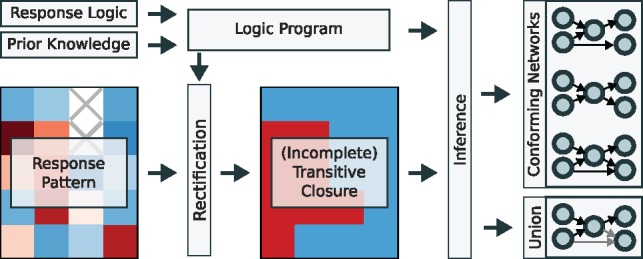
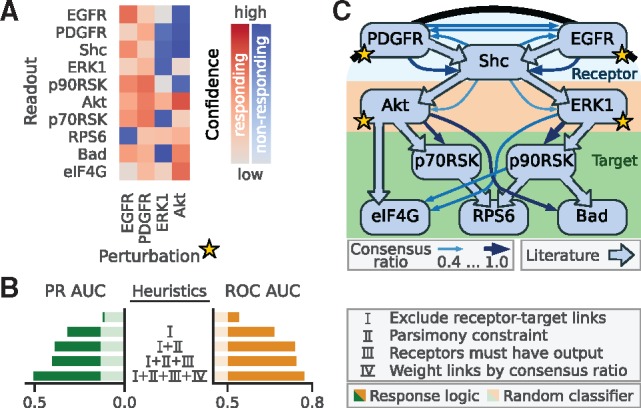
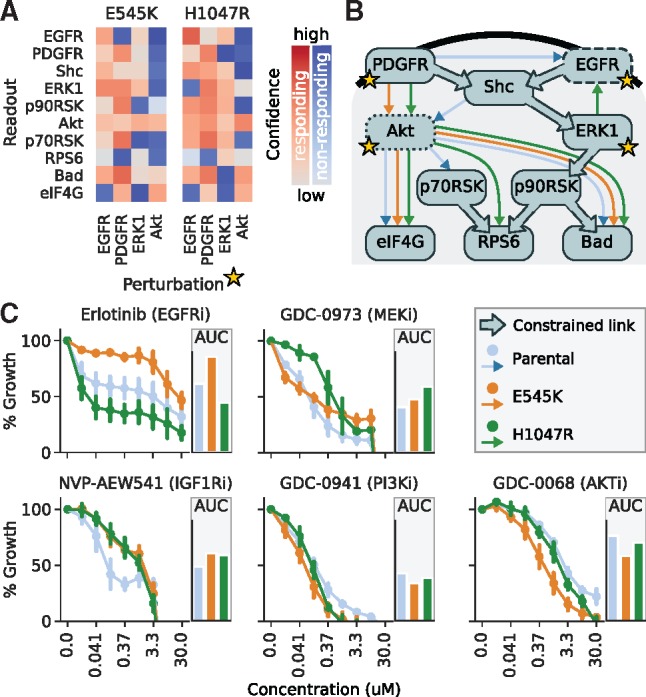
Motivation: A major challenge in molecular and cellular biology is to map out the regulatory networks of cells. As regulatory interactions can typically not be directly observed experimentally, various computational methods have been proposed to disentangling direct and indirect effects. Most of these rely on assumptions that are rarely met or cannot be adapted to a given context. Results: We present a network inference method that is based on a simple response logic with minimal presumptions. It requires that we can experimentally observe whether or not some of the system’s components respond to perturbations of some other components, and then identifies the directed networks that most accurately account for the observed propagation of the signal. To cope with the intractable number of possible networks, we developed a logic programming approach that can infer networks of hundreds of nodes, while being robust to noisy, heterogeneous or missing data. This allows to directly integrate prior network knowledge and additional constraints such as sparsity. We systematically benchmark our method on KEGG pathways, and show that it outperforms existing approaches in DREAM3 and DREAM4 challenges. Applied to a novel perturbation dataset on PI3K and MAPK pathways in isogenic models of a colon cancer cell line, it generates plausible network hypotheses that explain distinct sensitivities toward various targeted inhibitors due to different PI3K mutants. Availability and implementation: A Python/Answer Set Programming implementation can be accessed at github.com/GrossTor/response-logic. Data and analysis scripts are available at github.com/GrossTor/response-logic-projects. Supplementary information: Supplementary data are available at Bioinformatics online.
Overview
The claims and statistics of this paper haven’t been checked yet.
Free: it reads the open-access text and checks the first 5 claims that cite a source we can check. Create a free account to check every claim.
Integrity signals
Registry
Cites
Statistics
Figures
Verification
Claims the paper makes
The claims and statistics of this paper haven’t been checked yet.
Free: it reads the open-access text and checks the first 5 claims that cite a source we can check. Create a free account to check every claim.
Claims other papers make about this one
Each is checked against this paper’s own text: does it say what the citing paper says it does?
In the citing paper
“Directionality in regulatory network models cannot be inferred without interventional or time-series data10.”
From scPerturb: harmonized single-cell perturbation data (2024) · cites this paper as [10]
Self-check
Percentages, sums and reported differences re-computed from the paper’s own numbers.
The self-check needs the paper’s full text.
Citations
Cites
Investigating causal relations by econometric models and cross-spectral methods
Granger, C. W. J. (1969) · Econometrica · doi:10.2307/1912791 · Cited by 22,989
KEGG: new perspectives on genomes, pathways, diseases and drugs
Kanehisa, M., Furumichi, M., Tanabe, M., Sato, Y., & Morishima, K. (2017) · Nucleic Acids Research · doi:10.1093/nar/gkw1092 · Cited by 8,865
Exploring Network Structure, Dynamics, and Function Using NetworkX
Hagberg, A. A., Schult, D. A., & Swart, P. J. (2008) · Proceedings of the Python in Science Conference · doi:10.25080/tcwv9851 · Cited by 7,477 · cited 1×
“Additional functions were taken from the networkx package (Hagberg et al. , 2008).”
Detecting Causality in Complex Ecosystems
Sugihara, G., May, R., Ye, H., Hsieh, C.-H., Deyle, E., Fogarty, M., & Munch, S. (2012) · Science · doi:10.1126/science.1227079 · Cited by 2,539
Causal Protein-Signaling Networks Derived from Multiparameter Single-Cell Data
Sachs, K., Perez, O., Pe'er, D., Lauffenburger, D. A., & Nolan, G. P. (2005) · Science · doi:10.1126/science.1105809 · Cited by 1,708
Knowledge Representation, Reasoning and Declarative Problem Solving
Baral, C. (2003) · Cambridge University Press eBooks · doi:10.1017/cbo9780511543357 · Cited by 1,413
Reverse engineering of regulatory networks in human B cells
Basso, K., Margolin, A. A., Stolovitzky, G., Klein, U., Dalla-Favera, R., & Califano, A. (2005) · Nature Genetics · doi:10.1038/ng1532 · Cited by 1,404
Revealing strengths and weaknesses of methods for gene network inference
Marbach, D., Prill, R. J., Schaffter, T., Mattiussi, C., Floreano, D., & Stolovitzky, G. (2010) · Proceedings of the National Academy of Sciences · doi:10.1073/pnas.0913357107 · Cited by 752
The Transitive Reduction of a Directed Graph
Aho, A. V., Garey, M. R., & Ullman, J. D. (1972) · SIAM Journal on Computing · doi:10.1137/0201008 · Cited by 718
Negative feedback regulation of the ERK1/2 MAPK pathway
Lake, D., Corrêa, S. A. L., & Müller, J. (2016) · Cellular and Molecular Life Sciences · doi:10.1007/s00018-016-2297-8 · Cited by 565
Discovery of meaningful associations in genomic data using partial correlation coefficients
de la Fuente, A., Bing, N., Hoeschele, I., & Mendes, P. (2004) · Bioinformatics · doi:10.1093/bioinformatics/bth445 · Cited by 553
The Yeast Protein Interaction Network Evolves Rapidly and Contains Few Redundant Duplicate Genes
Wagner, A. (2001) · Molecular Biology and Evolution · doi:10.1093/oxfordjournals.molbev.a003913 · Cited by 521
Advantages and limitations of current network inference methods
De Smet, R., & Marchal, K. (2010) · Nature Reviews Microbiology · doi:10.1038/nrmicro2419 · Cited by 515
Potassco: The Potsdam Answer Set Solving Collection
Gebser, M., Kaufmann, B., Kaminski, R., Ostrowski, M., Schaub, T., & Schneider, M. (2011) · AI Communications · doi:10.3233/aic-2011-0491 · Cited by 456
Answer set programming and plan generation
Lifschitz, V. (2002) · Artificial Intelligence · doi:10.1016/s0004-3702(02)00186-8 · Cited by 442
Signaling via Shc family adapter proteins
Ravichandran, K. S. (2001) · Oncogene · doi:10.1038/sj.onc.1204776 · Cited by 423
Untangling the wires: A strategy to trace functional interactions in signaling and gene networks
Kholodenko, B. N., Kiyatkin, A., Bruggeman, F. J., Sontag, E., Westerhoff, H. V., & Hoek, J. B. (2002) · Proceedings of the National Academy of Sciences · doi:10.1073/pnas.192442699 · Cited by 422
A methodology for the structural and functional analysis of signaling and regulatory networks
Klamt, S., Saez-Rodriguez, J., Lindquist, J. A., Simeoni, L., & Gilles, E. D. (2006) · BMC Bioinformatics · doi:10.1186/1471-2105-7-56 · Cited by 395
STOLOVITZKY, G., MONROE, D., & CALIFANO, A. (2007) · Annals of the New York Academy of Sciences · doi:10.1196/annals.1407.021 · Cited by 377
Defining an essential transcription factor program for naïve pluripotency
Dunn, S.-J., Martello, G., Yordanov, B., Emmott, S., & Smith, A. G. (2014) · Science · doi:10.1126/science.1248882 · Cited by 370
Greenfield, A., Madar, A., Ostrer, H., & Bonneau, R. (2010) · PLoS ONE · doi:10.1371/journal.pone.0013397 · Cited by 255
Clingo = ASP + Control: Preliminary Report
Gebser, M., Kaminski, R., Kaufmann, B., & Schaub, T. (2014) · arXiv · doi:10.48550/arxiv.1405.3694 · Cited by 230
Lessons from the DREAM2 Challenges: A Community Effort to Assess Biological Network Inference
Stolovitzky, G., Prill, R. J., & Califano, A. (2009) · Annals of the New York Academy of Sciences · doi:10.1111/j.1749-6632.2009.04497.x · Cited by 196
Strong negative feedback from Erk to Raf confers robustness to MAPK signalling
Fritsche‐Guenther, R., Witzel, F., Sieber, A., Herr, R., Schmidt, N., Braun, S., Brummer, T., Sers, C., & Blüthgen, N. (2011) · Molecular Systems Biology · doi:10.1038/msb.2011.27 · Cited by 192
Self-citationPerturbation Biology: Inferring Signaling Networks in Cellular Systems
Molinelli, E. J., Korkut, A., Wang, W., Miller, M. L., Gauthier, N. P., Jing, X., Kaushik, P., He, Q., Mills, G., Solit, D. B., et al. (2013) · PLoS Computational Biology · doi:10.1371/journal.pcbi.1003290 · Cited by 187
Receptor Tyrosine Kinase Coactivation Networks in Cancer
Xu, A. M., & Huang, P. H. (2010) · Cancer Research · doi:10.1158/0008-5472.can-10-0163 · Cited by 173
Network quantification of EGFR signaling unveils potential for targeted combination therapy
Klinger, B., Sieber, A., Fritsche‐Guenther, R., Witzel, F., Berry, L., Schumacher, D., Yan, Y., Durek, P., Merchant, M. A., Schäfer, R., et al. (2013) · Molecular Systems Biology · doi:10.1038/msb.2013.29 · Cited by 158
Self-citationModular Response Analysis of Cellular Regulatory Networks
Bruggeman, F. J., Westerhoff, H. V., Hoek, J. B., & Kholodenko, B. Ν. (2002) · Journal of Theoretical Biology · doi:10.1006/jtbi.2002.3096 · Cited by 140
How to reconstruct a large genetic network from n gene perturbations in fewer than n2 easy steps
Wagner, A. (2001) · Bioinformatics · doi:10.1093/bioinformatics/17.12.1183 · Cited by 121
Modular Response Analysis of Cellular Regulatory Networks
Bruggeman, F. J. (2002) · Journal of Theoretical Biology · doi:10.1016/s0022-5193(02)93096-1 · Cited by 119
Yip, K. Y.-L., Alexander, R. P., Yan, K., & Gerstein, M. (2010) · PLoS ONE · doi:10.1371/journal.pone.0008121 · Cited by 105
Estimation of interrelation between chaotic observables
Čenys, A., Lasienė, G., & Pyragas, K. (1991) · Physica D Nonlinear Phenomena · doi:10.1016/0167-2789(91)90130-2 · Cited by 67
A method to identify and analyze biological programs through automated reasoning
Yordanov, B., Dunn, S.-J., Kugler, H., Smith, A. G., Martello, G., & Emmott, S. (2016) · npj Systems Biology and Applications · doi:10.1038/npjsba.2016.10 · Cited by 65
Network approaches and applications in biology
Ideker, T., & Nussinov, R. (2017) · PLoS Computational Biology · doi:10.1371/journal.pcbi.1005771 · Cited by 48
Using Hybrid Concurrent Constraint Programming to Model Dynamic Biological Systems
Bockmayr, A., & Courtois, A. (2002) · Lecture notes in computer science · doi:10.1007/3-540-45619-8_7 · Cited by 44
Petri Nets with Fuzzy Logic (PNFL): Reverse Engineering and Parametrization
Küffner, R., Petri, T., Windhager, L., & Zimmer, R. (2010) · PLoS ONE · doi:10.1371/journal.pone.0012807 · Cited by 43
Learning Boolean logic models of signaling networks with ASP
Videla, S., Guziołowski, C., Eduati, F., Thiele, S., Gebser, M., Nicolas, J., Sáez-Rodríguez, J., Schaub, T. H., & Siegel, A. (2014) · Theoretical Computer Science · doi:10.1016/j.tcs.2014.06.022 · Cited by 37
Razzaq, M., Paulevé, L., Siegel, A., et al. (2018) · PLoS Computational Biology · doi:10.1371/journal.pcbi.1006538 · Cited by 37
Modelling signalling networks from perturbation data
Dorel, M., Klinger, B., Groß, T., Sieber, A., Prahallad, A., Bosdriesz, E., Wessels, L. F. A., & Blüthgen, N. (2018) · Bioinformatics · doi:10.1093/bioinformatics/bty473 · Cited by 30
Self-citationReconstruction of gene networks using prior knowledge
Ghanbari, M., Lasserre, J., & Vingron, M. (2015) · BMC Systems Biology · doi:10.1186/s12918-015-0233-4 · Cited by 27
Reverse-engineering biological networks from large data setsPreprint
Natale, J. L., Hofmann, D., Hernández, D. G., & Nemenman, I. M. (2017) · bioRxiv (Cold Spring Harbor Laboratory) · doi:10.1101/142034 · Cited by 20
Bioinformatics and Constraints
Backofen, R., & Gilbert, D. (2001) · Constraints · doi:10.1023/a:1011477420926 · Cited by 18
DREAMTools: a Python package for scoring collaborative challenges
Cokelaer, T., Bansal, M., Bare, C., Bilal, E., Bot, B. M., Neto, E. C., Eduati, F., de la Fuente, A., Gönen, M., Hill, S. M., et al. (2016) · F1000Research · doi:10.12688/f1000research.7118.2 · Cited by 18
DREAMTools: a Python package for scoring collaborative challenges
Cokelaer, T., Bansal, M., Bare, C., Bilal, E., Bot, B. M., Neto, E. C., Eduati, F., Gönen, M., Hill, S. M., Hoff, B., et al. (2015) · F1000Research · doi:10.12688/f1000research.7118.1 · Cited by 18
Enriching for direct regulatory targets in perturbed gene-expression profiles
Tringe, S. G., Wagner, A., & Ruby, S. W. (2004) · Genome biology · doi:10.1186/gb-2004-5-4-r29 · Cited by 12
Designing miRNA-Based Synthetic Cell Classifier Circuits Using Answer Set Programming
Becker, K., Klarner, H., Nowicka, M., & Siebert, H. (2018) · Frontiers in Bioengineering and Biotechnology · doi:10.3389/fbioe.2018.00070 · Cited by 10
The gene regulatory network of mESC differentiation: a benchmark for reverse engineering methods
Meisig, J., & Blüthgen, N. (2018) · Philosophical Transactions of the Royal Society B Biological Sciences · doi:10.1098/rstb.2017.0222 · Cited by 6
Self-citationReverse-engineering biological networks from large data setsPreprint
Natale, J. L., Hofmann, D., Hernández, D. G., et al. (2017) · arXiv (Cornell University) · doi:10.48550/arxiv.1705.06370 · Cited by 1
Research works printed but not linked: 2
- Bockmayr, 2002, Logic Programming, Lecture Notes in Computer Science, 85
- Hagberg, 2008, Proceedings of the 7th Python in Science Conference, Pasadena, CA, 11
Cited by
scPerturb: harmonized single-cell perturbation data
Peidli, S., Green, T. D., Shen, C., Gross, T., Min, J., Garda, S., Yuan, B., Schumacher, L. J., Taylor-King, J. P., Marks, D. S., et al. (2024) · Nature Methods · doi:10.1038/s41592-023-02144-y · Cited by 194
Self-citationIdentifiability and experimental design in perturbation studies
Gross, T., & Blüthgen, N. (2020) · Bioinformatics · doi:10.1093/bioinformatics/btaa404 · Cited by 11
Self-citation
Metadata
- Authors
- Gross, T., Wongchenko, M. J., Yan, Y., & Blüthgen, N.
- Affiliations
- Humboldt-Universität zu Berlin (DE)
- Genentech (US)
- Corresponding author
- Blüthgen, Nils
- Venue
- Bioinformatics
- Publisher
- Oxford University Press (OUP)
- Published
- 2019-07
- Volume
- 35
- Issue
- 14
- Pages
- i634-i642
- ISSN
- 1367-4803 (ISSN-L)
- 1367-4811
- PMC
- PMC6612863
- OpenAlex
- W2953607540
- Cited by
- 7
- References
- 48
- Citations by year
- 2024: 2 · 2022: 1 · 2021: 3 · 2020: 1
- FWCI
- 0.41
- Type
- journal article
- Language
- en
- Open access
- hybrid
- doi.org
- Licence
- Locations
- Bioinformatics (publishedVersion, cc-by-nc)
- bioRxiv (Cold Spring Harbor Laboratory) (acceptedVersion, cc-by-nc-nd)
- Europe PMC (PubMed Central) (publishedVersion, cc-by-nc)
- PubMed Central (publishedVersion, cc-by-nc)
- PubMed (publishedVersion)
- edoc Publication server (Humboldt University of Berlin) (submittedVersion, cc-by-nc)
- edoc Publication server (Humboldt University of Berlin)
- Funders
- Berlin Institute of Health
- German Research Foundation (GRK1772, RTG2424)
- Topics
- Life Sciences › Biochemistry, Genetics and Molecular Biology › Molecular Biology › Gene Regulatory Network Analysis
- Life Sciences › Biochemistry, Genetics and Molecular Biology › Molecular Biology › Bioinformatics and Genomic Networks
- Life Sciences › Biochemistry, Genetics and Molecular Biology › Molecular Biology › Microbial Metabolic Engineering and Bioproduction
- Keywords
- network inference, gene regulatory networks, signal propagation, logic programming, answer set programming, robust inference, sparsity constraints, PI3K signaling, MAPK signaling, colon cancer cell lines, targeted inhibitors, DREAM challenge
- MeSH terms
- Algorithms, Logic, Computational Biology
About these checks
Registry, retraction, Cites and statistics results are computed, not judged, with one exception: a printed reference that no index lists is read once by a model before it counts as a citation error. Claims are extracted by a model and kept only when their quote appears verbatim in the text; each cited source is then checked, with a model’s help, for whether it says what the claim relies on. Those verdicts can be wrong — read the claim’s quote and the cited source before relying on one.
Statistics and arithmetic are recomputed, not judged.
Confidence bands are shown only for fields calibrated on our annotated test set. None is calibrated yet, so no band is shown.
What counts as a claim ›How we measure confidence ›How we check this ›
Are you an author, or do you see a problem with this page? Request a review
Data sources
Bibliographic data: Semantic Scholar, OpenAlex, Crossref.
Contains information from the Semantic Scholar Academic Graph Datasets, made available under the ODC Attribution License (ODC-BY 1.0).
Semantic Scholar’s data is described in: Kinney, R., et al. (2023). The Semantic Scholar Open Data Platform. arXiv:2301.10140.
