

A defect of sphingolipid metabolism modifies the properties of normal appearing white matter in multiple sclerosis
Open accessThe DOI matches its Crossref record; 45 of the 46 references it cites were found in a registry or an index.
Abstract
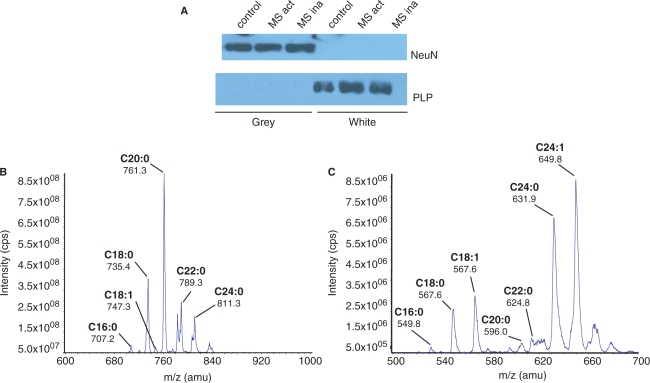
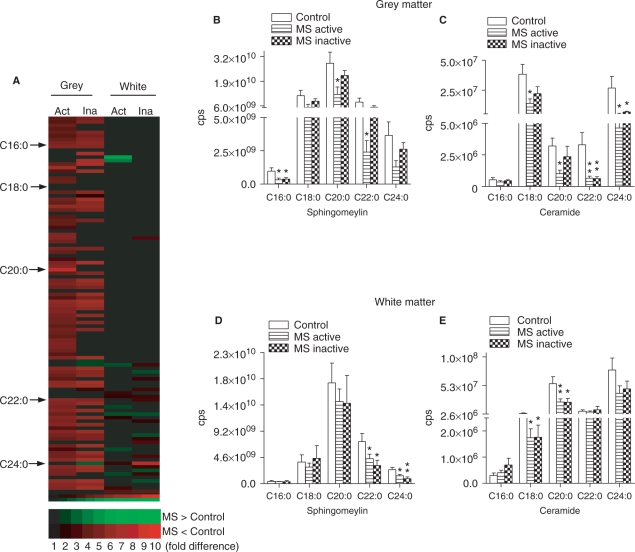
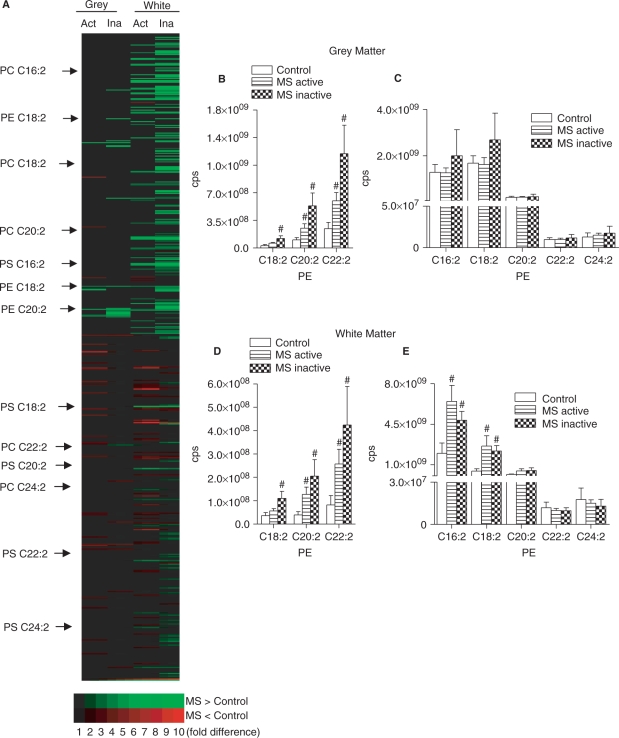
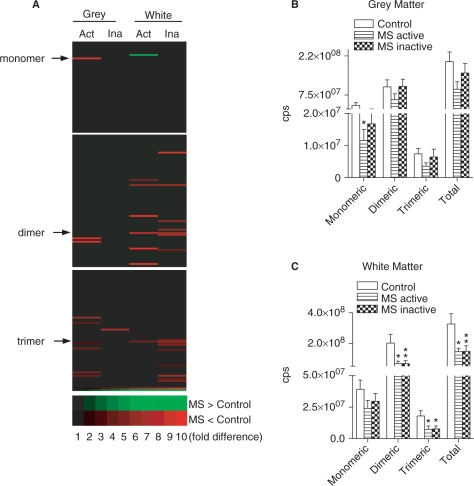
Maintaining the appropriate complement and content of lipids in cellular membranes is critical for normal neural function. Accumulating evidence suggests that even subtle perturbations in the lipid content of neurons and myelin can disrupt their function and may contribute to myelin and axonal degradation. In this study, we determined the composition and quantified the content of lipids and sterols in normal appearing white matter (NAWM) and normal appearing grey matter (NAGM) from control and multiple sclerosis brain tissues by electrospray ionization tandem mass spectrometry. Our results suggest that in active-multiple sclerosis, there is a shift in the lipid composition of NAWM and NAGM to a higher phospholipid and lower sphingolipid content. We found that this disturbance in lipid composition was reduced in NAGM but not in NAWM of inactive-multiple sclerosis. The pattern of disturbance in lipid composition suggests a metabolic defect that causes sphingolipids to be shuttled to phospholipid production. Modelling the biophysical consequence of this change in lipid composition of NAWM indicated an increase in the repulsive force between opposing bilayers that could explain decompaction and disruption of myelin structure.
Overview
The claims and statistics of this paper haven’t been checked yet.
Free: it reads the open-access text and checks the first 5 claims that cite a source we can check. Create a free account to check every claim.
Integrity signals
Registry
Cites
Statistics
Figures
Verification
Claims the paper makes
The claims and statistics of this paper haven’t been checked yet.
Free: it reads the open-access text and checks the first 5 claims that cite a source we can check. Create a free account to check every claim.
Claims other papers make about this one
Each is checked against this paper’s own text: does it say what the citing paper says it does?
The cited source says what the claim attributes to it.
In the citing paper
“Its composition can vary between tissue types (González de San Román et al., 2018), species (Gopalakrishnan et al., 2013) and in pathologies (Wheeler et al., 2008)”
From Can MRI measure myelin? Systematic review, qualitative assessment, and meta-analysis of studies validating microstructural imaging with myelin histology (2021) · cites this paper as Wheeler et al., 2008
Self-check
Percentages, sums and reported differences re-computed from the paper’s own numbers.
The self-check needs the paper’s full text.
Citations
Cites
Derjaguin, B. V. (1941) · Cited by 5,490
The Immune Modulator FTY720 Targets Sphingosine 1-Phosphate Receptors
Brinkmann, V., Davis, M. D., Heise, C. E., Albert, R., Cottens, S., Hof, R., Bruns, C., Prieschl, E., Baumruker, T., Hiestand, P., et al. (2002) · Journal of Biological Chemistry · doi:10.1074/jbc.c200176200 · Cited by 1,504 · cited 2×
“This orally available S1P-receptor modulator has shown striking efficacy in experimental allergic encephalomyelitis models of multiple sclerosis (Brinkmann et al., 2002; Fujino et al., 2003; Webb et al., 2004 Kataoka et al., 2005; Balatoni et al., 2007) and recent results from phase II trials with…”
BackgroundTheory of the Stability of Lyophobic Colloids.
Verwey, E. J. W. (1947) · The Journal of Physical and Colloid Chemistry · doi:10.1021/j150453a001 · Cited by 1,367
Oral Fingolimod (FTY720) for Relapsing Multiple Sclerosis
Kappos, L., Antel, J., Comi, G., Montalban, X., O'Connor, P., Polman, C. H., Haas, T., Korn, A. A., Karlsson, G., & Radue, E. W. (2006) · New England Journal of Medicine · doi:10.1056/nejmoa052643 · Cited by 1,054 · cited 2×
“, 2007) and recent results from phase II trials with RRMS patients are promising (Kappos et al., 2006).”
BackgroundResultIdentification of autoantibodies associated with myelin damage in multiple sclerosis
Genain, C. P., Cannella, B., Hauser, S. L., & Raine, C. S. (1999) · Nature Medicine · doi:10.1038/5532 · Cited by 892 · cited 1×
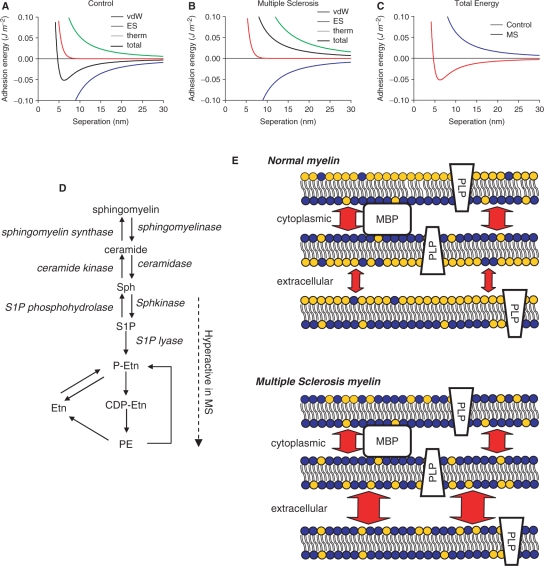
“Thus, a change in repulsive energy is more likely to disrupt adhesion at the intraperiod line, consistent with reports that this interface is more often disrupted in demyelinating disease (Bornstein and Raines, 1976; Genain et al., 1999).”
ResultPhysical properties of the fluid lipid-bilayer component of cell membranes: a perspective
Bloom, M., Evans, E., & Mouritsen, O. G. (1991) · Quarterly Reviews of Biophysics · doi:10.1017/s0033583500003735 · Cited by 872 · cited 1×
“6C) (Servuss et al., 1976; Evans and Parsegian, 1986; Bloom et al., 1991).”
Sphingosine kinases, sphingosine 1-phosphate, apoptosis and diseases
Hait, N. C., Oskeritzian, C. A., Paugh, S. W., Milstien, S., & Spiegel, S. (2006) · Biochimica et Biophysica Acta (BBA) - Biomembranes · doi:10.1016/j.bbamem.2006.08.007 · Cited by 478 · cited 1×
“S1P is a potent endogenous lipid mediator involved in cell survival, proliferation and cell–cell interactions (see Hait et al., 2006 for a review).”
BackgroundFoster, C. A., Howard, L. M., Schweitzer, A., Persohn, E., Hiestand, P. C., Balatoni, B., Reuschel, R., Beerli, C., Schwartz, M., & Billich, A. (2007) · The Journal of Pharmacology and Experimental Therapeutics · doi:10.1124/jpet.107.127183 · Cited by 322 · cited 1×
“These results are consistent with evidence that the bioactive metabolite FTY720-P widely distributes to the CNS white matter, supporting the likelihood for functional interaction with glial cells bearing S1P receptors in the brain and spinal cord (Foster et al., 2007).”
ResultVerwey, E. J. W., & Overbeek, J. T. G. (1948) · Elsevier eBooks · Cited by 293
Amelioration of Experimental Autoimmune Encephalomyelitis in Lewis Rats by FTY720 Treatment
Fujino, M., Funeshima, N., Kitazawa, Y., Kimura, H., Amemiya, H., Suzuki, S., & Li, X.-K. (2003) · The Journal of Pharmacology and Experimental Therapeutics · doi:10.1124/jpet.102.045658 · Cited by 280 · cited 2×
“…S1P-receptor modulator has shown striking efficacy in experimental allergic encephalomyelitis models of multiple sclerosis (Brinkmann et al., 2002; Fujino et al., 2003; Webb et al., 2004 Kataoka et al., 2005; Balatoni et al., 2007) and recent results from phase II trials with RRMS patients are…”
Background
Cited by
Items 101–170 of 170
Cerebrospinal fluid proteome shows disrupted neuronal development in multiple sclerosis
Mosleth, E. F., Vedeler, C. A., Liland, K. H., McLeod, A., Bringeland, G. H., Kroondijk, L., Berven, F. S., Lysenko, A., Rawlings, C., Eid, K. E.-H., et al. (2021) · Scientific Reports · doi:10.1038/s41598-021-82388-w · Cited by 29
Contribution of Metabolomics to Multiple Sclerosis Diagnosis, Prognosis and Treatment
Rispoli, M. G., Valentinuzzi, S., Luca, G. D., Boccio, P. D., Federici, L., di Ioia, M., Digiovanni, A., Grasso, E. A., Pozzilli, V., Villani, A., et al. (2021) · International Journal of Molecular Sciences · doi:10.3390/ijms222011112 · Cited by 28
“In fact, the immunemediated destruction of the myelin membrane, highly enriched in sphingomyelin, probably results in increased recycling of this molecule into ceramide, which is consistent with previously reported alterations of sphingolipids in post-mortem studies on MS brains [75].”
ResultHohlfeld, R., Barkhof, F., & Polman, C. H. (2011) · Neurology · doi:10.1212/wnl.0b013e31820db40f · Cited by 29
Phospholipids and Sphingolipids in Osteoarthritis
Steinmeyer, J. (2025) · Biomolecules · doi:10.3390/biom15020250 · Cited by 25
Metabolic Dysfunction and Peroxisome Proliferator-Activated Receptors (PPAR) in Multiple Sclerosis
Ferret-Sena, V., Capela, C., & Sena, A. (2018) · International Journal of Molecular Sciences · doi:10.3390/ijms19061639 · Cited by 28
“Recent spectrometry analysis of NAWM and normal and normal-appearing grey matter (NAGM) from MS patients support the view that an abnormal brain chemical composition could precede the development of immune-mediated lesions [67].”
BackgroundCamacho‐Morales, A., Huang, J. K., Delint‐Ramírez, I., Tan, C. Y., Fuller, M., Lelliott, C. J., Vidal‐Puig, A., & Franklin, R. J. M. (2013) · European Journal of Neuroscience · doi:10.1111/ejn.12281 · Cited by 24
“Active myelination requires the high demand of lipid biosynthesis in oligodendrocyte processes, and the disruption of lipid biosynthesis may result in abnormal myelin and CNS pathology (Saher et al., 2005; Wheeler et al., 2008; Verheijen et al., 2009; Adibhatla & Hatcher, 2010).”
BackgroundAnthony, D. C., Sibson, N. R., Losey, P., Meier, D. P., & Leppert, D. (2014) · Neuropharmacology · doi:10.1016/j.neuropharm.2013.12.022 · Cited by 23
Podbielska, M., Levery, S. B., & Hogan, E. L. (2011) · Clinical Lipidology · doi:10.2217/clp.11.8 · Cited by 21
González, G. M., Hart, B. A. ‘., Bugiani, M., Plemel, J. R., Schenk, G. J., Kooij, G., & Luchicchi, A. (2025) · Acta Neuropathologica · doi:10.1007/s00401-025-02923-1 · Cited by 21
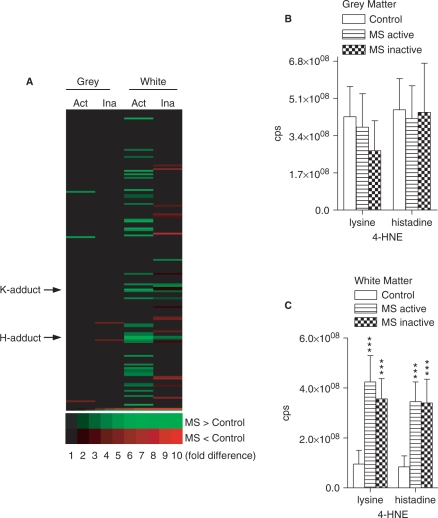
“Along the sphingolipid and phospholipid alterations, NAWM (but not NAGM) presented large accumulations of derivatives of the lipid peroxidation end-product 4-hydrox-ynonenal (4-HNE) [221].”
InfluentialDidonna, A., Isobe, N., Caillier, S. J., Li, K. H., Burlingame, A. L., Hauser, S. L., Baranzini, S. E., Patsopoulos, N. A., & Oksenberg, J. R. (2015) · Human Molecular Genetics · doi:10.1093/hmg/ddv412 · Cited by 26
Marangon, D., Audano, M., Pedretti, S., Fumagalli, M., Mitro, N., Lecca, D., Caruso, D., & Abbracchio, M. P. (2022) · Cells · doi:10.3390/cells11152369 · Cited by 20
“Moreover, mass spectrometric analysis revealed an increased abundance of phospholipids and a reduction in sphingolipid content in the normal appearing white matter (NAWM) of subjects with active MS [69], suggesting that specific metabolic alterations may appear before the onset of demyelinating lesions.”
BackgroundRaddatz, B. B., Sun, W., Brogden, G., Sun, Y., Kammeyer, P. L., Kalkuhl, A., Colbatzky, F., Deschl, U., Naim, H. Y., Baumgärtner, W., et al. (2015) · Brain Pathology · doi:10.1111/bpa.12266 · Cited by 22
“Furthermore, hyperactivities of degradation enzymes as described for the hydrolysis of sphingomyelin may play a central role (99).”
BackgroundInterictal, circulating sphingolipids in women with episodic migraine: A case-control study
Peterlin, B. L., Mielke, M. M., Dickens, A. M., Chatterjee, S. B., Dash, P. D., Alexander, G. M., Vieira, R. V. D. A., Bandaru, V. V. R., Dorskind, J. M., Tietjen, G. E., et al. (2015) · Neurology · doi:10.1212/wnl.0000000000002004 · Cited by 23
Self-citationLee, D. W., Banquy, X., Kristiansen, K. D. L., Min, Y., Ramachandran, A., Boggs, J. M., & Israelachvili, J. N. (2015) · Langmuir · doi:10.1021/acs.langmuir.5b00145 · Cited by 23
Li, T., He, H., Zhang, E., Hu, F., Wang, Z., Xu, J., Zeng, M., & Peng, B. (2025) · Brain Pathology · doi:10.1111/bpa.70033 · Cited by 24
“Alterations in sphingolipid metabolism have been observed in MS, with changes in ceramide levels detected in active MS lesions in brain homogenates, and even in normal appearing white matter of patients with MS [195, 196].”
Kasakin, M. F., Rogachev, A. D., Predtechenskaya, E. V., Zaigraev, V. J., Koval, V. V., & Pokrovsky, А. G. (2020) · Multiple Sclerosis International · doi:10.1155/2020/9010937 · Cited by 19
Dasgupta, S., & Ray, S. K. (2019) · International Journal of Molecular Sciences · doi:10.3390/ijms20205031 · Cited by 17
Widder, K., Harauz, G., & Hinderberger, D. (2019) · Biochimica et Biophysica Acta (BBA) - Biomembranes · doi:10.1016/j.bbamem.2019.183077 · Cited by 18
Pousinis, P., Ramos, I., Woodroofe, M. N., & Cole, L. M. (2020) · Metabolites · doi:10.3390/metabo10090366 · Cited by 17
A Biological Perspective of CSF Lipids as Surrogate Markers for Cognitive Status in HIV
Haughey, N. J., Zhu, X., & Bandaru, V. V. R. (2013) · Journal of Neuroimmune Pharmacology · doi:10.1007/s11481-013-9506-0 · Cited by 16
“…been linked to Parkinson's disease (Brugg et al. 1996; France-Lanord et al. 1997; Lwin et al. 2004; Cheng et al. 2011; Lee et al. 2011), and Multiple Scelrosis (Kim et al. 2012; van Doorn et al. 2013; Glabinski 1993; Chen et al. 2005; Hait et al. 2006; Narayanan et al. 2006; Wheeler et al. 2008).”
Self-citationEfectos del fingolimod en el sistema nervioso central
Cruz, V. T., & Fonseca, J. (2014) · Revista de Neurología · doi:10.33588/rn.5903.2013556 · Cited by 19
CDP-choline to promote remyelination in multiple sclerosis: the need for a clinical trial
Gudi, V., Grieb, P., Linker, R. A., & Skripuletz, T. (2023) · Neural Regeneration Research · doi:10.4103/1673-5374.373671 · Cited by 15
“CDPcholine may be a new candidate for regenerative MS therapy by reducing inflammation-related disorders, promoting CNS regeneration, and restoring biolipid metabolism, which appears to be disrupted in MS (Wheeler et al., 2008; Grassi et al., 2020; Penkert et al., 2020; Alaamery et al., 2021; PinedaTorra et al., 2021).”
BackgroundSeasonal Changes in Serum Metabolites in Multiple Sclerosis Relapse
Martynova, E. V., Хайбуллин, Т. И., Salafutdinov, I. I., Markelova, M., Laikov, A. V., Lopukhov, L. V., Liu, R., Sahay, K., Goyal, M., Baranwal, M., et al. (2023) · International Journal of Molecular Sciences · doi:10.3390/ijms24043542 · Cited by 16
“, that this pathway appears to be hyperactive in MS [52].”
BackgroundPotential therapeutic and diagnostic approaches of exosomes in multiple sclerosis pathophysiology
Hasaniani, N., Nouri, S., Shirzad, M., & Rostami-Mansoor, S. (2024) · Life Sciences · doi:10.1016/j.lfs.2024.122668 · Cited by 18
Amatruda, M., Maréchal, D., Gacias, M., Wentling, M., Turpin-Nolan, S. M., Morstein, J., Moniruzzaman, M., Brüning, J. C., Haughey, N. J., Trauner, D. H., et al. (2024) · Glia · doi:10.1002/glia.24631 · Cited by 15
Self-citationMatejuk, A., Matejuk, S., Offner, H., & Vandenbark, A. A. (2025) · International Journal of Molecular Sciences · doi:10.3390/ijms26178314 · Cited by 14
“…supporting data from the previous studies cited above as well as another 2008 report from Wheeler et al. indicating that there was not an overall loss of lipid mass in white and grey matter in MS brains, but a reduction in sphingolipids and gain in phospholipid content during active disease [192].”
Dasgupta, S., & Ray, S. K. (2018) · Therapeutic Targets for Neurological Diseases · doi:10.14800/ttnd.1598 · Cited by 14
Microglial states associate with lesion dynamics in multiple sclerosis
van den Bosch, A. M. R., Khoo, J. H., Lu, Z., Liang, H., Wever, D., Pu, L., Eggen, B. J. L., Uhlén, M., Smolders, J., Hamann, J., et al. (2026) · Cell Reports · doi:10.1016/j.celrep.2026.117538 · Cited by 13
Adult‐onset depletion of sulfatide leads to axonal degeneration with relative myelin sparing
Dustin, E., McQuiston, A. R., Honke, K., Palavicini, J. P., Han, X., & Dupree, J. L. (2023) · Glia · doi:10.1002/glia.24423 · Cited by 11
“Additionally, Wheeler et al. (2008) reported a significant increase in the phospholipid/sphingolipid ratio in both normal appearing white and normal appearing gray matter in MS brains as compared to non-MS brains while Moscatelli and Issacson (1969) reported an increase in sphingosine, a metabolite…”
BackgroundInfluentialAppadu, A., Jelokhani‐Niaraki, M., & DeBruin, L. S. (2015) · The Journal of Physical Chemistry B · doi:10.1021/acs.jpcb.5b07375 · Cited by 11
Acid sphingomyelinase: No potential as a biomarker for multiple sclerosis
Leurs, C. E., Pinheiro, M. A. L., Wierts, L., den Hoedt, S., Mulder, M. T., Eijlers, A. J. C., Schoonheim, M. M., Balk, L. J., Uitdehaag, B. M. J., Killestein, J., et al. (2018) · Multiple Sclerosis and Related Disorders · doi:10.1016/j.msard.2018.11.024 · Cited by 11
Metabolomics and biomarkers in ocular matrix: beyond ocular diseases
Luo, Y. (2020) · International Journal of Ophthalmology · doi:10.18240/ijo.2020.06.21 · Cited by 11
Ceramide is implicated in humoral peripheral and intrathecal autoimmune response in MS patients
Podbielska, M., Macała, J., Jakubiak-Augustyn, A., Szulc, Z. M., Fortuna, W., Budrewicz, S. P., Jaśkiewicz, E., Bilińska, M. M., Hogan, E. L., & Pokryszko‐Dragan, A. (2023) · Multiple Sclerosis and Related Disorders · doi:10.1016/j.msard.2023.104565 · Cited by 10
Systems biology strategy to study lipotoxicity and the metabolic syndrome
Orešič, M. (2009) · Biochimica et Biophysica Acta (BBA) - Molecular and Cell Biology of Lipids · doi:10.1016/j.bbalip.2009.11.003 · Cited by 10
White matter lipid alterations during aging in the rhesus monkey brain
Dimovasili, C., Vitantonio, A. T., Conner, B., Vaughan, K. L., Mattison, J. A., & Rosene, D. L. (2024) · GeroScience · doi:10.1007/s11357-024-01353-3 · Cited by 10
“Finally, we found disease associated biomarkers [36–39] changed in old monkeys.”
InfluentialPousinis, P., Begou, O., Boziki, M. K., Grigoriadis, N., Theodoridis, G. A., & Gika, H. (2024) · Metabolites · doi:10.3390/metabo14100545 · Cited by 10
“Wheeler et al. [31] showed that levels of sphingolipids were attenuated and phosphatidylethanolamine (PE) were increased in human brain tissue from MS and control post-mortem cases using mass spectrometry shotgun lipidomics.”
MethodSpatial lipidomics reveals demyelination and remyelination dynamics in the mouse brain
Opielka, M., Urbanowicz, K., Konieczna-Wolska, K., Müller, E., Krajewski, O., Feucherolles, M., Zhou, Q., Bienkowski, M., Frache, G., Hopf, C., et al. (2025) · Journal of Lipid Research · doi:10.1016/j.jlr.2025.100912 · Cited by 8
“Similar findings were reported in two independent studies of postmortem MS brains, where increased polyunsaturated glycerophospholipid levels in plaques and normal-appearing white matter (NAWM) were attributed to enhanced astrocytic migration, activation, or myelin remodeling (86, 87).”
Bi-exponential diffusion signal decay in normal appearing white matter of multiple sclerosis
Nagy, S. A., Aradi, M., Orsi, G., Perlaki, G., Kamson, D. O., Mike, A., Komáromy, H., Schwarcz, A., Kov́acs, Á., Janszky, J., et al. (2012) · Magnetic Resonance Imaging · doi:10.1016/j.mri.2012.07.007 · Cited by 9
“In brain specimens, decreased phospholipid levels in myelin structures were demonstrated in NAWM and significant axonal loss was also proved histologically [27]; in addition, choline and sphyngomyelin metabolism was also disturbed [45,46].”
BackgroundAtypical sphingosine-1-phosphate metabolites—biological implications of alkyl chain length
Glueck, M., Lucaciu, A., Subburayalu, J., Kestner, R. I., Pfeilschifter, W., Vutukuri, R., & Pfeilschifter, J. M. (2024) · Pflügers Archiv - European Journal of Physiology · doi:10.1007/s00424-024-03018-8 · Cited by 8
“More recently, sphingolipid LCBs ranging from C18 to C22 alkyl chain lengths in the grey and white matter of human brains were reported [79].”
Multiple sclerosis: what have we learned and can we still learn from electron microscopy
Oost, W., Meilof, J. F., & Baron, W. (2025) · Cellular and Molecular Life Sciences · doi:10.1007/s00018-025-05690-0 · Cited by 9
“Lipid composition of lipids extracted from NAWM and NAGM shifts towards a higher proportion of phospholipids and a lower proportion of sphingolipids [71].”
Circulating exosomes with unique lipid signature in relapsing remitting multiple sclerosis
Palazzo, C., Asci, I., Russo, S., Buccoliero, C., Mangialardi, V., Abbrescia, P., Valente, O., Ruggieri, M., Paolicelli, D., Lobasso, S., et al. (2025) · Frontiers in Cellular Neuroscience · doi:10.3389/fncel.2025.1613618 · Cited by 7
Zhou, C., He, M., Peng, C., Yu, J., Li, Z., Zhou, M., Li, Y., Yang, S., Ouyang, H., & Feng, Y. (2020) · Journal of Analytical Methods in Chemistry · doi:10.1155/2020/9101598 · Cited by 7
“Human research demonstrated that changes in the balance of sphingolipid metabolism were closely related to neurological diseases [44, 45].”
BackgroundOverlaps between multiple system atrophy and multiple sclerosis: A novel perspective
Jellinger, K. A., & Wenning, G. K. (2016) · Movement Disorders · doi:10.1002/mds.26870 · Cited by 6
Çam, B. E., Akçeşme, B., Çoban, A., & Korkut, Ş. V. (2022) · Multiple Sclerosis and Related Disorders · doi:10.1016/j.msard.2022.104253 · Cited by 7
Gupta, M., & Weaver, D. F. (2022) · Physical Chemistry Chemical Physics · doi:10.1039/d1cp03844c · Cited by 7
Therapeutic liposomes synergize with active molecules to enhance targeted therapy
Partoazar, A., Goudarzi, R., & Dehpour, A. R. (2025) · Journal of drug targeting · doi:10.1080/1061186x.2025.2533336 · Cited by 5
“…be affected by gene expression, oxidative stress, and apoptosis due to prevalent diseases [52] such as atherosclerosis [53] or multiple sclerosis [54]. therefore, oxidised Pls (OxPls) are mainly utilised as biomarkers for the detection of diseases like cardiovascular illness [55,56]. in a study…”
Amarjeet, Babu, R., Mohapatra, A., Pancholi, B., Garabadu, D., Sharma, A., Sharma, A., & Azad, A. (2023) · Acta Neurologica Scandinavica · doi:10.1155/2023/7398037 · Cited by 6
A thermodynamic analysis of the effects of myelin basic protein (MBP) on DPPS and DPPG monolayers
Zhang, L., Hao, C., Sheng-ju, W., Lu, X., Li, J., & Sun, R. (2016) · Colloids and Surfaces A Physicochemical and Engineering Aspects · doi:10.1016/j.colsurfa.2016.10.011 · Cited by 5
Ward, S., Page, M. I., McHugh, P., & Powles, N. T. (2017) · Analytical Methods · doi:10.1039/c7ay01922j · Cited by 4
Zhu, Z., Huang, L., Jin, H.-J. Y., Zhou, H.-Q., & Zhang, J. (2026) · Neurobiology of Disease · doi:10.1016/j.nbd.2026.107500 · Cited by 2
Expression of sphingosine-1-phosphate receptor 1 in neuroinflammation of canine brains
Yun, T., Kim, S., Koo, Y., Chae, Y., Lee, D., Kim, H., Kang, B., Kang, B.-T., & Kim, S. (2024) · Topics in companion animal medicine · doi:10.1016/j.tcam.2024.100847 · Cited by 2
A ceramide theory of multiple sclerosis
Rappoport, A. (2025) · Elsevier eBooks · doi:10.1016/b978-0-44-345008-2.00014-x · Cited by 2
Effect of postlactation iron deficiency on the composition of fatty acids of whole brain myelin
Romero, M. D. S. C., Pliego-Rivero, F. B., Moreno-Altamirano, B., & Otero, G. (2010) · Nutritional Neuroscience · doi:10.1179/147683010x12611460764606 · Cited by 2
Interictal ceramide kinase in migraine
Abdelazim, G., Maabady, M. H., & Elmadbouly, A. A. E. (2017) · Al-Azhar Assiut Medical Journal · doi:10.4103/azmj.azmj_28_17 · Cited by 1
Teo, W. (2015) · Libraries and Cultural Resources (University of Calgary) · doi:10.11575/prism/26864 · Cited by 1
Myelin lipids in the development of the autoimmune response in multiple sclerosis
Mv, I., Ильдарович, Т. А., Dzharullaeva, A. S., Logunov, D. Y., & Zakharova, M. N. (2014) · Neurochemical Journal · doi:10.1134/s1819712414040035
Eventos redox na biologia dos lipídios: modificação de tióis e alterações do lipidoma em ALS
Filho, A. D. B. C. (2018) · Digital Library of Theses and Dissertations (Universidade de São Paulo) · doi:10.11606/t.46.2018.tde-20072018-085559
Identifying the elephant: technological developments towards the complete identification of lipids
Bowman, A. P. (2021) · Research Publications (Maastricht University) · doi:10.26481/dis.20210831ab
Prognostic utility of the IgM oligoclonal bands against myelin lipids in multiple sclerosis
García, S. R., Estruch, B. C., Pajares, F. G., & Blanco, M. A. J. (2021) · Journal of Neuroimmunology · doi:10.1016/j.jneuroim.2021.577698
Exploring sphingolipid function in the pathogenesis of Alzheimer’s disease
Luo, Q. (2022) · Research Publications (Maastricht University) · doi:10.26481/dis.20220215ql
The profiling and imaging of sterol molecules in the human brain
Griffiths, L. (2023) · Cronfa (Swansea University) · doi:10.23889/suthesis.62587
The Potential to Inform Statin Use in Multiple Sclerosis Through Human Genetics
Buyukkurt, A., & Harroud, A. (2023) · Neurology · doi:10.1212/wnl.0000000000207773
Górka, M., Dębiec, M., Białoń, N., Bieczek, D., Suszyńśki, K., & Górka, D. (2023) · Postępy Biochemii · doi:10.18388/pb.2021_492
Oost, W., Huitema, A. J., Kats, K., Giepmans, B. N. G., Kooistra, S. M., Eggen, B. J. L., & Baron, W. (2024) · Figshare · doi:10.6084/m9.figshare.26598563
Additional file 1 of Synaptic tau: A pathological or physiological phenomenon?
Robbins, M., Clayton, E. L., & Schierle, G. S. K. (2021) · Figshare · doi:10.6084/m9.figshare.16599510
Oost, W., Huitema, A. J., Kats, K., Giepmans, B. N. G., Kooistra, S. M., Eggen, B. J. L., & Baron, W. (2024) · Figshare · doi:10.6084/m9.figshare.26598566
Hertanu, A. (2022) · theses.fr (ABES) · doi:10.70675/86960c50z2a2cz48fbz8daczc26d60f13577 · Cited by 1
Chaim, R. B., Rivlin, M., & Perlman, O. (2026) · Chemical & Biomedical Imaging · doi:10.64898/2026.08.17.743476
Metabolomic Profiles Associated With Disease Severity in Multiple Sclerosis
Siavoshi, F., Ladakis, D. C., Jank, L., Dewey, B. E., Filippatou, A. G., Smith, M. D., Prince, J. L., Sotirchos, E. S., Saidha, S., Mowry, E. M., et al. (2026) · Neurology Neuroimmunology & Neuroinflammation · doi:10.1212/nxi.0000000000200664
“Our fi ndings align with postmortem tissue data showing marked sphingo-lipid depletion in both normal-appearing white matter and cortical gray matter in MS. 29,43 Concurrently, our analyses revealed prominent enrichment of primary and secondary bile acid metabolism pathways.”
Self-citation
Metadata
- Authors
- Wheeler, D., Bandaru, V. V. R., Calabresi, P. A., Nath, A., & Haughey, N. J.
- Affiliations
- Johns Hopkins University (US)
- Corresponding author
- Haughey, Norman J.
- Venue
- Brain
- Publisher
- Oxford University Press (OUP)
- Published
- 2008-09-04
- Volume
- 131
- Issue
- 11
- Pages
- 3092-3102
- ISSN
- 0006-8950 (ISSN-L)
- 1460-2156
- PMC
- PMC2577809
- OpenAlex
- W2060437747
- Cited by
- 171
- References
- 46
- Citations by year
- 2026: 4 · 2025: 9 · 2024: 12 · 2023: 10 · 2022: 7 · 2021: 10 · 2020: 16 · 2019: 12 · 2018: 8 · 2017: 11 · 2016: 8 · 2015: 9 · 2014: 12 · 2013: 9 · 2012: 8
- FWCI
- 6.17
- Type
- journal article
- Language
- en
- Open access
- bronze
- doi.org
- Locations
- Brain (publishedVersion)
- PubMed Central (publishedVersion, cc-by-nc)
- PubMed (publishedVersion)
- Funders
- Multiple Sclerosis Society
- National Institutes of Health
- National Institute on Alcohol Abuse and Alcoholism (R01AA017408, AA017408)
- National Institute on Aging (R21AG034849, AG023471, R01AG023471)
- National Institute of Mental Health (MH077542, R21MH072534, R01MH077542, P30MH075673)
- Topics
- Health Sciences › Medicine › Clinical Neurology › Multiple Sclerosis Research Studies
- Life Sciences › Biochemistry, Genetics and Molecular Biology › Molecular Biology › Sphingolipid Metabolism and Signaling
- Life Sciences › Biochemistry, Genetics and Molecular Biology › Molecular Biology › Lipid Membrane Structure and Behavior
- Keywords
- multiple sclerosis, normal-appearing white matter, normal-appearing gray matter, sphingolipid metabolism, lipid composition, phospholipids, myelin, membrane sterols, myelin degradation, axonal degeneration
- MeSH terms
- Adult, Aldehydes, Biophysics, Brain, Cholesterol, Female, Humans, Male, Membrane Lipids, Middle Aged, Models, Biological, Multiple Sclerosis, Myelin Sheath, Phospholipids, Sphingolipids, Lipid Peroxidation, Spectrometry, Mass, Electrospray Ionization, Young Adult
About these checks
Registry, retraction, Cites and statistics results are computed, not judged, with one exception: a printed reference that no index lists is read once by a model before it counts as a citation error. Claims are extracted by a model and kept only when their quote appears verbatim in the text; each cited source is then checked, with a model’s help, for whether it says what the claim relies on. Those verdicts can be wrong — read the claim’s quote and the cited source before relying on one.
Statistics and arithmetic are recomputed, not judged.
Confidence bands are shown only for fields calibrated on our annotated test set. None is calibrated yet, so no band is shown.
What counts as a claim ›How we measure confidence ›How we check this ›
Are you an author, or do you see a problem with this page? Request a review
Data sources
Bibliographic data: Semantic Scholar, OpenAlex, Crossref.
Contains information from the Semantic Scholar Academic Graph Datasets, made available under the ODC Attribution License (ODC-BY 1.0).
Semantic Scholar’s data is described in: Kinney, R., et al. (2023). The Semantic Scholar Open Data Platform. arXiv:2301.10140.
