

Illusory Body Ownership Affects the Cortical Response to Vicarious Somatosensation
Open accessThe DOI matches its Crossref record; 110 of the 110 references it cites were found in a registry or an index.
Abstract
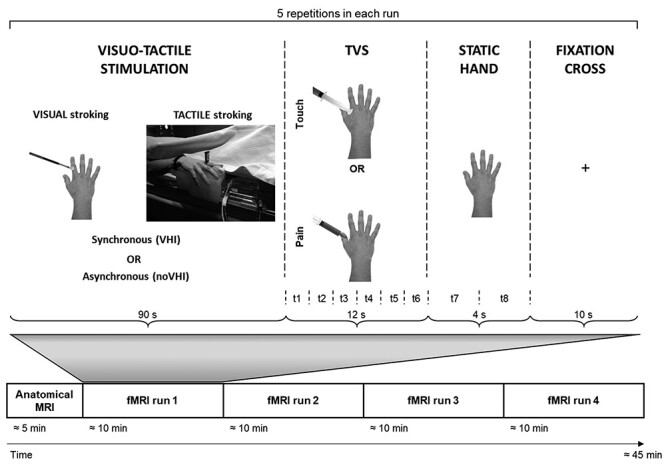
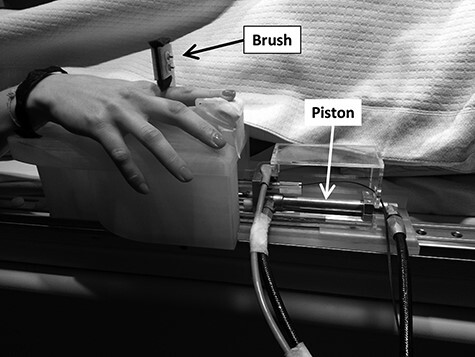
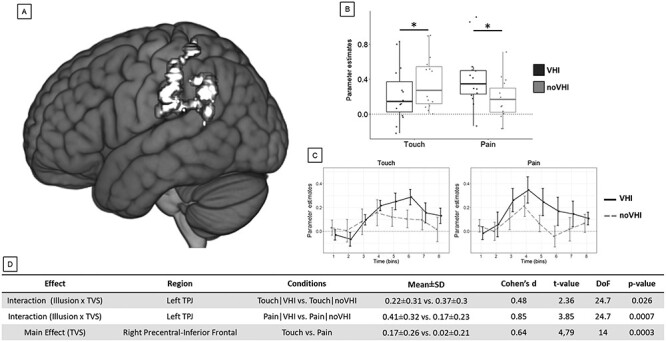
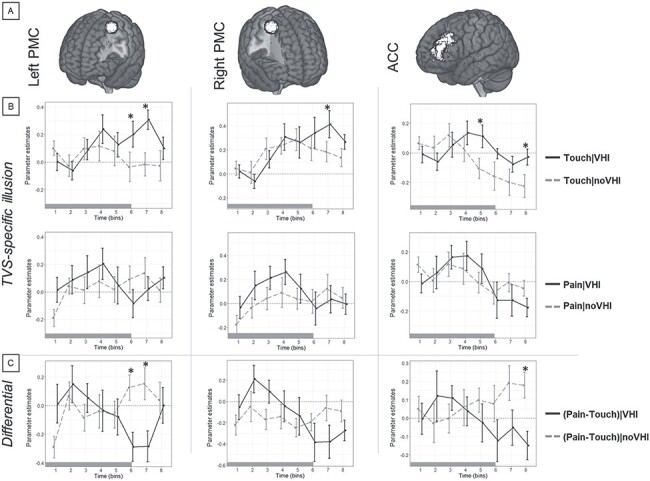
Fundamental human feelings such as body ownership (“this” body is “my” body) and vicariousness (first-person-like experience of events occurring to others) are based on multisensory integration. Behavioral links between body ownership and vicariousness have been shown, but the neural underpinnings remain largely unexplored. To fill this gap, we investigated the neural effects of altered body ownership on vicarious somatosensation. While recording functional brain imaging data, first, we altered participants’ body ownership by robotically delivering tactile stimulations (“tactile” stroking) in synchrony or not with videos of a virtual hand being brushed (“visual” stroking). Then, we manipulated vicarious somatosensation by showing videos of the virtual hand being touched by a syringe’s plunger (touch) or needle (pain). Only after the alteration of body ownership (synchronous visuo-tactile stroking) and specifically during late epochs of vicarious somatosensation, vicarious pain was associated with lower activation in premotor and anterior cingulate cortices with respect to vicarious touch. At the methodological level, the present study highlights the importance of the neural response’s temporal evolution. At the theoretical level, it shows that the higher-level (cognitive) impact of a lower-level (sensory) body-related processing (visuo-tactile) is not limited to body ownership but also extends to other psychological body-related domains, such as vicarious somatosensation.
Overview
The claims and statistics of this paper haven’t been checked yet.
Free: it reads the open-access text and checks the first 5 claims that cite a source we can check. Create a free account to check every claim.
Integrity signals
Registry
Cites
Statistics
Figures
Verification
Claims the paper makes
The claims and statistics of this paper haven’t been checked yet.
Free: it reads the open-access text and checks the first 5 claims that cite a source we can check. Create a free account to check every claim.
Claims other papers make about this one
Each is checked against this paper’s own text: does it say what the citing paper says it does?
The source backs part of the claim, not all of it — or backs it for a different population, condition or comparison.
In the citing paper
“In addition, following experimentally induced embodiment of a virtual body, a network involving the PMV and ACC showed time-locked decreased activity in response to pain-related vicarious somatosensation compared to touch-related vicarious somatosensation (Pamplona et al. 2022).”
From Neuroanatomical correlates of peripersonal space: bridging the gap between perception, action, emotion and social cognition (2024) · cites this paper as Pamplona et al. 2022
Experimental — accuracy not yet measured
Self-check
Percentages, sums and reported differences re-computed from the paper’s own numbers.
The self-check needs the paper’s full text.
Citations
Cites
The assessment and analysis of handedness: The Edinburgh inventory
Oldfield, R. C. (1971) · Neuropsychologia · doi:10.1016/0028-3932(71)90067-4 · Cited by 35,900
Tzourio-Mazoyer, N., Landeau, B., Papathanassiou, D., Crivello, F., Etard, O., Delcroix, N., Mazoyer, B., & Joliot, M. (2002) · NeuroImage · doi:10.1006/nimg.2001.0978 · Cited by 16,319 · cited 1×
“Supplementary Table 1 shows the selected ROIs and their respective automated anatomical labeling labels (Tzourio-Mazoyer et al. 2002), center coordinates, and number of voxels.”
BackgroundMeasuring individual differences in empathy: Evidence for a multidimensional approach.
Davis, M. H. (1983) · Journal of Personality and Social Psychology · doi:10.1037/0022-3514.44.1.113 · Cited by 10,272
emmeans: Estimated Marginal Means, aka Least-Squares Means
Lenth, R. V., & Piaskowski, J. (2017) · CRAN: Contributed Packages · doi:10.32614/cran.package.emmeans · Cited by 8,143
Rubber hands ‘feel’ touch that eyes see
Botvinick, M., & Cohen, J. (1998) · Nature · doi:10.1038/35784 · Cited by 4,410 · cited 1×
“fake hand (rubber hand) belongs to oneself via a visuo-tactile multisensory conflict (Botvinick and Cohen 1998).”
BackgroundEmpathy for Pain Involves the Affective but not Sensory Components of Pain
Singer, T., Seymour, B., O'Doherty, J., Kaube, H., Dolan, R. J., & Frith, C. D. (2004) · Science · doi:10.1126/science.1093535 · Cited by 3,929 · cited 4×
“These findings were in line with previous studies (Singer et al. 2004; Lamm et al. 2007; Costantini et al. 2008; Ionta et al. 2020) and suggested our sample’s general emotional sensitivity/reactivity.”
BackgroundResultInfluentialLarge-scale automated synthesis of human functional neuroimaging data.
Yarkoni, T., Poldrack, R. A., Nichols, T. E., Van Essen, D. C., & Wager, T. D. (2011) · Nature Methods · doi:10.1038/nmeth.1635 · Cited by 3,686 · cited 1×
“A second set of ROIs was defined from meta-analytic maps, downloaded from Neurosynth (http://www.neurosynth.org; Yarkoni et al. 2011) after entering the following terms: anterior cingulate cortex (ACC), anterior insula (ant Ins), precuneus (preCun), thalamus (Thal), and supplementary motor (SMA).”
MethodCircular analysis in systems neuroscience: the dangers of double dipping
Kriegeskorte, N., Simmons, W. K., Bellgowan, P. S. F., & Baker, C. I. (2009) · Nature Neuroscience · doi:10.1038/nn.2303 · Cited by 2,696 · cited 1×
“In order to avoid circular analysis, 18 hypothesized ROIs were defined through independent sources (Kriegeskorte et al. 2009).”
BackgroundA cortical area selective for visual processing of the human body
Downing, P. E., Jiang, Y., Shuman, M., & Kanwisher, N. (2001) · Science · doi:10.1126/science.1063414 · Cited by 2,043 · cited 1×
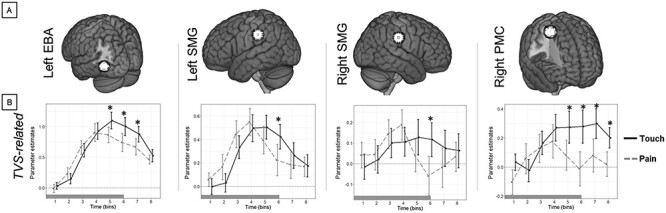
“2011), vision of a body or body parts (Downing et al. 2001), mental imagery of embodied self-location (Arzy et al.”
BackgroundLamm, C., Decety, J., & Singer, T. (2011) · NeuroImage · doi:10.1016/j.neuroimage.2010.10.014 · Cited by 2,016 · cited 3×
“However, its role is more related to processing the affective aspects of vicarious (Lamm et al. 2011; Bzdok et al. 2012; van der Heiden et al. 2013; Tholen et al. 2020) and illusory (Craig et al.”
Background
Research works printed but not linked: 1
- Brett M, Anton J-L, Valabregue R, Poline J-B. 2002. Region of interest analysis using an SPM toolbox. In: 8th International Conferance on Functional Mapping of the Human Brain. 16:497.
Cited by
Basile, G. A., Tatti, E., Bertino, S., Milardi, D., Genovese, G., Bruno, A., Muscatello, M. R. A., Ciurleo, R., Cerasa, A., Quartarone, A., et al. (2024) · Brain Structure and Function · doi:10.1007/s00429-024-02781-9 · Cited by 24
Visual Affective Stimulus Database: A Validated Set of Short Videos
Li, Q., Zhao, Y., Gong, B., Li, R., Wang, Y., Yan, X., & Wu, C. (2022) · Behavioral Sciences · doi:10.3390/bs12050137 · Cited by 20
“Further, emotion videos have been used in recent social cognition studies, such as in the areas of visually mediated empathy and somatosensory vicariousness and their interaction with neural activities [42,43].”
MethodHow pain and body representations transform each other: A narrative review
Beccherle, M., & Scandola, M. (2024) · Journal of Neuropsychology · doi:10.1111/jnp.12390 · Cited by 17
“Of note, Pamplona et al. (2022) demonstrated that only when participants felt a sense of ownership towards a virtual hand, vicarious pain videos elicited lower activation in premotor and anterior cingulate cortices.”
Visual perspective and body ownership modulate vicarious pain and touch: A systematic review
Lisi, M. P., Fusaro, M., & Aglioti, S. M. (2024) · Psychonomic Bulletin & Review · doi:10.3758/s13423-024-02477-5 · Cited by 14
Vision- and touch-dependent brain correlates of body-related mental processing
Pamplona, G. S. P., Hardmeier, M., Younes, S., Goy, I., Fornari, E., & Ionta, S. (2022) · Cortex · doi:10.1016/j.cortex.2022.09.005 · Cited by 12
Self-citationNeuro-cognitive effects of degraded visibility on illusory body ownership
Pamplona, G. S. P., Giussani, A., Salzmann, L., Stämpfli, P., Schneller, S., Gassert, R., & Ionta, S. (2024) · NeuroImage · doi:10.1016/j.neuroimage.2024.120870 · Cited by 12
“For instance, specifically after synchronous visuo-tactile stimulation, the premotor cortex is activated by both vicarious pain and touch, but its activation is higher for touch than pain (Pamplona et al., 2022c).”
BackgroundMethodSelf-citationNicolardi, V., Lisi, M. P., Mello, M., Fusaro, M., Tieri, G., & Aglioti, S. M. (2025) · Social Cognitive and Affective Neuroscience · doi:10.1093/scan/nsaf035 · Cited by 12
“Interest-ingly, increasing attention has been given to the vicarious experience of pain and pleasure (Mello et al. 2022, Pamplona et al. 2022, Seinfeld et al. 2022) also thanks to the ecological validity of immersive virtual reality (IVR; Tieri et al. 2018).”
Neural correlates of an illusionary sense of agency caused by virtual reality
Cai, Y., Yang, H., Wang, X., Xiong, Z., Kühn, S., Bi, Y., & Wei, K. (2024) · Cerebral Cortex · doi:10.1093/cercor/bhad547 · Cited by 9
Social Touch: Its Mirror-like Responses and Implications in Neurological and Psychiatric Diseases
Grandi, L. C., & Bruni, S. (2023) · NeuroSci · doi:10.3390/neurosci4020012 · Cited by 9
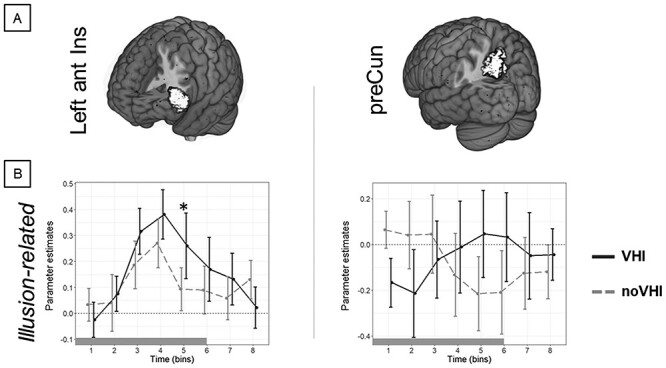
“It is noteworthy that, among those brain regions that changed their neural activity during the vicarious somatosensation, there was also the insula, which not only is the target of CT fibers but is also known to be involved in the processing of somatosensory aspects of altered body ownership [67].”
BackgroundSisterhood predicts similar neural processing of a film
Bacha‐Trams, M., Yorulmaz, G. E., Glerean, E., Ryyppö, E., Tapani, K., Virmavirta, E., Saaristo, J., Jääskeläinen, I. P., & Sams, M. E. (2024) · NeuroImage · doi:10.1016/j.neuroimage.2024.120712 · Cited by 8
Lesur, M. R., Vidal, L. T., Longo, M. R., Slatman, J., Väljamäe, A., & Tajadura‐Jiménez, A. (2026) · Psychophysiology · doi:10.1111/psyp.70234 · Cited by 8
The effect of sense of power on inaction inertia: From the perspective of endowment effect
Yue, S., & Wang, H. (2022) · Current Psychology · doi:10.1007/s12144-022-03983-2 · Cited by 6
“…can increase consumers’ psychological ownership of products by increasing the contact between consumers and products (such as touch, try on, etc.) (Pamplona et al., 2022; Peck & Shu, 2009), so as to realize the purpose of increasing consumers' action likelihood on the suboptimal opportunity from…”
Balconi, M., Sansone, M., & Acconito, C. (2023) · Sensors · doi:10.3390/s23094332 · Cited by 5
“For instance, it has been demonstrated that participants perceive a virtual bodies as being a part of their bodies after receiving synchronous visual–tactile stimulation (embodiment), and the prefrontal cortex (also recognized as the premotor cortex) is activated during emotionally significant vicarious somatosensatio…”
BackgroundDistinct patterns of visuo-tactile and visuo-motor body-related integration in Parkinson’s disease
Genovese, F., Romeo, M., Terrenzio, F. P., Esposito, N., Destefanis, C., Gindri, P., Garbarini, F., & Sebastiano, A. R. (2025) · Scientific Reports · doi:10.1038/s41598-025-08965-5 · Cited by 4
What makes an event significant: an fMRI study on self-defining memories
Monsa, R., Dafni‐Merom, A., & Arzy, S. (2024) · Cerebral Cortex · doi:10.1093/cercor/bhae303 · Cited by 4
Abrupt visibility modifications affect specific subjective (not objective) aspects of body ownership
Pamplona, G. S. P., Gruaz, Q., Mauron, K., & Ionta, S. (2022) · Acta Psychologica · doi:10.1016/j.actpsy.2022.103672 · Cited by 4
Self-citationOwens, E. A., & Duncan, R. O. (2025) · Frontiers in Human Neuroscience · doi:10.3389/fnhum.2025.1468947 · Cited by 3
“However, TPJ may also assist to distinguish the self from the non-self (Pamplona et al., 2022).”
Visibility manipulations affect the functional connectivity related to illusory body ownership
Pamplona, G. S. P., Salzmann, L., Giussani, A., Albanese, L., Stämpfli, P., Schneller, S., Gassert, R., & Ionta, S. (2025) · Cortex · doi:10.1016/j.cortex.2025.06.016 · Cited by 3
Self-citationArtificial embodiment displaces cortical neuromagnetic somatosensory responses
Isabella, S. L., D’Alonzo, M., Mioli, A., Arcara, G., Pellegrino, G., & Pino, G. D. (2024) · Scientific Reports · doi:10.1038/s41598-024-72460-6 · Cited by 2
“For example, activity within the premotor cortex has been linked with the RHI 81 , as well as with vicarious somatosensory experience (that is, first-person experience of others’ events) following embodiment 82 .”
BackgroundA pleasure that lasts: Convergent neural processes underpin comfort with prolonged gentle stroking
Cheng, X., Maeß, B., & Schirmer, A. (2025) · Cortex · doi:10.1016/j.cortex.2025.04.012
Lezcano, M., Santoni, F., & Aglioti, Y. S. R. S. M. (2026) · Neuropsychologia · doi:10.1016/j.neuropsychologia.2026.109621
Investigating the Influence of Vision on Tactile Processing
Nair, A. (2026) · Library, Museums and Press - UDSpace (University of Delaware)
Metadata
- Authors
- Pamplona, G. S. P., Salgado, J. A. D., Staempfli, P., Seifritz, E., Gassert, R., & Ionta, S.
- Affiliations
- ETH Zurich (CH)
- Department of Psychiatry, Psychotherapy, and Psychosomatics, Psychiatric Hospital of the University of Zurich, Zurich, Switzerland
- University of Zurich (CH)
- Corresponding author
- Ionta, Silvio
- Venue
- Cerebral Cortex
- Publisher
- Oxford University Press (OUP)
- Published
- 2021-07-08
- Volume
- 32
- Issue
- 2
- Pages
- 312-328
- ISSN
- 1047-3211 (ISSN-L)
- 1460-2199
- PMC
- PMC8754387
- OpenAlex
- W3177986964
- Cited by
- 23
- References
- 110
- Citations by year
- 2026: 2 · 2025: 5 · 2024: 8 · 2023: 4 · 2022: 4
- FWCI
- 2.45
- Type
- journal article
- Language
- en
- Open access
- hybrid
- doi.org
- Licence
- Locations
- Cerebral Cortex (publishedVersion, cc-by)
- PubMed Central (publishedVersion, cc-by)
- PubMed (publishedVersion)
- SERVAL (Université de Lausanne) (publishedVersion, cc-by)
- Zurich Open Repository and Archive (University of Zurich) (acceptedVersion, cc-by)
- IRIS (submittedVersion, cc-by)
- Repository for Publications and Research Data (ETH Zurich) (submittedVersion, cc-by)
- Zurich Open Repository and Archive (University of Zurich) (submittedVersion, cc-by)
- ETH Zürich Research Collection (cc-by)
- Zurich Open Repository and Archive (University of Zurich)
- Funders
- Swiss National Science Foundation
- National Center of Competence in Research on Neural Plasticity and Repair
- Professeurs Boursiers funding program (PZ00P1_170506/1)
- Topics
- Physical Sciences › Computer Science › Human-Computer Interaction › Virtual Reality Applications and Impacts
- Social Sciences › Psychology › Social Psychology › Action Observation and Synchronization
- Social Sciences › Psychology › Experimental and Cognitive Psychology › Multisensory perception and integration
- Keywords
- body ownership, vicarious pain, multisensory integration, virtual hand, premotor cortex, anterior cingulate cortex
- MeSH terms
- Body Image, Hand, Humans, Illusions, Ownership, Touch, Visual Perception, Touch Perception
About these checks
Registry, retraction, Cites and statistics results are computed, not judged, with one exception: a printed reference that no index lists is read once by a model before it counts as a citation error. Claims are extracted by a model and kept only when their quote appears verbatim in the text; each cited source is then checked, with a model’s help, for whether it says what the claim relies on. Those verdicts can be wrong — read the claim’s quote and the cited source before relying on one.
Statistics and arithmetic are recomputed, not judged.
Confidence bands are shown only for fields calibrated on our annotated test set. None is calibrated yet, so no band is shown.
What counts as a claim ›How we measure confidence ›How we check this ›
Are you an author, or do you see a problem with this page? Request a review
Data sources
Bibliographic data: Semantic Scholar, OpenAlex, Crossref.
Contains information from the Semantic Scholar Academic Graph Datasets, made available under the ODC Attribution License (ODC-BY 1.0).
Semantic Scholar’s data is described in: Kinney, R., et al. (2023). The Semantic Scholar Open Data Platform. arXiv:2301.10140.
