

Gender Differences in Connectome-based Predictions of Individualized Intelligence Quotient and Sub-domain Scores
Open accessThe DOI matches its Crossref record; 80 of the 80 references it cites were found in a registry or an index.
Abstract
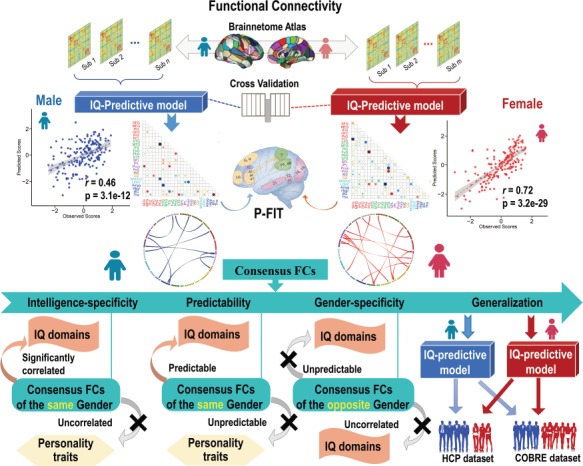
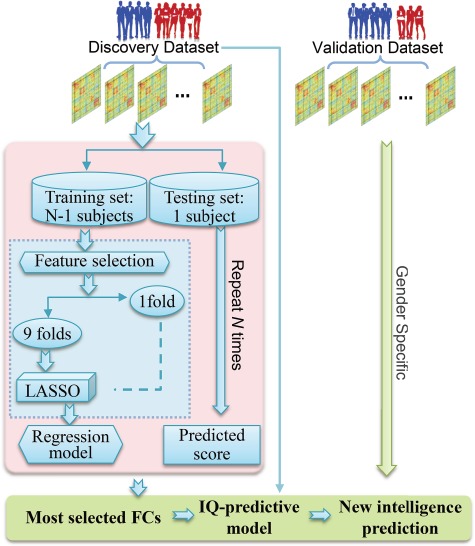
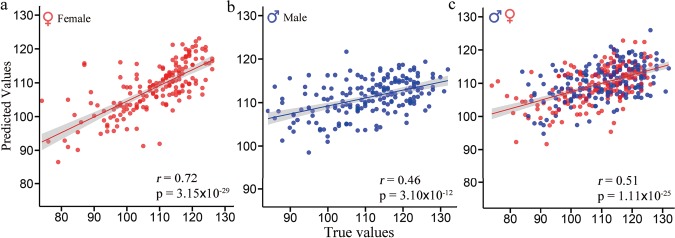
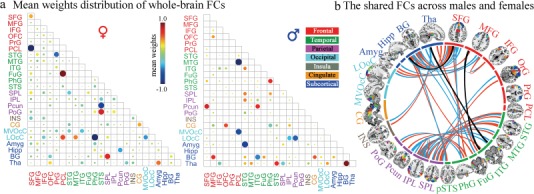
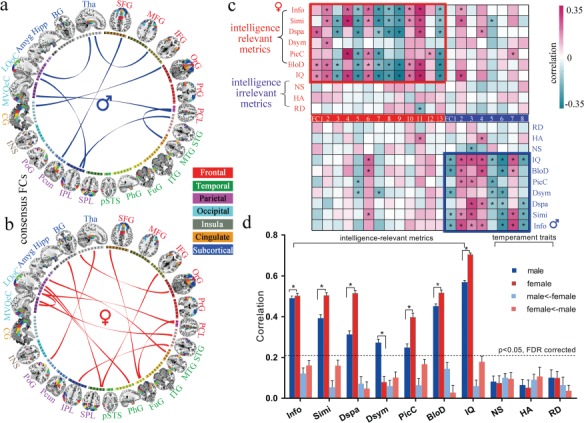
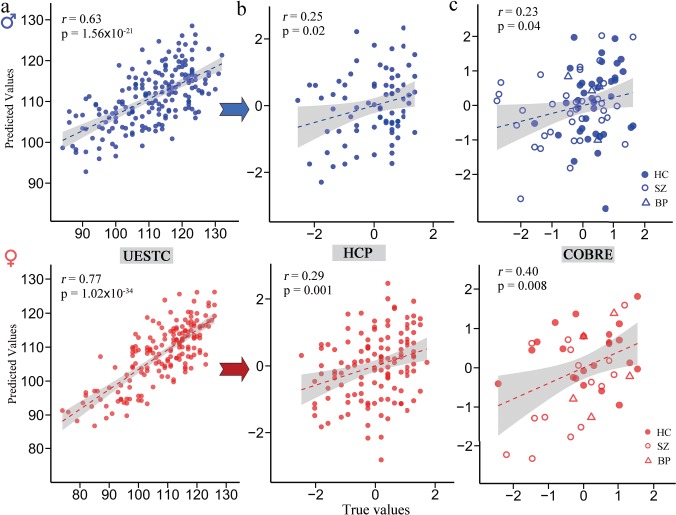
Scores on intelligence tests are strongly predictive of various important life outcomes. However, the gender discrepancy on intelligence quotient (IQ) prediction using brain imaging variables has not been studied. To this aim, we predicted individual IQ scores for males and females separately using whole-brain functional connectivity (FC). Robust predictions of intellectual capabilities were achieved across three independent data sets (680 subjects) and two intelligence measurements (IQ and fluid intelligence) using the same model within each gender. Interestingly, we found that intelligence of males and females were underpinned by different neurobiological correlates, which are consistent with their respective superiority in cognitive domains (visuospatial vs verbal ability). In addition, the identified FC patterns are uniquely predictive on IQ and its sub-domain scores only within the same gender but neither for the opposite gender nor on the IQ-irrelevant measures such as temperament traits. Moreover, females exhibit significantly higher IQ predictability than males in the discovery cohort. This findings facilitate our understanding of the biological basis of intelligence by demonstrating that intelligence is underpinned by a variety of complex neural mechanisms that engage an interacting network of regions—particularly prefrontal–parietal and basal ganglia—whereas the network pattern differs between genders.
Overview
The claims and statistics of this paper haven’t been checked yet.
Free: it reads the open-access text and checks the first 5 claims that cite a source we can check. Create a free account to check every claim.
Integrity signals
Registry
Cites
Statistics
Figures
Verification
Claims the paper makes
The claims and statistics of this paper haven’t been checked yet.
Free: it reads the open-access text and checks the first 5 claims that cite a source we can check. Create a free account to check every claim.
Claims other papers make about this one
Each is checked against this paper’s own text: does it say what the citing paper says it does?
In the citing paper
“However, in an fMRI study, the resting-state brain connectivity features that predicted higher IQ differed between neurotypical males and females223.”
From Sex and gender in neurodevelopmental conditions (2023) · cites this paper as [223]
Self-check
Percentages, sums and reported differences re-computed from the paper’s own numbers.
The self-check needs the paper’s full text.
Citations
Cites
A psychobiological model of temperament and character
Cloninger, C. R. (1993) · Archives of General Psychiatry · doi:10.1001/archpsyc.1993.01820240059008 · Cited by 5,458 · cited 1×
“The intelligence-specificity of the identified consensus FCs for each gender was tested by calculating correlations between the consensus FCs and IQ, six intellectual sub-domain, and three temperament traits [harm avoidance (HA), novelty seeking (NS), and reward dependence (RD)] scores (Cloninger et al. 1993), both in…”
MethodTests for comparing elements of a correlation matrix
Steiger, J. H. (1980) · Psychological Bulletin · doi:10.1037/0033-2909.87.2.245 · Cited by 4,621
The Human Brainnetome Atlas: A New Brain Atlas Based on Connectional Architecture
Fan, L., Li, H., Zhuo, J., Zhang, Y., Wang, J., Chen, L., Yang, Z., Chu, C., Xie, S., Laird, A. R., et al. (2016) · Cerebral Cortex · doi:10.1093/cercor/bhw157 · Cited by 2,998 · cited 3×
“For all three data sets, the preprocessed functional MRI data were parcellated using Brainnetome Atlas (Fan et al. 2016) (https://www.nitrc.org/projects/bn_atlas), resulting in 246 regions of interests (ROIs) that can serve as 210 cortical and 36 subcortical nodes for calculating fine FCs (Jiang et al. 2017).”
Self-citationFunctional connectome fingerprinting: Identifying individuals using patterns of brain connectivity
Finn, E. S., Shen, X., Scheinost, D., Rosenberg, M. D., Huang, J., Chun, M. M., Papademetris, X., & Constable, R. T. (2015) · Nature Neuroscience · doi:10.1038/nn.4135 · Cited by 2,747 · cited 1×
“2019), the predicted range was narrower than the observed range; therefore, the model may be most successful at generating predictions of IQ level relative to other subjects (Finn et al. 2015).”
BackgroundThe g factor: the science of mental ability
(1998) · Choice Reviews Online · doi:10.5860/choice.36-2443 · Cited by 2,746
Improving fluid intelligence with training on working memory
Jaeggi, S. M., Buschkuehl, M., Jonides, J., & Perrig, W. J. (2008) · Proceedings of the National Academy of Sciences · doi:10.1073/pnas.0801268105 · Cited by 2,187 · cited 1×
“The gF is the capacity to reason and solve novel problems, independent of any knowledge from the past (Jaeggi et al. 2008), which is highly correlated with IQ (Snow et al.”
BackgroundPrediction of individual brain maturity using fMRI
Dosenbach, N. U. F., Nardos, B., Cohen, A. L., Fair, D. A., Power, J. D., Church, J. A., Nelson, S. M., Wig, G. S., Vogel, A. C., Lessov-Schlaggar, C. N., et al. (2010) · Science · doi:10.1126/science.1194144 · Cited by 2,183 · cited 2×
“with a 100% occurrence rate), we obtained the “consensus FCs” (Dosenbach et al. 2010; Liu et al. 2018).”
BackgroundResultContributions of memory circuits to language: the declarative/procedural model
Ullman, M. T. (2004) · Cognition · doi:10.1016/j.cognition.2003.10.008 · Cited by 1,893
Intelligence and educational achievement
Deary, I. J., Strand, S., Smith, P., & Fernandes, C. (2007) · Intelligence · doi:10.1016/j.intell.2006.02.001 · Cited by 1,723 · cited 1×
“Compared with fluid intelligence (gF), IQ is a more generalizable and complex construct, which is also strongly predictive of various important life outcomes including educational achievement, occupational attainment, social mobility and job performance (Deary et al. 2007).”
BackgroundAdvances in the psychology of human intelligence
Eysenck, H. J. (1983) · Behaviour Research and Therapy · doi:10.1016/0005-7967(83)90111-0 · Cited by 1,563
Research works printed but not linked: 1
- Robnik-Sikonja M, Kononenko I 1997 An adaptation of Relief for attribute estimation in regression In: Fisher DH, editor. editor ICML. Burlington (MA): Morgan Kaufmann pp. 296– 304.
Cited by
Items 101–128 of 128
Xie, X., Fan, L., Chen, X., Luo, Y., & Chen, H. (2025) · Behavioural Brain Research · doi:10.1016/j.bbr.2025.115546 · Cited by 1
Self-citationGuragai, B., Jin, Z., Amos, T. J., Zhang, Q., Zhang, J., & Li, L. (2025) · Brain Communications · doi:10.1093/braincomms/fcaf461 · Cited by 1
“18,19,65 Here, we used the LOGOCV approach.”
Duttagupta, S., Tourdias, T., Sagnier, S., Poli, M., Debruxelles, S., Renou, P., Olindo, S., Sibon, I., & Berthoz, S. (2025) · Scientific Reports · doi:10.1038/s41598-025-32534-5 · Cited by 1
“Another extensive study reviewing sex-differences in cognition provided strong evidence for higher intercorrelations between cognition domains in men compared to women if the tests were presented in a more visuospatial manner similar to our results 42 .”
Intelligent quotient estimation from MRI images using optimal light gradient boosting machine
Thilakavathy, P., & Diwan, B. (2022) · The Journal of Supercomputing · doi:10.1007/s11227-022-04711-0 · Cited by 1
“The frontal component and the cerebello-parietal component are connected with intelligence [11].”
BackgroundGenon, S., & Li, J. (2023) · Elsevier eBooks · doi:10.1016/b978-0-323-91688-2.00001-1 · Cited by 1
Self-citationPaschali, M., Jiang, Y. Y., Siegel, S., González, C., Pohl, K. M., Chaudhari, A. S., & Zhao, Q. (2024) · Lecture notes in computer science · doi:10.1007/978-3-031-74561-4_3 · Cited by 1
“One existing solution to capturing factor-dependent predictive power is to learn a separate model in different sub-cohorts, e.g., using sex-specific models [16,7].”
BackgroundBig data approaches to identifying sex differences in long-term memory
Tejavibulya, L., & Scheinost, D. (2020) · Cognitive Neuroscience · doi:10.1080/17588928.2020.1866520 · Cited by 1
“Specific to this instance, CPM could be used to build classification models to detect group differences of interest, such as sex, based on functional connectivity of task-induced brain states and a behavioral variable of interest, such as long-term memory (Jiang et al., 2020).”
MethodDafflon, J., Moraczewski, D., Earl, E., Nielson, D. M., Loewinger, G. C., McClure, P., Thomas, A. G., & Pereira, F. L. F. (2024) · arXiv (Cornell University) · doi:10.48550/arxiv.2405.00255 · Cited by 1
“While reliability of the prediction targets has not been the focus of some of these studies (Finn et al., 2015; Jiang et al., 2020; Chen et al., 2022)., the feature weights of models frequently show moderate to low test-retest reliability as well.”
BackgroundJi, F., Li, R., Ma, X., Wang, L., Li, G., Jia, F., Wang, Y., Zhuo, C., Gao, S., Zhu, J., et al. (2020) · Psychiatry and Clinical Psychopharmacology · doi:10.5455/pcp.20200223125521
Self-citationDevelopment and validation of objective measures of brain maintenance and cognitive reserve
Boyle, R. T. (2021) · Arrow@dit (Dublin Institute of Technology)
Projection scrubbing: a more effective, data-driven fMRI denoising methodPreprint
Pham, D., McDonald, D. J., Ding, L., Nebel, M. B., & Mejia, A. F. (2021) · arXiv (Cornell University)
Abed, M., Ghafari, A. R., Azim, S., & Oria, M. S. (2022) · Interdisciplinary Approaches to Medicine · doi:10.26577/iam.2022.v3.i1.09
Knösche, T. R., & Haueisen, J. (2022) · Springer eBooks · doi:10.1007/978-3-030-74918-7_8
Understanding Individual Differences within Large-scale Brain Networks across Cognitive Contexts
Bottenhorn, K. L. (2021) · FIU - Digital Commons (Florida International University) · doi:10.25148/etd.fidc010186
Hubungan Kecerdasan Fluida dengan Kontrol Diri pada Mahasiswa Institut Teknologi Sumatera
Darmawan, A., Wulandari, P. A., & Nurhayu, W. (2023) · Bioscientist Jurnal Ilmiah Biologi · doi:10.33394/bioscientist.v11i2.8430
Withdrawn: DNA and IQ: Big deal or much ado about nothing? – A Meta-analysisPreprint
Oxley, F. A. R., Wilding, K., & von Stumm, S. (2024) · PsyArXiv (OSF Preprints) · doi:10.31234/osf.io/fgzdn
Li, X., Wei, W., Qian, L., Li, X., Li, M., Kakkos, I., Wang, Q., Yu, H., Guo, W., Ma, X., et al. (2025) · Brain Research Bulletin · doi:10.1016/j.brainresbull.2025.111238
Sex difference in neural substrates linking negative body image and disordered eating behaviors
Cui, Y., Pang, Y., Wang, S., & Chen, H. (2025) · Brain Structure and Function · doi:10.1007/s00429-025-03041-0
“Then, the realigned images were spatially normalized to the MNI152 space and resampled to 2 × 2 × 2 mm 3 resolution (Jiang et al. 2020).”
Individual Differential Functional Brain Networks Based on Sparsity and Dissimilarity
Zhao, C., Jiang, R., Wei, G., Adalı, T., Zhang, D., Calhoun, V. D., & Qi, S. (2025) · Annual International Conference of the IEEE Engineering in Medicine and Biology Society (EMBC) · doi:10.1109/embc58623.2025.11254225
Self-citationQi, S., Morris, R., Turner, J. A., Fu, Z., Jiang, R., DeRamus, T. P., Zhi, D., Calhoun, V. D., & Sui, J. (2020) · Figshare · doi:10.6084/m9.figshare.13257777
Self-citationNeuroimaging Insight into Sex and Gender Differences in Brain Health and Disease
Macik, M., Lee, H. W., & Constable, R. T. (2026) · Springer eBooks · doi:10.1007/978-981-95-2070-1_5
General cognitive function and the brain’s structural connectomePreprint
Buchanan, C. R., Moodie, J. E., Batziou, V., Conole, E. L. S., Maniega, S. M., Harris, M. A., Yeung, H. W., Corley, J., Liewald, D. C. M., Redmond, P. H., et al. (2026) · bioRxiv (Cold Spring Harbor Laboratory) · doi:10.64898/2026.03.30.715223
Neuronaukowe podstawy inteligencji
Haier, R. J., Kabziński, P., & Mąka, S. (2026) · Wydawnictwo Uniwersytetu Łódzkiego eBooks · doi:10.18778/8331-892-9
Smart Placement System with Integrated Feedback Mechanism
Abhinaya, A., Saleeda, A.Vaishnavi, Anvith, S., & Suvarchala, P. V. L. (2026) · American Journal of AI Cyber Computing Management · doi:10.64751/ajaccm.2026.v6.n2(2).741
Advanced Placement System with Real-Time Feedback Integration
Usha, G., Pujitha, A., Yuvan, M., Chary, S. N. K., Akash, A., & Munaf, D. A. (2026) · International Journal of Engineering Research and Science & Technology · doi:10.62643/ijerst.2026.v22.n2(1).4054
Sex differences in connectivity-based prediction of working memory and its neural organization
Zhuo, L., Xiong, R., Zhang, T., Wei, X., Zhang, J., Jin, Z., & Li, L. (2026) · Cognitive Neurodynamics · doi:10.1007/s11571-026-10525-0
Kuc, A. K. (2026) · Scientific School Dynamics of Complex Networks and their Applications (DCNA) · doi:10.1109/dcna72004.2026.11733430
“For classification, we used the DFA exponent in the alpha band averaged over the right frontal channels, as well as the topological characteristics of positive and negative functional networks identified through CPM [16], [17].”
Hu, P., Wang, P., Zhao, R., Yang, H., & Biswal, B. B. (2023) · doi:10.3389/fnins.2023.1248610.s001
Metadata
- Authors
- Jiang, R., Calhoun, V. D., Fan, L., Zuo, N., Jung, R., Qi, S., Lin, D., Li, J., Zhuo, C., Song, M., Fu, Z., Jiang, T., & Sui, J.
- Affiliations
- Chinese Academy of Sciences (CN)
- Georgia Institute of Technology (US)
- University of New Mexico (US)
- Nankai University (CN)
- University of Electronic Science and Technology of China (CN)
- Brainnetome Center and National Laboratory of Pattern Recognition, Institute of Automation, Chinese Academy of Sciences, Beijing, 100190, China
- Corresponding author
- Jiang, Tianzi
- ORCID
- Venue
- Cerebral Cortex
- Publisher
- Oxford University Press (OUP)
- Published
- 2019-07-29
- Volume
- 30
- Issue
- 3
- Pages
- 888-900
- ISSN
- 1047-3211 (ISSN-L)
- 1460-2199
- PMC
- PMC7132922
- OpenAlex
- W2965700737
- Cited by
- 126
- References
- 80
- Citations by year
- 2026: 6 · 2025: 14 · 2024: 23 · 2023: 18 · 2022: 31 · 2021: 18 · 2020: 13 · 2019: 3
- FWCI
- 9.44
- Type
- journal article
- Language
- en
- Open access
- hybrid
- doi.org
- Licence
- Locations
- Cerebral Cortex (publishedVersion, cc-by-nc)
- PubMed Central (publishedVersion, cc-by-nc)
- PubMed (publishedVersion)
- Funders
- National Science Foundation (1539067)
- National Institutes of Health (P30GM122734, P20GM103472, 1R01MH094524, 1R56MH117107, 1R01EB005846)
- Topics
- Life Sciences › Neuroscience › Cognitive Neuroscience › Functional Brain Connectivity Studies
- Social Sciences › Psychology › Experimental and Cognitive Psychology › Cognitive Abilities and Testing
- Health Sciences › Medicine › Radiology, Nuclear Medicine and Imaging › Advanced Neuroimaging Techniques and Applications
- Keywords
- functional connectivity, gender differences, fluid intelligence, visuospatial ability, verbal ability, basal ganglia, connectome
- MeSH terms
- Adolescent, Adult, Brain, Female, Humans, Intelligence, Intelligence Tests, Magnetic Resonance Imaging, Male, Sex Characteristics, Cohort Studies, Young Adult, Connectome
About these checks
Registry, retraction, Cites and statistics results are computed, not judged, with one exception: a printed reference that no index lists is read once by a model before it counts as a citation error. Claims are extracted by a model and kept only when their quote appears verbatim in the text; each cited source is then checked, with a model’s help, for whether it says what the claim relies on. Those verdicts can be wrong — read the claim’s quote and the cited source before relying on one.
Statistics and arithmetic are recomputed, not judged.
Confidence bands are shown only for fields calibrated on our annotated test set. None is calibrated yet, so no band is shown.
What counts as a claim ›How we measure confidence ›How we check this ›
Are you an author, or do you see a problem with this page? Request a review
Data sources
Bibliographic data: Semantic Scholar, OpenAlex, Crossref.
Contains information from the Semantic Scholar Academic Graph Datasets, made available under the ODC Attribution License (ODC-BY 1.0).
Semantic Scholar’s data is described in: Kinney, R., et al. (2023). The Semantic Scholar Open Data Platform. arXiv:2301.10140.
