

The DOI matches its Crossref record; 3 of the 3 references it cites were found in a registry or an index.
Evaluating Differences in Opioid and Stimulant Use-associated Infectious Disease Hospitalizations in Florida, 2016–2017
Abstract
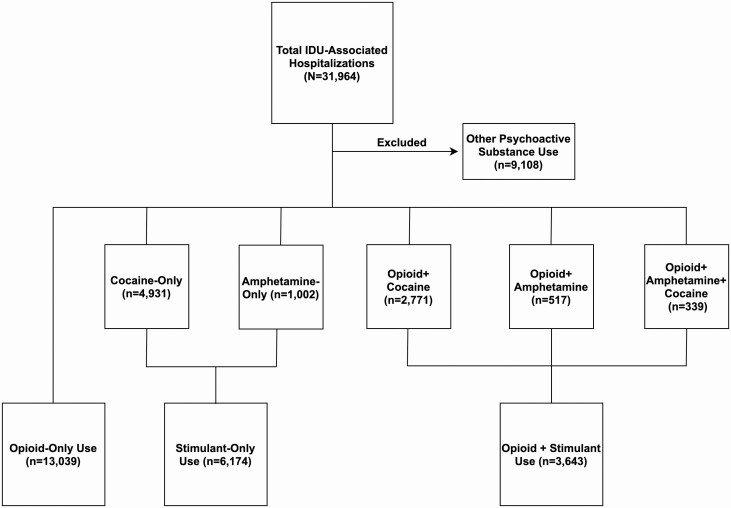
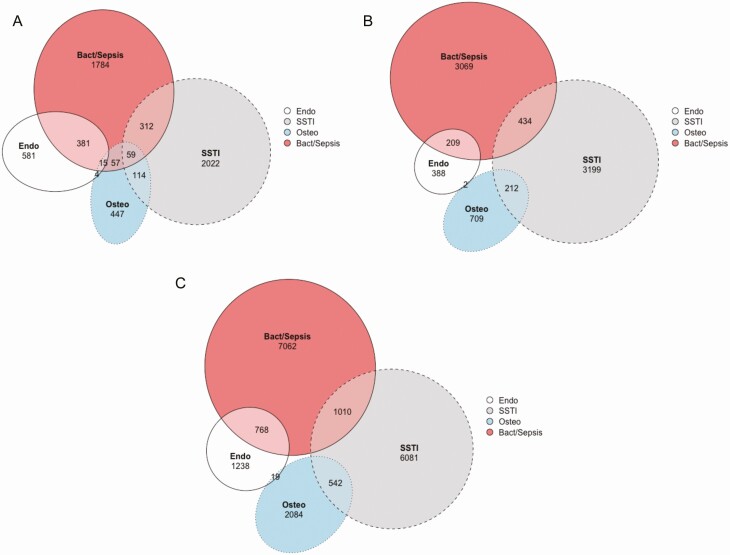
Background: The opioid epidemic has led to increases in injection drug use (IDU)-associated infectious diseases; however, little is known about how more recent increases in stimulant use have affected the incidence and outcomes of hospitalizations for infections among people who inject drugs (PWID). Methods: All hospitalizations of PWID for IDU-associated infections in Florida were identified using administrative diagnostic codes and were grouped by substance used (opioids, stimulants, or both) and site of infection. We evaluated the association between substance used and the outcomes: patient-directed discharge (PDD, or “against medical advice”) and in-hospital mortality. Results: There were 22 856 hospitalizations for infections among PWID. Opioid use was present in 73%, any stimulants in 43%, and stimulants-only in 27%. Skin and soft tissue infection was present in 50%, sepsis/bacteremia in 52%, osteomyelitis in 10%, and endocarditis in 10%. PWID using opioids/stimulants were youngest, most uninsured, and had the highest rates of endocarditis (16%) and hepatitis C (44%). Additionally, 25% of patients with opioid/stimulant use had PDD versus 12% for those using opioids-only. In adjusted models, opioid/stimulant use was associated with PDD compared to opioid-only use (aRR 1.28, 95% CI 1.17–1.40). Younger age and endocarditis were also associated with PDD. Compared to opioid-only use, stimulant-only use had higher risk of in-hospital mortality (aRR 1.26, 95% CI 1.03–1.46). Conclusions: While opioid use contributed to most IDU-associated infections, many hospitalizations also involved stimulants. Increasing access to harm reduction interventions could help prevent these infections, while further research on the acute management of stimulant use disorder-associated infections is needed.
Overview
The claims and statistics of this paper haven’t been checked yet.
Run the check — free, no account needed. It reads the open-access text and checks the sources it cites.
Integrity signals
Registry
Cites
Statistics
Figures
Verification
Claims the paper makes
The claims and statistics of this paper haven’t been checked yet.
Run the check — free, no account needed. It reads the open-access text and checks the sources it cites.
Claims other papers make about this one
Each is checked against this paper’s own text: does it say what the citing paper says it does?
In the citing paper
“Injection drug use–associated bacterial and fungal infections (e.g., skin and soft-tissue infections, endocarditis, osteomyelitis, septic arthritis, and epidural abscess) are associated with significant morbidity and mortality among people who inject drugs (PWID) and are costly for healthcare systems [1–6].”
Self-check
Percentages, sums and reported differences re-computed from the paper’s own numbers.
The self-check needs the paper’s full text.
Citations
Cites
Responding to global stimulant use: challenges and opportunities
Farrell, M., Martin, N. K., Stockings, E., Bórquez, A., Cepeda, J. A., Degenhardt, L., Ali, R., Tran, L. T., Rehm, J., Torrens, M., et al. (2019) · The Lancet · doi:10.1016/s0140-6736(19)32230-5 · Cited by 310 · cited 1×
“Based on these factors, stimulant use is especially strongly associated with HIV and HCV infection [20].”
BackgroundRisk Factors for Skin and Soft‐Tissue Abscesses among Injection Drug Users: A Case‐Control Study
Murphy, E. L., DeVita, D., Liu, H., Vittinghoff, E., Leung, P., Ciccarone, D. H., & Edlin, B. R. (2001) · Clinical Infectious Diseases · doi:10.1086/320879 · Cited by 262
Lloyd-Smith, E., Wood, E., Zhang, R., Tyndall, M. W., Montaner, J. S., & Kerr, T. (2008) · BMC Public Health · doi:10.1186/1471-2458-8-405 · Cited by 123
Research works printed but not linked: 38
- Cranston, 2019, Notes from the field: HIV diagnoses among persons who inject drugs—Northeastern Massachusetts, 2015–2018, MMWR Morb Mortal Wkly Rep, 68, 253, 10.15585/mmwr.mm6810a6 · DOI
- Golden, 2019, Outbreak of human immunodeficiency virus infection among heterosexual persons who are living homeless and inject drugs—Seattle, Washington, 2018, MMWR Morb Mortal Wkly Rep, 68, 344, 10.15585/mmwr.mm6815a2 · DOI
- Zibbell, 2015, Increases in hepatitis C virus infection related to injection drug use among persons aged </=30 years—Kentucky, Tennessee, Virginia, and West Virginia, 2006–2012, MMWR Morb Mortal Wkly Rep, 64, 453
- Ronan, 2016, Hospitalizations related to opioid abuse/dependence and associated serious infections increased sharply, 2002–12, Health Aff (Millwood), 35, 832, 10.1377/hlthaff.2015.1424 · DOI
- McCarthy, 2020, Bacterial infections associated with substance use disorders, large cohort of United States Hospitals, 2012–2017, Clin Infect Dis, 10.1093/cid/ciaa008 · DOI
- Schranz, 2019, Trends in drug use–associated infective endocarditis and heart valve surgery, 2007 to 2017: a study of statewide discharge datadrug use–associated infective endocarditis and valve surgery, Ann Intern Med, 170, 31, 10.7326/M18-2124 · DOI
- Leahey, 2019, High morbidity and mortality among patients with sentinel admission for injection drug use-related infective endocarditis, Open Forum Infect Dis, 6, ofz089, 10.1093/ofid/ofz089 · DOI
- Straw, 2019, Long-term outcomes are poor in intravenous drug users following infective endocarditis, even after surgery, Clin Infect Dis
- Bearnot, 2019, Experiences of care among individuals with opioid use disorder-associated endocarditis and their healthcare providers: Results from a qualitative study, J Subst Abuse Treat, 102, 16, 10.1016/j.jsat.2019.04.008 · DOI
- Rosenthal, 2016, Suboptimal addiction interventions for patients hospitalized with injection drug use-associated infective endocarditis, Am J Med, 129, 481, 10.1016/j.amjmed.2015.09.024 · DOI · Paper page
- Serota, 2019, Disparity in quality of infectious disease vs addiction care among patients with injection drug use-associated staphylococcus aureus bacteremia, Open Forum Infect Dis, 6, ofz289, 10.1093/ofid/ofz289 · DOI
- Barocas, 2020, Outcomes associated with medications for opioid use disorder among persons hospitalized for infective endocarditis, Clin Infect Dis
- Nguemeni Tiako, 2019, Recidivism is the leading cause of death among intravenous drug users who underwent cardiac surgery for infective endocarditis, Semin Thorac Cardiovasc Surg, 31, 40, 10.1053/j.semtcvs.2018.07.016 · DOI
- Shiels, 2018, Trends in U.S. drug overdose deaths in non-Hispanic black, Hispanic, and non-Hispanic white persons, 2000–2015, Ann Intern Med, 168, 453, 10.7326/M17-1812 · DOI
- Kariisa, 2019, Drug overdose deaths involving cocaine and psychostimulants with abuse potential—United States, 2003–2017, MMWR Morb Mortal Wkly Rep, 68, 388, 10.15585/mmwr.mm6817a3 · DOI
- Jones, 2020, Resurgent methamphetamine use at treatment admission in the United States, 2008–2017, Am J Public Health, 110, 509, 10.2105/AJPH.2019.305527 · DOI
- Bartholomew, 2020, Examining risk behavior and syringe coverage among people who inject drugs accessing a syringe services program: a latent class analysis, Int J Drug Policy, 78, 102716, 10.1016/j.drugpo.2020.102716 · DOI
- Barocas, 2019, Sociodemographic factors and social determinants associated with toxicology confirmed polysubstance opioid-related deaths, Drug Alcohol Depend, 200, 59, 10.1016/j.drugalcdep.2019.03.014 · DOI
- Al-Tayyib, 2017, Heroin and methamphetamine injection: an emerging drug use pattern, Subst Use Misuse, 52, 1051, 10.1080/10826084.2016.1271432 · DOI · Paper page
- Balán, 2018, High substance use and HIV risk behavior among young argentine men who have sex with men, AIDS Behav, 22, 1373, 10.1007/s10461-017-1987-z · DOI
- Tookes, 2015, A cost analysis of hospitalizations for infections related to injection drug use at a county safety-net hospital in Miami, Florida, PLoS One, 10, e0129360, 10.1371/journal.pone.0129360 · DOI · Paper page
- Coye, 2020, Hospital costs of injection drug use in Florida, Clin Infect Dis
- Janjua, 2018, Identifying injection drug use and estimating population size of people who inject drugs using healthcare administrative datasets, Int J Drug Policy, 55, 31, 10.1016/j.drugpo.2018.02.001 · DOI · Paper page
- Quan, 2005, Coding algorithms for defining comorbidities in ICD-9-CM and ICD-10 administrative data, Med Care, 43, 1130, 10.1097/01.mlr.0000182534.19832.83 · DOI · Paper page
- Dahlman, 2017, Behavioral characteristics and injection practices associated with skin and soft tissue infections among people who inject drugs: a community-based observational study, Subst Abus, 38, 105, 10.1080/08897077.2016.1263592 · DOI
- Ramachandran, 2018, A large HCV transmission network enabled a fast-growing HIV outbreak in rural Indiana, 2015, EBioMed, 37, 374, 10.1016/j.ebiom.2018.10.007 · DOI
- Lee, 2008, A systematic review of cognitive and behavioural therapies for methamphetamine dependence, Drug Alcohol Rev, 27, 309, 10.1080/09595230801919494 · DOI
- Montoya, 2004, Randomized trial of buprenorphine for treatment of concurrent opiate and cocaine dependence, Clin Pharmacol Ther, 75, 34, 10.1016/j.clpt.2003.09.004 · DOI
- Wang, 2017, Polydrug use and its association with drug treatment outcomes among primary heroin, methamphetamine, and cocaine users, Int J Drug Policy, 49, 32, 10.1016/j.drugpo.2017.07.009 · DOI
- DeMaria, 2000, The effect of stimulant and sedative use on treatment outcome of patients admitted to methadone maintenance treatment, Am J Addict, 9, 145, 10.1080/10550490050173217 · DOI
- Merchant, 2020, Hospitalization outcomes of people who use drugs: One size does not fit all, J Subst Abuse Treat, 112, 23, 10.1016/j.jsat.2020.01.010 · DOI
- Frontera, 2000, Right-side endocarditis in injection drug users: review of proposed mechanisms of pathogenesis, Clin Infect Dis, 30, 374, 10.1086/313664 · DOI
- Chambers, 1987, Cocaine use and the risk for endocarditis in intravenous drug users, Ann Intern Med, 106, 833, 10.7326/0003-4819-106-6-833 · DOI
- Silverman, 2020, Hydromorphone and the risk of infective endocarditis among people who inject drugs: a population-based, retrospective cohort study, Lancet Infect Dis, 20, 487, 10.1016/S1473-3099(19)30705-4 · DOI
- Marks, 2020, Evaluation of partial oral antibiotic treatment for persons who inject drugs and are hospitalized with invasive infections, Clin Infect Dis, 10.1093/cid/ciaa365 · DOI
- Eaton, 2020, In-hospital illicit drug use and patient-directed discharge: barriers to care for patients with injection-related infections, Open Forum Infect Dis, 7, ofaa074, 10.1093/ofid/ofaa074 · DOI
- Serota, 2019, Infectious complications of addiction: a call for a new subspecialty within infectious diseases, Clin Infect Dis
- Wurcel, 2020, Impact of substance use disorder on midterm mortality after valve surgery for endocarditis, Ann Thorac Surg, 109, 1426, 10.1016/j.athoracsur.2019.09.004 · DOI
Cited by
Sorted by citations
Brothers, T. D., Lewer, D., Jones, N., Colledge-Frisby, S., Farrell, M., Hickman, M., Webster, D., Hayward, A., & Degenhardt, L. (2022) · PLOS Medicine · doi:10.1371/journal.pmed.1004049 · Cited by 25
Metadata
- Authors
- Serota, D. P., Bartholomew, T. S., & Tookes, H. E.
- Affiliations
- Division of Infectious Diseases, Department of Medicine, University of Miami Miller School of Medicine, Miami, Florida, USA
- Department of Public Health Sciences, University of Miami Miller School of Medicine, Miami, Florida, USA
- ORCID
- Serota, David P
- Venue
- Clinical Infectious Diseases
- Publisher
- Oxford University Press (OUP)
- Published
- 2020-09-04
- Volume
- 73
- Issue
- 7
- Pages
- e1649-e1657
- ISSN
- 1058-4838
- 1537-6591
- PMC
- PMC8492144
- Cited by
- 38
- References
- 3
- Language
- en
- Funders
- National Institutes of Health (P30CA240139)
About these checks
Registry, retraction, Cites and statistics results are computed, not judged, with one exception: a printed reference that no index lists is read once by a model before it counts as a citation error. Claims are extracted by a model and kept only when their quote appears verbatim in the text; each cited source is then checked, with a model’s help, for whether it says what the claim relies on. Those verdicts can be wrong — read the claim’s quote and the cited source before relying on one.
Statistics and arithmetic are recomputed, not judged.
Confidence bands are shown only for fields calibrated on our annotated test set. None is calibrated yet, so no band is shown.
What counts as a claim ›How we measure confidence ›How we check this ›
Are you an author, or do you see a problem with this page? Request a review
How to cite
Cite CoChat for the checks on this page, and the paper for its own findings.
- This page
- CoChat. (2026). Citation check: Evaluating Differences in Opioid and Stimulant Use-associated Infectious Disease Hospitalizations in Florida, 2016–2017. https://app.cochat.ai/papers/10.1093/cid/ciaa1278
- The paper
- Serota, D. P., Bartholomew, T. S., & Tookes, H. E. (2021). Evaluating Differences in Opioid and Stimulant Use-associated Infectious Disease Hospitalizations in Florida, 2016–2017. Clinical Infectious Diseases. https://doi.org/10.1093/cid/ciaa1278
