

The potential for improving cardio-renal outcomes by sodium-glucose co-transporter-2 inhibition in people with chronic kidney disease: a rationale for the EMPA-KIDNEY study
Open accessThe DOI matches its Crossref record; 78 of the 79 references it cites were found in a registry or an index.
Abstract
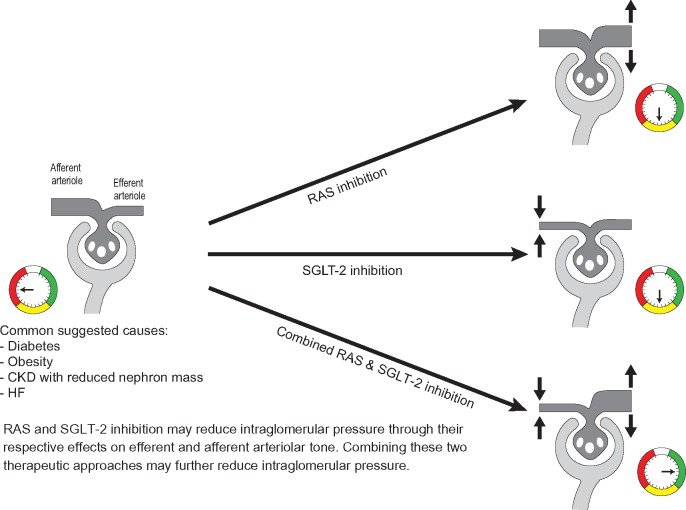
Diabetes is a common cause of chronic kidney disease (CKD), but in aggregate, non-diabetic diseases account for a higher proportion of cases of CKD than diabetes in many parts of the world. Inhibition of the renin-angiotensin system reduces the risk of kidney disease progression and treatments that lower blood pressure (BP) or low-density lipoprotein cholesterol reduce cardiovascular (CV) risk in this population. Nevertheless, despite such interventions, considerable risks for kidney and CV complications remain. Recently, large placebo-controlled outcome trials have shown that sodium-glucose co-transporter-2 (SGLT-2) inhibitors reduce the risk of CV disease (including CV death and hospitalization for heart failure) in people with type 2 diabetes who are at high risk of atherosclerotic disease, and these effects were largely independent of improvements in hyperglycaemia, BP and body weight. In the kidney, increased sodium delivery to the macula densa mediated by SGLT-2 inhibition has the potential to reduce intraglomerular pressure, which may explain why SGLT-2 inhibitors reduce albuminuria and appear to slow kidney function decline in people with diabetes. Importantly, in the trials completed to date, these benefits appeared to be maintained at lower levels of kidney function, despite attenuation of glycosuric effects, and did not appear to be dependent on ambient hyperglycaemia. There is therefore a rationale for studying the cardio-renal effects of SGLT-2 inhibition in people at risk of CV disease and hyperfiltration (i.e. those with substantially reduced nephron mass and/or albuminuria), irrespective of whether they have diabetes.
Overview
The claims and statistics of this paper haven’t been checked yet.
Free: it reads the open-access text and checks the first 5 claims that cite a source we can check. Create a free account to check every claim.
Integrity signals
Registry
Cites
Statistics
Figures
Verification
Claims the paper makes
The claims and statistics of this paper haven’t been checked yet.
Free: it reads the open-access text and checks the first 5 claims that cite a source we can check. Create a free account to check every claim.
Claims other papers make about this one
Each is checked against this paper’s own text: does it say what the citing paper says it does?
The source backs part of the claim, not all of it — or backs it for a different population, condition or comparison.
In the citing paper
“The EMPA-Kidney trial, although not yet published, also enrolled patients with an eGFR as low as 20 ml/min per 1.73 m 2 and was stopped early due to clear evidence of ef fi cacy. 95”
From KDIGO 2022 Clinical Practice Guideline for Diabetes Management in Chronic Kidney Disease (2022) · cites this paper as [95]
Experimental — accuracy not yet measuredIn the citing paper
“There is substantial overlap between the FLOW population and the populations studied in the dedicated kidney outcome studies with SGLT2is (CREDENCE, DAPA-CKD and EMPA-KIDNEY) [15,30,32]”
Self-check
Percentages, sums and reported differences re-computed from the paper’s own numbers.
The self-check needs the paper’s full text.
Citations
Cites
Empagliflozin, Cardiovascular Outcomes, and Mortality in Type 2 Diabetes
Zinman, B., Wanner, C., Lachin, J. M., Fitchett, D., Bluhmki, E., Hantel, S., Mattheus, M., Devins, T., Johansen, O. E., Woerle, H. J., et al. (2015) · New England Journal of Medicine · doi:10.1056/nejmoa1504720 · Cited by 12,315
Self-citationCanagliflozin and Cardiovascular and Renal Events in Type 2 Diabetes
Neal, B., Perkovic, V., Mahaffey, K. W., de Zeeuw, D., Fulcher, G., Erondu, N., Shaw, W., Law, G., Desai, M., & Matthews, D. R. (2017) · New England Journal of Medicine · doi:10.1056/nejmoa1611925 · Cited by 7,830
Brenner, B. M., Cooper, M. E., de Zeeuw, D., Keane, W. F., Mitch, W. E., Parving, H.-H., Remuzzi, G., Snapinn, S. M., Zhang, Z., & Shahinfar, S. (2001) · New England Journal of Medicine · doi:10.1056/nejmoa011161 · Cited by 7,493
Lewis, E. J., Hunsicker, L. G., Clarke, W. R., Berl, T., Pohl, M. A., Lewis, J. B., Ritz, E., Atkins, R. C., Rohde, R., & Raz, I. (2001) · New England Journal of Medicine · doi:10.1056/nejmoa011303 · Cited by 5,987 · cited 2×
“Angiotensin II is one key mediator of efferent arterio-lar resistance and ACEi/ARBs effectively reduce intraglomerular pressure and slow kidney disease progression through a reduction of efferent vascular resistance [11, 12].”
Chronic kidney disease: global dimension and perspectives
Jha, V., Garcia-Garcia, G., Iseki, K., Li, Z., Naicker, S., Plattner, B., Saran, R., Wang, A. Y.-M., & Yang, C.-W. (2013) · The Lancet · doi:10.1016/s0140-6736(13)60687-x · Cited by 4,383 · cited 1×
“Worldwide, diabetic kidney disease accounts for a large proportion of advanced CKD (i.e. Stages 4 and 5), but the proportion of those without diabetes still ranges from (cid:2) 50 to 70% [4, 5].”
Ettehad, D., Emdin, C. A., Kiran, A., Anderson, S. G., Callender, T., Emberson, J., Chalmers, J., Rodgers, A., & Rahimi, K. (2016) · The Lancet · doi:10.1016/s0140-6736(15)01225-8 · Cited by 3,755 · cited 1×
“Trials of intensification of blood pressure (BP) lowering also suggest small benefits on CKD progression may perhaps exist among those with proteinuria [18–21].”
Empagliflozin and Progression of Kidney Disease in Type 2 Diabetes
Wanner, C., Inzucchi, S. E., Lachin, J. M., Fitchett, D., von Eynatten, M., Mattheus, M., Johansen, O. E., Woerle, H. J., Broedl, U. C., & Zinman, B. (2016) · New England Journal of Medicine · doi:10.1056/nejmoa1515920 · Cited by 3,655
Self-citationKlahr, S., Levey, A. S., Beck, G. J., Caggiula, A. W., Hunsicker, L., Kusek, J. W., & Striker, G. (1994) · New England Journal of Medicine · doi:10.1056/nejm199403313301301 · Cited by 2,328
Epidemiology and risk profile of heart failure
Bui, A. L., Horwich, T. B., & Fonarow, G. C. (2011) · Nature Reviews Cardiology · doi:10.1038/nrcardio.2010.165 · Cited by 2,077
Research works printed but not linked: 2
- Kidney Disease: Improving Global Outcomes (KDIGO) Lipid Guideline Development Work Group. KDIGO clinical practice guideline for lipid management in chronic kid- ney disease. Kidney Int Suppl 2013; 3: 263-26
- Empagliflozin (JardianceV R ) to be studied in chronic kidney disease. https://www.boehringer-ingelheim.com/press-release/emp agliflozin-be-studied-chronic-kidney-disease (29 August 2017, date last accessed)
Cited by
Items 201–236 of 236
Fisher, M., Llano, A., & McKay, G. (2022) · Wiley eBooks · doi:10.1002/9781119785033.ch5 · Cited by 1
BIOMARKERS OF OXIDATIVE STRESS IN NEURODEGENERATIVE DISEASES
Sultana, R., Cenini, G., & Butterfield, D. A. (2025) · Wiley eBooks · doi:10.1002/9781119790419.ch18 · Cited by 1
Leon, S. J., & Tangri, N. (2022) · PubMed · doi:10.1097/mnh.0000000000000778
In high-risk T2DM, canagliflozin reduced CV events regardless of baseline renal function
Herrington, W. G., Zhu, D., & Haynes, R. (2019) · Annals of Internal Medicine · doi:10.7326/acpj201902190-015
Self-citationAn Age of Sodium-Glucose Cotransporter-2 Inhibitor Priority: Are We Ready?
Seo, J. A. (2019) · Diabetes & Metabolism Journal · doi:10.4093/dmj.2019.0173
In type 2 diabetes, SGLT-2 inhibitors reduce risk for major kidney outcomes
Ng, S. Y. A., Zhu, D., & Herrington, W. G. (2020) · Annals of Internal Medicine · doi:10.7326/acpj202002180-018
Self-citationThe position of SGLT2 inhibitors in current medicine
Prázný, M. (2020) · Vnitřní lékařství · doi:10.36290/vnl.2020.013
Частота, степень и предикторы ренальной дисфункции у пациентов с мозговым инсультом
Flomin, Y. V., Ivanov, D. D., Chervonopyska, O. M., Gurianov, V. G., & Соколова, Л. И. (2020) · KIDNEYS · doi:10.22141/2307-1257.9.4.2020.218553
Sousa, L. S., Nascimento, F. D. A., Rocha, J. S., & Parise, M. R. (2021) · International Journal of Cardiovascular Sciences · doi:10.36660/ijcs.20200339 · Cited by 2
Cardiometabolic Risk Reduction: A Review of Clinical Guidelines and the Role of SGLT-2 Inhibitors
Reid (2021) · The Journal of Family Practice · doi:10.12788/jfp.0216
Use of SGLT-2 Inhibitors in Patients with Chronic Kidney Disease
Mottl (2021) · The Journal of Family Practice · doi:10.12788/jfp.0225 · Cited by 3
Improving Shingles Vaccination Rates in Family Medicine
Luther (2021) · The Journal of Family Practice · doi:10.12788/jfp.0218
The Challenge: Finding the Most Appropriate Statin and Dose for Each Patient
Lillo (2021) · The Journal of Family Practice · doi:10.12788/jfp.0224
Clinical relevance of recent outcome trials with antidiabetic drugs
Fisher, M. (2021) · Practical Diabetes · doi:10.1002/pdi.2363
Maxson, R., & Jackson, C. (2022) · Physician Assistant Clinics · doi:10.1016/j.cpha.2021.11.002
New guidance on sodium glucose co-transporter 2 inhibitors in adults with kidney disease
Herrington, W. G., Frankel, A., & Burton, J. O. (2021) · Journal of Kidney Care · doi:10.12968/jokc.2021.6.6.300
Self-citationRenal Nutrition—Where It Has Been and Where It Is Going
Kopple, J. D., & Ekramzadeh, M. (2022) · Kidney and Dialysis · doi:10.3390/kidneydial2040046
SGLT-2 inhibitors in Lupus Nephropathy. It could be considered an intervention of Nephroprotection
Rico-Fontalvo, J. E., Jiménez, L. C. V., Yánez, T. R., Daza-Arnedo, R., Serpa, O. V. V., Uparella-Gulfo, I., & Álvarez-Estévez, G. (2022) · Revista Paraguaya de Reumatología · doi:10.18004/rpr/2022.08.02.94 · Cited by 1
SGLT2 Inhibitors for Nephrologists
Mahmood, M. B. U. R., & Farishta, S. (2022) · EMJ Nephrology · doi:10.33590/emjnephrol/22-00083
Shakour, N., Hoseinpoor, S., Iranshahi, M., Badpeyma, M., & Hadizadeh, F. (2023) · Research Square · doi:10.21203/rs.3.rs-2630494/v1
Diabetes: evolution of multifactorial vascular risk reduction
Falcetta, P., Garofolo, M., Penno, G., & Prato, S. D. (2023) · Elsevier eBooks · doi:10.1016/b978-0-323-99991-5.00007-3 · Cited by 1
Progression of Chronic Kidney Disease and Nephroprotective Therapy
Wühl, E., & Schaefer, F. S. (2023) · Springer eBooks · doi:10.1007/978-3-031-11665-0_55
der Beek, A. B. V. D. A. (2023) · University of Groningen research database (University of Groningen / Centre for Information Technology) · doi:10.33612/diss.637600695
Adjunct Drug Treatment to Reduce Vascular Disease in People with Diabetes
Jenkins, A. J. (2023) · Contemporary diabetes · doi:10.1007/978-3-031-26681-2_29
New Horizons in IgA Nephropathy: A Focus on Current Treatment and Emerging Solutions
Roberts, E. (2023) · European Medical Journal · doi:10.33590/emj/10303661
Davies, M. J., Drexel, H., Jornayvaz, F. R., Pataky, Z., Seferovic, P. M., & Wanner, C. (2022) · Figshare · doi:10.6084/m9.figshare.20438489
Self-citationSGLT2 inhibitors in lupus nephritis: a multicentric study in Latin America
Daza, J. L., Gutiérrez, G., Murcia, R. L. P., Cárdenas, A., & Bello, J. S. R. (2025) · Nefrología Latinoamericana · doi:10.24875/nefro.24000019
THE ROLE OF OXIDATIVE STRESS IN CHRONIC KIDNEY DISEASE (CKD)
Aboolian, A., Younes, J., Romero, A., Jha, J. C., Jandeleit-Dahm, K. A. M., & Meister, A. J. (2025) · Wiley eBooks · doi:10.1002/9781119790419.ch17 · Cited by 2
Abdulrasak, M., Someili, A. M., & Mohrag, M. (2025) · Medicina · doi:10.3390/medicina61050921 · Cited by 2
Diuretics in the Treatment of Heart Failure Due to Congenital Heart Disease
Hayabuchi, Y. (2025) · Japanese Society of Pediatric Cardiology and Cardiac Surgery · doi:10.9794/jspccs.41.67
Davies, M. J., Drexel, H., Jornayvaz, F. R., Pataky, Z., Seferović, P. M., & Wanner, C. (2022) · Figshare · doi:10.6084/m9.figshare.20438492
Self-citationYamada, T., Wakabayashi, M., Bhalla, A., Chopra, N., Miyashita, H., Mikami, T., Ueyama, H., Fujisaki, T., Saigusa, Y., Yamaji, T., et al. (2021) · Figshare · doi:10.6084/m9.figshare.13545484
Regulatory Approach to Medications for Type 2 Diabetes: Past, Present, and Future
Everett, B. M., Pagidipati, N. J., & Wang, C. C. L. (2026) · Elsevier eBooks · doi:10.1016/b978-0-323-87862-3.00011-2
Herrington, W. G., & Haynes, R. (2026) · Elsevier eBooks · doi:10.1016/b978-0-323-87862-3.00025-2
Self-citationPadda, B., Kelleher, J. T., Muroke, V., Sridhar, V. S., Tremblay‐Gravel, M., Tardif, J., & Boulet, J. (2026) · Frontiers in Cardiovascular Medicine · doi:10.3389/fcvm.2026.1809193
Ahmed, M. J., Ahmad, A. M., Naqvi, S., Ahmed, K., Ahmed, A., & Naqvi, Z. (2026) · Cureus · doi:10.7759/cureus.116699
Metadata
- Authors
- Herrington, W. G., Preiss, D., Haynes, R., von Eynatten, M., Staplin, N., Hauske, S. J., George, J. T., Green, J. B., Landray, M. J., Baigent, C., & Wanner, C.
- Affiliations
- University of Oxford (GB)
- Boehringer Ingelheim (Germany) (DE)
- Duke Medical Center (US)
- Universitätsklinikum Würzburg (DE)
- Corresponding author
- Herrington, William G
- ORCID
- Venue
- Clinical Kidney Journal
- Publisher
- Oxford University Press (OUP)
- Published
- 2018-10-25
- Volume
- 11
- Issue
- 6
- Pages
- 749-761
- ISSN
- 2048-8505 (ISSN-L)
- 2048-8513
- PMC
- PMC6275453
- OpenAlex
- W2898388822
- Cited by
- 237
- References
- 79
- Citations by year
- 2026: 5 · 2025: 9 · 2024: 8 · 2023: 23 · 2022: 49 · 2021: 64 · 2020: 48 · 2019: 29 · 2018: 1
- FWCI
- 6.09
- Type
- journal article
- Language
- en
- Open access
- gold
- doi.org
- Licence
- Locations
- Clinical Kidney Journal (publishedVersion, cc-by)
- Europe PMC (PubMed Central) (publishedVersion, cc-by)
- PubMed Central (publishedVersion, cc-by)
- PubMed (publishedVersion)
- Funders
- Medical Research Council
- Kidney Research UK
- Topics
- Health Sciences › Medicine › Nephrology › Chronic Kidney Disease and Diabetes
- Health Sciences › Medicine › Endocrinology, Diabetes and Metabolism › Diabetes Treatment and Management
- Health Sciences › Medicine › Cardiology and Cardiovascular Medicine › Blood Pressure and Hypertension Studies
- Keywords
- SGLT2 inhibitors, chronic kidney disease, EMPA-KIDNEY trial, cardiovascular outcomes, albuminuria, hyperfiltration, intraglomerular pressure, renal function decline, non-diabetic chronic kidney disease, renin-angiotensin system, heart failure hospitalization, cardiovascular mortality
About these checks
Registry, retraction, Cites and statistics results are computed, not judged, with one exception: a printed reference that no index lists is read once by a model before it counts as a citation error. Claims are extracted by a model and kept only when their quote appears verbatim in the text; each cited source is then checked, with a model’s help, for whether it says what the claim relies on. Those verdicts can be wrong — read the claim’s quote and the cited source before relying on one.
Statistics and arithmetic are recomputed, not judged.
Confidence bands are shown only for fields calibrated on our annotated test set. None is calibrated yet, so no band is shown.
What counts as a claim ›How we measure confidence ›How we check this ›
Are you an author, or do you see a problem with this page? Request a review
Data sources
Bibliographic data: Semantic Scholar, OpenAlex, Crossref.
Contains information from the Semantic Scholar Academic Graph Datasets, made available under the ODC Attribution License (ODC-BY 1.0).
Semantic Scholar’s data is described in: Kinney, R., et al. (2023). The Semantic Scholar Open Data Platform. arXiv:2301.10140.
