

The DOI matches its Crossref record; 35 of the 35 references it cites were found in a registry or an index.
In silico characterization of tandem repeats in Trichophyton rubrum and related dermatophytes provides new insights into their role in pathogenesis
Abstract
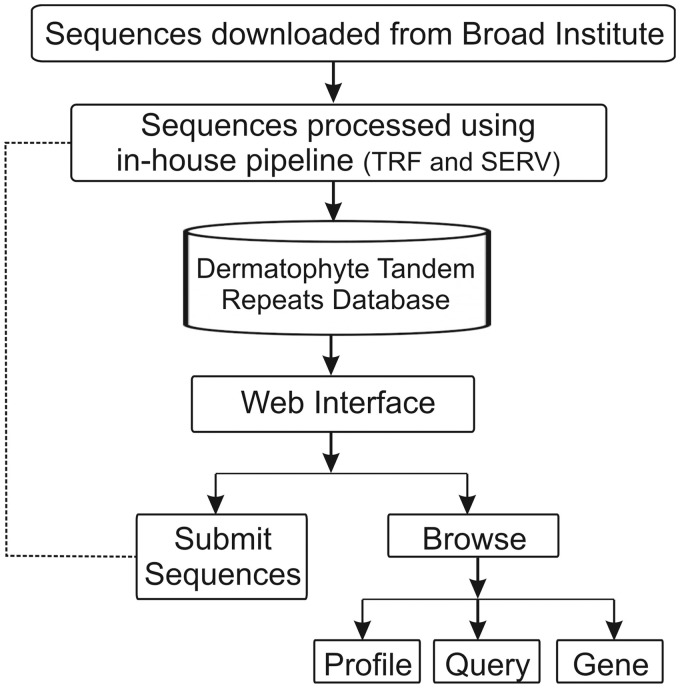
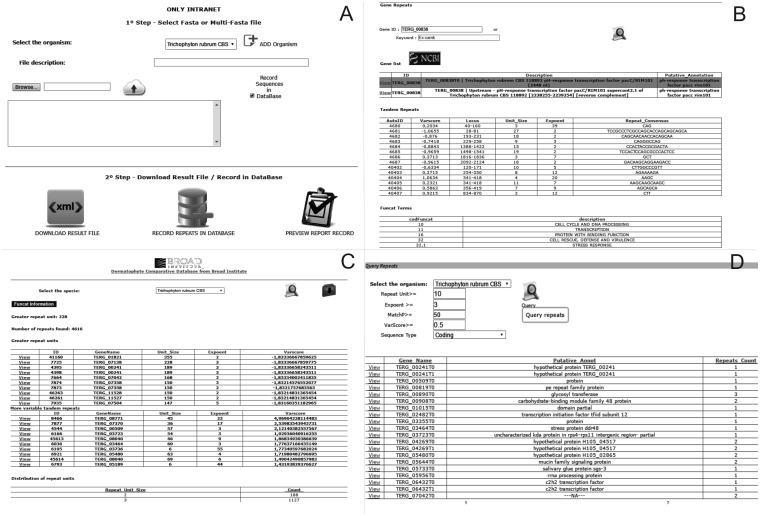
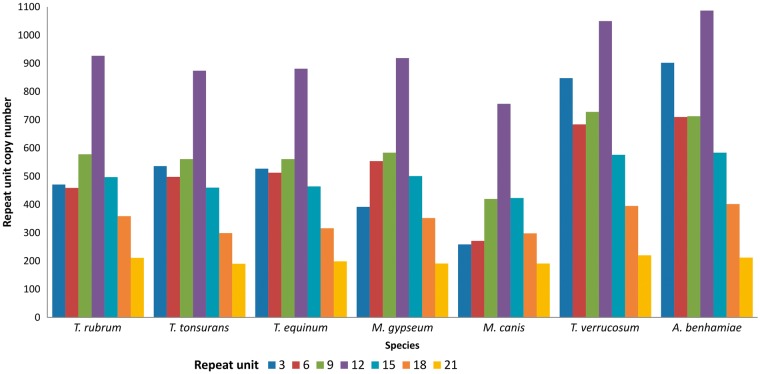
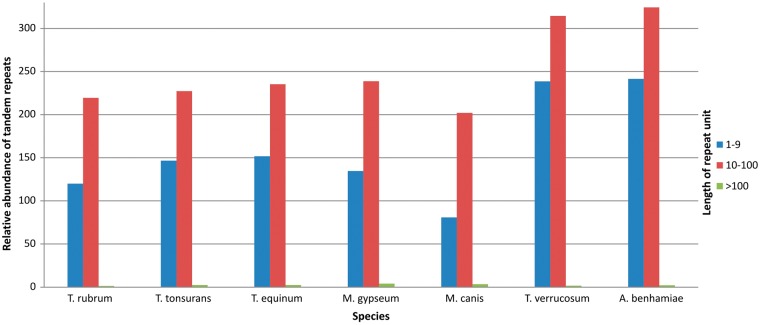
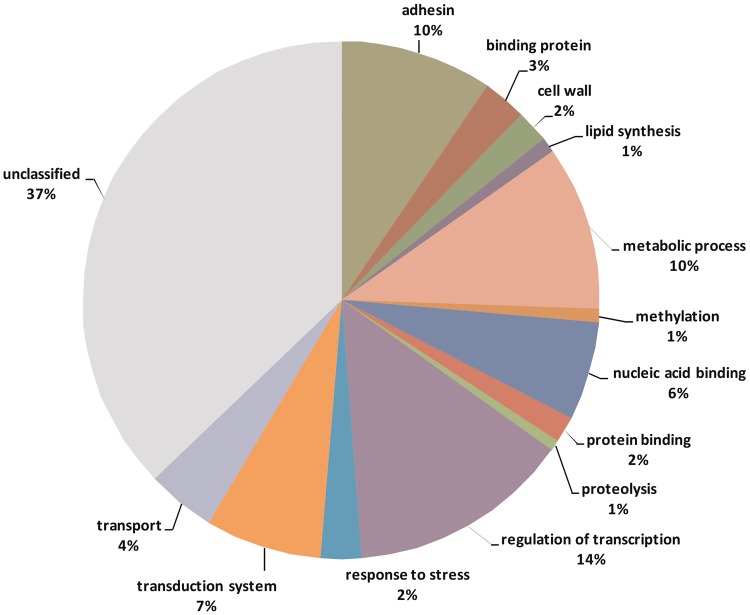
Trichophyton rubrum is the most common etiological agent of dermatophytoses worldwide, which is able to degrade keratinized tissues. The sequencing of the genome of different dermatophyte species has provided a large amount of data, including tandem repeats that may play a role in genetic variability and in the pathogenesis of these fungi. Tandem repeats are adjacent DNA sequences of 2–200 nucleotides in length, which exert regulatory and adaptive functions. These repetitive DNA sequences are found in different classes of fungal proteins, especially those involved in cell adhesion, a determinant factor for the establishment of fungal infection. The objective of this study was to develop a Dermatophyte Tandem Repeat Database (DTRDB) for the storage and identification of tandem repeats in T. rubrum and six other dermatophyte species. The current version of the database contains 35 577 tandem repeats detected in 16 173 coding sequences. The repeats can be searched using entry parameters such as repeat unit length (nt—nucleotide), repeat number, variability score, and repeat sequence motif. These data were used to study the relative frequency and distribution of repeats in the sequences, as well as their possible functions in dermatophytes. A search of the database revealed that these repeats occur in 22–33% of genes transcribed in dermatophytes where they could be involved in the success of adaptation to the host tissue and establishment of infection. The repeats were detected in transcripts that are mainly related to three biological processes: regulation, adhesion, and metabolism. The database developed enables users to identify and analyse tandem repeat regions in target genes related to pathogenicity and fungal–host interactions in dermatophytes and may contribute to the discovery of new targets for the development of antifungal agents. Database URL:http://comp.mch.ifsuldeminas.edu.br/dtrdb/
Overview
The claims and statistics of this paper haven’t been checked yet.
Run the check — free, no account needed. It reads the open-access text and checks the sources it cites.
Integrity signals
Registry
Cites
Statistics
Figures
Verification
Claims the paper makes
The claims and statistics of this paper haven’t been checked yet.
Run the check — free, no account needed. It reads the open-access text and checks the sources it cites.
Claims other papers make about this one
Each is checked against this paper’s own text: does it say what the citing paper says it does?
In the citing paper
“Other specialized databases have been developed recently in this regard (e.g. (122–126)), starting off from human-centered research questions and expanding to examples of many other species, such as the tobacco plant (127), Trichophytum rubrum, a fungus causing skin disease (128), or the Cannabis plant to characterize the origin of hemp seeds (US Cannabis DNA database; (129)).”
From Tandem repeats lead to sequence assembly errors and impose multi-level challenges for genome and protein databases (2019) · cites this paper as [128]
Self-check
Percentages, sums and reported differences re-computed from the paper’s own numbers.
The self-check needs the paper’s full text.
Citations
Cites
Gene Ontology: tool for the unification of biology
Ashburner, M., Ball, C. A., Blake, J. A., Botstein, D., Butler, H., Cherry, J. M., Davis, A. P., Dolinski, K., Dwight, S. S., Eppig, J. T., et al. (2000) · Nature Genetics · doi:10.1038/75556 · Cited by 43,206
The Pfam Protein Families Database
Bateman, A. (2002) · Nucleic Acids Research · doi:10.1093/nar/30.1.276 · Cited by 14,000
Conesa, A., Götz, S., García-Gómez, J. M., Terol, J., Talón, M., & Robles, M. (2005) · Bioinformatics · doi:10.1093/bioinformatics/bti610 · Cited by 11,495
Tandem repeats finder: a program to analyze DNA sequences
Benson, G. (1999) · Nucleic Acids Research · doi:10.1093/nar/27.2.573 · Cited by 9,374
The Pfam protein families database
Punta, M., Coggill, P. C., Eberhardt, R. Y., Mistry, J., Tate, J., Boursnell, C., Pang, N., Forslund, K., Ceric, G., Clements, J., et al. (2012) · Nucleic Acids Research · doi:10.1093/nar/gkr1065 · Cited by 3,719
Ruepp, A., Zollner, A., Maier, D., Albermann, K., Hani, J., Mokrejs, M., Tetko, I., Güldener, U., Mannhaupt, G., Münsterkötter, M., et al. (2004) · Nucleic Acids Research · doi:10.1093/nar/gkh894 · Cited by 1,144
Weitzman, I., & Summerbell, R. C. (1995) · Clinical Microbiology Reviews · doi:10.1128/cmr.8.2.240 · Cited by 968
Intragenic tandem repeats generate functional variability
Verstrepen, K. J., Jansen, A., Lewitter, F., & Fink, G. R. (2005) · Nature Genetics · doi:10.1038/ng1618 · Cited by 616
Flocculation, adhesion and biofilm formation in yeasts
Verstrepen, K. J., & Klis, F. M. (2006) · Molecular Microbiology · doi:10.1111/j.1365-2958.2006.05072.x · Cited by 589
Selection against frameshift mutations limits microsatellite expansion in coding DNA.
Metzgar, D., Bytof, J., & Wills, C. (2000) · PubMed · Cited by 488
Timescales of Genetic and Epigenetic Inheritance
Rando, O. J., & Verstrepen, K. J. (2007) · Cell · doi:10.1016/j.cell.2007.01.023 · Cited by 472
Unstable Tandem Repeats in Promoters Confer Transcriptional Evolvability
Vinces, M. D., Legendre, M., Caldara, M., Hagihara, M., & Verstrepen, K. J. (2009) · Science · doi:10.1126/science.1170097 · Cited by 370
Hoyer, L. L., Green, C. B., Oh, S.-H., & Zhao, X. (2008) · Medical Mycology · doi:10.1080/13693780701435317 · Cited by 356
An Overview of Fungal Infections
Garber, G. (2001) · Drugs · doi:10.2165/00003495-200161001-00001 · Cited by 309
Mycology – an update. Part 1: Dermatomycoses: Causative agents, epidemiology and pathogenesis
Nenoff, P., Krüger, C., Ginter‐Hanselmayer, G., & Tietz, H. (2014) · JDDG: Journal der Deutschen Dermatologischen Gesellschaft · doi:10.1111/ddg.12245 · Cited by 292
Survey of Simple Sequence Repeats in Completed Fungal Genomes
Karaoglu, H., Lee, C., & Meyer, W. (2004) · Molecular Biology and Evolution · doi:10.1093/molbev/msi057 · Cited by 246
Martinez, D. A., Oliver, B. G. G., Gräser, Y., Goldberg, J. M., Li, W., Martinez-Rossi, N. M., Monod, M., Shelest, E., Barton, R., Birch, E., et al. (2012) · mBio · doi:10.1128/mbio.00259-12 · Cited by 234
Sequence-based estimation of minisatellite and microsatellite repeat variabilityPreprint
Legendre, M., Pochet, N. L. M. M., Pak, T. R., & Verstrepen, K. J. (2007) · Genome Research · doi:10.1101/gr.6554007 · Cited by 204
Gemayel, R., Cho, J. M., Boeynaems, S., & Verstrepen, K. J. (2012) · Genes · doi:10.3390/genes3030461 · Cited by 154
Oh, S.-H., Cheng, G., Nuessen, J. A., Jajko, R., Yeater, K. M., Zhao, X., Pujol, C., Soll, D. R., & Hoyer, L. L. (2005) · Microbiology · doi:10.1099/mic.0.27680-0 · Cited by 108
Genome-wide analysis of tandem repeats in Daphnia pulex - a comparative approach
Mayer, C., Leese, F., & Tollrian, R. (2010) · BMC Genomics · doi:10.1186/1471-2164-11-277 · Cited by 100
Detecting microsatellites within genomes: significant variation among algorithms
Leclercq, S., Rivals, É., & Jarne, P. (2007) · BMC Bioinformatics · doi:10.1186/1471-2105-8-125 · Cited by 92
Coding Tandem Repeats Generate Diversity in Aspergillus fumigatus Genes
Levdansky, E., Romano, J., Shadkchan, Y., Sharon, H., Verstrepen, K. J., Fink, G. R., & Osherov, N. (2007) · Eukaryotic Cell · doi:10.1128/ec.00229-06 · Cited by 91
Marconi, V. C., Kradin, R. L., Marty, F. M., Hospenthal, D. R., & Kotton, C. N. (2010) · Medical Mycology · doi:10.3109/13693780903213512 · Cited by 87
Evolutionary Analysis of Amino Acid Repeats across the Genomes of 12 Drosophila Species
Huntley, M. A., & Clark, A. G. (2007) · Molecular Biology and Evolution · doi:10.1093/molbev/msm129 · Cited by 78
Levdansky, E., Kashi, O., Sharon, H., Shadkchan, Y., & Osherov, N. (2010) · Eukaryotic Cell · doi:10.1128/ec.00126-10 · Cited by 75
Large-scale analysis of tandem repeat variability in the human genome
Duitama, J., Zablotskaya, A., Gemayel, R., Jansen, A., Belet, S., Vermeesch, J. R., Verstrepen, K. J., & Froyen, G. (2014) · Nucleic Acids Research · doi:10.1093/nar/gku212 · Cited by 70
Proteomic profile of dormant Trichophyton Rubrum conidia
Leng, W., Liu, T., Li, R., Yang, J., Wei, C., Zhang, W., & Jin, Q. (2008) · BMC Genomics · doi:10.1186/1471-2164-9-303 · Cited by 45
Molecular Evolution of Minisatellites in Hemiascomycetous Yeasts
Richard, G., & Dujon, B. (2005) · Molecular Biology and Evolution · doi:10.1093/molbev/msj022 · Cited by 45
Bitencourt, T., Macedo, C., Franco, M. E., Assis, A. F., Komoto, T., Stehling, E. G., Beleboni, R., Malavazi, I., Marins, M., & Fachin, A. (2016) · BMC Genomics · doi:10.1186/s12864-016-2567-8 · Cited by 43
Self-citationFaaPred: A SVM-Based Prediction Method for Fungal Adhesins and Adhesin-Like Proteins
Ramana, J., & Gupta, D. K. (2010) · PLoS ONE · doi:10.1371/journal.pone.0009695 · Cited by 40
Comparative and Functional Characterization of Intragenic Tandem Repeats in 10 Aspergillus Genomes
Gibbons, J. G., & Rokas, A. (2008) · Molecular Biology and Evolution · doi:10.1093/molbev/msn277 · Cited by 22
Coding fungal tandem repeats as generators of fungal diversity
Levdansky, E., Sharon, H., & Osherov, N. (2008) · Fungal Biology Reviews · doi:10.1016/j.fbr.2008.08.001 · Cited by 22
Correcting BLAST e-Values for Low-Complexity Segments
Sharon, I., Birkland, A., Chang, K. Y., El‐Yaniv, R., & Yona, G. (2005) · Journal of Computational Biology · doi:10.1089/cmb.2005.12.980 · Cited by 13
Mining and survey of simple sequence repeats in wheat rust Puccinia sp
Singh, R., Pandey, B., Danishuddin, M., Sheoran, S., Sharma, P. K., & Chatrath, R. (2011) · Bioinformation · doi:10.6026/007/97320630007291 · Cited by 10
Cited by
Tørresen, O. K., Star, B., Mier, P., Andrade-Navarro, M. A., Bateman, A., Jarnot, P., Gruca, A., Grynberg, M., Kajava, A. V., Promponas, V. J., et al. (2019) · Nucleic Acids Research · doi:10.1093/nar/gkz841 · Cited by 347
Metadata
- Authors
- Franco, M. E., Bitencourt, T. A., Marins, M., & Fachin, A. L.
- Affiliations
- Unidade de Biotecnologia, Universidade de Ribeirão Preto, Av: Costabile Romano 2201, 14096-900, Ribeirao Preto SP, Brazil
- Venue
- Database
- Publisher
- Oxford University Press (OUP)
- Published
- 2017-01-01
- Volume
- 2017
- ISSN
- 1758-0463
- PMC
- PMC5502367
- Cited by
- 4
- References
- 35
- Language
- en
About these checks
Registry, retraction, Cites and statistics results are computed, not judged, with one exception: a printed reference that no index lists is read once by a model before it counts as a citation error. Claims are extracted by a model and kept only when their quote appears verbatim in the text; each cited source is then checked, with a model’s help, for whether it says what the claim relies on. Those verdicts can be wrong — read the claim’s quote and the cited source before relying on one.
Statistics and arithmetic are recomputed, not judged.
Confidence bands are shown only for fields calibrated on our annotated test set. None is calibrated yet, so no band is shown.
What counts as a claim ›How we measure confidence ›How we check this ›
Are you an author, or do you see a problem with this page? Request a review
Data sources
Bibliographic data: Semantic Scholar, OpenAlex, Crossref.
Contains information from the Semantic Scholar Academic Graph Datasets, made available under the ODC Attribution License (ODC-BY 1.0).
Semantic Scholar’s data is described in: Kinney, R., et al. (2023). The Semantic Scholar Open Data Platform. arXiv:2301.10140.
