

Moral Communities? Religion as a Source of Social Trust in a Multilevel Analysis of 97 German Regions
Open accessThe DOI matches its Crossref record; 54 of the 54 references it cites were found in a registry or an index; 1 of the 49 sources its claims cite were checked for support.
Abstract
This contribution examines the role of religion as source of social trust. Going beyond the scope of the existing literature, we jointly evaluate the effect of individual religiosity and regional religious context by means of multilevel analysis of 97 small-scale German regions. The results based on the German Socio-Economic Panel suggest that there is a double positive effect of Protestantism: Not only do Protestants tend to be more trusting, but a Protestant context also increases one’s trust—regardless of individual religious beliefs. Conversely, social trust is less developed in Catholic-dominated regions. In addition, although Catholic individuals are more trusting than the non-religious individuals, they do not differ from members of smaller Christian groups or Muslims. At same time, the notion that certain religious groups and especially religious minorities are distrustful of the wider society is not substantiated by empirical evidence. Furthermore, while church attendance is a powerful predictor for social trust, a context effect for regional levels of devoutness could not be detected. Finally, religious diversity decreases social trust for Muslims only, but not to a degree as to pose a threat to social integration.
Overview
CoChat Summary
TL;DR
This paper uses multilevel data on 20,515 Germans nested in 97 regions to test whether religion shapes social trust through both individual religiosity and regional religious context. It finds a strong positive association for Protestantism at both levels, a strong positive effect of church attendance, no direct trust penalty for religious diversity, and a contextual diversity effect that lowers trust only for Muslims.
Key findings
- Individual religiosity matters: regular church attendance is associated with higher social trust, with an estimated increase of about 16 points on the trust scale (e.g., 16.12 in Table 1; 16.05 in Table 2).
- Protestantism shows a “double positive effect”: Protestants are more trusting than the non-religious and Catholics, and living in a Protestant regional context also raises trust. The paper states that a hypothetical 100% Protestant region increases trust by 21 points, while a 100% Catholic region decreases trust by 19 points.
- Religious minorities are not generally distrustful: Catholics are more trusting than the non-religious, but do not differ from smaller Christian groups or Muslims; Muslims do not differ markedly from Christians in the main individual-level models.
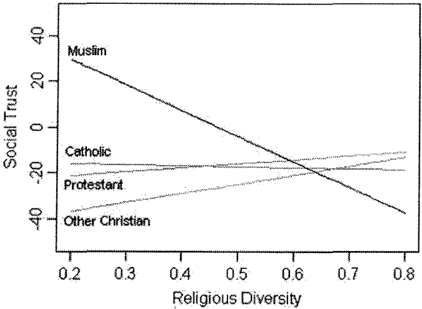
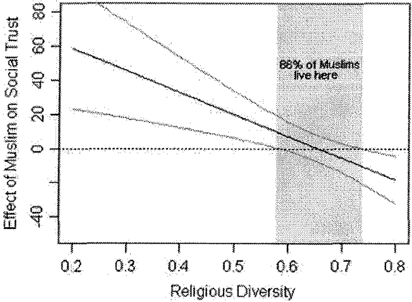
- Regional devoutness and religious diversity do not have significant direct effects on trust overall, but cross-level analyses show religious diversity lowers trust for Muslims specifically; the paper says the effect becomes statistically insignificant in regions with diversity scores between 0.58 and 0.74, where around 86% of Muslims in the sample live.
Methods
- Multilevel/hierarchical linear models were estimated on GSOEP 2003 survey data, with individuals nested in 97 German regions (Raumordnungsregionen); total sample size is 20,515 individuals aged 16+.
- Social trust was measured with three survey items and combined into a factor-based index; religiosity was measured by religious affiliation and church attendance, and regional context by Protestant/Catholic shares, devoutness, and a Herfindahl-based diversity index.
- Analyses used REML estimation and multiple imputation (m = 5) for missing data; the paper also tested cross-level interaction terms between individual religious affiliation and regional context.
Limitations
- The paper itself notes that regional church attendance may be measured at too high a level of aggregation; it suggests regions “might still be too large” to detect contextual effects that could appear at neighborhood or local-community levels.
- The author notes that some contextual measures are imperfect proxies because official regional data were unavailable, relying instead on GSOEP-based aggregation for Protestant/Catholic shares and devoutness.
- Evident from the text: the paper is observational and cross-sectional (2003 wave), so causal claims are not established.
Model-written summary. Check it against the paper before relying on it.
Integrity signals
Registry
Cites
Statistics
Figures
Verification
Claims the paper makes
1 Valid · 1 Not valid · 24 Not checked · 32 Own results and interpretations
A result the paper reports from its own data — it cites no other source for it, so there is none to check. The quote shows it is in the paper.
In the paper
“In addition, although Catholic individuals are more trusting than the non-religious individuals, they do not differ from members of smaller Christian groups or Muslims.”
plain- Asserted: passes — The authors put it forward as true.
- Checkable: passes — It can be checked against evidence.
- Load-bearing: passes — The paper’s conclusions depend on it.
- Based: passes — The paper gives a reason why it holds.
A result the paper reports from its own data — it cites no other source for it, so there is none to check. The quote shows it is in the paper.
In the paper
“In addition, although Catholic individuals are more trusting than the non-religious individuals, they do not differ from members of smaller Christian groups or Muslims.”
plainstates an association- Asserted: passes — The authors put it forward as true.
- Checkable: passes — It can be checked against evidence.
- Load-bearing: unclear — It is unclear whether the paper’s conclusions depend on it.
- Based: passes — The paper gives a reason why it holds.
A result the paper reports from its own data — it cites no other source for it, so there is none to check. The quote shows it is in the paper.
In the paper
“Not only do Protestants tend to be more trusting, but a Protestant context also increases one's trust—regardless of individual religious beliefs.”
plainstates a cause- Asserted: passes — The authors put it forward as true.
- Checkable: passes — It can be checked against evidence.
- Load-bearing: passes — The paper’s conclusions depend on it.
- Based: passes — The paper gives a reason why it holds.
A result the paper reports from its own data — it cites no other source for it, so there is none to check. The quote shows it is in the paper.
In the paper
“Furthermore, while church attendance is a powerful predictor for social trust”
boostedstates an association- Asserted: passes — The authors put it forward as true.
- Checkable: passes — It can be checked against evidence.
- Load-bearing: passes — The paper’s conclusions depend on it.
- Based: passes — The paper gives a reason why it holds.
15 more claims
Create a free account to see all 58 claims and to verify the 4 references still open.
- Probably not a substantial claim. 24
- It may state two separate claims as one. 24
- The quote only partly states this claim. 3
Citations
Cites
Social Capital in the Creation of Human Capital
Coleman, J. S. (1988) · American Journal of Sociology · doi:10.1086/228943 · Cited by 26,975
Social Capital in the Creation of Human Capital
COLEMAN, J. (2000) · Knowledge and Social Capital · doi:10.1016/b978-0-7506-7222-1.50005-2 · Cited by 21,666
Birds of a Feather: Homophily in Social Networks
McPherson, M., Smith-Lovin, L., & Cook, J. M. (2001) · Annual Review of Sociology · doi:10.1146/annurev.soc.27.1.415 · Cited by 18,567
Putnam, R. (2000) · doi:10.1145/358916.361990 · Cited by 17,114
Data Analysis Using Regression and Multilevel/Hierarchical Models
Gelman, A., & Hill, J. (2006) · doi:10.1017/cbo9780511790942 · Cited by 13,597
Understanding Interaction Models: Improving Empirical Analyses
Brambor, T., Clark, W. R., & Golder, M. (2006) · Political Analysis · doi:10.1093/pan/mpi014 · Cited by 6,223 · cited 1×
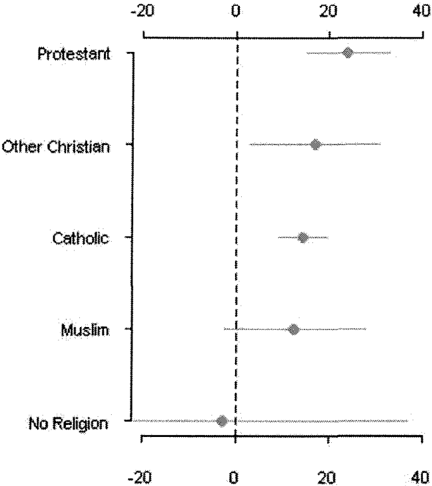
“Plotting the results in a marginal effect plot (cf. Brambor et al., 2005) shows that the positive effect of church attendance holds for all Christian groups but not for Muslims and the non-religious where in both cases the confidence intervals intersect zero (see Figure 1).”
BackgroundModernization, Cultural Change, and the Persistence of Traditional Values
Inglehart, R., & Baker, W. E. (2000) · American Sociological Review · doi:10.2307/2657288 · Cited by 4,524
Putnam, R. D. (2007) · Scandinavian Political Studies · doi:10.1111/j.1467-9477.2007.00176.x · Cited by 4,027
Comparative Politics and the Comparative Method
Lijphart, A. (1971) · American Political Science Review · doi:10.2307/1955513 · Cited by 3,151
The Moral Basis of a Backward Society.
Banfield, E. C. (1959) · Economica · doi:10.2307/2550413 · Cited by 3,136
Research works printed but not linked: 24
- Campbell, D. E. and Yonish, S. J. (2003). Religion and volunteering in America. In Smidt, C. E. (Ed.), Religion as Social Capital. Waco, TX: Baylor University Press, pp. 87-106.
- Durkheim, E. ([1897] 1951). Suicide. Glencoe, IL: Free Press.
- Durkheim, E. ([1912] 1995). The Elementary Forms of the Religious Life. New York: Free Press.
- Fukuyama, F. (1995). Trust. The Social Virtues and the Creation of Prosperity. New York: Free Press.
- Fukuyama, F. (2000). The Great Disruption: Human Nature and the Reconstruction of Social Order. New York: Free Press.
- Gellner, E. (1981). Muslim Society. Cambridge: Cambridge University Press.
- Gundelach, B. and Traunmüller, R. (2010). Kulturelle Diversität und sozialer Zusammenhalt. Eine Mehrebenenanalyse zum Einfluss multikultureller Kontexte auf das Sozialkapital in den deutschen Regionen [Cultural diversity and social cohesion. A multilevel analysis of the effect of multicultural contexts on social capital in the German regions]. In Freitag, M. and Vatter, A. (Eds.), Subnational vergleichende Analysen für Deutschland. Institutionen, Staatstätigkeiten und politische Kulturen. München: Lit-Verlag, pp. 315-343.
- Hooghe, M. and Stolle, D. (2003). Generating Social Capital. Civil Society and Institutions in Comparative Perspective. New York: Palgrave and MacMillan.
- Leege, D. C. (1993). Religion and politics in theoretical perspective. In Leege, D. C. and Kellstedt, L. A. (Eds.), Rediscovering the Religious Factor in American Politics. Armonk: M.E. Sharpe, pp. 3-25.
- Meulemann, H. (2004). Religiosität: Die Persistenz eines Sonderfalls [Religiosity: the persistence of a special case]. In van Deth, J. W. (Ed.), Deutschland in Europa. Wiesbaden: VS Verlag, pp. 55–76.
- Neller, K. (2008). Explaining social trust: what makes people trust their fellow citizens? In Meulemann, H. (Ed.), Social Capital in Europe: Similarity of Countries and Diversity of People? Multi-level analyses of the European Social Survey 2002. Leiden: Brill, pp. 103–133.
- Norris, P. and Inglehart, R. (2004). Sacred and Secular. Religion and Politics Worldwide. Cambridge: Cambridge University Press.
- Parsons, T. (1967). Sociological Theory and Modern Society. New York: Free Press.
- Putnam, R. D. (1993). Making Democracy Work. Civic Traditions in Modern Italy. Princeton: Princeton University Press.
- Raudenbush, S. W. and Bryk, A. S. (2002). Hierarchical Linear Models, 2nd edition Thousand Oaks: Sage.
- Roßteutscher, S. (2008). Undemokratische Assoziationen [Un-democratic associations]. In Brodocz, A., Llanque, M. and Schaal, G. L. (Eds.), Bedrohungen der Demokratie. Wiesbaden: VS Verlag, pp. 61–76. - Roßteutscher, S. (2009). Religion, Zivilgesellschaft, Demokratie. Eine international vergleichende Studie zur Natur religiöser Märkte und der demokratischen Rolle religiöser Zivilgesellschaften [Religion, Civil Society, Democracy. An International Comparative Study on the Nature of Religious Markets and the Democratic Role of Religious Civil Societies]. BadenBaden: Nomos.
- Sampson, R. J. (2001). Crime and public safety: insights from community-level perspectives on social capital. In Saegert, S., Thompson, J. P. and Warren, M. E. (Eds.), Social Capital and Poor Communities. New York: Russell Sage Foundation.
- Sztompka, P. (1995). Vertrauen: Die Fehlende Ressource in der Postkommunistichen Gesellschaft [Trust: the missing resource in post-communist society]. In Nedelmann, B. (Ed.), Politische
- Sztompka, P. (1999). Trust: A Sociological Theory. Cambridge: Cambridge University Press.
- Tocqueville, A. de ([1862] 1954). Democracy in America. New York: Oxford University Press.
- Verba, S., Schlozman, K. L. and Brady, H. (1995). Voice and Equality: Civic Voluntarism in American Politics. Cambridge: Harvard University Press.
- Bundesrepublik Deutschland [Religious pluralization in Germany]. In Friedrichs, J. and Jagodzinski, W. (Eds.), Soziale Integration. (Kölner Zeitschrift für Soziologie und Sozialpsychologie, Sonderheft 39). Opladen: Westdeutscher, pp. 320–349. Wolf, C. (1999). Religiose Pluralisierung in der
- Wuthnow, R. (1990). Religion and the voluntary spirit in the United States: mapping the terrain. In Wuthnow, R. and Hodgkinson, V. A. (Eds.), Faith and Philanthropy in America: Exploring the Role of Religion in America's Voluntary Sector. San Francisco: Jossey-Bass.
- Wuthnow, R. (1999). Mobilizing civic engagement: the changing impact of religious involvement. In Skocpol, T. and Fiorina, M. P. (Eds.), Civic Engagement in American Democracy. Washington, DC: Brookings Institution Press, Pp. 331-363.
Cited by
Trust and its determinants: Evidence from the Trustlab experiment
(2018) · OECD Statistics Working Papers · doi:10.1787/869ef2ec-en · Cited by 276
Do Social Connections Create Trust? An Examination Using New Longitudinal Data
Glanville, J. L., Andersson, M. A., & Paxton, P. (2013) · Social Forces · doi:10.1093/sf/sot079 · Cited by 222
“…services more frequently express higher levels of trust, and this correlation is generally observed across religious affiliations (Schoenfeld 1978; Traunmüller 2011).3 Thus, the social-integrative function of regular attendance is believed to be an important source of trust (Schoenfeld 1978;…”
BackgroundBerggren, N., & Bjørnskov, C. (2011) · Journal of Economic Behavior & Organization · doi:10.1016/j.jebo.2011.05.002 · Cited by 177
In Praise of Skepticism: Trust but Verify
Norris, P. (2022) · doi:10.1093/oso/9780197530108.001.0001 · Cited by 317
Social Capital and Generosity: A Multilevel Analysis
Glanville, J. L., Paxton, P. M., & Wang, Y. (2015) · Nonprofit and Voluntary Sector Quarterly · doi:10.1177/0899764015591366 · Cited by 126
“While we follow common practice in modeling volunteering and donating by including religious attendance and affiliation as controls, we acknowledge that religion is a source of both the network (Lewis, MacGregor, & Putnam, 2013) and trust (Traunmüller, 2011) components of social capital.”
BackgroundMethodKoopmans, R., & Veit, S. (2014) · Social Science Research · doi:10.1016/j.ssresearch.2014.03.014 · Cited by 107
Social capital, religion and small business activity
Deller, S. C., Conroy, T., & Markeson, B. (2018) · Journal of Economic Behavior & Organization · doi:10.1016/j.jebo.2018.09.006 · Cited by 111
Dingemans, E., & van Ingen, E. J. (2015) · Journal for the Scientific Study of Religion · doi:10.1111/jssr.12217 · Cited by 90
The relation between religion and depression in Europe: The moderating role of the religious context
de Velde, S. M. V., der Bracht, K. V., & Buffel, V. (2017) · International Journal of Comparative Sociology · doi:10.1177/0020715217736361 · Cited by 65
Bauer, P. C. (2014) · European Sociological Review · doi:10.1093/esr/jcu096 · Cited by 74
Does Religion Stave Off the Grave? Religious Affiliation in One’s Obituary and Longevity
Wallace, L., Anthony, R. A., End, C. M., & Way, B. M. (2018) · Social Psychological and Personality Science · doi:10.1177/1948550618779820 · Cited by 74
“…with a religious organization in a region have been associated with effects on the attitudes (Moore & Vanneman, 2003), values (e.g., social trust; Traunmüller, 2010), and health-relevant behaviors (suicide: Van Tubergen, Te Grotenhuis, & Ultee, 2005; substance use: Adamczyk & Palmer, 2008;…”
BackgroundGundelach, B., & Traunmüller, R. (2014) · Political Studies · doi:10.1111/1467-9248.12064 · Cited by 58
Self-citationDoebler, S. (2015) · PLoS ONE · doi:10.1371/journal.pone.0133538 · Cited by 74
“The religious moral community in Europe may foster trust and good neighborliness [98,99], but according to the EVSdata, at least on the country-level it is also strongly associated with intolerance toward homosexual lifestyles and toward homosexuals.”
BackgroundEthnic diversity, poverty and social trust in Germany: Evidence from a behavioral measure of trust
Gereke, J., Schaub, M., & Baldassarri, D. (2018) · PLoS ONE · doi:10.1371/journal.pone.0199834 · Cited by 66
Trust in a “Fallen World”: The Case of Protestant Theological Conservatism
Hempel, L. M., Matthews, T. L., & Bartkowski, J. P. (2012) · Journal for the Scientific Study of Religion · doi:10.1111/j.1468-5906.2012.01662.x · Cited by 57
Cultural religiosity: A neglected but powerful dimension of culture
Gebauer, J. E., & Sedikides, C. (2020) · Current Opinion in Psychology · doi:10.1016/j.copsyc.2020.08.027 · Cited by 65
Measuring Generalized Trust: Two New Approaches
Robbins, B. G. (2019) · Sociological Methods & Research · doi:10.1177/0049124119852371 · Cited by 56
“Contextual effects include moral communities (Traunmüller 2011), violent crime (Messner et al. 2004), ethnic diversity (Dinesen and Sønderskov 2015), and income inequality (Fairbrother and Martin 2013).”
BackgroundReeskens, T. (2012) · Social Indicators Research · doi:10.1007/s11205-012-0169-7 · Cited by 61
“…a Protestant tradition, and precisely its culturally embedded effects.3 The logic is that while Catholic, Islam and Eastern Orthodox religions are more hierarchically oriented, Protestant religion places more emphasis on horizontals relations that unite people (Bjørnskov 2007; Traunmüller 2011).”
BackgroundAn Exploratory Study of Religion and Trust in Ghana
Addai, I., Opoku-Agyeman, C., & Ghartey, H. T. (2011) · Social Indicators Research · doi:10.1007/s11205-011-9969-4 · Cited by 59
“…organization that has been implicated in dynamics of trust in society is religion (Brañas-Garza et al. 2009; Johansson-Stenman et al. 2009; Traunmüller 2009; Welch et al. 2007; Wald and Wilcox 2006; Wald et al. 2005; Sosis 2005; Welch et al. 2004; Guiso et al. 2003; Alesina and La…”
BackgroundGen(d)eralized Trust: Women, Work, and Trust in Strangers
Mewes, J. (2014) · European Sociological Review · doi:10.1093/esr/jcu049 · Cited by 51
Societal Level of Religiosity and Religious Identity Expression in Europe
van der Noll, J., Rohmann, A., & Saroglou, V. (2018) · Journal of Cross-Cultural Psychology · doi:10.1177/0022022117737302 · Cited by 44
“In line with the idea that religious denominational traditions of a society may predict individual values and attitudes, Traunmüller (2011) found that social trust among Germans was higher in Protestant regions than in Catholic regions, regardless of individual level of religiosity.”
BackgroundFirm innovation and generalized trust as a regional resource
Bischoff, T. S., Hipp, A., & Runst, P. (2023) · Research Policy · doi:10.1016/j.respol.2023.104813 · Cited by 44
“This history and the conditions of the former regime have left an imprint on how people trust each other (Traunmuller, 2011; Lichter et al., 2021).”
BackgroundOlson, D. V. A., & Li, M. (2015) · Journal for the Scientific Study of Religion · doi:10.1111/jssr.12231 · Cited by 50
Local Religious Subcultures and Generalized Social Trust in the United States
Marshall, J., & Olson, D. V. A. (2018) · Journal for the Scientific Study of Religion · doi:10.1111/jssr.12539 · Cited by 34
The Intraurban Geography of Generalised Trust in Sydney
Hermes, K., & Poulsen, M. (2013) · Environment and Planning A Economy and Space · doi:10.1068/a44663 · Cited by 31
“Key individual characteristics that infl uence trust are, among others, age, sex, ethnicity, religion, income and socioeconomic status (ie education and income) (Alesina and La Ferrara, 2002; Daniels and von der Ruhr, 2008; Duffy, 2004; Putnam, 2007; Rothstein, 2005; Traunmüller, 2011; Uslaner, 2002).”
BackgroundMoral Politics: The Religious Factor in Referenda Voting
Rapp, C. H., Traunmüller, R., Freitag, M., & Vatter, A. (2014) · Politics and Religion · doi:10.1017/s1755048314000303 · Cited by 31
“Individual positions may also be influenced by the prevailing religious norms within the wider community (Kotler-Berkowitz 2001; Lenksi 1961; Traunmüller 2011).”
BackgroundSelf-citationLove Thy Neighbor? Relationships between Religion and Racial Intolerance in Europe
Doebler, S. (2015) · Politics and Religion · doi:10.1017/s1755048315000607 · Cited by 36
Buzási, K. (2014) · Social Science Research · doi:10.1016/j.ssresearch.2014.08.005 · Cited by 30
Aksoy, O., & Wiertz, D. (2023) · European Sociological Review · doi:10.1093/esr/jcad024 · Cited by 41
“In this context, Traunmüller (2011) finds in Germany more positive effects of religious attendance on generalized trust among Protestants than among Catholics.”
BackgroundResultInspiring workplace happiness: religiosity and organizational trust in the academic context
Mousa, M., & Chaouali, W. (2021) · Asia-Pacific Journal of Business Administration · doi:10.1108/apjba-08-2021-0416 · Cited by 37
Religion, Religiosity, and Cultural Stratification: Theoretical Links and Empirical Evidence
Katz‐Gerro, T., & Jæger, M. M. (2012) · Research in the sociology of work · doi:10.1108/s0277-2833(2012)0000023017 · Cited by 26
Spierings, N. (2019) · European Sociological Review · doi:10.1093/esr/jcz038 · Cited by 30
“A few Western-based studies have already shown that the effect sizes of explanatory factors differ by context (Traunmüller, 2010; Laurence, 2011; Zmerli and Hooghe, 2011; Hakhverdian and Mayne, 2012), and previous MENA studies also show intraregional differences in the levels of trust (e.g. Jamal,…”
BackgroundInfluentialTraunmüller, R. (2018) · Springer eBooks · doi:10.1007/978-3-531-18924-6_37 · Cited by 29
Self-citationSiegers, P. (2019) · KZfSS Kölner Zeitschrift für Soziologie und Sozialpsychologie · doi:10.1007/s11577-019-00610-0 · Cited by 27
Religion and trust in strangers among China's rural-urban migrants
Niu, G., & Zhao, G. (2018) · China Economic Review · doi:10.1016/j.chieco.2018.05.005 · Cited by 27
Religion and the Extension of Trust
Hsiung, B. O., & Djupe, P. A. (2018) · Political Behavior · doi:10.1007/s11109-018-9466-4 · Cited by 23
Xia, H., Chen, T., & Hou, G. (2020) · Sustainability · doi:10.3390/su12114349 · Cited by 26
“Richard studied the relationship between social trust and religious belief by means of multilevel analysis of 97 small-scale German regions, and concluded that religious belief is an important source of social trust [39].”
BackgroundBerggren, N., & Bjørnskov, C. (2009) · SSRN Electronic Journal · doi:10.2139/ssrn.1478445 · Cited by 20
The Influence of Your Neighbors’ Religions on You, Your Attitudes and Behaviors, and Your Community
Olson, D. V. A. (2019) · Sociology of Religion · doi:10.1093/socrel/srz001 · Cited by 23
Cheung, C., Lo, T. W., & Liu, E. S.-C. (2015) · Journal of Social Service Research · doi:10.1080/01488376.2015.1078267 · Cited by 21
“Particularly, religious affiliation is supposed to be influential on volunteer identity and social trust, as it is the mission of religion to cultivate a volunteer identity and trust, at least among religious fellows (Ruiter & De Graaf, 2006; Traunmuller, 2011).”
BackgroundJones, J., Hymer, C. B., Roccapriore, A. Y., & Smith, B. R. (2023) · Small Business Economics · doi:10.1007/s11187-023-00840-9 · Cited by 23
Lundåsen, S. W. (2021) · VOLUNTAS International Journal of Voluntary and Nonprofit Organizations · doi:10.1007/s11266-021-00353-7 · Cited by 16
“Outside the USA, studies (e.g., Strømsnes, 2008) have found that those who often attend religious services and are members of a religious congregation in Norway also tend to be slightly more politically active.”
BackgroundInfluentialHow did trade norms evolve in Scandinavia? Long-distance trade and social trust in the Viking age
Svendsen, G. L. H., & Svendsen, G. T. (2016) · Economic Systems · doi:10.1016/j.ecosys.2016.03.001 · Cited by 23
State Support for Religion and Social Trust
Fox, J., Eisenstein, M. A., & Breslawski, J. (2022) · Political Studies · doi:10.1177/00323217221102826 · Cited by 24
“1 Some argue that religious affiliation influences trust levels (Bahr and Martin, 1983; Schoenfeld, 1987; Smith, 1997; Traunmüller, 2011).”
BackgroundResultKlie, A. W. (2021) · Springer eBooks · doi:10.1007/978-3-658-34298-2 · Cited by 24
A tale of many cities: Mapping social infrastructure and social capital across the United States
Fraser, T., Awadalla, O., Sarup, H., & Aldrich, D. P. (2024) · Computers Environment and Urban Systems · doi:10.1016/j.compenvurbsys.2024.102195 · Cited by 19
Negative views of Islam in Switzerland with special regard to religiosity as an explanatory factor
Yendell, A., & Huber, S. (2020) · Zeitschrift für Religion Gesellschaft und Politik · doi:10.1007/s41682-020-00053-x · Cited by 13
“Thus, distrust might be more applicable to fundamentalist or evangelical Protestants and Christian sects, whereas a high level of trust is more likely to be found in majority religions like Catholicism and Protestantism (see Traunmüller 2011, p. 348).”
BackgroundThe Protestant Fiscal Ethic: Religious Confession and Euro Skepticism in GermanyPreprint
Krapf, M., & Chadi, A. (2015) · RePEc: Research Papers in Economics · Cited by 14
Religious Certainty as Social Capital
Wollschleger, J. (2021) · Review of Religious Research · doi:10.1007/s13644-021-00462-1 · Cited by 15
“2007; Traunmuller 2011; Glanville et al.”
Social Integration: Conceptual Foundations and Open Questions. An Introduction to this Special Issue
Grunow, D., Sachweh, P., Schimank, U., & Traunmüller, R. (2023) · KZfSS Kölner Zeitschrift für Soziologie und Sozialpsychologie · doi:10.1007/s11577-023-00896-1 · Cited by 33
Self-citationKim, Y.-I., VanderWeele, T. J., & Johnson, B. R. (2025) · Scientific Reports · doi:10.1038/s41598-024-78201-z · Cited by 22
Yang, G., Badri, M. A., Albahar, M., & Rashdi, A. A. (2020) · Asian Social Work and Policy Review · doi:10.1111/aswp.12217 · Cited by 12
Religion, Inclusive Individualism, and Volunteering in Europe
Storm, I. (2015) · Journal of Contemporary Religion · doi:10.1080/13537903.2015.1025542 · Cited by 15
Robbins, B. G. (2021) · Sociological Methods & Research · doi:10.1177/00491241211055765 · Cited by 16
“…Hooghe 2010; Fairbrother and Martin 2013; Freitag and Buhlmann 2009; Glanville et al. 2013; Herreros 2004; Paxton 2002, 2007; Robbins 2011, 2012b; Rothstein and Uslaner 2005; Sønderskov and Dinesen 2016; Stolle 1998; Traunmüller 2011; Tsai et al. 2011; Uslaner 2002; Welch et al. 2004; You 2012).”
BackgroundThree essays on the concept of trust and its foundations
Bauer, P. C. (2015) · BORIS Theses (Bern Open Research Information System) (Bern University Library, Hochschulstrasse 6, 3012 Bern, Switzerland) · doi:10.24442/boristheses.923 · Cited by 26
Social Capital and Citizens’ Attitudes towards Migrant Workers
Diop, A., Li, Y., Al-Ansari, M., & Le, K. T. (2017) · Social Inclusion · doi:10.17645/si.v5i1.798 · Cited by 10
Financialization, religion, and social trust in rural China
Yin, W., Kirkulak-Uludag, B., & Matthews, K. (2020) · PLoS ONE · doi:10.1371/journal.pone.0240114 · Cited by 11
A civic bridge or a silo? Islam, religious affiliation, and civic engagement in rural Indonesia
Mondesir, R. (2023) · Social Science Research · doi:10.1016/j.ssresearch.2023.102876 · Cited by 23
Shen, J., & Kogan, I. (2019) · Journal of Ethnic and Migration Studies · doi:10.1080/1369183x.2019.1620422 · Cited by 10
Spatial geographies, socio-demographic factors and social trust in women's organisations in Africa
Oboro-Offerie, R. A., & Busia, K. A. (2022) · Women s Studies International Forum · doi:10.1016/j.wsif.2022.102593 · Cited by 10
Religiöse Diversität und Sozialintegration im internationalen Vergleich
Traunmüller, R. (2013) · KZfSS Kölner Zeitschrift für Soziologie und Sozialpsychologie · doi:10.1007/s11577-013-0233-6 · Cited by 15
Self-citationEuroscepticism and Protestant Heritage: The Role of Religion on EU Issue Voting
Scherer, M. (2019) · Politics and Religion · doi:10.1017/s1755048319000191 · Cited by 9
Social Trust, Religiosity, and Self-Rated Health in the Context of National Religious Pluralism
Upenieks, L., & Orfanidis, C. (2021) · Journal of Religion and Health · doi:10.1007/s10943-021-01380-w · Cited by 11
“Scholars have afforded significant attention to the link between religion and social trust (Alesina & La Ferrara, 2002; Bradshaw et al., 2019; Traunmüller, 2009, 2011; Valente & Okulicz-Kozaryn, 2020; Welch et al., 2004).”
BackgroundFood Value Chains: Social Networks and Knowledge Transfer in a Brazilian Halal Poultry Network
Macau, F., da Cunha, J. A. C., Alssabak, N. A. M., & Leandro, J. S. (2016) · The International Food and Agribusiness Management Review · doi:10.22004/ag.econ.244707 · Cited by 11
“Religion is also a source of trust (Traunmüller 2010) and encourages benevolence (the intention of one party to do”
BackgroundThe Decline of Trust Across the U.S. Finance IndustryPreprint
Limbach, P., Rau, P. R., & Schürmann, H. (2020) · SSRN Electronic Journal · doi:10.2139/ssrn.3559047 · Cited by 8
Religious identity, trust, reciprocity, and prosociality: Theory and evidence
Dhami, S., Wei, M., & Mamidi, P. (2023) · Journal of Development Economics · doi:10.1016/j.jdeveco.2023.103192 · Cited by 15
Fatke, M. (2015) · Electoral Studies · doi:10.1016/j.electstud.2015.10.008 · Cited by 7
Formal and Informal Social Capital in Germany: The Role of Institutions and Ethnic Diversity
Levels, M., Scheepers, P. L. H., Huijts, T., & Kraaykamp, G. (2015) · European Sociological Review · doi:10.1093/esr/jcv075 · Cited by 11
Social Trust and Religion in Sweden: Theological Belief Versus Social Organization
Lundåsen, S. W., & Trägårdh, L. (2013) · Springer eBooks · doi:10.1007/978-94-007-6815-4_6 · Cited by 8
Robbins, B. G. (2020) · SocArXiv (OSF Preprints) · doi:10.31235/osf.io/9ch5m · Cited by 6
Xia, H., Li, Y., Chen, F., & Xu, B. (2022) · Sustainability · doi:10.3390/su14031223 · Cited by 9
“Shared religious beliefs can improve the level of trust among participants and is an important source of social trust [56].”
BackgroundRius-Ulldemolins, J., & Pizzi, A. (2021) · International Journal of Cultural Policy · doi:10.1080/10286632.2021.1883597 · Cited by 7
Religious Identity, Trust, Reciprocity, and Prosociality: Theory and EvidencePreprint
Dhami, S., Wei, M., & Mamidi, P. (2022) · SSRN Electronic Journal · doi:10.2139/ssrn.4309198 · Cited by 6
The relationship between spiritual health and social trust among students
Rezaei, F., Hassan, H. K., Fallahi, A., Gheshlagh, R. G., Sadeghi, S., Fallahi, P., & Nemat, B. (2021) · Journal of Mind and Medical Sciences · doi:10.22543/7674.81.p100107 · Cited by 5
“Studies in other countries have reported a relationship between religious beliefs and social trust [28,29].”
BackgroundWhich dimensions of religiosity matter for trust? New insights from the MENA region
Badaoui, E. E. (2023) · World Development · doi:10.1016/j.worlddev.2023.106215 · Cited by 9
Odermatt, A. (2023) · Politik und Religion · doi:10.1007/978-3-658-41147-3 · Cited by 6
The decline of trust across the U.S. finance industry
Limbach, P., Rau, P. R., & Schürmann, H. (2023) · Journal of Economic Behavior & Organization · doi:10.1016/j.jebo.2023.07.006 · Cited by 31
Evans, M., & Kelley, J. (2021) · Journal for the Scientific Study of Religion · doi:10.1111/jssr.12756 · Cited by 9
Joxhe, M. (2022) · Springer eBooks · doi:10.1007/978-3-319-57365-6_252-1 · Cited by 8
Political disagreement and vote volatility: the role of familism across different European countries
Mancosu, M., & Hopmann, D. N. (2019) · European Political Science Review · doi:10.1017/s1755773919000158 · Cited by 5
Organ Bağışı Sürecinde Dinin Etkisinin Nitel Perspektifle İncelenmesi
Yurt, B. D., & Şavran, T. G. (2022) · Ankara Üniversitesi İlahiyat Fakültesi Dergisi · doi:10.33227/auifd.1097322 · Cited by 5
Ackermann, K., & Traunmüller, R. (2014) · Politische Vierteljahresschrift · doi:10.5771/0032-3470-2014-1-33 · Cited by 4
Self-citationSendroiu, I., & Upenieks, L. (2020) · British Journal of Sociology · doi:10.1111/1468-4446.12760 · Cited by 7
Religion and perceived attitudes among African immigrants in Guangzhou, China
Du, S., & Liang, Z. (2023) · Ethnic and Racial Studies · doi:10.1080/01419870.2023.2206466 · Cited by 5
Religion and Trust in Hong Kong
Cai, Y., & Hung, J. S. Y. (2024) · The China Quarterly · doi:10.1017/s0305741023001844 · Cited by 7
Sosyal Sermaye ve Din: Sosyal Sermayenin Grup İçi İşbirliği ve Eşgüdüme Etkisi Üzerine
Yavuz, S. (2013) · Journal of Divinity Faculty of Hitit University · doi:10.14395/jdiv55 · Cited by 4
THE PROTESTANT FISCAL ETHIC: RELIGIOUS CONFESSION AND EURO SKEPTICISM IN GERMANY
Chadi, A., & Krapf, M. (2017) · Economic Inquiry · doi:10.1111/ecin.12474 · Cited by 7
Nesbit, R., Paarlberg, L. E., & Compton, M. E. (2019) · Politics Groups and Identities · doi:10.1080/21565503.2019.1584747 · Cited by 3
Traunmüller, R. (2012) · VS Verlag für Sozialwissenschaften eBooks · doi:10.1007/978-3-531-18697-9_8 · Cited by 3
Self-citationThe Death of Trust Across the U.S. Finance IndustryPreprint
Limbach, P., Rau, P. R., & Schürmann, H. (2022) · SSRN Electronic Journal · doi:10.2139/ssrn.4088226 · Cited by 4
“We find that older (e.g., Mewes, 2014), male (e.g., Norris and Inglehart, 2006), white (e.g., Alesina and La Ferrara, 2002), native-born (e.g., Putnam, 2007), and more educated (e.g., Uslaner, 2008) people, as well as Protestants compared to Catholics (e.g., Traunmüller, 2011) are more trusting.”
Fallahi, A., Nemat-Shahrbabaki, B., Fallahi, P., & Fallahi, H. (2020) · Health Spirituality and Medical Ethics · doi:10.52547/jhsme.7.3.43 · Cited by 2
Rius-Ulldemolins, J., Pizzi, A., & Castiblanque, R. P. (2022) · International Journal of Comparative Sociology · doi:10.1177/00207152221118627 · Cited by 4
“…and national identity traits (Demerath, 2000).6 Hence, we think that the kind of dominant religion in an area may be linked to modes and repertoires that are socially embedded in a community and in ways of taking part in cultural life (Montoro-Pons and Cuadrado-García, 2018; Traunmüller, 2010).”
BackgroundHou, B., Rao, S., Huang, Y., & Wu, Y. (2023) · Religions · doi:10.3390/rel14060726 · Cited by 3
‘And forgive us our debts’: Christian moralities and over‐indebtedness
Hasan, I., Noth, F., & Kiesel, K. (2024) · The Journal of Financial Research · doi:10.1111/jfir.12436 · Cited by 2
When do peers influence preventive health behavior? Evidence from breast cancer screening
Redler, P., & Reichel, F. (2026) · Journal of Economic Behavior & Organization · doi:10.1016/j.jebo.2025.107391 · Cited by 1
Religion, Conflict, and Cooperation
McBride, M. T., & Richardson, G. (2012) · Oxford University Press eBooks · doi:10.1093/oxfordhb/9780195392777.013.0006 · Cited by 4
The General Theory of Skeptical Trust
Norris, P. (2022) · Oxford University Press eBooks · doi:10.1093/oso/9780197530108.003.0002 · Cited by 1
Norris, P. (2022) · Oxford University Press eBooks · doi:10.1093/oso/9780197530108.003.0001 · Cited by 1
Tihanyi, M., Sivadó, M., Fekete, M., & Miklósi, M. (2024) · Belügyi Szemle · doi:10.38146/bsz-ajia.2024.v72.i3.pp461-490
Leenheer, S., Gesthuizen, M., & Savelkoul, M. (2017) · Mens en Maatschappij · doi:10.5117/mem2017.3.leen · Cited by 1
Metadata
- Authors
- Traunmuller, R.
- Venue
- European Sociological Review
- Publisher
- Oxford University Press (OUP)
- Published
- 2010-03-07
- Volume
- 27
- Issue
- 3
- Pages
- 346-363
- ISSN
- 0266-7215 (ISSN-L)
- 1468-2672
- OpenAlex
- W2031538037
- Cited by
- 144
- References
- 47
- Citations by year
- 2026: 16 · 2025: 3 · 2024: 6 · 2023: 16 · 2022: 21 · 2021: 11 · 2020: 10 · 2019: 8 · 2018: 10 · 2017: 5 · 2016: 3 · 2015: 13 · 2014: 6 · 2013: 6 · 2012: 6
- FWCI
- 15.59
- Type
- journal article
- Language
- en
- Open access
- bronze
- doi.org
- Locations
- European Sociological Review (publishedVersion)
- KOPS (University of Konstanz) (submittedVersion)
- BORIS (University Library Bern) (submittedVersion, other-oa)
- HighWire Press Open Archive (submittedVersion)
- MADOC (University of Mannheim) (submittedVersion)
- Open Access CRIS of the University of Bern
- Funders
- Deutsche Forschungsgemeinschaft
- Topics
- Social Sciences › Sociology and Political Science › Religion and Society Interactions
- Social Sciences › Sociology and Political Science › Social Capital and Networks
- Social Sciences › Development › Culture, Economy, and Development Studies
- Keywords
- social trust, religion, individual religiosity, Protestantism, Catholicism, religious minorities, Muslims, church attendance, religious diversity, social integration, German regions
About these checks
Registry, retraction, Cites and statistics results are computed, not judged, with one exception: a printed reference that no index lists is read once by a model before it counts as a citation error. Claims are extracted by a model and kept only when their quote appears verbatim in the text; each cited source is then checked, with a model’s help, for whether it says what the claim relies on. Those verdicts can be wrong — read the claim’s quote and the cited source before relying on one.
The claim verdicts this report counts are experimental: their accuracy is not yet measured.
A language model drew the claims from the paper on 2026-10-10, under version 3 of the claim definition (model deepseek-v4.1-flash, prompt extract-v3).
A second model labelled each claim on 2026-10-10 (model jev-1.13-20260917, definition revision gold-guideline-v0.2).
Statistics and arithmetic are recomputed, not judged.
Confidence bands are shown only for fields calibrated on our annotated test set. None is calibrated yet, so no band is shown.
What counts as a claim ›How we measure confidence ›How we check this ›
Are you an author, or do you see a problem with this page? Request a review
Data sources
Bibliographic data: Semantic Scholar, OpenAlex, Crossref.
Contains information from the Semantic Scholar Academic Graph Datasets, made available under the ODC Attribution License (ODC-BY 1.0).
Semantic Scholar’s data is described in: Kinney, R., et al. (2023). The Semantic Scholar Open Data Platform. arXiv:2301.10140.
