

Moral Communities? Religion as a Source of Social Trust in a Multilevel Analysis of 97 German Regions
Open accessThe DOI matches its Crossref record; 55 of the 55 references it cites were found in a registry or an index; 1 of the 49 sources its claims cite were checked for support.
Abstract
This contribution examines the role of religion as source of social trust. Going beyond the scope of the existing literature, we jointly evaluate the effect of individual religiosity and regional religious context by means of multilevel analysis of 97 small-scale German regions. The results based on the German Socio-Economic Panel suggest that there is a double positive effect of Protestantism: Not only do Protestants tend to be more trusting, but a Protestant context also increases one’s trust—regardless of individual religious beliefs. Conversely, social trust is less developed in Catholic-dominated regions. In addition, although Catholic individuals are more trusting than the non-religious individuals, they do not differ from members of smaller Christian groups or Muslims. At same time, the notion that certain religious groups and especially religious minorities are distrustful of the wider society is not substantiated by empirical evidence. Furthermore, while church attendance is a powerful predictor for social trust, a context effect for regional levels of devoutness could not be detected. Finally, religious diversity decreases social trust for Muslims only, but not to a degree as to pose a threat to social integration.
Overview
CoChat Summary
TL;DR
This paper uses multilevel data on 20,515 Germans nested in 97 regions to test whether religion shapes social trust through both individual religiosity and regional religious context. It finds a strong positive association for Protestantism at both levels, a strong positive effect of church attendance, no direct trust penalty for religious diversity, and a contextual diversity effect that lowers trust only for Muslims.
Key findings
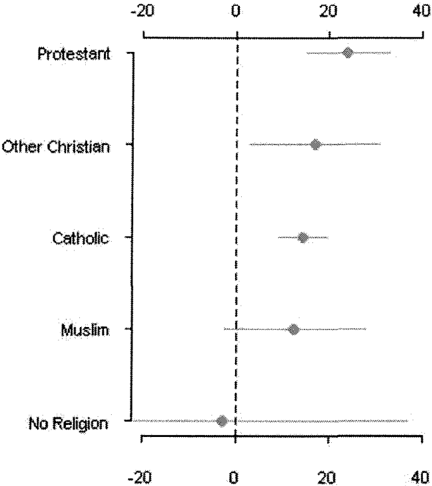
- Individual religiosity matters: regular church attendance is associated with higher social trust, with an estimated increase of about 16 points on the trust scale (e.g., 16.12 in Table 1; 16.05 in Table 2).
- Protestantism shows a “double positive effect”: Protestants are more trusting than the non-religious and Catholics, and living in a Protestant regional context also raises trust. The paper states that a hypothetical 100% Protestant region increases trust by 21 points, while a 100% Catholic region decreases trust by 19 points.
- Religious minorities are not generally distrustful: Catholics are more trusting than the non-religious, but do not differ from smaller Christian groups or Muslims; Muslims do not differ markedly from Christians in the main individual-level models.
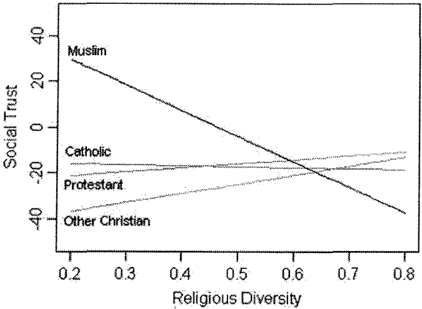
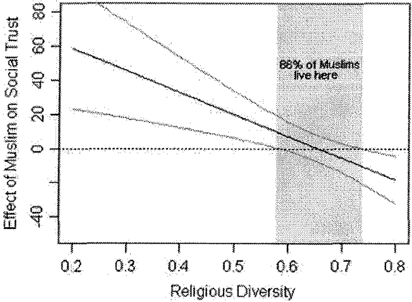
- Regional devoutness and religious diversity do not have significant direct effects on trust overall, but cross-level analyses show religious diversity lowers trust for Muslims specifically; the paper says the effect becomes statistically insignificant in regions with diversity scores between 0.58 and 0.74, where around 86% of Muslims in the sample live.
Methods
- Multilevel/hierarchical linear models were estimated on GSOEP 2003 survey data, with individuals nested in 97 German regions (Raumordnungsregionen); total sample size is 20,515 individuals aged 16+.
- Social trust was measured with three survey items and combined into a factor-based index; religiosity was measured by religious affiliation and church attendance, and regional context by Protestant/Catholic shares, devoutness, and a Herfindahl-based diversity index.
- Analyses used REML estimation and multiple imputation (m = 5) for missing data; the paper also tested cross-level interaction terms between individual religious affiliation and regional context.
Limitations
- The paper itself notes that regional church attendance may be measured at too high a level of aggregation; it suggests regions “might still be too large” to detect contextual effects that could appear at neighborhood or local-community levels.
- The author notes that some contextual measures are imperfect proxies because official regional data were unavailable, relying instead on GSOEP-based aggregation for Protestant/Catholic shares and devoutness.
- Evident from the text: the paper is observational and cross-sectional (2003 wave), so causal claims are not established.
Model-written summary. Check it against the paper before relying on it.
Integrity signals
Registry
Cites
Statistics
Figures
Verification
Claims the paper makes
1 Valid · 1 Not valid · 24 Not checked · 32 Own results and interpretations
A result the paper reports from its own data — it cites no other source for it, so there is none to check. The quote shows it is in the paper.
In the paper
“In addition, although Catholic individuals are more trusting than the non-religious individuals, they do not differ from members of smaller Christian groups or Muslims.”
plain- Asserted: passes — The authors put it forward as true.
- Checkable: passes — It can be checked against evidence.
- Load-bearing: passes — The paper’s conclusions depend on it.
- Based: passes — The paper gives a reason why it holds.
A result the paper reports from its own data — it cites no other source for it, so there is none to check. The quote shows it is in the paper.
In the paper
“In addition, although Catholic individuals are more trusting than the non-religious individuals, they do not differ from members of smaller Christian groups or Muslims.”
plainstates an association- Asserted: passes — The authors put it forward as true.
- Checkable: passes — It can be checked against evidence.
- Load-bearing: unclear — It is unclear whether the paper’s conclusions depend on it.
- Based: passes — The paper gives a reason why it holds.
A result the paper reports from its own data — it cites no other source for it, so there is none to check. The quote shows it is in the paper.
In the paper
“Not only do Protestants tend to be more trusting, but a Protestant context also increases one's trust—regardless of individual religious beliefs.”
plainstates a cause- Asserted: passes — The authors put it forward as true.
- Checkable: passes — It can be checked against evidence.
- Load-bearing: passes — The paper’s conclusions depend on it.
- Based: passes — The paper gives a reason why it holds.
A result the paper reports from its own data — it cites no other source for it, so there is none to check. The quote shows it is in the paper.
In the paper
“Furthermore, while church attendance is a powerful predictor for social trust”
boostedstates an association- Asserted: passes — The authors put it forward as true.
- Checkable: passes — It can be checked against evidence.
- Load-bearing: passes — The paper’s conclusions depend on it.
- Based: passes — The paper gives a reason why it holds.
15 more claims
Create a free account to see all 58 claims and to verify the 4 references still open.
- Probably not a substantial claim. 24
- It may state two separate claims as one. 24
- The quote only partly states this claim. 3
Citations
Cites
Social Capital in the Creation of Human Capital
Coleman, J. S. (1988) · American Journal of Sociology · doi:10.1086/228943 · Cited by 26,975
Social Capital in the Creation of Human Capital
COLEMAN, J. (2000) · Knowledge and Social Capital · doi:10.1016/b978-0-7506-7222-1.50005-2 · Cited by 21,666
Birds of a Feather: Homophily in Social Networks
McPherson, M., Smith-Lovin, L., & Cook, J. M. (2001) · Annual Review of Sociology · doi:10.1146/annurev.soc.27.1.415 · Cited by 18,567
Putnam, R. (2000) · doi:10.1145/358916.361990 · Cited by 17,114
Data Analysis Using Regression and Multilevel/Hierarchical Models
Gelman, A., & Hill, J. (2006) · doi:10.1017/cbo9780511790942 · Cited by 13,597
Understanding Interaction Models: Improving Empirical Analyses
Brambor, T., Clark, W. R., & Golder, M. (2006) · Political Analysis · doi:10.1093/pan/mpi014 · Cited by 6,223 · cited 1×
“Plotting the results in a marginal effect plot (cf. Brambor et al., 2005) shows that the positive effect of church attendance holds for all Christian groups but not for Muslims and the non-religious where in both cases the confidence intervals intersect zero (see Figure 1).”
BackgroundModernization, Cultural Change, and the Persistence of Traditional Values
Inglehart, R., & Baker, W. E. (2000) · American Sociological Review · doi:10.2307/2657288 · Cited by 4,524
Putnam, R. D. (2007) · Scandinavian Political Studies · doi:10.1111/j.1467-9477.2007.00176.x · Cited by 4,027
Comparative Politics and the Comparative Method
Lijphart, A. (1971) · American Political Science Review · doi:10.2307/1955513 · Cited by 3,151
The Moral Basis of a Backward Society.
Banfield, E. C. (1959) · Economica · doi:10.2307/2550413 · Cited by 3,136
The Moral Foundations of Trust
Uslaner, E. M. (2001) · Cambridge University Press eBooks · doi:10.1017/cbo9780511614934 · Cited by 2,836
Porta, R. L., Lopez-de-Silane, F., Shleifer, A., & Vishny, R. (1996) · National Bureau of Economic Research · doi:10.3386/w5864 · Cited by 2,474
Participation in Heterogeneous Communities*
Alesina, A., & La Ferrara, E. (2000) · Quarterly Journal of Economics · doi:10.1162/003355300554935 · Cited by 1,864
Analyzing Incomplete Political Science Data: An Alternative Algorithm for Multiple Imputation
King, G., Honaker, J., Joseph, A., & Scheve, K. (2001) · American Political Science Review · doi:10.1017/s0003055401000235 · Cited by 1,834 · cited 1×
“Furthermore, we have dealt with the problem of missing data by means of Multiple Imputation using the Amelia II package provided by King et al. (2001).”
MethodThe German Socio-Economic Panel Study (SOEP) - Scope, Evolution and Enhancements
Wagner, G. G., Frick, J. R., & Schupp, J. (2007) · Journal of Contextual Economics – Schmollers Jahrbuch · doi:10.3790/schm.127.1.139 · Cited by 1,765
People's opium? Religion and economic attitudes
Guiso, L., Sapienza, P., & Zingales, L. (2003) · Journal of Monetary Economics · doi:10.1016/s0304-3932(02)00202-7 · Cited by 1,675
Predicting Cross-National Levels of Social Trust: Global Pattern or Nordic Exceptionalism?
Delhey, J., & Newton, K. (2005) · European Sociological Review · doi:10.1093/esr/jci022 · Cited by 1,267 · cited 10×
“Since social trust largely rests upon perceived similarities and a sense of familiarity, religious diversity may lead to a decrease in regional trust levels (Delhey and Newton, 2005; Gundelach and Traunmiiller 2010).”
BackgroundInfluentialScaling Down: The Subnational Comparative Method
Snyder, R. (2001) · Studies in Comparative International Development · doi:10.1007/bf02687586 · Cited by 1,002
Determinants of generalized trust: a cross-country comparison
Bjørnskov, C. (2007) · Public Choice · doi:10.1007/s11127-006-9069-1 · Cited by 969
The German Socio-Economic Panel Study (SOEP) - Evolution, Scope and Enhancements
Wagner, G. G., Frick, J. R., & Schupp, J. (2007) · SSRN Electronic Journal · doi:10.2139/ssrn.1028709 · Cited by 937
“If You Love Me, Keep My Commandments”: A Meta-Analysis of the Effect of Religion on Crime
BAIER, C. J., & WRIGHT, B. R. E. (2001) · Journal of Research in Crime and Delinquency · doi:10.1177/0022427801038001001 · Cited by 572
National Context, Religiosity, and Volunteering: Results from 53 Countries
Ruiter, S., & De Graaf, N. D. (2006) · American Sociological Review · doi:10.1177/000312240607100202 · Cited by 451 · cited 1×
“Up to now, there have only been very few attempts to actually separate individual from contextual effects by considering them simultaneously in multilevel applications (Ruiter and De Graaf, 2006; Lam, 2006; Borgonovi, 2008).”
BackgroundReligion as Context: Hellfire and Delinquency One More Time
Stark, R. (1996) · Sociology of Religion · doi:10.2307/3711948 · Cited by 449 · cited 1×
“A number of empirical studies at the individual and aggregate level corroborate this idea and find that religion tends to reduce many forms of social deviance (e.g. Baier and Wright, 2001; Bainbridge, 1989; Stark and Bainbridge, 1996; Stark, 1996).”
BackgroundSpheres of trust: An empirical analysis of the foundations of particularised and generalised trust
Freitag, M., & Traunmüller, R. (2009) · European Journal of Political Research · doi:10.1111/j.1475-6765.2009.00849.x · Cited by 389
Self-citationReligious Involvement and Volunteering: Implications for Civil Society
Becker, P. E., & Dhingra, P. H. (2001) · Sociology of Religion · doi:10.2307/3712353 · Cited by 371 · cited 1×
“First, the literature so far has concentrated on the impact of religion on organizational membership and civic engagement (Becker and Dhingra, 2001; Campbell and Yonish, 2003; Greeley, 1997; Lam, 2002, 2006; Putnam, 2000; Ruiter and De Graaf, 2006; Smidt, 1999; Park and Smith, 2000; Uslaner, 2002a; Wilson and Janoski,…”
BackgroundEthnic Diversity and Generalized Trust in Europe: A Cross-National Multilevel Study
Hooghe, M., Reeskens, T., Stolle, D., & Trappers, A. (2009) · Comparative Political Studies · doi:10.1177/0010414008325286 · Cited by 362
The Contribution of Religion to Volunteer Work
Wilson, J., & Janoski, T. (1995) · Sociology of Religion · doi:10.2307/3711760 · Cited by 360
Park, J. Z., & Smith, C. (2000) · Journal for the Scientific Study of Religion · doi:10.1111/0021-8294.00023 · Cited by 305
As the Flocks Gather: How Religion Affects Voluntary Association Participation
Lam, P. (2002) · Journal for the Scientific Study of Religion · doi:10.1111/1468-5906.00127 · Cited by 234
Crafting Trust: The Role of Political Institutions in a Comparative Perspective
Freitag, M., & Bühlmann, M. (2009) · Comparative Political Studies · doi:10.1177/0010414009332151 · Cited by 233 · cited 2×
“Furthermore, recent research on the contextual determinants of social trust has been focusing on the impact of political institutions (e.g. Freitag and Biihlmann, 2005, 2009; Neller, 2008) and on the effects of ethnic diversity (e.g. Bj0rnskov, 2008; Hooghe et al., 2009; Putnam, 2007).”
BackgroundSocial Trust and Fractionalization: A Possible Reinterpretation
Bjornskov, C. (2008) · European Sociological Review · doi:10.1093/esr/jcn004 · Cited by 230
Coleman Revisited: Religious Structures as a Source of Social Capital
GREELEY, A. (1997) · American Behavioral Scientist · doi:10.1177/0002764297040005005 · Cited by 223
Anderson, C. J., & Paskeviciute, A. (2006) · The Journal of Politics · doi:10.1111/j.1468-2508.2006.00470.x · Cited by 200
Cross-National Moral Beliefs: The Influence of National Religious Context
Finke, R., & Adamczyk, A. (2008) · The Sociological Quarterly · doi:10.1111/j.1533-8525.2008.00130.x · Cited by 197
Religion, Deviance, and Social Control
Stark, R., & Bainbridge, W. S. (2013) · Routledge eBooks · doi:10.4324/9780203724217 · Cited by 186
People's Opium? Religion and Economic Attitudes
Guiso, L., Sapienza, P., & Zingales, L. (2002) · SSRN Electronic Journal · doi:10.2139/ssrn.331280 · Cited by 184
Education, Religiosity and Moral Attitudes: Explaining Cross-National Effect Differences
Scheepers, P., Grotenhuis, M. T., & Slik, F. V. D. (2002) · Sociology of Religion · doi:10.2307/3712563 · Cited by 182
Participation in Heterogeneous Communities
Alesina, A., & Ferrara, E. L. (1999) · National Bureau of Economic Research · doi:10.3386/w7155 · Cited by 177
Religion and Voting Behaviour in Great Britain: A Reassessment
KOTLER-BERKOWITZ, L. A. (2001) · British Journal of Political Science · doi:10.1017/s0007123401000205 · Cited by 176
Embedded trust: Control and learning
Buskens, V., & Raub, W. (2004) · Advances in Group Processes · doi:10.1016/s0882-6145(02)19007-2 · Cited by 170
Trust in God and Trust in Man: The Ambivalent Role of Religion in Shaping Dimensions of Social Trust
Welch, M. R., Sikkink, D., Sartain, E., & Bond, C. (2004) · Journal for the Scientific Study of Religion · doi:10.1111/j.1468-5906.2004.00238.x · Cited by 154 · cited 2×
“Therefore, inclusive religious group identities that advance doctrines of common grace, human potential, and goodness will encourage their adherents to be trusting (Welch et al., 2004).”
BackgroundReligion and Civic Engagement in Canada and the United States
Uslaner, E. M. (2002) · Journal for the Scientific Study of Religion · doi:10.1111/1468-5906.00114 · Cited by 148
The Religious Ecology of Deviance
Bainbridge, W. S. (1989) · American Sociological Review · doi:10.2307/2095796 · Cited by 132 · cited 1×
“A number of empirical studies at the individual and aggregate level corroborate this idea and find that religion tends to reduce many forms of social deviance (e.g. Baier and Wright, 2001; Bainbridge, 1989; Stark and Bainbridge, 1996; Stark, 1996).”
BackgroundReligion and Civic Culture: A Cross‐National Study of Voluntary Association Membership
Lam, P. (2006) · Journal for the Scientific Study of Religion · doi:10.1111/j.1468-5906.2006.00300.x · Cited by 130
Divided We Stand, United We Fall: Religious Pluralism, Giving, and Volunteering
Borgonovi, F. (2008) · American Sociological Review · doi:10.1177/000312240807300106 · Cited by 112 · cited 3×
“The regions of small scale may be theoretically better suited for analyzing context effects as compared to whole nations, since they constitute the immediate social surrounding of individuals (cf. Borgonovi, 2008).”
BackgroundPessi, A. B. (2004) · Nonprofit and Voluntary Sector Quarterly · doi:10.1177/0899764004265426 · Cited by 109
Assumptions about Human Nature: Implications for Researchers and Practitioners
Wrightsman, L. S. (1992) · Sage eBooks · doi:10.4135/9781483325934 · Cited by 99
(2001) · Cited by 98
Beyond Tocqueville: The Origins of Social Capital in Switzerland
Freitag, M. (2003) · European Sociological Review · doi:10.1093/esr/19.2.217 · Cited by 71 · cited 1×
“…avoid spurious effects between the religion variables and social trust, several controls on both the individual and contextual levels are considered (cf. Freitag 2003; Freitag and Biihlmann, 2009; Freitag and Traunmiiller, 2009; Delhey and Newton, 2005; Neller, 2008; Putnam, 2000; Uslaner, 2002b).”
BackgroundReligion und Sozialintegration: Eine empirische Analyse der religiösen Grundlagen sozialen Kapitals
Traunmüller, R. (2009) · Berliner Journal für Soziologie · doi:10.1007/s11609-009-0100-5 · Cited by 62
Self-citationFreitag, M., & Bühlmann, M. (2005) · Politische Vierteljahresschrift · doi:10.1007/s11615-005-0303-0 · Cited by 44
Einwanderung und der neue religiöse Pluralismus: Ein Vergleich zwischen der EU und den USA
Casanova, J. (2006) · Leviathan · doi:10.1007/s11578-006-0011-1 · Cited by 16 · cited 2×
“Growing religious heterogeneity, which is primarily, but not exclusively due to immigrants from Islamic countries, may however lead to conflicts between religious groups and pose a potential threat to social connectedness (Casanova, 2006; Huntington, 1996; Wolf, 1999).”
BackgroundReligion and volunteering in the Netherlands
de Hart, J. (2003) · Routledge eBooks · doi:10.4324/9780203451571-7 · Cited by 9
Religion and Social Capital: the Diversity of European Regions
Bahovec, I., Potočnik, V., & Zrinščak, S. (2007) · Cited by 7
Religion and Social Capital Revisited
Halman, L., & Pettersson, T. (2003) · BRILL eBooks · doi:10.1163/9789004496354_011 · Cited by 6
Research works printed but not linked: 24
- Campbell, D. E. and Yonish, S. J. (2003). Religion and volunteering in America. In Smidt, C. E. (Ed.), Religion as Social Capital. Waco, TX: Baylor University Press, pp. 87-106.
- Durkheim, E. ([1897] 1951). Suicide. Glencoe, IL: Free Press.
- Durkheim, E. ([1912] 1995). The Elementary Forms of the Religious Life. New York: Free Press.
- Fukuyama, F. (1995). Trust. The Social Virtues and the Creation of Prosperity. New York: Free Press.
- Fukuyama, F. (2000). The Great Disruption: Human Nature and the Reconstruction of Social Order. New York: Free Press.
- Gellner, E. (1981). Muslim Society. Cambridge: Cambridge University Press.
- Gundelach, B. and Traunmüller, R. (2010). Kulturelle Diversität und sozialer Zusammenhalt. Eine Mehrebenenanalyse zum Einfluss multikultureller Kontexte auf das Sozialkapital in den deutschen Regionen [Cultural diversity and social cohesion. A multilevel analysis of the effect of multicultural contexts on social capital in the German regions]. In Freitag, M. and Vatter, A. (Eds.), Subnational vergleichende Analysen für Deutschland. Institutionen, Staatstätigkeiten und politische Kulturen. München: Lit-Verlag, pp. 315-343.
- Hooghe, M. and Stolle, D. (2003). Generating Social Capital. Civil Society and Institutions in Comparative Perspective. New York: Palgrave and MacMillan.
- Leege, D. C. (1993). Religion and politics in theoretical perspective. In Leege, D. C. and Kellstedt, L. A. (Eds.), Rediscovering the Religious Factor in American Politics. Armonk: M.E. Sharpe, pp. 3-25.
- Meulemann, H. (2004). Religiosität: Die Persistenz eines Sonderfalls [Religiosity: the persistence of a special case]. In van Deth, J. W. (Ed.), Deutschland in Europa. Wiesbaden: VS Verlag, pp. 55–76.
- Neller, K. (2008). Explaining social trust: what makes people trust their fellow citizens? In Meulemann, H. (Ed.), Social Capital in Europe: Similarity of Countries and Diversity of People? Multi-level analyses of the European Social Survey 2002. Leiden: Brill, pp. 103–133.
- Norris, P. and Inglehart, R. (2004). Sacred and Secular. Religion and Politics Worldwide. Cambridge: Cambridge University Press.
- Parsons, T. (1967). Sociological Theory and Modern Society. New York: Free Press.
- Putnam, R. D. (1993). Making Democracy Work. Civic Traditions in Modern Italy. Princeton: Princeton University Press.
- Raudenbush, S. W. and Bryk, A. S. (2002). Hierarchical Linear Models, 2nd edition Thousand Oaks: Sage.
- Roßteutscher, S. (2008). Undemokratische Assoziationen [Un-democratic associations]. In Brodocz, A., Llanque, M. and Schaal, G. L. (Eds.), Bedrohungen der Demokratie. Wiesbaden: VS Verlag, pp. 61–76. - Roßteutscher, S. (2009). Religion, Zivilgesellschaft, Demokratie. Eine international vergleichende Studie zur Natur religiöser Märkte und der demokratischen Rolle religiöser Zivilgesellschaften [Religion, Civil Society, Democracy. An International Comparative Study on the Nature of Religious Markets and the Democratic Role of Religious Civil Societies]. BadenBaden: Nomos.
- Sampson, R. J. (2001). Crime and public safety: insights from community-level perspectives on social capital. In Saegert, S., Thompson, J. P. and Warren, M. E. (Eds.), Social Capital and Poor Communities. New York: Russell Sage Foundation.
- Sztompka, P. (1995). Vertrauen: Die Fehlende Ressource in der Postkommunistichen Gesellschaft [Trust: the missing resource in post-communist society]. In Nedelmann, B. (Ed.), Politische
- Sztompka, P. (1999). Trust: A Sociological Theory. Cambridge: Cambridge University Press.
- Tocqueville, A. de ([1862] 1954). Democracy in America. New York: Oxford University Press.
- Verba, S., Schlozman, K. L. and Brady, H. (1995). Voice and Equality: Civic Voluntarism in American Politics. Cambridge: Harvard University Press.
- Bundesrepublik Deutschland [Religious pluralization in Germany]. In Friedrichs, J. and Jagodzinski, W. (Eds.), Soziale Integration. (Kölner Zeitschrift für Soziologie und Sozialpsychologie, Sonderheft 39). Opladen: Westdeutscher, pp. 320–349. Wolf, C. (1999). Religiose Pluralisierung in der
- Wuthnow, R. (1990). Religion and the voluntary spirit in the United States: mapping the terrain. In Wuthnow, R. and Hodgkinson, V. A. (Eds.), Faith and Philanthropy in America: Exploring the Role of Religion in America's Voluntary Sector. San Francisco: Jossey-Bass.
- Wuthnow, R. (1999). Mobilizing civic engagement: the changing impact of religious involvement. In Skocpol, T. and Fiorina, M. P. (Eds.), Civic Engagement in American Democracy. Washington, DC: Brookings Institution Press, Pp. 331-363.
Cited by
Trust and its determinants: Evidence from the Trustlab experiment
(2018) · OECD Statistics Working Papers · doi:10.1787/869ef2ec-en · Cited by 276
Do Social Connections Create Trust? An Examination Using New Longitudinal Data
Glanville, J. L., Andersson, M. A., & Paxton, P. (2013) · Social Forces · doi:10.1093/sf/sot079 · Cited by 222
“…services more frequently express higher levels of trust, and this correlation is generally observed across religious affiliations (Schoenfeld 1978; Traunmüller 2011).3 Thus, the social-integrative function of regular attendance is believed to be an important source of trust (Schoenfeld 1978;…”
BackgroundBerggren, N., & Bjørnskov, C. (2011) · Journal of Economic Behavior & Organization · doi:10.1016/j.jebo.2011.05.002 · Cited by 177
In Praise of Skepticism: Trust but Verify
Norris, P. (2022) · doi:10.1093/oso/9780197530108.001.0001 · Cited by 317
Social Capital and Generosity: A Multilevel Analysis
Glanville, J. L., Paxton, P. M., & Wang, Y. (2015) · Nonprofit and Voluntary Sector Quarterly · doi:10.1177/0899764015591366 · Cited by 126
“While we follow common practice in modeling volunteering and donating by including religious attendance and affiliation as controls, we acknowledge that religion is a source of both the network (Lewis, MacGregor, & Putnam, 2013) and trust (Traunmüller, 2011) components of social capital.”
BackgroundMethod
Metadata
- Authors
- Traunmuller, R.
- Venue
- European Sociological Review
- Publisher
- Oxford University Press (OUP)
- Published
- 2010-03-07
- Volume
- 27
- Issue
- 3
- Pages
- 346-363
- ISSN
- 0266-7215 (ISSN-L)
- 1468-2672
- OpenAlex
- W2031538037
- Cited by
- 144
- References
- 47
- Citations by year
- 2026: 16 · 2025: 3 · 2024: 6 · 2023: 16 · 2022: 21 · 2021: 11 · 2020: 10 · 2019: 8 · 2018: 10 · 2017: 5 · 2016: 3 · 2015: 13 · 2014: 6 · 2013: 6 · 2012: 6
- FWCI
- 15.59
- Type
- journal article
- Language
- en
- Open access
- bronze
- doi.org
- Locations
- European Sociological Review (publishedVersion)
- KOPS (University of Konstanz) (submittedVersion)
- BORIS (University Library Bern) (submittedVersion, other-oa)
- HighWire Press Open Archive (submittedVersion)
- MADOC (University of Mannheim) (submittedVersion)
- Open Access CRIS of the University of Bern
- Funders
- Deutsche Forschungsgemeinschaft
- Topics
- Social Sciences › Sociology and Political Science › Religion and Society Interactions
- Social Sciences › Sociology and Political Science › Social Capital and Networks
- Social Sciences › Development › Culture, Economy, and Development Studies
- Keywords
- social trust, religion, individual religiosity, Protestantism, Catholicism, religious minorities, Muslims, church attendance, religious diversity, social integration, German regions
About these checks
Registry, retraction, Cites and statistics results are computed, not judged, with one exception: a printed reference that no index lists is read once by a model before it counts as a citation error. Claims are extracted by a model and kept only when their quote appears verbatim in the text; each cited source is then checked, with a model’s help, for whether it says what the claim relies on. Those verdicts can be wrong — read the claim’s quote and the cited source before relying on one.
The claim verdicts this report counts are experimental: their accuracy is not yet measured.
A language model drew the claims from the paper on 2026-10-10, under version 3 of the claim definition (model deepseek-v4.1-flash, prompt extract-v3).
A second model labelled each claim on 2026-10-10 (model jev-1.13-20260917, definition revision gold-guideline-v0.2).
Statistics and arithmetic are recomputed, not judged.
Confidence bands are shown only for fields calibrated on our annotated test set. None is calibrated yet, so no band is shown.
What counts as a claim ›How we measure confidence ›How we check this ›
Are you an author, or do you see a problem with this page? Request a review
Data sources
Bibliographic data: Semantic Scholar, OpenAlex, Crossref.
Contains information from the Semantic Scholar Academic Graph Datasets, made available under the ODC Attribution License (ODC-BY 1.0).
Semantic Scholar’s data is described in: Kinney, R., et al. (2023). The Semantic Scholar Open Data Platform. arXiv:2301.10140.
