

Moral Communities? Religion as a Source of Social Trust in a Multilevel Analysis of 97 German Regions
Open accessThe DOI matches its Crossref record; 55 of the 55 references it cites were found in a registry or an index; 1 of the 49 sources its claims cite were checked for support.
Abstract
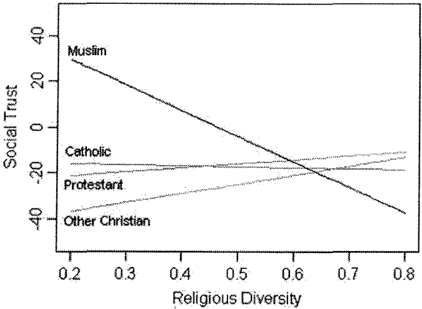
This contribution examines the role of religion as source of social trust. Going beyond the scope of the existing literature, we jointly evaluate the effect of individual religiosity and regional religious context by means of multilevel analysis of 97 small-scale German regions. The results based on the German Socio-Economic Panel suggest that there is a double positive effect of Protestantism: Not only do Protestants tend to be more trusting, but a Protestant context also increases one’s trust—regardless of individual religious beliefs. Conversely, social trust is less developed in Catholic-dominated regions. In addition, although Catholic individuals are more trusting than the non-religious individuals, they do not differ from members of smaller Christian groups or Muslims. At same time, the notion that certain religious groups and especially religious minorities are distrustful of the wider society is not substantiated by empirical evidence. Furthermore, while church attendance is a powerful predictor for social trust, a context effect for regional levels of devoutness could not be detected. Finally, religious diversity decreases social trust for Muslims only, but not to a degree as to pose a threat to social integration.
Overview
CoChat Summary
TL;DR
This paper uses multilevel data on 20,515 Germans nested in 97 regions to test whether religion shapes social trust through both individual religiosity and regional religious context. It finds a strong positive association for Protestantism at both levels, a strong positive effect of church attendance, no direct trust penalty for religious diversity, and a contextual diversity effect that lowers trust only for Muslims.
Key findings
- Individual religiosity matters: regular church attendance is associated with higher social trust, with an estimated increase of about 16 points on the trust scale (e.g., 16.12 in Table 1; 16.05 in Table 2).
- Protestantism shows a “double positive effect”: Protestants are more trusting than the non-religious and Catholics, and living in a Protestant regional context also raises trust. The paper states that a hypothetical 100% Protestant region increases trust by 21 points, while a 100% Catholic region decreases trust by 19 points.
- Religious minorities are not generally distrustful: Catholics are more trusting than the non-religious, but do not differ from smaller Christian groups or Muslims; Muslims do not differ markedly from Christians in the main individual-level models.
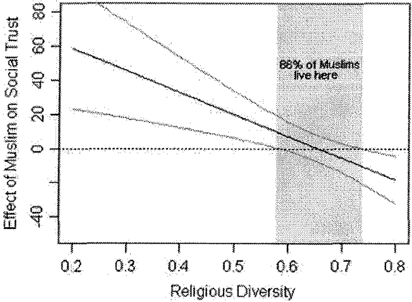
- Regional devoutness and religious diversity do not have significant direct effects on trust overall, but cross-level analyses show religious diversity lowers trust for Muslims specifically; the paper says the effect becomes statistically insignificant in regions with diversity scores between 0.58 and 0.74, where around 86% of Muslims in the sample live.
Methods
- Multilevel/hierarchical linear models were estimated on GSOEP 2003 survey data, with individuals nested in 97 German regions (Raumordnungsregionen); total sample size is 20,515 individuals aged 16+.
- Social trust was measured with three survey items and combined into a factor-based index; religiosity was measured by religious affiliation and church attendance, and regional context by Protestant/Catholic shares, devoutness, and a Herfindahl-based diversity index.
- Analyses used REML estimation and multiple imputation (m = 5) for missing data; the paper also tested cross-level interaction terms between individual religious affiliation and regional context.
Limitations
- The paper itself notes that regional church attendance may be measured at too high a level of aggregation; it suggests regions “might still be too large” to detect contextual effects that could appear at neighborhood or local-community levels.
- The author notes that some contextual measures are imperfect proxies because official regional data were unavailable, relying instead on GSOEP-based aggregation for Protestant/Catholic shares and devoutness.
- Evident from the text: the paper is observational and cross-sectional (2003 wave), so causal claims are not established.
Model-written summary. Check it against the paper before relying on it.
Integrity signals
Registry
Cites
Statistics
Figures
Verification
Claims the paper makes
1 Valid · 1 Not valid · 24 Not checked · 32 Own results and interpretations
A result the paper reports from its own data — it cites no other source for it, so there is none to check. The quote shows it is in the paper.
In the paper
“In addition, although Catholic individuals are more trusting than the non-religious individuals, they do not differ from members of smaller Christian groups or Muslims.”
plain- Asserted: passes — The authors put it forward as true.
- Checkable: passes — It can be checked against evidence.
- Load-bearing: passes — The paper’s conclusions depend on it.
- Based: passes — The paper gives a reason why it holds.
A result the paper reports from its own data — it cites no other source for it, so there is none to check. The quote shows it is in the paper.
In the paper
“In addition, although Catholic individuals are more trusting than the non-religious individuals, they do not differ from members of smaller Christian groups or Muslims.”
plainstates an association- Asserted: passes — The authors put it forward as true.
- Checkable: passes — It can be checked against evidence.
- Load-bearing: unclear — It is unclear whether the paper’s conclusions depend on it.
- Based: passes — The paper gives a reason why it holds.
A result the paper reports from its own data — it cites no other source for it, so there is none to check. The quote shows it is in the paper.
In the paper
“Not only do Protestants tend to be more trusting, but a Protestant context also increases one's trust—regardless of individual religious beliefs.”
plainstates a cause- Asserted: passes — The authors put it forward as true.
- Checkable: passes — It can be checked against evidence.
- Load-bearing: passes — The paper’s conclusions depend on it.
- Based: passes — The paper gives a reason why it holds.
A result the paper reports from its own data — it cites no other source for it, so there is none to check. The quote shows it is in the paper.
In the paper
“Furthermore, while church attendance is a powerful predictor for social trust”
boostedstates an association- Asserted: passes — The authors put it forward as true.
- Checkable: passes — It can be checked against evidence.
- Load-bearing: passes — The paper’s conclusions depend on it.
- Based: passes — The paper gives a reason why it holds.
15 more claims
Create a free account to see all 58 claims and to verify the 4 references still open.
- Probably not a substantial claim. 24
- It may state two separate claims as one. 24
- The quote only partly states this claim. 3
Citations
Cites
Social Capital in the Creation of Human Capital
Coleman, J. S. (1988) · American Journal of Sociology · doi:10.1086/228943 · Cited by 26,975
Social Capital in the Creation of Human Capital
COLEMAN, J. (2000) · Knowledge and Social Capital · doi:10.1016/b978-0-7506-7222-1.50005-2 · Cited by 21,666
Birds of a Feather: Homophily in Social Networks
McPherson, M., Smith-Lovin, L., & Cook, J. M. (2001) · Annual Review of Sociology · doi:10.1146/annurev.soc.27.1.415 · Cited by 18,567
Putnam, R. (2000) · doi:10.1145/358916.361990 · Cited by 17,114
Data Analysis Using Regression and Multilevel/Hierarchical Models
Gelman, A., & Hill, J. (2006) · doi:10.1017/cbo9780511790942 · Cited by 13,597
Understanding Interaction Models: Improving Empirical Analyses
Brambor, T., Clark, W. R., & Golder, M. (2006) · Political Analysis · doi:10.1093/pan/mpi014 · Cited by 6,223 · cited 1×
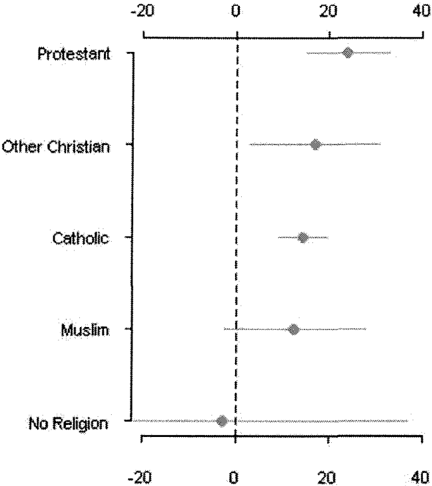
“Plotting the results in a marginal effect plot (cf. Brambor et al., 2005) shows that the positive effect of church attendance holds for all Christian groups but not for Muslims and the non-religious where in both cases the confidence intervals intersect zero (see Figure 1).”
BackgroundModernization, Cultural Change, and the Persistence of Traditional Values
Inglehart, R., & Baker, W. E. (2000) · American Sociological Review · doi:10.2307/2657288 · Cited by 4,524
Putnam, R. D. (2007) · Scandinavian Political Studies · doi:10.1111/j.1467-9477.2007.00176.x · Cited by 4,027
Comparative Politics and the Comparative Method
Lijphart, A. (1971) · American Political Science Review · doi:10.2307/1955513 · Cited by 3,151
The Moral Basis of a Backward Society.
Banfield, E. C. (1959) · Economica · doi:10.2307/2550413 · Cited by 3,136
Research works printed but not linked: 24
- Campbell, D. E. and Yonish, S. J. (2003). Religion and volunteering in America. In Smidt, C. E. (Ed.), Religion as Social Capital. Waco, TX: Baylor University Press, pp. 87-106.
- Durkheim, E. ([1897] 1951). Suicide. Glencoe, IL: Free Press.
- Durkheim, E. ([1912] 1995). The Elementary Forms of the Religious Life. New York: Free Press.
- Fukuyama, F. (1995). Trust. The Social Virtues and the Creation of Prosperity. New York: Free Press.
- Fukuyama, F. (2000). The Great Disruption: Human Nature and the Reconstruction of Social Order. New York: Free Press.
- Gellner, E. (1981). Muslim Society. Cambridge: Cambridge University Press.
- Gundelach, B. and Traunmüller, R. (2010). Kulturelle Diversität und sozialer Zusammenhalt. Eine Mehrebenenanalyse zum Einfluss multikultureller Kontexte auf das Sozialkapital in den deutschen Regionen [Cultural diversity and social cohesion. A multilevel analysis of the effect of multicultural contexts on social capital in the German regions]. In Freitag, M. and Vatter, A. (Eds.), Subnational vergleichende Analysen für Deutschland. Institutionen, Staatstätigkeiten und politische Kulturen. München: Lit-Verlag, pp. 315-343.
- Hooghe, M. and Stolle, D. (2003). Generating Social Capital. Civil Society and Institutions in Comparative Perspective. New York: Palgrave and MacMillan.
- Leege, D. C. (1993). Religion and politics in theoretical perspective. In Leege, D. C. and Kellstedt, L. A. (Eds.), Rediscovering the Religious Factor in American Politics. Armonk: M.E. Sharpe, pp. 3-25.
- Meulemann, H. (2004). Religiosität: Die Persistenz eines Sonderfalls [Religiosity: the persistence of a special case]. In van Deth, J. W. (Ed.), Deutschland in Europa. Wiesbaden: VS Verlag, pp. 55–76.
- Neller, K. (2008). Explaining social trust: what makes people trust their fellow citizens? In Meulemann, H. (Ed.), Social Capital in Europe: Similarity of Countries and Diversity of People? Multi-level analyses of the European Social Survey 2002. Leiden: Brill, pp. 103–133.
- Norris, P. and Inglehart, R. (2004). Sacred and Secular. Religion and Politics Worldwide. Cambridge: Cambridge University Press.
- Parsons, T. (1967). Sociological Theory and Modern Society. New York: Free Press.
- Putnam, R. D. (1993). Making Democracy Work. Civic Traditions in Modern Italy. Princeton: Princeton University Press.
- Raudenbush, S. W. and Bryk, A. S. (2002). Hierarchical Linear Models, 2nd edition Thousand Oaks: Sage.
- Roßteutscher, S. (2008). Undemokratische Assoziationen [Un-democratic associations]. In Brodocz, A., Llanque, M. and Schaal, G. L. (Eds.), Bedrohungen der Demokratie. Wiesbaden: VS Verlag, pp. 61–76. - Roßteutscher, S. (2009). Religion, Zivilgesellschaft, Demokratie. Eine international vergleichende Studie zur Natur religiöser Märkte und der demokratischen Rolle religiöser Zivilgesellschaften [Religion, Civil Society, Democracy. An International Comparative Study on the Nature of Religious Markets and the Democratic Role of Religious Civil Societies]. BadenBaden: Nomos.
- Sampson, R. J. (2001). Crime and public safety: insights from community-level perspectives on social capital. In Saegert, S., Thompson, J. P. and Warren, M. E. (Eds.), Social Capital and Poor Communities. New York: Russell Sage Foundation.
- Sztompka, P. (1995). Vertrauen: Die Fehlende Ressource in der Postkommunistichen Gesellschaft [Trust: the missing resource in post-communist society]. In Nedelmann, B. (Ed.), Politische
- Sztompka, P. (1999). Trust: A Sociological Theory. Cambridge: Cambridge University Press.
- Tocqueville, A. de ([1862] 1954). Democracy in America. New York: Oxford University Press.
- Verba, S., Schlozman, K. L. and Brady, H. (1995). Voice and Equality: Civic Voluntarism in American Politics. Cambridge: Harvard University Press.
- Bundesrepublik Deutschland [Religious pluralization in Germany]. In Friedrichs, J. and Jagodzinski, W. (Eds.), Soziale Integration. (Kölner Zeitschrift für Soziologie und Sozialpsychologie, Sonderheft 39). Opladen: Westdeutscher, pp. 320–349. Wolf, C. (1999). Religiose Pluralisierung in der
- Wuthnow, R. (1990). Religion and the voluntary spirit in the United States: mapping the terrain. In Wuthnow, R. and Hodgkinson, V. A. (Eds.), Faith and Philanthropy in America: Exploring the Role of Religion in America's Voluntary Sector. San Francisco: Jossey-Bass.
- Wuthnow, R. (1999). Mobilizing civic engagement: the changing impact of religious involvement. In Skocpol, T. and Fiorina, M. P. (Eds.), Civic Engagement in American Democracy. Washington, DC: Brookings Institution Press, Pp. 331-363.
Cited by
Items 101–145 of 145
Karandashev, V. N. (2020) · Springer eBooks · doi:10.1007/978-3-030-58438-2_1 · Cited by 2
Tóth, J. (2015) · CUB Ph.D. Dissertations (Corvinus University of Budapest) · doi:10.14267/phd.2015063
Botterman, S. (2015) · Lirias · Cited by 4
Außen religiös, innen säkular?
Lange, H. (2016) · Springer eBooks · doi:10.1007/978-3-658-11821-1_6
Negele, E. (2012) · Oldenbourg Wissenschaftsverlag Verlag eBooks · doi:10.1524/9783486717679.89
Measuring Social Trust: Two New ApproachesPreprint
Robbins, B. G. (2018) · SSRN Electronic Journal · doi:10.2139/ssrn.3212109
ANALYZING RELIGION AND TRUST RELATIONSHIP FROM TURKISH PERSPECTIVE
Yılmaz, M. (2021) · Dinbilimleri Akademik Araştırma Dergisi · doi:10.33415/daad.948160
Aksoy, O., & Wiertz, D. (2021) · doi:10.31235/osf.io/yv9et
Essays on the impact of education on misclassified civic outcomes: studies of Italy and the UK
Delprato, M. (2010) · WestminsterResearch (University of Westminster) · doi:10.34737/90574
Migheli, M. (2022) · Springer eBooks · doi:10.1007/978-3-319-57365-6_284-1 · Cited by 1
Norris, P. (2022) · Oxford University Press eBooks · doi:10.1093/oso/9780197530108.002.0005
Norris, P. (2022) · Oxford University Press eBooks · doi:10.1093/oso/9780197530108.003.0003
Norris, P. (2022) · Oxford University Press eBooks · doi:10.1093/oso/9780197530108.003.0007
Comparing Trends in Trust Worldwide
Norris, P. (2022) · Oxford University Press eBooks · doi:10.1093/oso/9780197530108.003.0004
Norris, P. (2022) · Oxford University Press eBooks · doi:10.1093/oso/9780197530108.002.0007
Norris, P. (2022) · Oxford University Press eBooks · doi:10.1093/oso/9780197530108.003.0006
Norris, P. (2022) · Oxford University Press eBooks · doi:10.1093/oso/9780197530108.003.0005
Norris, P. (2022) · Oxford University Press eBooks · doi:10.1093/oso/9780197530108.002.0008
Norris, P. (2022) · Oxford University Press eBooks · doi:10.1093/oso/9780197530108.002.0006
Norris, P. (2022) · Oxford University Press eBooks · doi:10.1093/oso/9780197530108.002.0003
Local Bias in Equity Crowdfunding: The Role of Intangible DistancePreprint
Wang, D. (2023) · SSRN Electronic Journal · doi:10.2139/ssrn.4407925 · Cited by 1
Akaeda, N. (2023) · International Sociology · doi:10.1177/02685809231167834 · Cited by 1
Kuşaklar Açısından Dinin Toplumsal Sermaye Potansiyeli ve Kullanım Alanları (Isparta Uygulaması)
Fatih, K. A. R. S., & ÖZKUL, M. (2023) · Süleyman Demirel Üniversitesi Vizyoner Dergisi · doi:10.21076/vizyoner.1215832
Karandashev, V. N. (2023) · Springer eBooks · doi:10.1007/978-3-031-39963-3_1
Ishaq, B., Bjertness, E., Østby, L., Johannessen, A., & Schnell, T. (2024) · Social Sciences & Humanities Open · doi:10.1016/j.ssaho.2024.101065 · Cited by 3
Religion and Social Trust: Evidence From Chinese Christians in New Zealand
Du, Y., & Liu, Y. (2024) · Review of Religious Research · doi:10.1177/0034673x241287512 · Cited by 1
“Empirical studies in North America and Europe have found mixed results on how religion fosters social trust (Berggren and Bjørnskov 2009; Hsiung and Djupe 2019; Traunmu¨ller 2011; Valente and Okulicz-Kozaryn 2021).”
Hámori, Á. (2023) · CUB Ph.D. Dissertations (Corvinus University of Budapest) · doi:10.14267/phd.2023070 · Cited by 2
Construction and Validation of Duâ Scale for Pakistani Muslim Adults
Tahir, W., & Adil, A. (2025) · Journal of Religion and Health · doi:10.1007/s10943-024-02246-7
“Previous studies also reveal that religious beliefs are associated with the social relations of individuals (Chuah et al., 2016; Traunmüller, 2011).”
Sosyal Sermaye-Din İlişkisi Bağlamında Türkiye’nin Sosyal Sermaye Kaynakları
Eroğlu, Y. (2025) · ADAM AKADEMİ Sosyal Bilimler Dergisi · doi:10.31679/adamakademi.1515229
Gezgin, A. Y. (2026) · Springer eBooks · doi:10.1007/978-3-032-06814-9_7
Abbas, T., Tamimova, M., Wabnitz, P. K., & Trebeschi, I. (2026) · The Review of Faith & International Affairs · doi:10.1080/15570274.2026.2620352 · Cited by 1
“Scholars such as Smith (2009) and Traunmüller (2011) have explored the relationship between religion and trust in various contexts.”
Religious Belief and Social Trust in the “Semi‐Acquaintance Society”: Evidence From China
Xu, L., & Li, W. (2026) · Journal for the Scientific Study of Religion · doi:10.1111/jssr.70038 · Cited by 1
Religiosity and Social Trust: What Happens When Diversity Increases?
Draper, I. C. (2026) · Journal for the Scientific Study of Religion · doi:10.1111/jssr.70063 · Cited by 1
Brennan, J. (2026) · Oxford University Press eBooks · doi:10.1093/9780197857427.003.0005
Glass Houses: Choosing Grace in a Judgmental World
Brennan, J. (2026) · doi:10.1093/9780197857427.001.0001
Torn Between Justice and Grace
Brennan, J. (2026) · Oxford University Press eBooks · doi:10.1093/9780197857427.003.0001
Should We Blackball Bad Character?
Brennan, J. (2026) · Oxford University Press eBooks · doi:10.1093/9780197857427.003.0003
Brennan, J. (2026) · Oxford University Press eBooks · doi:10.1093/9780197857427.003.0008
Should We Blackball Bad Belief?
Brennan, J. (2026) · Oxford University Press eBooks · doi:10.1093/9780197857427.003.0002
Brennan, J. (2026) · Oxford University Press eBooks · doi:10.1093/9780197857427.002.0004
Brennan, J. (2026) · Oxford University Press eBooks · doi:10.1093/9780197857427.003.0007
Brennan, J. (2026) · Oxford University Press eBooks · doi:10.1093/9780197857427.003.0006
Brennan, J. (2026) · Oxford University Press eBooks · doi:10.1093/9780197857427.003.0004
Gu, J. (2026) · Economic Change and Restructuring · doi:10.1007/s10644-026-10055-z
“Geog - raphy, climate, history, culture, and other factors in different regions affect the spread and development of religions, how they are practiced, and the degree of popular participation in religious activities (Traunmueller 2011).”
Metadata
- Authors
- Traunmuller, R.
- Venue
- European Sociological Review
- Publisher
- Oxford University Press (OUP)
- Published
- 2010-03-07
- Volume
- 27
- Issue
- 3
- Pages
- 346-363
- ISSN
- 0266-7215 (ISSN-L)
- 1468-2672
- OpenAlex
- W2031538037
- Cited by
- 144
- References
- 47
- Citations by year
- 2026: 16 · 2025: 3 · 2024: 6 · 2023: 16 · 2022: 21 · 2021: 11 · 2020: 10 · 2019: 8 · 2018: 10 · 2017: 5 · 2016: 3 · 2015: 13 · 2014: 6 · 2013: 6 · 2012: 6
- FWCI
- 15.59
- Type
- journal article
- Language
- en
- Open access
- bronze
- doi.org
- Locations
- European Sociological Review (publishedVersion)
- KOPS (University of Konstanz) (submittedVersion)
- BORIS (University Library Bern) (submittedVersion, other-oa)
- HighWire Press Open Archive (submittedVersion)
- MADOC (University of Mannheim) (submittedVersion)
- Open Access CRIS of the University of Bern
- Funders
- Deutsche Forschungsgemeinschaft
- Topics
- Social Sciences › Sociology and Political Science › Religion and Society Interactions
- Social Sciences › Sociology and Political Science › Social Capital and Networks
- Social Sciences › Development › Culture, Economy, and Development Studies
- Keywords
- social trust, religion, individual religiosity, Protestantism, Catholicism, religious minorities, Muslims, church attendance, religious diversity, social integration, German regions
About these checks
Registry, retraction, Cites and statistics results are computed, not judged, with one exception: a printed reference that no index lists is read once by a model before it counts as a citation error. Claims are extracted by a model and kept only when their quote appears verbatim in the text; each cited source is then checked, with a model’s help, for whether it says what the claim relies on. Those verdicts can be wrong — read the claim’s quote and the cited source before relying on one.
The claim verdicts this report counts are experimental: their accuracy is not yet measured.
A language model drew the claims from the paper on 2026-10-10, under version 3 of the claim definition (model deepseek-v4.1-flash, prompt extract-v3).
A second model labelled each claim on 2026-10-10 (model jev-1.13-20260917, definition revision gold-guideline-v0.2).
Statistics and arithmetic are recomputed, not judged.
Confidence bands are shown only for fields calibrated on our annotated test set. None is calibrated yet, so no band is shown.
What counts as a claim ›How we measure confidence ›How we check this ›
Are you an author, or do you see a problem with this page? Request a review
Data sources
Bibliographic data: Semantic Scholar, OpenAlex, Crossref.
Contains information from the Semantic Scholar Academic Graph Datasets, made available under the ODC Attribution License (ODC-BY 1.0).
Semantic Scholar’s data is described in: Kinney, R., et al. (2023). The Semantic Scholar Open Data Platform. arXiv:2301.10140.
