

Impact of cardiovascular risk factors and genetics on 10-year absolute risk of dementia: risk charts for targeted prevention
Open accessThe DOI matches its Crossref record; 43 of the 43 references it cites were found in a registry or an index.
Abstract
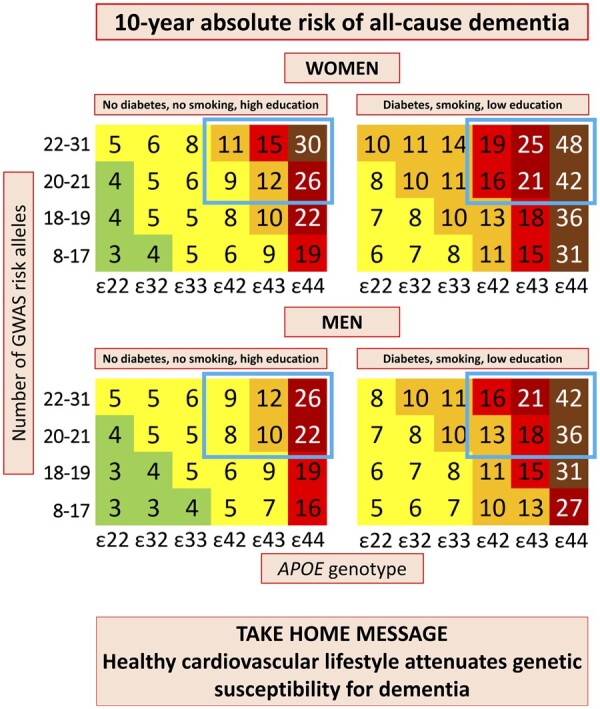
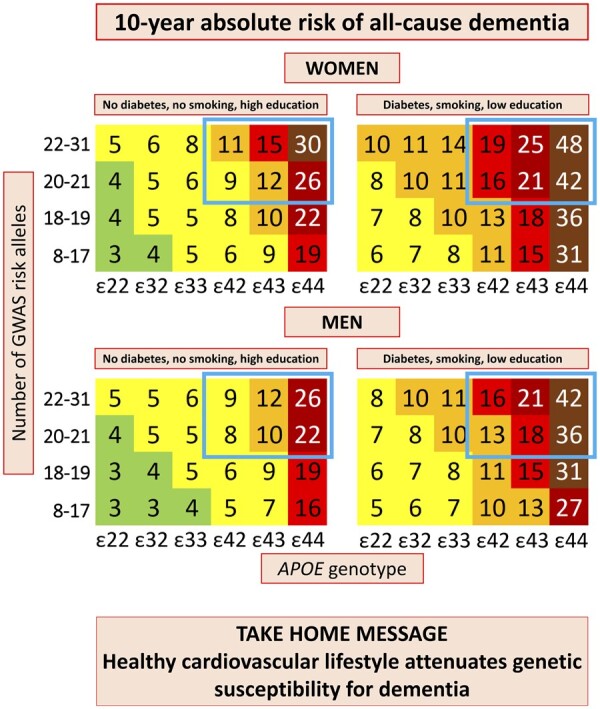
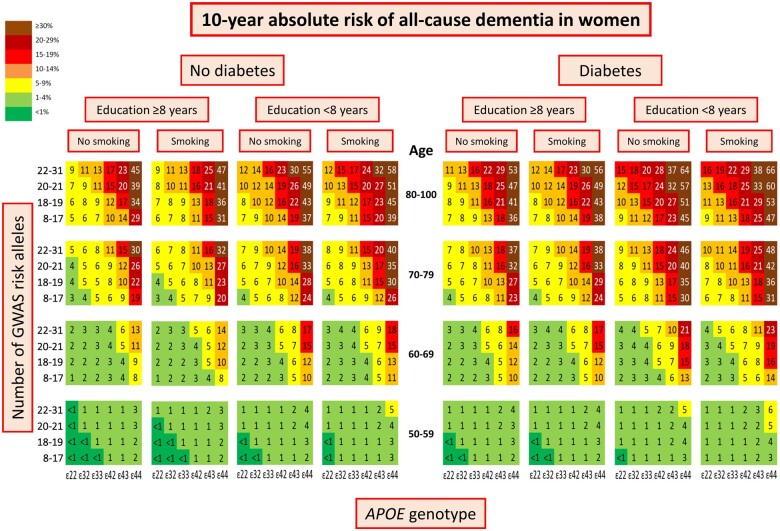
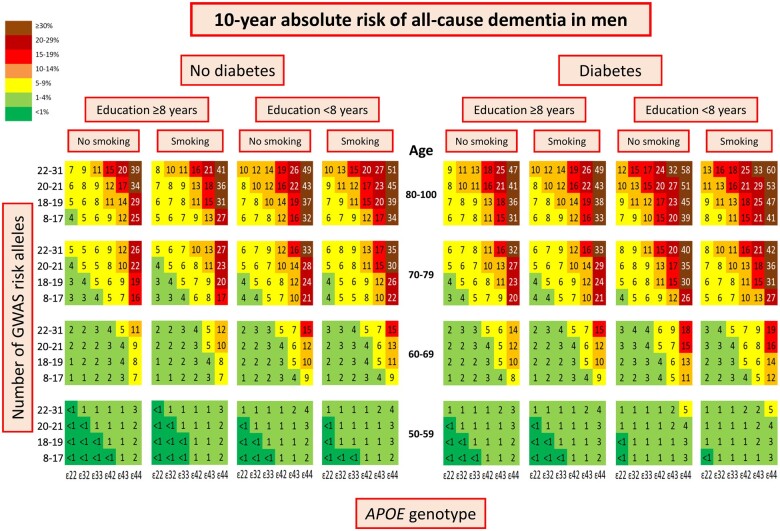
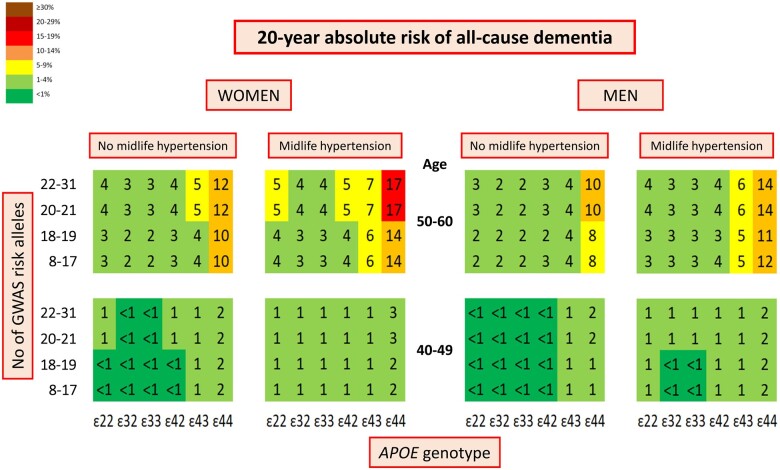
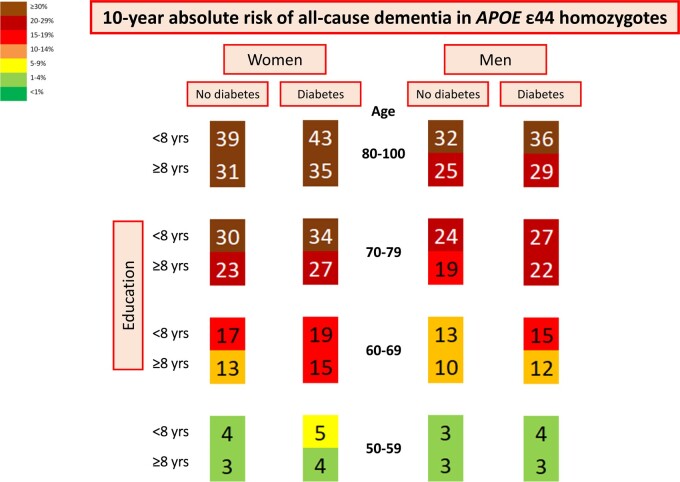
Aims: Dementia is a major global challenge for health and social care in aging populations. A third of all dementia may be preventable due to cardiovascular risk factors. Intensive multi-domain intervention trials targeting primarily cardiovascular risk factors show improved cognitive function in people at risk. Such interventions will, however, be expensive to implement in all individuals at risk and will represent unrealistic economic tasks for most societies. Therefore, a risk score identifying high-risk individuals is warranted. Methods and results: In 61 664 individuals from two prospective cohorts of the Danish general population, we generated 10-year absolute risk scores for all-cause dementia from cardiovascular risk factors and genetics. In both sexes, 10-year absolute risk of all-cause dementia increased with increasing age, number of apolipoprotein E (APOE) ɛ4 alleles, number of genome-wide association studies (GWAS) risk alleles, and cardiovascular risk factors. The highest 10-year absolute risks of all-cause dementia seen in smoking women with diabetes, low education, APOE ɛ44 genotype, and 22–31 GWAS risk alleles were 6%, 23%, 48%, and 66% in those aged 50–59, 60–69, 70–79, and 80–100, respectively. Corresponding values for men were 5%, 19%, 42%, and 60%, respectively. Conclusion: Ten-year absolute risk of all-cause dementia increased with age, APOE ɛ4 alleles, GWAS risk alleles, diabetes, low education, and smoking in both women and men. Ten-year absolute risk charts for dementia will facilitate identification of high-risk individuals, those who likely will benefit the most from an early intervention against cardiovascular risk factors.
Overview
The claims and statistics of this paper haven’t been checked yet.
Free: it reads the open-access text and checks the first 5 claims that cite a source we can check. Create a free account to check every claim.
Integrity signals
Registry
Cites
Statistics
Figures
Verification
Claims the paper makes
The claims and statistics of this paper haven’t been checked yet.
Free: it reads the open-access text and checks the first 5 claims that cite a source we can check. Create a free account to check every claim.
Self-check
Percentages, sums and reported differences re-computed from the paper’s own numbers.
The self-check needs the paper’s full text.
Citations
Cites
Regression shrinkage and selection via the lasso
Tibshirani, R. (1996) · Journal of the Royal Statistical Society Series B: Statistical Methodology · doi:10.1111/j.2517-6161.1996.tb02080.x · Cited by 51,482
A Proportional Hazards Model for the Subdistribution of a Competing Risk
Fine, J. P., & Gray, R. J. (1999) · Journal of the American Statistical Association · doi:10.1080/01621459.1999.10474144 · Cited by 14,290
Multiple imputation using chained equations: Issues and guidance for practice
White, I. R., Royston, P., & Wood, A. M. (2011) · Statistics in Medicine · doi:10.1002/sim.4067 · Cited by 9,792 · cited 1×
“Missing data on covariates were imputed from age, sex, and population by multiple imputation.(16) Missing values were <1% for modifiable risk factors.”
MethodMach, F., Baigent, C., Catapano, A. L., Koskinas, K. C., Casula, M., Badimon, L., Chapman, M. J., De Backer, G. G., Delgado, V., Ference, B. A., et al. (2020) · European Heart Journal · doi:10.1093/eurheartj/ehz455 · Cited by 8,961
Dementia prevention, intervention, and care
Livingston, G., Sommerlad, A., Orgeta, V., Costafreda, S. G., Huntley, J., Ames, D., Ballard, C., Banerjee, S., Burns, A., Cohen-Mansfield, J., et al. (2017) · The Lancet · doi:10.1016/s0140-6736(17)31363-6 · Cited by 6,072 · cited 10×
“Individuals with higher educational level tolerate more severe brain pathology without developing clinical dementia compared with individuals with lower educational level.(1,26) However, it is also likely that those with low education have a less favourable lifestyle than those with high education, potentially explain…”
BackgroundInfluentialMach, F., Baigent, C., Catapano, A. L., Koskinas, K. C., Casula, M., Badimon, L., Chapman, M. J., De Backer, G. G., Delgado, V., Ference, B. A., et al. (2019) · Atherosclerosis · doi:10.1016/j.atherosclerosis.2019.08.014 · Cited by 4,854
Meta-Analysis of 74,046 Individuals Identifies 11 New Susceptibility Loci for Alzheimer’s Disease
(EADI), E. A. D. I., Lambert, J.-C., (GERAD), G. A. E. R. I. A. D., Alzheimer's Disease Genetic Consortium (ADGC), (CHARGE), C. F. H. A. A. R. I. G. E., Ibrahim-Verbaas, C. A., Harold, D., Naj, A. C., Sims, R., Bellenguez, C., et al. (2013) · Nature Genetics · doi:10.1038/ng.2802 · Cited by 4,336
The Danish National Patient Register
Lynge, E., Sandegaard, J. L., & Rebolj, M. (2011) · Scandinavian Journal of Public Health · doi:10.1177/1403494811401482 · Cited by 3,968
Ngandu, T., Lehtisalo, J., Solomon, A., Levälahti, E., Ahtiluoto, S., Antikainen, R., Bäckman, L., Hänninen, T., Jula, A., Laatikainen, T., et al. (2015) · The Lancet · doi:10.1016/s0140-6736(15)60461-5 · Cited by 3,689 · cited 3×
“These findings are supported by a comprehensive intervention trial targeting primarily vascular risk factors leading to improved cognitive function in people at risk of dementia.(2,3) However, such intensive and staff-requiring interventions will be expensive to implement in all at risk of dementia and will represent…”
BackgroundForecasting the global burden of Alzheimer's disease
Brookmeyer, R., Johnson, E., Ziegler‐Graham, K., & Arrighi, H. M. (2007) · Alzheimer's & Dementia · doi:10.1016/j.jalz.2007.04.381 · Cited by 3,370 · cited 1×
“A key recommendation is to be ambitious about prevention, focusing on interventions to build up resilience and healthier lifestyles,(1) because postponing dementia just for a couple of years would enable many more to reach the end of life without developing dementia.(1,6) The exact nature of prevention and whether it…”
Background
Cited by
Dementia prevention, intervention, and care: 2024 report of the Lancet standing Commission
Livingston, G., Huntley, J., Liu, K. Y., Costafreda, S. G., Selbæk, G., Alladi, S., Ames, D., Banerjee, S., Burns, A., Brayne, C., et al. (2024) · The Lancet · doi:10.1016/s0140-6736(24)01296-0 · Cited by 3,860
(2022) · European Journal of Cardio-Thoracic Surgery · doi:10.1093/ejcts/ezag193 · Cited by 184
Cardiometabolic multimorbidity and incident dementia: the Swedish twin registry
Dove, A., Guo, J., Marseglia, A., Fastbom, J., Vetrano, D. L., Fratiglioni, L., Pedersen, N. L., & Xu, W. (2023) · European Heart Journal · doi:10.1093/eurheartj/ehac744 · Cited by 140
Cardiometabolic multimorbidity, genetic risk, and dementia: a prospective cohort study
Tai, X. Y., Veldsman, M., Lyall, D. M., Littlejohns, T. J., Langa, K. M., Husain, M., Ranson, J. M., & Llewellyn, D. J. (2022) · The Lancet Healthy Longevity · doi:10.1016/s2666-7568(22)00117-9 · Cited by 159
Shared Risk Factors between Dementia and Atherosclerotic Cardiovascular Disease
Nordestgaard, L. T., Christoffersen, M., & Frikke‐Schmidt, R. (2022) · International Journal of Molecular Sciences · doi:10.3390/ijms23179777 · Cited by 141
Self-citationHypertension: Causes and Consequences of Circadian Rhythms in Blood Pressure
Faraci, F. M., & Scheer, F. A. J. L. (2024) · Circulation Research · doi:10.1161/circresaha.124.323515 · Cited by 103
“5,14,211 Whether circadian dysfunction specifically influences features of mixed dementia is unknown.”
Plasma high-density lipoprotein cholesterol and risk of dementia: observational and genetic studies
Kjeldsen, E. W., Thomassen, J. Q., Rasmussen, I. J., Nordestgaard, B. G., Tybjærg‐Hansen, A., & Frikke‐Schmidt, R. (2021) · Cardiovascular Research · doi:10.1093/cvr/cvab164 · Cited by 91
Self-citationStep by step: towards a better understanding of the genetic architecture of Alzheimer’s disease
Lambert, J.-C., Ramirez, A., Grenier-Boley, B., & Bellenguez, C. (2023) · Molecular Psychiatry · doi:10.1038/s41380-023-02076-1 · Cited by 87
“Some researchers reported that polygenic risk scores and genetic risk scores based on common variants associated with AD modify the disease risk and the age at onset of AD in APOE ε 4 carriers [22, 51, 52].”
BackgroundNordestgaard, L. T., Christoffersen, M., Afzal, S., Nordestgaard, B. G., Tybjærg-Hansen, A., & Frikke-Schmidt, R. (2021) · Clinical Chemistry · doi:10.1093/clinchem/hvaa269 · Cited by 60
Self-citationModifiable cardiovascular risk factors and genetics for targeted prevention of dementia
Rasmussen, I. J., & Frikke‐Schmidt, R. (2023) · European Heart Journal · doi:10.1093/eurheartj/ehad293 · Cited by 62
“The risk was further increased as a function of APOE genotype.154 Juul Rasmussen et al.106 combined cardiovascular risk factors, education, age, sex, and genetic variants associated with AD and generated 10-year absolute risk charts for all-cause dementia and AD in a large, prospective cohort of 61 664 individuals.”
BackgroundMethodInfluentialSelf-citationApoE4 associated with severe COVID-19 outcomes via downregulation of ACE2 and imbalanced RAS pathway
Chen, F., Chen, Y., Ke, Q., Wang, Y., Gong, Z., Chen, X., Cai, Y., Li, S., Sun, Y., Peng, X., et al. (2023) · Journal of Translational Medicine · doi:10.1186/s12967-023-03945-7 · Cited by 48
“In the periphery, ApoE4 was reported to be associated with an increased risk of type 2 diabetes and cardiovascular disease [8, 9].”
BackgroundThe burden of cardiovascular risk factors: a global perspective
Crea, F. (2022) · European Heart Journal · doi:10.1093/eurheartj/ehac430 · Cited by 43
Influence of genetic and cardiometabolic risk factors in Alzheimer’s disease
Pasqualetti, G., Thayanandan, T., & Edison, P. (2022) · Ageing Research Reviews · doi:10.1016/j.arr.2022.101723 · Cited by 41
Cardiovascular disease risk models and dementia or cognitive decline: a systematic review
Jia, R., Wang, Q., Huang, H., Yang, Y., Chung, Y. F., & Liang, T. (2023) · Frontiers in Aging Neuroscience · doi:10.3389/fnagi.2023.1257367 · Cited by 39
Causal cardiovascular risk factors for dementia: insights from observational and genetic studies
Kjeldsen, E. W., & Frikke‐Schmidt, R. (2024) · Cardiovascular Research · doi:10.1093/cvr/cvae235 · Cited by 39
“19,156 Emerging pharmaceuticals, such as GLP-1-receptor agonists, have shown substantial influence on multiple domains, such as reduced dietary intake, weight loss, lower blood pressure, lower cholesterol levels, and diabetes indicators, including lower haemoglobin A 1c and fasting plasma glucose…”
Self-citationKjeldsen, E. W., Thomassen, J. Q., Rasmussen, K. L., Nordestgaard, B. G., Tybjærg‐Hansen, A., & Frikke‐Schmidt, R. (2022) · The Lancet Regional Health - Europe · doi:10.1016/j.lanepe.2022.100419 · Cited by 35
Self-citationGeethadevi, G. M., Quinn, T. J., George, J., Anstey, K. J., Bell, J. S., Sarwar, M. R., & Cross, A. J. (2023) · Cochrane Database of Systematic Reviews · doi:10.1002/14651858.cd014885.pub2 · Cited by 37
Zhang, N., Ranson, J. M., Zheng, Z., Hannon, E. J., Zhou, Z., Kong, X., Llewellyn, D. J., King, D. A., & Huang, J. (2021) · Scientific Reports · doi:10.1038/s41598-021-92304-x · Cited by 32
Effect of education on cognitive performance in patients with mild cognitive impairment
Godinho, F., Maruta, C., Borbinha, C., & Martins, I. P. (2021) · Applied Neuropsychology Adult · doi:10.1080/23279095.2021.1887191 · Cited by 24
Thomassen, J. Q., Tolstrup, J. S., Nordestgaard, B. G., Tybjærg‐Hansen, A., & Frikke‐Schmidt, R. (2021) · Clinical Chemistry · doi:10.1093/clinchem/hvab041 · Cited by 25
Self-citationRasmussen, I. J., Rasmussen, K. L., Thomassen, J. Q., Nordestgaard, B. G., Schnohr, P., Tybjærg‐Hansen, A., & Frikke‐Schmidt, R. (2022) · Atherosclerosis · doi:10.1016/j.atherosclerosis.2022.08.004 · Cited by 23
Self-citationLipids, lipoproteins, and apolipoproteins: Associations with cognition and dementia
Rasmussen, I. J., Luo, J. M., & Frikke‐Schmidt, R. (2024) · Atherosclerosis · doi:10.1016/j.atherosclerosis.2024.118614 · Cited by 23
Self-citationAmyloid-beta metabolism in age-related neurocardiovascular diseases
Aivalioti, E., Georgiopoulos, G. A., Tual‐Chalot, S., Bampatsias, D., Delialis, D., Sopova, K., Drakos, S. G., Stellos, K., & Stamatelopoulos, K. S. (2024) · European Heart Journal · doi:10.1093/eurheartj/ehae655 · Cited by 24
“28 36 To that end, evidence from cohort and Mendelian randomization (MR) studies indicated that smoking was associated with a higher risk for vascular and overall dementia.”
Association of Familial Hypercholesterolemia and Statin Use With Risk of Dementia in Norway
Mundal, L. J., Igland, J., Svendsen, K., Holven, K. B., Leren, T. P., & Retterstøl, K. (2022) · JAMA Network Open · doi:10.1001/jamanetworkopen.2022.7715 · Cited by 19
Treyer, V., Meyer, R., Buchmann, A., Crameri, G. A. G., Studer, S. T., Saake, A., Gruber, E., Unschuld, P. G., Nitsch, R. M., Höck, C., et al. (2021) · PLoS ONE · doi:10.1371/journal.pone.0247225 · Cited by 19
Screening dementia and predicting high dementia risk groups using machine learning
Byeon, H. (2022) · World Journal of Psychiatry · doi:10.5498/wjp.v12.i2.204 · Cited by 18
Wang, M., Fan, C., Han, Y., Wang, Y., Cai, H., Zhong, W., Yang, X., Wang, Z., Wang, H., & Han, Y. (2025) · Frontiers in Public Health · doi:10.3389/fpubh.2025.1529969 · Cited by 25
Selitser, M., Dietze, L. M. F., McWhinney, S. R., & Hájek, T. (2025) · Journal of Psychiatry and Neuroscience · doi:10.1503/jpn.240105 · Cited by 19
“47 Although both diabetes and hypertension are mentioned in current guidelines on dementia prevention, 48 our findings add to the urgency by documenting that these cardiometabolic risk factors contribute to brain structural alterations even among people without dementia.”
Xiong, L. Y., Alexander, M. W., Wong, Y. Y., Wu, C., Ruthirakuhan, M. T., Edwards, J. D., Lanctôt, K. L., Black, S. E., Rabin, J. S., Cogo‐Moreira, H., et al. (2024) · Molecular Psychiatry · doi:10.1038/s41380-024-02685-4 · Cited by 16
“Such interactions re fl ect the widely proposed theory that an individual ’ s dementia risk can be attributed to their genes, environmental exposures, and to interactions between them, which make particular neuroanatomical contributions that lead to cognitive outcomes and dementia [69 – 71].”
How to measure and model cardiovascular aging
Spray, L., Richardson, G. D., Booth, L. K., Haendeler, J., Altschmied, J., Bromage, D. I., Wallis, S. B., Stellos, K., Tual‐Chalot, S., & Spyridopoulos, I. (2025) · Cardiovascular Research · doi:10.1093/cvr/cvaf138 · Cited by 14
Impact of metabolic dysfunction on cognition in humans
Rasmussen, I. J., Thomassen, J. Q., & Frikke‐Schmidt, R. (2020) · Current Opinion in Lipidology · doi:10.1097/mol.0000000000000723 · Cited by 15
Self-citationMöllers, T., Stocker, H. R., Perna, L., Rujescu, D., Holleczek, B., Schöttker, B., & Brenner, H. (2022) · Age and Ageing · doi:10.1093/ageing/afac113 · Cited by 16
Genetic Variants behind Cardiovascular Diseases and Dementia
Ho, W.-M., Wu, Y.-Y., & Chen, Y. (2020) · Genes · doi:10.3390/genes11121514 · Cited by 15
“deterioration of neurodegenerative diseases [8].”
BackgroundKjeldsen, E. W., Thomassen, J. Q., Rasmussen, K. L., Nordestgaard, B. G., Tybjærg-Hansen, A., & Frikke-Schmidt, R. (2022) · Epidemiology and Psychiatric Sciences · doi:10.1017/s2045796022000567 · Cited by 13
Self-citationKjeldsen, E. W., Thomassen, J. Q., Rasmussen, K. L., Nordestgaard, B. G., Tybjærg‐Hansen, A., & Frikke‐Schmidt, R. (2024) · European Journal of Preventive Cardiology · doi:10.1093/eurjpc/zwae177 · Cited by 17
Self-citationBuawangpong, N., Pinyopornpanish, K., Phrommintikul, A., Chindapan, N., Devahastin, S., Chattipakorn, N., & Chattipakorn, S. C. (2022) · Food & Function · doi:10.1039/d2fo02021a · Cited by 12
Lipoprotein(a) and risk of dementia: findings from three cohort studies
Thomas, P. E., Vedel‐Krogh, S., Nielsen, S. F., Nordestgaard, B. G., Frikke‐Schmidt, R., & Kamstrup, P. R. (2025) · European Heart Journal · doi:10.1093/eurheartj/ehaf465 · Cited by 12
Self-citationUsing Polygenic Hazard Scores to Predict Age at Onset of Alzheimer’s Disease in Nordic Populations
Motazedi, E., Cheng, W., Thomassen, J. Q., Frei, O., Rongve, A., Athanasiu, L., Bahrami, S., Shadrin, A. A., Ulstein, I. D., Stordal, E., et al. (2022) · Journal of Alzheimer s Disease · doi:10.3233/jad-220174 · Cited by 13
Self-citationAssociation of cognitive impairment and peripheral artery disease (PAD): A systematic review
Cheshire, B. L., Messeder, S. J., Pepper, C., Beishon, L., Sayers, R. D., & Houghton, J. S. M. (2025) · Vascular Medicine · doi:10.1177/1358863x251336736 · Cited by 11
Gastrointestinal Bleeding on Oral Anticoagulation: What is Currently Known
Ingason, A. B., Hreinsson, J. P., & Bjornsson, E. S. (2022) · Drug Safety · doi:10.1007/s40264-022-01243-7 · Cited by 13
Evaluating risk of dementia in older people: a pathway to personalized prevention?
Sommerlad, A., & Mukadam, N. (2020) · European Heart Journal · doi:10.1093/eurheartj/ehaa691 · Cited by 12
Beneficial Effect of Societal Factors on APOE-ε2 and ε4 Carriers’ Brain Health: A Systematic Review
Aravena, J. M., Lee, J., Schwartz, A. E., Nyhan, K., Wang, S., & Levy, B. R. (2023) · The Journals of Gerontology Series A · doi:10.1093/gerona/glad237 · Cited by 11
Oxbøll, A., Jørgensen, K., Nielsen, T. R., Christiansen, S. D., Nielsen, A., Waldorff, F. B., & Waldemar, G. (2024) · BMC Geriatrics · doi:10.1186/s12877-024-04675-1 · Cited by 9
Rodríguez, A., Calero, O., Veiga, S., Menacho-Román, M., Arribas, I., Cano, L., García-Ribas, G., & Calero, M. (2025) · Alzheimer's Research & Therapy · doi:10.1186/s13195-025-01811-w · Cited by 8
“Although APOE ε2 provides a protective effect against AD, it is also linked to lipid homeostasis disorders, including familial type III hyperlipoproteinemia [17, 18].”
Bonnar, O., Shaw, K., Anderle, S., Grijseels, D. M., Clarke, D., Bell, L., King, S. L., & Hall, C. N. (2023) · Journal of Cerebral Blood Flow & Metabolism · doi:10.1177/0271678x231172842 · Cited by 8
Genetic basis of cardiovascular aging is at the core of human longevity
Marian, A. J. (2022) · The Journal of Cardiovascular Aging · doi:10.20517/jca.2022.06 · Cited by 7
Yassi, N., Pase, M. P., Buckley, R. F., Rosenich, E., Watson, R., Maruff, P. T., & Lim, Y. Y. (2022) · Journal of Alzheimer s Disease · doi:10.3233/jad-215375 · Cited by 7
Common genetic variation in the APOE gene and risk of cancer: a systematic review and meta-analysis
Barakji, Y. A., Hupfeld, N. B., Bertelsen, C. A., Frikke‐Schmidt, R., Nielsen, S. F., & Rasmussen, K. L. (2025) · Atherosclerosis · doi:10.1016/j.atherosclerosis.2025.120568 · Cited by 6
Self-citationAPOE Genotype and Endothelial Biomarkers: Towards Personalized Cardiovascular Screening
Titolo, G., Morello, M., Caiazza, S., Luisi, E., Solimene, A., Serpico, C., D’Elia, S., Golino, P., Loffredo, F. S., Natale, F., et al. (2025) · Genes · doi:10.3390/genes16121494 · Cited by 5
Hypertriglyceridemia and Alzheimer Disease: Opening the Mind to New Therapeutic Opportunities
Watts, G. F., & Mamo, J. C. L. (2020) · Clinical Chemistry · doi:10.1093/clinchem/hvaa294 · Cited by 5
The end of aspirin for dementia prevention in diabetes?
Kristensen, S. D., Olesen, K. K. W., & Mæng, M. (2022) · European Heart Journal · doi:10.1093/eurheartj/ehac211 · Cited by 5
Bone lesions mimicking disseminated malignancy after remission of thoracic sarcoidosis.
Jäger, J., Andriessen, M. P. M., & van Ingen, J. (1990) · University of Groningen research database (University of Groningen / Centre for Information Technology) · Cited by 4
The ESC Guidelines on cardiovascular prevention and a focus on old and new risk factors
Crea, F. (2021) · European Heart Journal · doi:10.1093/eurheartj/ehab577 · Cited by 3
Fan, Y., Lin, S., Chou, C., & Bai, C. (2023) · International Journal of Environmental Research and Public Health · doi:10.3390/ijerph20043065 · Cited by 3
“Several predictors independently associated with the risk of dementia, such as cardiovascular disease events [6], cardiovascular disease risk factors [7], and psychological disorders [8], have been demonstrated.”
BackgroundPerceptions About Discrimination in a Rural, Older, Racially and Ethnically Diverse Older Cohort
Weise, L., Abel, K., Park, J., & Williams, I. C. (2022) · Online Journal of Rural Nursing and Health Care · doi:10.14574/ojrnhc.v22i2.712 · Cited by 2
Atherosclerosis and dementia - causal aspects and preventive potential
Rasmussen, I. J., Luo, J., Rasmussen, K. L., Kjeldsen, E. W., Schneider, L. S., Sandau, N., Thomassen, J. Q., & Frikke‐Schmidt, R. (2026) · Atherosclerosis · doi:10.1016/j.atherosclerosis.2026.120745 · Cited by 2
Self-citationCrea, F. (2020) · European Heart Journal · doi:10.1093/eurheartj/ehaa896 · Cited by 2
“geted prevention’, Ruth Frikke-Schmidt from the Rigshospitalet in Copenhagen, Denmark and colleagues note that intensive multidomain intervention trials targeting primarily cardiovascular risk factors show improved cognitive function in people at risk.(13) Such interventions, however, would be expensive to implement i…”
BackgroundFocus on trials: dementia, lipids, thrombosis, and heart failure
Crea, F. (2022) · European Heart Journal · doi:10.1093/eurheartj/ehac746 · Cited by 2
Huang, J. V., Gill, D., Zuber, V., Matthews, P. M., Elliott, P., Tzoulaki, I., & Dehghan, A. (2023) · Frontiers in Genetics · doi:10.3389/fgene.2023.1124431 · Cited by 2
Rahim, F. O., Sakita, F. M., Coaxum, L. A., Kweka, G. L., Loring, Z., Mlangi, J. J., Galson, S. W., Tarimo, T. G., Temu, G. A., Bloomfield, G. S., et al. (2024) · PLoS ONE · doi:10.1371/journal.pone.0296440 · Cited by 2
“Thus, consistent with prior studies from other world regions, our results should alert clinicians to avoid dismissing stably elevated cTn values even without overt myocardial ischemia among patients and to address comorbidities related to worse outcomes [41–43].”
Dementia Appraisal: Overview of Good Clinical Practices, Barriers, and Gaps for Integrated Care
Margarida, A., Meira, B., Raquel, B., Francisco, P. M. B., Henrique, L., & Maria, V. A. (2023) · International Journal of Geriatrics and Gerontology · doi:10.29011/2577-0748.100073 · Cited by 1
Martins, R., Cao, Y., & Wu, J. (2026) · Journal of Alzheimer s Disease Reports · doi:10.1177/25424823261449503 · Cited by 1
Wu, W., Challagundla, L., Milner, A. R., Garrett, M. R., & Johnson, A. C. (2026) · Physiological Genomics · doi:10.1152/physiolgenomics.00299.2025 · Cited by 1
Luo, J., Rasmussen, I. J., Thomassen, J. Q., & Frikke‐Schmidt, R. (2026) · Atherosclerosis · doi:10.1016/j.atherosclerosis.2026.120824 · Cited by 1
Self-citationThe challenge of cardiovascular prevention in the elderly: importance of randomized clinical trials
Crea, F. (2022) · European Heart Journal · doi:10.1093/eurheartj/ehac273 · Cited by 1
Zhang, X. M., Ma, Z., Mao, C., Zhang, J., & Ma, Z. (2023) · Pharmacognosy Magazine · doi:10.1177/09731296231197077 · Cited by 1
“Endothelial dysfunction is regarded as the instigator of atherosclerotic disease (Favero et al., 2014; Rasmussen et al., 2020).”
BackgroundPreliminary results of the cohort study of cognitive impairment associated with Parkinson’s disease
Rotaru, L. (2021) · The Moldovan Medical Journal · doi:10.52418/moldovan-med-j.64-3.21.08
Ramos, G., Dulcey, L., Ayala, J. A. G., Ramos, J., Therán, J. S., & Torres, H. (2024) · doi:10.33774/coe-2024-kzv24
Análise da correlação entre doenças cardiovasculares e demência: uma revisão abrangente
Silva, A. P. D. F., Vieira, A. C. M., Dias, B. S. R., de Araújo, E. A. B., & Cintra, V. H. P. (2024) · Brazilian Journal of Health Review · doi:10.34119/bjhrv7n3-395 · Cited by 1
Demensia : Patofisiologi, Faktor Resiko dan Peran Inflamasi dalam Perkembangan Penyakit
Sidarta, E., Sari, T., & Nataprawira, S. M. D. (2025) · Termometer Jurnal Ilmiah Ilmu Kesehatan dan Kedokteran · doi:10.55606/termometer.v3i1.4801 · Cited by 4
Chen, F., Chen, Y., Ke, Q., Wang, Y., Gong, Z., Chen, X., Cai, Y., Li, S., Sun, Y., Peng, X., et al. (2024) · Figshare · doi:10.6084/m9.figshare.26567585
Genomics link obesity and type 2 diabetes to Alzheimer’s disease to unveil novel biological insightsPreprint
Cunha, C., García‐Ureña, M., Martínez, R., Romero-Lado, M. J., Fernández, M. V., Andreassen, O. A., Sims, R., Tsolaki, M., Sleegers, K., Hiltunen, M. O., et al. (2026) · medRxiv · doi:10.64898/2026.02.10.26344393
Self-citationHaas, S. A., & Cho, J. (2026) · The Journals of Gerontology Series B · doi:10.1093/geronb/gbag021
Xiong, L. Y. (2025) · TSpace (University of Toronto) · Cited by 1
Jiang, Y., Zhu, X., Zhao, L., Du, Y., Wang, H., Fan, H. X., Ma, K., Lu, H., Ma, D., Qiu, J., et al. (2026) · Journal of Alzheimer s Disease · doi:10.1177/13872877261434985 · Cited by 1
“2,3 Timely recognition of modi fi able characteristics is thus vital for the development of effective preventative strategies.”
Metadata
- Authors
- Juul Rasmussen, I., Rasmussen, K. L., Nordestgaard, B. G., Tybjærg-Hansen, A., & Frikke-Schmidt, R.
- Affiliations
- Department of Clinical Biochemistry, Rigshospitalet, Copenhagen University Hospital , Blegdamsvej 9, DK-2100 Copenhagen, Denmark
- Herlev Hospital (DK)
- University of Copenhagen (DK)
- Venue
- European Heart Journal
- Publisher
- Oxford University Press (OUP)
- Published
- 2020-10-06
- Volume
- 41
- Issue
- 41
- Pages
- 4024-4033
- ISSN
- 0195-668X (ISSN-L)
- 1522-9645
- PMC
- PMC7672536
- OpenAlex
- W3092368489
- Semantic Scholar
- 4286a385fdaec15edcddc287fd2209cd698b696a
- Cited by
- 73
- References
- 41
- Citations by year
- 2026: 6 · 2025: 7 · 2024: 12 · 2023: 11 · 2022: 22 · 2021: 8 · 2020: 6
- FWCI
- 8.57
- Type
- journal article
- Language
- en
- Open access
- hybrid
- doi.org
- Licence
- Locations
- European Heart Journal (publishedVersion, cc-by-nc)
- PubMed Central (publishedVersion, cc-by-nc)
- PubMed (publishedVersion)
- Research at the University of Copenhagen (University of Copenhagen) (publishedVersion, cc-by-nc)
- Funders
- Danish Medical Research Council (10-081618)
- Research Council at Rigshospitalet
- Danish Alzheimer Research Foundation
- Lundbeck Foundation (R278-2018-804)
- Topics
- Health Sciences › Medicine › Psychiatry and Mental health › Dementia and Cognitive Impairment Research
- Life Sciences › Neuroscience › Cellular and Molecular Neuroscience › Alzheimer's disease research and treatments
- Social Sciences › Psychology › Experimental and Cognitive Psychology › Cognitive Abilities and Testing
- Keywords
- dementia, cardiovascular risk factors, APOE ε4, risk alleles, genome-wide association study, risk charts, dementia prevention, smoking, diabetes mellitus, low educational attainment, sex differences, multidomain intervention
- MeSH terms
- Heart Disease Risk Factors, Cardiovascular Diseases, Dementia, Female, Genotype, Humans, Male, Middle Aged, Prospective Studies, Risk Factors, Cohort Studies, Apolipoprotein E4, Genome-Wide Association Study
About these checks
Registry, retraction, Cites and statistics results are computed, not judged, with one exception: a printed reference that no index lists is read once by a model before it counts as a citation error. Claims are extracted by a model and kept only when their quote appears verbatim in the text; each cited source is then checked, with a model’s help, for whether it says what the claim relies on. Those verdicts can be wrong — read the claim’s quote and the cited source before relying on one.
Statistics and arithmetic are recomputed, not judged.
Confidence bands are shown only for fields calibrated on our annotated test set. None is calibrated yet, so no band is shown.
What counts as a claim ›How we measure confidence ›How we check this ›
Are you an author, or do you see a problem with this page? Request a review
Data sources
Bibliographic data: Semantic Scholar, OpenAlex, Crossref.
Contains information from the Semantic Scholar Academic Graph Datasets, made available under the ODC Attribution License (ODC-BY 1.0).
Semantic Scholar’s data is described in: Kinney, R., et al. (2023). The Semantic Scholar Open Data Platform. arXiv:2301.10140.
