

Effect of dapagliflozin on ventricular arrhythmias, resuscitated cardiac arrest, or sudden death in DAPA-HF
Open accessThe DOI matches its Crossref record; 45 of the 45 references it cites were found in a registry or an index.
Abstract
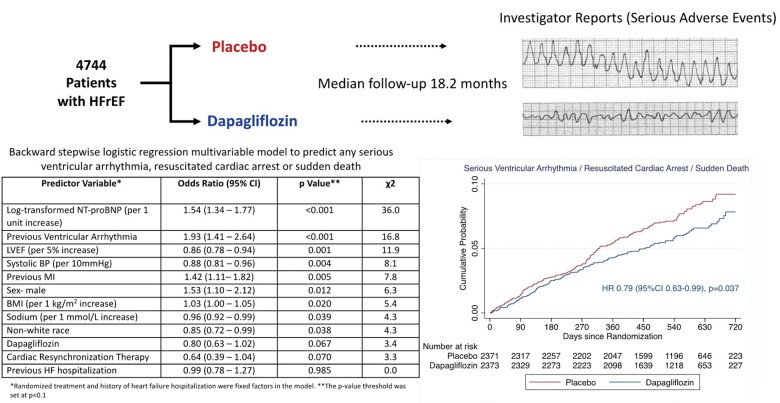
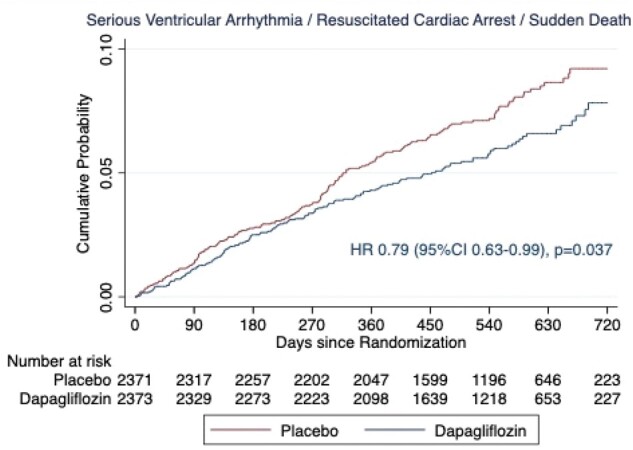
Aims: The aim of this study was to examine the effect of dapagliflozin on the incidence of ventricular arrhythmias and sudden death in patients with heart failure and reduced ejection fraction (HFrEF). Methods and results: In a post hoc analysis of DAPA-HF, we examined serious adverse event reports related to ventricular arrhythmias or cardiac arrest, in addition to adjudicated sudden death. The effect of dapagliflozin, compared with placebo, on the composite of the first occurrence of any serious ventricular arrhythmia, resuscitated cardiac arrest, or sudden death was examined using Cox proportional hazards models. A serious ventricular arrhythmia was reported in 115 (2.4%) of the 4744 patients in DAPA-HF (ventricular fibrillation in 15 patients, ventricular tachycardia in 86, ‘other’ ventricular arrhythmia/tachyarrhythmia in 12, and torsade de pointes in 2 patients). A total of 206 (41%) of the 500 cardiovascular deaths occurred suddenly. Eight patients survived resuscitation from cardiac arrest. Independent predictors of the composite outcome (first occurrence of any serious ventricular arrhythmia, resuscitated cardiac arrest or sudden death), ranked by chi-square value, were log-transformed N-terminal pro-B-type natriuretic peptide, history of ventricular arrhythmia, left ventricular ejection fraction, systolic blood pressure, history of myocardial infarction, male sex, body mass index, serum sodium concentration, non-white race, treatment with dapagliflozin, and cardiac resynchronization therapy. Of participants assigned to dapagliflozin, 140/2373 patients (5.9%) experienced the composite outcome compared with 175/2371 patients (7.4%) in the placebo group [hazard ratio 0.79 (95% confidence interval 0.63–0.99), P = 0.037], and the effect was consistent across each of the components of the composite outcome. Conclusions: Dapagliflozin reduced the risk of any serious ventricular arrhythmia, cardiac arrest, or sudden death when added to conventional therapy in patients with HFrEF. Clinical trial registration: ClinicalTrials.gov unique identifier: NCT03036124 (DAPA-HF).
Overview
The claims and statistics of this paper haven’t been checked yet.
Free: it reads the open-access text and checks the first 5 claims that cite a source we can check. Create a free account to check every claim.
Integrity signals
Registry
Cites
Statistics
Figures
Verification
Claims the paper makes
The claims and statistics of this paper haven’t been checked yet.
Free: it reads the open-access text and checks the first 5 claims that cite a source we can check. Create a free account to check every claim.
Claims other papers make about this one
Each is checked against this paper’s own text: does it say what the citing paper says it does?
In the citing paper
“However, a recent meta-analysis indicated that SGLT2 inhibition was not associated with an overall lower risk of SCD or ventricular arrhythmias in patients with T2DM and/or HF and/or CKD, although the point estimates suggested potential benefits.675”
From 2023 ESC guidelines for the management of cardiovascular disease in patients with diabetes. (2023) · cites this paper as [675]
Self-check
Percentages, sums and reported differences re-computed from the paper’s own numbers.
The self-check needs the paper’s full text.
Citations
Cites
A Proportional Hazards Model for the Subdistribution of a Competing Risk
Fine, J. P., & Gray, R. J. (1999) · Journal of the American Statistical Association · doi:10.1080/01621459.1999.10474144 · Cited by 14,290 · cited 1×
“22 To examine the relative hazard of clinical outcomes before or after the occurrence of any serious ventricular arrhythmia, Cox proportional hazards regression models were performed with the occurrence of the serious ventricular arrhythmia outcome modelled as a time-varying covariate.”
MethodDapagliflozin in Patients with Heart Failure and Reduced Ejection Fraction
McMurray, J. J. V., Solomon, S. D., Inzucchi, S. E., Køber, L., Kosiborod, M. N., Martinez, F. A., Ponikowski, P., Sabatine, M. S., Anand, I. S., Bělohlávek, J., et al. (2019) · New England Journal of Medicine · doi:10.1056/nejmoa1911303 · Cited by 7,140
Self-citationCardiovascular and renal outcomes with empagliflozin in heart failure
Packer, M., Anker, S. D., Butler, J., Filippatos, G., Pocock, S. J., Carson, P., Januzzi, J., Verma, S., Tsutsui, H., Brueckmann, M., et al. (2020) · New England Journal of Medicine · doi:10.1056/nejmoa2022190 · Cited by 5,206
Self-citationPriori, S. G., Blomström-Lundqvist, C., Mazzanti, A., Blom, N., Borggrefe, M., Camm, J., Elliott, P. M., Fitzsimons, D., Hatala, R., Hindricks, G., et al. (2015) · European Heart Journal · doi:10.1093/eurheartj/ehv316 · Cited by 3,893
Self-citationSotagliflozin in patients with diabetes and recent worsening heart failure
Bhatt, D. L., Szarek, M., Steg, P. G., Cannon, C. P., Leiter, L. A., McGuire, D. K., Lewis, J. B., Riddle, M. C., Voors, A. A., Metra, M., et al. (2021) · New England Journal of Medicine · doi:10.1056/nejmoa2030183 · Cited by 1,868
Self-citation(2015) · Europace · doi:10.1093/europace/euv319 · Cited by 1,592
Zannad, F., Ferreira, J. P., Pocock, S. J., Anker, S. D., Butler, J., Filippatos, G., Brueckmann, M., Ofstad, A. P., Pfarr, E., Jamal, W., et al. (2020) · The Lancet · doi:10.1016/s0140-6736(20)31824-9 · Cited by 1,408
Mechanisms of Cardiovascular Benefits of Sodium Glucose Co-Transporter 2 (SGLT2) Inhibitors
Lopaschuk, G. D., & Verma, S. (2020) · JACC: Basic to Translational Science · doi:10.1016/j.jacbts.2020.02.004 · Cited by 894 · cited 1×
“40–42 Our study had several limitations.”
Al-Khatib, S. M., Stevenson, W. G., Ackerman, M. J., Bryant, W. J., Callans, D. J., Curtis, A. B., Deal, B. J., Dickfeld, T., Field, M. E., Fonarow, G. C., et al. (2018) · Journal of the American College of Cardiology · doi:10.1016/j.jacc.2017.10.053 · Cited by 678
Uthman, L., Baartscheer, A., Bleijlevens, B., Schumacher, C. A., Fiolet, J. W. T., Koeman, A., Jancev, M., Hollmann, M. W., Weber, N. C., Coronel, R., et al. (2018) · Diabetologia · doi:10.1007/s00125-017-4509-7 · Cited by 610
Cited by
Items 101–200 of 255
Pascual-Figal, D. A., & Bayés‐Genís, A. (2024) · Frontiers in Cardiovascular Medicine · doi:10.3389/fcvm.2024.1439696 · Cited by 7
Masarone, D., Pacileo, R., & Pacileo, G. (2021) · Heart Failure Reviews · doi:10.1007/s10741-021-10189-4 · Cited by 7
Time to Rechallenge Primary Prevention ICD Guidelines
Wong, B., McDonald, K., & Keane, D. (2022) · ESC Heart Failure · doi:10.1002/ehf2.14113 · Cited by 7
“have been recently demonstrated in a multi-centre Italian registry,(13) and furthermore, the benefit of SGLT2i on VA/SCD risk have been demonstrated to be incremental past 12 months.(5) Delaying implantation and thereby reducing the number of unnecessary ICD implants would not only reduce patient risk associated with…”
BackgroundSGLT2 Inhibition in Acute Myocardial Infarction—A Comprehensive Review
Benedikt, M., Kolesnik, E., Sourij, H., & von Lewinski, D. (2023) · Reviews in Cardiovascular Medicine · doi:10.31083/j.rcm2402032 · Cited by 10
“…evidence with beneficial effects was the DAPA-HF demonstrating in a post-hoc analysis a significant lower number of serious ventricular arrythmias, resuscitated cardiac arrest and sudden death in patients with HFrEF with a relative risk reduction of 21% in dapagliflozin compared to placebo [38].”
Nakase, M., Yahagi, K., Horiuchi, Y., Asami, M., Yuzawa, H., Komiyama, K., Tanaka, J., Aoki, J., & Tanabe, K. (2023) · Heart and Vessels · doi:10.1007/s00380-023-02298-x · Cited by 7
Wang, Y., Wang, Y., He, X., & Li, X. (2025) · Frontiers in Endocrinology · doi:10.3389/fendo.2025.1554637 · Cited by 19
Is it time to revisit ICD indications?
Yehya, A., Davis, J. D., Sauer, A. J., & Ibrahim, N. E. (2022) · Heart Failure Reviews · doi:10.1007/s10741-022-10215-z · Cited by 6
The Future of Antiarrhythmic Drug Therapy: Will Drugs Be Entirely Replaced by Procedures?
Valderrábano, M. (2022) · Methodist DeBakey Cardiovascular Journal · doi:10.14797/mdcvj.1185 · Cited by 7
SGLT2 inhibitors: Do they have antiarrhythmic properties?
Caballero, R., Tamargo, J. L., & Delpón, E. (2026) · Pharmacology & Therapeutics · doi:10.1016/j.pharmthera.2025.108973 · Cited by 7
Lee, M., Mahtta, D., Dlouhy, L., Shahab, H., Rifai, M. A., & Virani, S. S. (2021) · Current Atherosclerosis Reports · doi:10.1007/s11883-021-00975-8 · Cited by 5
Ruffino, E., Gori, M., D’Elia, E., Sciatti, E., Shi, V. C., & Senni, M. (2022) · Cardiology Plus · doi:10.1097/cp9.0000000000000007 · Cited by 6
“Volume 7 • Number 1 • 2022 26 conventional therapy in patients with HFrEF([45]).”
BackgroundBilchick, K. C., Wang, Y., Curtis, J. P., Shadman, R., Dardas, T., Anand, I. S., Lund, L. H., Dahlström, U., Sartipy, U., & Levy, W. C. (2022) · Journal of the American Heart Association · doi:10.1161/jaha.121.023743 · Cited by 5
Crea, F. (2022) · European Heart Journal · doi:10.1093/eurheartj/ehac497 · Cited by 5
Sudden Cardiac Death in Heart Failure: A 20-Year Perspective From a Mediterranean Cohort
Codina, P., Zamora, E., Levy, W. C., Cediel, G., Santiago‐Vacas, E., Domingo, M., Ruiz-Cueto, M., Sánchez, D. C., Sarrias, A., Borrellas, A., et al. (2022) · Journal of Cardiac Failure · doi:10.1016/j.cardfail.2022.11.016 · Cited by 7
Vrachatis, D. A., Papathanasiou, K. A., Giotaki, S. G., Raisakis, K., Kaoukis, A., Kossyvakis, C., Theodorakis, A., Pediotidis, S., Avramides, D., Siasos, G., et al. (2023) · Current Pharmaceutical Design · doi:10.2174/1381612829666230316142450 · Cited by 8
Minguito‐Carazo, C., Muñoz, E. S., Rodríguez‐Mañero, M., Martínez‐Sande, J. L., Andrés, M. L. F., Seara, J. G., Rebollo, J. M. G., Santamarta, M. R., Melchor, L. G., Ferrero, T. G., et al. (2024) · Revista Española de Cardiología (English Edition) · doi:10.1016/j.rec.2023.12.010 · Cited by 9
Song, L., Wang, X., Sun, J., Hu, X., Li, H., Hu, P., & Liu, D. (2023) · Clinical Pharmacokinetics · doi:10.1007/s40262-022-01209-z · Cited by 7
Waldmann, V., Barra, S., & Marijon, É. (2023) · European Heart Journal · doi:10.1093/eurheartj/ehad001 · Cited by 5
Doldi, F., Willy, K., Wolfes, J., Ellermann, C., Taeger, S., Wegner, F. K., Güner, F., Korthals, D., Rath, B., Frommeyer, G., et al. (2025) · Journal of Clinical Medicine · doi:10.3390/jcm14092859 · Cited by 4
“Despite significant advances in heart failure management, recent randomized trials [2–6] have reported remaining high SCD rates highlighting the persistent relevance of ICD therapy among high-risk patients [7].”
Bertrand, A., Tomek, J., & Rodríguez, B. (2026) · The Journal of Physiology · doi:10.1113/jp287140 · Cited by 5
Treatment of Heart Failure with reduced Ejection Fraction in 2022: The Essential Pillars
Bonatto, M. G., Coiradas, A. D. O., & Moura, L. Z. (2022) · ABC Heart Failure & Cardiomyopathy · doi:10.36660/abchf.20220003 · Cited by 2
Xu, B., Zhang, T., Kang, B., Yang, X., Li, S., Chen, J., He, Z., & Zhou, J. (2024) · Cardiovascular Drugs and Therapy · doi:10.1007/s10557-024-07653-2 · Cited by 4
“In a post-hoc analysis of DAPA-HF, there was no significant association between the reduction of serious ventricular arrhythmia risk and dapagliflozin compared to placebo [14].”
InfluentialFazzini, L., Marchetti, M. F., Perra, F., Biddau, M., Massazza, N., Nissardi, V., Agus, E., Demelas, R., & Montisci, R. (2023) · Journal of Clinical Medicine · doi:10.3390/jcm12144743 · Cited by 4
“The WCD is a device that allows the clinician to have time to make the best decision while the patient is protected against SCD, and meanwhile offers time for non-antiarrhythmic drugs to act on SCD risk reduction [8,9].”
BackgroundStöllberger, C., Finsterer, J., & Schneider, B. (2023) · Expert Review of Cardiovascular Therapy · doi:10.1080/14779072.2023.2273900 · Cited by 11
“A further retrospective study using spontaneous reports from FAERS, VigiBase and the Canadian Adverse Reaction Database up to 2021, confirmed a potential risk of pancreatitis with the use of SGLT2-I [69].”
ResultRav-Acha, M., Wube, O., Tovia‐Brodie, O., Michowitz, Y., Ilan, M., Ovdat, T., Klempfner, R., Suleiman, M., Goldenberg, I., & Glikson, M. (2023) · The American Journal of Cardiology · doi:10.1016/j.amjcard.2023.10.044 · Cited by 4
Abedi, F., Mohammadpour, A. H., Ghavami, V., Heidari‐Bakavoli, A., Jomezadeh, V., & Tayyebi, M. (2024) · Naunyn-Schmiedeberg s Archives of Pharmacology · doi:10.1007/s00210-024-03224-2 · Cited by 4
“It was found that dapagliflozin at a dose of 10 mg daily reduces the incidence of ventricular arrhythmias compared to the placebo group (Curtain et al. 2021).”
Pagel, P. S., Hang, D., Freed, J. K., & Crystal, G. J. (2025) · Journal of Cardiothoracic and Vascular Anesthesia · doi:10.1053/j.jvca.2025.05.010 · Cited by 7
Sauer, J., Marksteiner, J., HOHENEGGER, M., Todt, H., Kubista, H., Dostal, C., Kiss, A., Podesser, B. K., Salzer, I., Koenig, X., et al. (2025) · American Journal of Physiology-Heart and Circulatory Physiology · doi:10.1152/ajpheart.00363.2025 · Cited by 5
“Among the various beneficial effects of SGLT2 inhibitors on the failing heart discussed (41, 42), their antiarrhythmic properties seem to play a relevant role (16, 53–55).”
Scheen, A. J. (2022) · Diabetes Epidemiology and Management · doi:10.1016/j.deman.2022.100107 · Cited by 4
Prameswari, H. S., Putra, I. C. S., Kamarullah, W., Pranata, R., Iqbal, M., Karwiky, G., Pramudyo, M., Kusumawardhani, N. Y., Achmad, C., Martha, J. W., et al. (2023) · Open Heart · doi:10.1136/openhrt-2022-002225 · Cited by 5
What to and Not to Monitor for Uptitration of GDMT in Patients With Heart Failure
Bozkurt, B. (2022) · JACC Heart Failure · doi:10.1016/j.jchf.2022.09.005 · Cited by 5
Antiarrhythmic potential of SGLT2 inhibitors: Mechanistic insights and clinical evidence
Fujiki, S. (2025) · Journal of Cardiology · doi:10.1016/j.jjcc.2025.09.018 · Cited by 6
Crea, F. (2022) · European Heart Journal · doi:10.1093/eurheartj/ehac734 · Cited by 3
Omari, M. B., Naseri, S., & Hassan, A. J. (2024) · Diabetes Metabolic Syndrome and Obesity · doi:10.2147/dmso.s448670 · Cited by 3
“9,23,79,80”
Sodium glucose cotransporter 2 inhibitors in the management of heart failure: Veni, Vidi, and Vici
Bhandari, M., Pradhan, A. K., Vishwakarma, P., Singh, A., & Sethi, R. (2024) · World Journal of Cardiology · doi:10.4330/wjc.v16.i10.550 · Cited by 4
“%)] exhibited significantly fewer arrhythmic events and SCD than those on placebo [175/2371 patients (7.4%); HR: 0.79; 95%CI: 0.63-0.99; P = 0.037)[48].”
InfluentialGale, C. P., Hindricks, G., Nadarajah, R., Tijssen, J. G. P., Bovéda, S., Nielsen, J. C., Merino, J. L., Lenarczyk, R., Táborský, M., & Dagres, N. (2025) · European Heart Journal - Quality of Care and Clinical Outcomes · doi:10.1093/ehjqcco/qcaf018 · Cited by 3
Nakamaru, R., Shiraishi, Y., Niimi, N., Ueda, I., Ikemura, N., Suzuki, M., Noma, S., Inohara, T., Numasawa, Y., Fukuda, K., et al. (2022) · The American Journal of Cardiology · doi:10.1016/j.amjcard.2022.11.019 · Cited by 3
Chronic heart failure with reduced EF: A decade of major pharmacological innovations
Trochu, J. (2023) · La Presse Médicale · doi:10.1016/j.lpm.2023.104219 · Cited by 4
Goldenberg, I., Ezekowitz, J. A., Albert, C. M., Alexis, J. D., Anderson, L., Behr, E. R., Daubert, J. P., Palo, K. E. D., Ellenbogen, K. A., Dzikowicz, D. J., et al. (2025) · Journal of Cardiac Failure · doi:10.1016/j.cardfail.2024.12.001 · Cited by 5
Focus on heart failure and cardiomyopathies: new ESC Guidelines and key meta-analyses
Crea, F. (2023) · European Heart Journal · doi:10.1093/eurheartj/ehad647 · Cited by 3
Wang, M., Goldenberg, I., Younis, A., Goldenberg, I., Christof, M., Huang, D. T.-C., McNitt, S. A., Polonsky, B., Kutyifa, V., Zaręba, W., et al. (2024) · Heart Rhythm · doi:10.1016/j.hrthm.2024.11.033 · Cited by 2
SGLT2 inhibitors across the acute cardiac care spectrum: insights and perspectives
Bertaina, M., Galluzzo, A., Carbonaro, C., Marzulli, A., Calcagnile, C., Sbarra, P., Franchin, L., Boccuzzi, G. G., & Iannaccone, M. (2025) · Future Cardiology · doi:10.1080/14796678.2025.2503666 · Cited by 3
The Timing for Primary Prevention for ICD in the Current Era of Pharmacotherapy
Shchendrygina, A., Yehya, A., & Skouri, H. N. (2025) · Cardiac failure review · doi:10.15420/cfr.2025.05 · Cited by 2
Yafasova, A., Doi, S. N., Thune, J. J., Nielsen, J. C., Bruun, N. E., Eiskjær, H., Hassager, C., Svendsen, J. H., Høfsten, D. E., Torp-Pedersen, C. T., et al. (2025) · International Journal of Cardiology · doi:10.1016/j.ijcard.2025.133969 · Cited by 3
Self-citationFoà, A., Vaduganathan, M., Claggett, B. L., Díaz, R., Malik, F. I., Heitner, S. B., Kupfer, S., Divanji, P., Felker, G. M., Metra, M., et al. (2026) · European Journal of Heart Failure · doi:10.1093/ejhf/xuag023 · Cited by 2
Self-citationDing, C., Lv, F., Wang, L., & Xu, X. (2026) · Frontiers in Cardiovascular Medicine · doi:10.3389/fcvm.2026.1742682 · Cited by 2
Skouri, H. N., Abdin, A., Müllens, W., Bucciarelli‐Ducci, C., Starling, R. C., van der Meer, P., Savarese, G., Gal, T. B., Bayés‐Genís, A., Heymans, S. R. B., et al. (2026) · ESC Heart Failure · doi:10.1093/eschf/xvag115 · Cited by 4
“101”
2025 Clinical practice guidelines for Dilated cardiomyopathy
Chesnikova, A. I., Sitnikova, M. Y., Ageev, F. T., Arutyunov, G. P., Баутин, А. Е., Begrambekova, Y. L., Belenkov, Y. N., Vasyuk, Y. A., Георгиевна, В. Н., Galyavich, A. S., et al. (2026) · Russian Journal of Cardiology · doi:10.15829/1560-4071-2026-6672 · Cited by 8
Is There Room for New Drugs in the Treatment of Advanced Heart Failure: SGLT2i?
Issa, V. S. (2022) · ABC Heart Failure & Cardiomyopathy · doi:10.36660/abchf.20220030 · Cited by 2
Managing arrhythmia in cardiac resynchronisation therapy
de Vere, F., Wijesuriya, N., Elliott, M. K., Mehta, V. S., Howell, S., Bishop, M. J., Strocchi, M., Niederer, S., & Rinaldi, C. A. (2023) · Frontiers in Cardiovascular Medicine · doi:10.3389/fcvm.2023.1211560 · Cited by 2
Kantharia, B. K., & Shah, A. N. (2023) · Journal of Cardiovascular Electrophysiology · doi:10.1111/jce.16055 · Cited by 2
Wang, Z., Li, Y., Liang, M., Sun, J., Zhang, J., Xu, L., & Han, Y. (2025) · Frontiers in Physiology · doi:10.3389/fphys.2025.1632680 · Cited by 2
Crea, F. (2023) · European Heart Journal · doi:10.1093/eurheartj/ehad815 · Cited by 2
Savarese, G., Lund, L. H., Rosano, G. M. C., & Coats, A. J. S. (2021) · European Heart Journal - Cardiovascular Pharmacotherapy · doi:10.1093/ehjcvp/pvab071 · Cited by 2
A Heart Team approach to contemporary device decision‐making in heart failure
Varshney, A. S., Singh, J. P., & Vaduganathan, M. (2022) · European Journal of Heart Failure · doi:10.1002/ejhf.2445 · Cited by 2
Al‐Khatib, S. M., & Thomas, K. L. (2023) · Circulation · doi:10.1161/circulationaha.123.065723 · Cited by 2
Lauretti, C., Antonio, G. L., Fernandes, A. E., Stocco, F. G., Girardi, A. C. C., Verrier, R. L., & Caramelli, B. (2024) · Cardiovascular Diabetology · doi:10.1186/s12933-024-02311-1 · Cited by 4
“Dapagliflozin, another SGLT2i, has been shown to reduce ventricular arrhythmias, cardiac arrests, and SCD in conjunction with standard heart failure (HF) treatments [12].”
BackgroundKatov, L., Rostan, J., Teumer, Y., Diofano, F., Bothner, C., Rottbauer, W., & Weinmann, K. (2025) · Journal of Clinical Medicine · doi:10.3390/jcm14030786 · Cited by 1
“Some analyses suggest potential antiarrhythmic benefits, particularly in high-risk patients [19,38,39].”
Kayhan, Y., Kaya, H., Kavalcı, V., Abuş, S., Bıyıklı, K., Markirt, S., Can, C., Markirt, E., & Özdemir, D. M. (2025) · Annals of Noninvasive Electrocardiology · doi:10.1111/anec.70101 · Cited by 1
Ventricular repolarization is improved by His resynchronization therapy but not biventricular pacing
Samways, J., Cheng, T., Chow, J., Shun-Shin, M. J., Ali, N., Keene, D., Howard, J. P., Naraen, A., Saleh, K., Kaza, N., et al. (2025) · Heart Rhythm · doi:10.1016/j.hrthm.2025.09.037 · Cited by 1
The role of implantable cardioverter-defibrillators in the elderly
Mugnai, G., Genovese, D., Tomasi, L., & Ribichini, F. L. (2025) · Progress in Cardiovascular Diseases · doi:10.1016/j.pcad.2025.12.002 · Cited by 2
Nakajima, K., Doi, T., Nakata, T., Nakahashi, T., Tada, H., Wakabayashi, H., & Verberne, H. J. (2026) · European Journal of Nuclear Medicine and Molecular Imaging · doi:10.1007/s00259-026-07776-8 · Cited by 1
“With advances in GDMT and device-based treatments, accurate of individualized risk in CHF has become increasingly important [24, 25].”
Dautov, D. R., Medvedev, A. D., & Lebedeva, V. K. (2026) · Journal of Arrhythmology · doi:10.35336/va-1586 · Cited by 1
Hernández, J. M., Bailey, L. R. J., Salemme, V., Ko, C. Y., Shen, E. Y., Ngim, M., Hoang, D., Corea, M., Bossuyt, J., Davis, J., et al. (2026) · Basic Research in Cardiology · doi:10.1007/s00395-026-01184-7 · Cited by 3
“In HFrEF patients, dapagliflozin, another SGLT2 inhibitor, reduced the risk of ventricular arrhythmia, cardiac arrest, or sudden death [13], and it also reduced QTc and dispersion of repolarization [40].”
Al‐Khatib, S. M., Ackerman, M. J., Califf, R. M., Chung, M. K., Chugh, S. S., Curtis, A. B., Dagres, N., Ellenbogen, K. A., Felker, G. M., Goldenberg, I., et al. (2026) · Heart Rhythm · doi:10.1016/j.hrthm.2026.05.040 · Cited by 2
Yang, P. Q., Liu, Y., Zhang, N., Yang, Y., ZHAO, Y., Zhu, D., Li, X., Song, Y., Fu, J., Shen, S., et al. (2026) · Frontiers in Cardiovascular Medicine · doi:10.3389/fcvm.2026.1767079 · Cited by 1
Guzmán, J. P., Capobianco, M., & Uberti, P. D. (2026) · Pacing and Clinical Electrophysiology · doi:10.1111/pace.70371 · Cited by 1
Voronkov, L. G., & Chendey, T. (2021) · Український медичний часопис · doi:10.32471/umj.1680-3051.145.219239 · Cited by 1
New tools to predict and new therapeutic targets to treat life-threatening ventricular arrhythmias
Crea, F. (2022) · European Heart Journal · doi:10.1093/eurheartj/ehac573 · Cited by 1
Contemporary management of ventricular arrhythmias in heart failure.
Kariki, O. K., Georgopoulos, M., Katsillis, N., Chatziantoniou, A., Koskina, S., Zygouri, A., Saplaouras, A., Bazoukis, G., Gkouziouta, A., Vlachos, K. G., et al. (2023) · PubMed Central · Cited by 1
Implantable cardioverter–defibrillators
Savarese, G., Linde, C. M., & Dickstein, K. (2023) · Oxford University Press eBooks · doi:10.1093/med/9780198891628.003.0053 · Cited by 1
Minguito‐Carazo, C., Muñoz, E. S., Rodríguez‐Mañero, M., Martínez‐Sande, J. L., Andrés, M. L. F., García‐Seara, J., Rebollo, J. M. G., Santamarta, M. R., Melchor, L. G., Ferrero, T. G., et al. (2023) · Revista Española de Cardiología · doi:10.1016/j.recesp.2023.12.006 · Cited by 1
Ikeya, Y., Okumura, Y., Kogawa, R., Nagashima, K., Nakai, T., Yokoyama, K., Iso, K., Kato, T., Tsuda, T., Tachibana, E., et al. (2024) · Journal of Arrhythmia · doi:10.1002/joa3.13028 · Cited by 1
Contemporary prospects for the use of sodium-glucose cotransporter-2 inhibitors
Kondratieva, A. R., Khazova, E. A., Lobanova, A. V., Sorokina, Y. А., Mosinа, A. A., & Занозина, О. В. (2024) · Perm Medical Journal · doi:10.17816/pmj41692-108 · Cited by 1
Atabekov, T. A., Криволапов, С. Н., Silivanova, I. K., Хлынин, М. С., Валерьевна, К. И., Batalov, R. E., & Popov, S. V. (2025) · Journal of Interventional Cardiac Electrophysiology · doi:10.1007/s10840-025-02014-x · Cited by 2
“…of 18 months, SGLT2i reduced the risk of the primary endpoint of any serious ventricular arrhythmia, cardiac arrest, or sudden cardiac death, and the effectiveness appeared to be more substantial in patients without an ICD device, although the interaction with SGLT2i was not significant [24].”
Do SGLT2 Inhibitors Represent a Promising Treatment for Sudden Cardiac Death?
Navarro‐García, J. A., Stump, K. A., & Wehrens, X. H. T. (2025) · Cardiovascular Drugs and Therapy · doi:10.1007/s10557-025-07707-z · Cited by 1
“A post-hoc analysis of the DAPA-HF trial [5] revealed that dapagliflozin, when combined with standard therapies, significantly lowered the composite risk of VA, cardiac arrest, and SCD in HF patients compared to placebo.”
Fighting against sudden cardiac death: the new frontiers
Crea, F. (2022) · European Heart Journal · doi:10.1093/eurheartj/ehac161 · Cited by 1
Scheen, A. J. (2022) · Médecine des Maladies Métaboliques · doi:10.1016/j.mmm.2022.11.001 · Cited by 1
HFrEF: SGLT-2 verringern auch ventrikuläres Arrhythmierisiko
Franke, K. (2022) · Aktuelle Kardiologie · doi:10.1055/a-1721-5672
Novel mechanistic insights into ventricular arrhythmias and sudden death
Crea, F. (2022) · European Heart Journal · doi:10.1093/eurheartj/ehac115
Ferrannini, G., & Savarese, G. (2022) · European Cardiology Review · doi:10.15420/ecr.2022.06
Кanorskiy, S. G. (2022) · Meditsinskiy sovet = Medical Council · doi:10.21518/2079-701x-2022-16-17-44-51 · Cited by 1
Antidiabetic agents and their hypothetical benefit on the risk of cardiac arrhythmias
Fauchier, L. (2022) · Diabetes & Metabolism · doi:10.1016/j.diabet.2022.101406
Management of ventricular arrhythmias in heart failure: current perspectives
Rafaj, A., Peichl, P., & Kautzner, J. (2022) · Intervenční a akutní kardiologie · doi:10.36290/kar.2022.019
Pharmacological treatment of CVD
Agewall, S. (2022) · European Heart Journal - Cardiovascular Pharmacotherapy · doi:10.1093/ehjcvp/pvac068
Halimi, S. (2022) · Médecine des Maladies Métaboliques · doi:10.1016/j.mmm.2022.12.008
Personalizing Risk Assessment for Sudden Cardiac Death in Heart Failure
Wilcox, J. E., & Al‐Khatib, S. M. (2023) · JACC Heart Failure · doi:10.1016/j.jchf.2022.10.011
Fonderico, C., Pergola, V., Faccenda, D., Comparone, G., Marrese, A., Salucci, A., Ammirati, G., Cocchiara, L., Varriale, A., Esposito, G., et al. (2023) · medRxiv · doi:10.1101/2023.03.30.23287985
Dapagliflozin in Low-EF Congestive Heart Failure (DAPA-HF)-2019
Checchio, L. (2023) · Springer eBooks · doi:10.1007/978-3-031-25620-2_13
ICD-Therapie zum Schutz vor dem plötzlichen Herztod. Sind die Leitlinien aktuell genug?
Dagres, N., & Hindricks, G. (2023) · Aktuelle Kardiologie · doi:10.1055/a-2046-0943
SGLT2 Inhibitors and Supraventricular Arrhythmias: The Antiarrhythmic Role of Gliflozins
(2023) · Insights of Cardiovascular Pharmacology Research · doi:10.33140/icvpr.03.01.01
Late breaking trials in heart failure
Crea, F. (2023) · European Heart Journal · doi:10.1093/eurheartj/ehad516
Irene, C. K.-K. (2022) · International Journal of Heart Rhythm · doi:10.4103/ijhr.ijhr_4_22
Innovative trials in heart failure, dyslipidaemias, and sinus node dysfunction
Crea, F. (2023) · European Heart Journal · doi:10.1093/eurheartj/ehad706
Naccarelli, G. V. (2023) · The American Journal of Cardiology · doi:10.1016/j.amjcard.2023.11.013
Critical Care Nurses' Performance Regarding Management of Patients with Ventricular Arrhythmias
Ghareb, A. (2023) · Trends in Nursing and Health Care Journal · doi:10.21608/tnhcj.2023.218250.1018
Doi, S. N., Thune, J. J., Nielsen, J. C., Haarbo, J., Videbæk, L. M., Yafasova, A., Bruun, N. E., Gustafsson, F., Eiskjær, H., Hassager, C., et al. (2024) · Journal of the American Heart Association · doi:10.1161/jaha.123.031977 · Cited by 1
“…with ischemic HF may be more susceptible to ventricular arrhythmias, originating from myocardial scar tissue, than those with nonischemic HF. 31,32 Finally, given the limitations of subgroup analyses, a significant interaction (or the lack hereof) could simply have resulted by chance, and the…”
Self-citationThe impact of SGLT 2 inhibitors: Heart failure and beyond
Mansoor, M., Shafiq, M. H., & Khalique, F. (2024) · Irish Journal of Medical Science (1971 -) · doi:10.1007/s11845-024-03644-2
“A study by Curtain JP et al. revealed a statistically significant reduction in ventricular arrhythmias in patients of heart failure as compared to placebo group (hazard ratio 0.79 (95% confidence interval 0.63–0.99), with a P -value of 0.037) [7].”
InfluentialSchmitt, A., Behnes, M., Rusnak, J., Akin, M., Reinhardt, M., Abel, N., Forner, J., Müller, J., Weidner, K., Abumayyaleh, M., et al. (2024) · Journal of Clinical Medicine · doi:10.3390/jcm13092665
“%) compared to HFpEF (0.9%), supporting prior study findings that reduced LVEF predicts ventricular arrhythmias in patients with HF [24,58].”
ResultInfluentialHow to better prevent sudden cardiac death? Recent advances
Bricoli, S., Aschieri, D., & Niccoli, G. (2024) · Polskie Archiwum Medycyny Wewnętrznej · doi:10.20452/pamw.16838 · Cited by 1
Metadata
- Authors
- Curtain, J. P., Docherty, K. F., Jhund, P. S., Petrie, M. C., Inzucchi, S. E., Køber, L., Kosiborod, M. N., Martinez, F. A., Ponikowski, P., Sabatine, M. S., Bengtsson, O., Langkilde, A. M., Sjöstrand, M., Solomon, S. D., & McMurray, J. J. V.
- Affiliations
- British Heart Foundation (GB)
- Yale University (US)
- Copenhagen University Hospital (DK)
- UNSW Sydney (AU)
- Universidad Nacional de Córdoba , Córdoba, Argentina
- Wroclaw Medical University (PL)
- Brigham and Women's Hospital (US)
- AstraZeneca (Sweden) (SE)
- Corresponding author
- McMurray, John J V
- ORCID
- Venue
- European Heart Journal
- Publisher
- Oxford University Press (OUP)
- Published
- 2021-08-27
- Volume
- 42
- Issue
- 36
- Pages
- 3727-3738
- ISSN
- 0195-668X (ISSN-L)
- 1522-9645
- PMC
- PMC8455345
- OpenAlex
- W3190779232
- Cited by
- 256
- References
- 45
- Citations by year
- 2026: 38 · 2025: 42 · 2024: 48 · 2023: 51 · 2022: 65 · 2021: 12
- FWCI
- 29.50
- Type
- journal article
- Language
- en
- Open access
- hybrid
- doi.org
- Licence
- Locations
- European Heart Journal (publishedVersion, cc-by)
- Europe PMC (PubMed Central) (publishedVersion, other-oa)
- PubMed Central (publishedVersion, cc-by)
- PubMed (publishedVersion)
- Research at the University of Copenhagen (University of Copenhagen) (publishedVersion, cc-by)
- ENLIGHTEN (Jurnal Bimbingan dan Konseling Islam) (acceptedVersion, cc-by-sa)
- Funders
- AstraZeneca
- British Heart Foundation Centre of Research Excellence Grant (RE/18/6/34217)
- Topics
- Health Sciences › Medicine › Cardiology and Cardiovascular Medicine › Heart Failure Treatment and Management
- Health Sciences › Medicine › Cardiology and Cardiovascular Medicine › Cardiac electrophysiology and arrhythmias
- Health Sciences › Medicine › Endocrinology, Diabetes and Metabolism › Diabetes Treatment and Management
- Keywords
- dapagliflozin, heart failure with reduced ejection fraction, ventricular arrhythmias, sudden cardiac death, resuscitated cardiac arrest, SGLT2 inhibitors, DAPA-HF, ventricular tachycardia, ventricular fibrillation, torsades de pointes, risk factors, N-terminal pro-brain natriuretic peptide, cardiac resynchronization therapy
- MeSH terms
- Arrhythmias, Cardiac, Benzhydryl Compounds, Death, Sudden, Glucosides, Heart Arrest, Heart Failure, Humans, Male, Stroke Volume, Ventricular Function, Left, Death, Sudden, Cardiac
About these checks
Registry, retraction, Cites and statistics results are computed, not judged, with one exception: a printed reference that no index lists is read once by a model before it counts as a citation error. Claims are extracted by a model and kept only when their quote appears verbatim in the text; each cited source is then checked, with a model’s help, for whether it says what the claim relies on. Those verdicts can be wrong — read the claim’s quote and the cited source before relying on one.
Statistics and arithmetic are recomputed, not judged.
Confidence bands are shown only for fields calibrated on our annotated test set. None is calibrated yet, so no band is shown.
What counts as a claim ›How we measure confidence ›How we check this ›
Are you an author, or do you see a problem with this page? Request a review
Data sources
Bibliographic data: Semantic Scholar, OpenAlex, Crossref.
Contains information from the Semantic Scholar Academic Graph Datasets, made available under the ODC Attribution License (ODC-BY 1.0).
Semantic Scholar’s data is described in: Kinney, R., et al. (2023). The Semantic Scholar Open Data Platform. arXiv:2301.10140.
