

Effect of dapagliflozin on ventricular arrhythmias, resuscitated cardiac arrest, or sudden death in DAPA-HF
Open accessThe DOI matches its Crossref record; 45 of the 45 references it cites were found in a registry or an index.
Abstract
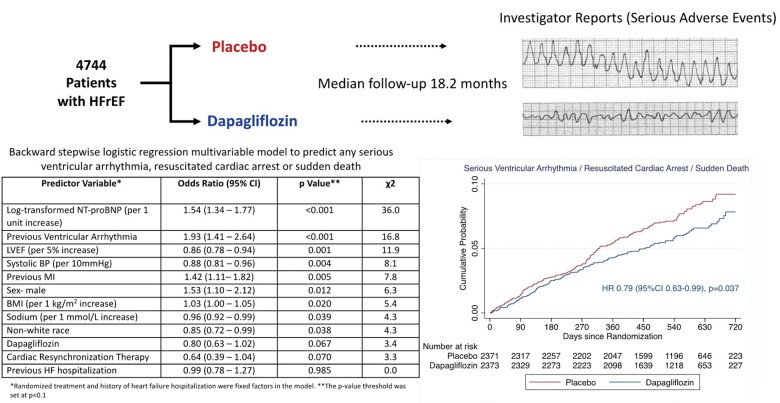
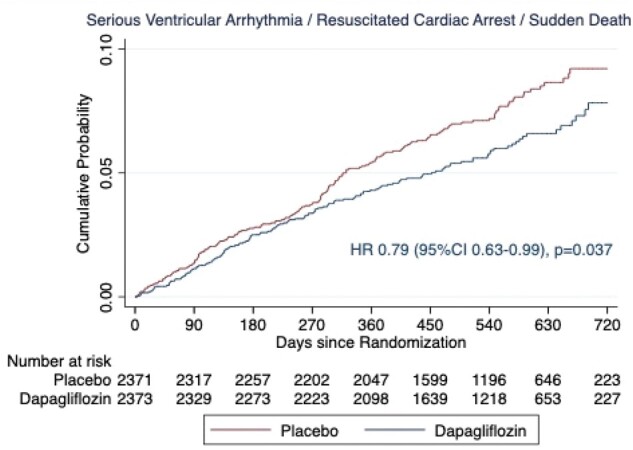
Aims: The aim of this study was to examine the effect of dapagliflozin on the incidence of ventricular arrhythmias and sudden death in patients with heart failure and reduced ejection fraction (HFrEF). Methods and results: In a post hoc analysis of DAPA-HF, we examined serious adverse event reports related to ventricular arrhythmias or cardiac arrest, in addition to adjudicated sudden death. The effect of dapagliflozin, compared with placebo, on the composite of the first occurrence of any serious ventricular arrhythmia, resuscitated cardiac arrest, or sudden death was examined using Cox proportional hazards models. A serious ventricular arrhythmia was reported in 115 (2.4%) of the 4744 patients in DAPA-HF (ventricular fibrillation in 15 patients, ventricular tachycardia in 86, ‘other’ ventricular arrhythmia/tachyarrhythmia in 12, and torsade de pointes in 2 patients). A total of 206 (41%) of the 500 cardiovascular deaths occurred suddenly. Eight patients survived resuscitation from cardiac arrest. Independent predictors of the composite outcome (first occurrence of any serious ventricular arrhythmia, resuscitated cardiac arrest or sudden death), ranked by chi-square value, were log-transformed N-terminal pro-B-type natriuretic peptide, history of ventricular arrhythmia, left ventricular ejection fraction, systolic blood pressure, history of myocardial infarction, male sex, body mass index, serum sodium concentration, non-white race, treatment with dapagliflozin, and cardiac resynchronization therapy. Of participants assigned to dapagliflozin, 140/2373 patients (5.9%) experienced the composite outcome compared with 175/2371 patients (7.4%) in the placebo group [hazard ratio 0.79 (95% confidence interval 0.63–0.99), P = 0.037], and the effect was consistent across each of the components of the composite outcome. Conclusions: Dapagliflozin reduced the risk of any serious ventricular arrhythmia, cardiac arrest, or sudden death when added to conventional therapy in patients with HFrEF. Clinical trial registration: ClinicalTrials.gov unique identifier: NCT03036124 (DAPA-HF).
Overview
The claims and statistics of this paper haven’t been checked yet.
Free: it reads the open-access text and checks the first 5 claims that cite a source we can check. Create a free account to check every claim.
Integrity signals
Registry
Cites
Statistics
Figures
Verification
Claims the paper makes
The claims and statistics of this paper haven’t been checked yet.
Free: it reads the open-access text and checks the first 5 claims that cite a source we can check. Create a free account to check every claim.
Claims other papers make about this one
Each is checked against this paper’s own text: does it say what the citing paper says it does?
In the citing paper
“However, a recent meta-analysis indicated that SGLT2 inhibition was not associated with an overall lower risk of SCD or ventricular arrhythmias in patients with T2DM and/or HF and/or CKD, although the point estimates suggested potential benefits.675”
From 2023 ESC guidelines for the management of cardiovascular disease in patients with diabetes. (2023) · cites this paper as [675]
Self-check
Percentages, sums and reported differences re-computed from the paper’s own numbers.
The self-check needs the paper’s full text.
Citations
Cites
A Proportional Hazards Model for the Subdistribution of a Competing Risk
Fine, J. P., & Gray, R. J. (1999) · Journal of the American Statistical Association · doi:10.1080/01621459.1999.10474144 · Cited by 14,290 · cited 1×
“22 To examine the relative hazard of clinical outcomes before or after the occurrence of any serious ventricular arrhythmia, Cox proportional hazards regression models were performed with the occurrence of the serious ventricular arrhythmia outcome modelled as a time-varying covariate.”
MethodDapagliflozin in Patients with Heart Failure and Reduced Ejection Fraction
McMurray, J. J. V., Solomon, S. D., Inzucchi, S. E., Køber, L., Kosiborod, M. N., Martinez, F. A., Ponikowski, P., Sabatine, M. S., Anand, I. S., Bělohlávek, J., et al. (2019) · New England Journal of Medicine · doi:10.1056/nejmoa1911303 · Cited by 7,140
Self-citationCardiovascular and renal outcomes with empagliflozin in heart failure
Packer, M., Anker, S. D., Butler, J., Filippatos, G., Pocock, S. J., Carson, P., Januzzi, J., Verma, S., Tsutsui, H., Brueckmann, M., et al. (2020) · New England Journal of Medicine · doi:10.1056/nejmoa2022190 · Cited by 5,206
Self-citationPriori, S. G., Blomström-Lundqvist, C., Mazzanti, A., Blom, N., Borggrefe, M., Camm, J., Elliott, P. M., Fitzsimons, D., Hatala, R., Hindricks, G., et al. (2015) · European Heart Journal · doi:10.1093/eurheartj/ehv316 · Cited by 3,893
Self-citationSotagliflozin in patients with diabetes and recent worsening heart failure
Bhatt, D. L., Szarek, M., Steg, P. G., Cannon, C. P., Leiter, L. A., McGuire, D. K., Lewis, J. B., Riddle, M. C., Voors, A. A., Metra, M., et al. (2021) · New England Journal of Medicine · doi:10.1056/nejmoa2030183 · Cited by 1,868
Self-citation(2015) · Europace · doi:10.1093/europace/euv319 · Cited by 1,592
Zannad, F., Ferreira, J. P., Pocock, S. J., Anker, S. D., Butler, J., Filippatos, G., Brueckmann, M., Ofstad, A. P., Pfarr, E., Jamal, W., et al. (2020) · The Lancet · doi:10.1016/s0140-6736(20)31824-9 · Cited by 1,408
Mechanisms of Cardiovascular Benefits of Sodium Glucose Co-Transporter 2 (SGLT2) Inhibitors
Lopaschuk, G. D., & Verma, S. (2020) · JACC: Basic to Translational Science · doi:10.1016/j.jacbts.2020.02.004 · Cited by 894 · cited 1×
“40–42 Our study had several limitations.”
Al-Khatib, S. M., Stevenson, W. G., Ackerman, M. J., Bryant, W. J., Callans, D. J., Curtis, A. B., Deal, B. J., Dickfeld, T., Field, M. E., Fonarow, G. C., et al. (2018) · Journal of the American College of Cardiology · doi:10.1016/j.jacc.2017.10.053 · Cited by 678
Uthman, L., Baartscheer, A., Bleijlevens, B., Schumacher, C. A., Fiolet, J. W. T., Koeman, A., Jancev, M., Hollmann, M. W., Weber, N. C., Coronel, R., et al. (2018) · Diabetologia · doi:10.1007/s00125-017-4509-7 · Cited by 610
Santos-Gallego, C. G., Vargas-Delgado, A. P., Requena-Ibanez, J. A., Garcia-Ropero, A., Mancini, D., Pinney, S., Macaluso, F., Sartori, S., Roque, M., Sabatel-Perez, F., et al. (2021) · Journal of the American College of Cardiology · doi:10.1016/j.jacc.2020.11.008 · Cited by 531
Declining Risk of Sudden Death in Heart Failure
Shen, L., Jhund, P. S., Petrie, M. C., Claggett, B. L., Barlera, S., Cleland, J. G. F., Dargie, H. J., Granger, C. B., Kjekshus, J., Køber, L., et al. (2017) · New England Journal of Medicine · doi:10.1056/nejmoa1609758 · Cited by 508 · cited 1×
“10 It is important, therefore, to investigate the effect of new therapies for HFrEF on ventricular arrhythmias and mode of death, including sudden death.”
BackgroundSelf-citationLee, M. M. Y., Brooksbank, K. J. M., Wetherall, K., Mangion, K., Roditi, G., Campbell, R. T., Berry, C., Chong, V., Coyle, L., Docherty, K. F., et al. (2021) · Circulation · doi:10.1161/circulationaha.120.052186 · Cited by 437
Self-citationMcMurray, J. J. V., DeMets, D. L., Inzucchi, S. E., Køber, L., Kosiborod, M. N., Langkilde, A. M., Martinez, F. A., Bengtsson, O., Ponikowski, P., Sabatine, M. S., et al. (2019) · European Journal of Heart Failure · doi:10.1002/ejhf.1432 · Cited by 433
Self-citationEmpagliflozin in Heart Failure: Diuretic and Cardiorenal Effects
Griffin, M., Rao, V. S., Ivey-Miranda, J., Fleming, J., Mahoney, D., Maulion, C., Suda, N., Siwakoti, K., Ahmad, T., Jacoby, D., et al. (2020) · Circulation · doi:10.1161/circulationaha.120.045691 · Cited by 414
Self-citationAntiarrhythmic effect of carvedilol after acute myocardial infarction
McMurray, J., Køber, L., Robertson, M., Dargie, H., Colucci, W., Lopez-Sendon, J., Remme, W., Sharpe, D. N., & Ford, I. (2005) · Journal of the American College of Cardiology · doi:10.1016/j.jacc.2004.09.076 · Cited by 275 · cited 1×
“Arrhythmias were not adjudicated although a prior similar study showed a reduction in arrhythmias with a beta-blocker, consistent with the effect found in studies using systematic monitoring.(44) Although ventricular arrhythmias are clearly linked with sudden death, not all sudden deaths are due to an arrhythmia (or a…”
ResultSelf-citationShimizu, W., Kubota, Y., Hoshika, Y., Mozawa, K., Tara, S., Tokita, Y., Yodogawa, K., Iwasaki, Y.-K., Yamamoto, T., Takano, H., et al. (2020) · Cardiovascular Diabetology · doi:10.1186/s12933-020-01127-z · Cited by 228
McMurray, J. J. V., DeMets, D. L., Inzucchi, S. E., Køber, L., Kosiborod, M. N., Langkilde, A. M., Martinez, F. A., Bengtsson, O., Ponikowski, P., Sabatine, M. S., et al. (2019) · European Journal of Heart Failure · doi:10.1002/ejhf.1548 · Cited by 222
Self-citationPhilippaert, K., Kalyaanamoorthy, S., Fatehi, M., Long, W., Soni, S., Byrne, N. J., Barr, A., Singh, J., Wong, J., Palechuk, T., et al. (2021) · Circulation · doi:10.1161/circulationaha.121.053350 · Cited by 204 · cited 1×
“5 sodium channels containing the long QT syndrome 3 mutations.(18)”
BackgroundLi, H.-L., Lip, G. Y. H., Feng, Q., Fei, Y., Tse, Y.-K., Wu, M.-Z., Ren, Q.-W., Tse, H.-F., Cheung, B.-M. Y., & Yiu, K.-H. (2021) · Cardiovascular Diabetology · doi:10.1186/s12933-021-01293-8 · Cited by 188 · cited 1×
“99).(43) Second, adverse event reporting likely underestimated the true prevalence of ventricular arrhythmias.”
BackgroundOmar, M., Jensen, J., Ali, M., Frederiksen, P. H., Kistorp, C., Videbæk, L., Poulsen, M. K., Tuxen, C. D., Möller, S., Gustafsson, F., et al. (2021) · JAMA Cardiology · doi:10.1001/jamacardio.2020.6827 · Cited by 177
Self-citationMartens, P., Nuyens, D., Rivero‐Ayerza, M., Herendael, H. V., Vercammen, J., Ceyssens, W., Luwel, E., Dupont, M., & Müllens, W. (2019) · Clinical Research in Cardiology · doi:10.1007/s00392-019-01440-y · Cited by 175
Zhang, N., Feng, B., Ma, X., Sun, K., Xu, G., & Zhou, Y. (2019) · Cardiovascular Diabetology · doi:10.1186/s12933-019-0914-1 · Cited by 167 · cited 1×
“33 Empagliflozin does not prolong QT interval in healthy humans and attenuated sotalol-induced QTc prolongation in rats.”
BackgroundZabel, M., Willems, R., Lubinski, A., Bauer, A., Brugada, J., Conen, D., Flevari, P., Hasenfuß, G., Svetlosak, M., Huikuri, H. V., et al. (2020) · European Heart Journal · doi:10.1093/eurheartj/ehaa226 · Cited by 161
What causes sudden death in patients with chronic heart failure and a reduced ejection fraction?
Packer, M. (2019) · European Heart Journal · doi:10.1093/eurheartj/ehz553 · Cited by 155
Chung, Y. J., Park, K. C., Tokar, S., Eykyn, T. R., Fuller, W., Pavlovic, D., Swietach, P., & Shattock, M. J. (2021) · Cardiovascular Research · doi:10.1093/cvr/cvaa323 · Cited by 143
Empagliflozin Inhibits Na+/H+ Exchanger Activity in Human Atrial Cardiomyocytes
Trum, M., Riechel, J., Lebek, S., Pabel, S., Sossalla, S. T., Hirt, S. W., Arzt, M. E., Maier, L. S., & Wagner, S. (2020) · ESC Heart Failure · doi:10.1002/ehf2.13024 · Cited by 125
Jensen, J., Omar, M., Kistorp, C., Poulsen, M. K., Tuxen, C., Gustafsson, I., Køber, L., Gustafsson, F., Faber, J. O., Fosbøl, E. L., et al. (2020) · American Heart Journal · doi:10.1016/j.ahj.2020.07.011 · Cited by 116
Self-citationEffect of Empagliflozin on Hemodynamics in Patients With Heart Failure and Reduced Ejection Fraction
Omar, M., Jensen, J., Frederiksen, P. H., Kistorp, C., Videbæk, L. M., Poulsen, M. K., Möller, S., Ali, M., Gustafsson, F., Køber, L., et al. (2020) · Journal of the American College of Cardiology · doi:10.1016/j.jacc.2020.10.005 · Cited by 111
Self-citationRosselló, X., Ariti, C. A., Pocock, S., Ferreira, J. P., Girerd, N., McMurray, J. J. V., van Veldhuisen, D. J., Pitt, B., & Zannad, F. M. (2018) · Clinical Research in Cardiology · doi:10.1007/s00392-018-1378-0 · Cited by 94 · cited 1×
“The independent predictors of the primary endpoint were NT-proBNP concentration, history of ventricular arrhythmia, LVEF, history of myocardial infarction, body mass index, systolic blood pressure, male sex, and serum sodium concentration, in keeping with prior reports.(24,25) The risk of any ventricular arrhythmia, r…”
ResultSelf-citationBeggs, S. A. S., Jhund, P. S., Jackson, C. E., McMurray, J. J. V., & Gardner, R. S. (2018) · Heart · doi:10.1136/heartjnl-2016-310850 · Cited by 90
Self-citationSato, T., Aizawa, Y., Yuasa, S., Fujita, S., Ikeda, Y., & Okabe, M. (2020) · Journal of Atherosclerosis and Thrombosis · doi:10.5551/jat.48009 · Cited by 66 · cited 1×
“40–42 Our study had several limitations.”
Goerg, J., Sommerfeld, M., Greiner, B., Lauer, D., Seckin, Y., Kulikov, A. N., Ivkin, D. Y., Kintscher, U., Okovityi, S. V., & Kaschina, E. (2021) · International Journal of Molecular Sciences · doi:10.3390/ijms22115437 · Cited by 58
Anti-arrhythmic and inotropic effects of empagliflozin following myocardial ischemia
Azam, M. A., Chakraborty, P., Si, D., Du, B., Massé, S., Lai, P. F. H., Ha, A. C. T., & Nanthakumar, K. (2021) · Life Sciences · doi:10.1016/j.lfs.2021.119440 · Cited by 52 · cited 1×
“31 There are several potential mechanisms by which SGLT2 inhibitors might reduce ventricular arrhythmias.”
BackgroundIs Sacubitril/Valsartan (Also) an Antiarrhythmic Drug?
Sarrias, A., & Bayés‐Genís, A. (2018) · Circulation · doi:10.1161/circulationaha.118.034755 · Cited by 49
The Effect of Aldosterone Antagonists for Ventricular Arrhythmia: A Meta‐Analysis
Wei, J., Ni, J., Huang, D., Chen, M., Yan, S., & Peng, Y. (2010) · Clinical Cardiology · doi:10.1002/clc.20762 · Cited by 47
Al‐Gobari, M., Al-Aqeel, S., Gueyffier, F., & Burnand, B. (2018) · BMJ Open · doi:10.1136/bmjopen-2017-021108 · Cited by 47
Goldstein, S., Kennedy, H. L., Hall, C., Anderson, J. L., Gheorghiade, M., Gottlieb, S. S., Jessup, M. L., Karlsberg, R. P., Friday, G. H., & Haskell, L. P. (1999) · American Heart Journal · doi:10.1016/s0002-8703(99)70083-9 · Cited by 46
Ring, A., Brand, T., Macha, S., Breithaupt-Groegler, K., Simons, G., Walter, B., Woerle, H. J., & Broedl, U. C. (2013) · Cardiovascular Diabetology · doi:10.1186/1475-2840-12-70 · Cited by 43 · cited 1×
“34,35 Experimentally, SGLT2 inhibitors also inhibit the cardiac sodium channel current (late I Na ) in cardiomyocytes from mice with heart failure and in cardiac Nav1.”
BackgroundStata Tip 8: Splitting Time-span Records with Categorical Time-varying Covariates
Jann, B. (2004) · The Stata Journal Promoting communications on statistics and Stata · doi:10.1177/1536867x0400400212 · Cited by 42
Zhang, H., Uthman, L., Bakker, D., Sari, S., Chen, S., Hollmann, M. W., Coronel, R., Weber, N. C., Houten, S. M., van Weeghel, M., et al. (2020) · Frontiers in Cardiovascular Medicine · doi:10.3389/fcvm.2020.592233 · Cited by 41
Sodium-Glucose Cotransporter Type 2 (SGLT-2) Inhibitors and Ketogenesis: the Good and the Bad
Ekanayake, P. S., Hupfeld, C. J., & Mudaliar, S. R. D. (2020) · Current Diabetes Reports · doi:10.1007/s11892-020-01359-z · Cited by 38
Empagliflozin significantly attenuates sotalol-induced QTc prolongation in rats
Barış, V. Ö., Dinçsoy, B., Gedikli, E., & Erdemb, A. (2020) · Kardiologia Polska · doi:10.33963/kp.15666 · Cited by 23
Shen, L., Claggett, B. L., Jhund, P. S., Abraham, W. T., Desai, A. S., Dickstein, K., Gong, J., Køber, L., Lefkowitz, M., Rouleau, J. L., et al. (2021) · Clinical Research in Cardiology · doi:10.1007/s00392-021-01888-x · Cited by 11 · cited 1×
“32 Sodium-glucose cotransporter 2 inhibitors may also have a favourable effect on the autonomic nervous system.”
BackgroundSelf-citationVentricular arrhythmias in heart failure with reduced ejection fraction
Voskoboinik, A., & Moss, J. D. (2020) · Current Opinion in Cardiology · doi:10.1097/hco.0000000000000733 · Cited by 3
Cited by
2023 ESC guidelines for the management of cardiovascular disease in patients with diabetes.
Marx, N., Federici, M., Schütt, K., Müller-Wieland, D., Ajjan, R. A., Antunes, M. J., Christodorescu, R. M., Crawford, C., Di Angelantonio, E., Eliasson, B., et al. (2023) · European Heart Journal · doi:10.1093/eurheartj/ehad192 · Cited by 1,642
Self-citationMarijon, E., Narayanan, K., Smith, K., Barra, S., Basso, C., Blom, M. T., Crotti, L., D'Avila, A., Deo, R., Dumas, F., et al. (2023) · The Lancet · doi:10.1016/s0140-6736(23)00875-9 · Cited by 313
Gliflozins in the Management of Cardiovascular Disease
Braunwald, E. (2022) · New England Journal of Medicine · doi:10.1056/nejmra2115011 · Cited by 266
JCS/JHFS 2025 Guideline on Diagnosis and Treatment of Heart Failure
Kitai, T., Kohsaka, S., Kato, T., Kato, E., Sato, K., Teramoto, K., Yaku, H., Akiyama, E., Ando, M., Izumi, C., et al. (2025) · Circulation Journal · doi:10.1253/circj.cj-25-0002 · Cited by 191
Dyck, J. R. B., Sossalla, S., Hamdani, N., Coronel, R., Weber, N. C., Light, P. E., & Zuurbier, C. J. (2022) · Journal of Molecular and Cellular Cardiology · doi:10.1016/j.yjmcc.2022.03.005 · Cited by 169
Metadata
- Authors
- Curtain, J. P., Docherty, K. F., Jhund, P. S., Petrie, M. C., Inzucchi, S. E., Køber, L., Kosiborod, M. N., Martinez, F. A., Ponikowski, P., Sabatine, M. S., Bengtsson, O., Langkilde, A. M., Sjöstrand, M., Solomon, S. D., & McMurray, J. J. V.
- Affiliations
- British Heart Foundation (GB)
- Yale University (US)
- Copenhagen University Hospital (DK)
- UNSW Sydney (AU)
- Universidad Nacional de Córdoba , Córdoba, Argentina
- Wroclaw Medical University (PL)
- Brigham and Women's Hospital (US)
- AstraZeneca (Sweden) (SE)
- Corresponding author
- McMurray, John J V
- ORCID
- Venue
- European Heart Journal
- Publisher
- Oxford University Press (OUP)
- Published
- 2021-08-27
- Volume
- 42
- Issue
- 36
- Pages
- 3727-3738
- ISSN
- 0195-668X (ISSN-L)
- 1522-9645
- PMC
- PMC8455345
- OpenAlex
- W3190779232
- Cited by
- 256
- References
- 45
- Citations by year
- 2026: 38 · 2025: 42 · 2024: 48 · 2023: 51 · 2022: 65 · 2021: 12
- FWCI
- 29.50
- Type
- journal article
- Language
- en
- Open access
- hybrid
- doi.org
- Licence
- Locations
- European Heart Journal (publishedVersion, cc-by)
- Europe PMC (PubMed Central) (publishedVersion, other-oa)
- PubMed Central (publishedVersion, cc-by)
- PubMed (publishedVersion)
- Research at the University of Copenhagen (University of Copenhagen) (publishedVersion, cc-by)
- ENLIGHTEN (Jurnal Bimbingan dan Konseling Islam) (acceptedVersion, cc-by-sa)
- Funders
- AstraZeneca
- British Heart Foundation Centre of Research Excellence Grant (RE/18/6/34217)
- Topics
- Health Sciences › Medicine › Cardiology and Cardiovascular Medicine › Heart Failure Treatment and Management
- Health Sciences › Medicine › Cardiology and Cardiovascular Medicine › Cardiac electrophysiology and arrhythmias
- Health Sciences › Medicine › Endocrinology, Diabetes and Metabolism › Diabetes Treatment and Management
- Keywords
- dapagliflozin, heart failure with reduced ejection fraction, ventricular arrhythmias, sudden cardiac death, resuscitated cardiac arrest, SGLT2 inhibitors, DAPA-HF, ventricular tachycardia, ventricular fibrillation, torsades de pointes, risk factors, N-terminal pro-brain natriuretic peptide, cardiac resynchronization therapy
- MeSH terms
- Arrhythmias, Cardiac, Benzhydryl Compounds, Death, Sudden, Glucosides, Heart Arrest, Heart Failure, Humans, Male, Stroke Volume, Ventricular Function, Left, Death, Sudden, Cardiac
About these checks
Registry, retraction, Cites and statistics results are computed, not judged, with one exception: a printed reference that no index lists is read once by a model before it counts as a citation error. Claims are extracted by a model and kept only when their quote appears verbatim in the text; each cited source is then checked, with a model’s help, for whether it says what the claim relies on. Those verdicts can be wrong — read the claim’s quote and the cited source before relying on one.
Statistics and arithmetic are recomputed, not judged.
Confidence bands are shown only for fields calibrated on our annotated test set. None is calibrated yet, so no band is shown.
What counts as a claim ›How we measure confidence ›How we check this ›
Are you an author, or do you see a problem with this page? Request a review
Data sources
Bibliographic data: Semantic Scholar, OpenAlex, Crossref.
Contains information from the Semantic Scholar Academic Graph Datasets, made available under the ODC Attribution License (ODC-BY 1.0).
Semantic Scholar’s data is described in: Kinney, R., et al. (2023). The Semantic Scholar Open Data Platform. arXiv:2301.10140.
