

Effect of empagliflozin in patients with heart failure across the spectrum of left ventricular ejection fraction
Open accessThe DOI matches its Crossref record; 28 of the 29 references it cites were found in a registry or an index.
Abstract
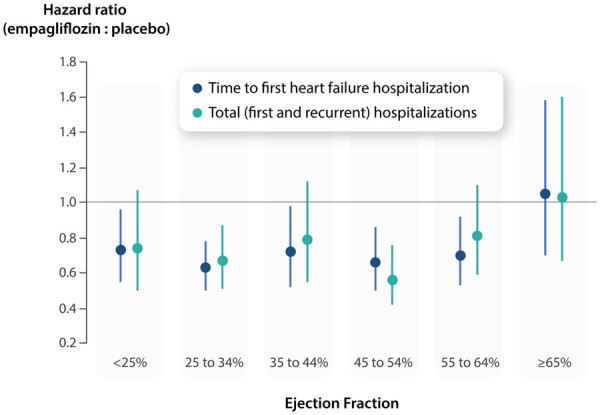
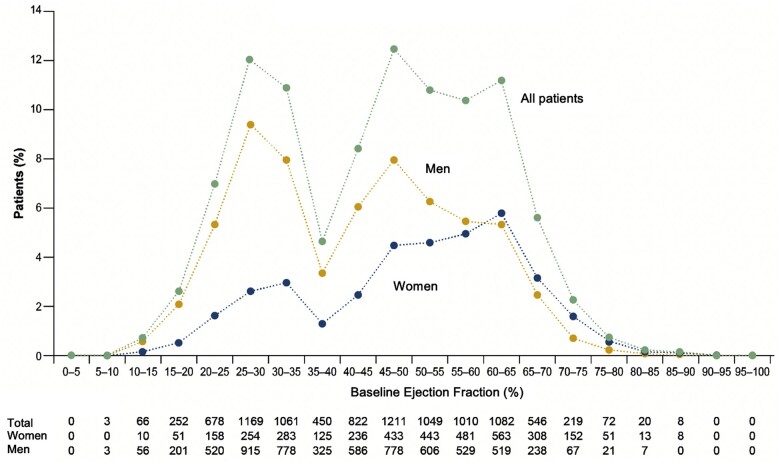
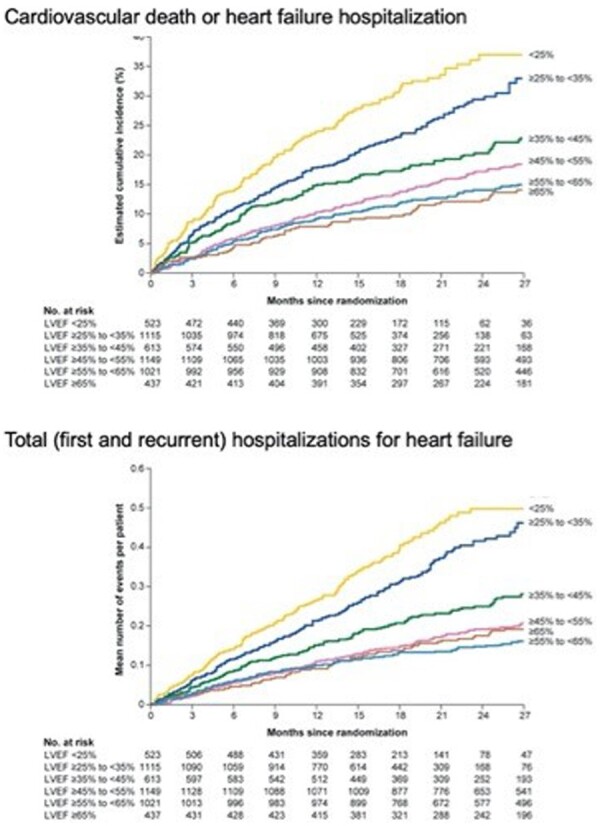
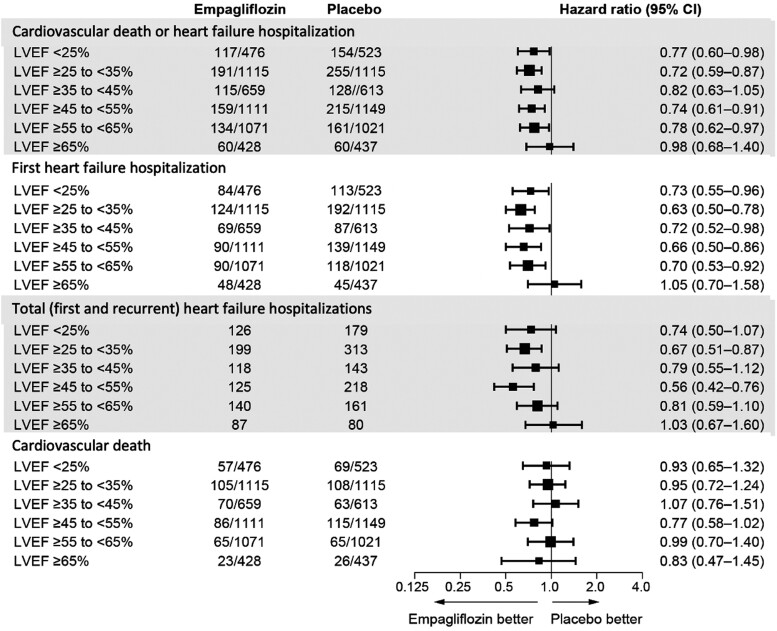
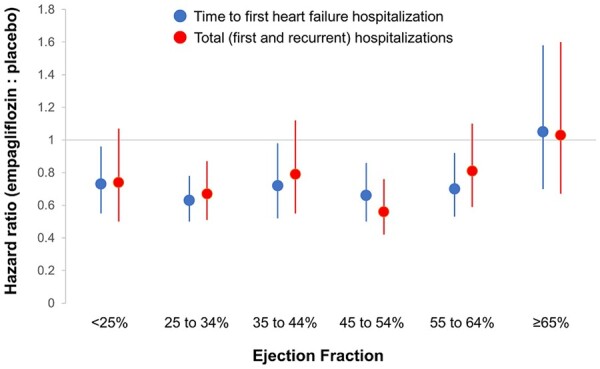
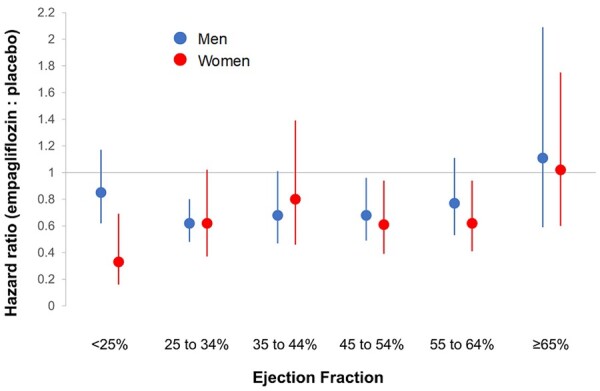
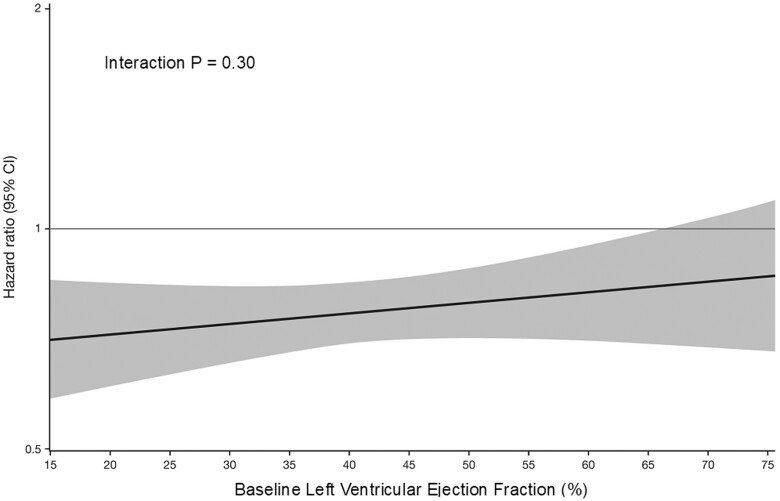
Aims: No therapy has shown to reduce the risk of hospitalization for heart failure across the entire range of ejection fractions seen in clinical practice. We assessed the influence of ejection fraction on the effect of the sodium–glucose cotransporter 2 inhibitor empagliflozin on heart failure outcomes. Methods and results: A pooled analysis was performed on both the EMPEROR-Reduced and EMPEROR-Preserved trials (9718 patients; 4860 empagliflozin and 4858 placebo), and patients were grouped based on ejection fraction: <25% (n = 999), 25–34% (n = 2230), 35–44% (n = 1272), 45–54% (n = 2260), 55–64% (n = 2092), and ≥65% (n = 865). Outcomes assessed included (i) time to first hospitalization for heart failure or cardiovascular mortality, (ii) time to first heart failure hospitalization, (iii) total (first and recurrent) hospitalizations for heart failure, and (iv) health status assessed by the Kansas City Cardiomyopathy Questionnaire (KCCQ). The risk of cardiovascular death and hospitalization for heart failure declined progressively as ejection fraction increased from <25% to ≥65%. Empagliflozin reduced the risk of cardiovascular death or heart failure hospitalization, mainly by reducing heart failure hospitalizations. Empagliflozin reduced the risk of heart failure hospitalization by ≈30% in all ejection fraction subgroups, with an attenuated effect in patients with an ejection fraction ≥65%. Hazard ratios and 95% confidence intervals were: ejection fraction <25%: 0.73 (0.55–0.96); ejection fraction 25–34%: 0.63 (0.50–0.78); ejection fraction 35–44%: 0.72 (0.52–0.98); ejection fraction 45–54%: 0.66 (0.50–0.86); ejection fraction 55–64%: 0.70 (0.53–0.92); and ejection fraction ≥65%: 1.05 (0.70–1.58). Other heart failure outcomes and measures, including KCCQ, showed a similar response pattern. Sex did not influence the responses to empagliflozin. Conclusion: The magnitude of the effect of empagliflozin on heart failure outcomes was clinically meaningful and similar in patients with ejection fractions <25% to <65%, but was attenuated in patients with an ejection fraction ≥65%. Key Question: How does ejection fraction influence the effects of empagliflozin in patients with heart failure and either a reduced or a preserved ejection fraction? Key Finding: The magnitude of the effect of empagliflozin on heart failure outcomes and health status was similar in patients with ejection fractions <25% to <65%, but it was attenuated in patients with an ejection fraction ≥65%. Take Home Message: The consistency of the response in patients with ejection fractions of <25% to <65% distinguishes the effects of empagliflozin from other drugs that have been evaluated across the full spectrum of ejection fractions in patients with heart failure.
Overview
The claims and statistics of this paper haven’t been checked yet.
Free: it reads the open-access text and checks the first 5 claims that cite a source we can check. Create a free account to check every claim.
Integrity signals
Registry
Cites
Statistics
Figures
Verification
Claims the paper makes
The claims and statistics of this paper haven’t been checked yet.
Free: it reads the open-access text and checks the first 5 claims that cite a source we can check. Create a free account to check every claim.
Claims other papers make about this one
Each is checked against this paper’s own text: does it say what the citing paper says it does?
The cited source says what the claim attributes to it.
In the citing paper
“These trials have reported favorable effects in patients with HFpEF7,8”
From Effects of Tirzepatide on the Clinical Trajectory of Patients With Heart Failure, Preserved Ejection Fraction, and Obesity (2025) · cites this paper as [8]
Self-check
Percentages, sums and reported differences re-computed from the paper’s own numbers.
The self-check needs the paper’s full text.
Citations
Cites
Ahmed, A., Jorna, T., & Bhandari, S. (2016) · Nephron · doi:10.1159/000447068 · Cited by 11,717
The Effect of Spironolactone on Morbidity and Mortality in Patients with Severe Heart Failure
Pitt, B., Zannad, F., Remme, W. J., Cody, R., Castaigne, A., Perez, A., Palensky, J., & Wittes, J. (1999) · New England Journal of Medicine · doi:10.1056/nejm199909023411001 · Cited by 9,214
Self-citationDapagliflozin in Patients with Heart Failure and Reduced Ejection Fraction
McMurray, J. J. V., Solomon, S. D., Inzucchi, S. E., Køber, L., Kosiborod, M. N., Martinez, F. A., Ponikowski, P., Sabatine, M. S., Anand, I. S., Bělohlávek, J., et al. (2019) · New England Journal of Medicine · doi:10.1056/nejmoa1911303 · Cited by 7,140
Angiotensin-neprilysin inhibition versus enalapril in heart failure
McMurray, J. J. V., Packer, M., Desai, A. S., Gong, J., Lefkowitz, M. P., Rizkala, A. R., Rouleau, J. L., Shi, V. C., Solomon, S. D., Swedberg, K., et al. (2014) · New England Journal of Medicine · doi:10.1056/nejmoa1409077 · Cited by 6,957
Self-citationCardiovascular and renal outcomes with empagliflozin in heart failure
Packer, M., Anker, S. D., Butler, J., Filippatos, G., Pocock, S. J., Carson, P., Januzzi, J., Verma, S., Tsutsui, H., Brueckmann, M., et al. (2020) · New England Journal of Medicine · doi:10.1056/nejmoa2022190 · Cited by 5,206
Self-citationEmpagliflozin in heart failure with a preserved ejection fraction
Anker, S. D., Butler, J., Filippatos, G., Ferreira, J. P., Bocchi, E., Böhm, M., Brunner–La Rocca, H.-P., Choi, D.-J., Chopra, V., Chuquiure-Valenzuela, E., et al. (2021) · New England Journal of Medicine · doi:10.1056/nejmoa2107038 · Cited by 4,874
Self-citationYusuf, S., Pfeffer, M. A., Swedberg, K., Granger, C. B., Held, P., McMurray, J. J., Michelson, E. L., Olofsson, B., & Östergren, J. (2003) · The Lancet · doi:10.1016/s0140-6736(03)14285-7 · Cited by 2,994
Spironolactone for heart failure with preserved ejection fraction
Pitt, B., Pfeffer, M. A., Assmann, S. F., Boineau, R., Anand, I. S., Claggett, B., Clausell, N., Desai, A. S., Diaz, R., Fleg, J. L., et al. (2014) · New England Journal of Medicine · doi:10.1056/nejmoa1313731 · Cited by 2,809 · cited 1×
“Other 42 (4) 108 (5) 73 (6) 143 (6) 126 (6) 60 (7)”
Angiotensin–Neprilysin Inhibition in Heart Failure with Preserved Ejection Fraction
Solomon, S. D., McMurray, J. J. V., Anand, I. S., Ge, J., Lam, C. S. P., Maggioni, A. P., Martinez, F., Packer, M., Pfeffer, M. A., Pieske, B., et al. (2019) · New England Journal of Medicine · doi:10.1056/nejmoa1908655 · Cited by 2,430
Self-citationSotagliflozin in patients with diabetes and recent worsening heart failure
Bhatt, D. L., Szarek, M., Steg, P. G., Cannon, C. P., Leiter, L. A., McGuire, D. K., Lewis, J. B., Riddle, M. C., Voors, A. A., Metra, M., et al. (2021) · New England Journal of Medicine · doi:10.1056/nejmoa2030183 · Cited by 1,868
Research works printed but not linked: 1
- Packer M, Butler J, Filippatos GS et al; the EMPEROR‐Reduced Trial Committees and Investigators. Evaluation of the effect of sodium–glucose co-transporter 2 inhibition with empagliflozin on morbidity and mortality of patients with chronic heart failure and a reduced ejection fraction: rationale for and design of the EMPEROR-Reduced trial. Eur J Heart Fail 2019; 21: 1270– 1278. 31584231 · DOI
Cited by
Items 101–200 of 263
Fukuta, H., Hagiwara, H., & Kamiya, T. (2022) · IJC Heart & Vasculature · doi:10.1016/j.ijcha.2022.101103 · Cited by 16
Palazzuoli, A., Correale, M., Iacoviello, M., & Gronda, E. (2023) · Journal of Clinical Medicine · doi:10.3390/jcm12020693 · Cited by 11
“However, a pooled analysis performed on both the EMPERORReduced and EMPEROR-Preserved trials demonstrated that empagliflozin reduced the risk of HF hospitalization by ≈30% in all LVEF subgroups, with an attenuated effect in patients with an LVEF ≥ 65% [29] (Figure 2).”
BackgroundMethodSGLT2 Inhibitors in the Management of Cardio-Renal-Metabolic Syndrome: A New Therapeutic Era
Grigoriou, K., Karakasis, P., Nasoufidou, A., Stachteas, P., Klisic, A. N., Karagiannidis, E., Fyntanidou, B., Popovic, D. S., Patoulias, D., Antoniadis, A. P., et al. (2025) · Medicina · doi:10.3390/medicina61111903 · Cited by 23
“Both analyses reported significant reductions in the composite outcome of CV death and HHF, with no observed heterogeneity across the full spectrum of LVEF [103,104].”
Theodorakopoulou, M. P., Alexandrou, M. E., Tsitouridis, A., Kamperidis, V., Pella, E., Xanthopoulos, A. V., Ziakas, A., Triposkiadis, F. K., Vassilikos, V. P., Papagianni, A. A., et al. (2024) · European Heart Journal - Cardiovascular Pharmacotherapy · doi:10.1093/ehjcvp/pvae003 · Cited by 11
Merlo, A., D’Elia, E., Odoardo, L. A. F. D., Sciatti, E., & Senni, M. (2025) · European Heart Journal Supplements · doi:10.1093/eurheartjsupp/suae117 · Cited by 13
“3,4 Notably, Butler et al. 5 reported that the beneficial effect of empagliflozin on HF outcomes was both clinically significant and consistent across patients with EF ranging from < 25 to < 65%, with a diminished effect observed in those with EF ≥ 65%.”
HF?EF: The Mysterious Relationship Between Heart Failure and Ejection Fraction Continues
Brener, M. I., Borlaug, B. A., & Burkhoff, D. (2022) · Circulation · doi:10.1161/circulationaha.122.060540 · Cited by 10
DELIVERing Therapeutic Efficacy Across the Ejection Fraction Spectrum of Heart Failure
Lam, C. S. P., & Solomon, S. D. (2022) · Circulation · doi:10.1161/circulationaha.122.062022 · Cited by 11
Matsukawa, R., Okahara, A., Tokutome, M., Itonaga, J., Hara, A., Kisanuki, H., Sada, M., Okabe, K., Kawai, S., Matsuura, H., et al. (2023) · Circulation Reports · doi:10.1253/circrep.cr-22-0118 · Cited by 11
Clinical Phenotypes of Heart Failure Patients with Supranormal Ejection Fraction
Huang, L., Feng, J., Zhai, M., Huang, Y., Zhou, Q., Zhang, Y., & Zhang, J. (2024) · ESC Heart Failure · doi:10.1002/ehf2.15021 · Cited by 10
Loria, F., Mone, P., Rispoli, A., Fonzo, R. D., Masarone, D., Mancusi, C., Correale, M., Vitullo, A., Granatiero, M., Mazzeo, P., et al. (2024) · Cardiovascular Diabetology · doi:10.1186/s12933-024-02515-5 · Cited by 12
Ferreira, J. P., Vasques‐Nóvoa, F., Saraiva, F. A., Oliveira, A., Almeida, J., Batista, A. B., Barbosa, A., Ferreira, A. F., Costa, C., Santos‐Ferreira, D., et al. (2025) · ESC Heart Failure · doi:10.1002/ehf2.15294 · Cited by 10
Self-citationIsmayl, M., Abbasi, M. A., Al-Abcha, A. K., El-Am, E. A., Lundgren, S. W., Goldsweig, A. M., & Anavekar, N. S. (2023) · Current Problems in Cardiology · doi:10.1016/j.cpcardiol.2023.101597 · Cited by 11
Mele, M., Imbrici, P., Mele, A., Togo, M. V., Dinoi, G., Correale, M., Brunetti, N. D., Nicolotti, O., Luca, A. D., Altomare, C., et al. (2023) · Frontiers in Pharmacology · doi:10.3389/fphar.2023.1175606 · Cited by 9
“According to a pooled analysis of the EMPEREORReduced and EMPEREOR-Preserved trials, the beneficial effect of empagliflozin was similar in patients with LVEF <25% and <65% and produced a reduced response in patients with LVEF ≥65%, in terms of major adverse cardiovascular events and hospitalizations (Butler et al., 20…”
MethodJi, L., Mishra, M., & Geest, B. D. (2023) · Pharmaceutics · doi:10.3390/pharmaceutics15041092 · Cited by 10
“Furthermore, a post hoc analysis of EMPEROR-Reduced and EMPERORPreserved, in which patients were grouped based on ejection fraction, revealed a potential attenuation of the benefit of empagliflozin in patients with a LVEF ≥ 65% [151].”
MethodRomanò, M. (2025) · Journal of Clinical Medicine · doi:10.3390/jcm14145090 · Cited by 9
“Moreover, it does not seem to benefit from treatment with SGLT2i [63].”
Chang, H., Huang, W., Lin, L., Lee, C., Tseng, C., Yu, W., Cheng, H., Chiang, C., Chen, C., & Sung, S. (2025) · European Journal of Heart Failure · doi:10.1002/ejhf.70061 · Cited by 9
Pharmacologic Therapy for Heart Failure with Preserved Ejection Fraction
Peters, A. E., & DeVore, A. D. (2022) · Cardiology Clinics · doi:10.1016/j.ccl.2022.06.004 · Cited by 11
Mechanoenergetische Defekte bei Herzinsuffizienz
Maack, C. (2023) · Herz · doi:10.1007/s00059-022-05161-3 · Cited by 9
Jhund, P. S. (2023) · Diabetes Obesity and Metabolism · doi:10.1111/dom.15171 · Cited by 8
“HF that the treatment benefit may be attenuated and in an analysis of the EMPEROR trials across the ejection fraction spectrum, the attenuation of effect appeared to be present although a formal test for interaction was not statistically significant.(35) To provide a definitive answer to whether SGLT-2is could improve…”
ResultYan, Q., Chen, X., Yu, C., & Yin, Y. (2024) · BMC Cardiovascular Disorders · doi:10.1186/s12872-024-04316-w · Cited by 12
“However, therapeutic options for HF patients, particularly those with a preserved ejection fraction (HFpEF), are currently limited [4, 5].”
Farmakis, D. T., Tromp, J., Marinaki, S., Ouwerkerk, W., Angermann, C. E., Bistola, V., Dahlström, U., Dickstein, K., Ertl, G., Ghadanfar, M. M., et al. (2023) · European Journal of Heart Failure · doi:10.1002/ejhf.2833 · Cited by 9
“On the other hand, evidence from the sodium glucose co-transporter 2 inhibitor trials in HF, have shown that dapagliflozin and empagliflozin are effective in reducing the risk of CV death or HF events across the spectrum of LVEF [31,32].”
Self-citationLiang, B., & Gu, N. (2022) · International Journal of Medical Sciences · doi:10.7150/ijms.72772 · Cited by 9
“A pooled analysis of both the EMPEROR-Reduced and EMPEROR-Preserved trials indicated that the magnitude of the effect of empagliflozin on HF outcomes and health status was similar in patients with ejection fractions < 25% to < 65%, but it was attenuated in patients with an ejection fraction ≥ 65% [46], which may heral…”
Nakka, S., Muchakayala, S. K., & Surya, S. B. M. (2023) · Biomedical Chromatography · doi:10.1002/bmc.5755 · Cited by 7
Duan, X., Zhang, X., & Sun, B. (2025) · Cardiovascular Diabetology · doi:10.1186/s12933-025-02750-4 · Cited by 8
“[76].”
Requena-Ibáñez, J. A., Santos‐Gallego, C. G., & Badimón, J. J. (2022) · Revista Española de Cardiología (English Edition) · doi:10.1016/j.rec.2022.04.019 · Cited by 8
A nomogram for predicting the risk of heart failure with preserved ejection fraction
Li, H., Zhang, R., Chen, R., & Shao, W. (2024) · International Journal of Cardiology · doi:10.1016/j.ijcard.2024.131973 · Cited by 7
Cheng, X.-Q., Huang, P., Liu, H., Bi, X., Gao, Y., Lu, R., Gao, Y., Liu, Y., & Deng, Y. (2024) · Journal of Diabetes Investigation · doi:10.1111/jdi.14199 · Cited by 7
“However, its effect appears to be relatively attenuated in HF patients with EF > 65% 37 .”
BackgroundEmpagliflozin in the treatment of heart failure
Shafiq, A., Hameed, I., Biegus, J., Fudim, M., & Khan, M. S. (2024) · Future Cardiology · doi:10.1080/14796678.2024.2360818 · Cited by 10
Distinct Profiles and New Pharmacological Targets for Heart Failure with Preserved Ejection Fraction
Palazzuoli, A., Severino, P., D’Amato, A., Myftari, V., Tricarico, L., Correale, M., Dattilo, G., Fioretti, F., & Nodari, S. (2024) · Reviews in Cardiovascular Medicine · doi:10.31083/j.rcm2507270 · Cited by 10
“…of 6263 heart failure patients (mean age: 71, 44% female, mean LVEF: 54%), dapagliflozin led to an 18% risk reduction in the primary combined endpoint (HR 0.82; 95% CI, 0.73–0.92) and a non-significant 12% reduction in cardiovascular mortality (HR 0.88; 95% CI, 0.74–1.05) [107] over 2.3 years.”
InfluentialKamperidis, V., Anastasiou, V., & Ziakas, A. (2024) · Heart Failure Reviews · doi:10.1007/s10741-024-10467-x · Cited by 6
Grilo, R. M., & Falcão, L. M. (2025) · The American Journal of Cardiology · doi:10.1016/j.amjcard.2025.10.013 · Cited by 9
Thanapongsatorn, P., Tanomchartchai, A., & Assavahanrit, J. (2024) · Kidney Research and Clinical Practice · doi:10.23876/j.krcp.23.323 · Cited by 6
“Therefore, reassessing NT-proBNP levels before discharge becomes crucial to provide valuable insights [31–33], the lower usage in our study may be influenced by financial constraints and access to healthcare limitations, limiting our ability to observe the potential benefits of SGLT2i in this study.”
Wettersten, N. W., Katz, R., Greenberg, J. H., Gutiérrez, O. M., Lima, J. A. C., Sarnak, M. J., Schrauben, S. J., Deo, R., Bonventre, J. V., Vasan, R. S., et al. (2023) · The American Journal of Cardiology · doi:10.1016/j.amjcard.2023.02.031 · Cited by 6
Santas, E., Llàcer, P., Palau, P., de la Espriella, R., Miñana, G., Lorenzo, M., Núñez‐Marín, G., Miró, Ò., Chorro, F. J., Bayés‐Genís, A., et al. (2023) · Revista Española de Cardiología (English Edition) · doi:10.1016/j.rec.2023.05.005 · Cited by 6
Non-steroidal mineralocorticoid receptor antagonists in heart failure
Filippatos, G. S., & Farmakis, D. T. (2023) · Nature Reviews Cardiology · doi:10.1038/s41569-023-00922-x · Cited by 10
Self-citationLandgraf, R., Aberle, J., Birkenfeld, A. L., Gallwitz, B., Kellerer, M., Klein, H. H., Müller‐Wieland, D., Nauck, M. A., Wiesner, T., & Siegel, E. G. (2024) · Experimental and Clinical Endocrinology & Diabetes · doi:10.1055/a-2166-6755 · Cited by 7
“However, in the absence of randomised trials, the observational studies available to date do not provide robust evidence to use DPP-4 inhibitors in COVID-19 infection [70].”
SGLT2 Inhibitors in Older Adults with Heart Failure with Preserved Ejection Fraction
Hias, J., Hellemans, L., Walgraeve, K., Tournoy, J., & der Linden, L. R. V. (2022) · Drugs & Aging · doi:10.1007/s40266-022-00920-7 · Cited by 10
“from < 25 to < 65% and does this within 3 weeks [20, 21].”
Santas, E., Llàcer, P., Palau, P., de la Espriella, R., Miñana, G., Lorenzo, M., Núñez‐Marín, G., Miró, Ò., Chorro, F. J., Bayés‐Genís, A., et al. (2023) · Revista Española de Cardiología · doi:10.1016/j.recesp.2023.05.006 · Cited by 6
Fazzini, L., Togni, G., & D’Elia, E. (2025) · Journal of the American Heart Association · doi:10.1161/jaha.125.040833 · Cited by 6
Early prescription of SGLT2i for acute patient care: from current evidence to future directions
Ricci, F., Saraullo, S., Boccatonda, A., Sorella, A., Cipollone, A., Simeone, P., Gallina, S., Santilli, F., Cipollone, F., & D’Ardes, D. (2025) · Current Problems in Cardiology · doi:10.1016/j.cpcardiol.2025.103081 · Cited by 6
Imamura, T., Hida, Y., Ueno, H., Kinugawa, K., Yashima, F., Tada, N., Yamawaki, M., Shirai, S., Naganuma, T., Yamanaka, F., et al. (2023) · Journal of Clinical Medicine · doi:10.3390/jcm12237429 · Cited by 5
Bibliometric and visual analysis of coronary microvascular dysfunction
Lin, X., Wu, G., Gao, B., Wang, S., & Huang, J. (2022) · Frontiers in Cardiovascular Medicine · doi:10.3389/fcvm.2022.1021346 · Cited by 6
“At present, all largescale clinical trials had neutral results regarding the efficacy of pharmaceutical treatments for HFpEF with the exception of SGLT2 inhibitors (50–75), and even the effect of empagliflozin was attenuated in patients with an ejection fraction >65% (76).”
BackgroundKotit, S. (2023) · Global Cardiology Science and Practice · doi:10.21542/gcsp.2023.14 · Cited by 8
Roles of cMyBP-C phosphorylation on cardiac contractile dysfunction in db/db mice
Desai, D. A., Baby, A., Ananthamohan, K., Green, L. C., Arif, M., Duncan, B. C., Kumar, M., Singh, R. R., Koch, S. E., Natesan, S., et al. (2024) · Journal of Molecular and Cellular Cardiology Plus · doi:10.1016/j.jmccpl.2024.100075 · Cited by 7
“Interestingly, however, these treatments show limited efficacy in patients with ejection fractions > 65 [37].”
Chung, J.-F., Yang, P.-J., Chang, C., Lee, C., Huang, J., Wang, K., & Yang, S. (2024) · Archives of Medical Science · doi:10.5114/aoms/174228 · Cited by 6
Hassan, A., Samaan, K., Asfour, A. M. S., Baghdady, Y., & Samaan, A. A. (2024) · The Egyptian Heart Journal · doi:10.1186/s43044-024-00508-z · Cited by 6
Supra-normal left ventricular ejection fraction in cardiac amyloidosis
Martens, P., Hanna, M. A., Valent, J. N., Estep, J. D., & Tang, W. H. W. (2022) · Clinical Research in Cardiology · doi:10.1007/s00392-022-02043-w · Cited by 6
“1 3 disease severity, which might partially be related to identifying patients in an earlier disease stage [2, 3, 5].”
BackgroundResultInfluentialThe Emerging Role of Sodium-glucose Cotransporter 2 Inhibitors in Heart Failure
Gitto, M., Villaschi, A., Federici, M., Condorelli, G., & Stefanini, G. G. (2023) · Current Pharmaceutical Design · doi:10.2174/1381612829666230217143324 · Cited by 6
Six lessons learned from the use of SGLT2 inhibitors in patients with heart failure
Packer, M. (2022) · Nature Reviews Cardiology · doi:10.1038/s41569-022-00736-3 · Cited by 5
Self-citationStępień, K., Eliasz, K., Nowak, K. W., Karcińska, A., Kachnic, N., Yika, A. D. C., Platschek, M., Krawczyk, K., Siniarski, A., Zalewski, J., et al. (2025) · Advances in Medical Sciences · doi:10.1016/j.advms.2025.02.005 · Cited by 5
Bauer, K. I., Baker, D., Lerner, R., Koeck, T., Buch, G., Fischer, Z., Martens, R., Esenkova, E. E., Nuber, M., Andrade-Navarro, M. A., et al. (2025) · Cardiovascular Diabetology · doi:10.1186/s12933-025-02916-0 · Cited by 8
“…varies according to LVEF, highlighting clinical heterogeneity in HFpEF patients and the need for more precise patient stratification strategies [43, 44] Overall, integration of lipidomics with clinical phenotyping and other omics data offers a promising path toward identifying molecular HFpEF…”
Nakagaito, M., Imamura, T., Joho, S., Ushijima, R., Nakamura, M., & Kinugawa, K. (2022) · Journal of Clinical Medicine · doi:10.3390/jcm11175027 · Cited by 4
“A pooled analysis using both the EMPEROR-Reduced and EMPEROR-Preserved trials showed that empagliflozin reduced the risk of hospitalization for HF irrespective of the ejection fraction levels [11].”
Codina, P., Lupón, J., Subirana, I., Zamora, E., Domingo, M., Santiago‐Vacas, E., Cediel, G., Borrellas, A., Barallat, J., & Bayés‐Genís, A. (2022) · European Journal of Heart Failure · doi:10.1002/ejhf.2752 · Cited by 4
Ageev, F. T., Ovchinnikov, A. G., Ageeva, S. F., & VIu, M. (2023) · Kardiologiia · doi:10.18087/cardio.2023.6.n2404 · Cited by 6
Omar, A. M. S., Murphy, S., Felker, G. M., Piña, I. L., Butler, J., Liu, Y., MOHEBI, R., Bhatia, K., Ward, J. H., WILLIAMSON, K. M., et al. (2023) · Journal of Cardiac Failure · doi:10.1016/j.cardfail.2023.10.001 · Cited by 4
Self-citationZhou, L., Huang, Z., Zeng, Y., & Zhang, Y. (2024) · Journal of Cardiovascular Pharmacology · doi:10.1097/fjc.0000000000001610 · Cited by 4
Heart Failure Treatment in the Last Years of Life: A Nationwide Study of 364 000 Individuals
Sundström, J., Gustafsson, S., Cars, T., & Lindholm, D. P. (2024) · European Journal of Heart Failure · doi:10.1002/ejhf.3426 · Cited by 4
Pagel, P. S., Hang, D., Freed, J. K., & Crystal, G. J. (2025) · Journal of Cardiothoracic and Vascular Anesthesia · doi:10.1053/j.jvca.2025.05.010 · Cited by 7
A Comprehensive Guide to Sodium Glucose Cotransport Inhibitors
Cunningham, C., Jabri, A., Alhuneafat, L., & Aneja, A. (2023) · Current Problems in Cardiology · doi:10.1016/j.cpcardiol.2023.101817 · Cited by 7
Tsai, T.-Y., Yang, P., Chao, S.-C., Lee, C., Huang, J., Yang, S., & Lin, H. (2024) · International Journal of Medical Sciences · doi:10.7150/ijms.91571 · Cited by 4
“In previous publications, there was no evidence that the different sex or numbers of T2DM complications would influence the control effect of SGLT2 inhibitors on cardiovascular diseases [38, 39].”
Early Longitudinal Change in Heart Failure Health Status Following Initiation of Canagliflozin
Mohebi, R., Jones, P. G., Spertus, J. A., Lingvay, I., Lanfear, D. E., GOSCH, K. L., Birmingham, M. C., Kosiborod, M., Butler, J., & Januzzi, J. L. (2024) · JACC Heart Failure · doi:10.1016/j.jchf.2024.01.005 · Cited by 6
Self-citationBorder Disputes Between Heart Failure Phenotypes
Paulus, W. J. (2022) · Circulation · doi:10.1161/circulationaha.121.058516 · Cited by 4
Nagy, D., Radovits, T., Bálint, T., Horváth, Z., Kocsis‐Balogh, P., Tóth, Á. G., Oláh, A., Sayour, A. A., Barta, B. A., Merkely, B. P., et al. (2025) · British Journal of Pharmacology · doi:10.1111/bph.70250 · Cited by 4
“SGLT2is demonstrate a broad range of effectiveness across the HF spectrum, likely to be attributable to their potential anti-remodelling properties, which extend beyond their antidiabetic effects (Butler et al., 2022).”
Seated Pulmonary Artery Pressure Management in Patients With Heart Failure
Guichard, J. L., Bonno, E. L., Nassif, M. E., Khumri, T. M., Miranda, D., Jonsson, O., Shah, H., Alexy, T., MACALUSO, G. P., Sur, J. P., et al. (2026) · JACC Heart Failure · doi:10.1016/j.jchf.2025.102847 · Cited by 5
Γιαννόπουλος, Γ., Kousta, M. S., Anagnostopoulos, I., Karageorgiou, S., Myrovali, E., Deftereos, G., Fragakis, N., Siasos, G., & Vassilikos, V. P. (2023) · Current Pharmaceutical Design · doi:10.2174/1381612829666230202141437 · Cited by 4
The Use of Empagliflozin Post Myocardial Infarction
Ravendran, K., Madouros, N., Yoztyurk, E., Wilson, A., Jeejo, M. J., Camelio, M. E., Sinha, A., George, A., Rai, M., & Malik, H. K. (2023) · Cureus · doi:10.7759/cureus.40602 · Cited by 3
“Sodium-glucose cotransporter 2 (SGLT2) inhibitors prevent heart failure hospitalisation in high-risk diabetics who typically do not have heart failure [1].”
BackgroundInfluentialYao, Y.-P., Yang, P., Lee, C., Huang, J., Yang, S., & Lin, H. (2023) · International Journal of Medical Sciences · doi:10.7150/ijms.88720 · Cited by 5
“SGLT2 inhibitors were found to produce similar heart failure control outcomes in men and women [34].”
Maged, R., Sinha, M., Koneru, H. M., Sarwar, H., Bandi, V. V., Tarar, P., & Halawa, N. (2024) · Cureus · doi:10.7759/cureus.69623 · Cited by 4
Horiuchi, Y., Asami, M., Yahagi, K., Oshima, A., Gonda, Y., Yoshiura, D., Komiyama, K., Yuzawa, H., Tanaka, J., Aoki, J., et al. (2024) · Heart and Vessels · doi:10.1007/s00380-024-02459-6 · Cited by 3
Nagy, A. C., Tóth, Á., Bak, N., Ulambayar, B., Ghanem, A. S., & Sztanek, F. (2024) · Journal of Clinical Medicine · doi:10.3390/jcm13237093 · Cited by 3
Yang, X., Wang, W., Xu, Y., Guo, W., & Guo, Y. (2025) · International Journal of General Medicine · doi:10.2147/ijgm.s522314 · Cited by 5
“30 To address this issue, it is crucial to improve the ejection fraction.”
Lee, H., Jhee, J. H., Kim, E., Son, D., Kim, H. C., Lloyd‐Jones, D. M., & Lee, H. (2025) · American Journal of Kidney Diseases · doi:10.1053/j.ajkd.2025.03.024 · Cited by 3
SGLT2 inhibitors in patients with HFpEF: how old is too old?
Tong, D. (2022) · The Journal of Cardiovascular Aging · doi:10.20517/jca.2022.30 · Cited by 3
“Of note, prior analysis has suggested that empagliflozin has attenuated beneficial effects for patients with LVEF > 65%[6], and there are concerns that this group will be preferentially represented in the very elderly.”
Alnsasra, H., Tsaban, G., Solomon, A., Khalil, F. M., Aboalhasan, E., Weinstein, J. M., Azuri, J., Hammerman, A., & Arbel, R. (2023) · American Journal of Cardiovascular Drugs · doi:10.1007/s40256-023-00578-5 · Cited by 5
“Recently published pooled analyses of the dapagliflozin [5] and empagliflozin trials [6] showed consistent reductions in the primary outcomes of worsening HF and CVD across the spectrum of left ventricular ejection fraction (LVEF).”
Ishiguchi, H., Yoshiga, Y., Shimizu, A., Fukuda, M., Hisaoka, M., Hashimoto, S., Omuro, T., Okamura, T., Kobayashi, S., & Yano, M. (2023) · IJC Heart & Vasculature · doi:10.1016/j.ijcha.2023.101228 · Cited by 4
“It is uncertain whether our results can be applied to the current clinical settings when new therapeutic agents, such as sacubitril/valsartan and sodium-glucose cotransporter-2 inhibitors, which showed beneficial evidence for patients with HF across the spectrum of LVEF, are widely available [18,19].”
Pandey, A., Kolkailah, A. A., Cosentino, F., Cannon, C. P., Frederich, R. C., Cherney, D. Z. I., Dagogo-Jack, S. E., Pratley, R. E., Cater, N. B., Gantz, I., et al. (2023) · European Heart Journal · doi:10.1093/eurheartj/ehad639 · Cited by 4
“4 Taken together, our study findings suggest that the treatment effect of ertugliflozin on HHF demonstrated in the overall analyses are exaggerated at lower pre-trial EF thresholds ( 45”
How to Enhance Cardiorenal Benefits in Patients With Chronic Heart Failure?
Izumida, T., & Kinugawa, K. (2025) · International Journal of Heart Failure · doi:10.36628/ijhf.2025.0004 · Cited by 3
Crea, F. (2022) · European Heart Journal · doi:10.1093/eurheartj/ehab906 · Cited by 3
Chen, X., Wang, L., Li, H., Huang, W., Huang, S., Zhao, L., & Guo, W. (2022) · Frontiers in Cardiovascular Medicine · doi:10.3389/fcvm.2022.1067806 · Cited by 3
“Additionally, SGLT-2i reduced the composite outcome of CV mortality or HHF in patients with HF, regardless of the type of HF or the presence of diabetes, according to a pooled analysis of the EMPEROR-Preserved and EMPEROR-Reduced study (6).”
BackgroundMethodAsif, M., & Laique, T. (2024) · Pakistan Journal of Medical and Health Sciences · doi:10.53350/pjmhs0202418138 · Cited by 2
Recent Progress and Perspectives in Sodium-Glucose Co-transporter 1/2 Inhibitors
Demirkiran, C., Demiryürek, Ş., & Demiryürek, A. T. (2024) · Mini-Reviews in Medicinal Chemistry · doi:10.2174/0113895575325210240805092741 · Cited by 4
SGLT2 inhibitors across the acute cardiac care spectrum: insights and perspectives
Bertaina, M., Galluzzo, A., Carbonaro, C., Marzulli, A., Calcagnile, C., Sbarra, P., Franchin, L., Boccuzzi, G. G., & Iannaccone, M. (2025) · Future Cardiology · doi:10.1080/14796678.2025.2503666 · Cited by 3
Shen, L., Shen, L., Cheang, I., Yao, W., Zhu, X., Zhang, Y., Yang, Y., Li, Q., Zhang, H., Petrie, M. C., et al. (2026) · European Journal of Heart Failure · doi:10.1093/ejhf/xuaf017 · Cited by 3
Prognostic significance of concomitant valvular disease in moderate aortic regurgitation
Benzoni, G., Gómez, A. G., Ruiz, J. M. M., Cano, P. R., Hinojar, R., Sánchez, I. C., Nappa, D., Vives, P. M., Martin, A. G., Sebastián, C. G., et al. (2026) · European Heart Journal - Cardiovascular Imaging · doi:10.1093/ehjci/jeag045 · Cited by 2
Empagliflozin in De Novo vs Acute Decompensated Chronic Heart Failure
Angermann, C. E., Gerhardt, T., Blatchford, J., Biegus, J., Collins, S. P., Kosiborod, M., Ferreira, J. P., Nassif, M. E., Psotka, M. A., Tromp, J., et al. (2026) · JACC Heart Failure · doi:10.1016/j.jchf.2026.102999 · Cited by 4
Self-citationOdoardo, L. A. F. D., D’Elia, E., Sciatti, E., Zucchetti, O., Fazzini, L., D’Isa, S., & Senni, M. (2026) · European Heart Journal Supplements · doi:10.1093/eurheartjsupp/suag039 · Cited by 2
“6,7 Therefore, for the first time in the history of pharmacological treatment of heart failure, a drug class has demonstrated efficacy regardless of EF and has received a Class I, LoE A recommendation across all EF-based heart failure phenotypes (HFrEF, HFmrEF, Table 1 Arguments for and against…”
What makes a meta-analysis believable?
Lee, M. M. Y., Kaul, S., Krumholz, H. M., Pocock, S., Lam, C. S. P., & Zannad, F. M. (2026) · The Lancet · doi:10.1016/s0140-6736(26)01087-1 · Cited by 2
Self-citationNeuromodulation in heart failure
Zannad, F. M. (2022) · European Heart Journal Supplements · doi:10.1093/eurheartjsupp/suac032 · Cited by 2
“In the most recent drug trials, patients suffering from HF with reduced ejection fraction (HFrEF) receiving the best guideline-directed medical therapy (GDMT) have an annual rate of HF hospitalization and cardiovascular death around 18%, up to 25% in HF with EF below 25%.(1) The absolute risk of all-cause mortality af…”
BackgroundSelf-citationSodium-Glukose-Transporter 2-Hemmer bei Herzinsuffizienz mit erhaltener Auswurffraktion
Böhm, M., & Bauersachs, J. K. (2023) · Die Kardiologie · doi:10.1007/s12181-023-00598-0 · Cited by 3
Chronic kidney disease and cardiovascular disease: is there a connection?
Shukurova, S. M., & Rashidov, I. (2024) · Health care of Tajikistan · doi:10.52888/0514-2515-2024-362-3-111-118 · Cited by 2
Ferrannini, E., Baldi, S., Scozzaro, T., Ferrannini, G., & Hansen, M. K. (2024) · JCI Insight · doi:10.1172/jci.insight.180637 · Cited by 3
“…reflected by the beneficial class effects of SGLT2i on the heart and the kidney which, after the landmark cardiovascular outcome trials in patients with T2D, are now established even in patients with HF and without T2D (23, 24) and in patients with CKD regardless of the presence of T2D (25, 26).”
Empagliflozin Reduces High Glucose-Induced Cardiomyopathy in hiPSC-Derived Cardiomyocytes
Tsai, H.-H., Hsiao, F., Yu, A. L.-T., Juang, J., Yu, J., & Chu, P. (2025) · Stem Cell Reviews and Reports · doi:10.1007/s12015-024-10839-8 · Cited by 3
“Patient-level pooled meta-analyses have provided strong evidence of the protective effects of SGLT2is in patients with HF across a wide range of ejection fractions [8 , 9 ].”
Kalyuzhin, V. V., Teplyakov, A. T., Bespalova, I. D., Kalyuzhinа, E. V., Terentyeva, N. N., Grakova, E. V., Kopeva, K. V., Usov, V. Y., Garganeeva, N. P., Павленко, О. А., et al. (2022) · Bulletin of Siberian Medicine · doi:10.20538/1682-0363-2022-3-181-197 · Cited by 4
Revisited Metformin Therapy in Heart Failure With Preserved Ejection Fraction
Tanaka, A., & Node, K. (2022) · JACC Heart Failure · doi:10.1016/j.jchf.2022.02.012 · Cited by 2
Landgraf, R., Aberle, J., Birkenfeld, A. L., Gallwitz, B., Kellerer, M., Klein, H. H., Müller‐Wieland, D., Nauck, M. A., Wiesner, T., & Siegel, E. G. (2023) · Die Diabetologie · doi:10.1007/s11428-023-01047-y · Cited by 2
Khoshnazar, S. M., Dehghani, A., Bagheri, F., Pezeshki, S., & Yousefzadeh, G. (2024) · Hipertensión y Riesgo Vascular · doi:10.1016/j.hipert.2023.10.004 · Cited by 1
Larina, V. N., & Васильевна, Л. М. (2024) · Meditsinskiy sovet = Medical Council · doi:10.21518/ms2024-129 · Cited by 1
Zhuravleva, M. V., Gagarina, J. V., & Marin, T. V. (2024) · Diabetes Mellitus · doi:10.14341/dm13147 · Cited by 2
Heart Failure with Supranormal Ejection Fraction: A Female-Predominant Syndrome
Garg, R., & Prakash, P. (2025) · Indian Journal of Cardiovascular Disease in Women · doi:10.25259/ijcdw_109_2024 · Cited by 1
Proteomic patterns according to ejection fraction: an EMPEROR-programme analysis
Ferreira, J. P., Fioretti, F., Sumin, M., Anker, S. D., Filippatos, G. S., Kuhn, M. M., Panova‐Noeva, M., Prochaska, J. H., Saadati, M., Stolze, B., et al. (2026) · European Journal of Heart Failure · doi:10.1093/ejhf/xuag013 · Cited by 2
Self-citation
Metadata
- Authors
- Butler, J., Packer, M., Filippatos, G., Ferreira, J. P., Zeller, C., Schnee, J., Brueckmann, M., Pocock, S. J., Zannad, F., & Anker, S. D.
- Affiliations
- University of Mississippi (US)
- Baylor Jack and Jane Hamilton Heart and Vascular Hospital (US)
- National and Kapodistrian University of Athens (GR)
- Université de Lorraine, Inserm INI-CRCT, CHRU , Nancy, France
- Boehringer Ingelheim (Germany) (DE)
- Boehringer Ingelheim (United States) (US)
- Heidelberg University (DE)
- London School of Hygiene & Tropical Medicine (GB)
- Inserm (FR)
- Berlin-Brandenburger Centrum für Regenerative Therapien (DE)
- Corresponding author
- Butler, Javed
- Packer, Milton
- ORCID
- Venue
- European Heart Journal
- Publisher
- Oxford University Press (OUP)
- Published
- 2021-12-08
- Volume
- 43
- Issue
- 5
- Pages
- 416-424
- ISSN
- 0195-668X (ISSN-L)
- 1522-9645
- PMC
- PMC8825259
- OpenAlex
- W4200586754
- Cited by
- 264
- References
- 29
- Citations by year
- 2026: 28 · 2025: 32 · 2024: 56 · 2023: 81 · 2022: 65 · 2021: 1
- FWCI
- 33.98
- Type
- journal article
- Language
- en
- Open access
- hybrid
- doi.org
- Licence
- Locations
- European Heart Journal (publishedVersion, cc-by-nc)
- PubMed Central (publishedVersion, cc-by-nc)
- PubMed (publishedVersion)
- LSHTM Research Online (London School of Hygiene and Tropical Medicine) (acceptedVersion)
- HAL (submittedVersion, cc-by-nc)
- Funders
- Boehringer Ingelheim and Eli Lilly and Company
- Topics
- Health Sciences › Medicine › Cardiology and Cardiovascular Medicine › Heart Failure Treatment and Management
- Health Sciences › Medicine › Endocrinology, Diabetes and Metabolism › Diabetes Treatment and Management
- Health Sciences › Medicine › Cardiology and Cardiovascular Medicine › Cardiovascular Function and Risk Factors
- Keywords
- empagliflozin, heart failure, left ventricular ejection fraction, SGLT2 inhibitors, heart failure hospitalization, cardiovascular mortality, EMPEROR-Reduced, EMPEROR-Preserved, Kansas City Cardiomyopathy Questionnaire, health-related quality of life, subgroup analysis, preserved ejection fraction, reduced ejection fraction, heart failure with reduced ejection fraction
- MeSH terms
- Benzhydryl Compounds, Glucosides, Heart Failure, Hospitalization, Humans, Stroke Volume, Ventricular Function, Left
About these checks
Registry, retraction, Cites and statistics results are computed, not judged, with one exception: a printed reference that no index lists is read once by a model before it counts as a citation error. Claims are extracted by a model and kept only when their quote appears verbatim in the text; each cited source is then checked, with a model’s help, for whether it says what the claim relies on. Those verdicts can be wrong — read the claim’s quote and the cited source before relying on one.
Statistics and arithmetic are recomputed, not judged.
Confidence bands are shown only for fields calibrated on our annotated test set. None is calibrated yet, so no band is shown.
What counts as a claim ›How we measure confidence ›How we check this ›
Are you an author, or do you see a problem with this page? Request a review
Data sources
Bibliographic data: Semantic Scholar, OpenAlex, Crossref.
Contains information from the Semantic Scholar Academic Graph Datasets, made available under the ODC Attribution License (ODC-BY 1.0).
Semantic Scholar’s data is described in: Kinney, R., et al. (2023). The Semantic Scholar Open Data Platform. arXiv:2301.10140.
