

Effects of the high-density lipoprotein mimetic agent CER-001 on coronary atherosclerosis in patients with acute coronary syndromes: a randomized trial
Open accessThe DOI matches its Crossref record, with a small difference in title or year; 25 of the 25 references it cites were found in a registry or an index.
Abstract
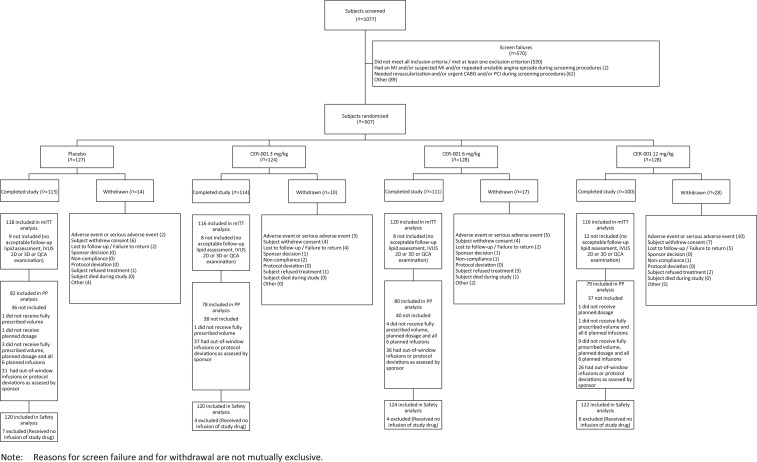
AIM: High-density lipoproteins (HDLs) have several potentially protective vascular effects. Most clinical studies of therapies targeting HDL have failed to show benefits vs. placebo. OBJECTIVE: To investigate the effects of an HDL-mimetic agent on atherosclerosis by intravascular ultrasonography (IVUS) and quantitative coronary angiography (QCA). DESIGN AND SETTING: A prospective, double-blinded, randomized trial was conducted at 51 centres in the USA, the Netherlands, Canada, and France. Intravascular ultrasonography and QCA were performed to assess coronary atherosclerosis at baseline and 3 (2-5) weeks after the last study infusion. PATIENTS: Five hundred and seven patients were randomized; 417 and 461 had paired IVUS and QCA measurements, respectively. INTERVENTION: Patients were randomized to receive 6 weekly infusions of placebo, 3 mg/kg, 6 mg/kg, or 12 mg/kg CER-001. MAIN OUTCOME MEASURES: The primary efficacy parameter was the nominal change in the total atheroma volume. Nominal changes in per cent atheroma volume on IVUS and coronary scores on QCA were also pre-specified endpoints. RESULTS: The nominal change in the total atheroma volume (adjusted means) was -2.71, -3.13, -1.50, and -3.05 mm(3) with placebo, CER-001 3 mg/kg, 6 mg/kg, and 12 mg/kg, respectively (primary analysis of 12 mg/kg vs. placebo: P = 0.81). There was also no difference among groups for the nominal change in per cent atheroma volume (0.02, -0.02, 0.01, and 0.19%; nominal P = 0.53 for 12 mg/kg vs. placebo). Change in the coronary artery score was -0.022, -0.036, -0.022, and -0.015 mm (nominal P = 0.25, 0.99, 0.55), and change in the cumulative coronary stenosis score was -0.51, 2.65, 0.71, and -0.77% (compared with placebo, nominal P = 0.85 for 12 mg/kg and nominal P = 0.01 for 3 mg/kg). The number of patients with major cardiovascular events was 10 (8.3%), 16 (13.3%), 17 (13.7%), and 12 (9.8%) in the four groups. CONCLUSION: CER-001 infusions did not reduce coronary atherosclerosis on IVUS and QCA when compared with placebo. Whether CER-001 administered in other regimens or to other populations could favourably affect atherosclerosis must await further study. Name of the trial registry: Clinicaltrials.gov; Registry's URL: http://clinicaltrials.gov/ct2/show/NCT01201837?term=cer-001&rank=2; TRIAL REGISTRATION NUMBER: NCT01201837.
Overview
The claims and statistics of this paper haven’t been checked yet.
Free: it reads the open-access text and checks the first 5 claims that cite a source we can check. Create a free account to check every claim.
Integrity signals
Registry
Cites
Statistics
Figures
Verification
Claims the paper makes
The claims and statistics of this paper haven’t been checked yet.
Free: it reads the open-access text and checks the first 5 claims that cite a source we can check. Create a free account to check every claim.
Claims other papers make about this one
Each is checked against this paper’s own text: does it say what the citing paper says it does?
The source backs part of the claim, not all of it — or backs it for a different population, condition or comparison.
In the citing paper
“Furthermore, several randomized trials have shown that directly infused HDL mimetics increase plasma HDL-C concentrations, but do not reduce the progression of atherosclerosis as measured by intravascular ultrasound [68,69].”
From 2019 ESC/EAS guidelines for the management of dyslipidaemias: lipid modification to reduce cardiovascular risk (2019) · cites this paper as [68]
Experimental — accuracy not yet measured
Self-check
Percentages, sums and reported differences re-computed from the paper’s own numbers.
The self-check needs the paper’s full text.
Citations
Cites
Intensive versus Moderate Lipid Lowering with Statins after Acute Coronary Syndromes
Cannon, C. P., Braunwald, E., McCabe, C. H., Rader, D. J., Rouleau, J. L., Belder, R., Joyal, S. V., Hill, K. A., Pfeffer, M. A., & Skene, A. M. (2004) · New England Journal of Medicine · doi:10.1056/nejmoa040583 · Cited by 4,938
Self-citationEffects of torcetrapib in patients at high risk for coronary events
Barter, P. J., Caulfield, M., Eriksson, M., Grundy, S. M., Kastelein, J. J. P., Komajda, M., Lopez-Sendon, J., Mosca, L., Tardif, J.-C., Waters, D. D., et al. (2007) · New England Journal of Medicine · doi:10.1056/nejmoa0706628 · Cited by 3,139
Self-citationNiacin in Patients with Low HDL Cholesterol Levels Receiving Intensive Statin Therapy
The AIM-HIGH Investigators (2011) · New England Journal of Medicine · doi:10.1056/nejmoa1107579 · Cited by 2,911
The State of US Health, 1990-2010: Burden of Diseases, Injuries, and Risk Factors
Murray, C. J. L. (2013) · JAMA · doi:10.1001/jama.2013.13805 · Cited by 2,438
Effects of dalcetrapib in patients with a recent acute coronary syndrome
Schwartz, G. G., Olsson, A. G., Abt, M., Ballantyne, C. M., Barter, P. J., Brumm, J., Chaitman, B. R., Holme, I. M., Kallend, D., Leiter, L. A., et al. (2012) · New England Journal of Medicine · doi:10.1056/nejmoa1206797 · Cited by 2,022
Self-citationNissen, S. E., Tsunoda, T., Tuzcu, E. M., Schoenhagen, P., Cooper, C. J., Yasin, M., Eaton, G. M., Lauer, M. A., Sheldon, W. S., Grines, C. L., et al. (2003) · JAMA · doi:10.1001/jama.290.17.2292 · Cited by 1,707
Self-citationTardif, J.-C. (2007) · JAMA · doi:10.1001/jama.297.15.jpc70004 · Cited by 726
Self-citationHPS2-THRIVE Collaborative Group, Haynes, R., Jiang, L., Hopewell, J. C., Li, J., Chen, F., Parish, S., Landray, M. J., Collins, R., Armitage, J., et al. (2013) · European Heart Journal · doi:10.1093/eurheartj/eht055 · Cited by 676
Probucol and Multivitamins in the Prevention of Restenosis after Coronary Angioplasty
Tardif, J.-C., Côté, G., Lespérance, J., Bourassa, M., Lambert, J., Doucet, S., Bilodeau, L., Nattel, S., & de Guise, P. (1997) · New England Journal of Medicine · doi:10.1056/nejm199708073370601 · Cited by 565
Self-citationWaters, D., Higginson, L., Gladstone, P., Kimball, B., Le May, M., Boccuzzi, S. J., & Lespérance, J. (1994) · Circulation · doi:10.1161/01.cir.89.3.959 · Cited by 499 · cited 1×
“20,21 Quantitativecoronaryangiographywasperformedbyexperiencedtech-nicians supervised by an expert physician in matched projections from baseline and follow-up angiograms.”
Self-citation
Research works printed but not linked: 4
- 2004, New England Journal of Medicine, 350, 1495, 10.1056/nejmoa040583 · DOI · Paper page
- 2011, New England Journal of Medicine, 365, 2255, 10.1056/nejmoa1107579 · DOI · Paper page
- 2007, New England Journal of Medicine, 357, 2109, 10.1056/nejmoa0706628 · DOI · Paper page
- 2001, Journal of Biological Chemistry, 276, 15641, 10.1074/jbc.m010230200 · DOI · Paper page
Cited by
Mach, F., Baigent, C., Catapano, A. L., Koskinas, K. C., Casula, M., Badimon, L., Chapman, M. J., De Backer, G. G., Delgado, V., Ference, B. A., et al. (2020) · European Heart Journal · doi:10.1093/eurheartj/ehz455 · Cited by 8,961
Mach, F., Baigent, C., Catapano, A. L., Koskinas, K. C., Casula, M., Badimon, L., Chapman, M. J., De Backer, G. G., Delgado, V., Ference, B. A., et al. (2019) · Atherosclerosis · doi:10.1016/j.atherosclerosis.2019.08.014 · Cited by 4,854
Cholesterol, inflammation and innate immunity.
Tall, A. R., & Yvan-Charvet, L. (2015) · Nature Reviews Immunology · doi:10.1038/nri3793 · Cited by 1,479
HDL and cardiovascular disease
Rader, D. J., & Hovingh, G. K. (2014) · The Lancet · doi:10.1016/s0140-6736(14)61217-4 · Cited by 870
Mechanisms of foam cell formation in atherosclerosis
Chistiakov, D. A., Melnichenko, A. A., Myasoedova, V. A., Grechko, A. V., & Orekhov, A. N. (2017) · Journal of Molecular Medicine · doi:10.1007/s00109-017-1575-8 · Cited by 742
Macrophage-targeted nanomedicine for the diagnosis and treatment of atherosclerosis
Chen, W., Schilperoort, M., Cao, Y., Shi, J., Tabas, I., & Tao, W. (2022) · Nature Reviews Cardiology · doi:10.1038/s41569-021-00629-x · Cited by 518
High-density lipoprotein revisited: biological functions and clinical relevance
von Eckardstein, A., Nordestgaard, B. G., Remaley, A. T., & Catapano, A. L. (2023) · European Heart Journal · doi:10.1093/eurheartj/ehac605 · Cited by 401
“Although CER-001 promoted the regression of diet-induced atherosclerosis in a mouse model,171 no changes in coronary atherosclerosis were observed among patients with a recent ACS.172 It is conceivable that the infusion with HDL mimetics cannot reduce plaque burden beyond the effect induced by intensive statin therapy.”
BackgroundHigh-Density Lipoproteins: Nature’s Multifunctional Nanoparticles
Kuai, R., Li, D., Chen, Y. E., Moon, J. J., & Schwendeman, A. (2016) · ACS Nano · doi:10.1021/acsnano.5b07522 · Cited by 338
Lipid management in patients with chronic kidney disease
Ferro, C. J., Mark, P. B., Kanbay, M., Sarafidis, P., Heine, G. H., Rossignol, P., Massy, Z. A., Mallamaci, F., Valdivielso, J. M., Malyszko, J., et al. (2018) · Nature Reviews Nephrology · doi:10.1038/s41581-018-0072-9 · Cited by 273
HDL cholesterol: reappraisal of its clinical relevance
März, W., Kleber, M. E., Scharnagl, H., Speer, T., Zewinger, S., Ritsch, A., Parhofer, K. G., von Eckardstein, A., Landmesser, U., & Laufs, U. (2017) · Clinical Research in Cardiology · doi:10.1007/s00392-017-1106-1 · Cited by 275
“CER-001 (Cerenis) HDL mimetic produced from recombinant APOA1 complexed with phospholipids IVUS-Study neutral, additional studies ongoing [114]”
MethodTargeting Foam Cell Formation in Atherosclerosis: Therapeutic Potential of Natural Products
Wang, D., Yang, Y., Lei, Y., Tzvetkov, N. T., Liu, X., Yeung, A. W. K., Xu, S., & Atanasov, A. G. (2019) · Pharmacological Reviews · doi:10.1124/pr.118.017178 · Cited by 226
Priem, B., van Leent, M. M. T., Teunissen, A. J. P., Sofias, A. M., Mourits, V. P., Willemsen, L., Klein, E. D., Oosterwijk, R. S., Meerwaldt, A. E., Munitz, J., et al. (2020) · Cell · doi:10.1016/j.cell.2020.09.059 · Cited by 222
Self-citationCholesterol transport system: An integrated cholesterol transport model involved in atherosclerosis
Yu, X.-H., Zhang, D.-W., Zheng, X.-L., & Tang, C.-K. (2019) · Progress in Lipid Research · doi:10.1016/j.plipres.2018.12.002 · Cited by 218
From Lipids to Inflammation: New Approaches to Reducing Atherosclerotic Risk
Shapiro, M. D., & Fazio, S. (2016) · Circulation Research · doi:10.1161/circresaha.115.306471 · Cited by 217
Coronary Atherosclerotic Plaque Regression
Dawson, L. P., Lum, M., Nerleker, N., Nicholls, S. J., & Layland, J. (2022) · Journal of the American College of Cardiology · doi:10.1016/j.jacc.2021.10.035 · Cited by 196
Michael Gibson, C., Korjian, S., Tricoci, P., Daaboul, Y., Yee, M., Jain, P., Alexander, J. H., Steg, P. G., Lincoff, A. M., Kastelein, J. J. P., et al. (2016) · Circulation · doi:10.1161/circulationaha.116.025687 · Cited by 191
Self-citationNicholls, S. J., Andrews, J., Kastelein, J. J. P., Merkely, B., Nissen, S. E., Ray, K. K., Schwartz, G. G., Worthley, S. G., Keyserling, C., Dasseux, J.-L., et al. (2018) · JAMA Cardiology · doi:10.1001/jamacardio.2018.2121 · Cited by 185
Self-citationAdvances in HDL: Much More than Lipid Transporters
Ben‐Aicha, S., Badimón, L., & Vilahur, G. (2020) · International Journal of Molecular Sciences · doi:10.3390/ijms21030732 · Cited by 171
Recent advances in nanomaterials for therapy and diagnosis for atherosclerosis
Chen, J., Zhang, X., Millican, R. C., Sherwood, J. A., Martin, S., Jo, H., Yoon, Y., Brott, B. C., & Jun, H. (2021) · Advanced Drug Delivery Reviews · doi:10.1016/j.addr.2021.01.005 · Cited by 162
HDL in Atherosclerotic Cardiovascular Disease: In Search of a Role
Casula, M., Colpani, O., Xie, S., Catapano, A. L., & Baragetti, A. (2021) · Cells · doi:10.3390/cells10081869 · Cited by 165
“2014 [119] CER-001 apoA-I and sphingomyelin CHI-SQUARE study 507 patients with a clinical indication for coronary angiography increased cholesterol mobilization PAV * 0.”
BackgroundLipoproteins and lipoprotein mimetics for imaging and drug delivery
Thaxton, C. S., Rink, J. S., Naha, P. C., & Cormode, D. P. (2016) · Advanced Drug Delivery Reviews · doi:10.1016/j.addr.2016.04.020 · Cited by 154
“[85] However, in a separate trial, CER-001 was found to decrease carotid artery wall thickness, which increases during the development of atherosclerosis, in patients with homozygous familial hypercholesterolemia,[86] implying that rHDL therapy may be more useful in patients where the current standard of care (e.”
Lameijer, M., Binderup, T., van Leent, M. M. T., Senders, M. L., Fay, F., Malkus, J., Sanchez-Gaytan, B. L., Teunissen, A. J. P., Karakatsanis, N., Robson, P., et al. (2018) · Nature Biomedical Engineering · doi:10.1038/s41551-018-0221-2 · Cited by 132
Self-citationNovel anti-inflammatory therapies for the treatment of atherosclerosis
Khan, R., Spagnoli, V., Tardif, J., & L’Allier, P. L. (2015) · Atherosclerosis · doi:10.1016/j.atherosclerosis.2015.04.783 · Cited by 139
Self-citationNanomedicine for Diagnosis and Treatment of Atherosclerosis
Cheng, J., Huang, H., Chen, Y., & WU, R. T. (2023) · Advanced Science · doi:10.1002/advs.202304294 · Cited by 140
Sacks, F. M., & Jensen, M. K. (2018) · Arteriosclerosis, Thrombosis, and Vascular Biology · doi:10.1161/atvbaha.117.307025 · Cited by 117
Tricoci, P., D’Andrea, D. M., Gurbel, P. A., Yao, Z., Cuchel, M., Winston, B., Schott, R. J., Weiss, R., Blazing, M. A., Cannon, L., et al. (2015) · Journal of the American Heart Association · doi:10.1161/jaha.115.002171 · Cited by 122
Self-citationHDL from an Alzheimer's disease perspective
Button, E. B., Robert, J., Caffrey, T. M., Fan, J., Zhao, W., & Wellington, C. L. (2019) · Current Opinion in Lipidology · doi:10.1097/mol.0000000000000604 · Cited by 114
Atherosclerotic plaque stabilization and regression: a review of clinical evidence
Sarraju, A., & Nissen, S. E. (2024) · Nature Reviews Cardiology · doi:10.1038/s41569-023-00979-8 · Cited by 122
“In the randomized CHI-SQUARE trial 86 of 507 patients with ACS, infusion of an HDL-C mimetic agent, CER-100, did not result in plaque regression by IVUS and quantitative coronary angiography compared with placebo.”
Birner-Gruenberger, R., Schittmayer, M., Holzer, M., & Marsche, G. (2014) · Progress in Lipid Research · doi:10.1016/j.plipres.2014.07.003 · Cited by 98
“[43] Calabresi L, Franceschini G, Sirtori CR, De Palma A, Saresella M, Ferrante P, et al. Inhibition of VCAM-1 expression in endothelial cells by reconstituted high density lipoproteins.”
BackgroundBeginning to Understand High-Density Lipoproteins
Santos‐Gallego, C. G., Badimon, J. J., & Rosenson, R. S. (2014) · Endocrinology and Metabolism Clinics of North America · doi:10.1016/j.ecl.2014.08.001 · Cited by 102
“001 in the end point of nominal change in atheroma volume assessed with IVUS.(167) Two very recent proof-of-concept studies show that CER-001 had a statistically significant reduction in the carotid atheroma burden assessed by MRI in patients with homozygous familial hypercholesterolemia (MODE,(168) 23 patients) and h…”
BackgroundAnnema, W., & von Eckardstein, A. (2016) · Translational Research · doi:10.1016/j.trsl.2016.02.008 · Cited by 94
The role of the lymphatic system in cholesterol transport
Huang, L., Elvington, A., & Randolph, G. J. (2015) · Frontiers in Pharmacology · doi:10.3389/fphar.2015.00182 · Cited by 106
Anti-inflammatory and cholesterol-reducing properties of apolipoprotein mimetics: a review
White, C. R., Garber, D. W., & Anantharamaiah, G. M. (2014) · Journal of Lipid Research · doi:10.1194/jlr.r051367 · Cited by 88
Kootte, R. S., Smits, L. P., van der Valk, F. M., Dasseux, J.-L., Keyserling, C. H., Barbaras, R., Paolini, J. F., Santos, R. D., van Dijk, T. H., Dallinga-van Thie, G. M., et al. (2015) · Journal of Lipid Research · doi:10.1194/jlr.m055665 · Cited by 88
Self-citationDragoljevic, D., Kraakman, M. J., Nagareddy, P. R., Ngo, D., Shihata, W., Kammoun, H. L., Whillas, A., Lee, M. K. S., Al‐Sharea, A., Pernes, G., et al. (2018) · European Heart Journal · doi:10.1093/eurheartj/ehy119 · Cited by 88
Pharmacological Intervention to Modulate HDL: What Do We Target?
Woudberg, N. J., Pedretti, S., Lecour, S., Schulz, R., Vuilleumier, N., James, R. W., & Frias, M. A. (2018) · Frontiers in Pharmacology · doi:10.3389/fphar.2017.00989 · Cited by 76
Treatment of atherosclerotic plaque: perspectives on theranostics
Zhang, Y., Koradia, A., Kamato, D., Popat, A., Little, P. J., & Ta, H. T. (2019) · Journal of Pharmacy and Pharmacology · doi:10.1111/jphp.13092 · Cited by 81
“Engineering nanoparticles that mimic or imitate the properties of HDL have been trialled lately (CER-001, phase II clinical trial).([20]) Gene silencing approaches target miR-712, a proatherogenic miRNA that is upregulated during initiation of atherosclerosis([26]); chemokine receptor (CCR2) involved with the generati…”
BackgroundHDL-cholesterol and cardiovascular disease: rethinking our approach
Siddiqi, H. K., Kiss, D., & Rader, D. (2015) · Current Opinion in Cardiology · doi:10.1097/hco.0000000000000211 · Cited by 77
Karjalainen, M. K., Holmes, M. V., Wang, Q., Anufrieva, O., Kähönen, M., Lehtimäki, T., Havulinna, A. S., Kristiansson, K., Salomaa, V., Perola, M., et al. (2020) · Atherosclerosis · doi:10.1016/j.atherosclerosis.2020.02.002 · Cited by 73
Button, E. B., Boyce, G. K., Wilkinson, A., Stukas, S., Hayat, A., Fan, J., Wadsworth, B. J., Robert, J., Martens, K. M., & Wellington, C. L. (2019) · Alzheimer's Research & Therapy · doi:10.1186/s13195-019-0497-9 · Cited by 66
New Therapeutic Approaches to the Treatment of Dyslipidemia
Rader, D. J. (2016) · Cell Metabolism · doi:10.1016/j.cmet.2016.01.005 · Cited by 78
“Infusion of a third recombinant HDL product suggested possible modest regression in plaque volume compared to baseline (Tardif et al., 2014) and in patients with very low HDL-C may have decreased carotid mean vessel wall area and inflammation (Kootte et al., 2015).”
Current and future trends in the lipid lowering therapy
Okopień, B., Bułdak, Ł., & Bołdys, A. (2016) · Pharmacological Reports · doi:10.1016/j.pharep.2016.03.016 · Cited by 72
“The impact on HDL-C level is substantial, but the CV benefit is not clearly outlined [135,136].”
BackgroundHovingh, G. K., Smits, L. P., Stefanutti, C., Soran, H., Kwok, S., Graaf, J. D., Gaudet, D., Keyserling, C., Klepp, H., Frick, J. E., et al. (2015) · American Heart Journal · doi:10.1016/j.ahj.2015.01.008 · Cited by 69
Self-citationHDL mimetic CER-001 targets atherosclerotic plaques in patients
Zheng, K. H., van der Valk, F. M., Smits, L. P., Sandberg, M., Dasseux, J., Baron, R., Barbaras, R., Keyserling, C., Coolen, B. F., Nederveen, A. J., et al. (2016) · Atherosclerosis · doi:10.1016/j.atherosclerosis.2016.05.038 · Cited by 74
Self-citationSjouke, B., Hovingh, G. K., Kastelein, J. J. P., & Stefanutti, C. (2015) · Current Opinion in Lipidology · doi:10.1097/mol.0000000000000179 · Cited by 69
Self-citationWiese, C. B., Zhong, J., Xu, Z., Zhang, Y., Solano, M. A. R., Zhu, W., Linton, M. F., Sheng, Q., Kon, V., & Vickers, K. C. (2019) · Atherosclerosis · doi:10.1016/j.atherosclerosis.2019.01.023 · Cited by 65
“The CER-001 trials demonstrated a reduction in atheroma volume only for the subjects with the most severe level of atherosclerosis (> 30% atheroma volume) and lacked an effect on the entire cohort of acute coronary syndrome patients [44,45].”
BackgroundApolipoprotein Mimetic Peptides: Potential New Therapies for Cardiovascular Diseases
Wolska, A., Reimund, M., Sviridov, D. O., Amar, M. J., & Remaley, A. T. (2021) · Cells · doi:10.3390/cells10030597 · Cited by 62
“CER-001 Recombinant apoA-I reconstituted with sphingomyelin and DPPC IV No plaque reduction Phase 2 [62]”
Simonsen, J. B. (2016) · Nanomedicine Nanotechnology Biology and Medicine · doi:10.1016/j.nano.2016.05.009 · Cited by 69
Effects of LDL Receptor Modulation on Lymphatic Function
Milasan, A., Dallaire, F., Mayer, G., & Martel, C. (2016) · Scientific Reports · doi:10.1038/srep27862 · Cited by 69
Kühnast, S., Fiocco, M. F., van der Hoorn, J. W. A., Princen, H. M. G., & Jukema, J. W. (2015) · European Journal of Pharmacology · doi:10.1016/j.ejphar.2015.03.089 · Cited by 64
“In humans, infusions of reconstituted HDL, CSL-111 reduced atheroma volume from baseline, but not versus placebo in the ERASE trial (Tardif et al., 2007), whereas another small study revealed a significant reduction in lipid content in the plaque after CSL-111 infusion versus placebo (Shaw et al.”
ResultNew Era of Lipid-Lowering Drugs
Barter, P. J., & Rye, K. (2016) · Pharmacological Reviews · doi:10.1124/pr.115.012203 · Cited by 65
Self-citationReconstituted HDL: Drug Delivery Platform for Overcoming Biological Barriers to Cancer Therapy
Raut, S., Mooberry, L. K., Sabnis, N. A., Garud, A., Dossou, A. S., & Lacko, A. G. (2018) · Frontiers in Pharmacology · doi:10.3389/fphar.2018.01154 · Cited by 63
“Moreover, recent clinical trials (TANGO) conducted by Cerenis Therapeutics testing an engineered HDL mimetic NP formulation (CER-001) in human subjects, did not reveal any adverse reactions, compared to control (Tardif et al., 2014).”
ResultTherapeutic strategies for atherosclerosis and atherothrombosis: Past, present and future
Weber, C., Badimón, L., Mach, F., & van der Vorst, E. P. C. (2017) · Thrombosis and Haemostasis · doi:10.1160/th16-10-0814 · Cited by 60
“Although their impact on HDL levels was substantial, the beneficial effects on cardiovascular outcome remain unclear (73, 74).”
BackgroundLCAT- targeted therapies: Progress, failures and future
Yang, K., Wang, J., Xiang, H., Ding, P., Wu, T., & Ji, G. (2022) · Biomedicine & Pharmacotherapy · doi:10.1016/j.biopha.2022.112677 · Cited by 56
Andrews, J., Janssan, A., Nguyen, T., Pisaniello, A. D., Scherer, D. J., Kastelein, J. J. P., Merkely, B., Nissen, S. E., Ray, K., Schwartz, G. G., et al. (2017) · Cardiovascular Diagnosis and Therapy · doi:10.21037/cdt.2017.01.01 · Cited by 53
“A similar observation for plaque regression at the lowest CER-001 dose was found on examination of percent atheroma volume (PAV), which in previous trials has associated more closely with clinical outcomes (46).”
BackgroundResultSelf-citationKataoka, Y., Andrews, J., Duong, M., Nguyen, T., Schwarz, N., Fendler, J., Puri, R., Butters, J., Keyserling, C., Paolini, J. F., et al. (2017) · Cardiovascular Diagnosis and Therapy · doi:10.21037/cdt.2017.02.01 · Cited by 54
“Methods CHI-SQUARE study protocol The details of the CHI-SQUARE protocol have been described in detail previously (10) (NCT01201837).”
BackgroundMethodResultInfluentialSelf-citationHigh-density lipoproteins (HDL): Novel function and therapeutic applications
Darabi, M., & Kontush, A. (2021) · Biochimica et Biophysica Acta (BBA) - Molecular and Cell Biology of Lipids · doi:10.1016/j.bbalip.2021.159058 · Cited by 57
Hovingh, G. K., Rader, D. J., & Hegele, R. A. (2015) · Current Opinion in Lipidology · doi:10.1097/mol.0000000000000161 · Cited by 58
“These therapies have been reviewed in the beginning of 2014 [52], and to the best of our knowledge the only large study published thereafter was the Can Hdl Infusions Significantly QUicken Atherosclerosis REgression (CHI-SQUARE, NCT01201837) [53], a study in over 400 patients randomized to placebo or three different d…”
BackgroundTherapeutic applications of reconstituted HDL: When structure meets function
Darabi, M., Guillas, I., Goff, W. L., Chapman, M. J., & Kontush, A. (2015) · Pharmacology & Therapeutics · doi:10.1016/j.pharmthera.2015.10.010 · Cited by 57
Luthi, A. J., Lyssenko, N. N., Quach, D., McMahon, K. M., Millar, J. S., Vickers, K. C., Rader, D. J., Phillips, M. C., Mirkin, C. A., & Thaxton, C. S. (2015) · Journal of Lipid Research · doi:10.1194/jlr.m054635 · Cited by 51
Landowski, M., & Rickman, C. B. (2022) · Journal of Ocular Pharmacology and Therapeutics · doi:10.1089/jop.2021.0067 · Cited by 48
Modulating cholesterol efflux capacity to improve cardiovascular disease
Brownell, N., & Rohatgi, A. (2016) · Current Opinion in Lipidology · doi:10.1097/mol.0000000000000317 · Cited by 45
“com acute coronary syndrome treated with CER-001 did not have any change in atheroma volume or coronary artery calcium score [54].”
BackgroundYuan, W., Yu, B., Yu, M., Kuai, R., Morin, E. E., Wang, H. H., Hu, D., Zhang, J., Moon, J. J., Chen, Y., et al. (2020) · Journal of Controlled Release · doi:10.1016/j.jconrel.2020.11.016 · Cited by 49
“Acute treatment consisting of 4–6 weekly infusion of sHDL has been shown to reduce plaque burden in coronary artery disease patients [25,27,28].”
Chalmers, A. D., Bursill, C. A., & Myerscough, M. R. (2017) · PLoS ONE · doi:10.1371/journal.pone.0187674 · Cited by 48
Stasi, A., Fiorentino, M., Franzin, R., Staffieri, F., Carparelli, S., Losapio, R., Crovace, A. M., Lacitignola, L., Cimmarusti, M. T., Murgolo, F., et al. (2023) · BMC Medicine · doi:10.1186/s12916-023-03057-5 · Cited by 45
“CER-001 treat-ment was administered twice a day on days 1, 2, 3, and 6 and each dose was preceded with a dose of antihistamine to avoid any potential infusion reactions, which have been previously reported [38, 39].”
MethodHDL/ApoA-1 infusion and ApoA-1 gene therapy in atherosclerosis
Chyu, K., & Shah, P. K. (2015) · Frontiers in Pharmacology · doi:10.3389/fphar.2015.00187 · Cited by 48
Apolipoprotein A‐I Modulates Atherosclerosis Through Lymphatic Vessel‐Dependent Mechanisms in Mice
Milasan, A., Jean, G., Dallaire, F., Tardif, J., Merhi, Y., Sorci‐Thomas, M. G., & Martel, C. (2017) · Journal of the American Heart Association · doi:10.1161/jaha.117.006892 · Cited by 46
Self-citationReversal of coronary atherosclerosis: Role of life style and medical management
Parsons, C. E., Agasthi, P., Mookadam, F., & Arsanjani, R. (2018) · Trends in Cardiovascular Medicine · doi:10.1016/j.tcm.2018.05.002 · Cited by 46
Karalis, I. K., & Jukema, J. W. (2018) · Current Cardiology Reports · doi:10.1007/s11886-018-1004-9 · Cited by 48
HDL therapy today: from atherosclerosis, to stent compatibility to heart failure
Sirtori, C. R., Ruscica, M., Calabresi, L., Chiesa, G., Giovannoni, R., & Badimon, J. J. (2019) · Annals of Medicine · doi:10.1080/07853890.2019.1694695 · Cited by 40
“was no reduction in coronary atherosclerosis on IVUS or quantitative coronary angiography (QCA) and no difference in major CV events at each dose tested [80], but a following analysis suggested efficacy of the lowest CER-001 dose [81].”
BackgroundIslam, R. M., Pourmousa, M., Sviridov, D. O., Gordon, S. M., Neufeld, E. B., Freeman, L. A., Perrin, B. S., Pastor, R. W., & Remaley, A. T. (2018) · Scientific Reports · doi:10.1038/s41598-018-20965-2 · Cited by 44
Current and Emerging Reconstituted HDL-apoA-I and HDL-apoE Approaches to Treat Atherosclerosis
Valanti, E.-K., Dalakoura-Karagkouni, K., & Sanoudou, D. (2018) · Journal of Personalized Medicine · doi:10.3390/jpm8040034 · Cited by 44
“Further clinical development of MDCO-216 and CSL-111 has been halted due to prohibitive production costs and adverse effects, respectively, combined with their failure to demonstrate a beneficial effect at the clinical level [11,25,53,57].”
BackgroundInfluentialAltered HDL metabolism in metabolic disorders: insights into the therapeutic potential of HDL
Hui, N., Barter, P. J., Ong, K. L., & Rye, K. (2019) · Clinical Science · doi:10.1042/cs20190873 · Cited by 46
Self-citationLuo, Y., Guo, Y., Wang, H. H., Yu, M., Hong, K. W., Li, D., Li, R., Wen, B., Hu, D., Chang, L., et al. (2021) · EBioMedicine · doi:10.1016/j.ebiom.2021.103725 · Cited by 44
Self-citationFoody, J. M., & Vishwanath, R. L. (2016) · Journal of clinical lipidology · doi:10.1016/j.jacl.2016.04.009 · Cited by 41
Zhao, Y., Black, A. S., Bonnet, D. J., Maryanoff, B. E., Curtiss, L. K., Leman, L. J., & Ghadiri, M. R. (2014) · Journal of Lipid Research · doi:10.1194/jlr.m049262 · Cited by 38
Translating Evidence of HDL and Plaque Regression
Bartolo, B. A. D., Psaltis, P. J., Bursill, C. A., & Nicholls, S. J. (2018) · Arteriosclerosis Thrombosis and Vascular Biology · doi:10.1161/atvbaha.118.307026 · Cited by 41
Arterial Lymphatics in Atherosclerosis: Old Questions, New Insights, and Remaining Challenges
Csányi, G., & Singla, B. (2019) · Journal of Clinical Medicine · doi:10.3390/jcm8040495 · Cited by 40
Bruikman, C. S., Stoekenbroek, R. M., Hovingh, G. K., & Kastelein, J. J. P. (2016) · Canadian Journal of Cardiology · doi:10.1016/j.cjca.2016.09.010 · Cited by 45
Self-citationHuang, J., Wang, D., Huang, L., & Huang, H. (2020) · International Journal of Molecular Sciences · doi:10.3390/ijms21030739 · Cited by 37
Lipid efflux mechanisms, relation to disease and potential therapeutic aspects
Castaño, D., Rattanasopa, C., Monteiro-Cardoso, V. F., Corlianò, M., Liu, Y., Zhong, A., Rusu, M., Liehn, E. A., & Singaraja, R. R. (2020) · Advanced Drug Delivery Reviews · doi:10.1016/j.addr.2020.04.013 · Cited by 38
Residual risks and evolving atherosclerotic plaques
Noothi, S. K., Ahmed, M. R., & Agrawal, D. K. (2023) · Molecular and Cellular Biochemistry · doi:10.1007/s11010-023-04689-0 · Cited by 49
“Results of the ongoing phase III clinical trials of direct HDL infusion therapies and novel CETP inhibitors such as anacetrapib and evacetrapib that can reduce LDL-C and lipoprotein (a) to 40–45% and elevate HDL-C up to 130% with or without a statin are now under investigation [49–52].”
BackgroundImplications of reverse cholesterol transport: Recent studies
Levinson, S. S., & Wagner, S. G. (2014) · Clinica Chimica Acta · doi:10.1016/j.cca.2014.10.018 · Cited by 39
Zein, M. A., Khazzeka, A., Khoury, A. E., Zein, J. A., Dima, Z., & Eid, A. H. (2024) · Progress in Cardiovascular Diseases · doi:10.1016/j.pcad.2024.10.009 · Cited by 37
Targeting High-density Lipoproteins to Reduce Cardiovascular Risk: What Is the Evidence?
Barter, P. J., & Rye, K. (2015) · Clinical Therapeutics · doi:10.1016/j.clinthera.2015.07.021 · Cited by 36
Self-citationApoA-I Infusion Therapies Following Acute Coronary Syndrome: Past, Present, and Future
Kalaycı, A., Gibson, C. M., Ridker, P. M., Wright, S. D., Kingwell, B. A., Korjian, S., Chi, G., Lee, J., Tricoci, P., Kazmi, S. H. A., et al. (2022) · Current Atherosclerosis Reports · doi:10.1007/s11883-022-01025-7 · Cited by 38
Tsujita, M., Wolska, A. T., Gutmann, D. A. P., & Remaley, A. T. (2018) · Current Atherosclerosis Reports · doi:10.1007/s11883-018-0759-1 · Cited by 35
Atherosclerosis: Recent trials, new targets and future directions
Ladeiras‐Lopes, R., Agewall, S., Tawakol, A. A., Staels, B., Stein, E. A., Mentz, R. J., Leite-Moreira, A. F., Zannad, F. M., & Köenig, W. (2015) · International Journal of Cardiology · doi:10.1016/j.ijcard.2015.05.013 · Cited by 39
Self-citationZheng, K. H., Kaiser, Y., van Olden, C. C., Santos, R. D., Dasseux, J., Genest, J. J., Gaudet, D., Westerink, J., Keyserling, C., Verberne, H. J., et al. (2020) · Atherosclerosis · doi:10.1016/j.atherosclerosis.2020.08.004 · Cited by 36
Self-citationMarsche, G., Stadler, J. T., Kargl, J., & Holzer, M. (2022) · Antioxidants · doi:10.3390/antiox11030556 · Cited by 35
High-density lipoprotein mimetics: promises and challenges
Sviridov, D., & Remaley, A. T. (2015) · Biochemical Journal · doi:10.1042/bj20150832 · Cited by 38
“However, CER-001 failed to reduce atheroma volume in patients with acute coronary syndrome [23], but mildly decreased carotid mean vessel wall area in patients with familial hypoalphalipoproteinemia [97].”
BackgroundGibson, C. M., Korjian, S., Tricoci, P., Daaboul, Y., Alexander, J. H., Steg, P. G., Lincoff, A. M., Kastelein, J. J. P., Mehran, R., D’Andrea, D. M., et al. (2016) · American Heart Journal · doi:10.1016/j.ahj.2016.06.017 · Cited by 36
Self-citationYang, T.-M., Miao, M., Yu, W., Wang, X., Xia, F.-J., Li, Y., & Guo, S. (2023) · Frontiers in Molecular Biosciences · doi:10.3389/fmolb.2023.1147699 · Cited by 38
History of lipidology and lipoprotein apheresis
Julius, U. (2017) · Atherosclerosis Supplements · doi:10.1016/j.atherosclerosissup.2017.05.034 · Cited by 32
Cholesterol Efflux Efficiency of Reconstituted HDL Is Affected by Nanoparticle Lipid Composition
Jebari‐Benslaiman, S., Uribe, K. B., Benito‐Vicente, A., Galicia-García, U., Larrea, A., Alloza, I., Vandenbroeck, K., Ostolaza, H., & Martín, C. (2020) · Biomedicines · doi:10.3390/biomedicines8100373 · Cited by 31
Lu, Y., Li, B., Wei, M., Zhu, Q., Gao, L., Ma, N., Ma, X., Yang, Q., Tong, Z., Lu, G., et al. (2023) · International Immunopharmacology · doi:10.1016/j.intimp.2023.110950 · Cited by 29
Jebari‐Benslaiman, S., Uribe, K. B., Benito‐Vicente, A., Galicia-García, U., Larrea, A., Santín, I., Alloza, I., Vandenbroeck, K., Ostolaza, H., & Martín, C. (2022) · Small · doi:10.1002/smll.202105915 · Cited by 29
Klančič, T., Woodward, L., Hofmann, S. M., & Fisher, E. A. A. (2016) · Molecular Metabolism · doi:10.1016/j.molmet.2016.03.001 · Cited by 34
“2014 (CHI-SQUARE)([62]) CER-001 infusion (recombinant human apoA-I-containing HDL mimetic) e IVUS (coronary arteries) QCA Major cardiovascular events CER-011 infusions did not reduce coronary atheroma burden on IVUS or QCA, compared to placebo No statistically significant difference in the number of major adverse card…”
BackgroundDevelopment of CER-001: Preclinical Dose Selection Through to Phase I Clinical Findings
Keyserling, C., Barbaras, R., Benghozi, R., & Dasseux, J. (2017) · Clinical Drug Investigation · doi:10.1007/s40261-017-0506-3 · Cited by 29
“ETC-216, CER-001) in clinical trials [7, 12].”
BackgroundSelf-citationCausal Effect of Lipids and Lipoproteins on Atherosclerosis
Ference, B. A. (2018) · Cardiology Clinics · doi:10.1016/j.ccl.2017.12.001 · Cited by 28
Metadata
- Authors
- Tardif, J.-C., Ballantyne, C. M., Barter, P., Dasseux, J.-L., Fayad, Z. A., Guertin, M.-C., Kastelein, J. J. P., Keyserling, C., Klepp, H., Koenig, W., L'Allier, P. L., Lesperance, J., Luscher, T. F., Paolini, J. F., Tawakol, A., Waters, D. D., for the Can Hdl Infusions Significantly QUicken Atherosclerosis REgression (CHI-SQUARE) Investigators, Pfeffer, M., Brown, V., Rouleau, J., Watkins, P., Wei, L. J., Gosselin, G., Chayer, C., Lanthier, S., Pelletier, G. B., Racine, N., Agarwal, H., Brilakis, E., Cannon, L., Carrie, D., Corbelli, J., Coste, P., de Winter, R., Diaz, A., Eisenberg, S., Ennis, B., Fajadet, J., Fam, N., Fortuin, D., Gessler, C., Grines, C., Guerra, D., Gum, H., Haldis, T., Heestermans, T., Herrman, J. P., Huynh, T., Kedhi, E., Koren, M., Kouz, S., Krolick, M., Kumkumian, G., Lavi, S., Li, R. J., Masud, A., McAlhany, C., McGrew, F. A., O'Shaughnessy, C., Oude Ophuis, A. J. M., Parr, K., Penny, W., Pesant, Y., Post, H., Robinson, S., Rodes-Cabau, J., Roy, A., Schulman, S., Spence, F., Stouffer, G., Stys, T., Sussex, B., Tahirkheli, N., Tardif, J.-C., Gregoire, J., ten Berg, J., van Boven, A. J., von Birgelen, C., & Weinstein, D.
- Affiliations
- Baylor College of Medicine (US)
- UNSW Sydney (AU)
- Cerenis Therapeutics (France) (FR)
- Icahn School of Medicine at Mount Sinai (US)
- Montreal Heart Institute (CA)
- Amsterdam UMC Location University of Amsterdam (NL)
- Harvard University (US)
- University of California, San Francisco (US)
- University of California System (US)
- Universität Ulm (DE)
- University Hospital Zurich (CH)
- ORCID
- Ballantyne, C. M.
- Dasseux, J.-L.
- Fayad, Z. A.
- Guertin, M.-C.
- Kastelein, J. J. P.
- Paolini, J. F.
- Tawakol, A.
- Waters, D. D.
- Rouleau, J.
- Wei, L. J.
- Gosselin, G.
- Lanthier, S.
- Racine, N.
- Brilakis, E.
- Coste, P.
- Fam, N.
- Grines, C.
- Haldis, T.
- Herrman, J. P.
- Huynh, T.
- Kedhi, E.
- Koren, M.
- Kouz, S.
- Penny, W.
- Roy, A.
- Stouffer, G.
- Stys, T.
- Tahirkheli, N.
- Venue
- European Heart Journal
- Publisher
- Oxford University Press (OUP)
- Published
- 2014-04-29
- Volume
- 35
- Issue
- 46
- Pages
- 3277-3286
- ISSN
- 0195-668X (ISSN-L)
- 1522-9645
- PMC
- PMC4258222
- OpenAlex
- W2126147349
- Cited by
- 251
- References
- 25
- Citations by year
- 2026: 7 · 2025: 9 · 2024: 10 · 2023: 14 · 2022: 16 · 2021: 19 · 2020: 19 · 2019: 22 · 2018: 29 · 2017: 23 · 2016: 30 · 2015: 37 · 2014: 15
- FWCI
- 34.73
- Type
- journal article
- Language
- en
- Open access
- hybrid
- doi.org
- Licence
- cc-by-nc
- Locations
- European Heart Journal (publishedVersion, cc-by-nc)
- PubMed Central (publishedVersion, cc-by-nc)
- PubMed (publishedVersion)
- Pure Amsterdam UMC (publishedVersion)
- Zurich Open Repository and Archive (University of Zurich) (acceptedVersion, other-oa)
- Digital Access to Scholarship at Harvard (DASH) (Harvard University) (submittedVersion, cc-by)
- Data Archiving and Networked Services (DANS) (submittedVersion)
- eScholarship (California Digital Library) (submittedVersion)
- Zurich Open Repository and Archive (University of Zurich) (submittedVersion, other-oa)
- Zurich Open Repository and Archive (University of Zurich)
- Funders
- Institut de Cardiologie de Montréal
- Topics
- Health Sciences › Medicine › Cardiology and Cardiovascular Medicine › Lipoproteins and Cardiovascular Health
- Life Sciences › Immunology and Microbiology › Immunology › Atherosclerosis and Cardiovascular Diseases
- Health Sciences › Medicine › Cardiology and Cardiovascular Medicine › Coronary Interventions and Diagnostics
- Keywords
- high-density lipoprotein, coronary artery disease, acute coronary syndrome, atheroma volume, coronary artery stenosis, intravascular ultrasound, quantitative coronary angiography, lipid-lowering therapy, atherosclerosis regression, statins, ezetimibe, nicotinamide
- MeSH terms
- Adult, Aged, Aged, 80 and over, Cardiovascular Agents, Coronary Artery Disease, Female, Humans, Infusions, Intravenous, Male, Middle Aged, Phospholipids, Prospective Studies, Recombinant Proteins, Ultrasonography, Apolipoprotein A-I, Treatment Outcome, Coronary Angiography, Acute Coronary Syndrome
About these checks
Registry, retraction, Cites and statistics results are computed, not judged, with one exception: a printed reference that no index lists is read once by a model before it counts as a citation error. Claims are extracted by a model and kept only when their quote appears verbatim in the text; each cited source is then checked, with a model’s help, for whether it says what the claim relies on. Those verdicts can be wrong — read the claim’s quote and the cited source before relying on one.
Statistics and arithmetic are recomputed, not judged.
Confidence bands are shown only for fields calibrated on our annotated test set. None is calibrated yet, so no band is shown.
What counts as a claim ›How we measure confidence ›How we check this ›
Are you an author, or do you see a problem with this page? Request a review
Data sources
Bibliographic data: Semantic Scholar, OpenAlex, Crossref.
Contains information from the Semantic Scholar Academic Graph Datasets, made available under the ODC Attribution License (ODC-BY 1.0).
Semantic Scholar’s data is described in: Kinney, R., et al. (2023). The Semantic Scholar Open Data Platform. arXiv:2301.10140.
