

Effects of the high-density lipoprotein mimetic agent CER-001 on coronary atherosclerosis in patients with acute coronary syndromes: a randomized trial
Open accessThe DOI matches its Crossref record, with a small difference in title or year; 25 of the 25 references it cites were found in a registry or an index.
Abstract
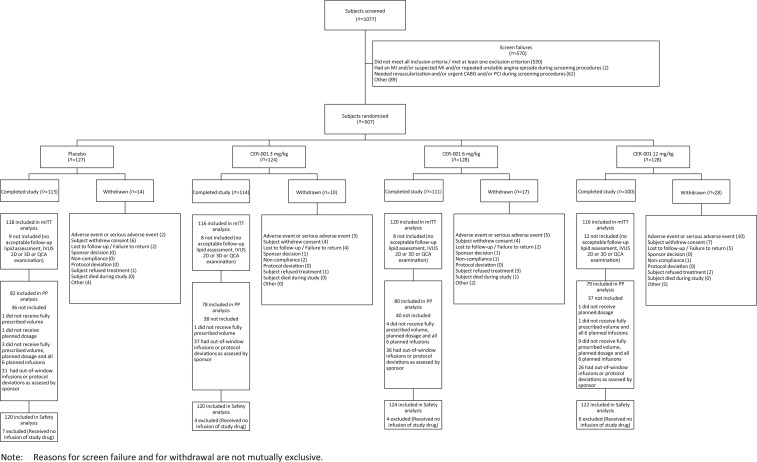
AIM: High-density lipoproteins (HDLs) have several potentially protective vascular effects. Most clinical studies of therapies targeting HDL have failed to show benefits vs. placebo. OBJECTIVE: To investigate the effects of an HDL-mimetic agent on atherosclerosis by intravascular ultrasonography (IVUS) and quantitative coronary angiography (QCA). DESIGN AND SETTING: A prospective, double-blinded, randomized trial was conducted at 51 centres in the USA, the Netherlands, Canada, and France. Intravascular ultrasonography and QCA were performed to assess coronary atherosclerosis at baseline and 3 (2-5) weeks after the last study infusion. PATIENTS: Five hundred and seven patients were randomized; 417 and 461 had paired IVUS and QCA measurements, respectively. INTERVENTION: Patients were randomized to receive 6 weekly infusions of placebo, 3 mg/kg, 6 mg/kg, or 12 mg/kg CER-001. MAIN OUTCOME MEASURES: The primary efficacy parameter was the nominal change in the total atheroma volume. Nominal changes in per cent atheroma volume on IVUS and coronary scores on QCA were also pre-specified endpoints. RESULTS: The nominal change in the total atheroma volume (adjusted means) was -2.71, -3.13, -1.50, and -3.05 mm(3) with placebo, CER-001 3 mg/kg, 6 mg/kg, and 12 mg/kg, respectively (primary analysis of 12 mg/kg vs. placebo: P = 0.81). There was also no difference among groups for the nominal change in per cent atheroma volume (0.02, -0.02, 0.01, and 0.19%; nominal P = 0.53 for 12 mg/kg vs. placebo). Change in the coronary artery score was -0.022, -0.036, -0.022, and -0.015 mm (nominal P = 0.25, 0.99, 0.55), and change in the cumulative coronary stenosis score was -0.51, 2.65, 0.71, and -0.77% (compared with placebo, nominal P = 0.85 for 12 mg/kg and nominal P = 0.01 for 3 mg/kg). The number of patients with major cardiovascular events was 10 (8.3%), 16 (13.3%), 17 (13.7%), and 12 (9.8%) in the four groups. CONCLUSION: CER-001 infusions did not reduce coronary atherosclerosis on IVUS and QCA when compared with placebo. Whether CER-001 administered in other regimens or to other populations could favourably affect atherosclerosis must await further study. Name of the trial registry: Clinicaltrials.gov; Registry's URL: http://clinicaltrials.gov/ct2/show/NCT01201837?term=cer-001&rank=2; TRIAL REGISTRATION NUMBER: NCT01201837.
Overview
The claims and statistics of this paper haven’t been checked yet.
Free: it reads the open-access text and checks the first 5 claims that cite a source we can check. Create a free account to check every claim.
Integrity signals
Registry
Cites
Statistics
Figures
Verification
Claims the paper makes
The claims and statistics of this paper haven’t been checked yet.
Free: it reads the open-access text and checks the first 5 claims that cite a source we can check. Create a free account to check every claim.
Claims other papers make about this one
Each is checked against this paper’s own text: does it say what the citing paper says it does?
The source backs part of the claim, not all of it — or backs it for a different population, condition or comparison.
In the citing paper
“Furthermore, several randomized trials have shown that directly infused HDL mimetics increase plasma HDL-C concentrations, but do not reduce the progression of atherosclerosis as measured by intravascular ultrasound [68,69].”
From 2019 ESC/EAS guidelines for the management of dyslipidaemias: lipid modification to reduce cardiovascular risk (2019) · cites this paper as [68]
Experimental — accuracy not yet measured
Self-check
Percentages, sums and reported differences re-computed from the paper’s own numbers.
The self-check needs the paper’s full text.
Citations
Cites
Intensive versus Moderate Lipid Lowering with Statins after Acute Coronary Syndromes
Cannon, C. P., Braunwald, E., McCabe, C. H., Rader, D. J., Rouleau, J. L., Belder, R., Joyal, S. V., Hill, K. A., Pfeffer, M. A., & Skene, A. M. (2004) · New England Journal of Medicine · doi:10.1056/nejmoa040583 · Cited by 4,938
Self-citationEffects of torcetrapib in patients at high risk for coronary events
Barter, P. J., Caulfield, M., Eriksson, M., Grundy, S. M., Kastelein, J. J. P., Komajda, M., Lopez-Sendon, J., Mosca, L., Tardif, J.-C., Waters, D. D., et al. (2007) · New England Journal of Medicine · doi:10.1056/nejmoa0706628 · Cited by 3,139
Self-citationNiacin in Patients with Low HDL Cholesterol Levels Receiving Intensive Statin Therapy
The AIM-HIGH Investigators (2011) · New England Journal of Medicine · doi:10.1056/nejmoa1107579 · Cited by 2,911
The State of US Health, 1990-2010: Burden of Diseases, Injuries, and Risk Factors
Murray, C. J. L. (2013) · JAMA · doi:10.1001/jama.2013.13805 · Cited by 2,438
Effects of dalcetrapib in patients with a recent acute coronary syndrome
Schwartz, G. G., Olsson, A. G., Abt, M., Ballantyne, C. M., Barter, P. J., Brumm, J., Chaitman, B. R., Holme, I. M., Kallend, D., Leiter, L. A., et al. (2012) · New England Journal of Medicine · doi:10.1056/nejmoa1206797 · Cited by 2,022
Self-citationNissen, S. E., Tsunoda, T., Tuzcu, E. M., Schoenhagen, P., Cooper, C. J., Yasin, M., Eaton, G. M., Lauer, M. A., Sheldon, W. S., Grines, C. L., et al. (2003) · JAMA · doi:10.1001/jama.290.17.2292 · Cited by 1,707
Self-citationTardif, J.-C. (2007) · JAMA · doi:10.1001/jama.297.15.jpc70004 · Cited by 726
Self-citationHPS2-THRIVE Collaborative Group, Haynes, R., Jiang, L., Hopewell, J. C., Li, J., Chen, F., Parish, S., Landray, M. J., Collins, R., Armitage, J., et al. (2013) · European Heart Journal · doi:10.1093/eurheartj/eht055 · Cited by 676
Probucol and Multivitamins in the Prevention of Restenosis after Coronary Angioplasty
Tardif, J.-C., Côté, G., Lespérance, J., Bourassa, M., Lambert, J., Doucet, S., Bilodeau, L., Nattel, S., & de Guise, P. (1997) · New England Journal of Medicine · doi:10.1056/nejm199708073370601 · Cited by 565
Self-citationWaters, D., Higginson, L., Gladstone, P., Kimball, B., Le May, M., Boccuzzi, S. J., & Lespérance, J. (1994) · Circulation · doi:10.1161/01.cir.89.3.959 · Cited by 499 · cited 1×
“20,21 Quantitativecoronaryangiographywasperformedbyexperiencedtech-nicians supervised by an expert physician in matched projections from baseline and follow-up angiograms.”
Self-citation
Research works printed but not linked: 4
- 2004, New England Journal of Medicine, 350, 1495, 10.1056/nejmoa040583 · DOI · Paper page
- 2011, New England Journal of Medicine, 365, 2255, 10.1056/nejmoa1107579 · DOI · Paper page
- 2007, New England Journal of Medicine, 357, 2109, 10.1056/nejmoa0706628 · DOI · Paper page
- 2001, Journal of Biological Chemistry, 276, 15641, 10.1074/jbc.m010230200 · DOI · Paper page
Cited by
Items 101–200 of 258
Tardy, C., Goffinet, M., Boubekeur, N., Cholez, G., Ackermann, R., Sy, G., Keyserling, C., Lalwani, N. D., Paolini, J. F., Dasseux, J., et al. (2015) · PLoS ONE · doi:10.1371/journal.pone.0137584 · Cited by 29
“ETC-216, CER-001) in clinical trials [34, 35].”
Self-citationCardioprotective Properties of HDL: Structural and Functional Considerations
Pappa, E. T., Elisaf, M., Kostara, C. E., Bairaktari, E. T., & Tsimihodimos, V. (2019) · Current Medicinal Chemistry · doi:10.2174/0929867326666190201142321 · Cited by 30
George, R. T., Abuhatzira, L., Stoughton, S. M., Karathanasis, S. K., She, D., Jin, C., Buss, N. A. P. S., Bakker-Arkema, R. G., Ongstad, E. L., Koren, M. J., et al. (2021) · Journal of the American Heart Association · doi:10.1161/jaha.119.014572 · Cited by 26
Self-citationDesgagné, V., Guérin, R., Guay, S., Corbin, F., Couture, P., Lamarche, B., & Bouchard, L. (2017) · Epigenomics · doi:10.2217/epi-2016-0177 · Cited by 27
Martínez-Aguilar, E., Orbe, J., Fernández‐Montero, A., Fernandez-Alonso, S., Rodríguez, J. A., Fernandez‐Alonso, L., Páramo, J. A., & Roncal, C. (2017) · Journal of Vascular Surgery · doi:10.1016/j.jvs.2017.04.056 · Cited by 33
Feng, J., Wang, Y., Li, W., Zhao, Y., Liu, Y., Yao, X., Liu, S., Yu, P., & Li, R. (2022) · Frontiers in Endocrinology · doi:10.3389/fendo.2022.993193 · Cited by 26
Self-citationApolipoprotein and LRP1-Based Peptides as New Therapeutic Tools in Atherosclerosis
Amaro, A. B., Curco, A. S., García, E., Julve, J., Rives, J., Benítez, S., & Llorente‐Cortés, V. (2021) · Journal of Clinical Medicine · doi:10.3390/jcm10163571 · Cited by 26
“This phase 2 study revealed that CER-001 did not reduce coronary atherosclerosis, as assessed by IVUS and quantitative coronary angiography (QCA) [113].”
BackgroundHigh-Density Lipoprotein Mimetics: a Therapeutic Tool for Atherosclerotic Diseases
Ikenaga, M., Higaki, Y., Saku, K., & Uehara, Y. (2016) · Journal of Atherosclerosis and Thrombosis · doi:10.5551/jat.33720 · Cited by 25
Bonacina, F., Pirillo, A., Catapano, A. L., & Norata, G. D. (2019) · Current Opinion in Lipidology · doi:10.1097/mol.0000000000000642 · Cited by 27
“However, no regression of coronary atherosclerosis was observed in statin-treated patients with acute coronary syndrome [40,41].”
BackgroundSynthetic high-density lipoprotein nanoparticles for the treatment of Niemann–Pick diseases
Schultz, M. L., Fawaz, M. V., Azaria, R. D., Hollon, T. C., Liu, E. A., Kunkel, T. J., Halseth, T. A., Krus, K. L., Ming, R., Morin, E. E., et al. (2019) · BMC Medicine · doi:10.1186/s12916-019-1423-5 · Cited by 23
A systematic review of the biodistribution of biomimetic high-density lipoproteins in mice
Pedersbæk, D., & Simonsen, J. B. (2020) · Journal of Controlled Release · doi:10.1016/j.jconrel.2020.09.038 · Cited by 24
Gupta, A., Sharma, R., Kuche, K., & Jain, S. (2021) · International Journal of Pharmaceutics · doi:10.1016/j.ijpharm.2021.120272 · Cited by 23
Korjian, S., Kazmi, S. H. A., Chi, G., Kalaycı, A., Lee, J., Talib, U., Wright, S. D., Duffy, D., Kingwell, B. A., Mehran, R., et al. (2023) · European Heart Journal - Cardiovascular Pharmacotherapy · doi:10.1093/ehjcvp/pvad014 · Cited by 24
Tufaro, V., Serruys, P. W. J. C., Räber, L., Bennett, M. R., Torii, R., Gu, S. Z., Onuma, Y., Mathur, A., Baumbach, A., & Bourantas, C. V. (2022) · Cardiovascular Research · doi:10.1093/cvr/cvac051 · Cited by 23
He, H., Hong, K. W., Liu, L., & Schwendeman, A. A. (2021) · Wiley Interdisciplinary Reviews Nanomedicine and Nanobiotechnology · doi:10.1002/wnan.1737 · Cited by 29
Niesor, E. J. (2015) · Biology · doi:10.3390/biology4010017 · Cited by 27
“, ACS patients) [5–11].”
Capodanno, D., Mehran, R., Gibson, C. M., & Angiolillo, D. J. (2018) · Expert Opinion on Investigational Drugs · doi:10.1080/13543784.2018.1543399 · Cited by 21
“A well powered doubleblind, randomized trial of CER-001, a negatively charged engineered pre-β HDL-mimetic agent containing apolipoprotein A-I and sphingomyelin, failed to reduce the atheroma volume by intravascular ultrasound compared with placebo [32].”
Backgroundvan Capelleveen, J. C., Bochem, A. E., Boekholdt, S. M., Mora, S., Hoogeveen, R. C., Ballantyne, C. M., Ridker, P. M., Sun, W., Barter, P. J., Tall, A. R., et al. (2017) · Journal of the American Heart Association · doi:10.1161/jaha.117.006636 · Cited by 21
Self-citationApoA-I-Directed Therapies for the Management of Atherosclerosis
Millar, J. S., & Cuchel, M. (2015) · Current Atherosclerosis Reports · doi:10.1007/s11883-015-0539-0 · Cited by 21
Rani, A., & Marsche, G. (2023) · Pharmaceutics · doi:10.3390/pharmaceutics15051504 · Cited by 23
“In the first double-blind study of multiple intravenous doses of 3 mg/kg, 6 mg/kg, or 12 mg/kg of CER-001 in 507 randomized subjects, the results were not significant in terms of atheroma volume reduction and cumulative coronary stenosis score [250].”
BackgroundThe future of apolipoprotein E mimetic peptides in the prevention of cardiovascular disease
Valanti, E.-K., Chroni, A., & Sanoudou, D. (2019) · Current Opinion in Lipidology · doi:10.1097/mol.0000000000000615 · Cited by 20
Recombinant high-density lipoproteins and their use in cardiovascular diseases
Cao, Y., Xu, L., Han, Y., Wang, Y.-N., Liu, C., & Qi, R. (2016) · Drug Discovery Today · doi:10.1016/j.drudis.2016.08.010 · Cited by 19
Advances in coronary imaging of atherosclerotic plaques
García‐García, H. M., Sanz‐Sánchez, J., Pinilla‐Echeverri, N., Blanco, P. J., Bourantas, C. V., & Alfonso, F. (2025) · EuroIntervention · doi:10.4244/eij-d-24-00387 · Cited by 20
Nakazawa, M., Arashi, H., Yamaguchi, J., Ogawa, H., & Hagiwara, N. (2020) · Atherosclerosis · doi:10.1016/j.atherosclerosis.2020.05.005 · Cited by 18
Nanoengineering Apolipoprotein A1‐Based Immunotherapeutics
Schrijver, D. P., de Dreu, A., Hofstraat, S. R. J., Kluza, E., Zwolsman, R. C., Deckers, J., Anbergen, T., de Bruin, K., Trines, M. M., Nugraha, E. G., et al. (2021) · Advanced Therapeutics · doi:10.1002/adtp.202100083 · Cited by 22
Self-citationPapafaklis, M. I., Koros, R., Tsigkas, G., Καρανάσος, Α., Μούλιας, Α., & Davlouros, P. A. (2024) · Biomedicines · doi:10.3390/biomedicines12112435 · Cited by 21
“Both trials revealed neutral effects on atherosclerosis reduction [97,98].”
Primary genetic disorders affecting high density lipoprotein (HDL)
Kosmas, C. E., Silverio, D., Sourlas, A., Garcia, F., Montan, P. D., & Guzman, E. (2018) · Drugs in Context · doi:10.7573/dic.212546 · Cited by 17
HDL as a Treatment Target: Should We Abandon This Idea?
Bègue, F., Apalama, M. L., Lambert, G. C., & Meilhac, O. (2023) · Current Atherosclerosis Reports · doi:10.1007/s11883-023-01176-1 · Cited by 16
Targeting High-Density Lipoproteins: Increasing De Novo Production Versus Decreasing Clearance
Mooradian, A. D., & Haas, M. J. (2015) · Drugs · doi:10.1007/s40265-015-0390-1 · Cited by 17
“A-I:1-palmitoyl-2-oleoyl phosphatidylcholine (POPC) complex infusions have failed to show favorable effects on atheroma volume [16, 17].”
BackgroundHDL, ApoA-I and ApoE-Mimetic Peptides: Potential Broad Spectrum Agent for Clinical Use?
Nankar, S. A., Kawathe, P. S., & Pande, A. H. (2022) · International Journal of Peptide Research and Therapeutics · doi:10.1007/s10989-021-10352-3 · Cited by 19
Very low HDL levels: clinical assessment and management
Bonilha, I., Luchiari, B., Nadruz, W., & Sposito, A. C. (2023) · Archives of Endocrinology and Metabolism · doi:10.20945/2359-3997000000585 · Cited by 22
“In the CHI-SQUARE study (110), however, its administration did not reduce the coronary atherosclerotic burden.”
BackgroundZhang, G., Guo, J., Jin, H., Wei, X., Zhu, X., Jia, W., & Huang, Y. (2023) · Frontiers in Cardiovascular Medicine · doi:10.3389/fcvm.2023.1201107 · Cited by 16
Zhou, R., Stouffer, G. A., & Smith, S. C. (2021) · Journal of Cardiovascular Pharmacology and Therapeutics · doi:10.1177/10742484211023632 · Cited by 15
Self-citationYuan, W., Ernst, K., Kuai, R., Morin, E. E., Yu, M., Sviridov, D. O., Tang, J., Mei, L., Li, D., Ackermann, R., et al. (2022) · Nanomedicine Nanotechnology Biology and Medicine · doi:10.1016/j.nano.2022.102646 · Cited by 15
Advances in the Study of the Antiatherogenic Function and Novel Therapies for HDL
Cao, P., Pan, H., Xiao, T., Zhou, T., Guo, J., & Su, Z. (2015) · International Journal of Molecular Sciences · doi:10.3390/ijms160817245 · Cited by 16
“However, most clinical studies have demonstrated that rapid clearance of CER-001 leads to a requirement for repeated administration due to the inability to achieve effective plasma concentrations [117].”
BackgroundEppinga, R. N., Hartman, M. H. T., van Veldhuisen, D. J., Lexis, C. P. H., Connelly, M. A., Lipšic, E., van der Horst, I. C. C., van der Harst, P., & Dullaart, R. P. F. (2016) · PLoS ONE · doi:10.1371/journal.pone.0145719 · Cited by 17
“Experimental induction of apoA-I, HDL’s most abundant apolipoprotein, improves cardiac remodeling after MI in mice [44], although HDL mimetic therapy was unsuccessful in improving cardiac outcome in humans [45].”
BackgroundAndrews, J., Puri, R., Kataoka, Y., Nicholls, S. J., & Psaltis, P. J. (2016) · Cardiovascular Diagnosis and Therapy · doi:10.21037/cdt.2015.10.02 · Cited by 19
Xu, R., Li, S., Shi, M., Li, Z., Wang, Y., Li, J., Li, Q., Klausen, L. H., Li, A., Zhao, H., et al. (2020) · Nano Today · doi:10.1016/j.nantod.2020.101054 · Cited by 15
Uribe, K. B., Benito‐Vicente, A., Martín, C., Blanco‐Vaca, F., & Rotllán, N. (2021) · Biomaterials Science · doi:10.1039/d0bm01838d · Cited by 14
Preventing Diabetes and Atherosclerosis in the Cardiometabolic Syndrome
Ahmad, M. I., & Shapiro, M. D. (2021) · Current Atherosclerosis Reports · doi:10.1007/s11883-021-00913-8 · Cited by 15
High-density lipoprotein cholesterol: origins and the path ahead
Oda, M. N. (2015) · Current Opinion in Endocrinology Diabetes and Obesity · doi:10.1097/med.0000000000000139 · Cited by 14
“These include cholesterol ester transfer protein inhibitors: Torcetrapib (ILLUMINATE) [71] and Dalcetrapib (Dal-OUTCOMES) [72]; HDL-elevating compounds: niacin (AIM HIGH) [73], RVX-208 [74] (ASSURE); HDL infusion: CER-001 (CHI-SQUARE) [75]; and fenofibrate (ACCORD) [76,77].”
BackgroundHDL infusion for the management of atherosclerosis: current developments and new directions
Zheng, K. H., & Stroes, E. S. G. (2016) · Current Opinion in Lipidology · doi:10.1097/mol.0000000000000349 · Cited by 17
“Predecessor CSL-111 showed efficacy in patients with recent ACS on plaque composition on intravascular ultrasound (IVUS) and coronary score on quantitative coronary angiography (QCA) [33], as well as in patients with femoral atherosclerosis in whom a single 80 mg/kg dose infusion reduced plaque lipid content, macropha…”
BackgroundInfluentialEvolving targets for lipid‐modifying therapy
Do, R. Q., Nicholls, S. J., & Schwartz, G. G. (2014) · EMBO Molecular Medicine · doi:10.15252/emmm.201404000 · Cited by 15
“In a Phase 2 trial, the primary endpoint of reducing atheroma volume compared with placebo was not reached (Tardif et al , 2014).”
The role of intracoronary imaging in translational research
Montarello, N. J., Nelson, A. J., Verjans, J. W. H., Nicholls, S. J., & Psaltis, P. J. (2020) · Cardiovascular Diagnosis and Therapy · doi:10.21037/cdt-20-1 · Cited by 14
High-Density Lipoprotein Infusion Therapy and Atherosclerosis
Chen, N., & Frishman, W. H. (2016) · Cardiology in Review · doi:10.1097/crd.0000000000000111 · Cited by 13
Increasing HDL-C levels with medication: current perspectives
Smit, R. A. J., Jukema, J. W., & Trompet, S. (2017) · Current Opinion in Lipidology · doi:10.1097/mol.0000000000000426 · Cited by 14
Treating Dyslipidemia in Type 2 Diabetes
Nelson, A. J., & Nicholls, S. J. (2018) · Cardiology Clinics · doi:10.1016/j.ccl.2017.12.005 · Cited by 14
Inheritance of high and low HDL: mechanisms and management
Sourlas, A., & Kosmas, C. E. (2019) · Current Opinion in Lipidology · doi:10.1097/mol.0000000000000610 · Cited by 13
“However, in a very recent randomized clinical trial, infusion of CER-001 failed to promote regression of coronary atherosclerosis in statin-treated patients with ACS and high plaque burden [56].”
BackgroundInfluentialRivas-Urbina, A., Rull, A., Montoliu‐Gaya, L., Pérez‐Cuellar, M., Ordóñez‐Llanos, J., Villegas, S., & Sánchez‐Quesada, J. L. (2019) · Biochimica et Biophysica Acta (BBA) - Molecular and Cell Biology of Lipids · doi:10.1016/j.bbalip.2019.158541 · Cited by 13
Tackling cardiometabolic risk in the Asia Pacific region
Li, J., Yeo, K. K., Tan, K., Ako, J., Krittayaphong, R., Tan, R., Aylward, P. E., Lam, C. S. P., Baek, S. H., Dalal, J. J., et al. (2020) · American Journal of Preventive Cardiology · doi:10.1016/j.ajpc.2020.100096 · Cited by 14
“Infusion of HDL mimetics have had variable effects on atherosclerotic plaque in studies conducted outside of the region, although the impact of one agent on cardiovascular outcomes is currently being evaluated in a large clinical trial [47 – 54].”
BackgroundEndo, Y., Sasaki, K., & Ikewaki, K. (2024) · Journal of Atherosclerosis and Thrombosis · doi:10.5551/jat.rv22020 · Cited by 13
“However, another apoA-1 mimetic (CER-001) failed to reduce coronary atherosclerosis, possibly because of the small sample size 91) .”
BackgroundSynergetic Effect of rHDL and LXR Agonist on Reduction of Atherosclerosis in Mice
Morin, E. E., Guo, Y., He, H., Yuan, W., Souery, W. N., Fawaz, M. V., Chen, Y. E., & Schwendeman, A. A. (2020) · Frontiers in Pharmacology · doi:10.3389/fphar.2020.513031 · Cited by 14
“%) downregulation of ABCA1 mRNA and membrane protein expression at higher doses of CER-001 (Tardy et al., 2015).”
BackgroundInfluentialKluck, G. E. G., Durham, K. K., Yoo, J., & Trigatti, B. L. (2020) · Frontiers in Cardiovascular Medicine · doi:10.3389/fcvm.2020.00065 · Cited by 13
High-density lipoprotein mimetic nanotherapeutics for cardiovascular and neurodegenerative diseases
Ahn, S. I., Park, H., Yom, J., Kim, T., & Kim, Y. (2018) · Nano Research · doi:10.1007/s12274-018-2101-1 · Cited by 12
Marsche, G. (2015) · Journal of the American Heart Association · doi:10.1161/jaha.115.002371 · Cited by 12
Lipoprotein modulation of proteinuric renal injury
Tsuchida, Y., Zhong, J., Otsuka, T., Dikalova, A., Pastan, I. H., Anantharamaiah, G. M., Linton, M. F., Yancey, P. G., Ikizler, T. A., Fogo, A. B., et al. (2019) · Laboratory Investigation · doi:10.1038/s41374-019-0253-6 · Cited by 11
Investigational drugs in phase II clinical trials for acute coronary syndromes
Rout, A., Sukhi, A., Chaudhary, R., Bliden, K. P., Tantry, U. S., & Gurbel, P. A. (2019) · Expert Opinion on Investigational Drugs · doi:10.1080/13543784.2020.1708324 · Cited by 11
Abudukeremu, A., Huang, C., Li, H., Sun, R., Liu, X., Wu, X., Xie, X., Huang, J., Zhang, J., Bao, J., et al. (2021) · Frontiers in Cardiovascular Medicine · doi:10.3389/fcvm.2021.700233 · Cited by 12
Yang, H. S., Jeong, H. J., Kim, H., Hwang, H. K., Hur, M., & Lee, S. (2022) · Annals of Laboratory Medicine · doi:10.3343/alm.2022.42.4.415 · Cited by 11
“Mendelian genetic randomization failed to prove causal effects, and several pharmacological trials to increase HDL-C levels failed to reduce the risk of ASCVD [26-29].”
BackgroundHigh density lipoprotein as a therapeutic target: Focus on its functionality
Rosso, L. A. G., Davico, B., Chiappe, E. L., Tetzlaff, W., Boero, L. E., Brites, F. D., & Martín, M. (2023) · Biocell · doi:10.32604/biocell.2023.031063 · Cited by 10
Regenass-Lechner, F., Staack, R. F., Mary, J.-L., Richter, W., Winter, M., Jordan, G., Justies, N., Langenkamp, A., Garrido, R., Albassam, M., et al. (2016) · Toxicological Sciences · doi:10.1093/toxsci/kfw004 · Cited by 10
Elbaz, M., Faccini, J., Bongard, V., Ingueneau, C., Taraszkiewicz, D., Perret, B., Ferrières, J., Ruidavets, J., & Vindis, C. (2016) · Archives of cardiovascular diseases · doi:10.1016/j.acvd.2016.04.007 · Cited by 10
Recent developments in modulating atherogenic lipoproteins
White, C. R., Goldberg, D., & Anantharamaiah, G. M. (2015) · Current Opinion in Lipidology · doi:10.1097/mol.0000000000000216 · Cited by 11
Androulakis, E. S., Zacharia, E. M., Παπαγεωργίου, Ν., Lioudaki, E., Bertsias, D., Charakida, M., Siasos, G., & Tousoulis, D. (2017) · Current Cardiology Reviews · doi:10.2174/1573403x13666170209145622 · Cited by 11
“The major CV events incidence was not significantly affected either [82].”
BackgroundCardiovascular risk reduction: the future of cholesterol lowering drugs
Malham, S. B., & Goldberg, A. C. (2016) · Current Opinion in Pharmacology · doi:10.1016/j.coph.2016.01.007 · Cited by 10
“Despite those properties, in a recent randomized controlled trial in patients post acute coronary syndrome, CER-001 infusion did not reduce coronary atherosclerosis when compared with placebo [46].”
BackgroundHigh-density lipoprotein infusion therapy: A review
Brewer, H. B., Schaefer, E. J., Foldyna, B., & Ghoshhajra, B. B. (2024) · Journal of clinical lipidology · doi:10.1016/j.jacl.2024.01.009 · Cited by 9
High-density lipoprotein-based drug discovery for treatment of atherosclerosis
Du, Y., Wang, L., & Hong, B. (2015) · Expert Opinion on Drug Discovery · doi:10.1517/17460441.2015.1051963 · Cited by 9
“Whether this result reflects a beneficial effect of CER-001 at the low dose will have to await further investigation [26].”
BackgroundMethodHigh Density Lipoprotein Cholesterol Increasing Therapy: The Unmet Cardiovascular Need.
Cimmino, G., Ciccarelli, G., Morello, A., Ciccarelli, M., & Golino, P. (2015) · Europe PMC (PubMed Central) · Cited by 11
Non-clinical development of CER-001
Barbaras, R. (2015) · Frontiers in Pharmacology · doi:10.3389/fphar.2015.00220 · Cited by 9
Invasive coronary imaging: any role in primary and secondary prevention?
Mario, C. D., & Moreno, P. (2016) · European Heart Journal · doi:10.1093/eurheartj/ehv323 · Cited by 9
New perspectives on biological HDL-targeted therapies
Muthuramu, I., Amin, R., & Geest, B. D. (2017) · Expert Opinion on Biological Therapy · doi:10.1080/14712598.2017.1333597 · Cited by 9
Escaping the atherogenic trap: Preventing LDL fusion and binding in the intima
Houde, M., & Van Eck, M. (2018) · Atherosclerosis · doi:10.1016/j.atherosclerosis.2018.05.032 · Cited by 8
Antilipidemic Drug Therapy Today and in the Future
Kramer, W. (2015) · Handbook of experimental pharmacology · doi:10.1007/164_2015_15 · Cited by 9
The Rise and Fall “ing” of the HDL Hypothesis
Feghaly, J., & Mooradian, A. D. (2020) · Drugs · doi:10.1007/s40265-020-01265-4 · Cited by 9
“In contrast, studies with another rHDL preparation labelled CSL-111 did not result in any significant change in atheroma volume [47], while CER-001, an alternative rHDL preparation, has demonstrated mixed results, both improving efflux of cholesterol and decreasing carotid wall area [48, 49], without altering the athe…”
ResultHaghikia, A., & Landmesser, U. (2018) · JACC Basic to Translational Science · doi:10.1016/j.jacbts.2018.03.003 · Cited by 8
“infusion studies did not demonstrate a significant benefit on coronary atheroma volume (10).”
BackgroundHe, J., Dai, Y., Xu, F., Huang, X., Gao, Y., Liu, L., Zhang, W., & Liu, J. (2025) · International Journal of Biological Macromolecules · doi:10.1016/j.ijbiomac.2025.140826 · Cited by 9
Synthetic High-Density Lipoprotein (sHDL) Inhibits Steroid Production in HAC15 Adrenal Cells
Taylor, M. J., Sanjanwala, A. R., Morin, E. E., Rowland-Fisher, E., Anderson, K., Schwendeman, A. A., & Rainey, W. E. (2016) · Endocrinology · doi:10.1210/en.2014-1663 · Cited by 9
Smolders, L., Plat, J., & Mensink, R. P. (2017) · Journal of Nutrition and Metabolism · doi:10.1155/2017/5415921 · Cited by 7
“It was speculated that a higher dose or a different patient group would have shown more positive results [157].”
ResultNovel Hypolipidaemic Drugs: Mechanisms of Action and Main Metabolic Effects
Filippatos, T. D., Liontos, A., Christopoulou, E. C., & Elisaf, M. (2018) · Current Vascular Pharmacology · doi:10.2174/1570161116666180209112351 · Cited by 8
Reconstituted High-Density Lipoprotein Therapies: A Cause for Optimism
Javaheri, A., Kolansky, D. M., & Cuchel, M. (2014) · Arteriosclerosis Thrombosis and Vascular Biology · doi:10.1161/atvbaha.114.304156 · Cited by 8
Ongoing challenges for pharmacotherapy for dyslipidemia
Pisaniello, A. D., Scherer, D. J., Kataoka, Y., & Nicholls, S. J. (2014) · Expert Opinion on Pharmacotherapy · doi:10.1517/14656566.2014.986094 · Cited by 6
“From the HDL perspective, there continues to be interest in the concept of infusing lipid-deplete forms of HDL [104], with early evidence of regression in imaging studies [105-108].”
BackgroundInfusional high-density lipoproteins therapies as a novel strategy for treating atherosclerosis
Bartolo, B. A. D., Schwarz, N., Andrews, J., & Nicholls, S. J. (2016) · Archives of Medical Science · doi:10.5114/aoms.2016.60941 · Cited by 6
“In the Can HDL Infusions Significantly Quicken Atherosclerosis Regression (CHI-SQUARE) study, 507 patients with acute coronary syndromes and angiographic coronary artery disease were randomized to treatment with 6 weekly infusions of placebo or CER-001 at a dose of 3, 6 or 12 mg/kg and underwent evaluation of the chan…”
BackgroundInfluentialApolipoprotein-mimetic Peptides: Current and Future Prospectives
Pande, A. H., Nankar, S. A., Ahmed, S., & Sharma, S. S. (2022) · Current Protein and Peptide Science · doi:10.2174/1389203723666221003122624 · Cited by 7
HDL-replacement therapy: From traditional to emerging clinical applications
Sirtori, C. R., Cincotto, G., Castiglione, S., & Pavanello, C. (2025) · Atherosclerosis Plus · doi:10.1016/j.athplu.2025.02.001 · Cited by 8
“No reduction in coronary atherosclerosis, as assessed by IVUS or quantitative coronary angiography, nor any difference in major cardiovascular events was observed across the tested doses [77].”
Ye, Z., Lü, H., Su, Q., & Li, L. (2018) · PubMed Central · doi:10.11909/j.issn.1671-5411.2018.10.003 · Cited by 6
Development of End-Spliced Dimeric Nanodiscs for the Improved Virucidal Activity of a Nanoperforator
Oh, H., Jung, Y., Moon, S., Hwang, J., Ban, C., Chung, J., Chung, W., & Kweon, D. (2021) · ACS Applied Materials & Interfaces · doi:10.1021/acsami.1c06364 · Cited by 6
Trying to harness the potential of HDL: wishful thinking or sound strategy?
Fogelman, A. M. (2014) · European Heart Journal · doi:10.1093/eurheartj/ehu194 · Cited by 6
Cho, K., Lee, Y., Lee, S., Kim, J.-E., Bahuguna, A., Domínguez-Horta, M. D. C., & Martínez‐Donato, G. (2024) · Antioxidants · doi:10.3390/antiox13091049 · Cited by 5
Henry, D., Baugé, E., Staels, B., & Lalloyer, F. (2025) · Pharmacological Reviews · doi:10.1016/j.pharmr.2025.100086 · Cited by 5
Biomimetic oral drug delivery: Translating nature’s design into therapeutic innovation
Madny, M. A., & Yadav, K. S. (2025) · Colloids and Surfaces B Biointerfaces · doi:10.1016/j.colsurfb.2025.115348 · Cited by 5
Dorweiler, T. F., & Hla, T. (2026) · Journal of Biological Chemistry · doi:10.1016/j.jbc.2026.111335 · Cited by 5
“Notably, reconstituted HDL therapy using ApoA1 also failed to achieve clinical benefit, emphasizing the complex nature of HDL-based therapeutics (NCT00254137) (124).”
Emerging drugs for hyperlipidaemia: an update
Florentin, M., Kostapanos, M. S., Kei, A. A., & Elisaf, M. (2014) · Expert Opinion on Emerging Drugs · doi:10.1517/14728214.2014.976553 · Cited by 5
Kılıç, İ. D., Fabris, E., Kedhi, E., Ghilencea, L.-N., Caiazzo, G., Sherif, S. A., & Mario, C. D. (2020) · Current Atherosclerosis Reports · doi:10.1007/s11883-020-00890-4 · Cited by 5
Self-citationA Nomogram to Predict Lifestyle Factors for Recurrence of Large-Vessel Ischemic Stroke
Huang, Z., Yuan, S., Li, D.-S., Hao, H., Liu, Z., & Lin, J. (2021) · Risk Management and Healthcare Policy · doi:10.2147/rmhp.s289761 · Cited by 6
“However, the impact of HDL on the risk for RS has not been well studied, and some clinical studies have shown that the relationship between HDL and adverse cardiovascular events has been controversial.(58) In the present study, we observed that HDL was negatively correlated with RS risk in patients with ALVIS after ad…”
ResultLiu, J., Gong, R., Zhang, S., Zhou, Z., & Wu, Y. (2022) · Medicine · doi:10.1097/md.0000000000031724 · Cited by 5
“[120] Nevertheless, the results of a prospective, double-blinded, randomized trial conducted at 51 centers comparing the effect of 6 weekly infusions of CER001 (3, 6, and 12 mg/kg) versus placebo in 570 ACS patients showed that CER-001 infusions did not reduce coronary atherosclerosis.[121] Another double-blind, rando…”
BackgroundLi, L., Guo, M., Wang, Z., Yu, M., Cai, D., Xu, Y., Liu, Z., Huang, C., Jin, Z., Xie, Y., et al. (2025) · Acta Pharmaceutica Sinica B · doi:10.1016/j.apsb.2025.11.001 · Cited by 4
Li, K., Xie, X., & Guo, Y. (2022) · Advances in experimental medicine and biology · doi:10.1007/978-981-19-1592-5_14 · Cited by 4
Li, J., Zhang, S., Sun, Y., Li, J. H., Feng, Z., Li, H., Zhang, M., Yan, T., Han, J., & Duan, Y. (2024) · EMBO Reports · doi:10.1038/s44319-024-00121-w · Cited by 4
“…substrate for progesterone synthesis and it has been established that MTTP can regulate the ef fl ux of cholesterol from the liver to the blood (Alam et al, 2001; Niwa et al, 2018; Tardif et al, 2014), we speculate that MTTP may promote progesterone synthesis by regulating cholesterol metabolism.”
HDL Cholesterol Story Is Dead: Long Live HDL!
Simha, V., & Kudva, Y. C. (2016) · Diabetes · doi:10.2337/dbi16-0039 · Cited by 4
Poteryaeva, O. N., & Усынин, И. Ф. (2023) · Russian Clinical Laboratory Diagnostics · doi:10.51620/0869-2084-2022-67-7-381-390 · Cited by 4
Metadata
- Authors
- Tardif, J.-C., Ballantyne, C. M., Barter, P., Dasseux, J.-L., Fayad, Z. A., Guertin, M.-C., Kastelein, J. J. P., Keyserling, C., Klepp, H., Koenig, W., L'Allier, P. L., Lesperance, J., Luscher, T. F., Paolini, J. F., Tawakol, A., Waters, D. D., for the Can Hdl Infusions Significantly QUicken Atherosclerosis REgression (CHI-SQUARE) Investigators, Pfeffer, M., Brown, V., Rouleau, J., Watkins, P., Wei, L. J., Gosselin, G., Chayer, C., Lanthier, S., Pelletier, G. B., Racine, N., Agarwal, H., Brilakis, E., Cannon, L., Carrie, D., Corbelli, J., Coste, P., de Winter, R., Diaz, A., Eisenberg, S., Ennis, B., Fajadet, J., Fam, N., Fortuin, D., Gessler, C., Grines, C., Guerra, D., Gum, H., Haldis, T., Heestermans, T., Herrman, J. P., Huynh, T., Kedhi, E., Koren, M., Kouz, S., Krolick, M., Kumkumian, G., Lavi, S., Li, R. J., Masud, A., McAlhany, C., McGrew, F. A., O'Shaughnessy, C., Oude Ophuis, A. J. M., Parr, K., Penny, W., Pesant, Y., Post, H., Robinson, S., Rodes-Cabau, J., Roy, A., Schulman, S., Spence, F., Stouffer, G., Stys, T., Sussex, B., Tahirkheli, N., Tardif, J.-C., Gregoire, J., ten Berg, J., van Boven, A. J., von Birgelen, C., & Weinstein, D.
- Affiliations
- Baylor College of Medicine (US)
- UNSW Sydney (AU)
- Cerenis Therapeutics (France) (FR)
- Icahn School of Medicine at Mount Sinai (US)
- Montreal Heart Institute (CA)
- Amsterdam UMC Location University of Amsterdam (NL)
- Harvard University (US)
- University of California, San Francisco (US)
- University of California System (US)
- Universität Ulm (DE)
- University Hospital Zurich (CH)
- ORCID
- Ballantyne, C. M.
- Dasseux, J.-L.
- Fayad, Z. A.
- Guertin, M.-C.
- Kastelein, J. J. P.
- Paolini, J. F.
- Tawakol, A.
- Waters, D. D.
- Rouleau, J.
- Wei, L. J.
- Gosselin, G.
- Lanthier, S.
- Racine, N.
- Brilakis, E.
- Coste, P.
- Fam, N.
- Grines, C.
- Haldis, T.
- Herrman, J. P.
- Huynh, T.
- Kedhi, E.
- Koren, M.
- Kouz, S.
- Penny, W.
- Roy, A.
- Stouffer, G.
- Stys, T.
- Tahirkheli, N.
- Venue
- European Heart Journal
- Publisher
- Oxford University Press (OUP)
- Published
- 2014-04-29
- Volume
- 35
- Issue
- 46
- Pages
- 3277-3286
- ISSN
- 0195-668X (ISSN-L)
- 1522-9645
- PMC
- PMC4258222
- OpenAlex
- W2126147349
- Cited by
- 251
- References
- 25
- Citations by year
- 2026: 7 · 2025: 9 · 2024: 10 · 2023: 14 · 2022: 16 · 2021: 19 · 2020: 19 · 2019: 22 · 2018: 29 · 2017: 23 · 2016: 30 · 2015: 37 · 2014: 15
- FWCI
- 34.73
- Type
- journal article
- Language
- en
- Open access
- hybrid
- doi.org
- Licence
- cc-by-nc
- Locations
- European Heart Journal (publishedVersion, cc-by-nc)
- PubMed Central (publishedVersion, cc-by-nc)
- PubMed (publishedVersion)
- Pure Amsterdam UMC (publishedVersion)
- Zurich Open Repository and Archive (University of Zurich) (acceptedVersion, other-oa)
- Digital Access to Scholarship at Harvard (DASH) (Harvard University) (submittedVersion, cc-by)
- Data Archiving and Networked Services (DANS) (submittedVersion)
- eScholarship (California Digital Library) (submittedVersion)
- Zurich Open Repository and Archive (University of Zurich) (submittedVersion, other-oa)
- Zurich Open Repository and Archive (University of Zurich)
- Funders
- Institut de Cardiologie de Montréal
- Topics
- Health Sciences › Medicine › Cardiology and Cardiovascular Medicine › Lipoproteins and Cardiovascular Health
- Life Sciences › Immunology and Microbiology › Immunology › Atherosclerosis and Cardiovascular Diseases
- Health Sciences › Medicine › Cardiology and Cardiovascular Medicine › Coronary Interventions and Diagnostics
- Keywords
- high-density lipoprotein, coronary artery disease, acute coronary syndrome, atheroma volume, coronary artery stenosis, intravascular ultrasound, quantitative coronary angiography, lipid-lowering therapy, atherosclerosis regression, statins, ezetimibe, nicotinamide
- MeSH terms
- Adult, Aged, Aged, 80 and over, Cardiovascular Agents, Coronary Artery Disease, Female, Humans, Infusions, Intravenous, Male, Middle Aged, Phospholipids, Prospective Studies, Recombinant Proteins, Ultrasonography, Apolipoprotein A-I, Treatment Outcome, Coronary Angiography, Acute Coronary Syndrome
About these checks
Registry, retraction, Cites and statistics results are computed, not judged, with one exception: a printed reference that no index lists is read once by a model before it counts as a citation error. Claims are extracted by a model and kept only when their quote appears verbatim in the text; each cited source is then checked, with a model’s help, for whether it says what the claim relies on. Those verdicts can be wrong — read the claim’s quote and the cited source before relying on one.
Statistics and arithmetic are recomputed, not judged.
Confidence bands are shown only for fields calibrated on our annotated test set. None is calibrated yet, so no band is shown.
What counts as a claim ›How we measure confidence ›How we check this ›
Are you an author, or do you see a problem with this page? Request a review
Data sources
Bibliographic data: Semantic Scholar, OpenAlex, Crossref.
Contains information from the Semantic Scholar Academic Graph Datasets, made available under the ODC Attribution License (ODC-BY 1.0).
Semantic Scholar’s data is described in: Kinney, R., et al. (2023). The Semantic Scholar Open Data Platform. arXiv:2301.10140.
