

The high-density lipoprotein-adjusted SCORE model worsens SCORE-based risk classification in a contemporary population of 30,824 Europeans: the Copenhagen General Population Study
Open accessThe DOI matches its Crossref record; 20 of the 20 references it cites were found in a registry or an index.
Abstract
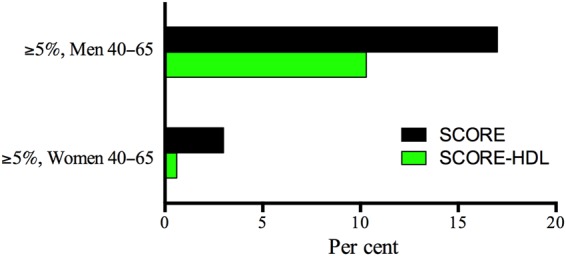
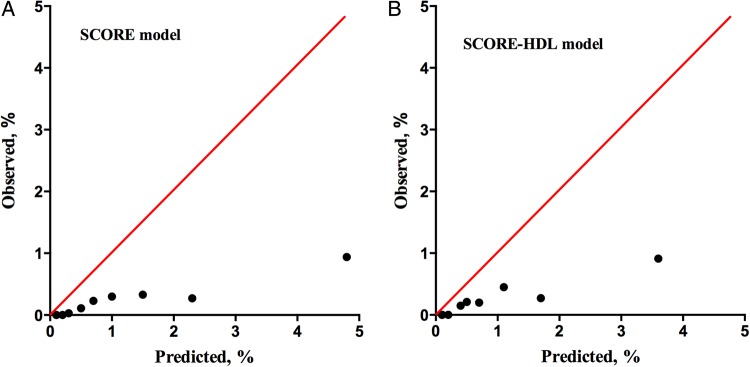
AIMS: Recent European guidelines recommend to include high-density lipoprotein (HDL) cholesterol in risk assessment for primary prevention of cardiovascular disease (CVD), using a SCORE-based risk model (SCORE-HDL). We compared the predictive performance of SCORE-HDL with SCORE in an independent, contemporary, 'low-risk' European population, focusing on ability to identify those in need of intensified CVD prevention. METHODS AND RESULTS: Between 2003 and 2008, 46,092 individuals without CVD, diabetes, or statin use were enrolled in the Copenhagen General Population Study (CGPS). During a mean of 6.8 years of follow-up, 339 individuals died of CVD. In the SCORE target population (age 40-65; n = 30,824), fewer individuals were at baseline categorized as high risk (≥5% 10-year risk of fatal CVD) using SCORE-HDL compared with SCORE (10 vs. 17% in men, 1 vs. 3% in women). SCORE-HDL did not improve discrimination of future fatal CVD, compared with SCORE, but decreased the detection rate (sensitivity) of the 5% high-risk threshold from 42 to 26%, yielding a negative net reclassification index (NRI) of -12%. Importantly, using SCORE-HDL, the sensitivity was zero among women. Both SCORE and SCORE-HDL overestimated risk of fatal CVD. In well-calibrated models developed from the CGPS, HDL did not improve discrimination or NRI. Lowering the decision threshold from 5 to 1% led to progressive gain in NRI for both CVD mortality and morbidity. CONCLUSION: SCORE-HDL did not improve discrimination compared with SCORE, but deteriorated risk classification based on NRI. Future guidelines should consider lower decision thresholds and prioritize CVD morbidity and people above age 65.
Overview
The claims and statistics of this paper haven’t been checked yet.
Free: it reads the open-access text and checks the first 5 claims that cite a source we can check. Create a free account to check every claim.
Integrity signals
Registry
Cites
Statistics
Figures
Verification
Claims the paper makes
The claims and statistics of this paper haven’t been checked yet.
Free: it reads the open-access text and checks the first 5 claims that cite a source we can check. Create a free account to check every claim.
Claims other papers make about this one
Each is checked against this paper’s own text: does it say what the citing paper says it does?
In the citing paper
“Social deprivation and psychosocial stress set the scene for increased risk. 57”
From 2016 ESC/EAS Guidelines for the Management of Dyslipidaemias (2016) · cites this paper as [57]
In the citing paper
“Overall, HDL-C has a modest but useful effect in refining risk estimation, 56 but this may not be universal, as its effect may not be seen in some low-risk populations, particularly with a relatively high mean HDL-C level. 57”
From 2016 ESC/EAS Guidelines for the Management of Dyslipidaemias (2016) · cites this paper as [57]
In the citing paper
“Muscle symptoms are the most commonly described clinically relevant adverse effect of statin treatment. 57”
From 2016 ESC/EAS Guidelines for the Management of Dyslipidaemias (2016) · cites this paper as [57]
In the citing paper
“Several studies have shown a considerable LDL-C lowering effect of alternative dosing such as every other day or twice a week with atorvastatin or rosuvastatin. 57,220”
From 2016 ESC/EAS Guidelines for the Management of Dyslipidaemias (2016) · cites this paper as [57]
In the citing paper
“Social deprivation and psychosocial stress set the scene for increased risk.57”
From 2016 ESC/EAS Guidelines for the Management of Dyslipidaemias (2016) · cites this paper as [57]
3 more claims about this paper
Create a free account to see every claim other papers make about this one.
Self-check
Percentages, sums and reported differences re-computed from the paper’s own numbers.
The self-check needs the paper’s full text.
Citations
Cites
European Guidelines on cardiovascular disease prevention in clinical practice (version 2012)
Authors/Task Force Members:, Perk, J., De Backer, G., Gohlke, H., Graham, I., Reiner, Ž., Verschuren, M., Albus, C., Benlian, P., Boysen, G., et al. (2012) · European Heart Journal · doi:10.1093/eurheartj/ehs092 · Cited by 8,490
Estimation of ten-year risk of fatal cardiovascular disease in Europe: the SCORE project
Conroy, R. (2003) · European Heart Journal · doi:10.1016/s0195-668x(03)00114-3 · Cited by 5,290
Authors/Task Force Members, Graham, I., Atar, D., Borch-Johnsen, K., Boysen, G., Burell, G., Cifkova, R., Dallongeville, J., De Backer, G., Ebrahim, S., et al. (2007) · European Heart Journal · doi:10.1093/eurheartj/ehm316 · Cited by 3,753
ESC/EAS Guidelines for the management of dyslipidaemias
Reiner, Ž., Catapano, A. L., De Backer, G., Graham, I., Taskinen, M.-R., Wiklund, O., Agewall, S., Alegria, E., Chapman, M. J., Durrington, P., et al. (2011) · European Heart Journal · doi:10.1093/eurheartj/ehr158 · Cited by 3,549
De Backer, G. (2003) · European Heart Journal · doi:10.1016/s0195-668x(03)00347-6 · Cited by 2,251
Cardiovascular disease in Europe: epidemiological update
Nichols, M., Townsend, N., Scarborough, P., & Rayner, M. (2013) · European Heart Journal · doi:10.1093/eurheartj/eht356 · Cited by 1,343 · cited 2×
“Cardiovascular disease (CVD) remains a leading cause of mortality, morbidity, and healthcare costs in Europe.(1) The most recent European guidelines for the management of dyslipidaemias(2) and prevention of CVD(3) recommend including high-density lipoprotein (HDL) cholesterol in risk assessment for the primary prevent…”
BackgroundEUROPEAN GUIDELINES ON CARDIOVASCULAR DISEASE PREVENTION IN CLINICAL PRACTICE
Backer, G. D., Ambrosioni, E., Borch-Johnsen, K., Brotons, C., Cifkova, R., Dallongeville, J., Ebrahim, S., Faergeman, O., Graham, I., Mancia, G., et al. (2005) · Rational Pharmacotherapy in Cardiology · doi:10.20996/1819-6446-2005-1-3-57-65 · Cited by 1,267
Loss-of-Function Mutations in APOC3 and Risk of Ischemic Vascular Disease
Jørgensen, A. B., Frikke-Schmidt, R., Nordestgaard, B. G., & Tybjærg-Hansen, A. (2014) · New England Journal of Medicine · doi:10.1056/nejmoa1308027 · Cited by 919
Self-citationKavousi, M., Leening, M. J. G., Nanchen, D., Greenland, P., Graham, I. M., Steyerberg, E. W., Ikram, M. A., Stricker, B. H., Hofman, A., & Franco, O. H. (2014) · JAMA · doi:10.1001/jama.2014.2632 · Cited by 351
Nordestgaard, B. G., Palmer, T. M., Benn, M., Zacho, J., Tybjærg-Hansen, A., Davey Smith, G., & Timpson, N. J. (2012) · PLoS Medicine · doi:10.1371/journal.pmed.1001212 · Cited by 280
Self-citation
Cited by
2016 European Guidelines on cardiovascular disease prevention in clinical practice
Piepoli, M. F., Hoes, A. W., Agewall, S., Albus, C., Brotons, C., Catapano, A. L., Cooney, M.-T., Corrà, U., Cosyns, B., Deaton, C., et al. (2016) · European Heart Journal · doi:10.1093/eurheartj/ehw106 · Cited by 6,457
2016 ESC/EAS Guidelines for the Management of Dyslipidaemias
Catapano, A. L., Graham, I., De Backer, G., Wiklund, O., Chapman, M. J., Drexel, H., Hoes, A. W., Jennings, C. S., Landmesser, U., Pedersen, T. R., et al. (2016) · European Heart Journal · doi:10.1093/eurheartj/ehw272 · Cited by 3,162
2016 ESC/EAS Guidelines for the Management of Dyslipidaemias
Catapano, A. L., Graham, I., De Backer, G., Wiklund, O., Chapman, M. J., Drexel, H., Hoes, A. W., Jennings, C. S., Landmesser, U., Pedersen, T. R., et al. (2016) · Atherosclerosis · doi:10.1016/j.atherosclerosis.2016.08.018 · Cited by 1,582
“Overall, HDL-C has a modest but useful effect in refining risk estimation,(56) but this may not be universal, as its effect may not be seen in some low-risk populations, particularly with a relatively high mean HDL-C level.(57)”
BackgroundInfluentialAuthors/Task Force Members, Piepoli, M. F., Hoes, A. W., Agewall, S., Albus, C., Brotons, C., Catapano, A. L., Cooney, M.-T., Corrà, U., Cosyns, B., et al. (2016) · European Journal of Preventive Cardiology · doi:10.1177/2047487316653709 · Cited by 1,334
“–64 Overall HDL-C has a modest but useful effect in redefining risk estimation,(63,64) but this may not be seen in some low-risk populations.(65) Assessing HDL-C is particularly important at levels of risk just below the threshold for intensive risk modification of 5%, where”
2016 European Guidelines on cardiovascular disease prevention in clinical practice
Piepoli, M. F., Hoes, A. W., Agewall, S., Albus, C., Brotons, C., Catapano, A. L., Cooney, M.-T., Corrà, U., Cosyns, B., Deaton, C., et al. (2016) · Atherosclerosis · doi:10.1016/j.atherosclerosis.2016.05.037 · Cited by 486
F. Piepoli, M. (2017) · International Journal of Behavioral Medicine · doi:10.1007/s12529-016-9583-6 · Cited by 162
2016 European Guidelines on cardiovascular disease prevention in clinical practice
Piepoli, M. F., Hoes, A. W., Agewall, S., Albus, C., Brotons, C., Catapano, A. L., Cooney, M. T., Corrà, U., Cosyns, B., Deaton, C., et al. (2016) · Kardiologia Polska · doi:10.5603/kp.2016.0120 · Cited by 179
Cholesterol efflux capacity: An introduction for clinicians
Anastasius, M. O., Kockx, M., Jessup, W., SULLIVAN, D. R., Rye, K., & Kritharides, L. (2016) · American Heart Journal · doi:10.1016/j.ahj.2016.07.005 · Cited by 83
Mortensen, M. B., & Nordestgaard, B. G. (2019) · JAMA Cardiology · doi:10.1001/jamacardio.2019.3665 · Cited by 87
Self-citationMortensen, M. B., & Nordestgaard, B. G. (2018) · Annals of Internal Medicine · doi:10.7326/m17-0681 · Cited by 76
Self-citationPrimary Prevention With Statins
Mortensen, M. B., Afzal, S., Nordestgaard, B. G., & Falk, E. (2015) · Journal of the American College of Cardiology · doi:10.1016/j.jacc.2015.09.089 · Cited by 65
“Finally, although use of preventive medications was limited during follow-up (18), preferential prescription of such medications to those at highest risk might have contributed to the observed overestimation of risk in subjects with PCE >10%.”
BackgroundMethodSelf-citationHDL cholesterol and ASCVD risk stratification: A debate
Barter, P. J., & Genest, J. J. (2019) · Atherosclerosis · doi:10.1016/j.atherosclerosis.2019.01.001 · Cited by 73
Mortensen, M. B., Nordestgaard, B. G., Afzal, S., & Falk, E. (2016) · European Heart Journal · doi:10.1093/eurheartj/ehw426 · Cited by 61
Self-citationLimitations of the SCORE-guided European guidelines on cardiovascular disease prevention
Mortensen, M. B., & Falk, E. (2016) · European Heart Journal · doi:10.1093/eurheartj/ehw568 · Cited by 65
Self-citationMadsen, C. M., Varbo, A., & Nordestgaard, B. G. (2018) · European Heart Journal · doi:10.1093/eurheartj/ehx659 · Cited by 47
Self-citationWorld Heart Federation Cholesterol Roadmap
Murphy, A., Faria-Neto, J. R., Al-Rasadi, K., Blom, D., Catapano, A., Cuevas, A., Lopez-Jimenez, F., Perel, P., Santos, R., Sniderman, A., et al. (2017) · Global Heart · doi:10.1016/j.gheart.2017.03.002 · Cited by 43
2016 ESC/EAS Guidelines for the Management of Dyslipidaemias
Catapano, A. L., Graham, I. M., Backer, G. D., Wiklund, O., Chapman, M. J., Drexel, H., Hoes, A. W., Jennings, C. S., Landmesser, U., Pedersen, T. R., et al. (2016) · Kardiologia Polska · doi:10.5603/kp.2016.0157 · Cited by 65
Raygor, V., & Khera, A. (2020) · Current Cardiology Reports · doi:10.1007/s11886-020-01331-z · Cited by 40
Defining optimal health range for thyroid function based on the risk of cardiovascular disease
Chaker, L., Korevaar, T. I. M., Rizopoulos, D., Collet, T.-H., Völzke, H., Hofman, A., Rodondi, N., Cappola, A. R., Peeters, R. P., & Franco, O. H. (2017) · The Journal of Clinical Endocrinology & Metabolism · doi:10.1210/jc.2017-00410 · Cited by 33
Eeltink, E., van der Horst, M. Z., Zinkstok, J., Aalfs, C. M., & Luykx, J. J. (2020) · Neuroscience & Biobehavioral Reviews · doi:10.1016/j.neubiorev.2020.11.021 · Cited by 31
Baena-Díez, J. M., Subirana, I., Ramos, R., de la Cámara, A. G., Elosúa, R., Vila, J., Marín-Ibáñez, A., Guembe, M. J., Rigo, F., Tormo-Díaz, M. J., et al. (2017) · Revista Española de Cardiología · doi:10.1016/j.recesp.2017.03.016 · Cited by 27
Søgaard, R., Diederichsen, A. C. P., Rasmussen, L. M., Lambrechtsen, J., Steffensen, F. H., Frost, L., Egstrup, K., Urbonavičienė, G., Busk, M., & Lindholt, J. S. (2022) · European Heart Journal · doi:10.1093/eurheartj/ehac488 · Cited by 33
Lipid digestion of oil-in-water emulsions stabilized with low molecular weight surfactants
Ng, N., Chen, P. X., Ghazani, S. M., Wright, A. J., Marangoni, A. G., Goff, H. D., Joye, I. J., & Rogers, M. A. (2019) · Food & Function · doi:10.1039/c9fo02210d · Cited by 31
Mortensen, M. B., Kulenovic, I., & Falk, E. (2016) · Cardiovascular Diabetology · doi:10.1186/s12933-016-0400-y · Cited by 27
“In Denmark, 10–15 % of the general population were current smokers in 2010–2012 [48].”
BackgroundSelf-citationExtensive carotid atherosclerosis and the diagnostic accuracy of coronary risk calculators
Romanens, M., Mortensen, M. B., Sudano, I., Szucs, T. D., & Adams, A. (2017) · Preventive Medicine Reports · doi:10.1016/j.pmedr.2017.03.006 · Cited by 26
“We do not present hard coronary outcome data in this study, however, there is high confidence for TPA80 being a true coronary risk finding and we were able to confirm the poor sensitivity performance of SCORE-HDL versus SCORE, originally described in the Copenhagen General Population Study (Mortensen et al., 2015).”
BackgroundResultInfluentialSelf-citationXie, B., He, J., Liu, Y., Liu, T., & Liu, C. (2021) · Lipids in Health and Disease · doi:10.1186/s12944-021-01444-6 · Cited by 24
Langlois, M. R., & Nordestgaard, B. G. (2018) · Current Cardiology Reports · doi:10.1007/s11886-018-1036-1 · Cited by 19
Self-citationLotrionte, M., Biasucci, L. M., Peruzzi, M., Frati, G., Giordano, A., & Biondi‐Zoccai, G. (2016) · Progress in Cardiovascular Diseases · doi:10.1016/j.pcad.2016.02.001 · Cited by 20
HDL Subclass Analysis in Predicting Metabolic Syndrome in Koreans With High HDL Cholesterol Levels
Yang, H. S., Hur, M., Kim, H., Kim, S. J., Shin, S., Somma, S. D., & the GREAT Network (2020) · Annals of Laboratory Medicine · doi:10.3343/alm.2020.40.4.297 · Cited by 14
Motamed, N., Rabiee, B., Roozafzai, F., Zamani, F., Faraji, A. H., Maadi, M., Keyvani, H., Khonsari, M. R., & Hemasi, G. R. (2017) · Acta cardiologica. Supplementum · doi:10.1080/00015385.2017.1410335 · Cited by 12
“Although, there are other versions of SCORE in which the HDL-C values were applied, these models did not show a clear superiority over non-HDL-C version of SCORE to predict 10-year fatal CVD risk [27,28].”
MethodKulenovic, I., Mortensen, M. B., Bertelsen, J., May, O., Dodt, K. K., Kanstrup, H., & Falk, E. (2015) · Preventive Medicine · doi:10.1016/j.ypmed.2015.12.001 · Cited by 11
Self-citationRomanens, M., Sudano, I., Adams, A., & Warmuth, W. (2019) · Swiss Medical Weekly · doi:10.4414/smw.2019.20006 · Cited by 13
Baena-Díez, J. M., Subirana, I., Ramos, R., de la Cámara, A. G., Elosúa, R., Vila, J., Marín-Ibáñez, A., Guembe, M. J., Rigo, F., Tormo-Díaz, M. J., et al. (2017) · Revista Española de Cardiología (English Edition) · doi:10.1016/j.rec.2017.03.030 · Cited by 10
High Density Lipoproteins: Is There a Comeback as a Therapeutic Target?
von Eckardstein, A. (2021) · Handbook of experimental pharmacology · doi:10.1007/164_2021_536 · Cited by 13
Scores de risco cardiovascular: utilidade e limitações
Rocha, E. (2016) · Revista Portuguesa de Cardiologia · doi:10.1016/j.repc.2015.11.002 · Cited by 11
Quarta, S., Santarpino, G., Carluccio, M. A., Calabriso, N., Maffia, M., Siculella, L., Damiano, F., Madonna, R., & Massaro, M. (2023) · Vascular Pharmacology · doi:10.1016/j.vph.2023.107210 · Cited by 10
Piccininni, M., Rohmann, J. L., Huscher, D., Mielke, N., Ebert, N., Logroscino, G., Schäffner, E., & Kurth, T. (2020) · PLoS ONE · doi:10.1371/journal.pone.0231097 · Cited by 8
Mortensen, M. B., & Nordestgaard, B. G. (2021) · Atherosclerosis · doi:10.1016/j.atherosclerosis.2021.12.002 · Cited by 8
Self-citationPerini, W., Snijder, M. B., Peters, R. J. G., Kunst, A. E., & van Valkengoed, I. G. M. (2019) · European Journal of Preventive Cardiology · doi:10.1177/2047487319853354 · Cited by 10
“Replication of our findings in other countries is necessary, in part because ethnic-specific lipid profiles among migrants may differ from those who remained in the country of origin.20 Studies comparing the SCORE algorithms have reported strong associations between the two algorithms, which were generally similar to…”
MethodResultInfluentialCardiovascular risk scores: Usefulness and limitations
Rocha, E. (2016) · Revista Portuguesa de Cardiologia (English Edition) · doi:10.1016/j.repce.2015.12.018 · Cited by 7
“However, these cutoffs for classification of CV risk and therapeutic recommendations are to some extent arbitrary, since risk is a continuum, and some authors have found that SCORE performs less well in certain populations, giving rise to some controversy.(11,12) Risk estimation is not an exact science; in the Cox pro…”
BackgroundYao, Q., Zhang, X., Huang, Y., Wang, H., Hui, X., & Zhao, B. (2019) · Medicine · doi:10.1097/md.0000000000018209 · Cited by 6
Comparison of risk assessment tools for cardiovascular diseases: results of an Iranian cohort study
Motamed, N., Ajdarkosh, H., Perumal, D., Ashrafi, G. H., Maadi, M., Tameshkel, F. S., Farahani, B., Rezaie, N., Nikkhah, M., Faraji, A. H., et al. (2021) · Public Health · doi:10.1016/j.puhe.2021.09.021 · Cited by 5
PCSK9 inhibition: A promise fulfilled?
Solaru, K. W., Mohan, C., & Rocco, M. B. (2016) · Cleveland Clinic Journal of Medicine · doi:10.3949/ccjm.83.s2.05 · Cited by 5
Residual Cardiovascular Risk Factors in Dyslipidemia
Nguyen, V. S., Tran, X. T., Vo, T. D., & Le, Q. T. C. (2022) · IntechOpen eBooks · doi:10.5772/intechopen.100046 · Cited by 3
“A study published in 2015 evaluated the predictive capacity of two models, SCORE HDL-C and SCORE, and found that while the SCORE - HDL-C did not enhance CV mortality prognosis, it did lower the sensitivity of finding persons at high risk of CVD in the population [60].”
MethodCystatin C as a Candidate Biomarker of Cardiovascular Outcomes: Too Near, but too Far from Reality
de Carvalho, L. S. F., Quinaglia, T., & Coelho‐Filho, O. R. (2018) · Arquivos Brasileiros de Cardiologia · doi:10.5935/abc.20180226 · Cited by 2
Treating lipid disorders and diabetes with novel and established drugs
Lüscher, T. F. (2015) · European Heart Journal · doi:10.1093/eurheartj/ehv410 · Cited by 1
“Børge Grønne Nordestgaard and colleagues from the Herlev University Hospital in Herlev, Denmark.14 The topic is of great clinical importance as the role of HDL-C as a risk predictor15,16 and therapeutic target17 – 20 has become quite controversial recently.”
BackgroundEndothelial dysfunction in context of women’s health disorders from menarche to menopause
Kuznetsova, I. V. (2020) · Medical alphabet · doi:10.33667/2078-5631-2019-4-33(408)-6-14 · Cited by 1
The Editor's Round Table: Current Perspectives on Triglycerides and Atherosclerosis
Friedewald, V. E., Jones, P. H., Mason, P. P., Roberts, R., & WEINTRAUB, H. S. (2016) · The American Journal of Cardiology · doi:10.1016/j.amjcard.2016.02.025
Reply to: “Appropriate use of cholesterol-lowering therapy”
Langsted, A., Freiberg, J., & Nordestgaard, B. G. (2017) · Atherosclerosis · doi:10.1016/j.atherosclerosis.2017.03.017
“To estimate “definite” undertreatment, we simply calculated the number of individuals in the Copenhagen General Population Study that either i) likely had familial hypercholesterolemia defined as total cholesterol >8 mmol/L or ii) were in the groups colored red and with the advice “Lifestyle intervention and immediate…”
MethodSelf-citationGiga, V. L., & Petrovic, M. T. (2017) · Glasnik Instituta za �titastu �lezdu i metabolizam · doi:10.5937/medgla1764018g
“However, those physicians who advocate for ESC guidelines approach should keep in mind that only 18% of all fatal CV events in apparently healthy people occur in the age group of 40-65 years (8).”
BackgroundSome comments on the 2016 ESC/EAS guidelines for diagnosing and treating dyslipidaemias
Vrablík, M. (2017) · Medicína pro praxi · doi:10.36290/med.2017.048
Гиляревский, С. Р., Kuzmina, I. M., Golshmid, M. V., & Захарова, Г. Ю. (2016) · Aterotromboz = Atherothrombosis · doi:10.21518/2307-1109-2016-2-98-105
The use of scales in clinical practice. Part 1. Coronary heart disease
Belyalov, F. I. (2017) · Clinical Medicine (Russian Journal) · doi:10.18821/0023-2149-2016-94-11-861-864 · Cited by 1
Герасимова, Е. В., Попкова, Т. В., Shalygina, M. V., & Gerasimova, D. A. (2024) · Gene Expression · doi:10.14218/ge.2024.00036 · Cited by 1
Xie, B., He, J., Liu, Y., Liu, T., & Liu, C. (2021) · Figshare · doi:10.6084/m9.figshare.14072308
Xie, B., He, J., Liu, Y., Liu, T., & Liu, C. (2021) · Figshare · doi:10.6084/m9.figshare.14072302
Xie, B., He, J., Liu, Y., Liu, T., & Liu, C. (2021) · Figshare · doi:10.6084/m9.figshare.14072317
Xie, B., He, J., Liu, Y., Liu, T., & Liu, C. (2021) · Figshare · doi:10.6084/m9.figshare.14072290
Xie, B., He, J., Liu, Y., Liu, T., & Liu, C. (2021) · Figshare · doi:10.6084/m9.figshare.14072305
Xie, B., He, J., Liu, Y., Liu, T., & Liu, C. (2021) · Figshare · doi:10.6084/m9.figshare.14072296
Xie, B., He, J., Liu, Y., Liu, T., & Liu, C. (2021) · Figshare · doi:10.6084/m9.figshare.14072311
Xie, B., He, J., Liu, Y., Liu, T., & Liu, C. (2021) · Figshare · doi:10.6084/m9.figshare.14072293
Xie, B., He, J., Liu, Y., Liu, T., & Liu, C. (2021) · Figshare · doi:10.6084/m9.figshare.14072299
Xie, B., He, J., Liu, Y., Liu, T., & Liu, C. (2021) · Figshare · doi:10.6084/m9.figshare.14072314
Metadata
- Authors
- Mortensen, M. B., Afzal, S., Nordestgaard, B. G., & Falk, E.
- Affiliations
- Aarhus University Hospital (DK)
- University of Copenhagen (DK)
- Corresponding author
- Nordestgaard, Børge G.
- Venue
- European Heart Journal
- Publisher
- Oxford University Press (OUP)
- Published
- 2015-06-16
- Volume
- 36
- Issue
- 36
- Pages
- 2446-2453
- ISSN
- 0195-668X (ISSN-L)
- 1522-9645
- PMC
- PMC4576144
- OpenAlex
- W1910876008
- Semantic Scholar
- c82a20dcb256ec52de257c6587c61f13fe95c5de
- Cited by
- 64
- References
- 20
- Citations by year
- 2024: 1 · 2023: 1 · 2022: 1 · 2021: 15 · 2020: 5 · 2019: 6 · 2018: 3 · 2017: 12 · 2016: 17 · 2015: 3
- FWCI
- 11.75
- Type
- journal article
- Language
- en
- Open access
- hybrid
- doi.org
- Licence
- cc-by-nc
- Locations
- European Heart Journal (publishedVersion, cc-by-nc)
- Europe PMC (PubMed Central) (publishedVersion, cc-by-nc)
- PubMed Central (publishedVersion, cc-by-nc)
- PubMed (publishedVersion)
- Research at the University of Copenhagen (University of Copenhagen) (publishedVersion, other-oa)
- Funders
- Herlev Hospital, Copenhagen University Hospital, the Copenhagen County Foundation, and Aarhus University
- Topics
- Health Sciences › Medicine › Cardiology and Cardiovascular Medicine › Lipoproteins and Cardiovascular Health
- Health Sciences › Medicine › Public Health, Environmental and Occupational Health › Health Promotion and Cardiovascular Prevention
- Health Sciences › Medicine › Endocrinology, Diabetes and Metabolism › Diabetes, Cardiovascular Risks, and Lipoproteins
- Keywords
- SCORE risk model, HDL cholesterol, cardiovascular risk prediction, primary prevention, net reclassification improvement, risk classification, decision threshold, sex differences, cardiovascular mortality, cardiovascular morbidity, Copenhagen General Population Study
- MeSH terms
- Adult, Aged, Cardiovascular Diseases, Denmark, Female, Humans, Cholesterol, HDL, Male, Middle Aged, Myocardial Infarction, Prospective Studies, Sensitivity and Specificity, Sex Distribution, Risk Assessment, Hydroxymethylglutaryl-CoA Reductase Inhibitors, Stroke
About these checks
Registry, retraction, Cites and statistics results are computed, not judged, with one exception: a printed reference that no index lists is read once by a model before it counts as a citation error. Claims are extracted by a model and kept only when their quote appears verbatim in the text; each cited source is then checked, with a model’s help, for whether it says what the claim relies on. Those verdicts can be wrong — read the claim’s quote and the cited source before relying on one.
Statistics and arithmetic are recomputed, not judged.
Confidence bands are shown only for fields calibrated on our annotated test set. None is calibrated yet, so no band is shown.
What counts as a claim ›How we measure confidence ›How we check this ›
Are you an author, or do you see a problem with this page? Request a review
Data sources
Bibliographic data: Semantic Scholar, OpenAlex, Crossref.
Contains information from the Semantic Scholar Academic Graph Datasets, made available under the ODC Attribution License (ODC-BY 1.0).
Semantic Scholar’s data is described in: Kinney, R., et al. (2023). The Semantic Scholar Open Data Platform. arXiv:2301.10140.
