

Reduction of low density lipoprotein-cholesterol and cardiovascular events with proprotein convertase subtilisin-kexin type 9 (PCSK9) inhibitors and statins: an analysis of FOURIER, SPIRE, and the Cholesterol Treatment Trialists Collaboration
Open accessThe DOI matches its Crossref record; 16 of the 19 references it cites were found in a registry or an index.
Abstract
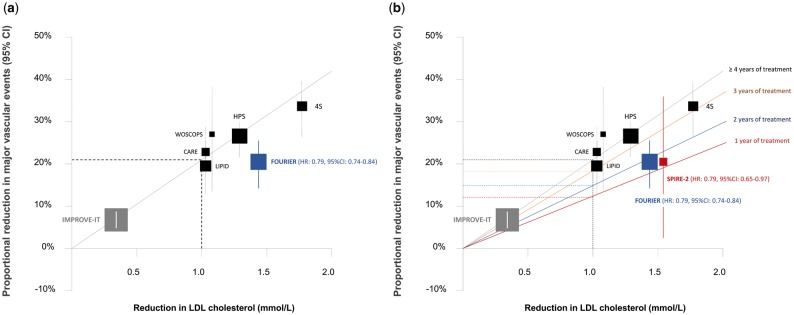
Treatment with proprotein convertase subtilisin-kexin type 9 (PCSK9) inhibitors reduce low density lipoprotein cholesterol (LDL-C) by approximately 45–60%, whether used alone or in combination with a statin.1 , 2 Two large cardiovascular outcomes trials have now reported that lowering LDL-C with a PCSK9 inhibitor when added to treatment with a statin reduces the risk of major cardiovascular events.3 , 4 We sought to compare the efficacy of PCSK9 inhibitors and statins for reducing the risk of cardiovascular events by comparing the results of the FOURIER and SPIRE trials with the results of the Cholesterol Treatment Trialists (CTT) meta-analysis of statin trials.5 , 6 In the FOURIER trial, 27 564 patients with cardiovascular disease and LDL-C levels above 1.8 mmol/L (70 mg/dL) on statin therapy were randomized to either 140 mg every 2 weeks (or 420 mg monthly) of evolocumab subcutaneously or matching placebo.3 At 48 weeks, treatment with evoloculmab reduced LDL-C by 59%, from a baseline level of 2.4 mmol/L (92 mg/dL) to 0.78 mmol/L (30 mg/dL). Using the CTT method of imputation for missing values, this translated into a 1.4 mmol/L (53.4 mg/dL) absolute difference in LDL-C between the two treatment groups. After a median follow-up of 26 months (2.2 years), treatment with evolocumab reduced the incidence of the composite primary cardiovascular endpoint of cardiovascular death (CVD), myocardial infarction (MI), stroke, coronary revascularization, or hospitalization for unstable angina by 15%, from 11.3 to 9.8% (hazard ratio 0.85, 95% CI: 0.79–0.92, P < 0.001). The key secondary endpoint of CVD, MI, or stroke was reduced by 20%, from 7.4 to 5.9% (HR 0.80, 95% CI: 0.73–0.88, P < 0.001). When measured per mmol/L reduction in LDL-C, treatment with evolocumab reduced the risk of the primary outcome by 11.0% (HR 0.89, 95% CI: 0.84–0.94) per mmol/L reduction in LDL-C, and reduced the key secondary endpoint by 14.7% (HR 0.85, 95% CI: 0.80–0.91) per mmol/L reduction in LDL-C. The magnitude of this effect appears to be slightly less than the 22% reduction in risk (HR 0.78, 95% CI: 0.76–0.80) per mmol/L reduction in LDL-C during treatment with a statin as reported by CTT collaboration (P for difference = 1.6 × 10⁻⁵ for primary outcome; P = 0.015 for secondary outcome).5 , 6 Similarly, in two large-scale cardiovascular outcomes trials designated as SPIRE-1 and SPIRE-2, a total of 27 438 participants with either a history of cardiovascular disease, familial hypercholesterolaemia or who were at high risk for cardiovascular disease were randomized to either 150 mg every 2 weeks of bococizumab subcutaneously or matching placebo.4 The SPIRE trials were stopped early due to high rates of the development of neutralizing antidrug antibodies that resulted in an attenuation of the LDL-cholesterol lowering effect of bococizumab over time. The short duration of follow-up limits the usefulness of the findings in these prematurely terminated trials, but do shed some light on the effects of this class of drug. Because the median follow-up prior to discontinuation of the SPIRE-1 trial was only 7 months, we limit our analysis to the results of the SPIRE-2 trial which had a median follow-up of 12 months. Among 10 621 patients with a baseline LDL-C greater than 2.6 mmol/L (100 mg/dL) enrolled in the SPIRE-2 trial, treatment with bococizumab reduced LDL-C by 54.6% at 14 weeks as compared to placebo which attenuated to a 40.6% reduction at 52 weeks, resulting in a reduction in LDL-C from a baseline level of 3.5 mmol/L (133.9 mg/dL) to 2.1 mmol/L (79.5 mg/dL) or a 1.5 mmol/L (57.3 mg/dL) absolute difference in LDL-C between the two treatment groups at 1 year. After a median follow-up of 1.0 year, treatment with bococizumab reduced the incidence of the primary composite outcome of CVD, MI, stroke, or hospitalization for unstable angina requiring urgent coronary revascularization by 21%, from 4.2 to 3.2% (HR 0.79, 95% CI: 0.65–0.97, P = 0.02), and reduced the key secondary outcome of CVD, MI or stroke by 26%, from 3.6 to 2.7% (HR 0.74, 95% CI: 0.60–0.92, P = 0.007). When measured per mmol/L reduction in LDL-C, treatment with bococizumab reduced the risk of the primary outcome by 14.5% (HR 0.85, 95% CI: 0.75–0.98) per mmol/L reduction in LDL-C, and reduced the key secondary endpoint by 18.2% (HR 0.82, 95% CI: 0.71–0.94) per mmol/L reduction in LDL-C. As observed in the FOURIER trial, the magnitude of this effect appears to be slightly less than the 22% reduction in risk per mmol/L reduction in LDL-C during treatment with a statin (P for difference = 0.19 for primary outcome; P = 0.52 for secondary outcome).5 , 6 Indeed, when plotted on the CTT regression line, the results of the FOURIER trial does appear to fall slightly below the regression line describing the average expected benefit from treatment with a statin (Figure 1 A).6 However, this may not be a fair comparison. It should be noted that the CTT regression line is based on the observed red
Overview
The claims and statistics of this paper haven’t been checked yet.
Free: it reads the open-access text and checks the first 5 claims that cite a source we can check. Create a free account to check every claim.
Integrity signals
Registry
Cites
Statistics
Figures
Verification
Claims the paper makes
The claims and statistics of this paper haven’t been checked yet.
Free: it reads the open-access text and checks the first 5 claims that cite a source we can check. Create a free account to check every claim.
Claims other papers make about this one
Each is checked against this paper’s own text: does it say what the citing paper says it does?
The check wasn’t confident either way, so it gives no verdict — never disputed.
In the citing paper
“In observational studies, TC is negatively associated with haemorrhagic stroke”
From 2019 ESC/EAS guidelines for the management of dyslipidaemias: lipid modification to reduce cardiovascular risk (2019) · cites this paper as [252]
Experimental — accuracy not yet measuredIn the citing paper
“in the CTT meta-analysis, there was a 21% [95% confidence interval (CI) 5-41%; P =0.01] relative increase per mmol/L lower LDL cholesterol in haemorrhagic stroke [34,251,252].”
From 2019 ESC/EAS guidelines for the management of dyslipidaemias: lipid modification to reduce cardiovascular risk (2019) · cites this paper as [252]
In the citing paper
“Statin therapy may yield a small increase in the risk of haemorrhagic stroke, but the evidence regarding this risk is uncertain [34,36,251,252].”
From 2019 ESC/EAS guidelines for the management of dyslipidaemias: lipid modification to reduce cardiovascular risk (2019) · cites this paper as [252]
Self-check
Percentages, sums and reported differences re-computed from the paper’s own numbers.
The self-check needs the paper’s full text.
Citations
Cites
Cholesterol Treatment Trialists' (CTT) Collaboration (2010) · The Lancet · doi:10.1016/s0140-6736(10)61350-5 · Cited by 6,550
Evolocumab and Clinical Outcomes in Patients with Cardiovascular Disease
Sabatine, M. S., Giugliano, R. P., Keech, A. C., Honarpour, N., Wiviott, S. D., Murphy, S. A., Kuder, J. F., Wang, H., Liu, T., Wasserman, S. M., et al. (2017) · New England Journal of Medicine · doi:10.1056/nejmoa1615664 · Cited by 6,138
Ference, B. A., Ginsberg, H. N., Graham, I., Ray, K. K., Packard, C. J., Bruckert, E., Hegele, R. A., Krauss, R. M., Raal, F. J., Schunkert, H., et al. (2017) · European Heart Journal · doi:10.1093/eurheartj/ehx144 · Cited by 3,962
Self-citationEfficacy and Safety of Alirocumab in Reducing Lipids and Cardiovascular Events
Robinson, J. G., Farnier, M., Krempf, M., Bergeron, J., Luc, G., Averna, M., Stroes, E. S., Langslet, G., Raal, F. J., El Shahawy, M., et al. (2015) · New England Journal of Medicine · doi:10.1056/nejmoa1501031 · Cited by 2,296
Interpretation of the evidence for the efficacy and safety of statin therapy
Collins, R., Reith, C., Emberson, J., Armitage, J., Baigent, C., Blackwell, L., Blumenthal, R., Danesh, J., Smith, G. D., DeMets, D., et al. (2016) · The Lancet · doi:10.1016/s0140-6736(16)31357-5 · Cited by 1,857
Efficacy and Safety of Evolocumab in Reducing Lipids and Cardiovascular Events
Sabatine, M. S., Giugliano, R. P., Wiviott, S. D., Raal, F. J., Blom, D. J., Robinson, J., Ballantyne, C. M., Somaratne, R., Legg, J., Wasserman, S. M., et al. (2015) · New England Journal of Medicine · doi:10.1056/nejmoa1500858 · Cited by 1,509
Variation in PCSK9 and HMGCR and Risk of Cardiovascular Disease and Diabetes
Ference, B. A., Robinson, J. G., Brook, R. D., Catapano, A. L., Chapman, M. J., Neff, D. R., Voros, S., Giugliano, R. P., Davey Smith, G., Fazio, S., et al. (2016) · New England Journal of Medicine · doi:10.1056/nejmoa1604304 · Cited by 743 · cited 8×
“When measured per mmol/L reduction in LDL-C, treatment with evolocumab reduced the risk of the primary outcome by 11.0% (HR 0.89, 95% CI: 0.84–0.94) per mmol/L reduction in LDL-C, and reduced the key secondary endpoint by 14.7% (HR 0.85, 95% CI: 0.80–0.91) per mmol/L reduction in LDL-C.”
InfluentialSelf-citationSwerdlow, D. I., Preiss, D., Kuchenbaecker, K. B., Holmes, M. V., Engmann, J. E. L., Shah, T., Sofat, R., Stender, S., Johnson, P. C. D., Scott, R. A., et al. (2015) · The Lancet · doi:10.1016/s0140-6736(14)61183-1 · Cited by 680
Self-citationCardiovascular Efficacy and Safety of Bococizumab in High-Risk Patients
Ridker, P. M., Revkin, J., Amarenco, P., Brunell, R., Curto, M., Civeira, F., Flather, M., Glynn, R. J., Gregoire, J., Jukema, J. W., et al. (2017) · New England Journal of Medicine · doi:10.1056/nejmoa1701488 · Cited by 624
Cited by
Mach, F., Baigent, C., Catapano, A. L., Koskinas, K. C., Casula, M., Badimon, L., Chapman, M. J., De Backer, G. G., Delgado, V., Ference, B. A., et al. (2020) · European Heart Journal · doi:10.1093/eurheartj/ehz455 · Cited by 8,961
Self-citationMach, F., Baigent, C., Catapano, A. L., Koskinas, K. C., Casula, M., Badimon, L., Chapman, M. J., De Backer, G. G., Delgado, V., Ference, B. A., et al. (2019) · Atherosclerosis · doi:10.1016/j.atherosclerosis.2019.08.014 · Cited by 4,854
“In this group of patients already treated with statins to reach goals, the absolute CV benefit from added ezetimibe was small, although significant and in line with the CTT expectations.(268) Therefore, the study supports the proposition that LDL-C lowering by means other than statins is beneficial and safe.”
Self-citationImpact of Lipids on Cardiovascular Health
Ference, B. A., Graham, I., Tokgozoglu, L., & Catapano, A. L. (2018) · Journal of the American College of Cardiology · doi:10.1016/j.jacc.2018.06.046 · Cited by 511
Self-citationUpdated Cardiovascular Prevention Guideline of the Brazilian Society of Cardiology - 2019
Précoma, D. B., Oliveira, G. M. M. D., Simão, A. F., Dutra, O. P., Coelho-Filho, O. R., Izar, M. C. D. O., Póvoa, R. M. D. S., Giuliano, I. D. C. B., Alencar Filho, A. C. D., Machado, C. A., et al. (2019) · Arquivos Brasileiros de Cardiologia · doi:10.5935/abc.20190204 · Cited by 434
Soppert, J., Lehrke, M., Marx, N., Jankowski, J., & Noels, H. (2020) · Advanced Drug Delivery Reviews · doi:10.1016/j.addr.2020.07.019 · Cited by 407
Metadata
- Authors
- Ference, B. A., Cannon, C. P., Landmesser, U., Lüscher, T. F., Catapano, A. L., & Ray, K. K.
- Affiliations
- Wayne State University (US)
- Brigham and Women's Hospital (US)
- Charité – Universitätsmedizin Berlin (DE)
- University Hospital Zurich (CH)
- University of Milan (IT)
- Imperial College London (GB)
- Corresponding author
- Catapano, Alberico L
- Venue
- European Heart Journal
- Publisher
- Oxford University Press (OUP)
- Published
- 2017-08-14
- Volume
- 39
- Issue
- 27
- Pages
- 2540-2545
- ISSN
- 0195-668X (ISSN-L)
- 1522-9645
- PMC
- PMC6047439
- OpenAlex
- W2748261813
- Cited by
- 161
- References
- 19
- Citations by year
- 2026: 8 · 2025: 10 · 2024: 15 · 2023: 10 · 2022: 17 · 2021: 14 · 2020: 18 · 2019: 26 · 2018: 35 · 2017: 8
- FWCI
- 24.36
- Type
- journal article
- Language
- en
- Open access
- hybrid
- doi.org
- Licence
- Locations
- European Heart Journal (publishedVersion, cc-by-nc)
- Europe PMC (PubMed Central) (publishedVersion, cc-by-nc)
- PubMed Central (publishedVersion, cc-by-nc)
- PubMed (publishedVersion)
- Zurich Open Repository and Archive (University of Zurich) (acceptedVersion, cc-by-nc)
- Archivio Istituzionale della Ricerca (Universita Degli Studi Di Milano) (submittedVersion, other-oa)
- Spiral (Imperial College London) (submittedVersion, cc-by-nc)
- Zurich Open Repository and Archive (University of Zurich) (submittedVersion, cc-by-nc)
- Zurich Open Repository and Archive (University of Zurich)
- Funders
- Fondazione Cariplo (2015-0524, 2015-0524 and 2015-0564, 2015-0564, PHC-03-2015/667837-2)
- Horizon 2020 Framework Programme (REPROGRAM PHC-03-2015/667837-2, 667837, PHC-03-2015/667837–2)
- Topics
- Health Sciences › Medicine › Cardiology and Cardiovascular Medicine › Lipoproteins and Cardiovascular Health
- Life Sciences › Biochemistry, Genetics and Molecular Biology › Biochemistry › Cholesterol and Lipid Metabolism
- Life Sciences › Biochemistry, Genetics and Molecular Biology › Cancer Research › Cancer, Lipids, and Metabolism
- Keywords
- PCSK9 inhibitors, statins, LDL cholesterol lowering, cardiovascular events, evolocumab, FOURIER trial, cardiovascular risk reduction, cardiovascular mortality, myocardial infarction, stroke, coronary revascularization, unstable angina, hypercholesterolemia
- MeSH terms
- Proprotein Convertase 9, PCSK9 Inhibitors, Cardiovascular Diseases, Humans, Hypercholesterolemia, Cholesterol, LDL, Hydroxymethylglutaryl-CoA Reductase Inhibitors
About these checks
Registry, retraction, Cites and statistics results are computed, not judged, with one exception: a printed reference that no index lists is read once by a model before it counts as a citation error. Claims are extracted by a model and kept only when their quote appears verbatim in the text; each cited source is then checked, with a model’s help, for whether it says what the claim relies on. Those verdicts can be wrong — read the claim’s quote and the cited source before relying on one.
Statistics and arithmetic are recomputed, not judged.
Confidence bands are shown only for fields calibrated on our annotated test set. None is calibrated yet, so no band is shown.
What counts as a claim ›How we measure confidence ›How we check this ›
Are you an author, or do you see a problem with this page? Request a review
How to cite
Cite CoChat for the checks on this page, and the paper for its own findings.
- This page
- CoChat. (2026). Citation check: Reduction of low density lipoprotein-cholesterol and cardiovascular events with proprotein convertase subtilisin-kexin type 9 (PCSK9) inhibitors and statins: an analysis of FOURIER, SPIRE, and the Cholesterol Treatment Trialists Collaboration. https://app.cochat.ai/papers/10.1093/eurheartj/ehx450
- The paper
- Ference, B. A., Cannon, C. P., Landmesser, U., Lüscher, T. F., Catapano, A. L., & Ray, K. K. (2018). Reduction of low density lipoprotein-cholesterol and cardiovascular events with proprotein convertase subtilisin-kexin type 9 (PCSK9) inhibitors and statins: an analysis of FOURIER, SPIRE, and the Cholesterol Treatment Trialists Collaboration. European Heart Journal. https://doi.org/10.1093/eurheartj/ehx450
Data sources
Bibliographic data: Semantic Scholar, OpenAlex, Crossref.
Contains information from the Semantic Scholar Academic Graph Datasets, made available under the ODC Attribution License (ODC-BY 1.0).
Semantic Scholar’s data is described in: Kinney, R., et al. (2023). The Semantic Scholar Open Data Platform. arXiv:2301.10140.
