

Improved outcomes in patients with ST-elevation myocardial infarction during the last 20 years are related to implementation of evidence-based treatments: experiences from the SWEDEHEART registry 1995-2014
Open accessThe DOI matches its Crossref record; 34 of the 35 references it cites were found in a registry or an index.
Abstract
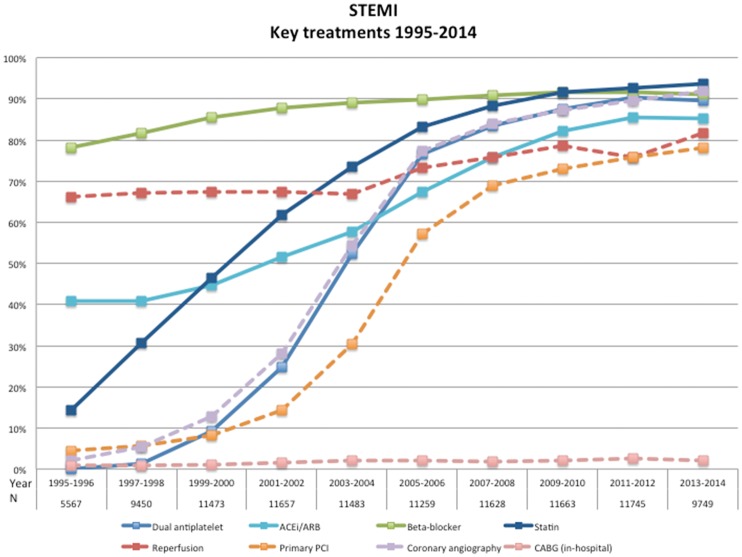
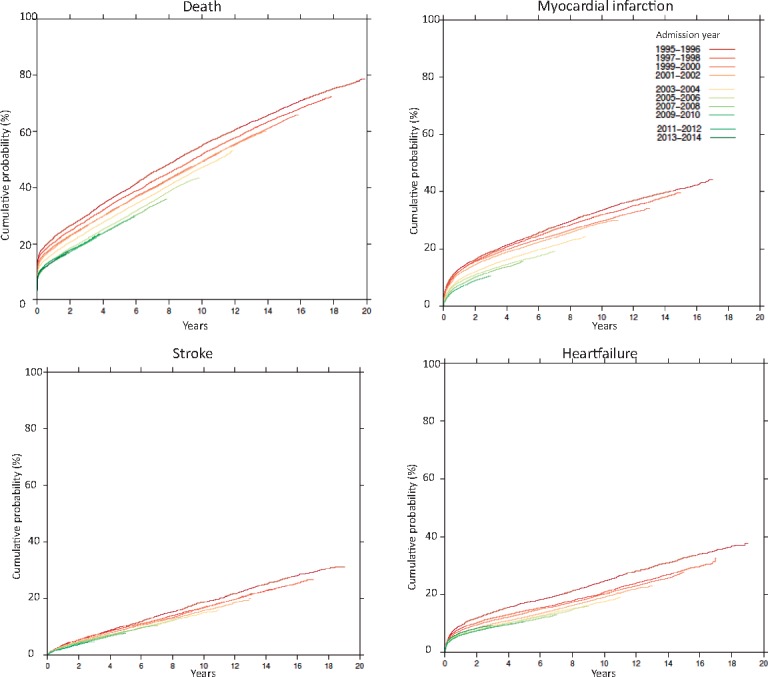
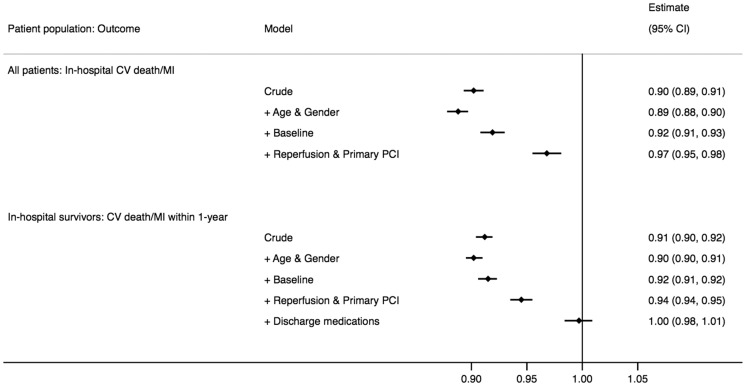
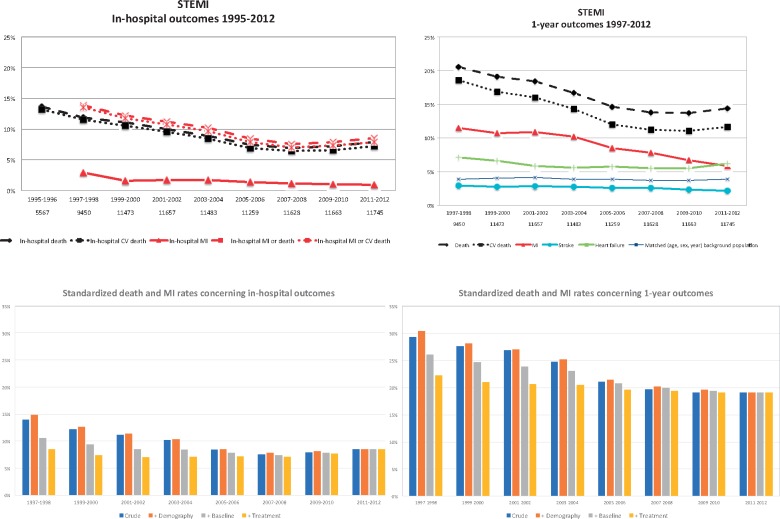
AIMS: Impact of changes of treatments on outcomes in ST-elevation myocardial infarction (STEMI) patients in real-life health care has not been documented. METHODS AND RESULTS: All STEMI cases (n = 105.674) registered in the nation-wide SWEDEHEART registry between 1995 and 2014 were included and followed for fatal and non-fatal outcomes for up to 20 years. Most changes in treatment and outcomes occurred from 1994 to 2008. Evidence-based treatments increased: reperfusion from 66.2 to 81.7%; primary percutaneous coronary intervention: 4.5 to 78.0%; dual antiplatelet therapy from 0 to 89.6%; statin: 14.1 to 93.6%; beta-blocker: 78.2 to 91.0%, and angiotensin-converting-enzyme/angiotensin-2-receptor inhibitors: 40.8 to 85.2% (P-value for-trend <0.001 for all). One-year mortality decreased from 22.1 to 14.1%. Standardized incidence ratio compared with the general population decreased from 5.54 to 3.74 (P < 0.001). Cardiovascular (CV) death decreased from 20.1 to 11.1%, myocardial infarction (MI) from 11.5 to 5.8%; stroke from 2.9 to 2.1%; heart failure from 7.1 to 6.2%. After standardization for differences in demography and baseline characteristics, the change of 1-year CV-death or MI corresponded to a linear trend of 0.915 (95% confidence interval: 0.906-0.923) per 2-year period which no longer was significant, 0.997 (0.984-1.009), after adjustment for changes in treatment. The changes in treatment and outcomes were most pronounced from 1994 to 2008. CONCLUSION: Gradual implementation of new and established evidence-based treatments in STEMI patients during the last 20 years has been associated with prolonged survival and lower risk of recurrent ischaemic events, although a plateauing is seen since around 2008.
Overview
The claims and statistics of this paper haven’t been checked yet.
Free: it reads the open-access text and checks the first 5 claims that cite a source we can check. Create a free account to check every claim.
Integrity signals
Registry
Cites
Statistics
Figures
Verification
Claims the paper makes
The claims and statistics of this paper haven’t been checked yet.
Free: it reads the open-access text and checks the first 5 claims that cite a source we can check. Create a free account to check every claim.
Claims other papers make about this one
Each is checked against this paper’s own text: does it say what the citing paper says it does?
In the citing paper
“It may be better revealed by non-HDL-C levels [415].”
From 2019 ESC/EAS guidelines for the management of dyslipidaemias: lipid modification to reduce cardiovascular risk (2019) · cites this paper as [415]
Self-check
Percentages, sums and reported differences re-computed from the paper’s own numbers.
The self-check needs the paper’s full text.
Citations
Cites
Multiple imputation using chained equations: Issues and guidance for practice
White, I. R., Royston, P., & Wood, A. M. (2011) · Statistics in Medicine · doi:10.1002/sim.4067 · Cited by 9,792 · cited 1×
“Missing data were handled using multiple imputations with the method of chained equations.(19) Five imputed data sets were generated.”
MethodRoffi, M., Patrono, C., Collet, J.-P., Mueller, C., Valgimigli, M., Andreotti, F., Bax, J. J., Borger, M. A., Brotons, C., Chew, D. P., et al. (2016) · European Heart Journal · doi:10.1093/eurheartj/ehv320 · Cited by 8,261
Self-citationAuthors/Task Force Members, Steg, P. G., James, S. K., Atar, D., Badano, L. P., Lundqvist, C. B., Borger, M. A., Di Mario, C., Dickstein, K., Ducrocq, G., et al. (2012) · European Heart Journal · doi:10.1093/eurheartj/ehs215 · Cited by 6,829
Self-citationExternal review and validation of the Swedish national inpatient register
Ludvigsson, J. F., Andersson, E., Ekbom, A., Feychting, M., Kim, J.-L., Reuterwall, C., Heurgren, M., & Olausson, P. O. (2011) · BMC Public Health · doi:10.1186/1471-2458-11-450 · Cited by 5,055
WRITING COMMITTEE MEMBERS*, O’Gara, P. T., Kushner, F. G., Ascheim, D. D., Casey, D. E., Chung, M. K., de Lemos, J. A., Ettinger, S. M., Fang, J. C., Fesmire, F. M., et al. (2013) · Circulation · doi:10.1161/cir.0b013e3182742cf6 · Cited by 4,725
(2014) · European Heart Journal · doi:10.1093/eurheartj/ehu278 · Cited by 4,314
Universal Definition of Myocardial Infarction
Thygesen, K., Alpert, J. S., White, H. D., TASK FORCE MEMBERS: Chairpersons: Kristian Thygesen (Denmark), J. S. A. (., Biomarker Group: Allan S. Jaffe, C. (., ECG Group: Bernard Chaitman, C.-O. (., Imaging Group: Richard Underwood, C. (., Intervention Group: Jean-Pierre Bassand, C.-O. (., Clinical Investigation Group: Paul W. Armstrong, C. (., Global Perspective Group: Philip A. Poole-Wilson, C. (., et al. (2007) · Circulation · doi:10.1161/circulationaha.107.187397 · Cited by 4,230
2014 ESC/EACTS Guidelines on myocardial revascularization
Kolh, P., Windecker, S., Alfonso, F., Collet, J.-P., Cremer, J., Falk, V., Filippatos, G., Hamm, C., Head, S. J., Jüni, P., et al. (2014) · European Journal of Cardio-Thoracic Surgery · doi:10.1093/ejcts/ezu366 · Cited by 4,199
2014 AHA/ACC Guideline for the Management of Patients With Non–ST-Elevation Acute Coronary Syndromes
Amsterdam, E. A., Wenger, N. K., Brindis, R. G., Casey, D. E., Ganiats, T. G., Holmes, D. R., Jaffe, A. S., Jneid, H., Kelly, R. F., Kontos, M. C., et al. (2014) · Journal of the American College of Cardiology · doi:10.1016/j.jacc.2014.09.017 · Cited by 3,595
Task Force Members, Thygesen, K., Alpert, J. S., White, H. D., Biomarker Group, Jaffe, A. S., Apple, F. S., Galvani, M., Katus, H. A., Newby, L. K., et al. (2007) · European Heart Journal · doi:10.1093/eurheartj/ehm355 · Cited by 2,541
Self-citation
Cited by
Items 201–300 of 458
Left atrial strain is associated with long-term mortality in acute coronary syndrome patients
Pedersson, P. R., Skaarup, K. G., Lassen, M. C. H., Olsen, F. J., Iversen, A. Z., Jørgensen, P. G., & Biering‐Sørensen, T. (2024) · The International Journal of Cardiovascular Imaging · doi:10.1007/s10554-024-03053-7 · Cited by 8
Novel cardioprotective approaches in ischaemic heart disease
Vilahur, G., Radike, M., & Badimón, L. (2024) · European Heart Journal · doi:10.1093/eurheartj/ehae058 · Cited by 8
Bönner, F., Jung, C., Polzin, A., Erkens, R., Dannenberg, L., Ipek, R., Kaldirim, M., Gastl, M., Wischmann, P., Zaharia, O., et al. (2023) · BMC Cardiovascular Disorders · doi:10.1186/s12872-023-03210-1 · Cited by 8
Lara, J. G., Gracida, M., Rivero, F., Gutiérrez, A., Muntané‐Carol, G., Romaguera, R., Fuentes, L., Marcano, A. L., Roura, G., Ferreiro, J. L., et al. (2023) · Journal of the American Heart Association · doi:10.1161/jaha.123.030285 · Cited by 8
Qiu, R., Wan, S., Zhong, C., Han, S., He, T., Huang, Y., Wei, X., Li, M., Guan, Z., Zhang, X., et al. (2024) · Journal of Evidence-Based Medicine · doi:10.1111/jebm.12579 · Cited by 8
Trends of acute myocardial infarction-related deaths in US patients from 1999 to 2020
Ullah, I., Farooqi, H. A., Ahmad, O., Irfan, M., Khan, E. H., Khan, O. A., Goyal, A., Khan, A. W., Sattar, Z., Mehta, S., et al. (2024) · Archives of Medical Science - Atherosclerotic Diseases · doi:10.5114/amsad/199656 · Cited by 8
Chacón-Díaz, M., Tarco, O. A., Alarco, W., Aguirre-Zurita, O., Rosales-Vidal, M., & Rebaza-Miyasato, P. (2018) · Archivos de cardiología de México · doi:10.1016/j.acmx.2018.03.007 · Cited by 10
Chiara, A. D., Clagnan, E., & Valent, F. (2019) · Journal of Cardiovascular Medicine · doi:10.2459/jcm.0000000000000893 · Cited by 8
White, H. D., Stewart, R., Dalby, A. J., Stebbins, A., Cannon, C. P., Budaj, A., Linhart, A., Pais, P. S., Díaz, R., Steg, P. G., et al. (2020) · American Heart Journal · doi:10.1016/j.ahj.2020.04.004 · Cited by 9
Self-citationTizón‐Marcos, H., Vaquerizo, B., Marrugat, J., Ariza, A., Carrillo, X., Muñoz, J.-F., Cárdenas, M., García‐Picart, J., Rojas, S. G., Querol, C. T., et al. (2020) · Revista Española de Cardiología · doi:10.1016/j.recesp.2020.05.024 · Cited by 8
Jensen, E. S., Olesen, K. K. W., Gyldenkerne, C., Thrane, P. G., Jensen, L. O., Raungaard, B., Poulsen, P. L., Thomsen, R. W., & Mæng, M. (2021) · BMC Cardiovascular Disorders · doi:10.1186/s12872-021-02312-y · Cited by 8
“Moreover, two Swedish studies compared outcomes for all patients with acute coronary syndrome from 1995 to 2014 [30, 31] but differed concerning inclusion criteria (chronic vs acute coronary syndrome), study period, and lack of stratification based on presence of diabetes.”
ResultZhang, J., Wang, J., Wu, Y., Li, W., Gong, K., & Zhao, P. (2021) · International Heart Journal · doi:10.1536/ihj.20-439 · Cited by 7
Risk-associated management disparities in acute myocardial infarction
Eggers, K. M., Jernberg, T., & Lindahl, B. (2021) · Scientific Reports · doi:10.1038/s41598-021-03742-6 · Cited by 7
Self-citationYang, Y., Hao, Y., Liu, J., Yang, N., Hu, D., Sun, Z., Zhao, D. H., Liu, J., & on behalf of the Improving Care for Cardiovascular Disease in China–Acute Coronary Syndrome (CCC-ACS) Investigators (2022) · Chinese Medical Journal · doi:10.1097/cm9.0000000000002257 · Cited by 7
“8%).([14,15]) The rate of primary PCI (55.”
BackgroundMatić, D., Ašanin, M., Vukcevic, V. D., Mehmedbegović, Z., Marinković, J., Kocev, N. I., Marjanovic, M. M., Mrdović, I., Antonijevic, N. M., Milošević, A., et al. (2019) · Heart · doi:10.1136/heartjnl-2019-314728 · Cited by 7
Tizón‐Marcos, H., Vaquerizo, B., Marrugat, J., Ariza, A., Carrillo, X., Muñoz, J.-F., Cárdenas, M., García‐Picart, J., Rojas, S. G., Querol, C. T., et al. (2020) · Revista Española de Cardiología (English Edition) · doi:10.1016/j.rec.2020.06.002 · Cited by 9
Jánosi, A., Pach, F. P., Erdős, G., Tóth, K., Hári, P., Ofner, P., & Andreka, P. G. (2021) · Orvosi Hetilap · doi:10.1556/650.2021.32205 · Cited by 7
The risk score for in-hospital mortality in patients with ST-segment elevation myocardial infarction
Bessonov, I. S., Va, K., Сталикович, С. С., Горбатенко, Е. А., & Алексеевич, Ш. А. (2021) · Kardiologiia · doi:10.18087/cardio.2021.9.n1720 · Cited by 7
Huang, H., Lai, W., Li, Q., Wei, H., Remutula, N., Tuersun, T., Zhou, Y., Bao, K., Yan, Z.-L., Wang, B., et al. (2022) · Frontiers in Cardiovascular Medicine · doi:10.3389/fcvm.2022.774365 · Cited by 7
“While several studies indicate that women have experienced frustratingly smaller decreases compared with men in CAD mortality rates (6, 7).”
ResultBayat, S., Nazari, S. S. H., Mehrabi, Y., & Sistanizad, M. (2022) · Journal of Research in Health Sciences · doi:10.34172/jrhs.2022.102 · Cited by 7
Beer, J. H., & Bonetti, N. R. (2017) · European Heart Journal · doi:10.1093/eurheartj/ehx702 · Cited by 7
Pedriali, G., Leo, S., Tiezzi, M., Colarusso, E. N., Morciano, G., Tremoli, E., & Pinton, P. (2026) · Basic Research in Cardiology · doi:10.1007/s00395-026-01162-z · Cited by 9
“However, progress has plateaued since around 2008 [217].”
Ayayo, S. A., Martin, G. P., Zghebi, S. S., Taxiarchi, V. P., Rashid, M. O., Kontopantelis, E., & Mamas, M. A. (2025) · Heart · doi:10.1136/heartjnl-2024-325474 · Cited by 8
Long-term outcomes of recurrent myocardial infarction: a nationwide Danish study
Christensen, D. M., Zahir, D., Garred, C. H., Nouhravesh, N., Elmegaard, M., Malmborg, M. W., Sindet‐Pedersen, C., Mohamed, A. A., El-Chouli, M. H., Fosbøl, E. L., et al. (2025) · European Heart Journal Acute Cardiovascular Care · doi:10.1093/ehjacc/zuaf101 · Cited by 6
Okamoto, H., Nishi, T., Ishii, M., Tsujita, K., Koto, S., Nakai, M., Sumita, Y., Iwanaga, Y., Matoba, S., Kobayashi, Y., et al. (2022) · Circulation Journal · doi:10.1253/circj.cj-22-0241 · Cited by 7
Tang, X., Li, R., & Zhang, T. (2022) · Coronary Artery Disease · doi:10.1097/mca.0000000000001177 · Cited by 9
Acute myocardial infarction in young adults: incidence, risk factors and prognosis
Gautadóttir, K., Guðmundsdóttir, I. J., Sigurdsson, M. I., & Andersen, K. K. (2022) · Læknablaðið · doi:10.17992/lbl.2022.10.709 · Cited by 6
Zhang, Y., Wang, S., Qi, D., Wang, X., Li, M., Zhu, Z., Cheng, Q., Hu, D., & Gao, C. (2023) · Chinese Medical Journal · doi:10.1097/cm9.0000000000002698 · Cited by 6
Lipid-Lowering Therapy after Acute Coronary Syndrome in Outpatient Practice—How to Achieve Goal
Rajtar-Salwa, R., Bobrowska, B., Batko, J., Bartuś, S., Dimitrow, P. P., & Krawczyk‐Ożóg, A. (2023) · Journal of Clinical Medicine · doi:10.3390/jcm12206579 · Cited by 6
“Despite the recognized benefits of lowering LDL-C levels in patients after myocardial infarction, achieving desired LDL-C targets in this high-risk setting remains suboptimal [4,11,12].”
BackgroundThe Evolving Role of Vericiguat in Patients With Chronic Heart Failure
Dies, R., Jackson, C. N., Flanagan, C. J., Sinnathamby, E. S., Spillers, N. J., Potharaju, P., Singh, N., Varrassi, G., Ahmadzadeh, S., Shekoohi, S., et al. (2023) · Cureus · doi:10.7759/cureus.49782 · Cited by 6
Yndigegn, T., Gu, T., Grufman, H., Erlinge, D., Mokhtari, A., Ekelund, U., Magnusson, M., Gustafsson, E., Nilsson, J. Å., Gonçalves, I., et al. (2024) · ESC Heart Failure · doi:10.1002/ehf2.15037 · Cited by 6
Self-citationFoà, A., Pabón, M. A., Braunwald, E., Jering, K., Vaduganathan, M., Claggett, B. L., Køber, L., Lewis, E. F., Granger, C. B., van der Meer, P., et al. (2024) · European Journal of Heart Failure · doi:10.1002/ejhf.3557 · Cited by 6
Cirillo, P. L., Serafino, L. D., Taglialatela, V., Calabrò, P., Antonucci, E., Gresele, P., Palareti, G., Patti, G., Pengo, V., Pignatelli, P., et al. (2019) · Angiology · doi:10.1177/0003319719895171 · Cited by 6
“Moreover, this study furnishes a “real” snapshot about the impact of OMT on clinical outcome in patients with ACS.”
BackgroundInfluentialWu, Y., Ma, L., & Hu, Z.-P. (2021) · Heart and Vessels · doi:10.1007/s00380-021-01950-8 · Cited by 6
Zhang, Y., Wang, S., Cheng, Q., Zhang, J., Qi, D., Wang, X., Zhu, Z., Li, M., Hu, D., & Gao, C. (2021) · BMJ Open · doi:10.1136/bmjopen-2021-053510 · Cited by 6
Tizón‐Marcos, H., Vaquerizo, B., Ferré, J. M., Farré, N., Lidón, R. M., García‐Picart, J., Regueiro, A., Ariza, A., Carrillo, X., Durán, X., et al. (2022) · Frontiers in Cardiovascular Medicine · doi:10.3389/fcvm.2022.847982 · Cited by 6
Kotronias, R. A., Fielding, K., Greenhalgh, C., Lee, R., Alkhalil, M., Marin, F., Emfietzoglou, M., BANNING, A. P., Vallance, C., Channon, K. M., et al. (2022) · Frontiers in Cardiovascular Medicine · doi:10.3389/fcvm.2022.930015 · Cited by 6
ST-segment elevation myocardial infarction: the new ESC Guidelines
Lüscher, T. F. (2018) · European Heart Journal · doi:10.1093/eurheartj/ehx792 · Cited by 6
“Although huge progress has been made in its management in the last decades,(2) in-hospital mortality is still in the range of 5–8%.(3) To allow for further optimization of the management of STEMI, considering also the most recent evidence, a task force of the ESC published updated guidelines.”
BackgroundElgendy, I. Y., & Jneid, H. M. (2018) · Journal of Thoracic Disease · doi:10.21037/jtd.2018.03.58 · Cited by 6
“com Over the past decades, a significant reduction in mortality due to ST elevation myocardial infarction (STEMI) has been observed worldwide (1,2).”
BackgroundRong, X., Ge, D., Yu, L., Li, L., Chu, M., & Lv, H. (2019) · Experimental and Therapeutic Medicine · doi:10.3892/etm.2019.8280 · Cited by 6
“Over the previous 2 decades, there has been a marked increase in the use of enalapril-treatment, which has contributed to the decreased rates of mortality observed (8).”
BackgroundMachine learning for holistic visualization of STEMI registry data
Nayak, K. R., Skupin, A., Schempp, T., Garberich, R., Bhavnani, S. P., & Henry, T. D. (2021) · Journal of Biomedical Informatics · doi:10.1016/j.jbi.2021.103869 · Cited by 7
Ritsinger, V., Bodegård, J., Kristófi, R., Thuresson, M., Nathanson, D., Nyström, T., Eriksson, J. W., & Norhammar, A. (2023) · BMJ Open · doi:10.1136/bmjopen-2022-069037 · Cited by 7
Wang, S., Zhang, Y., Qi, D., Wang, X., Zhu, Z., Yang, W. Y. L., Li, M., Hu, D., & Gao, C. (2024) · Annals of Medicine · doi:10.1080/07853890.2024.2311854 · Cited by 5
Tavecchia, G., Gualini, E., Sacco, A., & Oliva, F. G. (2024) · European Heart Journal Supplements · doi:10.1093/eurheartjsupp/suae008 · Cited by 5
Thrane, P. G., Olesen, K. K. W., Thim, T., Gyldenkerne, C., Hansen, M. K., Stødkilde-Jørgensen, N., Kristensen, S. D., & Mæng, M. (2025) · JACC Advances · doi:10.1016/j.jacadv.2025.101614 · Cited by 5
Lechner, I., Carberry, J., Stiermaier, T., Tiller, C., Holzknecht, M., Oberhollenzer, F., Kaser, A., Mair, J. M., Mayr, A., Feistritzer, H., et al. (2025) · European Heart Journal - Cardiovascular Imaging · doi:10.1093/ehjci/jeaf250 · Cited by 5
“12 However, restoring epicardial blood flow through percutaneous coronary intervention (PCI) may also trigger a cascade of deleterious pathophysiological processes (e.g. 15 Importantly, the extent of infarcted tissue (infarct size) is not the sole determinant of outcome following STEMI.”
Abdelaziz, A. A., Ramadan, S., Hasan, M. T., Desouky, M., Atta, K., Hafez, A. H., Shams, M. M., Helmi, A., Ibrahim, R. A., Sobhy, A., et al. (2025) · American Heart Journal · doi:10.1016/j.ahj.2025.107284 · Cited by 5
Gencer, B., Follonier, C., Abdelrahman, A., Rosselló, X., Sionís, A., Wilhelm, M., Koskinas, K., Moholdt, T. T., Panagiotakos, D. B., Dendale, P., et al. (2025) · European Journal of Preventive Cardiology · doi:10.1093/eurjpc/zwaf761 · Cited by 5
Bruthans, J., Mayer, O., Jarkovský, J., Zvolský, M., & Bruthans, J. (2020) · Biomedical Papers · doi:10.5507/bp.2020.014 · Cited by 5
López, A. P., Almiñana, M. A., & Peris, J. (2020) · Journal of Cardiovascular Translational Research · doi:10.1007/s12265-020-10045-0 · Cited by 5
Ferrer‐Curriu, G., Rueda, F., Revuelta‐López, E., García‐García, C., Codina, P., Gálvez‐Montón, C., Roura, S., Aimo, A., Emdin, M., Planavila, A., et al. (2023) · Revista Española de Cardiología · doi:10.1016/j.recesp.2023.03.016 · Cited by 5
30-Day and 1-Year Acute Myocardial Infarction Outcomes in Côte d'Ivoire
Yao, H., Kyandabike, R. K., Ekou, A. K., Ehouman, E., Touré, C., Kouame, I., Sepih, E., Vy, L., & N’Guetta, R. (2024) · JACC Advances · doi:10.1016/j.jacadv.2024.101285 · Cited by 5
Farmakis, I. T., Zafeiropoulos, S., Κάρτας, Α., Boulmpou, A., Nevras, V., Papadimitriou, I., Tampaki, A., Vlachou, A., Markidis, E., Koutsakis, A., et al. (2019) · Acta cardiologica. Supplementum · doi:10.1080/00015385.2019.1626087 · Cited by 5
Aldama, G., López, M., Santás, M., Rios, X. F., Piñón-Esteban, P., Salgado, J., Calviño, R., Vazquez, N., Mesías-Prego, A., González‐Juanatey, C., et al. (2020) · Revista Española de Cardiología (English Edition) · doi:10.1016/j.rec.2019.09.031 · Cited by 5
Abe, T., Olanipekun, T., Igwe, J., Ndausung, U., Amah, C., Chang, A., Effoe, V., Egbuche, O., Ogunbayo, G. O., & Onwuanyi, A. (2022) · Coronary Artery Disease · doi:10.1097/mca.0000000000001119 · Cited by 5
Luca, L. D., D’Errigo, P., Rosato, S., Mureddu, G. F., Badoni, G., Seccareccia, F., & Baglìo, G. (2022) · European Heart Journal Supplements · doi:10.1093/eurheartj/suac013 · Cited by 5
Salah, M., Gevaert, S., Coussement, P. K., Beauloye, C., Sinnaeve, P., Convens, C., RAEDT, H. D., Dens, J., Pourbaix, S., Saenen, J. B., et al. (2019) · European Heart Journal Acute Cardiovascular Care · doi:10.1177/2048872619872127 · Cited by 5
Hoedemaker, N., de Winter, R. J., Kommer, G. J., Giesbers, H., Adams, R., van den Bosch, S. E., & Damman, P. (2020) · Netherlands Heart Journal · doi:10.1007/s12471-020-01466-2 · Cited by 5
Thirteen-year trends in cardiovascular risk in men and women with chronic coronary syndrome
Olesen, K. K. W., Jensen, E. S., Gyldenkerne, C., Würtz, M., Mortensen, M. B., Nørgaard, B. L., Sørensen, H. T., Bøtker, H. E., & Mæng, M. (2021) · European Heart Journal - Quality of Care and Clinical Outcomes · doi:10.1093/ehjqcco/qcab015 · Cited by 5
PCSK9 Inhibition could be Effective for Acute Myocardial Infarction
Gencer, B., & Mach, F. (2021) · Current Medicinal Chemistry · doi:10.2174/0929867328666210804091003 · Cited by 5
Conradie, A., Delacroix, S., Duong, M., Schwarz, N., Chowdhury, E., Worthley, S. G., Atherton, J. J., & Eccleston, D. S. (2022) · Journal of Clinical Medicine · doi:10.3390/jcm11041138 · Cited by 5
“This resulted not only in a short-term benefit, but also in improved 1-year outcomes [18].”
BackgroundCardiovascular Medicine in Sweden: Improvement by Continuous Measuring
Rosengren, A., & Wallentin, L. C. (2020) · Circulation · doi:10.1161/circulationaha.119.041280 · Cited by 5
Self-citationKishigami, T., Ishikane, S., Arioka, M., Igawa, K., Nishimura, Y., & Takahashi‐Yanaga, F. (2024) · Journal of Pharmacological Sciences · doi:10.1016/j.jphs.2024.01.001 · Cited by 4
Wang, J., Kong, Y., Xi, J., Zhang, M., Lu, Y., Hu, C., & Xu, K. (2023) · PLoS ONE · doi:10.1371/journal.pone.0282027 · Cited by 4
“Despite improvements in modern interventional and pharmacologic therapeutic treatment, some patients have unfavorable prognoses; therefore, valid risk stratification is crucial for STEMI [1,2].”
BackgroundTrends in Survival After First Myocardial Infarction in People With Diabetes
Glynn, L., Lind, M., Andersson, T., Eliasson, B., Hofmann, R., & Nyström, T. (2024) · Journal of the American Heart Association · doi:10.1161/jaha.123.034741 · Cited by 5
“Thus, our results based on large subgroups of people with T1D and T2D derived from a nationwide cohort strengthen previous studies, 11,13,23 demonstrating decreasing mortality risk after MI in both people without diabetes and in people with T2D.”
BAY-6096: A Potent, Selective, and Highly Water-Soluble Adrenergic α2B Antagonist
Meibom, D., Meyer, J., von Bühler, C.-J., Collins, K. D., Maassen, S., Gericke, K. M., Hüser, J., Mittendorf, J., Hernández, N. O., Schamberger, J., et al. (2023) · Journal of Medicinal Chemistry · doi:10.1021/acs.jmedchem.2c01690 · Cited by 4
Maio, M. D., Esposito, L., Silverio, A., Bellino, M., Cancro, F. P., Luca, G. D., Muro, F. M. D., Vassallo, M. G., Vecchione, C., & Galasso, G. (2023) · Catheterization and Cardiovascular Interventions · doi:10.1002/ccd.30842 · Cited by 4
Hu, Z., Luo, D., Zhou, W., Xu, C., Chen, X.-Z., Zhang, B., Jin, X., Wang, Y., Zhang, J., Wu, H. M., et al. (2024) · BMC Cardiovascular Disorders · doi:10.1186/s12872-024-04168-4 · Cited by 4
Farré, N., Fort, A., Tizón‐Marcos, H., Recasens, L., Vaquerizo, B., Serrat, R., Grau, M., Tornero, L. C. B., Colet, J. C., & Martí‐Almor, J. (2019) · REC CardioClinics · doi:10.1016/j.rccl.2019.01.014 · Cited by 4
Bodde, M. C., van Hattem, N. E., Abou, R., Mertens, B. J. A., van Duijn, H. J., Numans, M. E., Bax, J. J., Schalij, M. J., & Jukema, J. W. (2019) · Netherlands Heart Journal · doi:10.1007/s12471-019-01316-w · Cited by 4
Role of omega-3 polyunsaturated fatty acids in cardiovascular risk management
Podzolkov, V. I., & Владимирович, П. М. (2020) · CARDIOVASCULAR THERAPY AND PREVENTION · doi:10.15829/1728-8800-2020-2589 · Cited by 4
Pavlyuk, E. I., Васильевич, И. М., Alieva, A. S., Avdonina, N. G., Yakovlev, A. N., & Звартау, Н. Э. (2021) · Russian Journal of Cardiology · doi:10.15829/1560-4071-2021-4608 · Cited by 4
Konagai, N., Asaumi, Y., Murata, S., Noda, T., Takeuchi, S., Fujino, M., Honda, S., Yoneda, S., Kataoka, Y., Otsuka, F., et al. (2023) · Journal of Cardiology · doi:10.1016/j.jjcc.2023.05.003 · Cited by 4
Ryabov, V. V., Энхэевна, Г. А., Литвяков, Н. В., Ibragimova, M. K., Tsyganov, M. M., Rogovskaya, Y., & Kzhyshkowska, J. G. (2023) · Biomedicines · doi:10.3390/biomedicines11123294 · Cited by 4
“However, there have been no further improvements in early survival during the last decade [3].”
BackgroundKorsgaard, S., Christiansen, C. F., Pedersen, L. H., Sørensen, H. T., & Schmidt, M. (2021) · The American Journal of Cardiology · doi:10.1016/j.amjcard.2021.08.032 · Cited by 4
Yndigegn, T., & Jernberg, T. (2020) · European Heart Journal - Cardiovascular Pharmacotherapy · doi:10.1093/ehjcvp/pvaa084 · Cited by 4
Self-citationSilverio, A., Galasso, G., & Luca, G. D. (2021) · International Journal of Cardiology · doi:10.1016/j.ijcard.2021.04.002 · Cited by 4
Evolución del pronóstico del infarto agudo de miocardio
Oristrell, G., & Ribera, A. (2022) · Medicina Clínica · doi:10.1016/j.medcli.2022.07.014 · Cited by 4
Xie, P., Wang, H., Xiao, J., Xu, F., Guo, R. J., Xie, B., Li, T., Ma, R., Ding, H., Ma, Y., et al. (2025) · International Journal of Cardiology · doi:10.1016/j.ijcard.2025.133649 · Cited by 3
Ericsson, M., Alfredsson, J., Strömberg, A., Thylén, I., & Lawesson, S. S. (2025) · European Heart Journal Acute Cardiovascular Care · doi:10.1093/ehjacc/zuaf165 · Cited by 3
“24 The registry contains information on transportation mode, clinical status on admission, key time-points, time of symptom onset, diagnostic ECG, medical history, medications on admission, during hospital care and at discharge, in-hospital procedures such as coronary angiography, PPCI and…”
InfluentialSelf-citationFan, H., Xia, D., Li, J., & Dong, X. (2026) · Frontiers in Endocrinology · doi:10.3389/fendo.2025.1745588 · Cited by 6
Xin-yi, Z. H. A. O., Chang, T., Wu, X., Huo, T., Peng, J., Liu, Y., Li, D., Wang, C., Yang, F., Wang, J., et al. (2026) · Acta Pharmaceutica Sinica B · doi:10.1016/j.apsb.2026.03.038 · Cited by 3
Tu, J., Yi, T.-P., & Tu, M.-Q. (2026) · Journal of Investigative Medicine · doi:10.1177/10815589261444734 · Cited by 3
Yasuda, Y., Ishiguchi, H., Yamaguchi, M., Murakami, K., Kinoshita, N., Kato, T., Yoshida, M., Imoto, K., Sonoyama, K., Kawabata, T., et al. (2023) · Circulation Reports · doi:10.1253/circrep.cr-23-0029 · Cited by 3
Engelbertz, C. M., Feld, J., Makowski, L., Lange, S. A., Günster, C., Dröge, P., Ruhnke, T., Gerß, J., Reinecke, H., & Köppe, J. (2023) · Clinical Kidney Journal · doi:10.1093/ckj/sfad219 · Cited by 3
“Time trends over recent decades have shown increasing prescription rates resulting in decreased mortality and recurrent ischaemic events [ 5 , 6 ], but optimal medical treatment is still insufficient, even in high-income countries [ 7 ].”
Roule, V., Beygui, F., Guérin, M., Materne, C., Procopi, N., Rahoual, G., Guedeney, P., Zeitouni, M., Kernéis, M., Montalescot, G., et al. (2025) · European Heart Journal Acute Cardiovascular Care · doi:10.1093/ehjacc/zuaf070 · Cited by 3
Polat, F., Tüner, H., Çakmak, Ç. B., & Özbek, E. (2025) · Acta cardiologica. Supplementum · doi:10.1080/00015385.2025.2576433 · Cited by 5
Atrial fibrillation and myocardial infarction – in constant need for new data
Pyka, Ł., & Gąsior, M. (2019) · European Journal of Preventive Cardiology · doi:10.1177/2047487319849509 · Cited by 3
“Data published from the PL-ACS and SWEDEHEART registries show an adoption of invasive strategy in contemporary all-comer MI patients at the level of 90%.(11,12) Jortveit et al.”
MethodLópez, A. P. (2020) · Revista Clínica Española · doi:10.1016/j.rce.2020.04.019 · Cited by 3
López, A. P. (2021) · Revista Clínica Española (English Edition) · doi:10.1016/j.rceng.2020.04.012 · Cited by 3
Kamal, A., Zaki, A. M., Aaty, A. A., & Madkour, M. (2023) · The Egyptian Heart Journal · doi:10.1186/s43044-023-00332-x · Cited by 3
Liu, X., Xu, T., Peng, Y., Yuan, J., Wang, S., Xu, W., & Gong, J. (2023) · Frontiers in Cardiovascular Medicine · doi:10.3389/fcvm.2023.1274267 · Cited by 3
Yi-fen, L., Liao, L., Wang, S., Zhang, S.-Z., Zhong, X.-B., Zhou, H., Xu, X., Xiong, Z.-Y., Huang, Y., Liu, M., et al. (2024) · International Journal of Medical Sciences · doi:10.7150/ijms.94179 · Cited by 4
“…from 1995 to 2014, with the gradual widespread implementation of new evidence-based treatment strategies including reperfusion, primary percutaneous coronary intervention, dual antiplatelet therapy, statins, beta-blockers, and angiotensin-converting-enzyme/ angiotensin-2-receptor inhibitors [2, 3].”
BackgroundGeremew, G. W., Alemayehu, T. T., Bekalu, A. F., Mengistu, M. E., Anberbr, S. S., Getahun, A. D., Fentahun, S., Tadesse, G., & Wassie, Y. A. (2024) · BMC Cardiovascular Disorders · doi:10.1186/s12872-024-04199-x · Cited by 3
“The mortality rate for individuals with ACS has decreased due to the widespread use of revascularization through percutaneous coronary intervention (PCI) and pharmaceutical therapy [22].”
BackgroundSeitz, A., Wollert, K. C., Meyer, G. P., Müller‐Ehmsen, J., Tschöpe, C., May, A. E., Empen, K., Chorianopoulos, E., Ritter, B., Pirr, J., et al. (2019) · Clinical Research in Cardiology · doi:10.1007/s00392-019-01537-4 · Cited by 3
Ma, W., Li, X., Gao, C., Gao, Y., Liu, Y., Kang, S., & Pan, J. (2022) · Diagnostics · doi:10.3390/diagnostics12112780 · Cited by 3
“Although the mortality at the acute stage has been notably reduced by primary percutaneous coronary intervention (PPCI), the instances of long-term adverse events, especially chronic heart dysfunction, remain high [1].”
BackgroundНиколаева, А. М., Ryabova, T. R., Aa, S., & Ryabov, V. V. (2023) · Russian Journal of Cardiology · doi:10.15829/1560-4071-2022-4951 · Cited by 2
Kondo, T., Seo, M., Watanabe, T., Yamada, T., Morita, T., Kawasaki, M., Kikuchi, A., Kawai, T., Nishimoto, Y., Nakamura, J., et al. (2024) · European Journal of Nuclear Medicine and Molecular Imaging · doi:10.1007/s00259-024-06934-0 · Cited by 2
Xiang, J., Zheng, J., Dai, Y., Yu, L.-Y., Qian, Y., Xie, W., Shi, R., Chen, B., Pu, J., & Wu, L. (2025) · Circulation Cardiovascular Imaging · doi:10.1161/circimaging.124.017830 · Cited by 2
Percutaneous coronary interventions in Sudan: insights from severely influenced conflict zone
Humida, E. H. M., Ibrahim, S. M., Mohammed, A. K. Y., Hamid, N. A., Ahmed, M. O. A., & Ahmed, H. G. (2025) · Cardiovascular Endocrinology & Metabolism · doi:10.1097/xce.0000000000000329 · Cited by 2
“Evidence from developed countries indicates that the implementation of such recommendations has improved practices and reduced mortality rates among patients with ACS in recent years [17].”
Metadata
- Authors
- Szummer, K., Wallentin, L., Lindhagen, L., Alfredsson, J., Erlinge, D., Held, C., James, S., Kellerth, T., Lindahl, B., Ravn-Fischer, A., Rydberg, E., Yndigegn, T., & Jernberg, T.
- Affiliations
- Karolinska University Hospital (SE)
- Uppsala University (SE)
- Linköping University (SE)
- Lund University (SE)
- Örebro University Hospital (SE)
- Department of Molecular and Clinical Medicine, Institution of Medicine, Sahlgrenska University Hospital, Göteborg, Sweden
- Danderyds sjukhus (SE)
- Corresponding author
- Szummer, Karolina
- ORCID
- Venue
- European Heart Journal
- Publisher
- Oxford University Press (OUP)
- Published
- 2017-08-29
- Volume
- 38
- Issue
- 41
- Pages
- 3056-3065
- ISSN
- 0195-668X (ISSN-L)
- 1522-9645
- PMC
- PMC5837507
- OpenAlex
- W2752734847
- Cited by
- 443
- References
- 35
- Citations by year
- 2026: 31 · 2025: 42 · 2024: 44 · 2023: 58 · 2022: 60 · 2021: 67 · 2020: 48 · 2019: 58 · 2018: 29 · 2017: 6
- FWCI
- 29.84
- Type
- journal article
- Language
- en
- Open access
- hybrid
- doi.org
- Licence
- cc-by-nc
- Locations
- European Heart Journal (publishedVersion, cc-by-nc)
- PubMed Central (publishedVersion, cc-by-nc)
- PubMed (publishedVersion)
- DiVA (Linkoping University) (submittedVersion, other-oa)
- Uppsala University Publications (Uppsala University) (submittedVersion, other-oa)
- Lund University Publications (Lund University) (submittedVersion)
- Funders
- Swedish Foundation for Strategic Research
- Stockholm County Council
- Topics
- Health Sciences › Medicine › Cardiology and Cardiovascular Medicine › Acute Myocardial Infarction Research
- Health Sciences › Medicine › Cardiology and Cardiovascular Medicine › Coronary Interventions and Diagnostics
- Health Sciences › Medicine › Cardiology and Cardiovascular Medicine › Antiplatelet Therapy and Cardiovascular Diseases
- Keywords
- ST-elevation myocardial infarction, evidence-based treatment, treatment trends, primary percutaneous coronary intervention, reperfusion therapy, dual antiplatelet therapy, statins, beta-blockers, ACE inhibitors, angiotensin receptor blockers, one-year mortality, cardiovascular mortality, myocardial infarction, stroke, heart failure, SWEDEHEART registry, real-world outcomes
- MeSH terms
- ST Elevation Myocardial Infarction, Aged, Angiotensin-Converting Enzyme Inhibitors, Female, Heart Failure, Hospitalization, Humans, Male, Platelet Aggregation Inhibitors, Recurrence, Registries, Sweden, Time Factors, Treatment Outcome, Evidence-Based Medicine, Stroke, Kaplan-Meier Estimate, Angiotensin II Type 2 Receptor Blockers, Percutaneous Coronary Intervention
About these checks
Registry, retraction, Cites and statistics results are computed, not judged, with one exception: a printed reference that no index lists is read once by a model before it counts as a citation error. Claims are extracted by a model and kept only when their quote appears verbatim in the text; each cited source is then checked, with a model’s help, for whether it says what the claim relies on. Those verdicts can be wrong — read the claim’s quote and the cited source before relying on one.
Statistics and arithmetic are recomputed, not judged.
Confidence bands are shown only for fields calibrated on our annotated test set. None is calibrated yet, so no band is shown.
What counts as a claim ›How we measure confidence ›How we check this ›
Are you an author, or do you see a problem with this page? Request a review
Data sources
Bibliographic data: Semantic Scholar, OpenAlex, Crossref.
Contains information from the Semantic Scholar Academic Graph Datasets, made available under the ODC Attribution License (ODC-BY 1.0).
Semantic Scholar’s data is described in: Kinney, R., et al. (2023). The Semantic Scholar Open Data Platform. arXiv:2301.10140.
