

The DOI matches its Crossref record; 5 of the 5 references it cites were found in a registry or an index.
Clonal haematopoiesis in patients with degenerative aortic valve stenosis undergoing transcatheter aortic valve implantation
Abstract
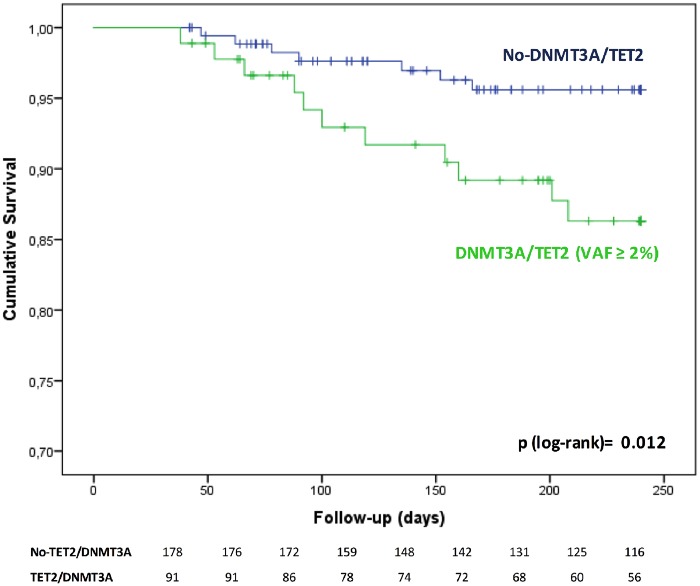
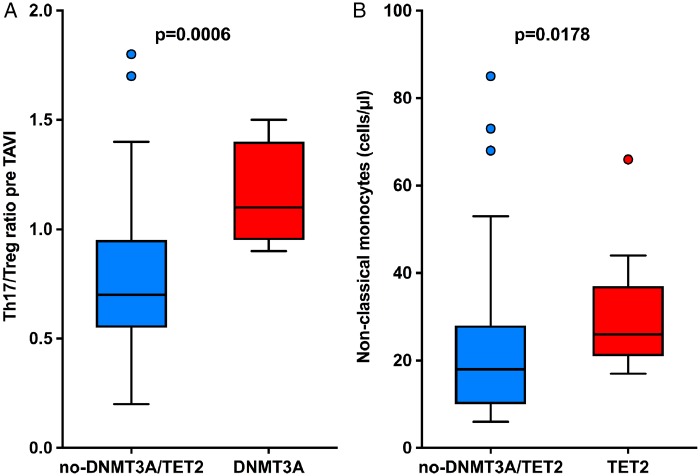
Aims: Clonal haematopoiesis of indeterminate potential (CHIP), defined as the presence of an expanded somatic blood cell clone without other haematological abnormalities, was recently shown to increase with age and is associated with coronary artery disease and calcification. The most commonly mutated CHIP genes, DNMT3A and TET2, were shown to regulate inflammatory potential of circulating leucocytes. The incidence of degenerative calcified aortic valve (AV) stenosis increases with age and correlates with chronic inflammation. We assessed the incidence of CHIP and its association with inflammatory blood cell phenotypes in patients with AV stenosis undergoing transfemoral aortic valve implantation (TAVI). Methods and results: Targeted amplicon sequencing for DNMT3A and TET2 was performed in 279 patients with severe AV stenosis undergoing TAVI. Somatic DNMT3A- or TET2-CHIP-driver mutations with a VAF ≥ 2% were detected in 93 out of 279 patients (33.3%), with an age-dependent increase in the incidence from 25% (55–69 years) to 52.9% (90–100 years). Patients with DNMT3A- or TET2-CHIP-driver mutations did not differ from patients without such mutations in clinical parameters, concomitant atherosclerotic disease, blood cell counts, inflammatory markers, or procedural characteristics. However, patients with DNMT3A- or TET2-CHIP-driver mutations had a profoundly increased medium-term all-cause mortality following successful TAVI. Differential myeloid and T-cell distributions revealed pro-inflammatory T-cell polarization in DNMT3A-mutation carriers and increased pro-inflammatory non-classical monocytes in TET2-mutation carriers. Conclusion: This is the first study to show that acquired somatic mutations in the most commonly mutated CHIP-driver genes occur frequently in patients with severe degenerative AV stenosis, are associated with increased pro-inflammatory leucocyte subsets, and confer a profound increase in mortality following successful TAVI.
Overview
The claims and statistics of this paper haven’t been checked yet.
Run the check — free, no account needed. It reads the open-access text and checks the sources it cites.
Integrity signals
Registry
Cites
Statistics
Figures
Verification
Claims the paper makes
The claims and statistics of this paper haven’t been checked yet.
Run the check — free, no account needed. It reads the open-access text and checks the sources it cites.
Claims other papers make about this one
Each is checked against this paper’s own text: does it say what the citing paper says it does?
In the citing paper
“Recently, clonal hematopoiesis resulting from inactivating mutations in DNMT3A or TET2 has been associated with future risk of cardiovascular disease and poor prognosis in patients with ischemic heart failure and in patients who have undergone treatment for aortic valve stenosis (14, 15).”
From Tet2-mediated clonal hematopoiesis in nonconditioned mice accelerates age-associated cardiac dysfunction (2020) · cites this paper as [14]
Self-check
Percentages, sums and reported differences re-computed from the paper’s own numbers.
The self-check needs the paper’s full text.
Citations
Cites
Age-related clonal hematopoiesis associated with adverse outcomes
Jaiswal, S., Fontanillas, P., Flannick, J., Manning, A., Grauman, P. V., Mar, B. G., Lindsley, R. C., Mermel, C. H., Burtt, N., Chavez, A., et al. (2014) · New England Journal of Medicine · doi:10.1056/nejmoa1408617 · Cited by 4,841
Clonal hematopoiesis and risk of atherosclerotic cardiovascular disease
Jaiswal, S., Natarajan, P., Silver, A. J., Gibson, C. J., Bick, A. G., Shvartz, E., McConkey, M., Gupta, N., Gabriel, S., Ardissino, D., et al. (2017) · New England Journal of Medicine · doi:10.1056/nejmoa1701719 · Cited by 2,683
Clonal hematopoiesis associated with TET2 deficiency accelerates atherosclerosis development in mice
Fuster, J. J., MacLauchlan, S., Zuriaga, M. A., Polackal, M. N., Ostriker, A. C., Chakraborty, R., Wu, C.-L., Sano, S., Muralidharan, S., Rius, C., et al. (2017) · Science · doi:10.1126/science.aag1381 · Cited by 1,536
Lindman, B. R., Clavel, M.-A., Mathieu, P., Iung, B., Lancellotti, P., Otto, C. M., & Pibarot, P. (2016) · Nature Reviews Disease Primers · doi:10.1038/nrdp.2016.6 · Cited by 982 · cited 1×
“The incidence of calcified degenerative aortic valve (AV) stenosis increases with age(6) and correlates with chronic inflammation.(7) Moreover, the outcome of transcatheter aortic valve implantation (TAVI) was previously shown to be unfavourably influenced by a systemic inflammatory response.”
BackgroundHematopoietic lineage distribution and evolutionary dynamics of clonal hematopoiesis
Arends, C. M., Galan-Sousa, J., Hoyer, K., Chan, W., Jäger, M., Yoshida, K., Seemann, R., Noerenberg, D., Waldhueter, N., Fleischer-Notter, H., et al. (2018) · Leukemia · doi:10.1038/s41375-018-0047-7 · Cited by 194
Research works printed but not linked: 12
- Steensma, 2015, Clonal hematopoiesis of indeterminate potential and its distinction from myelodysplastic syndromes, Blood, 126, 9, 10.1182/blood-2015-03-631747 · DOI · Paper page
- Sano, 2018, CRISPR-mediated gene editing to assess the roles of Tet2 and Dnmt3a in clonal hematopoiesis and cardiovascular disease, Circ Res, 123, 335, 10.1161/CIRCRESAHA.118.313225 · DOI · Paper page
- Nkomo, 2006, Burden of valvular heart diseases: a population-based study, Lancet (Lond, Engl), 368, 1005, 10.1016/S0140-6736(06)69208-8 · DOI · Paper page
- Sinning, 2012, Systemic inflammatory response syndrome predicts increased mortality in patients after transcatheter aortic valve implantation, Eur Heart J, 33, 1459, 10.1093/eurheartj/ehs002 · DOI
- Liebetrau, 2015, Release kinetics of inflammatory biomarkers in a clinical model of acute myocardial infarction, Circ Res, 116, 867, 10.1161/CIRCRESAHA.116.304653 · DOI
- Mahnke, 2013, OMIP-017: human CD4(+) helper T-cell subsets including follicular helper cells, Cytometry A, 83, 439, 10.1002/cyto.a.22269 · DOI
- Dorsheimer, 2019, Association of mutations contributing to clonal hematopoiesis with prognosis in chronic ischemic heart failure, JAMA Cardiol, 4, 25, 10.1001/jamacardio.2018.3965 · DOI · Paper page
- Sano, 2018, Tet2-mediated clonal hematopoiesis accelerates heart failure through a mechanism involving the IL-1β/NLRP3 inflammasome, J Am Coll Cardiol, 71, 875, 10.1016/j.jacc.2017.12.037 · DOI · Paper page
- Zhan, 2015, Activation of tlr3 induces osteogenic responses in human aortic valve interstitial cells through the NF-κB and ERK1/2 pathways, Int J Biol Sci, 11, 482, 10.7150/ijbs.10905 · DOI
- Mathieu, 2014, Basic mechanisms of calcific aortic valve disease, Can J Cardiol, 30, 982, 10.1016/j.cjca.2014.03.029 · DOI · Paper page
- Mukherjee, 2015, Non-classical monocytes display inflammatory features: validation in sepsis and systemic lupus erythematous, Sci Rep, 5, 13886., 10.1038/srep13886 · DOI
- Buscarlet, 2018, Lineage restriction analyses in CHIP indicate myeloid bias for TET2 and multipotent stem cell origin for DNMT3A, Blood, 132, 277, 10.1182/blood-2018-01-829937 · DOI · Paper page
Cited by
Wang, Y., Sano, S., Yura, Y., Ke, Z., Sano, M., Oshima, K., Ogawa, H., Horitani, K., Min, K.-D., Miura-Yura, E., et al. (2020) · JCI Insight · doi:10.1172/jci.insight.135204 · Cited by 167
Clonal hematopoiesis: Mutation-specific adaptation to environmental change
Florez, M. A., Tran, B. T., Wathan, T. K., DeGregori, J., Pietras, E. M., & King, K. Y. (2022) · Cell Stem Cell · doi:10.1016/j.stem.2022.05.006 · Cited by 129
Roadmap for alleviating the manifestations of ageing in the cardiovascular system
Liberale, L., Tual-Chalot, S., Sedej, S., Ministrini, S., Georgiopoulos, G., Grunewald, M., Bäck, M., Bochaton-Piallat, M.-L., Boon, R. A., Ramos, G. C., et al. (2025) · Nature Reviews Cardiology · doi:10.1038/s41569-025-01130-5 · Cited by 59
Self-citationCalcific aortic stenosis: omics-based target discovery and therapy development
Blaser, M. C., Bäck, M., Lüscher, T. F., & Aikawa, E. (2025) · European Heart Journal · doi:10.1093/eurheartj/ehae829 · Cited by 45
Yun, J., Youn, Y. C., & Kim, H. R. (2024) · Annals of Laboratory Medicine · doi:10.3343/alm.2024.0086 · Cited by 6
Metadata
- Authors
- Mas-Peiro, S., Hoffmann, J., Fichtlscherer, S., Dorsheimer, L., Rieger, M. A., Dimmeler, S., Vasa-Nicotera, M., & Zeiher, A. M.
- Affiliations
- Department of Medicine, Cardiology, Goethe University Hospital , Theodor-Stern-Kai 7, 60590 Frankfurt, Germany
- Department of Medicine, Haematology/Oncology, Goethe University Hospital , Frankfurt, Germany
- German Centre for Cardiovascular Research, Berlin, Partner Site Frankfurt Rhine-Main , Germany
- ORCID
- Mas-Peiro, Silvia
- Venue
- European Heart Journal
- Publisher
- Oxford University Press (OUP)
- Published
- 2019-09-03
- Volume
- 41
- Issue
- 8
- Pages
- 933-939
- ISSN
- 0195-668X
- 1522-9645
- PMC
- PMC7033916
- Cited by
- 228
- References
- 5
- Language
- en
- Funders
- German Research Foundation
- Excellence Cluster of Cardiopulmonary Systems
- German Centre for Cardiovascular Research
About these checks
Registry, retraction, Cites and statistics results are computed, not judged, with one exception: a printed reference that no index lists is read once by a model before it counts as a citation error. Claims are extracted by a model and kept only when their quote appears verbatim in the text; each cited source is then checked, with a model’s help, for whether it says what the claim relies on. Those verdicts can be wrong — read the claim’s quote and the cited source before relying on one.
Statistics and arithmetic are recomputed, not judged.
Confidence bands are shown only for fields calibrated on our annotated test set. None is calibrated yet, so no band is shown.
What counts as a claim ›How we measure confidence ›How we check this ›
Are you an author, or do you see a problem with this page? Request a review
