

Statin use and risk of dementia or Alzheimer's disease: a systematic review and meta-analysis of observational studies
Open accessThe DOI matches its Crossref record; 96 of the 97 references it cites were found in a registry or an index.
Abstract
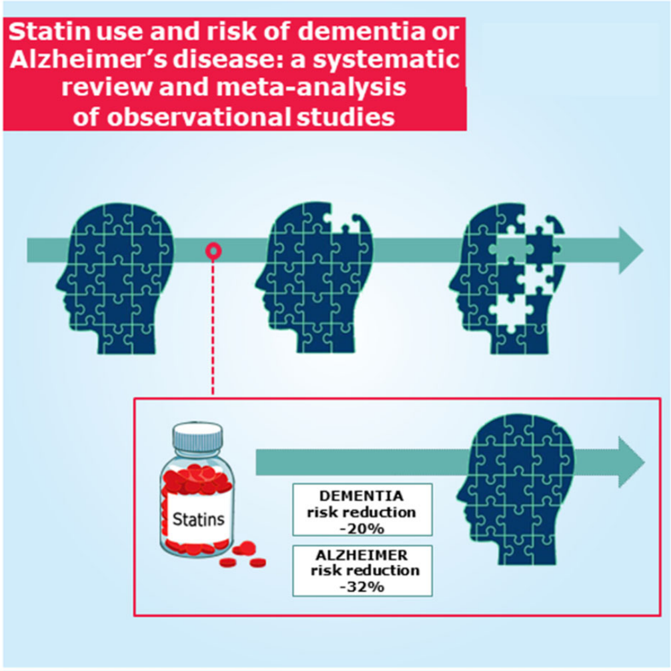
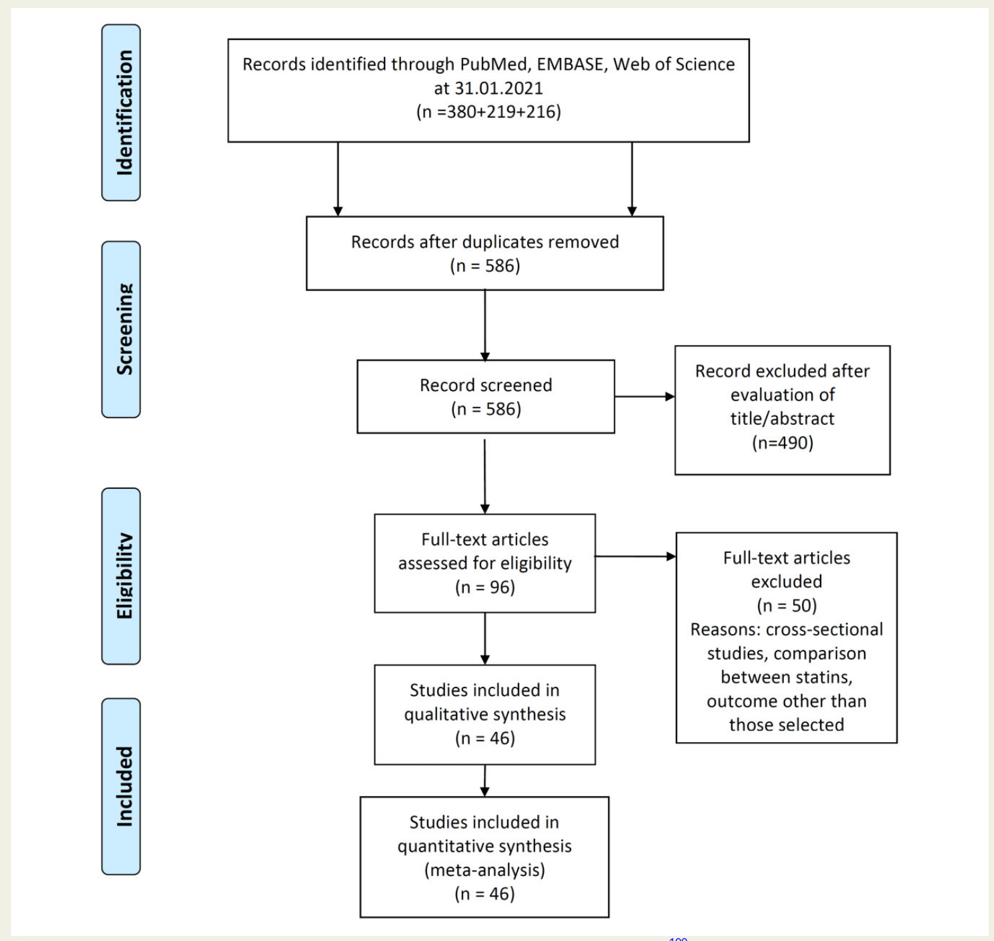
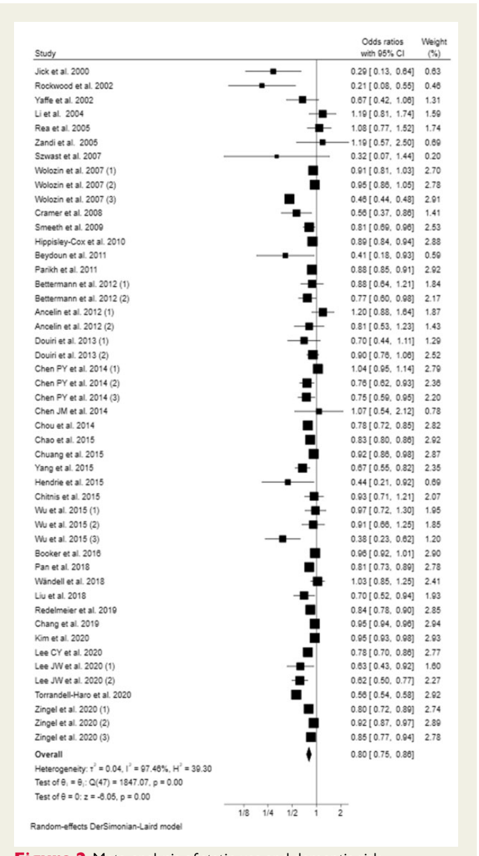
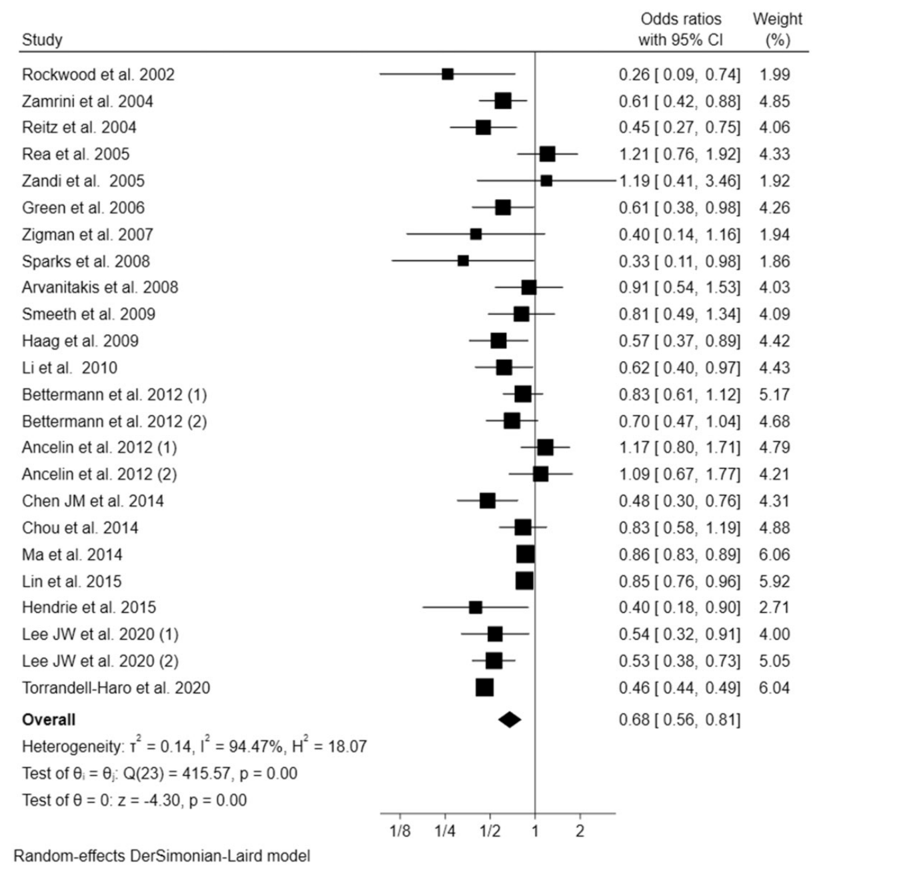
Aims: As the potential impact of statins on cognitive decline and dementia is still debated, we conducted a meta-analysis of observational studies to examine the effect of statin use on the risk of Alzheimer’s disease (AD) and dementia. Methods and results: PubMed, Cochrane, and EMBASE were searched since inception to January 2021. Inclusion criteria were: (i) cohort or case–control studies; (ii) statin users compared to non-users; and (iii) AD and/or dementia risk as outcome. Estimates from original studies were pooled using restricted maximum-likelihood random-effect model. Measure of effects were reported as odds ratio (OR) and 95% confidence intervals (CIs). In the pooled analyses, statins were associated with a decreased risk of dementia [36 studies, OR 0.80 (CI 0.75–0.86)] and of AD [21 studies, OR 0.68 (CI 0.56–0.81)]. In the stratified analysis by sex, no difference was observed in the risk reduction of dementia between men [OR 0.86 (CI 0.81–0.92)] and women [OR 0.86 (CI 0.81–0.92)]. Similar risks were observed for lipophilic and hydrophilic statins for both dementia and AD, while high-potency statins showed a 20% reduction of dementia risk compared with a 16% risk reduction associated with low-potency statins, suggesting a greater efficacy of the former, although a borderline statistical significance (P = 0.05) for the heterogeneity between estimates. Conclusion: These results confirm the absence of a neurocognitive risk associated with statin treatment and suggest a potential favourable role of statins. Randomized clinical trials with an ad hoc design are needed to explore this potential neuroprotective effect.
Overview
The claims and statistics of this paper haven’t been checked yet.
Free: it reads the open-access text and checks the first 5 claims that cite a source we can check. Create a free account to check every claim.
Integrity signals
Registry
Cites
Statistics
Figures
Verification
Claims the paper makes
The claims and statistics of this paper haven’t been checked yet.
Free: it reads the open-access text and checks the first 5 claims that cite a source we can check. Create a free account to check every claim.
Claims other papers make about this one
Each is checked against this paper’s own text: does it say what the citing paper says it does?
The source backs part of the claim, not all of it — or backs it for a different population, condition or comparison.
In the citing paper
“A meta-analysis of 36 cohort studies found statin use was associated with a reduced risk of all-cause dementia compared to untreated high cholesterol (OR 0.80, 0.750.86, I 2 =97.5) and AD (OR 0.68, 0.56-0.81 I 2 =94.5) with no difference between men and women. (162)”
From Dementia prevention, intervention, and care: 2024 report of the Lancet standing Commission (2024) · cites this paper as [162]
Experimental — accuracy not yet measuredThe source backs part of the claim, not all of it — or backs it for a different population, condition or comparison.
In the citing paper
“In addition, systematic reviews of randomized controlled trials and prospective cohort studies evaluating cognition in individuals receiving statins found that published data do not reveal an adverse effect of statins on cognition (171,172).”
From 10. Cardiovascular Disease and Risk Management: Standards of Care in Diabetes—2025 (2025) · cites this paper as [171]
Experimental — accuracy not yet measuredThe source backs part of the claim, not all of it — or backs it for a different population, condition or comparison.
In the citing paper
“In addition, systematic reviews of randomized controlled trials and prospective cohort studies evaluating cognition in individuals receiving statins found that published data do not reveal an adverse effect of statins on cognition (165,166).”
From 10. Cardiovascular Disease and Risk Management: Standards of Care in Diabetes—2026 (2026) · cites this paper as [165]
Experimental — accuracy not yet measured
Self-check
Percentages, sums and reported differences re-computed from the paper’s own numbers.
The self-check needs the paper’s full text.
Citations
Cites
Preferred Reporting Items for Systematic Reviews and Meta-Analyses: The PRISMA Statement
Moher, D., Liberati, A., Tetzlaff, J., Altman, D. G., & The PRISMA Group (2009) · PLoS Medicine · doi:10.1371/journal.pmed.1000097 · Cited by 64,042
Measuring inconsistency in meta-analyses
Higgins, J. P. T., Thompson, S. G., Deeks, J. J., & Altman, D. G. (2003) · BMJ · doi:10.1136/bmj.327.7414.557 · Cited by 63,139
Bias in meta-analysis detected by a simple, graphical test
Egger, M., Smith, G. D., Schneider, M., & Minder, C. (1997) · BMJ · doi:10.1136/bmj.315.7109.629 · Cited by 56,722
McKhann, G., Drachman, D., Folstein, M., Katzman, R., Price, D., & Stadlan, E. M. (1984) · Neurology · doi:10.1212/wnl.34.7.939 · Cited by 27,915
PRISMA-P Group, Moher, D., Shamseer, L., Clarke, M., Ghersi, D., Liberati, A., Petticrew, M., Shekelle, P., & Stewart, L. A. (2015) · Systematic Reviews · doi:10.1186/2046-4053-4-1 · Cited by 26,223
Meta-analysis of Observational Studies in Epidemiology<SUBTITLE>A Proposal for Reporting</SUBTITLE>
Stroup, D. F. (2000) · JAMA · doi:10.1001/jama.283.15.2008 · Cited by 20,623
Mach, F., Baigent, C., Catapano, A. L., Koskinas, K. C., Casula, M., Badimon, L., Chapman, M. J., De Backer, G. G., Delgado, V., Ference, B. A., et al. (2020) · European Heart Journal · doi:10.1093/eurheartj/ehz455 · Cited by 8,961
Self-citationGrundy, S. M., Stone, N. J., Bailey, A. L., Beam, C., Birtcher, K. K., Blumenthal, R. S., Braun, L. T., de Ferranti, S., Faiella-Tommasino, J., Forman, D. E., et al. (2019) · Circulation · doi:10.1161/cir.0000000000000625 · Cited by 6,185
Shepherd, J., Blauw, G. J., Murphy, M. B., Bollen, E. L., Buckley, B. M., Cobbe, S. M., Ford, I., Gaw, A., Hyland, M., Jukema, J. W., et al. (2002) · The Lancet · doi:10.1016/s0140-6736(02)11600-x · Cited by 3,378
Research works printed but not linked: 2
- 25. Zhou B, Teramukai S, Fukushima M. Prevention and treatment of dementia or Alzheimer's disease by statins: a meta-analysis. Dement Geriatr Cogn Disord 2007; 23:194-201. · DOI · Paper page
- 29. World Health Organization. The ICD-10 Classification of Mental and Behavioural Disorders: clinical Descriptions and Diagnostic Guidelines. Geneva: World Health Organization; 1992. xii, 362 p.
Cited by
Dementia prevention, intervention, and care: 2024 report of the Lancet standing Commission
Livingston, G., Huntley, J., Liu, K. Y., Costafreda, S. G., Selbæk, G., Alladi, S., Ames, D., Banerjee, S., Burns, A., Brayne, C., et al. (2024) · The Lancet · doi:10.1016/s0140-6736(24)01296-0 · Cited by 3,860
10. Cardiovascular Disease and Risk Management: Standards of Care in Diabetes—2025
American Diabetes Association Professional Practice Committee, ElSayed, N. A., McCoy, R. G., Aleppo, G., Balapattabi, K., Beverly, E. A., Briggs Early, K., Bruemmer, D., Das, S. R., Echouffo-Tcheugui, J. B., et al. (2025) · Diabetes Care · doi:10.2337/dc25-s010 · Cited by 486
Ruscica, M., Ferri, N., Banach, M., Sirtori, C. R., & Corsini, A. (2023) · Cardiovascular Research · doi:10.1093/cvr/cvac020 · Cited by 243
Cognitive Impairment in Patients With Cardiac Disease: Implications for Clinical Practice
Nieuwkerk, A. C. V., Delewi, R., Wolters, F. J., Muller, M., Daemen, M. J. A. P., & Biessels, G. J. (2023) · Stroke · doi:10.1161/strokeaha.123.040499 · Cited by 188
10. Cardiovascular Disease and Risk Management: Standards of Care in Diabetes—2026
American Diabetes Association Professional Practice Committee for Diabetes*, Bajaj, M., McCoy, R. G., Balapattabi, K., Bannuru, R. R., Bellini, N. J., Bennett, A. K., Beverly, E. A., Briggs Early, K., ChallaSivaKanaka, S., et al. (2026) · Diabetes Care · doi:10.2337/dc26-s010 · Cited by 225
Vascular cognitive impairment and dementia: Mechanisms, treatment, and future directions
Mok, V., Cai, Y., & Markus, H. S. (2024) · International Journal of Stroke · doi:10.1177/17474930241279888 · Cited by 135
“108 A recent observational study among patients with heart failure showed that the use of statins was associated with a lower risk of all-cause dementia and its sub-types (AD, vascular dementia, and unspecified dementia).”
BackgroundGoldstein, L. B., Toth, P. P., Dearborn-Tomazos, J. L., Giugliano, R. P., Hirsh, B. J., Peña, J. M., Selim, M. H., Woo, D., & on behalf of the American Heart Association Council on Arteriosclerosis, T. A. V. B. C. O. C. A. S. N. C. O. P. V. D. A. S. C. (2023) · Arteriosclerosis, Thrombosis, and Vascular Biology · doi:10.1161/atv.0000000000000164 · Cited by 92
Alzheimer’s disease and its treatment–yesterday, today, and tomorrow
Kim, A. Y., Jerdi, S. A., MacDonald, R., & Triggle, C. R. (2024) · Frontiers in Pharmacology · doi:10.3389/fphar.2024.1399121 · Cited by 118
Statins Use in Alzheimer Disease: Bane or Boon from Frantic Search and Narrative Review
Alsubaie, N., Al-Kuraishy, H. M., Al-Gareeb, A. I., Alharbi, B., WAARD, M. M. D., Sabatier, J., Saad, H. M., & Batiha, G. E. (2022) · Brain Sciences · doi:10.3390/brainsci12101290 · Cited by 89
“[94] A systematic review and meta-analysis Statins therapy has no harmful effects on the neurocognitive function in AD patients.”
BackgroundHigh-throughput target trial emulation for Alzheimer’s disease drug repurposing with real-world data
Zang, C., Zhang, H., Xu, J., Zhang, H., Fouladvand, S., Havaldar, S., Cheng, F., Chen, K., Chen, Y., Glicksberg, B. S., et al. (2023) · Nature Communications · doi:10.1038/s41467-023-43929-1 · Cited by 69
“Atorvastatin is used to treat high cholesterol and triglyceride levels and shows potentially bene fi cial but not signi fi cant effects on AD 32,33 .”
Sahebkar, A., Foroutan, Z., Katsiki, N., Jamialahmadi, T., & Mantzoros, C. S. (2023) · Metabolism · doi:10.1016/j.metabol.2023.155659 · Cited by 79
Petek, B., Häbel, H., Xu, H., Villa-Lopez, M., Kalar, I., Hoang, M. T., Maioli, S., Pereira, J. B., Mostafaei, S., Winblad, B., et al. (2023) · Alzheimer's Research & Therapy · doi:10.1186/s13195-023-01360-0 · Cited by 65
“Most work has been done on evaluating these factors in the prevention of dementia or AD [32, 33, 57].”
BackgroundResultStatin use and dementia risk: A systematic review and updated meta‐analysis
Westphal Filho, F. L., Moss Lopes, P. R., Menegaz de Almeida, A., Sano, V. K. T., Tamashiro, F. M., Gonçalves, O. R., de Moraes, F. C. A., Kreuz, M., Kelly, F. A., & Silveira Feitoza, P. V. (2025) · Alzheimer's & Dementia: Translational Research & Clinical Interventions · doi:10.1002/trc2.70039 · Cited by 62
Couteur, D. G. L., Hilmer, S. N., Glasgow, N., Naganathan, V., & Cumming, R. G. (2025) · Wiley eBooks · doi:10.1002/9781119870203.mpg006.pub2 · Cited by 59
Drug-Induced Cognitive Impairment
Reimers, A., Odin, P., & Ljung, H. (2024) · Drug Safety · doi:10.1007/s40264-024-01506-5 · Cited by 69
“However, many reviews, meta-analyses and position papers did not find detrimental effects and conclude that the beneficial vascular effects of statins outweigh potential cognitive risks [41, 232, 242–246].”
Unlocking Alzheimer’s Disease: The Role of BDNF Signaling in Neuropathology and Treatment
Alqahtani, S. M., Al-Kuraishy, H. M., Al-Gareeb, A. I., Albuhadily, A. K., Alexiou, A. T., Papadakis, M., Hemeda, L. R., Faheem, S. A., & Batiha, G. E. (2025) · NeuroMolecular Medicine · doi:10.1007/s12017-025-08857-x · Cited by 59
“A meta-analysis and comprehensive review found no evidence linking statins to cognitive impairment, as well, statins have favorable effects against AD neuropathology (Olmastroni et al., 2022).”
The Mammalian Cysteine Protease Legumain in Health and Disease
Solberg, R., Lunde, N. N., Forbord, K. M., Okla, M., Kassem, M. S., & Jafari, A. (2022) · International Journal of Molecular Sciences · doi:10.3390/ijms232415983 · Cited by 59
Gunta, S. P., O’Keefe, J. H., O’Keefe, E. L., & Lavie, C. J. (2023) · Progress in Cardiovascular Diseases · doi:10.1016/j.pcad.2023.02.007 · Cited by 45
Tong, X., Royea, J., & Hamel, É. (2022) · Cell Death and Disease · doi:10.1038/s41419-022-04784-y · Cited by 43
Zheng, B., Su, B., Ahmadi‐Abhari, S., Kapogiannis, D., Tzoulaki, I., Riboli, E., & Middleton, L. (2023) · Alzheimer's & Dementia · doi:10.1002/alz.13349 · Cited by 34
“We also conducted subgroup analyses by sex and age at baseline”
Rajan, K. B., Mcaninch, E. A., Wilson, R. S., Dhana, A., Evans-Lacko, S., & Evans, D. A. (2024) · Neurology · doi:10.1212/wnl.0000000000209168 · Cited by 34
Acute Myocardial Infarction and Risk of Cognitive Impairment and Dementia: A Review
Thong, E. H., Quek, J. W. E., Loo, J. H., Yun, C.-Y., Teo, Y. N., Teo, Y. H., Leow, A. S., Li, T. Y., Sharma, V. K., Tan, B. Y., et al. (2023) · Biology · doi:10.3390/biology12081154 · Cited by 40
“In addition, statin usage was not associated with any neurocognitive risk, including in that of older adults [231].”
BackgroundResultInfluentialFalsetti, L., Viticchi, G., Zaccone, V., Guerrieri, E., Moroncini, G., Luzzi, S., & Silvestrini, M. (2022) · Biomedicines · doi:10.3390/biomedicines10020439 · Cited by 34
Current and Future Treatments of Vascular Cognitive Impairment
Ip, B. Y. M., Ko, H., Lam, B. Y. K., Au, L. W. C., Lau, A. Y. L., Huang, J., Kwok, A. J., Leng, X., Cai, Y., Leung, T. W. H., et al. (2024) · Stroke · doi:10.1161/strokeaha.123.044174 · Cited by 32
“75,109,110 To date, among the few RCTs conducted on the effects of statins on dementia prevention, only 1 study yielded positive results.”
BackgroundCausal cardiovascular risk factors for dementia: insights from observational and genetic studies
Kjeldsen, E. W., & Frikke‐Schmidt, R. (2024) · Cardiovascular Research · doi:10.1093/cvr/cvae235 · Cited by 39
Cognitive decline and dementia in women after menopause: Prevention strategies
Stefanowski, B., Kucharski, M., Szeliga, A., Snopek, M., Kostrzak, A., Smolarczyk, R., Maciejewska-Jeske, M., Duszewska, A. M., Niwczyk, O., Drozd, S., et al. (2022) · Maturitas · doi:10.1016/j.maturitas.2022.10.012 · Cited by 32
Long-Term Cognitive Safety of Achieving Very Low LDL Cholesterol with Evolocumab
Zimerman, A., O’Donoghue, M. L., Ran, X., Im, K., Ott, B. R., Mach, F., Zavitz, K. H., Kurtz, C. E., Monsalvo, M. L., Wang, B., et al. (2024) · NEJM Evidence · doi:10.1056/evidoa2400112 · Cited by 31
Kalkman, H. O., & Smigielski, L. (2025) · Molecular Neurobiology · doi:10.1007/s12035-025-04989-0 · Cited by 30
The effects of cholesterol and statins on Parkinson’s neuropathology: a narrative review
Al-Kuraishy, H. M., Fahad, E. H., Al‐Windy, S., El-Sherbeni, S. A., Negm, W. A., & Batiha, G. E. (2024) · Inflammopharmacology · doi:10.1007/s10787-023-01400-z · Cited by 27
Statin Use and Incidence of Parkinson's Disease in Women from the French E3N Cohort Study
Nguyen, T. T. H., Fournier, A., Courtois, É., Artaud, F., Escolano, S., Tubert‐Bitter, P., Boutron‐Ruault, M., Degaey, I., Roze, E. F., Canonico, M., et al. (2023) · Movement Disorders · doi:10.1002/mds.29349 · Cited by 26
Pathology of Amyloid-β (Aβ) Peptide Peripheral Clearance in Alzheimer’s Disease
Tsoy, A., Umbayev, B. A., Kassenova, A., Kaupbayeva, B., & Askarova, S. (2024) · International Journal of Molecular Sciences · doi:10.3390/ijms252010964 · Cited by 27
“A recent systematic review and meta-analysis on the relationship between statin use and the risk of dementia or Alzheimer’s disease showed that statin reduces the risk of developing dementia [156].”
BackgroundPrimary prevention statin therapy in older adults
Nanna, M. G., Abdullah, A., Mortensen, M. B., & Návar, A. M. (2022) · Current Opinion in Cardiology · doi:10.1097/hco.0000000000001003 · Cited by 29
Niotis, K., Saperia, C., Saif, N., Carlton, C., & Isaacson, R. (2024) · Nature Mental Health · doi:10.1038/s44220-023-00191-0 · Cited by 21
Cardiovascular-kidney-metabolic syndrome and incidence of dementia among older adults
Jiang, X., Bahorik, A. L., Dintica, C. S., & Yaffe, K. S. (2025) · The Journal of Prevention of Alzheimer s Disease · doi:10.1016/j.tjpad.2025.100112 · Cited by 23
Do Statins Affect Cognitive Health? A Narrative Review and Critical Analysis of the Evidence
Kazibwe, R., Rikhi, R. R., Mirzai, S., Ashburn, N. P., Schaich, C. L., & Shapiro, M. D. (2024) · Current Atherosclerosis Reports · doi:10.1007/s11883-024-01255-x · Cited by 22
“Moreover, high-potency statins were linked to a 20% reduction in AD risk, compared to a 16% reduction with low-potency statins [51].”
InfluentialClinical guidelines «Cognitive disorders in the elderly and senile persons»
Tkacheva, O. N., Yahno, N. N., Незнанов, Н. Г., Шпорт, С. В., Shamalov, N. A., Levin, O. S., Kostyuk, G. P., Gusev, E. I., Martynov, M. Y., Si, G., et al. (2025) · S S Korsakov Journal of Neurology and Psychiatry · doi:10.17116/jnevro2025125337 · Cited by 23
Švec, A., & Adameová, A. (2022) · Molecular and Cellular Biochemistry · doi:10.1007/s11010-022-04621-y · Cited by 23
“A very recent meta-analysis has indicated the absence of statins-induced neurocognitive risk and highlighted that treatment with statins shall be considered and not discontinued in elderly patients for primary and secondary prevention of cardiovascular disease [25].”
BackgroundHassen, C. B., Machado‐Fragua, M. D., Landré, B., Fayossé, A., Dumurgier, J., Kivimäki, M., Sabia, S., & Singh‐Manoux, A. (2023) · Alzheimer s & Dementia · doi:10.1002/alz.13140 · Cited by 21
“28 Use of statins was associated with a decreased risk ofdementiainobservationalstudies, 29,30 althoughasystematicreview found no clear association with cognitive function in observational studies or in clinical trials; 31 the follow-up was less than 6 years in the trials and 3 to 15 years in…”
BackgroundLipids, lipoproteins, and apolipoproteins: Associations with cognition and dementia
Rasmussen, I. J., Luo, J. M., & Frikke‐Schmidt, R. (2024) · Atherosclerosis · doi:10.1016/j.atherosclerosis.2024.118614 · Cited by 23
Yin, M., Ding, S., Zhao, M., Liu, J., Su, W., Fu, M., Wu, M., Ma, C., Sun, X., & Kong, Y. (2025) · Journal of Alzheimer s Disease · doi:10.1177/13872877251360221 · Cited by 24
Peng, T., Lin, H.-H., Lee, M., & Chen, S. (2024) · General Hospital Psychiatry · doi:10.1016/j.genhosppsych.2024.05.001 · Cited by 17
Bioenergetics and lipid metabolism in Alzheimer's disease: From cell biology to systemic health
Maioli, S., Nalvarte, I., Ankarcrona, M., Schultzberg, M., Zuloaga, K. L., Goikolea, J., Visser, P. J., Strooper, B. D., Winblad, B., Pizzo, P., et al. (2025) · Journal of Internal Medicine · doi:10.1111/joim.70036 · Cited by 21
“These include statins to reduce hyperlipidaemia [195], GLP-1 agonists for obesity and T2D [196] and insulin sen-sitizers such as metformin [197] (Table 1).”
The Cross-Talk Between the Peripheral and Brain Cholesterol Metabolisms
Săvulescu-Fiedler, I., Dorobantu-Lungu, L.-R., Dragosloveanu, Ş., Benea, S. N., Dragosloveanu, C. D. M., Căruntu, A., Scheau, A.-E., Căruntu, C., & Scheau, C. (2025) · Current Issues in Molecular Biology · doi:10.3390/cimb47020115 · Cited by 25
Does statin use affect amyloid beta deposition and brain metabolism?
Nabizadeh, F., Valizadeh, P., Balabandian, M., & Initiative, A. D. N. (2023) · CNS Neuroscience & Therapeutics · doi:10.1111/cns.14117 · Cited by 16
Liu, L., Liang, J., Liu, Y.-H., Liu, B., Dong, X., Cai, W.-H., & Zhang, N. (2024) · Heliyon · doi:10.1016/j.heliyon.2024.e30523 · Cited by 17
RetractedSánchez-Melgar, A., Izquierdo-Ramírez, P. J., Griñán‐Ferré, C., Pallàs, M., Martín, M., & Albasanz, J. L. (2022) · International Journal of Molecular Sciences · doi:10.3390/ijms23147580 · Cited by 17
Weekman, E. M., Johnson, S. N., Rogers, C. B., Sudduth, T. L., Xie, K., Qiao, Q., Fardo, D. W., Bottiglieri, T., & Wilcock, D. M. (2023) · Journal of Neuroinflammation · doi:10.1186/s12974-023-02883-x · Cited by 18
“Epidemiologic data suggests that statins could reduce the risk of AD and dementia [1–3].”
BackgroundZhou, J., Liu, W., Zhou, H., Lau, K. K., Wong, G. H. Y., Chan, W. C., Zhang, Q., Knapp, M. R. J., Wong, I. C. K., & Luo, H. (2024) · The Lancet Regional Health - Western Pacific · doi:10.1016/j.lanwpc.2024.101060 · Cited by 15
“50 Nutrition de fi ciency contributed to an increased probability of dementia.”
BackgroundPappolla, M. A., Refolo, L. M., Sambamurti, K., Zambón, D., & Duff, K. (2024) · Journal of Alzheimer s Disease · doi:10.3233/jad-240388 · Cited by 18
“In another meta-analysis, Elena Olmastroni (2022) and her colleagues, also motivated by the FDA’s adversestanceonstatins,soughttoclarifythedebated impactofthesedrugsoncognitivedecline[81].”
Chen, J., Wang, L., Zhou, Y., Zhao, S., Chen, Q., & Zheng, K. (2026) · The Journal of Prevention of Alzheimer s Disease · doi:10.1016/j.tjpad.2026.100478 · Cited by 15
“However, clinical results remain inconsistent, potentially due to differential BBB permeability of statins and heterogeneous cognitive outcome measures [112].”
Towards a Unitary Hypothesis of Alzheimer’s Disease Pathogenesis
Área-Gómez, E., & Schon, E. A. (2024) · Journal of Alzheimer s Disease · doi:10.3233/jad-231318 · Cited by 20
Cholesterol Lowering in Older Adults: Should We Wait for Further Evidence?
Jamil, Y., Cohen, R., Alameddine, D., Deo, S. V., Kumar, M., & Orkaby, A. R. (2024) · Current Atherosclerosis Reports · doi:10.1007/s11883-024-01224-4 · Cited by 19
“A systematic review and meta-analysis of 57 observational studies of statins reported a decreased risk of any dementia [OR 0.80 (CI 0.75–0.86)] and Alzheimer’s dementia [OR 0.68 (CI 0.56–0.81)] with high potency statins associated with higher risk reduction vs low potency statins [81].”
InfluentialFang, B., Wang, Z., & Nan, G. (2024) · The journal of nutrition health & aging · doi:10.1016/j.jnha.2024.100428 · Cited by 15
Du, Y., Yu, Z., Li, C., Zhang, Y., & Xu, B. (2025) · Frontiers in Pharmacology · doi:10.3389/fphar.2025.1473796 · Cited by 13
Heart failure and late-onset Alzheimer’s disease: A Mendelian randomization study
Arega, Y., & Shao, Y. (2022) · Frontiers in Genetics · doi:10.3389/fgene.2022.1015674 · Cited by 13
“In general, heart failure is commonly treated with HF-related medications and many of them have been reported to have protective effects on cognitive decline and AD (Barthold et al., 2020; Poly et al., 2020; Nguyen et al., 2022; Olmastroni et al., 2022).”
BackgroundResultVolonté, C., Hu, G., Shaw, C. A., Claudio, V. J., dos Santos, J. A., Vaz, S. H., Sebastião, A. M., Balcar, V. J., Mozley, P. D., Verde, F., et al. (2026) · Exploration of Neuroprotective Therapy · doi:10.37349/ent.2026.1004136 · Cited by 14
Chang, H.-T., Chan, P., & Chiu, P. (2024) · BMC Geriatrics · doi:10.1186/s12877-024-05030-0 · Cited by 12
“Thus, the optimal level of cholesterol on cognitive function could be a result of proper pharmacological control of CVD risks [53, 54].”
BackgroundXu, J., Wang, F., Zang, C., Zhang, H., Niotis, K., Liberman, A. L., Stonnington, C. M., Ishii, M., Adekkanattu, P. M., Luo, Y., et al. (2023) · Scientific Reports · doi:10.1038/s41598-023-35258-6 · Cited by 11
García-Zamora, M., García‐Lluch, G., Moreno, L., Pardo, J., & Cháfer‐Pericás, C. (2024) · Pharmacological Research · doi:10.1016/j.phrs.2024.107446 · Cited by 11
A multifactorial lens on risk factors promoting the progression of Alzheimer’s disease
Parker, J., Moris, J. M., Goodman, L. C., Paidisetty, V. K., Vanegas, V., Turner, H. A., Melgar, D., & Koh, Y. (2024) · Brain Research · doi:10.1016/j.brainres.2024.149262 · Cited by 12
Cordoș, B. A., Tero-Vescan, A., HAMPSON, I. N., Oliver, A. W., & SLEVIN, M. A. (2025) · Pharmaceuticals · doi:10.3390/ph18060829 · Cited by 12
Liu, T., Rong, Z., Li, J., Wu, H., & Wei, J. (2025) · Genes & Diseases · doi:10.1016/j.gendis.2025.101846 · Cited by 14
“207 Clinically, epidemiological studies have associated statin use with a reduced AD incidence, but randomized controlled trials (e.g., HPS, PROSPER) have shown no cognitive benefits in elderly populations.”
Ha, J., Kwon, G. E., Son, Y., Jang, S. A., Cho, S. Y., Park, S. J., Kim, H. J., Lee, J., Lee, J., Seo, D., et al. (2024) · Psychiatry and Clinical Neurosciences · doi:10.1111/pcn.13706 · Cited by 9
“62 However, these con fl icting results may suggest that measurement of 7 β -OHC levels is a potential avenue for personalized medicine for AD, as levels of 7 β -OHC can be used to identify those who are eligible for statin therapy to inhibit AD pathology.”
Medications and cognitive decline in Alzheimer's disease: Cohort cluster analysis of 15,428 patients
Jurado, P. G., Mostafaei, S., Xu, H., Mo, M., Petek, B., Kalar, I., Naia, L., Kele, J., Maioli, S., Pereira, J. B., et al. (2025) · Journal of Alzheimer s Disease · doi:10.1177/13872877241307870 · Cited by 9
Medication Exposure and Risk of Dementia and Alzheimer’s Disease
Sharma, N., An, S. S. A., & Kim, S. (2024) · International Journal of Molecular Sciences · doi:10.3390/ijms252312850 · Cited by 11
Reddin, C., Stankard, A., Chan, K. Y., Krewer, F., Judge, C., Canavan, M., Davis, D. H. J., & O’Donnell, M. (2025) · Age and Ageing · doi:10.1093/ageing/afaf219 · Cited by 8
“…between elevated levels of LDL cholesterol and dementia risk, laboratory findings that cerebral AB generation is cholesterol dependent and identification of apolipoprotein E ∈ 4 allele which is involved in cholesterol metabolism as a genetic risk factor for Alzheimer’s disease [36, 4, 37].”
Han, S., Byun, M. S., Yi, D., Jung, J., Kong, N., Chang, Y. Y., Keum, M., Jung, G. J., Lee, J.-Y., Lee, Y. S., et al. (2024) · The Journal of Prevention of Alzheimer s Disease · doi:10.14283/jpad.2024.131 · Cited by 8
Adverse Lipid Profiles Are Associated with Lower Dementia Risk in Older People
Schroevers, J. L., Richard, E., Hoevenaar‐Blom, M. P., van den Born, B. H., van Gool, W. A., van Charante, E. P. M., & van Dalen, J. W. (2024) · Journal of the American Medical Directors Association · doi:10.1016/j.jamda.2024.105132 · Cited by 10
Ding, M., Wennberg, A. M. V., Engström, G., & Modig, K. (2024) · Alzheimer s & Dementia · doi:10.1002/alz.14389 · Cited by 8
Systemic medications and dementia risk: a systematic umbrella review
Belessiotis‐Richards, C., Hayes, J., Yap, Y. F., Talwar, S., Eskinazi, M., Li, W., Ward, H., Letrondo, P. A., Morelli‐Batters, M., Bruun, A., et al. (2025) · Molecular Psychiatry · doi:10.1038/s41380-025-03129-3 · Cited by 11
Saeed, A., Chang, Y.-F., Swanson, J., Vu, M., Mapstone, M. E., Villemagne, V. L., Snitz, B. E., Royse, S. K., Wang, H.-T., Lopresti, B. J., et al. (2025) · Journal of Alzheimer s Disease Reports · doi:10.1177/25424823241299297 · Cited by 11
“60,61 However, a comprehensive impact of primordial and primary prevention of ASCVD risk factors on WMHs, neurodegeneration, AD pathology and overall, cognitive decline remains to be tested in randomized and controlled studies.”
Zang, C., Zhang, H., Xu, J., Zhang, H., Fouladvand, S., Havaldar, S., Cheng, F., Chen, K., Chen, Y., Glicksberg, B. S., et al. (2022) · medRxiv · doi:10.1101/2022.01.31.22270132 · Cited by 7
Ma, Y., Wu, Y., Jin, L., Hu, L., Chen, W., Young, C. A., Zhang, X., Zheng, D., Liu, Z., & Jin, G. (2024) · Investigative Ophthalmology & Visual Science · doi:10.1167/iovs.65.11.12 · Cited by 6
Pleiotropic Effects of PCSK9 Inhibitors on Cardio-Cerebrovascular Diseases
Li, Z., Zhu, L., Xu, Y., Zhang, Y., Liu, Y., Sun, H., Li, S., Wang, M., Jiang, T., Zhou, J., et al. (2024) · Biomedicines · doi:10.3390/biomedicines12122729 · Cited by 8
“The use of PCSK9 inhibitors, similar to statins [70] in cognitive function, did not demonstrate an increased risk of cognitive impairment [11].”
Zimmerman, S. C., Choi, M., Jiang, C., Ferguson, E. L., Hoffmann, T. J., Swinnerton, K. N., Oni‐Orisan, A., Gilsanz, P., Meyers, T. J., Choudhary, V., et al. (2025) · Neurology · doi:10.1212/wnl.0000000000213855 · Cited by 10
Zimmer, A. R., Bourourou, M., Lesage, F., & Hamel, É. (2025) · Alzheimer s & Dementia · doi:10.1002/alz.70402 · Cited by 8
Banach, M., Toth, P. P., Ahn, H., Bielecka-Dabrowa, A. M., Cicero, A. F. G., Covic, A. C., Dalakoti, M., Escobar, C., Fogacci, F., Gaiță, D. I., et al. (2025) · Progress in Cardiovascular Diseases · doi:10.1016/j.pcad.2025.11.003 · Cited by 14
Alameen, A. A. M., Al‐kuraishy, H. M., Al-Gareeb, A. I., Shokr, M. M., & Batiha, G. E. (2026) · Microvascular Research · doi:10.1016/j.mvr.2026.104947 · Cited by 7
Azmi, N. H., Ismail, N., Imam, M. U., Ooi, D. J., Zhang, Y., Aziz, A. H. A., & Rosdi, M. N. M. (2023) · Journal of Functional Foods · doi:10.1016/j.jff.2023.105587 · Cited by 6
Aizawa, F., Kajimoto, H., Okabayashi, A., Moriyama, D., Yagi, K., Takahashi, S., Sonoda, Y., Shibata, T., Goda, M., Niimura, T., et al. (2024) · Neurochemistry International · doi:10.1016/j.neuint.2024.105863 · Cited by 6
Treating Hypercholesterolemia in Older Adults for Primary Prevention of Cardiovascular Events
Al-Ani, A., Jamil, Y., & Orkaby, A. R. (2024) · Drugs & Aging · doi:10.1007/s40266-024-01139-4 · Cited by 7
“The results confirmed the absence of dementia risk and potentially lower risk of dementia [odds ratio (OR) 0.80, CI 0.75–0.86] [72].”
Influentialaf Geijerstam, P., Chalmers, J. P., Pikkemaat, M., Peters, R., Marre, M., Mancia, G., Woodward, M., & Harris, K. (2025) · Cardiovascular Diabetology · doi:10.1186/s12933-025-02894-3 · Cited by 6
“In a recent meta-analysis of 46 observational studies, statin use was associated with lower incident dementia equally in both women and men [37].”
Healthy dietary patterns, cognition and dementia risk: current evidence and context
Shannon, O. M., Mathers, J. C., Stevenson, E., & Siervo, M. (2025) · Proceedings of The Nutrition Society · doi:10.1017/s0029665125100050 · Cited by 6
Sex Differences in the Preventive Effect of Cardiovascular and Metabolic Therapeutics on Dementia
Choi, S. A., Jee, H. J., Bormate, K. J., Kim, Y., & Jung, Y.-S. (2023) · Biomolecules & Therapeutics · doi:10.4062/biomolther.2023.115 · Cited by 6
Does a pickle a day keep Alzheimer's away? Fermented food in Alzheimer's disease: A review
Tyliszczak, M., Wiatrak, B., Danielewski, M., Szeląg, A., Kucharska, A. Z., & Sozański, T. (2023) · Experimental Gerontology · doi:10.1016/j.exger.2023.112332 · Cited by 8
“M . purpureus is known to produce monacolin K, a substance with the same chemical structure as the lipid-lowering drug - lovastatin, which in addition to its use in cardiovascular disease treatment, has shown neuroprotective effects in dementia (Olmastroni et al., 2022).”
BackgroundStatin therapy reduces dementia risk in atrial fibrillation patients receiving oral anticoagulants
Kim, M. H., Yuan, S. L., Lee, K. M., Jin, X. S., Song, Z. Y., Park, J. S., Cho, Y., Lim, K., Yun, S., Lee, M. S., et al. (2023) · European Heart Journal - Cardiovascular Pharmacotherapy · doi:10.1093/ehjcvp/pvad039 · Cited by 7
Solanki, A., Kamrava, M. R., Posadas, E. M., Freedland, S. J., Ballas, L., Sandler, H. M., Merz, C. N. B., Atkins, K. M., & Nikolova, A. (2024) · Cancer · doi:10.1002/cncr.35285 · Cited by 8
Tian, Y. M., Zhang, W. S., Jiang, C. Q., Zhu, F., Jin, Y. L., Yeung, S. L. A., Wang, J., Cheng, K. K., Lam, T. H., & Xu, L. (2025) · European Archives of Psychiatry and Clinical Neuroscience · doi:10.1007/s00406-025-01974-5 · Cited by 5
Melendez, J. C., Venegas‐Sanabria, L. C., & de la Fuente, C. P. (2026) · International Journal of Geriatric Psychiatry · doi:10.1002/gps.70190 · Cited by 6
“Indeed, studies have shown that antihyper-tensives [36], statins [37], and glucose‐lowering agents [38] may offer neuroprotective effects, especially when adherence is high and treatment begins early.”
Lipid trajectories improve risk models for Alzheimer’s disease and mild cognitive impairment
Chase, B. A., Frigerio, R., Yucus, C. J., Patel, S. V., Maraganore, D. M., Sanders, A. R., Duan, J., & Markopoulou, K. (2024) · Journal of Lipid Research · doi:10.1016/j.jlr.2024.100714 · Cited by 5
Ferguson, E. L., Zimmerman, S. C., Jiang, C., Choi, M., Meyers, T. J., Hoffmann, T. J., Gilsanz, P., Wang, J., Oni‐Orisan, A., Whitmer, R. A., et al. (2025) · European Journal of Epidemiology · doi:10.1007/s10654-025-01231-y · Cited by 6
“Our multiverse analysis was not consistent with literature estimating a protective effect of statins on dementia risk [ 5, 8, 9, 36, 48 ].”
InfluentialKhaled, M., Al-Jamal, H., Tajer, L., & El-Mir, R. (2024) · Journal of Alzheimer s Disease · doi:10.3233/jad-231432 · Cited by 4
Sang, X., Chen, W., Hou, X., Wang, C., Zhang, D., & Hou, L.-J. (2024) · Journal of Alzheimer s Disease · doi:10.3233/jad-240270 · Cited by 5
“A meta-analysis of observational studies, including cohorts and case-control studies, finished by Olmastroni et al. 40 suggested that the effect of lipophilic and hydrophilic statins on reducing the risk of dementia/AD was comparable.”
Ferreira, N. V., Bittencourt, M. S., Generoso, G., Gonçalves, N. G., Barreto, S. M., Giatti, L., Santos, R. D., Lotufo, P. A., Benseñor, I. M., & Suemoto, C. K. (2025) · Atherosclerosis · doi:10.1016/j.atherosclerosis.2025.119159 · Cited by 6
Medication-Wide Association Study Plus (MWAS+): A Proof of Concept Study on Drug Repurposing
Cheng, Y., ZAMRINI, E. Y., Ahmed, A., Wu, W., Shao, Y., & Zeng‐Treitler, Q. (2022) · Medical Sciences · doi:10.3390/medsci10030048 · Cited by 5
“In observational studies, statins have also been linked to decreased risk of ADRD [21].”
BackgroundFormulating Treatment to Cure Alzheimer’s Dementia: Approach #2
Fessel, J. (2024) · International Journal of Molecular Sciences · doi:10.3390/ijms25063524 · Cited by 7
Statins and dementia: effect of statins beyond the treatment of dyslipidaemia
Uzokov, J. (2021) · European Journal of Preventive Cardiology · doi:10.1093/eurjpc/zwab226 · Cited by 4
Coley, N., Hoevenaar‐Blom, M. P., Shourick, J., van Charante, E. P. M., van Dalen, J. W., van Gool, W. A., Richard, E., Andrieu, S., & the preDIVA study group and the MAPT/IHU HealthAge Open Science group (2025) · Alzheimer s & Dementia · doi:10.1002/alz.14472 · Cited by 4
Petek, B., Mo, M., Xu, H., Norgren, J., Hoang, M. T., Villa‐Lopez, M., Häbel, H., Kele, J., Naia, L., Maioli, S., et al. (2025) · Journal of Alzheimer s Disease Reports · doi:10.1177/25424823251385903 · Cited by 3
“27 35 In patients with established AD, clinical trials were probably underpowered and showed a null effect 36,37 or a bene fi cial effect.”
Diagnosis of arterial stiffness using the cardio-ankle vascular index. Expert consensus
Podzolkov, V. I., Safronova, T. A., Vasyuk, Y. A., Kotovskaya, Y. V., Кislyak, O. A., Starodubova, A. V., Kopylov, P., Evsevyeva, M. E., Sumin, A. N., Tarzimanova, A. I., et al. (2025) · CARDIOVASCULAR THERAPY AND PREVENTION · doi:10.15829/1728-8800-2025-4481 · Cited by 5
Metadata
- Authors
- Olmastroni, E., Molari, G., De Beni, N., Colpani, O., Galimberti, F., Gazzotti, M., Zambon, A., Catapano, A. L., & Casula, M.
- Affiliations
- University of Milan (IT)
- MultiMedica (IT)
- Department of Pharmacological and Biomolecular Sciences, Epidemiology and Preventive Pharmacology Service (SEFAP), University of Milan, Via Balzaretti 9, 20133 Milan, Italy
- University of Padua (IT)
- Corresponding author
- Casula, Manuela
- ORCID
- Venue
- European Journal of Preventive Cardiology
- Publisher
- Oxford University Press (OUP)
- Published
- 2021-12-06
- Volume
- 29
- Issue
- 5
- Pages
- 804-814
- ISSN
- 2047-4873 (ISSN-L)
- 2047-4881
- OpenAlex
- W4200013341
- Cited by
- 197
- References
- 97
- Citations by year
- 2026: 43 · 2025: 52 · 2024: 59 · 2023: 25 · 2022: 17 · 2021: 1
- FWCI
- 4.61
- Type
- journal article
- Language
- en
- Open access
- hybrid
- doi.org
- Licence
- Locations
- European Journal of Preventive Cardiology (publishedVersion, cc-by-nc)
- PubMed (publishedVersion)
- Archivio Istituzionale della Ricerca (Universita Degli Studi Di Milano) (submittedVersion, other-oa)
- Padua Research Archive (University of Padova) (submittedVersion, cc-by-nc)
- Funders
- Ministry of Health-IRCCS MultiMedica (GR-2016-02361198, GR-2011-02346974)
- Fondazione SISA
- Fondazione Cariplo (2015-0524, 2015-0564)
- H2020 REPROGRAM (PHC-03-2015/667837-2)
- ERANET (ER-2017-2364981, PRIN 2017H5F943)
- SISA Lombardia and Fondazione SISA
- Topics
- Health Sciences › Medicine › Psychiatry and Mental health › Dementia and Cognitive Impairment Research
- Health Sciences › Medicine › Cardiology and Cardiovascular Medicine › Lipoproteins and Cardiovascular Health
- Life Sciences › Neuroscience › Cellular and Molecular Neuroscience › Alzheimer's disease research and treatments
- Keywords
- statins, dementia, Alzheimer's disease, cognitive decline, neuroprotection, statin potency, sex differences, drug safety
- MeSH terms
- Alzheimer Disease, Dementia, Female, Humans, Male, Odds Ratio, Hydroxymethylglutaryl-CoA Reductase Inhibitors, Cognitive Dysfunction
About these checks
Registry, retraction, Cites and statistics results are computed, not judged, with one exception: a printed reference that no index lists is read once by a model before it counts as a citation error. Claims are extracted by a model and kept only when their quote appears verbatim in the text; each cited source is then checked, with a model’s help, for whether it says what the claim relies on. Those verdicts can be wrong — read the claim’s quote and the cited source before relying on one.
Statistics and arithmetic are recomputed, not judged.
Confidence bands are shown only for fields calibrated on our annotated test set. None is calibrated yet, so no band is shown.
What counts as a claim ›How we measure confidence ›How we check this ›
Are you an author, or do you see a problem with this page? Request a review
Data sources
Bibliographic data: Semantic Scholar, OpenAlex, Crossref.
Contains information from the Semantic Scholar Academic Graph Datasets, made available under the ODC Attribution License (ODC-BY 1.0).
Semantic Scholar’s data is described in: Kinney, R., et al. (2023). The Semantic Scholar Open Data Platform. arXiv:2301.10140.
