

Statin use and risk of dementia or Alzheimer's disease: a systematic review and meta-analysis of observational studies
Open accessThe DOI matches its Crossref record; 96 of the 97 references it cites were found in a registry or an index.
Abstract
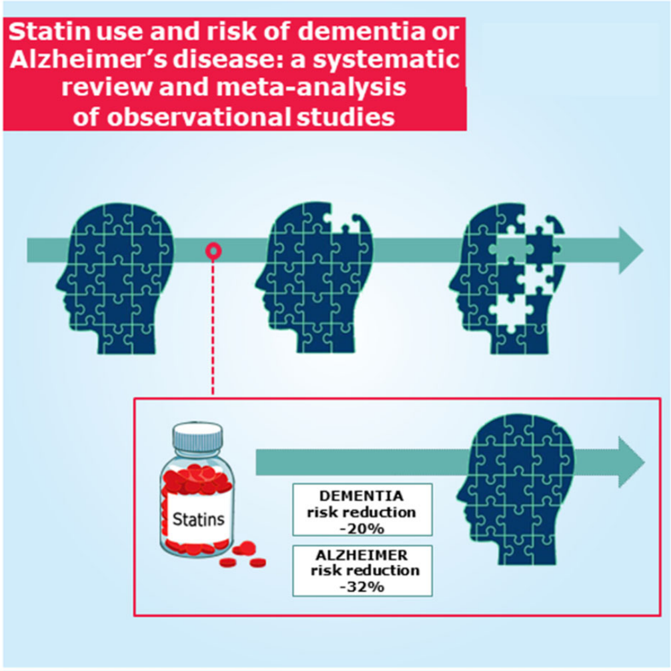
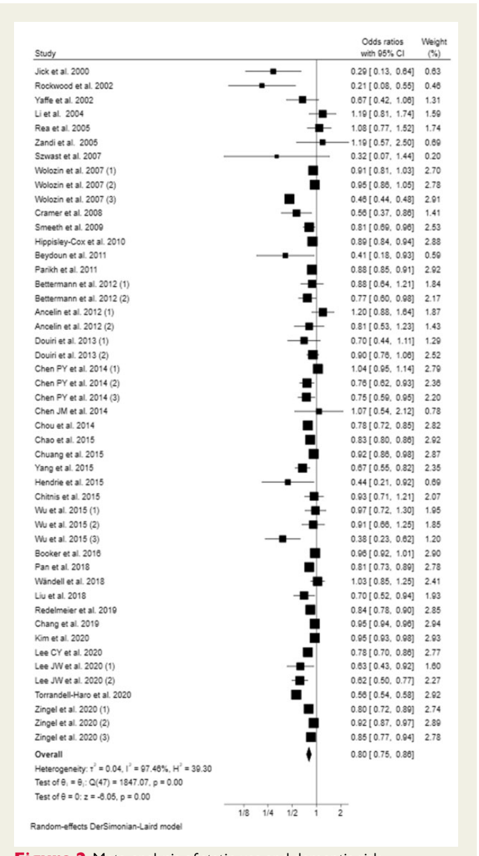
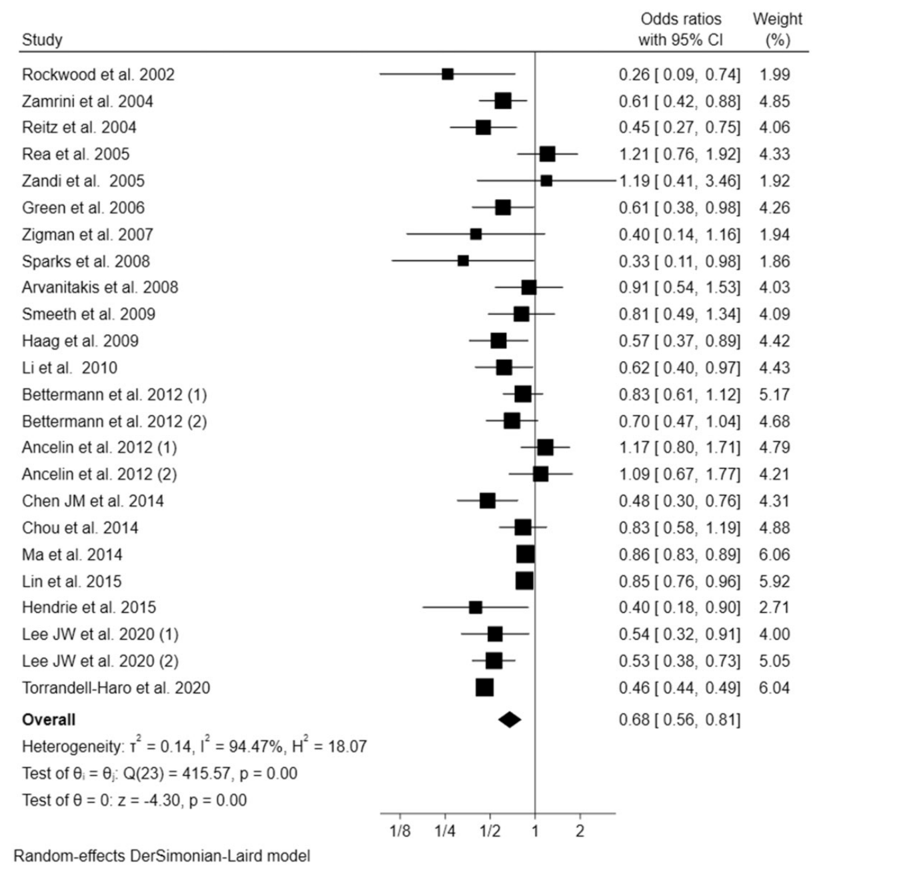
Aims: As the potential impact of statins on cognitive decline and dementia is still debated, we conducted a meta-analysis of observational studies to examine the effect of statin use on the risk of Alzheimer’s disease (AD) and dementia. Methods and results: PubMed, Cochrane, and EMBASE were searched since inception to January 2021. Inclusion criteria were: (i) cohort or case–control studies; (ii) statin users compared to non-users; and (iii) AD and/or dementia risk as outcome. Estimates from original studies were pooled using restricted maximum-likelihood random-effect model. Measure of effects were reported as odds ratio (OR) and 95% confidence intervals (CIs). In the pooled analyses, statins were associated with a decreased risk of dementia [36 studies, OR 0.80 (CI 0.75–0.86)] and of AD [21 studies, OR 0.68 (CI 0.56–0.81)]. In the stratified analysis by sex, no difference was observed in the risk reduction of dementia between men [OR 0.86 (CI 0.81–0.92)] and women [OR 0.86 (CI 0.81–0.92)]. Similar risks were observed for lipophilic and hydrophilic statins for both dementia and AD, while high-potency statins showed a 20% reduction of dementia risk compared with a 16% risk reduction associated with low-potency statins, suggesting a greater efficacy of the former, although a borderline statistical significance (P = 0.05) for the heterogeneity between estimates. Conclusion: These results confirm the absence of a neurocognitive risk associated with statin treatment and suggest a potential favourable role of statins. Randomized clinical trials with an ad hoc design are needed to explore this potential neuroprotective effect.
Overview
The claims and statistics of this paper haven’t been checked yet.
Free: it reads the open-access text and checks the first 5 claims that cite a source we can check. Create a free account to check every claim.
Integrity signals
Registry
Cites
Statistics
Figures
Verification
Claims the paper makes
The claims and statistics of this paper haven’t been checked yet.
Free: it reads the open-access text and checks the first 5 claims that cite a source we can check. Create a free account to check every claim.
Claims other papers make about this one
Each is checked against this paper’s own text: does it say what the citing paper says it does?
The source backs part of the claim, not all of it — or backs it for a different population, condition or comparison.
In the citing paper
“A meta-analysis of 36 cohort studies found statin use was associated with a reduced risk of all-cause dementia compared to untreated high cholesterol (OR 0.80, 0.750.86, I 2 =97.5) and AD (OR 0.68, 0.56-0.81 I 2 =94.5) with no difference between men and women. (162)”
From Dementia prevention, intervention, and care: 2024 report of the Lancet standing Commission (2024) · cites this paper as [162]
Experimental — accuracy not yet measuredThe source backs part of the claim, not all of it — or backs it for a different population, condition or comparison.
In the citing paper
“In addition, systematic reviews of randomized controlled trials and prospective cohort studies evaluating cognition in individuals receiving statins found that published data do not reveal an adverse effect of statins on cognition (171,172).”
From 10. Cardiovascular Disease and Risk Management: Standards of Care in Diabetes—2025 (2025) · cites this paper as [171]
Experimental — accuracy not yet measuredThe source backs part of the claim, not all of it — or backs it for a different population, condition or comparison.
In the citing paper
“In addition, systematic reviews of randomized controlled trials and prospective cohort studies evaluating cognition in individuals receiving statins found that published data do not reveal an adverse effect of statins on cognition (165,166).”
From 10. Cardiovascular Disease and Risk Management: Standards of Care in Diabetes—2026 (2026) · cites this paper as [165]
Experimental — accuracy not yet measured
Self-check
Percentages, sums and reported differences re-computed from the paper’s own numbers.
The self-check needs the paper’s full text.
Citations
Cites
Preferred Reporting Items for Systematic Reviews and Meta-Analyses: The PRISMA Statement
Moher, D., Liberati, A., Tetzlaff, J., Altman, D. G., & The PRISMA Group (2009) · PLoS Medicine · doi:10.1371/journal.pmed.1000097 · Cited by 64,042
Measuring inconsistency in meta-analyses
Higgins, J. P. T., Thompson, S. G., Deeks, J. J., & Altman, D. G. (2003) · BMJ · doi:10.1136/bmj.327.7414.557 · Cited by 63,139
Bias in meta-analysis detected by a simple, graphical test
Egger, M., Smith, G. D., Schneider, M., & Minder, C. (1997) · BMJ · doi:10.1136/bmj.315.7109.629 · Cited by 56,722
McKhann, G., Drachman, D., Folstein, M., Katzman, R., Price, D., & Stadlan, E. M. (1984) · Neurology · doi:10.1212/wnl.34.7.939 · Cited by 27,915
PRISMA-P Group, Moher, D., Shamseer, L., Clarke, M., Ghersi, D., Liberati, A., Petticrew, M., Shekelle, P., & Stewart, L. A. (2015) · Systematic Reviews · doi:10.1186/2046-4053-4-1 · Cited by 26,223
Meta-analysis of Observational Studies in Epidemiology<SUBTITLE>A Proposal for Reporting</SUBTITLE>
Stroup, D. F. (2000) · JAMA · doi:10.1001/jama.283.15.2008 · Cited by 20,623
Mach, F., Baigent, C., Catapano, A. L., Koskinas, K. C., Casula, M., Badimon, L., Chapman, M. J., De Backer, G. G., Delgado, V., Ference, B. A., et al. (2020) · European Heart Journal · doi:10.1093/eurheartj/ehz455 · Cited by 8,961
Self-citationGrundy, S. M., Stone, N. J., Bailey, A. L., Beam, C., Birtcher, K. K., Blumenthal, R. S., Braun, L. T., de Ferranti, S., Faiella-Tommasino, J., Forman, D. E., et al. (2019) · Circulation · doi:10.1161/cir.0000000000000625 · Cited by 6,185
Shepherd, J., Blauw, G. J., Murphy, M. B., Bollen, E. L., Buckley, B. M., Cobbe, S. M., Ford, I., Gaw, A., Hyland, M., Jukema, J. W., et al. (2002) · The Lancet · doi:10.1016/s0140-6736(02)11600-x · Cited by 3,378
Research works printed but not linked: 2
- 25. Zhou B, Teramukai S, Fukushima M. Prevention and treatment of dementia or Alzheimer's disease by statins: a meta-analysis. Dement Geriatr Cogn Disord 2007; 23:194-201. · DOI · Paper page
- 29. World Health Organization. The ICD-10 Classification of Mental and Behavioural Disorders: clinical Descriptions and Diagnostic Guidelines. Geneva: World Health Organization; 1992. xii, 362 p.
Cited by
Items 101–197 of 197
Drug enteric metabolism in gut microbiota-brain crosstalk
Maramai, S., Taddei, M., Castagnetti, A., Viciani, E., Koufi, F., Neri, I., Boschetti, E., Evangelisti, C., Ratti, S., Baldelli, L., et al. (2025) · Life Sciences · doi:10.1016/j.lfs.2025.124075 · Cited by 3
Bridging the gaps in alzheimer’s disease: a comprehensive review of current and emerging therapies
Mostafa, R. E., & Asaad, G. F. (2026) · Inflammopharmacology · doi:10.1007/s10787-026-02151-3 · Cited by 6
Jong, G., Lin, T., Huang, J., Liao, P., Yang, T., & Pan, L.-F. (2023) · Biomedicines · doi:10.3390/biomedicines11041073 · Cited by 4
“It is possible that statins directly affect the pathological changes that lead from Alzheimer’s to dementia [24,25].”
BackgroundBaneu, P., Prelipcean, A., Buda, V. O., Jianu, N., Tudor, A., Andor, M., Merlan, C., Romanescu, M., Suciu, M., Buda, S., et al. (2024) · Journal of Clinical Medicine · doi:10.3390/jcm13195970 · Cited by 6
“However, statins’ negative effects on cognitive function are questionable and have not been confirmed by conclusive data [59,60].”
BackgroundStatins Reduce Delirium Risk in Older Adults With Type 2 Diabetes
Sun, M., Wang, X., Lu, Z., Yang, Y., Lv, S., Miao, M., Chen, W., Wu, S., & Zhang, J. (2025) · Journal of the American Medical Directors Association · doi:10.1016/j.jamda.2025.105490 · Cited by 3
Exploring the connection between dementia and cardiovascular risk with a focus on ADAM10
Targas, A. B. A., Victoriano, P. H. M., Garcia, M. B. B., Alexandre-Silva, V., & Cominetti, M. R. (2025) · Biochimica et Biophysica Acta (BBA) - Molecular Basis of Disease · doi:10.1016/j.bbadis.2025.167825 · Cited by 3
Patterns of Statin Therapy Use and Associated Outcomes in Older Veterans Across Kidney Function
Gjyriqi, G., Gross, A., Burns, E. A., Gianos, E., Sidhu, M. S., & Mathew, R. O. (2024) · The American Journal of Medicine · doi:10.1016/j.amjmed.2024.03.016 · Cited by 4
Connections Between Hypertension, Atherosclerosis, Acute Myocardial Infarction, and Risk of Dementia
Stern, A., & Frishman, W. H. (2024) · Cardiology in Review · doi:10.1097/crd.0000000000000739 · Cited by 4
Statin is associated with higher cortical thickness in early Alzheimer's disease
Zheng, Y., Gu, H., & Kong, Y. (2025) · Experimental Gerontology · doi:10.1016/j.exger.2025.112698 · Cited by 5
Hintermayer, M. A., Mendelson, D., & Byun, J. H. (2024) · The Journals of Gerontology Series A · doi:10.1093/gerona/glae156 · Cited by 2
Park, Y., Lee, H. W., Ye, B. S., Kim, S. Y., & Yu, Y. M. (2025) · Frontiers in Neuroendocrinology · doi:10.1016/j.yfrne.2025.101218 · Cited by 2
Alameen, A. A. M., Al‐kuraishy, H. M., Fawzy, M. N., & Batiha, G. E. (2026) · Naunyn-Schmiedeberg s Archives of Pharmacology · doi:10.1007/s00210-026-05309-6 · Cited by 4
Ternhamar, T., Johansen, M. Ø., Nordestgaard, B. G., & Afzal, S. (2026) · The Lancet Regional Health - Europe · doi:10.1016/j.lanepe.2026.101814 · Cited by 5
Enhancing the human health and lifespan: a targeted strategy emphasizing statins
Calabrese, E. J., & Pressman, P. (2024) · Biogerontology · doi:10.1007/s10522-024-10112-y · Cited by 2
Ge, S., Kitamura, T., Zha, L., Komatsu, M., Komukai, S., Murata, F., Maeda, M., Gon, Y., Kimura, Y., Kiyohara, K., et al. (2024) · Journal of Alzheimer s Disease · doi:10.3233/jad-240113 · Cited by 3
Zhang, T., Wu, J., Wang, Y., Zhang, H., & Zhan, X. (2024) · International Journal of Biological Macromolecules · doi:10.1016/j.ijbiomac.2024.133862 · Cited by 5
Drug-induced dementia: a pharmacovigilance analysis of the FAERS database
Wang, Y., Kong, J.-H., Yang, Y., Zheng, Y., & Li, J. (2024) · Expert Opinion on Drug Safety · doi:10.1080/14740338.2024.2443106 · Cited by 2
“In 2012, the US FDA highlighted the potential for reversible cognitive impairment with statins; however, some studies have suggested a correlation between statin exposure and a lower incidence of AD, possibly due to the protective effects of statins on cerebrovascular health [37,38].”
Bussy, A., Patel, R., Parent, O., Salaciak, A., Bedford, S. A., Farzin, S., Tullo, S., Picard, C., Villeneuve, S., Poirier, J., et al. (2025) · Neurobiology of Aging · doi:10.1016/j.neurobiolaging.2025.01.011 · Cited by 3
Aizawa, F., Yagi, K., Sato, M., Niimura, T., Goda, M., Izawa‐Ishizawa, Y., & Ishizawa, K. (2025) · Journal of Pharmaceutical Health Care and Sciences · doi:10.1186/s40780-025-00428-3 · Cited by 4
Topical issues concerning modern lipid-lowering therapy
Susekov, A. V. (2022) · Consilium Medicum · doi:10.26442/20751753.2022.1.201484 · Cited by 2
Thompson, F., Russell, S., Quigley, R., McDonald, M., Sagigi, B., Taylor, S., Campbell, S., Schmidt, B., Esterman, A., Harriss, L. R., et al. (2023) · Frontiers in Dementia · doi:10.3389/frdem.2023.1218709 · Cited by 2
Alzheimer’s disease: Prevention Strategy
Kitisripanya, B. (2022) · International Journal of Current Science Research and Review · doi:10.47191/ijcsrr/v5-i7-59 · Cited by 1
Saeed, A., Chang, Y., Swanson, J., Vu, M., Mapstone, M. E., Villemagne, V. L., Snitz, B. E., Royse, S. K., Lopresti, B. J., Aizenstein, H. J., et al. (2024) · medRxiv · doi:10.1101/2024.01.24.24301752 · Cited by 2
Li, V. O., Han, Y., Lam, J. C., & Downey, J. (2025) · doi:10.1101/2025.05.13.25327570 · Cited by 2
Association of whole-person eigen-polygenic risk scores with Alzheimer’s disease
Kharaghani, A., Tio, E. S., Milic, M. S., Bennett, D. A., Jager, P. L. D., Schneider, J. A., Sun, L., & Felsky, D. (2024) · Human Molecular Genetics · doi:10.1093/hmg/ddae067 · Cited by 1
Neha, N., Pinky, P., Khan, S. A., Ali, M., Ali, N., Shaquiquzzaman, M., & Parvez, S. (2024) · Molecular Neurobiology · doi:10.1007/s12035-024-04465-1 · Cited by 3
Hiding in Plain Sight: FDA-Approved Cholesterol Drug Ezetimibe as a Treatment for Alzheimer’s
Gorbunova, V. A., & Seluanov, A. (2024) · doi:10.59368/agingbio.20240037 · Cited by 1
Statin Use in Women: Unique Aspects over the Lifespan
Myerson, M. L. (2024) · Current Cardiovascular Risk Reports · doi:10.1007/s12170-024-00757-2 · Cited by 1
“…on the risk of Alzheimer’s disease and dementia, data did not support this association and in fact suggested a potential favorable role of statins [15] In a study with 11-year follow up that included analysis of women participants, statin use was found to be associated with a 35% decrease in the…”
Alsalhi, A. A., Almazyad, F. H., Alharbi, A. Z., AlDhuwaihy, A. A., & Alsulaim, Y. B. (2026) · Saudi Journal of Anaesthesia · doi:10.4103/sja.sja_565_25 · Cited by 1
“Hypertension (OR 1.36, 95% CI [1.16, 1.59]), hyperlipidemia [12] (OR 1.19, 95% CI [1.16, 1.22]), and coronary artery disease (OR 2.45, 95% CI [1.72, 3.50]) were linked to increased dementia risk.”
InfluentialThe association of statin use with the risk of anxiety: a systematic review and meta-analysis
Yan, Y., Deng, S., Li, Y., Fu, J., Gong, H., Zhang, H., & Zhang, F. (2026) · Frontiers in Psychiatry · doi:10.3389/fpsyt.2026.1769044 · Cited by 2
Novak, D. A., Saleem, N., Gerhardt, P. C., Maestas, D., Kejriwal, N., Vaezazizi, E., Murray, I., & Al-Khoury, L. (2026) · Journal of Alzheimer s Disease · doi:10.1177/13872877261424220 · Cited by 2
“This risk reduction is in line with the relative risk reductions reported in recent meta-analyses of observational studies (generally between 20% and 35%), 11,12,20,21 and similar to Olmastroni et al. 20 and their fi nding of an OR of .68, and much greater than the null or modest effects found in RCT-based studies and…”
InfluentialFood and nutrition in the prevention of dementia–A mini-review
Lange, K. W., NAKAMURA, Y., & Lange, K. M. (2026) · Journal of Food Bioactives · doi:10.26599/jfb.2026.95033435 · Cited by 1
Gupta, K. R., Thombre, K. R., & Umekar, M. J. (2026) · European Journal of Neuroscience · doi:10.1111/ejn.70508 · Cited by 2
Resveratrol induces molecular changes in cholesterol homeostasis in SAMP8 mice cerebellum
Tejero, A., Benito-Patón, V., Griñán‐Ferré, C., Pallàs, M., León-Navarro, D., & Martín, M. (2026) · Biomedicine & Pharmacotherapy · doi:10.1016/j.biopha.2026.119319 · Cited by 2
Zhao, Y., Luo, G., Huang, C., Chen, Z., Wei, Y., Chen, Q., Wang, F., Gan, Y., & Yin, X. (2026) · The Journal of Prevention of Alzheimer s Disease · doi:10.1016/j.tjpad.2026.100564 · Cited by 1
Sternberg, Z., Podolsky, R., Yu, J., Hua, S., Halvorsen, S. W., & Schaller, B. J. (2026) · The Journal of Prevention of Alzheimer s Disease · doi:10.1016/j.tjpad.2026.100555 · Cited by 1
“By contrast, some epidemiological and mechanistic studies have suggested that statins may reduce amyloid deposition or tau phosphorylation, particularly in APOE4 carriers [31,45].”
Brain, benefit, or burden? Revisiting statins and cognitive function in older adults
Liu, Y., & Kunutsor, S. K. (2026) · GeroScience · doi:10.1007/s11357-026-02259-y · Cited by 2
“Similarly, Olmastroni et al. [59] pooled 46 observational studies and reported significant risk reductions in older adults (> 75 years), with an 18% lower risk of dementia and 27% lower risk of AD.”
Zárate-Correa, L. C., García-Peña, Á. A., Kaiser, S. E., Aguilar-Salinas, C. A., Méndez-Castillo, M., Mehta, R., Valério, C. M., Moreira, R. O., Mancillas‐Adame, L. G., Canto, J. A. C., et al. (2026) · Atherosclerosis · doi:10.1016/j.atherosclerosis.2026.120783 · Cited by 2
Atherosclerosis and dementia - causal aspects and preventive potential
Rasmussen, I. J., Luo, J., Rasmussen, K. L., Kjeldsen, E. W., Schneider, L. S., Sandau, N., Thomassen, J. Q., & Frikke‐Schmidt, R. (2026) · Atherosclerosis · doi:10.1016/j.atherosclerosis.2026.120745 · Cited by 2
Xie, S., Galimberti, F., Olmastroni, E., Catapano, A. L., & Casula, M. (2026) · Nutrition Metabolism and Cardiovascular Diseases · doi:10.1016/j.numecd.2026.104851 · Cited by 1
Self-citationCardiovascular risk management in the elderly: a dilemma in daily clinical practice
Dacquino, G. M., Galati, G., Genovese, L., Bravo, F. F., Bernardi, M., Spadafora, L., & Pedretti, R. F. E. (2026) · European Journal of Preventive Cardiology · doi:10.1093/eurjpc/zwag316 · Cited by 2
Kaur, D., Bucholc, M., Finn, D. P., Todd, S., Wong‐Lin, K., & McClean, P. L. (2024) · Journal of Alzheimer s Disease · doi:10.3233/jad-230456 · Cited by 3
Choi, M., Zimmerman, S. C., Jiang, C., Wang, J., Swinnerton, K. N., Hoffmann, T. J., Oni‐Orisan, A., Ferguson, E. L., Meyers, T. J., Choudhary, V., et al. (2025) · Alzheimer s & Dementia · doi:10.1002/alz.14627 · Cited by 3
Fi, B., Veltishchev, D. Y., Volel, B. A., Garganeeva, N. P., Kopylov, F. Y., Lareva, N. V., Medvedev, V. E., Mosolov, S. N., Petrova, M. M., Петрунько, О. В., et al. (2025) · Kardiologiia · doi:10.18087/cardio.2025.6.n2921 · Cited by 3
Smetana, G. W., Benson, M. D., Juraschek, S. P., & Burns, R. B. (2022) · Annals of Internal Medicine · doi:10.7326/m22-0908 · Cited by 1
Editor comment: Focus on atherosclerosis and lipid
Hálasz, G., & Piepoli, M. F. (2022) · European Journal of Preventive Cardiology · doi:10.1093/eurjpc/zwac065 · Cited by 1
Bussy, A., Patel, R., Parent, O., Salaciak, A., Bedford, S. A., Farzin, S., Tullo, S., Picard, C., Villeneuve, S., Poirier, J., et al. (2024) · bioRxiv (Cold Spring Harbor Laboratory) · doi:10.1101/2024.01.24.576996 · Cited by 1
Jeremic, D., Jiménez‐Díaz, L., & Navarro‐López, J. D. (2025) · bioRxiv (Cold Spring Harbor Laboratory) · doi:10.1101/2025.05.13.653795 · Cited by 1
Statins and genetic inhibition of the mevalonate pathway activate an ATF3-STMN2 regenerative programPreprint
Nolan, M., Aryal, S., Ndayambaje, I. S., Cao, M., Lee, P., Hovde, M. J., Yun, S., Wlaschin, J. J., Held, A., Beaussant, H. D. A. M., et al. (2026) · bioRxiv (Cold Spring Harbor Laboratory) · doi:10.64898/2026.02.23.707492 · Cited by 3
Cognitive impairment in the elderly: the need for a comprehensive approach
(2022) · Asian Biomedicine · doi:10.2478/abm-2022-0007 · Cited by 1
“A systematic review and meta-analysis of observational studies found no neurocognitive risk associated with statin treatment and suggests a potentially favorable role of statins in clinical settings [5].”
BackgroundHuan, S., Gao, J., & Guoping, Y. I. N. (2023) · Research Square · doi:10.21203/rs.3.rs-2822676/v1
Best Practice London: focus on lipid and migraine management
Titmarsh, S. (2023) · Prescriber · doi:10.1002/psb.2080
Kossakowski, K., Orzechowska, K., Sikora, W., Grabowska, W., Kowalska, K., Kujawski, R., Czora-Poczwardowska, K., Szulc, M., Mikołajczak, P. Ł., & Bartkowiak-Wieczorek, J. (2023) · Farmacja Polska · doi:10.32383/farmpol/174070
Gentreau, M., Rukh, G., Miguet, M., Clemensson, L. E., Alsehli, A. M., Titova, O. E., & Schiöth, H. B. (2023) · The Journals of Gerontology Series A · doi:10.1093/gerona/glad253
Kawada, T. (2023) · The Journals of Gerontology Series A · doi:10.1093/gerona/glad252
Statine: Nebenwirkungen – alternative Therapieoptionen
Makhmudova, U., & Weingärtner, O. (2024) · Die Kardiologie · doi:10.1007/s12181-024-00669-w · Cited by 1
Identifying drug repositioning candidates for age-related outcomes in the Danish health registriesPreprint
Jung, A. W., Louloudis, I. E., Brunak, S., & Mortensen, L. H. (2024) · medRxiv · doi:10.1101/2024.08.12.24311869
Gonzalvo, J. D., Hamm, J. A., Stratton, S. M., Chaudhry, F., Duker, P. N., & Muñoz, C. (2024) · ADCES in Practice · doi:10.1177/2633559x241280410 · Cited by 1
Reducing CETP activity prevents memory decline in an Alzheimer’s disease mouse model
Phénix, J., Sarty, I. M., Katz, M. S., Cobá, A. V., Marure-Rojano, A. E., Nie, H., Kerksiek, A., Jerry, I., Berger, C. S., Kiss, R. S., et al. (2026) · EMBO Molecular Medicine · doi:10.1038/s44321-026-00482-w · Cited by 4
Statins in the practice of an internal medicine specialist: A review
Susekov, A. V. (2024) · Consilium Medicum · doi:10.26442/20751753.2024.10.202995
Alkhalidi, H. M. (2025) · International Journal of Pharmacology · doi:10.3923/ijp.2025.1.15
MOHAMMAD, F. K., & Al-Shalchi, R. F. (2025) · Toxicology Reports · doi:10.1016/j.toxrep.2025.101958 · Cited by 1
“Clinical evidence supports this hypothesis by indicating a reduced dementia risk in statin-treated patients [60], suggesting potential repurposing of statins for pleiotropic effects beyond modulation of blood cholesterol levels [5,8,32,59].”
InfluentialSilva‐Spínola, A., Baldeiras, I., Santana, I. J., Arrais, J. P., & Initiative, A. D. N. (2025) · Journal of Alzheimer s Disease · doi:10.1177/13872877251331096 · Cited by 1
D’Amuri, A., Bordini, B., Pagani, M., Ciaffi, J., D’Agostino, C., Martino, A. C. D., Faldini, C., & Ursini, F. (2025) · Frontiers in Pharmacology · doi:10.3389/fphar.2025.1492200 · Cited by 2
Jamali, Q., & Oraegbunam, C. (2025) · BJPsych Advances · doi:10.1192/bja.2025.10112 · Cited by 2
Medication Exposure and Neurodegenerative Disease Risk Across National BiobanksPreprint
Levine, K. S., Sargent, L. J., Somerville, E. N., Pitz, V., Price, E. T., Bandrés‐Ciga, S., Simmonds, E., Long, R. A., Jonson, C., Lange, L. M., et al. (2025) · medRxiv · doi:10.1101/2025.07.07.25330740
Dysregulation of cerebral perfusion dynamics is associated with Alzheimer's disease
Marmarelis, V. Z., Billinger, S., Joe, E., Shin, D. C., Hashem, S., Rizko, J., Hazen, E. M., Cardim, D., Burns, J., Zhang, R., et al. (2025) · Alzheimer s & Dementia Diagnosis Assessment & Disease Monitoring · doi:10.1002/dad2.70134 · Cited by 3
Nicholl, C. G., Wilson, K. J., & D'Souza, S. (2025) · Wiley eBooks · doi:10.1002/9781394397976.ch8
Lyall, D. M., Oni, O., McKie, A., Beazer, J., Kancheva, A. K., Tank, R., Fullerton, J. L., Gilchrist, L., Lyall, L. M., McIlvride, S., et al. (2025) · Research Square · doi:10.21203/rs.3.rs-6802545/v1
Zhang, J., Song, A., Xiang, Y., Liu, J., Li, B., & Li, X. (2025) · Annals of Human Genetics · doi:10.1111/ahg.70025
Reassuring evidence on statins and cognition in people with HIV
Vera, J. H., & Martínez, E. (2025) · AIDS · doi:10.1097/qad.0000000000004286
Cardiovascular Disease and Risk Management
(2025) · American Diabetes Association eBooks · doi:10.2337/9781580408462-ch17
Weekman, E. M., Johnson, S. N., Rogers, C. B., Sudduth, T. L., Xie, K., Qiao, Q., Fardo, D. W., Bottiglieri, T., & Wilcock, D. M. (2023) · Figshare · doi:10.6084/m9.figshare.24076902
Chang, H.-T., Chan, P.-C., & Chiu, P.-Y. (2024) · Figshare · doi:10.6084/m9.figshare.25940103
Demidova, T. Y., & Belolipetsky, Y. A. (2025) · FOCUS Endocrinology · doi:10.62751/2713-0177-2025-6-4-10 · Cited by 1
Paruparla, R., Lalan, M. S., Shah, P., & Vasdev, N. (2026) · Pharmaceutical Development and Technology · doi:10.1080/10837450.2026.2614071
Physical Inactivity as a Risk Factor for Neurodegeneration and Sports Medicine-based Recommendations
Schaeffer, E., & Weisser, B. (2026) · Klinische Monatsblätter für Augenheilkunde · doi:10.1055/a-2815-0976
Karmakar, A., Roycowdhury, P., Sengupta, P., & Mukhopadhyay, D. (2026) · International review of neurobiology · doi:10.1016/bs.irn.2026.02.007
Betat, A., dos Santos, V., de Oliveira, C. G. A., Alflen, L., Ferreira, C. F., Izídio, G. S., & Lataro, R. M. (2026) · Journal of Hypertension · doi:10.1097/hjh.0000000000004277
Belachew, E. A., Peterson, G. M., & Bezabhe, W. M. M. (2026) · Scientific Reports · doi:10.1038/s41598-026-46974-0 · Cited by 1
“Despite mixed evidence on statin use and dementia risk 42,43 , our results indicate a possible increased risk with baseline statin use.”
Hartmann, T. (2026) · The Journal of Prevention of Alzheimer s Disease · doi:10.1016/j.tjpad.2026.100576
“…effectiveness of pharmacologically lowering LDL cholesterol remains uncertain: randomized controlled trials (RCTs) of statins have not provided clear evidence, often due to limitations in trial design, while observational cohort studies suggest no harm and a possible reduction in dementia risk [3].”
Jeremic, D., Jiménez‐Díaz, L., & Navarro‐López, J. D. (2026) · Journal of Molecular Graphics and Modelling · doi:10.1016/j.jmgm.2026.109417 · Cited by 1
Serfilippi, T., Piccirillo, S., Preziuso, A., Terenzi, V., Ciancio, R., Magi, S., Lariccia, V., & Secondo, A. (2026) · Biomolecules · doi:10.3390/biom16050667
The physiological effects of APOE genotype in healthy young/middle‐aged individuals
de Leeuw, S. M., Emrani, S., Putter, J., & Nuriel, T. (2026) · Biological reviews/Biological reviews of the Cambridge Philosophical Society · doi:10.1002/brv.70187 · Cited by 1
Wang, Q., Fang, M.-L., Li, L.-L., Qin, Q., Huang, F., Sun, Y., & (15030), J. L. (2026) · International Journal of Behavioral Medicine · doi:10.1007/s12529-026-10473-3
PCSK9 inhibitors do not increase cognitive risk
Ni, D., Feng, Z., Liang, D., Qi, Z., Lu, Y., Zhu, L., & Li, G. (2026) · Biology Direct · doi:10.1186/s13062-026-00865-6
Kronenberg, F., Höllerl, F., Brath, H., Rega‐Kaun, G., Greber‐Platzer, S., Weiser, C., Klein, D. P., Riesenhuber, N., Binder, C. J., Brix, J. M., et al. (2026) · Wiener klinische Wochenschrift · doi:10.1007/s00508-026-02760-6
Artner, A., Szélvári, Á., Oláh, I., Ballya, I., Hankó, B., Zelkó, R., & Torzsa, P. (2026) · GeroScience · doi:10.1007/s11357-026-02445-y
Yuan, J., Huang, S., Jiao, K., Yang, S., Ge, X., Liu, W., Wang, W., Shu, H., & Zhou, X. (2026) · CNS Neuroscience & Therapeutics · doi:10.1002/cns.71109
“Statins inhibit the key synthetic enzyme HMG-CoA reductase and upregulate ApoE expression to mediate cholesterol transport and facilitate Aβ clearance [170].”
Cognitive safety of statin use in the elderly: Evidence from a nationally representative sample
Ding, J., Miao, J., Zhang, L., Liu, Q., Zhang, Y., Li, J., & Li, Y. (2026) · Journal of Internal Medicine · doi:10.1111/joim.70159
“…regarding memory or attention symptoms [13, 14], but clinical trial meta-analyses did not identify a consistent adverse cognitive signal [15], and observational syntheses and dementia-focused studies have also reported heterogeneous results rather than a uniform harmful association [16–18].”
Cardiometabolic medication exposures and cognitive outcomes in Alzheimer’s disease
Wang, Y., Goudey, B., Masters, C. L., Jin, L., Pan, Y., & The Health and Aging Brain Study (HABS‐HD) Study Team (2026) · Age and Ageing · doi:10.1093/ageing/afag263
Gee, J. R. (2026) · Journal of the Osteopathic Family Physicians of California · doi:10.58858/050302
Gu, M.-X., Wang, M.-Y., Niu, W.-H., Tian, H., Wang, H., & Zhang, Q.-L. (2026) · Journal of Hazardous Materials Advances · doi:10.1016/j.hazadv.2026.101578
Heart and Brain: Linking Obesity-Related Inflammation, Cardiovascular Disease and Cognitive Function
Reiss, A. B., Gulkarov, S., Syed, U., Ben-Dor, G. A., Srivastava, A., Singh, M., & Leon, J. D. (2026) · Journal of Cardiovascular Development and Disease · doi:10.3390/jcdd13100477
“In a meta-analysis of observational studies with primary outcomes of AD and dementia, Olmastroni et al. found no statistically significant neurocognitive risk associated with statin treatment [298].”
Pakhomov, N. V., Kostyunina, D. S., & Artemenkov, A. A. (2026) · I P Pavlov Russian Medical Biological Herald · doi:10.17816/pavlovj635884
Association of statin use with reduced risk of Alzheimer’s disease: findings in UK Biobank
Yang, H., Zhu, C., He, J., Wei, Y., Li, D., Luo, X., & Wang, Y. (2026) · Frontiers in Aging Neuroscience · doi:10.3389/fnagi.2026.1961033
“Statin treatment does not pose any risk to neurocognition, and suggest that statins may have positive effects (Olmastroni et al., 2022; Royall and Palmer, 2024; Loera-Valencia et al., 2019).”
Influential
Metadata
- Authors
- Olmastroni, E., Molari, G., De Beni, N., Colpani, O., Galimberti, F., Gazzotti, M., Zambon, A., Catapano, A. L., & Casula, M.
- Affiliations
- University of Milan (IT)
- MultiMedica (IT)
- Department of Pharmacological and Biomolecular Sciences, Epidemiology and Preventive Pharmacology Service (SEFAP), University of Milan, Via Balzaretti 9, 20133 Milan, Italy
- University of Padua (IT)
- Corresponding author
- Casula, Manuela
- ORCID
- Venue
- European Journal of Preventive Cardiology
- Publisher
- Oxford University Press (OUP)
- Published
- 2021-12-06
- Volume
- 29
- Issue
- 5
- Pages
- 804-814
- ISSN
- 2047-4873 (ISSN-L)
- 2047-4881
- OpenAlex
- W4200013341
- Cited by
- 197
- References
- 97
- Citations by year
- 2026: 43 · 2025: 52 · 2024: 59 · 2023: 25 · 2022: 17 · 2021: 1
- FWCI
- 4.61
- Type
- journal article
- Language
- en
- Open access
- hybrid
- doi.org
- Licence
- Locations
- European Journal of Preventive Cardiology (publishedVersion, cc-by-nc)
- PubMed (publishedVersion)
- Archivio Istituzionale della Ricerca (Universita Degli Studi Di Milano) (submittedVersion, other-oa)
- Padua Research Archive (University of Padova) (submittedVersion, cc-by-nc)
- Funders
- Ministry of Health-IRCCS MultiMedica (GR-2016-02361198, GR-2011-02346974)
- Fondazione SISA
- Fondazione Cariplo (2015-0524, 2015-0564)
- H2020 REPROGRAM (PHC-03-2015/667837-2)
- ERANET (ER-2017-2364981, PRIN 2017H5F943)
- SISA Lombardia and Fondazione SISA
- Topics
- Health Sciences › Medicine › Psychiatry and Mental health › Dementia and Cognitive Impairment Research
- Health Sciences › Medicine › Cardiology and Cardiovascular Medicine › Lipoproteins and Cardiovascular Health
- Life Sciences › Neuroscience › Cellular and Molecular Neuroscience › Alzheimer's disease research and treatments
- Keywords
- statins, dementia, Alzheimer's disease, cognitive decline, neuroprotection, statin potency, sex differences, drug safety
- MeSH terms
- Alzheimer Disease, Dementia, Female, Humans, Male, Odds Ratio, Hydroxymethylglutaryl-CoA Reductase Inhibitors, Cognitive Dysfunction
About these checks
Registry, retraction, Cites and statistics results are computed, not judged, with one exception: a printed reference that no index lists is read once by a model before it counts as a citation error. Claims are extracted by a model and kept only when their quote appears verbatim in the text; each cited source is then checked, with a model’s help, for whether it says what the claim relies on. Those verdicts can be wrong — read the claim’s quote and the cited source before relying on one.
Statistics and arithmetic are recomputed, not judged.
Confidence bands are shown only for fields calibrated on our annotated test set. None is calibrated yet, so no band is shown.
What counts as a claim ›How we measure confidence ›How we check this ›
Are you an author, or do you see a problem with this page? Request a review
Data sources
Bibliographic data: Semantic Scholar, OpenAlex, Crossref.
Contains information from the Semantic Scholar Academic Graph Datasets, made available under the ODC Attribution License (ODC-BY 1.0).
Semantic Scholar’s data is described in: Kinney, R., et al. (2023). The Semantic Scholar Open Data Platform. arXiv:2301.10140.
