

Genomic Insights into Plastid Evolution
Open accessThe DOI matches its Crossref record; 114 of the 116 references it cites were found in a registry or an index; 46 of the 106 sources its claims cite were checked for support.
Abstract
The origin of plastids (chloroplasts) by endosymbiosis stands as one of the most important events in the history of eukaryotic life. The genetic, biochemical, and cell biological integration of a cyanobacterial endosymbiont into a heterotrophic host eukaryote approximately a billion years ago paved the way for the evolution of diverse algal groups in a wide range of aquatic and, eventually, terrestrial environments. In this review, we provide an overview of recent advances in our understanding of the origin and spread of plastids from the perspective of comparative genomics. Comparative genomics has also allowed us to better understand how endosymbionts become organelles.
Overview
CoChat Summary
## TL;DR
This is a review article summarizing genomic evidence on how plastids originated, spread, were replaced, and were lost across eukaryotes. It argues that comparative genomics has clarified many major transitions but that key questions about the number and partners of endosymbioses remain unresolved.
## Key findings
- Primary plastids are described as originating once from a cyanobacterial endosymbiont, likely at least ~900 Ma, in the ancestor of green algae/land plants, red algae, and glaucophytes.
- Comparative genomics indicates that endosymbiotic gene transfer was extensive: less than 5% of genes thought present in the cyanobacterial progenitor typically remain in plastid genomes, and 7–15% of plastid-targeted proteins in diverse lineages are noncyanobacterial in origin.
- The paper states that only three unambiguous cases of complete plastid loss have been documented so far, all in parasitic species: Cryptosporidium, certain gregarines, and Hematodinium.
- It reports several specific plastid replacement / complex-plastid examples, including at least 11 different diatom species found across closely related dinoflagellates, 90 haptophyte-to-dinoflagellate EGTs in Karenia brevis and Karlodinium veneficum, and only 17 of 433 nucleus-encoded chromatophore-targeted proteins in Paulinella chromatophora appearing to come from α-cyanobacteria.
## Methods
- Narrative review of recent genomics-based studies of plastid evolution, with emphasis on comparative genomics, phylogenomics, transcriptomics, genome sequencing, and proteomics.
- Synthesizes evidence from multiple taxa, including algae, plants, dinoflagellates, apicomplexans, Paulinella, and other protists, using published genome and transcriptome datasets.
- Main analysis is interpretive: the authors compare phylogenetic, genomic, and cell-biological evidence to reconstruct plastid gains, losses, replacements, and endosymbiotic gene transfer.
## Limitations
- The paper explicitly says that important details are still missing and that “we are still in the dark” about how many eukaryote–eukaryote endosymbioses occurred and, in many cases, who the partner cells were.
- It notes that phylogenetic reconstruction is limited by conflicting signals, methodological artifacts, and incomplete taxonomic sampling. (stated in the paper)
- It also states that increased plastid-genome sampling alone may not resolve some questions because of limited phylogenetic signal; nuclear genomes and better taxon sampling are needed. (stated in the paper)
Model-written summary. Check it against the paper before relying on it.
Integrity signals
Registry
Cites
Statistics
Figures
Verification
Claims the paper makes
31 Valid · 2 Not valid · 42 Not checked · 30 Own results and interpretations
Some cited sources support this claim and some don’t — read each source’s verdict below.
In the paper
“Less than 5% of the genes thought to have been present in the cyanobacterial progenitor of the plastid typically remain in the organellar genome, and hundreds of cyanobacterial genes can be found in the nuclear genomes of extant algae and plants (Dagan et al. 2013, Qiu, Yoon, et al. 2013).”
§ Genomic Insights into Plastid Evolution > The Endosymbiont-to-Organelle Transition
What the sources say
- Disputedcites Dagan et al. 2013 sourceExperimental — accuracy not yet measured
The Introduction gives a different figure: modern plastid genomes contain 5–10% as many genes as free-living cyanobacteria, not less than 5%. It also says many ancestral genes were lost or transferred to the nucleus, but that does not support the claimed percentage. (LLM, conf=0.88)
Checked by a reasoning model — may be wrong.
- Partly supportedcites Qiu, Yoon, et al. 2013 sourceExperimental — accuracy not yet measured
The section on endosymbiotic/horizontal gene transfer of prokaryotic genes in Plantae says modern plastid genomes are highly reduced and encode fewer than 250 genes. It does not give the estimated gene count of the cyanobacterial progenitor or state that less than 5% remain, so the claimed proportion is unsupported by this paper. (LLM, conf=0.85)
plain- Asserted: passes — The authors put it forward as true.
- Checkable: passes — It can be checked against evidence.
- Load-bearing: unclear — It is unclear whether the paper’s conclusions depend on it.
- Based: passes — The paper gives a reason why it holds.
- Disputed
At least one cited source doesn’t support this claim or points to a different paper, and none confirmed it — see the verdicts below.
In the paper
“Approximately half of the described dinoflagellate species maintain the peridinin-pigmented plastid thought to have been present in their common ancestor (Yoon et al. 2002).”
§ Genomic Insights into Plastid Evolution > Kleptomania Thus far, we have focused on the origins and fates of permanently integrated organelles. But there is also much to learn from the study of more transient associations between organisms in nature, the phenomenon of kleptoplasty—“plastid stealing”—being one such an example. Kleptoplasty is surprisingly common, having been observed in a variety of protist lineages (particularly foraminiferans, dinoflagellates, and ciliates) and even some animals (sea slugs and some flat worms). These stolen plastids come from varying sources and exhibit a wide range of retention times. In sea slugs, algal plastids are harvested, sequestered, and retained for periods of time ranging from days to weeks and months before being lost (Händeler et al. 2009). Even though only the plastid remains from its algal prey, the kleptoplasts remain photosynthetically active. Transcriptome and genome sequencing have failed to provide evidence of gene transfer from algae to the sacoglossan sea slug nuclear genome, despite suggestions that this had occurred (see Bhattacharya et al. 2013; Rauch et al. 2015 and references therein). In a recently described case of kleptoplasty in two flatworm species, sequestered plastids are stolen from different diatom species and retained for a couple of weeks (Steenkiste et al. 2019). In this instance, transcriptome sequencing suggests that kleptoplast genes are actively expressed, whereas algal nuclear genes are not, supporting the observation that only the plastid is retained and is functional (Steenkiste et al. 2019). Kleptoplastic tendencies are frequently observed in single-celled eukaryotes and are especially common among dinoflagellates. Approximately half of the described dinoflagellate species maintain the peridinin-pigmented plastid thought to have been present in their common ancestor (Yoon et al. 2002). Many dinoflagellates harbor kleptoplastids of various origins, whereas others have permanently replacing their ancestral plastid (see below). In addition as discussed above, still others completely lack photosynthetic abilities and appear to no longer have a plastid (e.g., Hematodinium; Gornik et al. 2015). Haptophyte-derived kleptoplastids are found in Phalacroma mitra (Koike et al. 2005) and the Antarctic Ross Sea (ARS) dinoflagellate (Sellers et al. 2014; Hehenberger et al. 2019). The ARS dinoflagellate is known not only to retain a relic version of its ancestral peridinin plastid but also to be obligately kleptoplastidic and reliant on its haptophyte prey for photosynthesis, which it can maintain for at least 30 months (Gast et al. 2007). Transcriptomics of the ARS dinoflagellate by Hehenberger et al. (2019) showed that plastid functions are split between the relic peridinin plastid and the kleptoplast, with photosynthesis related functions occurring there. Bioinformatic analyses suggest that many nucleus-encoded proteins are targeted to the kleptoplast, most of which do not appear to be derived from the plastid donor itself. Notably, the ARS dinoflagellate is closely related to other dinoflagellate lineages, specifically Karenia and Karlodinium, who harbor fully integrated, permanent haptophyte-derived plastids. Comparative genomics between the species with permanent haptophyte plastids and the haptophyte-derived kleptoplasts of the ARS dinoflagellate showed a number of shared gene transfers whose protein products are targeted to the plastid/kleptoplast, suggesting that, in some cases at least, a certain level of genetic integration can precede permanent organelle integration (Hehenberger et al. 2019). Other dinoflagellates have cryptophyte- or diatom-derived kleptoplasts. In one of the most intricate cases, Dinophysis obtains its kleptoplast by preying on a ciliate (Mesodinium rubrum) which itself harbors a kleptoplast of cryptophyte origin (either Geminigera cryophila [Johnson et al. 2006] or Teleaulax amphioxeia [Nishitani et al. 2010]). In Mesodinium rubrum, the kleptoplast is transcriptionally active and has been observed to be retained for up to a month with continual replacement (Johnson et al. 2007). Transcriptomics and phylogenetic analysis of plastid-related genes in Dinophysis fortii revealed that most such genes are of apparent peridinin plastid origin and thus represent EGTs from the original dinoflagellate plastid (Hongo et al. 2019). Intriguingly, the rest of the plastid-associated genes were not only of cryptophyte kleptoplast origin but also of haptophyte origin—including genes related to those of dinoflagellates with permanent tertiary haptophyte plastids (i.e., fucoxanthin dinoflagellates). This suggests that the ancestors of extant Dinophysis engaged in haptophyte kleptoplasty at some point during their evolutionary history (Hongo et al. 2019). Finally, dinoflagellates are known to harbor plastids derived from diatoms. These so-called “dinotoms” are retained permanently in the cytosol and the evidence suggests that the host cell exhibits some level of control over their division (e.g., Hehenberger et al. 2016; Yamada et al. 2017). To date, there is only one known example of a kleptoplasty-derived dinotom. In this case, the dinoflagellate Durinskia capensis appears to retain its diatom only temporarily, for ∼2 months, and does not appear to control its cell division (Yamada et al. 2019). Further genomic and transcriptomic investigations of the myriad ways in which dinoflagellates acquire and recycle their plastids will no doubt continue to provide insight into the molecular, biochemical, and cell biological factors underlying the endosymbiont-to-organelle transition.
What the sources say
- Disputedcites Yoon et al. 2002 sourceExperimental — accuracy not yet measured
The Discussion (page not provided) calls fucoxanthin the primitive plastid condition and peridinin a derived state, contrary to the claim that the peridinin-pigmented plastid was present in the common ancestor. The introductory passage says about half of dinoflagellates are photosynthetic; it does not say that half of described species retain a peridinin plastid. (LLM, conf=0.88)
Checked by a reasoning model — may be wrong.
plain- Asserted: passes — The authors put it forward as true.
- Checkable: passes — It can be checked against evidence.
- Load-bearing: unclear — It is unclear whether the paper’s conclusions depend on it.
- Based: passes — The paper gives a reason why it holds.
- Disputed
The cited sources support only part of this claim — read each source’s verdict below.
In the paper
“Recent molecular clock analyses estimate that the Paulinella chromatophore evolved a mere 90–140 Ma (Delaye et al. 2016).”
§ Genomic Insights into Plastid Evolution > The Chromatophores of Paulinella
What the sources say
- Partly supportedcites Delaye et al. 2016 sourceExperimental — accuracy not yet measured
The Abstract reports molecular-clock estimates of roughly 90–140 million years for the divergence of P. chromatophora from heterotrophic relatives. It calls that divergence a maximum date for the chromatophore’s origin, not an estimate that the chromatophore itself evolved within that interval. (LLM, conf=0.88)
hedged- Asserted: passes — The authors put it forward as true.
- Checkable: passes — It can be checked against evidence.
- Load-bearing: unclear — It is unclear whether the paper’s conclusions depend on it.
- Based: passes — The paper gives a reason why it holds.
- Partly supported
The sources with a verdict support this claim; the rest weren’t checked yet, have no full text we could read, or their verdicts aren’t rated yet.
In the paper
“a trend that has nevertheless emerged is plastid trees that unite haptophytes and cryptophytes to the exclusion of all other complex algae; see, e.g., Janouškovec et al. 2010; Ševčíková et al. 2015; Kim et al. 2017 and references therein for discussion”
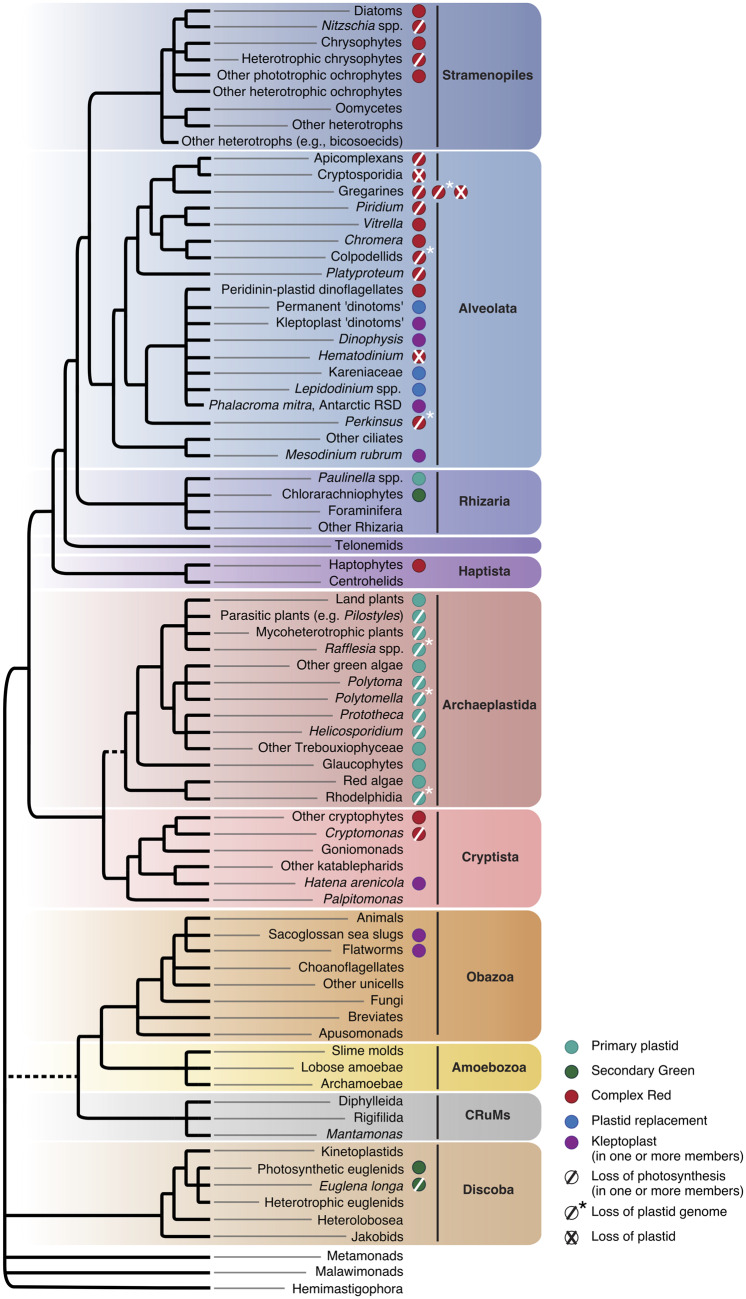
§ Genomic Insights into Plastid Evolution > The Complexity of Complex Plastids As important as it was, the primary endosymbiotic origin of plastids accounts for only a fraction of the diversity of plant and algal life on Earth. Multiple higher-order endosymbiotic events—mergers between two eukaryotic cells—have taken place. In some photosynthetic lineages, the details are reasonably well understood, whereas in others they are completely uncertain. So-called “secondary” plastids of green algal origin arose on two separate occasions, one in the chlorarachniophytes and the other in the euglenids. We can infer that these correspond to two separate secondary endosymbioses because the organisms belong to different eukaryotic supergroups, Rhizaria in the case of chlorarachniophytes and Discoba in the case of euglenids (fig. 1). Efforts to pinpoint the precise green algal source for each of these plastids have brought us closer to an answer as more genomic data have become available. For example, recent targeted sequencing of algal lineages closely related to potential plastid donors (based on previous sequencing and phylogenetic analysis) and taxon-rich phylogenetic analysis of their plastid genomes pinned down their sources to be a precursor of siphonous green algae (Bryopsidales) in the case of chlorarachniophytes, and a prasinophyte from the order pyramimonadales in euglenids (Jackson et al. 2018). Although progress has been made, Jackson et al. (2018) suggest that increased sampling of plastid genomes of secondary green plastid relatives may not resolve the question much further due to limitations in phylogenetic signal. Improved resolution may be obtained by increased nuclear genome sequencing of these taxa and investigation of endosymbiont-derived nuclear genes. However, we must also acknowledge that in the case of chlorarachniophytes and/or euglenids, the plastid donor could have been an unknown lineage or a distant relative of extant taxa that has gone extinct. Complex plastids of red algal origin (including those acquired from secondary, tertiary, and possibly even higher-order endosymbiotic events) are found across an even wider diversity of eukaryotes, including cryptophytes and haptophytes, as well as some alveolates and stramenopiles (including diatoms and brown/golden algae) (fig. 1). Despite decades of study, many uncertainties still surround the origin(s) and evolution of red algal complex plastids—how many times they were established and how often they were horizontally spread (and between whom) is unclear. Why is the evolutionary history of such plastids so difficult to discern? Part of the problem lies in incongruences between phylogenies of plastid and nuclear genes. Plastid multigene phylogenies typically place complex red plastid-containing algae in a monophyletic clade that branches from within the red algae, albeit with internal tree topologies that are sensitive to phylogenetic method and taxon sampling (a trend that has nevertheless emerged is plastid trees that unite haptophytes and cryptophytes to the exclusion of all other complex algae; see, e.g., Janouškovec et al. 2010; Ševčíková et al. 2015; Kim et al. 2017 and references therein for discussion). Such phylogenies are consistent with the idea of a single secondary endosymbiotic origin of complex red alga-derived plastids, although it is important to note that, in isolation, they are also consistent with multiple independent endosymbioses involving closely related red algal endosymbionts. The precise nature of the algal donor is similarly unclear. At present, the data suggest that red alga-type complex plastids share more recent common ancestry with those of mesophilic red algae such as Porphyra and Chondrus than they do with the plastids of extremophiles such as Cyanidioschyzon and Galdieria (e.g., Ševčíková et al. 2015; Kim et al. 2017; Muñoz-Gómez et al. 2017). Host nuclear gene phylogenies, however, generally do not resolve the various algae containing complex red plastids as a monophyletic group (e.g., Strassert et al. 2019); the organisms are found in several different eukaryotic supergroups, with intervening heterotrophic lineages in which there is no evidence of there ever having been a plastid (fig. 1). This discordance makes it unclear whether complex plastids of red algal origin were established once, vertically inherited, and differentially lost, or whether they were horizontally transferred from one lineage to another on multiple occasions. One of the most prominent and controversial hypotheses of the past two decades of research in this area is the chromalveolate hypothesis (Cavalier-Smith 1999), which suggests that all red algal complex plastids are derived from a single secondary endosymbiosis with a red alga in the common ancestor of all taxa who possess them (i.e., some stramenopiles, some alveolates, haptophytes, and cryptophytes). Enthusiasm for the chromalveolate hypothesis has diminished in recent years, in part due to the results of large-scale phylogenomic analyses. The hypothesis was initially founded on the premise that the number of inferred plastid establishments should be minimized due to the perceived difficulties associated with evolving an organelle, including the nucleus-to-nucleus transfer of hundreds to thousands of genes and the establishment of a functional protein import apparatus with each secondary endosymbiosis (Cavalier-Smith 1999). However, given our current understanding of the structure of the eukaryotic tree of life (e.g., Burki et al. 2016; Strassert et al. 2019), the chromalveolate hypothesis is unparsimonious in the sense that it requires extensive plastid loss in numerous, phylogenetically intervening, heterotrophic lineages (fig. 1; see below). Recent large-scale phylogenomic studies of nuclear genes place haptophytes and the heterotrophic centrohelids together (Haptista) as sister to the SAR assemblage (stramenopiles, alveolates, and rhizarians), whereas Cryptista (to which cryptophytes belong) branches completely separate in a highly supported relationship with Archaeplastida (e.g., Burki et al. 2016; Strassert et al. 2019). As Burki et al. (2016) pointed out, this branching pattern altogether rules out the chromalveolate hypothesis as red alga-derived secondary plastids would have had to originate before red algal plastids themselves even existed. Although the genomes of red alga-derived complex plastids appear monophyletic (see above), the conflicting evolutionary histories of the plastid and nucleus have prompted alternative (and generally quite similar) hypotheses centered around scenarios involving a single secondary endosymbiosis followed by additional higher-order endosymbiotic events (e.g., Sanchez-Puerta and Delwiche 2008; Bodył et al. 2009; Petersen et al. 2014; Stiller et al. 2014; Ševčíková et al. 2015; Burki 2017; Bodył 2018). Stiller et al. (2014) proposed one such scenario, where the initial secondary endosymbiosis occurred in a heterotrophic ancestor of cryptophytes. The secondary plastid in cryptophytes is then suggested to have spread to an ancestor of photosynthetic stramenopiles via a tertiary endosymbiosis, and then into haptophytes by a quaternary endosymbiotic event with a stramenopile. This “cryptophyte first” model places the initial secondary event in the ancestor of cryptophytes on the basis of plastid gene phylogenies, statistical analyses of EGTs in ochrophytes, haptophytes, and cryptophytes, and the preservation of a relic of the primary red algal nucleus in cryptophytes (i.e., the nucleomorph; Stiller et al. 2014). Ševčíková et al. (2015) further expanded phylogenetic analysis to include the plastid genome of a chromerid (a representative of alveolates, which were not included in the analyses of Stiller et al. [2014]). In doing so, these authors proposed that the chromerid plastid, and perhaps other plastid-bearing alveolates, emerged from a tertiary or quaternary endosymbiotic event with an early ochrophyte, with the exact type of endosymbiosis depending on the evolutionary origin of the ochrophyte plastid itself (see below for discussion). As its name suggests, the “cryptophyte first” scenario places cryptophytes at the origin of red algal complex plastids, making these algae and the rest of Cryptista of particular interest for the study of how these secondary plastids evolved. Cryptista is generally thought to be an ancestrally nonphotosynthetic clade due to a lack of molecular evidence for a cryptic plastid or plastid-derived genes in the katablepharids (Burki et al. 2012), one of the early diverging plastid-lacking clades within this phylum. Until recently, it was not known if the closest heterotrophic lineage to the cryptophytes—the goniomonads—was ancestrally heterotrophic, or if it once had a red alga-derived plastid. In the absence of cytological evidence for the existence of a vestigial plastid in the goniomonad species Goniomonas avonlea (Kim and Archibald 2013), Cenci et al. (2018) searched for a genomic footprint of red algal endosymbiosis (i.e., EGTs) and past plastid ancestry. Consistent with a previous transcriptome-based survey of Goniomonas pacifica (Yabuki et al. 2014), the genomic survey of G. avonlea found no convincing evidence for the previous existence of a red alga-derived plastid in goniomonads, suggesting that the red algal plastid in cryptophytes was established after their divergence from goniomonads (Cenci et al. 2018). Intriguingly, Cenci et al. (2018) identified genes in G. avonlea suggesting that it grazes not just on bacteria but eukaryotes as well, including algae and specifically red algae (via the identification of an agarase gene encoding a protein with a signal peptide). It is thus not a stretch to imagine a scenario in which a red algal cell was phagocytosed by a Goniomonas-like ancestor but not digested, giving rise to the first photosynthetic cryptophytes.
What the sources say
- Not checked yetcites Janouškovec et al. 2010 source
Checked before — its earlier verdict is held back until a new check runs.
- Could not verifycites Ševčíková et al. 2015 sourceExperimental — accuracy not yet measured
The section “Phylogenomic analyses of plastid genomes support the Limnista clade” reports that haptophyte and cryptophyte plastids are each monophyletic, but does not say they form a clade together. Searches for their sister relationship did not find a passage in our copy establishing that plastid trees unite them to the exclusion of other complex algae. The Abstract’s discussion of their uncertain affiliations concerns host lineages, not this plastid-tree claim; no page numbers were available. (LLM, conf=0.70)
- Supportedcites Kim et al. 2017 source
In Results and Discussion (Phylogenetic Relationships among Major Red-Algal-Derived Plastids; page not provided), the plastid-genome tree strongly groups cryptophytes with haptophytes, with that pair sister to stramenopiles and alveolates. The paper also says these two lineages consistently cluster together in its plastid-genome trees. (LLM, conf=0.93)
hedgedstates an association- Asserted: passes — The authors put it forward as true.
- Checkable: passes — It can be checked against evidence.
- Load-bearing: unclear — It is unclear whether the paper’s conclusions depend on it.
- Based: passes — The paper gives a reason why it holds.
- Not checked yet
Every source the paper cites for this claim was checked and supports it.
In the paper
“Less than 5% of the genes thought to have been present in the cyanobacterial progenitor of the plastid typically remain in the organellar genome, and hundreds of cyanobacterial genes can be found in the nuclear genomes of extant algae and plants (Dagan et al. 2013, Qiu, Yoon, et al. 2013).”
§ Genomic Insights into Plastid Evolution > The Endosymbiont-to-Organelle Transition
What the sources say
- Supportedcites Dagan et al. 2013 source
The Results section, “The Nature of the Plastid Ancestor” (page not provided), identifies 611 plant nuclear gene families as plastid acquisitions and reports cyanobacterial homologs among nuclear genes in the sampled photosynthetic eukaryotes. This supports the claim that hundreds of cyanobacterial genes are found in the nuclear genomes of extant algae and plants. (LLM, conf=0.94)
- Supportedcites Qiu, Yoon, et al. 2013 source
The section “Endosymbiotic/Horizontal Gene Transfer of Prokaryotic Genes in Plantae” states that hundreds of cyanobacterium-derived genes moved to host nuclear genomes and identifies living algae and land plants among the lineages with these genes. This supports the attributed claim. (LLM, conf=0.94)
plain- Asserted: passes — The authors put it forward as true.
- Checkable: passes — It can be checked against evidence.
- Load-bearing: passes — The paper’s conclusions depend on it.
- Based: passes — The paper gives a reason why it holds.
- Supported
39 more claims · 9 with their cited sources checked
Create a free account to see all 105 claims and to verify the 24 references still open.
- It may state two separate claims as one. 54
- Probably not a substantial claim. 11
- The quote only partly states this claim. 1
Claims other papers make about this one
Each is checked against this paper’s own text: does it say what the citing paper says it does?
The cited source says what the claim attributes to it.
In the citing paper
“CASH lineages have plastids related to red algae, but the mechanisms by which they were acquired and the ancestors involved remain unclear [1–3].”
From Decontamination, pooling and dereplication of the 678 samples of the Marine Microbial Eukaryote Transcriptome Sequencing Project (2021) · cites this paper as [3]
Citations
Cites
Shinozaki, K., Ohme, M., Tanaka, M., Wakasugi, T., Hayashida, N., Matsubayashi, T., Zaita, N., Chunwongse, J., Obokata, J., Yamaguchi-Shinozaki, K., et al. (1986) · The EMBO Journal · doi:10.1002/j.1460-2075.1986.tb04464.x · Cited by 2,403
Endosymbiotic gene transfer: organelle genomes forge eukaryotic chromosomes
Timmis, J. N., Ayliffe, M. A., Huang, C. Y., & Martin, W. (2004) · Nature Reviews Genetics · doi:10.1038/nrg1271 · Cited by 1,568
Ohyama, K., Fukuzawa, H., Kohchi, T., Shirai, H., Sano, T., Sano, S., Umesono, K., Shiki, Y., Takeuchi, M., Chang, Z., et al. (1986) · Nature · doi:10.1038/322572a0 · Cited by 1,446
Burki, F., Roger, A. J., Brown, M. W., & Simpson, A. G. B. (2020) · Trends in Ecology & Evolution · doi:10.1016/j.tree.2019.08.008 · Cited by 913
Estimating the timing of early eukaryotic diversification with multigene molecular clocks
Parfrey, L. W., Lahr, D. J. G., Knoll, A. H., & Katz, L. A. (2011) · Proceedings of the National Academy of Sciences · doi:10.1073/pnas.1110633108 · Cited by 899
Improving the coverage of the cyanobacterial phylum using diversity driven genome sequencing
Shih, P. M., Wu, D., Latifi, A., Axen, S. D., Fewer, D. P., Talla, E., Calteau, A., Cai, F., Tandeau de Marsac, N., Rippka, R., et al. (2013) · Proceedings of the National Academy of Sciences · doi:10.1073/pnas.1217107110 · Cited by 800
Gould, S. B., Waller, R. F., & McFadden, G. I. (2008) · Annual Review of Plant Biology · doi:10.1146/annurev.arplant.59.032607.092915 · Cited by 634
CAVALIER‐SMITH, T. (1999) · Journal of Eukaryotic Microbiology · doi:10.1111/j.1550-7408.1999.tb04614.x · Cited by 621 · cited 2×
“One of the most prominent and controversial hypotheses of the past two decades of research in this area is the chromalveolate hypothesis (Cavalier-Smith 1999), which suggests that all red algal complex plastids are derived from a single secondary endosymbiosis with a red alga in the common ancestor…”
BackgroundPan genome of the phytoplankton Emiliania underpins its global distribution
Emiliania huxleyi Annotation Consortium, Read, B. A., Kegel, J., Klute, M. J., Kuo, A., Lefebvre, S. C., Maumus, F., Mayer, C., Miller, J., Monier, A., et al. (2013) · Nature · doi:10.1038/nature12221 · Cited by 516
A common red algal origin of the apicomplexan, dinoflagellate, and heterokont plastids
Janouškovec, J., Horák, A., Oborník, M., Lukeš, J., & Keeling, P. J. (2010) · Proceedings of the National Academy of Sciences · doi:10.1073/pnas.1003335107 · Cited by 489
Research works printed but not linked: 1
- Lauterborn, 1895, Protozoenstudien II. Paulinella chromatophora nov gen., nov. spec., ein beschalter Rhizopode des Süßwassers mit blaugrünen chromatophorenartigen Einschlüssen., Z Wiss Zool, 59, 537
Cited by
Tiara: deep learning-based classification system for eukaryotic sequences
Karlicki, M., Antonowicz, S., & Karnkowska, A. (2021) · Bioinformatics · doi:10.1093/bioinformatics/btab672 · Cited by 159
Single cell genomics reveals plastid-lacking Picozoa are close relatives of red algae
Schön, M. E., Zlatogursky, V. V., Singh, R. P., Poirier, C. L., Wilken, S., Mathur, V., Strassert, J. F. H., Pinhassi, J., Worden, A. Z., Keeling, P. J., et al. (2021) · Nature Communications · doi:10.1038/s41467-021-26918-0 · Cited by 118
Green diatom mutants reveal an intricate biosynthetic pathway of fucoxanthin
Bai, Y. J., Cao, T., Dautermann, O., Buschbeck, P., Cantrell, M., Chen, Y., Lein, C. D., Shi, X., Ware, M. A., Yang, F., et al. (2022) · Proceedings of the National Academy of Sciences · doi:10.1073/pnas.2203708119 · Cited by 121
“Peridinin and the various fucoxanthin species are present only in algae with so-called complex plastids that were acquired by secondary or higher-order endosymbiosis involving an early red alga (8, 9).”
BackgroundUwizeye, C., Decelle, J., Jouneau, P., Flori, S., Gallet, B., Keck, J.-B., Bo, D. D., Moriscot, C., Seydoux, C., Chevalier, F., et al. (2021) · Nature Communications · doi:10.1038/s41467-021-21314-0 · Cited by 114
Biomolecular Basis of Cellular Consciousness via Subcellular Nanobrains
Baluška, F., Miller, W. B., & Reber, A. S. (2021) · International Journal of Molecular Sciences · doi:10.3390/ijms22052545 · Cited by 99
Metadata
- Authors
- Sibbald, S. J., & Archibald, J. M.
- Affiliations
- Dalhousie University (CA)
- Corresponding author
- Archibald, John M
- Venue
- Genome Biology and Evolution
- Publisher
- Oxford University Press (OUP)
- Published
- 2020-05-13
- Volume
- 12
- Issue
- 7
- Pages
- 978-990
- ISSN
- 1759-6653 (ISSN-L)
- PMC
- PMC7348690
- OpenAlex
- W3024872414
- Cited by
- 161
- References
- 116
- Citations by year
- 2026: 26 · 2025: 31 · 2024: 34 · 2023: 17 · 2022: 22 · 2021: 27 · 2020: 4
- FWCI
- 1.68
- Type
- journal article
- Language
- en
- Open access
- gold
- doi.org
- Licence
- Locations
- Genome Biology and Evolution (publishedVersion, cc-by-nc)
- PubMed Central (publishedVersion, cc-by-nc)
- PubMed (publishedVersion)
- Funders
- Natural Sciences and Engineering Research Council of Canada (05871-2014)
- Gordon and Betty Moore Foundation (GBMF5782)
- Natural Sciences and Engineering Research Council of Canada and Killam Trusts
- Topics
- Life Sciences › Agricultural and Biological Sciences › Ecology, Evolution, Behavior and Systematics › Protist diversity and phylogeny
- Life Sciences › Biochemistry, Genetics and Molecular Biology › Molecular Biology › Photosynthetic Processes and Mechanisms
- Life Sciences › Biochemistry, Genetics and Molecular Biology › Genetics › Chromosomal and Genetic Variations
- Keywords
- plastid evolution, chloroplast origin, endosymbiosis, secondary endosymbiosis, comparative genomics, photosynthetic eukaryotes, organelle evolution, cyanobacterial endosymbiont, algal phylogeny
- MeSH terms
- Amoeba, Chromatophores, Biological Evolution, Photosynthesis, Symbiosis, Diatoms, Plastids, Genomics
About these checks
Registry, retraction, Cites and statistics results are computed, not judged, with one exception: a printed reference that no index lists is read once by a model before it counts as a citation error. Claims are extracted by a model and kept only when their quote appears verbatim in the text; each cited source is then checked, with a model’s help, for whether it says what the claim relies on. Those verdicts can be wrong — read the claim’s quote and the cited source before relying on one.
The claim verdicts this report counts are experimental: their accuracy is not yet measured.
A language model drew the claims from the paper on 2026-10-10, under version 3 of the claim definition (model deepseek-v4.1-flash, prompt extract-v3).
A second model labelled each claim on 2026-10-10 (model jev-1.13-20260917, definition revision gold-guideline-v0.2).
Cited sources are checked with a language model’s help (gpt-6-sol).
Statistics and arithmetic are recomputed, not judged.
Confidence bands are shown only for fields calibrated on our annotated test set. None is calibrated yet, so no band is shown.
What counts as a claim ›How we measure confidence ›How we check this ›
Are you an author, or do you see a problem with this page? Request a review
Data sources
Bibliographic data: Semantic Scholar, OpenAlex, Crossref.
Contains information from the Semantic Scholar Academic Graph Datasets, made available under the ODC Attribution License (ODC-BY 1.0).
Semantic Scholar’s data is described in: Kinney, R., et al. (2023). The Semantic Scholar Open Data Platform. arXiv:2301.10140.
