

Evolutionary Dynamics of Cryptophyte Plastid Genomes
Open accessThe DOI matches its Crossref record; 84 of the 84 references it cites were found in a registry or an index.
Abstract
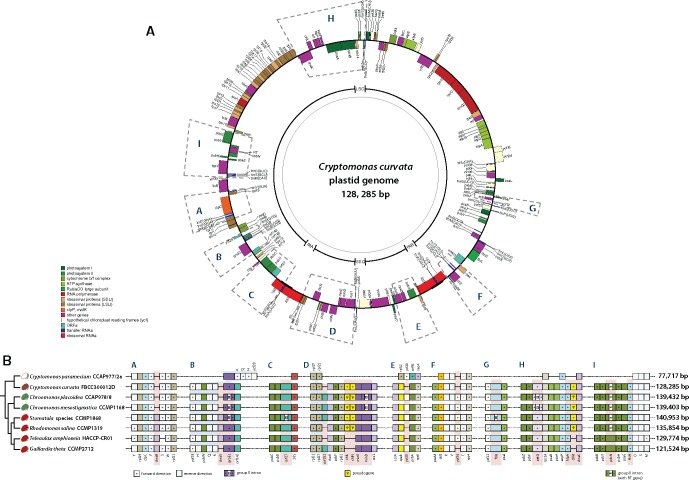
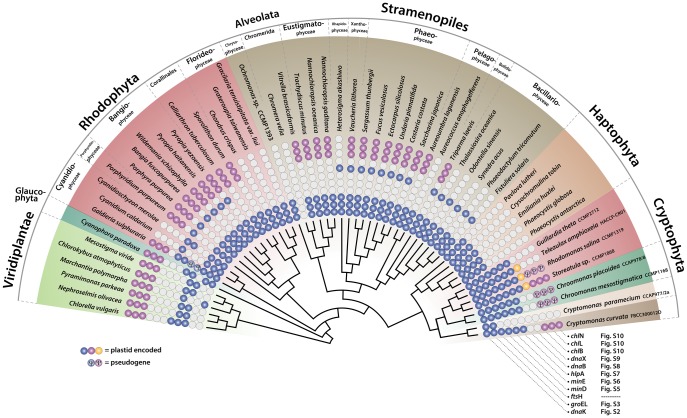
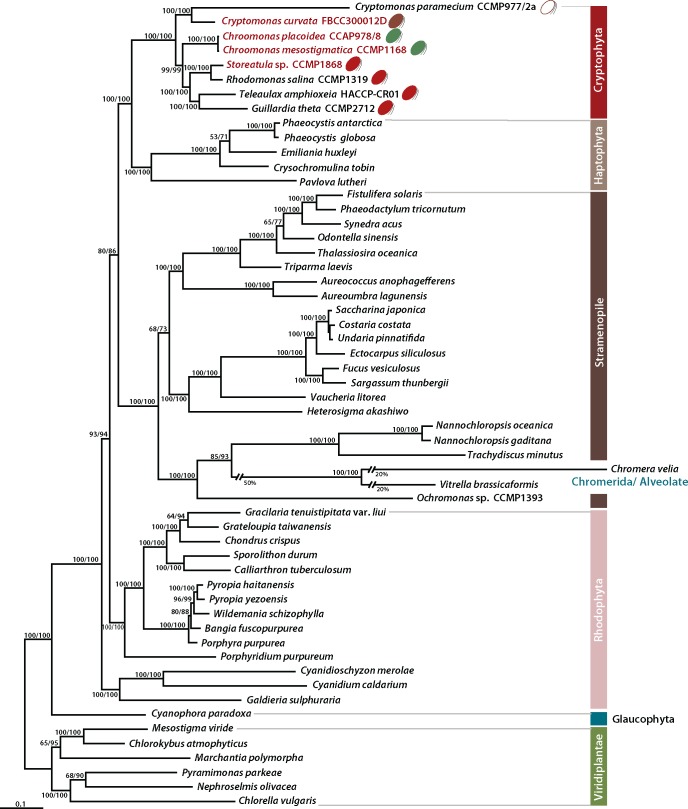
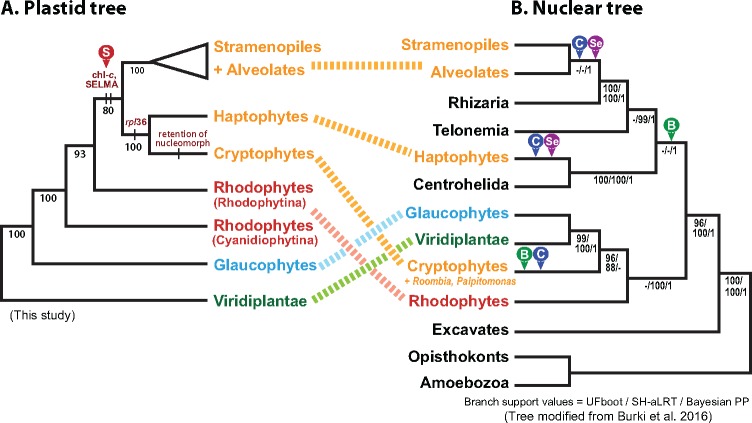
Cryptophytes are an ecologically important group of largely photosynthetic unicellular eukaryotes. This lineage is of great interest to evolutionary biologists because their plastids are of red algal secondary endosymbiotic origin and the host cell retains four different genomes (host nuclear, mitochondrial, plastid, and red algal nucleomorph). Here, we report a comparative analysis of plastid genomes from six representative cryptophyte genera. Four newly sequenced cryptophyte plastid genomes of Chroomonas mesostigmatica, Ch. placoidea, Cryptomonas curvata, and Storeatula sp. CCMP1868 share a number of features including synteny and gene content with the previously sequenced genomes of Cryptomonas paramecium, Rhodomonas salina, Teleaulax amphioxeia, and Guillardia theta. Our analysis of these plastid genomes reveals examples of gene loss and intron insertion. In particular, the chlB/chlL/chlN genes, which encode light-independent (dark active) protochlorophyllide oxidoreductase (LIPOR) proteins have undergone recent gene loss and pseudogenization in cryptophytes. Comparison of phylogenetic trees based on plastid and nuclear genome data sets show the introduction, via secondary endosymbiosis, of a red algal derived plastid in a lineage of chlorophyll-c containing algae. This event was followed by additional rounds of eukaryotic endosymbioses that spread the red lineage plastid to diverse groups such as haptophytes and stramenopiles.
Overview
The claims and statistics of this paper haven’t been checked yet.
Free: it reads the open-access text and checks the first 5 claims that cite a source we can check. Create a free account to check every claim.
Integrity signals
Registry
Cites
Statistics
Figures
Verification
Claims the paper makes
The claims and statistics of this paper haven’t been checked yet.
Free: it reads the open-access text and checks the first 5 claims that cite a source we can check. Create a free account to check every claim.
Claims other papers make about this one
Each is checked against this paper’s own text: does it say what the citing paper says it does?
The source backs part of the claim, not all of it — or backs it for a different population, condition or comparison.
In the citing paper
“At present, the data suggest that red alga-type complex plastids share more recent common ancestry with those of mesophilic red algae such as Porphyra and Chondrus than they do with the plastids of extremophiles such as Cyanidioschyzon and Galdieria (e.g., Ševčíková et al. 2015; Kim et al. 2017; Muñoz-Gómez et al. 2017).”
From Genomic Insights into Plastid Evolution (2020) · cites this paper as Kim et al. 2017
Experimental — accuracy not yet measuredThe cited source says what the claim attributes to it.
In the citing paper
“a trend that has nevertheless emerged is plastid trees that unite haptophytes and cryptophytes to the exclusion of all other complex algae; see, e.g., Janouškovec et al. 2010; Ševčíková et al. 2015; Kim et al. 2017 and references therein for discussion”
From Genomic Insights into Plastid Evolution (2020) · cites this paper as Kim et al. 2017
Self-check
Percentages, sums and reported differences re-computed from the paper’s own numbers.
The self-check needs the paper’s full text.
Citations
Cites
RAxML version 8: a tool for phylogenetic analysis and post-analysis of large phylogenies
Stamatakis, A. (2014) · Bioinformatics · doi:10.1093/bioinformatics/btu033 · Cited by 32,291
MrBayes 3.2: Efficient Bayesian Phylogenetic Inference and Model Choice Across a Large Model Space
Ronquist, F., Teslenko, M., van der Mark, P., Ayres, D. L., Darling, A., Höhna, S., Larget, B., Liu, L., Suchard, M. A., & Huelsenbeck, J. P. (2012) · Systematic Biology · doi:10.1093/sysbio/sys029 · Cited by 27,843
IQ-TREE: A Fast and Effective Stochastic Algorithm for Estimating Maximum-Likelihood Phylogenies
Nguyen, L.-T., Schmidt, H. A., von Haeseler, A., & Minh, B. Q. (2015) · Molecular Biology and Evolution · doi:10.1093/molbev/msu300 · Cited by 26,046
Mauve: Multiple alignment of conserved genomic sequence with rearrangements
Darling, A. C. E., Mau, B., Blattner, F. R., & Perna, N. T. (2004) · Genome Research · doi:10.1101/gr.2289704 · Cited by 4,949
An Improved General Amino Acid Replacement Matrix
Le, S. Q., & Gascuel, O. (2008) · Molecular Biology and Evolution · doi:10.1093/molbev/msn067 · Cited by 3,127
ProtTest 3: fast selection of best-fit models of protein evolution
Darriba, D., Taboada, G. L., Doallo, R., & Posada, D. (2011) · Bioinformatics · doi:10.1093/bioinformatics/btr088 · Cited by 2,672
(2003) · Elsevier eBooks · doi:10.1016/c2009-0-22714-0 · Cited by 2,592
Genomic sequence of the pathogenic and allergenic filamentous fungus Aspergillus fumigatus
Nierman, W. C., Pain, A., Anderson, M. J., Wortman, J. R., Kim, H. S., Arroyo, J., Berriman, M., Abe, K., Archer, D. B., Bermejo, C., et al. (2005) · Nature · doi:10.1038/nature04332 · Cited by 1,391
Ellis, R. J., & van der Vies, S. M. (1991) · Annual Review of Biochemistry · doi:10.1146/annurev.bi.60.070191.001541 · Cited by 1,120
Gene transfer to the nucleus and the evolution of chloroplasts
Martin, W., Stoebe, B., Goremykin, V., Hansmann, S., Hasegawa, M., & Kowallik, K. V. (1998) · Nature · doi:10.1038/30234 · Cited by 772
Research works printed but not linked: 2
- Archibald JM, Keeling PJ. 2005 On the origin and evolution of plastids In: Saap J, editor. Microbial phylogeny and evolution. New York: Oxford University Press p. 238– 260.
- McFadden GI. 1993 Second-hand chloroplasts: evolution of cryptomonad algae In: Callow JA, editor. Advances in botanical research. London: Academic Press Limited p. 189– 230.
Cited by
Borowitzka, M. A. (2018) · Elsevier eBooks · doi:10.1016/b978-0-12-811405-6.00003-7 · Cited by 234
Genomic Insights into Plastid Evolution
Sibbald, S. J., & Archibald, J. M. (2020) · Genome Biology and Evolution · doi:10.1093/gbe/evaa096 · Cited by 161
Self-citationDinoflagellates with relic endosymbiont nuclei as models for elucidating organellogenesis
Sarai, C., Tanifuji, G., Nakayama, T., Kamikawa, R., Takahashi, K., Yazaki, E., Matsuo, E., Miyashita, H., Ishida, K.-I., Iwataki, M., et al. (2020) · Proceedings of the National Academy of Sciences · doi:10.1073/pnas.1911884117 · Cited by 82
Get the shovel: morphological and evolutionary complexities of belowground organs in geophytes
Tribble, C. M., Martínez‐Gómez, J., Howard, C. C., Males, J., Sosa, V., Sessa, E. B., Cellinese, N., & Specht, C. D. (2021) · American Journal of Botany · doi:10.1002/ajb2.1623 · Cited by 71
Barre, A., Simplicien, M., Benoist, H., Damme, E. J. M. V., & Rougé, P. (2019) · Marine Drugs · doi:10.3390/md17080440 · Cited by 70
Metadata
- Authors
- Kim, J. I., Moore, C. E., Archibald, J. M., Bhattacharya, D., Yi, G., Yoon, H. S., & Shin, W.
- Affiliations
- Chungnam National University (KR)
- Dalhousie University (CA)
- Rutgers, The State University of New Jersey (US)
- Dongguk University (KR)
- Sungkyunkwan University (KR)
- Corresponding author
- Yoon, Hwan Su
- Shin, Woongghi
- Venue
- Genome Biology and Evolution
- Publisher
- Oxford University Press (OUP)
- Published
- 2017-07
- Volume
- 9
- Issue
- 7
- Pages
- 1859-1872
- ISSN
- 1759-6653 (ISSN-L)
- PMC
- PMC5534331
- OpenAlex
- W2726178529
- Cited by
- 70
- References
- 84
- Citations by year
- 2026: 8 · 2025: 8 · 2024: 11 · 2023: 7 · 2022: 7 · 2021: 5 · 2020: 9 · 2019: 5 · 2018: 10
- FWCI
- 2.68
- Type
- journal article
- Language
- en
- Open access
- gold
- doi.org
- Licence
- cc-by-nc
- Locations
- Genome Biology and Evolution (publishedVersion, cc-by-nc)
- PubMed Central (publishedVersion, cc-by-nc)
- PubMed (publishedVersion)
- Rutgers University Community Repository (Rutgers University) (submittedVersion)
- Funders
- National Research Foundation
- Ministry of Science, ICT and Future Planning
- Topics
- Life Sciences › Agricultural and Biological Sciences › Ecology, Evolution, Behavior and Systematics › Protist diversity and phylogeny
- Life Sciences › Biochemistry, Genetics and Molecular Biology › Molecular Biology › Photosynthetic Processes and Mechanisms
- Life Sciences › Biochemistry, Genetics and Molecular Biology › Genetics › Chromosomal and Genetic Variations
- Keywords
- cryptophytes, chloroplast genome, secondary endosymbiosis, nucleomorph, gene loss, pseudogenization, protochlorophyllide oxidoreductase, intron insertion, plastid gene content, plastid phylogeny
- MeSH terms
- Phylogeny, Symbiosis, Sequence Analysis, DNA, Plastids, Evolution, Molecular, Cryptophyta, Genome, Plastid
About these checks
Registry, retraction, Cites and statistics results are computed, not judged, with one exception: a printed reference that no index lists is read once by a model before it counts as a citation error. Claims are extracted by a model and kept only when their quote appears verbatim in the text; each cited source is then checked, with a model’s help, for whether it says what the claim relies on. Those verdicts can be wrong — read the claim’s quote and the cited source before relying on one.
Statistics and arithmetic are recomputed, not judged.
Confidence bands are shown only for fields calibrated on our annotated test set. None is calibrated yet, so no band is shown.
What counts as a claim ›How we measure confidence ›How we check this ›
Are you an author, or do you see a problem with this page? Request a review
How to cite
Cite CoChat for the checks on this page, and the paper for its own findings.
- This page
- CoChat. (2026). Citation check: Evolutionary Dynamics of Cryptophyte Plastid Genomes. https://app.cochat.ai/papers/10.1093/gbe/evx123
- The paper
- Kim, J. I., Moore, C. E., Archibald, J. M., Bhattacharya, D., Yi, G., Yoon, H. S., & Shin, W. (2017). Evolutionary Dynamics of Cryptophyte Plastid Genomes. Genome Biology and Evolution. https://doi.org/10.1093/gbe/evx123
Data sources
Bibliographic data: Semantic Scholar, OpenAlex, Crossref.
Contains information from the Semantic Scholar Academic Graph Datasets, made available under the ODC Attribution License (ODC-BY 1.0).
Semantic Scholar’s data is described in: Kinney, R., et al. (2023). The Semantic Scholar Open Data Platform. arXiv:2301.10140.
