

The DOI matches its Crossref record; 58 of the 58 references it cites were found in a registry or an index.
Robust Binding Capability and Occasional Gene Loss of Telomere-Binding Proteins Underlying Telomere Evolution in Nematoda
Open accessPublished version of a preprint
Abstract
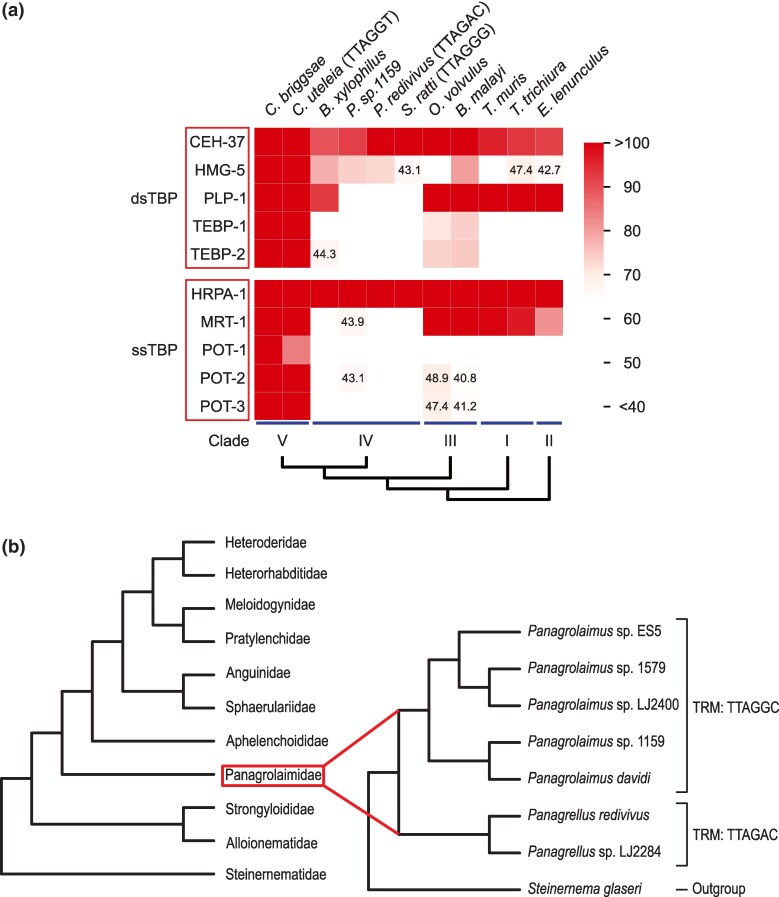
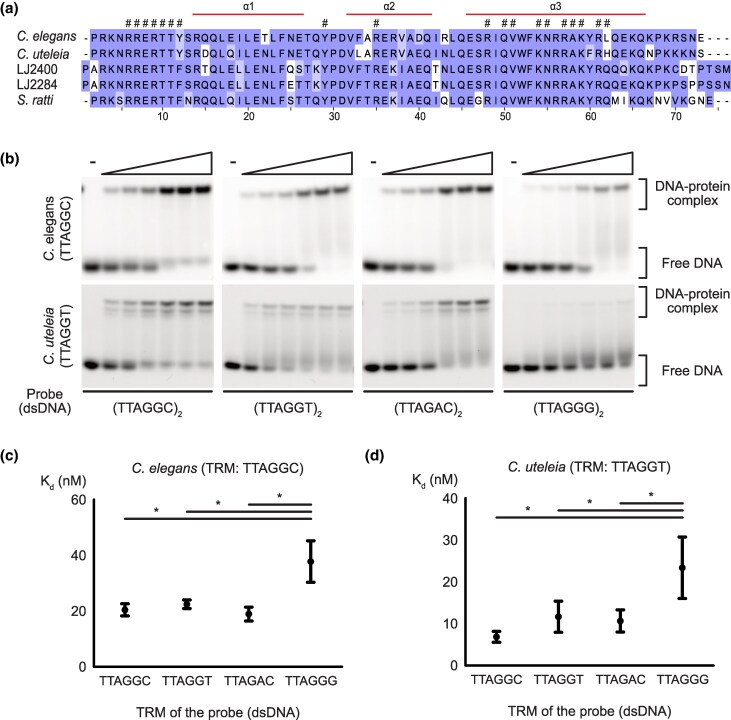
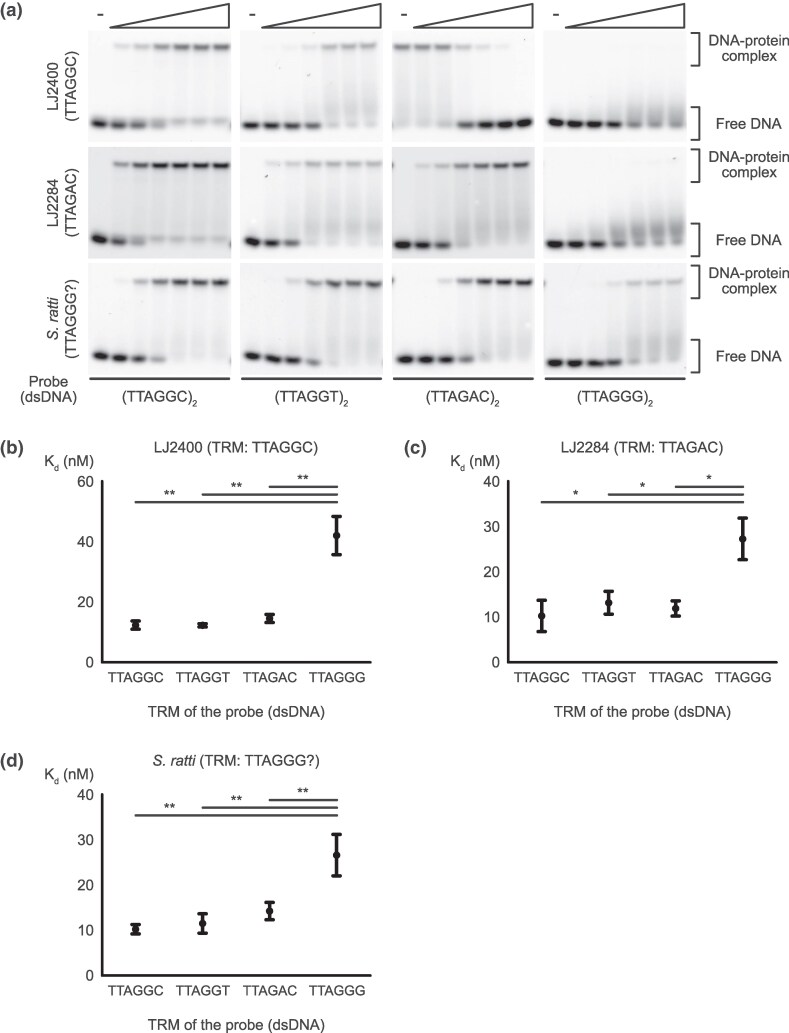
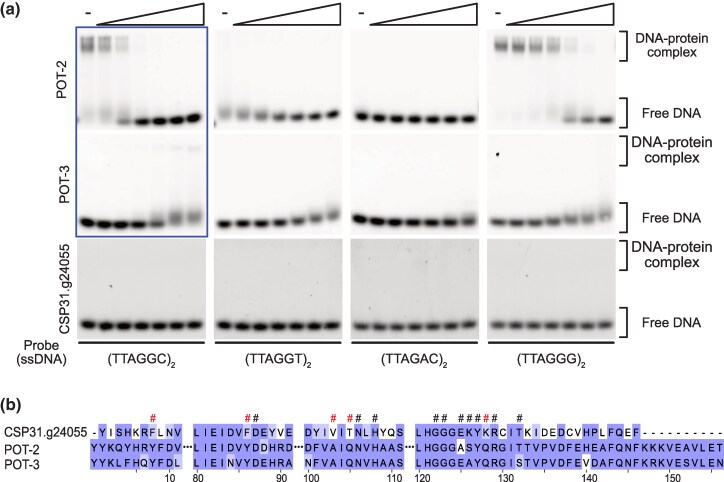
Telomeres, the nucleoprotein complexes that protect the ends of linear chromosomes, are essential for maintaining the stability of eukaryotic genomes. As telomeres generally consist of repetitive DNA associated with specifically bound proteins, telomeric repeat motifs are thought to be difficult to evolve. However, a recent study identified nematodes with telomeric repeats distinct from the canonical TTAGGC motif. Here, we investigated how telomere repeats could have evolved despite the challenge posed by the specificity of telomere-binding proteins (TBPs) to the telomeric DNA in Nematoda. We performed a phylogenetic analysis and electrophoresis mobility shift assays to assess the binding affinities of two TBPs, which displayed different conservation patterns. Our results revealed that the well-conserved protein CEH-37 exhibits limited specificity, unable to distinguish telomeric repeats found in nematodes except for the TTAGGG motif, while the less conserved POT proteins displayed rigid specificity. These findings suggest that the emergence of novel telomeric repeat motifs correlated with the characteristics and evolutionary outcomes of TBPs in Nematoda. Our study not only revealed the dynamics of telomere evolution but also enhanced the understanding of the evolutionary relationship between proteins and DNAs.
Overview
The claims and statistics of this paper haven’t been checked yet.
Run the check — free, no account needed. It reads the open-access text and checks the sources it cites.
Integrity signals
Registry
Cites
Statistics
Figures
Verification
Claims the paper makes
The claims and statistics of this paper haven’t been checked yet.
Run the check — free, no account needed. It reads the open-access text and checks the sources it cites.
Self-check
Percentages, sums and reported differences re-computed from the paper’s own numbers.
The self-check needs the paper’s full text.
Citations
Cites
Highly accurate protein structure prediction with AlphaFold
Jumper, J., Evans, R., Pritzel, A., Green, T., Figurnov, M., Ronneberger, O., Tunyasuvunakool, K., Bates, R., Žídek, A., Potapenko, A., et al. (2021) · Nature · doi:10.1038/s41586-021-03819-2 · Cited by 43,764
BLAST+: architecture and applications
Camacho, C., Coulouris, G., Avagyan, V., Ma, N., Papadopoulos, J., Bealer, K., & Madden, T. L. (2009) · BMC Bioinformatics · doi:10.1186/1471-2105-10-421 · Cited by 22,074
Accurate structure prediction of biomolecular interactions with AlphaFold 3
Abramson, J., Adler, J., Dunger, J., Evans, R., Green, T., Pritzel, A., Ronneberger, O., Willmore, L., Ballard, A. J., Bambrick, J., et al. (2024) · Nature · doi:10.1038/s41586-024-07487-w · Cited by 15,861
THE GENETICS OF CAENORHABDITIS ELEGANS
Brenner, S. (1974) · Genetics · doi:10.1093/genetics/77.1.71 · Cited by 15,081
Jalview Version 2—a multiple sequence alignment editor and analysis workbench
Waterhouse, A. M., Procter, J. B., Martin, D. M. A., Clamp, M., & Barton, G. J. (2009) · Bioinformatics · doi:10.1093/bioinformatics/btp033 · Cited by 10,235
Varadi, M., Anyango, S., Deshpande, M., Nair, S., Natassia, C., Yordanova, G., Yuan, D., Stroe, O., Wood, G., Laydon, A., et al. (2022) · Nucleic Acids Research · doi:10.1093/nar/gkab1061 · Cited by 7,850
UniProt: the Universal Protein Knowledgebase in 2023
The UniProt Consortium, Bateman, A., Martin, M.-J., Orchard, S., Magrane, M., Ahmad, S., Alpi, E., Bowler-Barnett, E. H., Britto, R., Bye-A-Jee, H., et al. (2023) · Nucleic Acids Research · doi:10.1093/nar/gkac1052 · Cited by 7,210
UCSF ChimeraX: Meeting modern challenges in visualization and analysis
Goddard, T. D., Huang, C. C., Meng, E. C., Pettersen, E. F., Couch, G. S., Morris, J. H., & Ferrin, T. E. (2018) · Protein Science · doi:10.1002/pro.3235 · Cited by 5,267
Sensitive protein alignments at tree-of-life scale using DIAMOND
Buchfink, B., Reuter, K., & Drost, H.-G. (2021) · Nature Methods · doi:10.1038/s41592-021-01101-x · Cited by 5,097
TM-align: a protein structure alignment algorithm based on the TM-score
Zhang, Y. (2005) · Nucleic Acids Research · doi:10.1093/nar/gki524 · Cited by 3,774
C. elegans: des neurones et des gènes
Gally, C., & Bessereau, J.-L. (2003) · médecine/sciences · doi:10.1051/medsci/20031967725 · Cited by 3,287
CDD/SPARCLE: the conserved domain database in 2020
Lu, S., Wang, J., Chitsaz, F., Derbyshire, M. K., Geer, R. C., Gonzales, N. R., Gwadz, M., Hurwitz, D. I., Marchler, G. H., Song, J. S., et al. (2019) · Nucleic Acids Research · doi:10.1093/nar/gkz991 · Cited by 3,062
Shelterin: the protein complex that shapes and safeguards human telomeres
de Lange, T. (2005) · Genes & Development · doi:10.1101/gad.1346005 · Cited by 3,056
CDD/SPARCLE: functional classification of proteins via subfamily domain architectures
Marchler-Bauer, A., Bo, Y., Han, L., He, J., Lanczycki, C. J., Lu, S., Chitsaz, F., Derbyshire, M. K., Geer, R. C., Gonzales, N. R., et al. (2017) · Nucleic Acids Research · doi:10.1093/nar/gkw1129 · Cited by 2,713
A molecular evolutionary framework for the phylum Nematoda
Blaxter, M., Ley, P. D., Garey, J. R., Liu, L. X., Scheldeman, P., Vierstraete, A. R., Vanfleteren, J. R., Mackey, L. Y., Dorris, M., Frisse, L. M., et al. (1998) · Nature · doi:10.1038/32160 · Cited by 2,008
The EMBL-EBI Job Dispatcher sequence analysis tools framework in 2024
Madeira, F., Madhusoodanan, N., Lee, J., Eusebi, A., Niewielska, A., Tivey, A. R., López, R., & Butcher, S. (2024) · Nucleic Acids Research · doi:10.1093/nar/gkae241 · Cited by 1,871
Self-citationOlovnikov (1973) · doi:10.1016/0022-5193(73)90198-7 · Cited by 1,847
Dendroscope 3: An Interactive Tool for Rooted Phylogenetic Trees and Networks
Huson, D. H., & Scornavacca, C. (2012) · Systematic Biology · doi:10.1093/sysbio/sys062 · Cited by 1,691
WATSON, J. D. (1972) · Nature New Biology · doi:10.1038/newbio239197a0 · Cited by 1,632
The conserved domain database in 2023
Wang, J., Chitsaz, F., Derbyshire, M. K., Gonzales, N. R., Gwadz, M., Lu, S., Marchler, G. H., Song, J. S., Thanki, N., Yamashita, R. A., et al. (2023) · Nucleic Acids Research · doi:10.1093/nar/gkac1096 · Cited by 1,277
How significant is a protein structure similarity with TM-score = 0.5?
Xu, J., & Zhang, Y. (2010) · Bioinformatics · doi:10.1093/bioinformatics/btq066 · Cited by 1,142
raxmlGUI 2.0: A graphical interface and toolkit for phylogenetic analyses using RAxML
Edler, D., Klein, J. T., Antonelli, A., & Silvestro, D. (2020) · Methods in Ecology and Evolution · doi:10.1111/2041-210x.13512 · Cited by 1,069
An Introduction to Sequence Similarity (“Homology”) Searching
Pearson, W. R. (2013) · Current Protocols in Bioinformatics · doi:10.1002/0471250953.bi0301s42 · Cited by 937
Regularized gene selection in cancer microarray meta-analysis
Ma, S., & Huang, J. (2009) · BMC Bioinformatics · doi:10.1186/1471-2105-10-1 · Cited by 831
How Telomeres Solve the End-Protection Problem
de Lange, T. (2009) · Science · doi:10.1126/science.1170633 · Cited by 826
WormBase ParaSite − a comprehensive resource for helminth genomics
Howe, K. L., Bolt, B. J., Shafie, M., Kersey, P., & Berriman, M. (2017) · Molecular and Biochemical Parasitology · doi:10.1016/j.molbiopara.2016.11.005 · Cited by 745
Shore, D., & Nasmyth, K. (1987) · Cell · doi:10.1016/0092-8674(87)90095-x · Cited by 620
YUDKIN, J. (1972) · Nature · doi:10.1038/239197a0 · Cited by 545
WormBase 2016: expanding to enable helminth genomic research
Howe, K. L., Bolt, B. J., Cain, S., Chan, J., Chen, W. J., Davis, P., Done, J., Down, T., Gao, S., Grove, C., et al. (2016) · Nucleic Acids Research · doi:10.1093/nar/gkv1217 · Cited by 355
The Crystal Structure of the DNA-Binding Domain of Yeast RAP1 in Complex with Telomeric DNA
König, P., Giraldo, R., Chapman, L., & Rhodes, D. (1996) · Cell · doi:10.1016/s0092-8674(00)81088-0 · Cited by 312
G-Quadruplexes at Telomeres: Friend or Foe?
Bryan, T. M. (2020) · Molecules · doi:10.3390/molecules25163686 · Cited by 194
Otx/otd Homeobox Genes Specify Distinct Sensory Neuron Identities in C. elegans
Lanjuin, A., VanHoven, M. K., Bargmann, C. I., et al. (2003) · Developmental Cell · doi:10.1016/s1534-5807(03)00293-4 · Cited by 162
C. elegans Telomeres Contain G-Strand and C-Strand Overhangs that Are Bound by Distinct Proteins
Raíces, M., Verdún, R. E., Compton, S. A., Haggblom, C., Griffith, J. D., Dillin, A. G., & Karlseder, J. (2008) · Cell · doi:10.1016/j.cell.2007.12.039 · Cited by 142
Long lifespan in worms with long telomeric DNA
Joeng, K. S., Song, E. J., Lee, K., & Lee, J. (2004) · Nature Genetics · doi:10.1038/ng1356 · Cited by 138
Self-citationRudimentary G-quadruplex-based telomere capping in Saccharomyces cerevisiae
Smith, J. S., Chen, Q., Yatsunyk, L. A., Nicoludis, J. M., Garcia, M. S., Kranaster, R., Balasubramanian, S., Monchaud, D., Teulade-Fichou, M.-P., Abramowitz, L., et al. (2011) · Nature Structural & Molecular Biology · doi:10.1038/nsmb.2033 · Cited by 135
Smythe, A. B., Holovachov, O. V., & Kocot, K. M. (2019) · BMC Evolutionary Biology · doi:10.1186/s12862-019-1444-x · Cited by 132
ProRule: a new database containing functional and structural information on PROSITE profiles
Sigrist, C. J. A., de Castro, E., Langendijk-Genevaux, P. S., Saux, V. L., Bairoch, A., & Hulo, N. (2005) · Computer applications in the biosciences · doi:10.1093/bioinformatics/bti614 · Cited by 91
Chromosome end protection by blunt-ended telomeresPreprint
Kazda, A., Zellinger, B., Rössler, M., Derboven, E., Kusenda, B., & Říha, K. (2012) · Genes & Development · doi:10.1101/gad.194944.112 · Cited by 83
Telomere structure in insects: A review
Kuznetsova, V. G., Grozeva, S. M., & Gokhman, V. E. (2019) · Journal of Zoological Systematics & Evolutionary Research · doi:10.1111/jzs.12332 · Cited by 77
Moser, B. A., & Nakamura, T. (2009) · Biochemistry and Cell Biology · doi:10.1139/o09-037 · Cited by 64
Meier, B., Barber, L. J., Liu, Y., Shtessel, L., Boulton, S. J., Gartner, A., & Ahmed, S. C. (2009) · The EMBO Journal · doi:10.1038/emboj.2009.278 · Cited by 55
The Telomere Paradox: Stable Genome Preservation with Rapidly Evolving Proteins
Saint‐Leandre, B., & Levine, M. T. (2020) · Trends in Genetics · doi:10.1016/j.tig.2020.01.007 · Cited by 51
Telomere- and Telomerase-Associated Proteins and Their Functions in the Plant Cell
Schrumpfová, P. P., Schořová, Š., & Fajkus, J. (2016) · Frontiers in Plant Science · doi:10.3389/fpls.2016.00851 · Cited by 40
Step-by-Step Evolution of Telomeres: Lessons from Yeasts
Červenák, F., Sepšiová, R., Nosek, J., & Tomáška, Ľ. (2020) · Genome Biology and Evolution · doi:10.1093/gbe/evaa268 · Cited by 38
Steinberg‐Neifach, O., & Lue, N. F. (2015) · Frontiers in Genetics · doi:10.3389/fgene.2015.00162 · Cited by 34
Shakirov, E. V., Song, X., Joseph, J. A., & Shippen, D. E. (2009) · Nucleic Acids Research · doi:10.1093/nar/gkp785 · Cited by 33
Liu, F., Zhang, H., Wang, H., Zhu, X., Li, S., Jiang, N., Yu, C., Liu, Y., & Xiao, Y. (2023) · Cellular and Molecular Life Sciences · doi:10.1007/s00018-023-04970-x · Cited by 27
Sepšiová, R., Nečasová, I., Willcox, S., Procházková, K., Gorilák, P., Nosek, J., Hofr, C., Griffith, J. D., & Tomáška, Ľ. (2016) · PLoS ONE · doi:10.1371/journal.pone.0154225 · Cited by 25
Kim, S. H., Hwang, S. B., Chung, I. K., & Lee, J. (2003) · Journal of Biological Chemistry · doi:10.1074/jbc.m302192200 · Cited by 20
Self-citationThe double-stranded DNA-binding proteins TEBP-1 and TEBP-2 form a telomeric complex with POT-1
Dietz, S., Almeida, M. V., Nischwitz, E., Schreier, J., Viceconte, N., Fradera-Sola, A., Renz, C., Ceron‐Noriega, A., Ulrich, H. D., Kappei, D., et al. (2021) · Nature Communications · doi:10.1038/s41467-021-22861-2 · Cited by 20
Yamamoto, I., Zhang, K., Zhang, J., Vorontsov, E. A., & Shibuya, H. (2021) · eLife · doi:10.7554/elife.64104 · Cited by 16
Marquevielle, J., Rache, A. D., Vialet, B., Morvan, E., Mergny, J., & Amrane, S. (2022) · Nucleic Acids Research · doi:10.1093/nar/gkac523 · Cited by 16
Im, S. H., & Lee, J. (2003) · FEBS Letters · doi:10.1016/s0014-5793(03)01191-8 · Cited by 15
Self-citationLim, J., Kim, W., Kim, J., & Lee, J. (2023) · Genome Research · doi:10.1101/gr.278124.123 · Cited by 15
Self-citationPOT-3 preferentially binds the terminal DNA-repeat on the telomeric G-overhang
Yu, X., Gray, S., & Ferreira, H. C. (2022) · Nucleic Acids Research · doi:10.1093/nar/gkac1203 · Cited by 7
PLP-1 Binds Nematode Double-stranded Telomeric DNA
Im, S. H., & Lee, J. (2005) · Molecules and Cells · doi:10.1016/s1016-8478(23)13230-4 · Cited by 6
Self-citationSingle-stranded DNA-binding proteins in plant telomeres
Luo, M., Luo, H., Li, H., Liu, D., & Lu, H. (2020) · International Journal of Biological Macromolecules · doi:10.1016/j.ijbiomac.2020.09.211 · Cited by 5
Solution structure of CEH-37 homeodomain of the nematode Caenorhabditis elegans
Moon, S., Lee, Y. W., Kim, W. T., & Lee, W. (2013) · Biochemical and Biophysical Research Communications · doi:10.1016/j.bbrc.2013.11.133 · Cited by 3
Metadata
- Authors
- Song, H., Kim, S., Lim, D. S., Choi, H.-J., & Lee, J.
- Affiliations
- Seoul National University (KR)
- Corresponding author
- Choi, Hee-Jung
- Lee, Junho
- Venue
- Genome Biology and Evolution
- Publisher
- Oxford University Press (OUP)
- Published
- 2025-04-30
- Volume
- 17
- Issue
- 5
- ISSN
- 1759-6653 (ISSN-L)
- PMC
- PMC12084805
- OpenAlex
- W4410312204
- Cited by
- 2
- References
- 58
- Citations by year
- 2026: 1 · 2025: 1
- FWCI
- 1.29
- Type
- journal article
- Language
- en
- Open access
- gold
- doi.org
- Licence
- Locations
- Genome Biology and Evolution (publishedVersion, cc-by-nc)
- bioRxiv (Cold Spring Harbor Laboratory) (acceptedVersion, cc-by-nc-nd)
- PubMed Central (publishedVersion, cc-by-nc)
- PubMed (publishedVersion)
- Funders
- National Research Foundation of Korea (2020R1A2C3003352)
- Topics
- Life Sciences › Biochemistry, Genetics and Molecular Biology › Cell Biology › Telomeres, Telomerase, and Senescence
- Life Sciences › Biochemistry, Genetics and Molecular Biology › Genetics › Chromosomal and Genetic Variations
- Life Sciences › Biochemistry, Genetics and Molecular Biology › Aging › Genetics, Aging, and Longevity in Model Organisms
- Keywords
- telomere evolution, telomere-binding proteins, nematodes, protein-DNA binding specificity, gene loss, genome stability
- MeSH terms
- Animals, Nematoda, Phylogeny, Protein Binding, Telomere, Evolution, Molecular, Telomere-Binding Proteins
About these checks
Registry, retraction, Cites and statistics results are computed, not judged, with one exception: a printed reference that no index lists is read once by a model before it counts as a citation error. Claims are extracted by a model and kept only when their quote appears verbatim in the text; each cited source is then checked, with a model’s help, for whether it says what the claim relies on. Those verdicts can be wrong — read the claim’s quote and the cited source before relying on one.
Statistics and arithmetic are recomputed, not judged.
Confidence bands are shown only for fields calibrated on our annotated test set. None is calibrated yet, so no band is shown.
What counts as a claim ›How we measure confidence ›How we check this ›
Are you an author, or do you see a problem with this page? Request a review
Data sources
Bibliographic data: Semantic Scholar, OpenAlex, Crossref.
Contains information from the Semantic Scholar Academic Graph Datasets, made available under the ODC Attribution License (ODC-BY 1.0).
Semantic Scholar’s data is described in: Kinney, R., et al. (2023). The Semantic Scholar Open Data Platform. arXiv:2301.10140.
