

Genomes of Stigonematalean Cyanobacteria (Subsection V) and the Evolution of Oxygenic Photosynthesis from Prokaryotes to Plastids
Open accessThe DOI matches its Crossref record; 108 of the 108 references it cites were found in a registry or an index.
Abstract
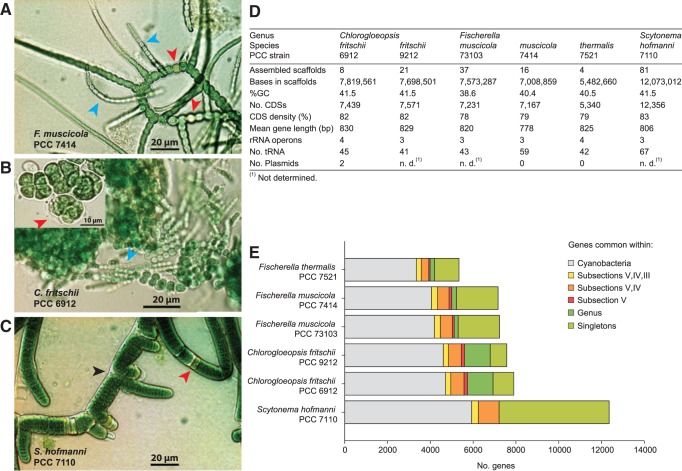
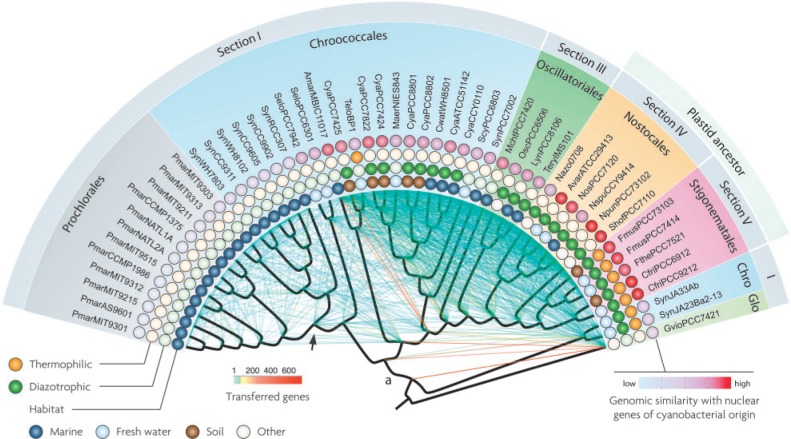
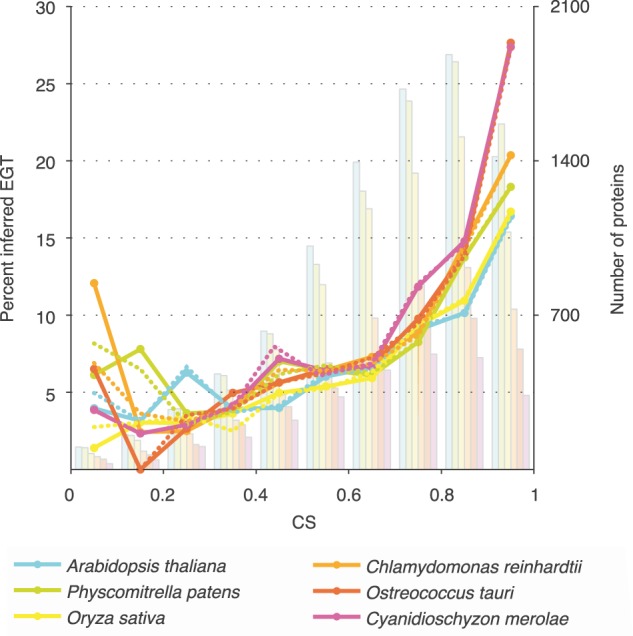
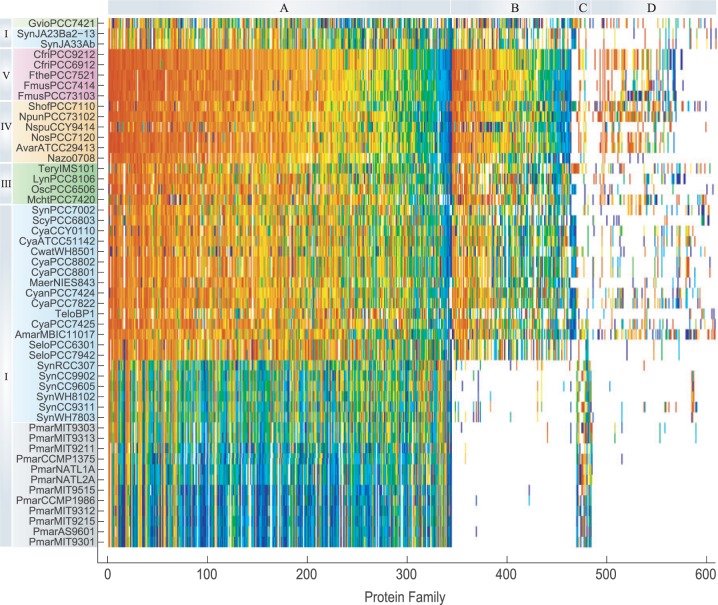
Cyanobacteria forged two major evolutionary transitions with the invention of oxygenic photosynthesis and the bestowal of photosynthetic lifestyle upon eukaryotes through endosymbiosis. Information germane to understanding those transitions is imprinted in cyanobacterial genomes, but deciphering it is complicated by lateral gene transfer (LGT). Here, we report genome sequences for the morphologically most complex true-branching cyanobacteria, and for Scytonema hofmanni PCC 7110, which with 12,356 proteins is the most gene-rich prokaryote currently known. We investigated components of cyanobacterial evolution that have been vertically inherited, horizontally transferred, and donated to eukaryotes at plastid origin. The vertical component indicates a freshwater origin for water-splitting photosynthesis. Networks of the horizontal component reveal that 60% of cyanobacterial gene families have been affected by LGT. Plant nuclear genes acquired from cyanobacteria define a lower bound frequency of 611 multigene families that, in turn, specify diazotrophic cyanobacterial lineages as having a gene collection most similar to that possessed by the plastid ancestor.
Overview
The claims and statistics of this paper haven’t been checked yet.
Free: it reads the open-access text and checks the first 5 claims that cite a source we can check. Create a free account to check every claim.
Integrity signals
Registry
Cites
Statistics
Figures
Verification
Claims the paper makes
The claims and statistics of this paper haven’t been checked yet.
Free: it reads the open-access text and checks the first 5 claims that cite a source we can check. Create a free account to check every claim.
Claims other papers make about this one
Each is checked against this paper’s own text: does it say what the citing paper says it does?
The cited source doesn’t support the claim as written.
In the citing paper
“Less than 5% of the genes thought to have been present in the cyanobacterial progenitor of the plastid typically remain in the organellar genome, and hundreds of cyanobacterial genes can be found in the nuclear genomes of extant algae and plants (Dagan et al. 2013, Qiu, Yoon, et al. 2013).”
From Genomic Insights into Plastid Evolution (2020) · cites this paper as Dagan et al. 2013
Checked by a reasoning model — may be wrong.
Experimental — accuracy not yet measuredThe cited source says what the claim attributes to it.
In the citing paper
“Less than 5% of the genes thought to have been present in the cyanobacterial progenitor of the plastid typically remain in the organellar genome, and hundreds of cyanobacterial genes can be found in the nuclear genomes of extant algae and plants (Dagan et al. 2013, Qiu, Yoon, et al. 2013).”
From Genomic Insights into Plastid Evolution (2020) · cites this paper as Dagan et al. 2013
Self-check
Percentages, sums and reported differences re-computed from the paper’s own numbers.
The self-check needs the paper’s full text.
Citations
Cites
Gapped BLAST and PSI-BLAST: a new generation of protein database search programs
Altschul, S. (1997) · Nucleic Acids Research · doi:10.1093/nar/25.17.3389 · Cited by 73,302
The neighbor-joining method: a new method for reconstructing phylogenetic trees.
(1987) · Molecular Biology and Evolution · doi:10.1093/oxfordjournals.molbev.a040454 · Cited by 59,715 · cited 2×
“Polysaccharide-free high molecular weight genomic DNA (gDNA) from strains of Fischerella was obtained by following a protocol for polysaccharide-rich plants (Sharma et al. 2002).”
MethodPHYLIP-Phylogeny inference package (Version 3.2)
Felsenstein, J. (1989) · Cladistics · Cited by 18,906
Guindon, S., Dufayard, J.-F., Lefort, V., Anisimova, M., Hordijk, W., & Gascuel, O. (2010) · Systematic Biology · doi:10.1093/sysbio/syq010 · Cited by 18,376 · cited 5×
“A phylogenetic tree was reconstructed from the concatenated alignment using the NJ approach and the software described as earlier.”
MethodInfluentialMAFFT: a novel method for rapid multiple sequence alignment based on fast Fourier transform
Katoh, K. (2002) · Nucleic Acids Research · doi:10.1093/nar/gkf436 · Cited by 17,027 · cited 5×
“The sequences of protein families were aligned using MAFFT (Katoh et al. 2002) Ver.”
MethodInfluentialApplication of Phylogenetic Networks in Evolutionary Studies
Huson, D. H., & Bryant, D. (2006) · Molecular Biology and Evolution · doi:10.1093/molbev/msj030 · Cited by 8,830 · cited 5×
“To test the consistency of the backbone (consensus) phylogeny, we reconstructed a phylogenetic network using SplitsTree (Huson and Bryant 2006).”
BackgroundMethodInfluentialGeneric Assignments, Strain Histories and Properties of Pure Cultures of Cyanobacteria
Rippka, R., Stanier, R. Y., Deruelles, J., Herdman, M., & Waterbury, J. B. (1979) · Microbiology · doi:10.1099/00221287-111-1-1 · Cited by 7,606 · cited 7×
“In addition Scytonema hofmanni PCC 7110, a Nostocales representative (subsection IV) isolated from a limestone cave (Crystal cave, Bermuda) (Rippka et al. 1979), whose filaments form false branches (fig.”
BackgroundInfluentialSelf-citationThe rapid generation of mutation data matrices from protein sequences
Jones, D. T., Taylor, W. R., & Thornton, J. M. (1992) · Bioinformatics · doi:10.1093/bioinformatics/8.3.275 · Cited by 6,947 · cited 4×
“Protein sequence distances were calculated with PROTDIST (Felsenstein 1993), and applying the JTT substitution model (Jones et al. 1992).”
MethodInfluentialKEGG for integration and interpretation of large-scale molecular data sets
Kanehisa, M., Goto, S., Sato, Y., Furumichi, M., & Tanabe, M. (2012) · Nucleic Acids Research · doi:10.1093/nar/gkr988 · Cited by 4,848
Pruitt, K. D., Tatusova, T., & Maglott, D. R. (2007) · Nucleic Acids Research · doi:10.1093/nar/gkl842 · Cited by 4,481
Research works printed but not linked: 3
- Mereschkowsky C Über Natur und Ursprung der Chromatophoren im Pflanzenreiche Biol Centralbl. 1905 25 593 604 [English translation in Eur J Phycol. 1999;34:287–295.]
- Rippka R Herdman H Pasteur culture collection of Cyanobacteria: catalogue and taxonomic handbook. I. Catalogue of strains 2002 Paris Institut Pasteur
- Stanier RY Some aspects of the biology of cells and their possible evolutionary significance Symp Soc Gen Microbiol. 1970 20 1 38
Cited by
Items 201–263 of 263
Springstein, B. L., Nürnberg, D. J., Woehle, C., Weissenbach, J., Theune, M. L., Helbig, A. O., Maldener, I., Dagan, T., & Stucken, K. (2019) · bioRxiv (Cold Spring Harbor Laboratory) · doi:10.1101/553073 · Cited by 2
Self-citationGarg, S., Zimorski, V., & Martin, W. F. (2016) · Elsevier eBooks · doi:10.1016/b978-0-12-800049-6.00191-8 · Cited by 3
Self-citationRubisco biogenesis and assembly in Chlamydomonas reinhardtii
Wietrzyñski, W. (2017) · theses.fr (ABES) · doi:10.70675/3b7a32d6z4284z4681zbf4bz64cfb6963294 · Cited by 3
The Extent, Role, and Timing of Endosymbiotic Gene Transfer in Plastids
Hehenberger, E., & Burki, F. (2024) · Springer eBooks · doi:10.1007/978-3-031-57446-7_4 · Cited by 2
Ball, S. G., Baurain, D., Leleu, M., Lafontaine, I., Cenci, U., Colleoni, C., Vallon, O., Greub, G., Weber, A. P. M., & Bhattacharya, D. (2025) · Comptes Rendus Biologies · doi:10.5802/crbiol.176 · Cited by 1
Secondary Metabolites Predict Diazotrophic Cyanobacteria: A Model-Based Cheminformatic Approach
Young, J., Nawaz, T., Gu, L., & Zhou, R. (2025) · Metabolites · doi:10.3390/metabo15090562 · Cited by 1
Stoyneva-Gärtner, M. P., Gärtner, G., & Uzunov, B. (2025) · Microbiology Research · doi:10.3390/microbiolres16090204 · Cited by 1
“The best-studied coccoid cyanoprokaryotes mostly belong to the genera Synechococcus and Thermosynechococcus , which form two very deep branches near the base of the phylum [19,39,40].”
The basic genetic toolkit to move in with your photosynthetic partner
Reyes‐Prieto, A. (2015) · Frontiers in Ecology and Evolution · doi:10.3389/fevo.2015.00100 · Cited by 2
“Remarkably, only between 600 and 1700 of the plastid-localized proteins are of cyanobacterial provenance (Price et al., 2012; Dagan et al., 2013), and a considerable proportion of the organelle protein collection has been recruited from the host repertoire and diverse bacterial sources during…”
BackgroundPhylogenomics in Algal Research: Current Trends and Future Perspectives
Chan, C. X. (2015) · Cellular origin, life in extreme habitats and astrobiology · doi:10.1007/978-94-017-7321-8_20 · Cited by 1
Bodył, A., Cieśla, J., Mackiewicz, P., & Gagat, P. (2016) · WORLD SCIENTIFIC (EUROPE) eBooks · doi:10.1142/9781786340580_0009 · Cited by 1
Easier Lost than Found? What We Know about Plastid Genome Reduction
Konupková, A., Tomečková, L., Záhonová, K., Oborník, M., & Füssy, Z. (2024) · Springer eBooks · doi:10.1007/978-3-031-57446-7_5 · Cited by 1
Büyüktaş, D., Mehl, J. A., Engelsdorf, T., Voll, L. M., Kunz, H., Schwenkert, S., & de Vries, S. (2026) · Genome Biology and Evolution · doi:10.1101/2025.06.18.660430 · Cited by 1
How many genes does it take to make a person?
Nee, S. (2016) · The Conversation · doi:10.64628/aai.nstmpysst · Cited by 1
Phylogenomic Networks of Microbial Genome Evolution
Dagan, T., Popa, O., Kloesges, T., & Landan, G. (2015) · ASM Press eBooks · doi:10.1128/9781555818821.ch4.1.1 · Cited by 1
Self-citationSistemas socioeconômicos sustentáveis: contribuições do modelo de dinâmica simbiótica
Terra, L. A. A. (2016) · Digital Library of Theses and Dissertations (Universidade de São Paulo) · doi:10.11606/t.96.2016.tde-27072015-141716
de Souza, B. C. E. (2016) · Digital Library of Theses and Dissertations (Universidade de São Paulo) · doi:10.11606/d.11.2016.tde-28032016-132147
EMERGENCE OF LIFE AND ITS EARLY HISTORY
Russell, M. J. (2015) · CRC Press eBooks · doi:10.1201/b19121-4
Chan, C. X. (2013) · Malaysian Journal of Science · doi:10.22452/mjs.vol32no3.2
Identification and functional characterization of cytoskeletal proteins in cyanobacteria
Springstein, B. L. (2018) · MACAU: Open Access Repository of Kiel University
Ritter, S. P. A. (2020) · ERA: Education and Research Archive (University of Alberta) · doi:10.7939/r3-xby8-cn56
MarinOmics – Current and Future Perspectives
Sharma, K. S., Venkatasubramani, L. P., Prasad, K., Bhamare, A. N., & Mahesh, A. (2020) · Springer eBooks · doi:10.1007/978-981-15-5017-1_2
Evolution of default genetic control mechanisms
Bains, W., Borriello, E., & Schulze‐Makuch, D. (2021) · PLoS ONE · doi:10.1371/journal.pone.0251568
A quantitative risk assessment method for synthetic biology products in the environment
Rycroft, T., Hamilton, K. A., Haas, C. N., & Linkov, I. (2021) · US Army Corps of Engineers: Engineer Research and Development Center (Knowledge Core) · doi:10.21079/11681/41331
Camargo, S. D. L. (2016) · Digital Library of Theses and Dissertations (Universidade de São Paulo) · doi:10.11606/d.64.2016.tde-27042018-093751
Miller, S. R. (2021) · Wiley eBooks · doi:10.1002/9781118960608.gbm00467.pub2
Semchonok, D. A., Mondal, J. U., Cooper, C. J., Schlum, K., Li, M., Amin, M., Sorzano, C. Ó. S., Ramírez-Aportela, E., Kastritis, P. L., Boekema, E. J., et al. (2020) · Research Square · doi:10.21203/rs.3.rs-81702/v1
“These organisms have been frequently proposed as the likely 106 chloroplast progenitor (26).”
BackgroundField, M. C. (2019) · Faculty Opinions – Post-Publication Peer Review of the Biomedical Literature · doi:10.3410/f.727720455.793558298
Review: Evolutionary genomic insights into cyanobacterial symbioses in plants — R0/PR2
(2021) · Quantitative Plant Biology · doi:10.1017/qpb.2022.3.pr2
Review: Evolutionary genomic insights into cyanobacterial symbioses in plants — R1/PR6
(2021) · Quantitative Plant Biology · doi:10.1017/qpb.2022.3.pr6
Author comment: Evolutionary genomic insights into cyanobacterial symbioses in plants — R1/PR5
de Vries, S. (2021) · Quantitative Plant Biology · doi:10.1017/qpb.2022.3.pr5
Recommendation: Evolutionary genomic insights into cyanobacterial symbioses in plants — R0/PR3
(2021) · Quantitative Plant Biology · doi:10.1017/qpb.2022.3.pr3
Author comment: Evolutionary genomic insights into cyanobacterial symbioses in plants — R0/PR1
de Vries, S. (2021) · Quantitative Plant Biology · doi:10.1017/qpb.2022.3.pr1
Decision: Evolutionary genomic insights into cyanobacterial symbioses in plants — R0/PR4
(2021) · Quantitative Plant Biology · doi:10.1017/qpb.2022.3.pr4
Decision: Evolutionary genomic insights into cyanobacterial symbioses in plants — R2/PR11
(2022) · Quantitative Plant Biology · doi:10.1017/qpb.2022.3.pr11
Recommendation: Evolutionary genomic insights into cyanobacterial symbioses in plants — R1/PR7
(2022) · Quantitative Plant Biology · doi:10.1017/qpb.2022.3.pr7
Author comment: Evolutionary genomic insights into cyanobacterial symbioses in plants — R2/PR9
de Vries, S. (2022) · Quantitative Plant Biology · doi:10.1017/qpb.2022.3.pr9
Recommendation: Evolutionary genomic insights into cyanobacterial symbioses in plants — R2/PR10
(2022) · Quantitative Plant Biology · doi:10.1017/qpb.2022.3.pr10
Decision: Evolutionary genomic insights into cyanobacterial symbioses in plants — R1/PR8
(2022) · Quantitative Plant Biology · doi:10.1017/qpb.2022.3.pr8
de Vries, J., & Friedl, T. (2024) · Springer eBooks · doi:10.1007/978-3-662-65712-6_2 · Cited by 1
Raval, P. K., Zimorski, V., & Martin, W. F. (2024) · Elsevier eBooks · doi:10.1016/b978-0-443-15750-9.00011-2
Self-citationGeeta, A., Mukherjee, M., Das, B., Dutta, S., Prusty, A., Ghosh, S., Raha, A. B., Sarkar, M. P., & Tripathy, S. (2024) · Algal Research · doi:10.1016/j.algal.2024.103603
Comparative Modelling and Binding Compatibility of Bi-Functional Proteins in Microcystis aeruginosa
Anandaram, H. (2024) · BENTHAM SCIENCE PUBLISHERS eBooks · doi:10.2174/9789815196269124030009
Živčák, M., Kern, J. F., Tomo, T., SOYKAN, G., Eaton‐Rye, J. J., Allakhverdiev, S. I., & Bruce, B. D. (2025) · Photosynthetica · doi:10.32615/ps.2025.010
“His research focused on redox control of chloroplast transcription (Allen and Pfannschmidt 2000), the role of redox processes in organelle genome function (Allen 2015), and the origin and evolution of oxygenic photosynthesis (Dagan et al. 2013).”
Adaptation des cyanobactéries marines du genre Synechococcus au gradient latitudinal de température
Pittera, J. (2015) · theses.fr (ABES) · doi:10.70675/13cc9b0dza736z4bfeza67az902142c34f6d · Cited by 7
Analyse du génome et du pan-génome pour classifier les bactéries émergentes
Caputo, A. (2017) · theses.fr (ABES) · doi:10.70675/becdad70z922bz4088za538z3c96509f22c0
Origins and early evolution of photosynthetic eukaryotes
Ponce-Toledo, R. I. (2018) · theses.fr (ABES) · doi:10.70675/e80da54ez4400z4af2z90ccza6b6fb5b6bc7 · Cited by 1
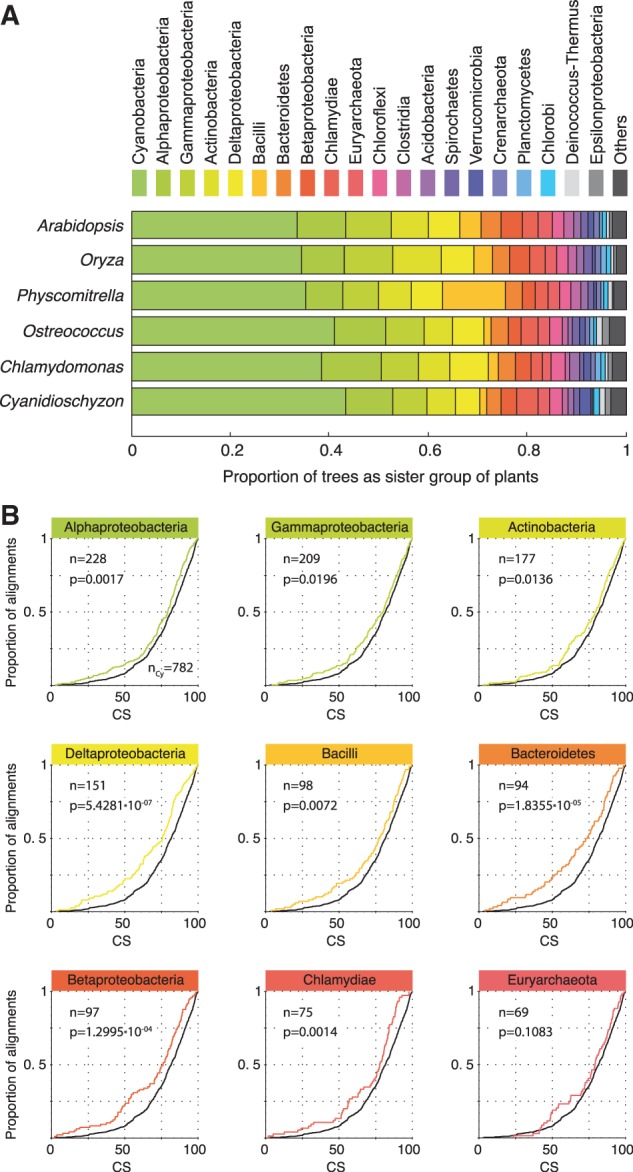
“Gammaproteobacteria, Actinobacteria, Deltaproteobacteria, Bacilli, Bacteroidetes, Betaproteobacteria) outnumber the quantity of genes transferred to nuclear genomes of Archaeplastida (Dagan et al., 2013).”
BackgroundResultInfluentialVeaudor, T. (2017) · theses.fr (ABES) · doi:10.70675/aa7c6087z0317z479az9d07z09f387a7df40 · Cited by 3
“Most cyanobacteria possess a single circular chromosome, ranging from 1.44Mb in size (the marine symbiotic strain UCYN-A) to 12.07Mb (Scytonema hofmanni PCC7110) (Dagan et al., 2013).”
BackgroundPancrace, C. (2017) · theses.fr (ABES) · doi:10.70675/f30cf2d4ze3a1z438dz86bfz67afec0a1a18 · Cited by 1
Ingénierie de cyanobactéries pour la photoproduction de terpènes (biocarburants)
Chenebault, C. (2020) · theses.fr (ABES) · doi:10.70675/cdc8a507zf28ez43fcza640zd2f8419950c4 · Cited by 1
Deciphering the "OPR code" to further assess the physiological role of OPR proteins
Jarrige, D. (2019) · theses.fr (ABES) · doi:10.70675/03177f5azabf4z4b09z9e7ez12f687346f4d · Cited by 6
Implication des Chlamydiales dans l'évolution des Archaeplastida
Leleu, M. (2022) · theses.fr (ABES) · doi:10.70675/688a4855zffb1z4fafzab75z12aaf55a01e9
Evolution des cyanobactéries à l'origine du chloroplaste
Bacchetta, T. (2022) · theses.fr (ABES) · doi:10.70675/44b6b0fazb0fdz4664zb003zab9a0a6378f6
Khomutovska, N., Rudak, A., Gkelis, S., Kokociński, M., & Jasser, I. (2026) · PeerJ · doi:10.7717/peerj.21284
On the recognition of possible euglenid cysts in non-marine Precambrian deposits
Strother, P. K., van de Schootbrugge, B., Foster, C., Taylor, W. A., & Wellman, C. H. (2026) · Review of Palaeobotany and Palynology · doi:10.1016/j.revpalbo.2026.105713
From endosymbiont to signalling hub: evolution and functional integration of mitochondria
Hazır, Z. D., Türkel, İ., & Kubat, G. B. (2026) · Journal of Mitochondria Plastids and Endosymbiosis · doi:10.1080/28347056.2026.2737069
Data from: Cyanobacteria and the Great Oxidation Event: evidence from genes and fossils
Schirrmeister, B. E., Gugger, M., & Donoghue, P. C. J. (2015) · Data Archiving and Networked Services (DANS) · doi:10.5061/dryad.h75ht.1
Self-citationŠafranek, M., Shumbusho, A., Johansen, W., Šarkanová, J., Voško, S., Bokor, B., Jásik, J., & Demko, V. (2023) · doi:10.3389/fpls.2023.1289785.s001
Dahaj, Z. (2015) · MacSphere (McMaster University) · doi:10.71548/10071
Metadata
- Authors
- Dagan, T., Roettger, M., Stucken, K., Landan, G., Koch, R., Major, P., Gould, S. B., Goremykin, V. V., Rippka, R., Tandeau de Marsac, N., Gugger, M., Lockhart, P. J., Allen, J. F., Brune, I., Maus, I., Pühler, A., & Martin, W. F.
- Affiliations
- Heinrich Heine University Düsseldorf (DE)
- Fondazione Edmund Mach (IT)
- Institut Pasteur (FR)
- Massey University (NZ)
- Queen Mary University of London (GB)
- Bielefeld University (DE)
- Corresponding author
- Dagan, Tal
- ORCID
- Venue
- Genome Biology and Evolution
- Publisher
- Oxford University Press (OUP)
- Published
- 2012-12-07
- Volume
- 5
- Issue
- 1
- Pages
- 31-44
- ISSN
- 1759-6653 (ISSN-L)
- PMC
- PMC3595030
- OpenAlex
- W2163991020
- Semantic Scholar
- b6ba87597ba08d95e25091a3ecb0b5b48f2f2e04
- Cited by
- 255
- References
- 108
- Citations by year
- 2026: 4 · 2025: 8 · 2024: 15 · 2023: 7 · 2022: 16 · 2021: 19 · 2020: 22 · 2019: 21 · 2018: 14 · 2017: 32 · 2016: 32 · 2015: 30 · 2014: 22 · 2013: 13
- FWCI
- 8.36
- Type
- journal article
- Language
- en
- Open access
- gold
- doi.org
- Licence
- cc-by-nc
- Locations
- Genome Biology and Evolution (publishedVersion, cc-by-nc)
- Europe PMC (PubMed Central) (publishedVersion, cc-by-nc)
- PubMed Central (publishedVersion, cc-by-nc)
- PubMed (publishedVersion)
- CINECA IRIS Institutional Research Information System (Fondazione Edmund Mach) (submittedVersion, cc-by-nc)
- UCL Discovery (University College London) (submittedVersion)
- PUB – Publications at Bielefeld University (Bielefeld University) (submittedVersion)
- Publikationen an der Universität Bielefeld (Universität Bielefeld) (submittedVersion)
- Funders
- Leverhulme Trust
- Centre National de la Recherche Scientifique
- FP7 Ideas: European Research Council (281357, 232975)
- Topics
- Life Sciences › Biochemistry, Genetics and Molecular Biology › Molecular Biology › Photosynthetic Processes and Mechanisms
- Life Sciences › Agricultural and Biological Sciences › Ecology, Evolution, Behavior and Systematics › Protist diversity and phylogeny
- Life Sciences › Biochemistry, Genetics and Molecular Biology › Molecular Biology › Genomics and Phylogenetic Studies
- Keywords
- cyanobacterial genome, endosymbiosis, plastid origin, horizontal gene transfer, diazotrophic cyanobacteria
- MeSH terms
- Cyanobacteria, Fresh Water, Multigene Family, Photosynthesis, Phylogeny, Plants, Symbiosis, Water, Genome, Bacterial, Ecosystem, Evolution, Molecular, Gene Transfer, Horizontal, Genome, Plastid
About these checks
Registry, retraction, Cites and statistics results are computed, not judged, with one exception: a printed reference that no index lists is read once by a model before it counts as a citation error. Claims are extracted by a model and kept only when their quote appears verbatim in the text; each cited source is then checked, with a model’s help, for whether it says what the claim relies on. Those verdicts can be wrong — read the claim’s quote and the cited source before relying on one.
Statistics and arithmetic are recomputed, not judged.
Confidence bands are shown only for fields calibrated on our annotated test set. None is calibrated yet, so no band is shown.
What counts as a claim ›How we measure confidence ›How we check this ›
Are you an author, or do you see a problem with this page? Request a review
Data sources
Bibliographic data: Semantic Scholar, OpenAlex, Crossref.
Contains information from the Semantic Scholar Academic Graph Datasets, made available under the ODC Attribution License (ODC-BY 1.0).
Semantic Scholar’s data is described in: Kinney, R., et al. (2023). The Semantic Scholar Open Data Platform. arXiv:2301.10140.
